
Electric Vehicle Leasing Market Size and Share
Market Overview
| Study Period | 2019 - 2031 |
|---|---|
| Market Size (2026) | USD 122.87 Billion |
| Market Size (2031) | USD 269.06 Billion |
| Growth Rate (2026 - 2031) | 16.97 % |
| Fastest Growing Market | Asia-Pacific |
| Largest Market | Europe |
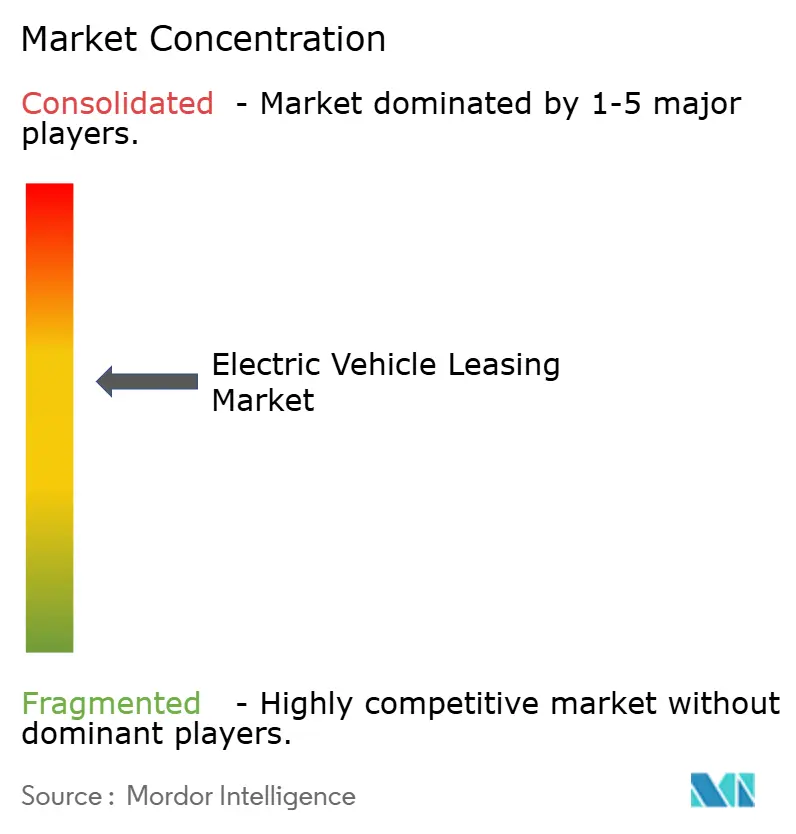
| Market Concentration | Medium |
Major Players *Disclaimer: Major Players sorted in no particular order Image © Mordor Intelligence. Reuse requires attribution under CC BY 4.0. | |
Electric Vehicle Leasing Market Analysis by Mordor Intelligence
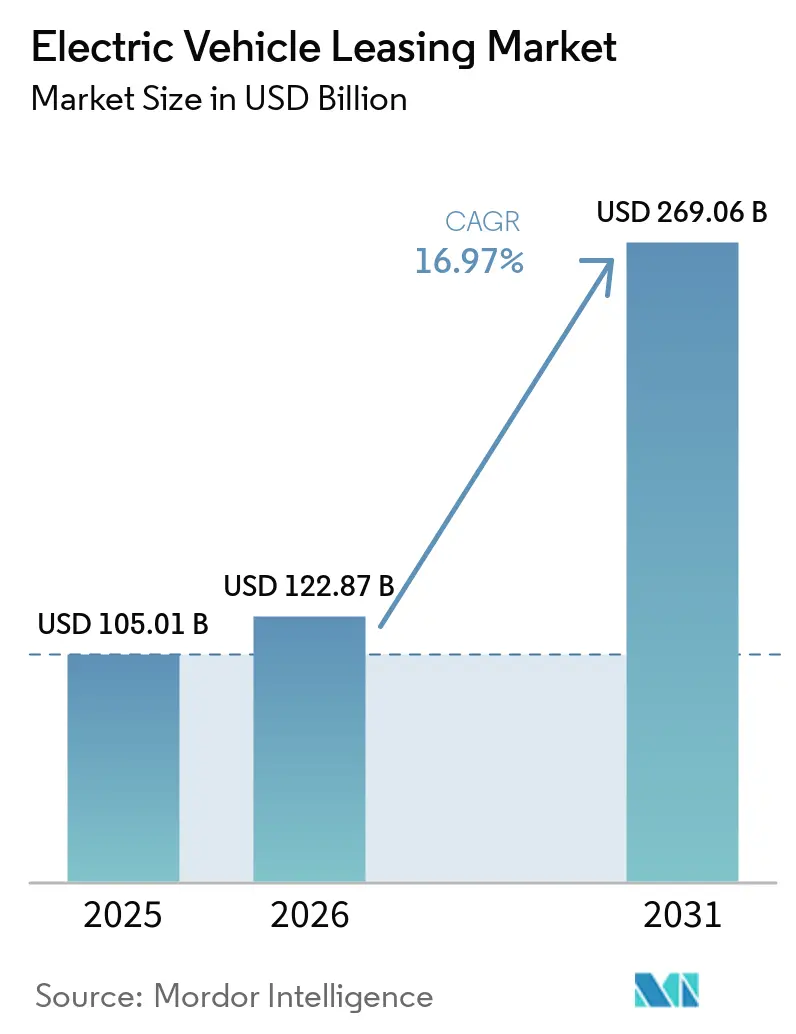
The electric vehicle leasing market size was valued at USD 105.01 billion in 2025 and is estimated at USD 122.87 billion in 2026, and is projected to reach USD 269.06 billion by 2031, growing at a CAGR of 16.97% from 2026 to 2031. Corporate sustainability goals, subsidy-rich fiscal policies, and battery-price deflation are collectively lowering total-cost-of-ownership barriers, accelerating the shift from outright purchase to leasing. In 2026, as battery pack prices decline, residual-value discount rates tighten, enabling lessors to present more attractive monthly payment options. Governments preferentially route incentives through lease structures, enabling commercial lessors to monetize credits at origination and pass savings to fleet clients. Model proliferation—now well above 500 nameplates worldwide—intensifies technology-obsolescence risk for buyers, further tilting preference toward lease contracts that offer upgrade optionality. At the same time, telematics-driven underwriting lowers residual-value uncertainty, giving data-rich lessors a defensible edge in pricing.
Key Report Takeaways
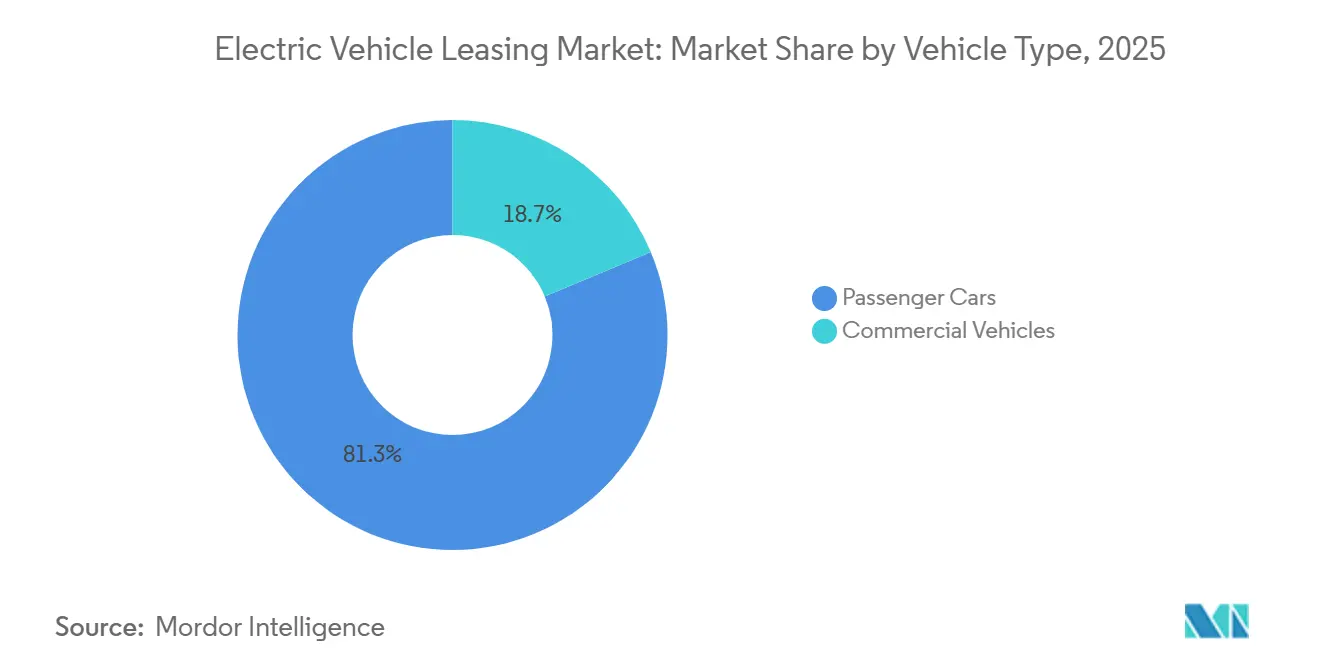
- By vehicle type, passenger cars led with 81.25% of the electric vehicle leasing market share in 2025, while commercial vehicles will advance at a 17.86% CAGR to 2031.
- By propulsion type, battery-electric vehicles commanded a 73.18% share of the electric vehicle leasing market size in 2025 and are projected to expand at a 19.13% CAGR over 2026-2031.
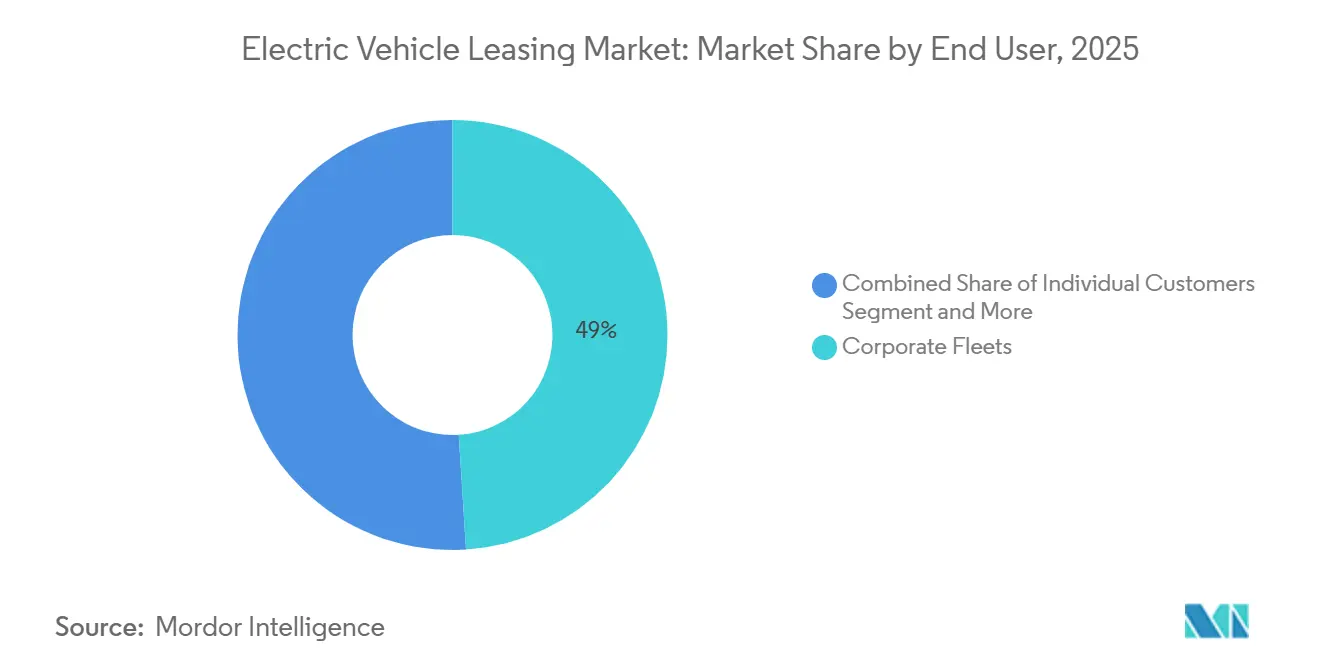
- By end user, corporate fleets accounted for 49.03% share in 2025; ride-sharing and delivery platforms are set to record the fastest CAGR at 18.79% through 2031.
- By duration, mid-term contracts (1-3 years) held 57.11% of the electric vehicle leasing market share in 2025, whereas short-term leases (less than 12 months) will grow at 18.35% CAGR.
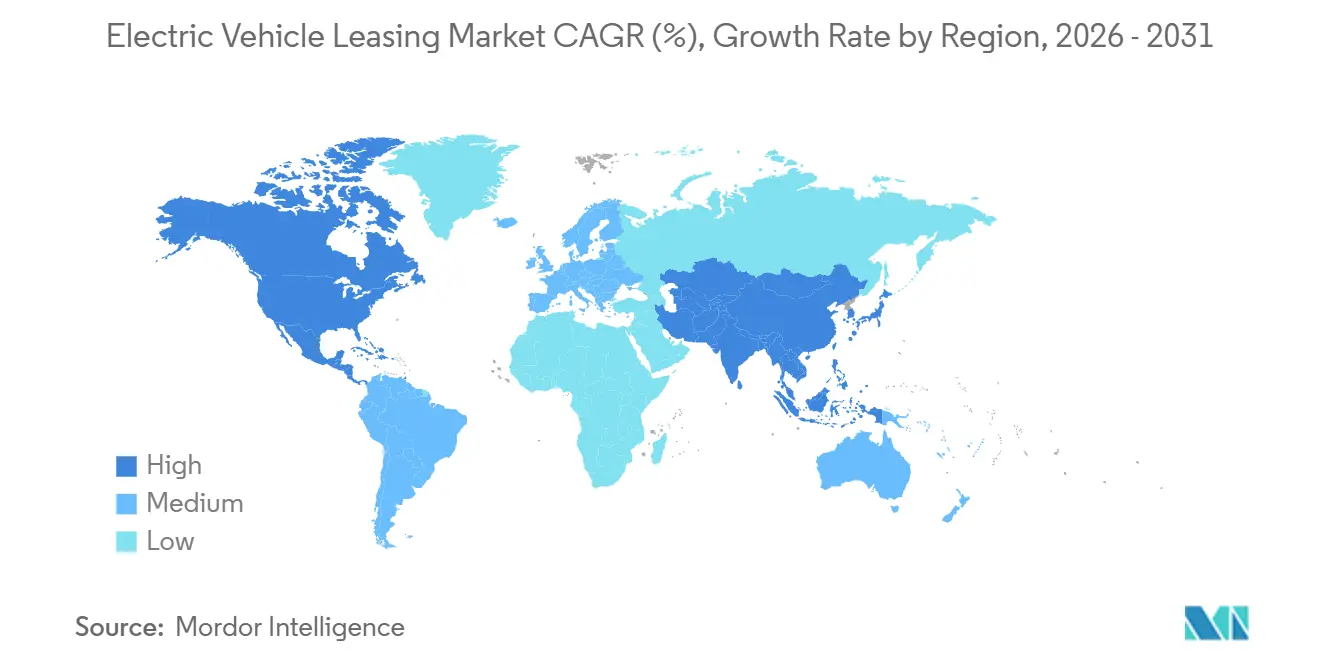
- By geography, Europe controlled 46.22% of the electric vehicle leasing market in 2025, while Asia-Pacific is projected to be the fastest-growing region at 17.48% CAGR to 2031.
Note: Market size and forecast figures in this report are generated using Mordor Intelligence’s proprietary estimation framework, updated with the latest available data and insights as of January 2026.
Market Trends and Insights
Drivers Impact Analysis of Electric Vehicle Leasing Market*
| Driver | (~) % Impact on CAGR Forecast | Geographic Relevance | Impact Timeline |
|---|---|---|---|
| Government Incentives and Tax Credits | +4.1% | Global hotspots (United States, EU, China, India) | Short term (≤ 2 years) |
| Corporate Sustainability Mandates | +3.2% | Europe, North America, Core Asia-Pacific | Medium term (2-4 years) |
| Declining Battery Costs | +2.8% | Global (especially in mature markets) | Long term (≥ 4 years) |
| Rising EV Model Variety | +2.3% | Global, strongest in Europe and China | Medium term (2-4 years) |
| Flexible/Micro-Lease Platforms | +1.9% | North America, Europe, urban Asia-Pacific | Short term (≤ 2 years) |
| AI-Driven Battery Analytics | +1.5% | Europe and North America lead adoption | Long term (≥ 4 years) |
| Source: Mordor Intelligence | |||
Government Incentives and Tax Credits Favor Leasing
Fiscal architecture channels bigger subsidies through leasing than through direct purchase in several key markets. United States commercial lessors can claim the full USD 7,500 credit irrespective of customer income thresholds, passing the benefit to lessees in the form of lower money factors [1]“Clean Vehicle Tax Credits,” Internal Revenue Service, irs.gov . Fleet operators in India can benefit from the FAME-II scheme, which provides significant incentives for electric vehicles, making EVs more financially attractive than traditional purchases. China’s purchase-tax exemption, recently extended through 2027, now includes provincial-level top-ups for leasing companies deploying vehicles in ride-hailing applications. Germany’s benefit-in-kind valuation for battery-electric company cars keeps salary-sacrifice leases firmly ahead of outright acquisitions. Lessors, therefore, lobby for multiyear subsidy visibility, arguing that opaque policy timelines inflate the risk premium baked into residuals.
Corporate Sustainability Mandates Electrify Fleets
Corporations committed to the Science-Based Targets initiative are shifting towards zero-emission fleets, viewing leasing as a cost-effective compliance strategy. The European Union mandates that by 2030, 45% of new corporate vehicle acquisitions must be zero-emission, with the target increasing further by 2035 [2]“Regulation on Clean Corporate Vehicles,” European Commission, europa.eu. Simultaneously, the United States offers a commercial clean-vehicle credit under the Inflation Reduction Act, providing financial incentives for leased units at the time of origination. Ayvens reported a surge in demand in 2025, revealing a notable increase in battery-electric vehicles from 2024. Fleet managers, eager to secure residual guarantees, are rolling out multi-year tenders, favoring lessors who boast integrated maintenance and depot-charging partnerships. In contrast, those without dedicated infrastructure are feeling the pinch, as outsourcing services drive up lifecycle costs.
Declining Battery Costs Improve Residual Values
In 2026, average prices for lithium-ion battery packs significantly declined compared to 2022 levels. This reduction in costs can be attributed to economies of scale and the growing adoption of lithium-iron-phosphate chemistries. As a result of this cost deflation, residual-value discounts have diminished, allowing lessors to align lease pricing more closely with traditional internal-combustion vehicles. Concurrently, the accelerated phase-out of nickel-manganese-cobalt packs has led to a divided secondary market, where older battery chemistries experience sharper depreciation. Lease underwriting has evolved, now incorporating predictive battery-analytics platforms that facilitate real-time health assessments and proactive remarketing. European auction houses have noted a trend: vehicles boasting certified battery passports command higher prices than their uncertified counterparts, underscoring the value of data-driven re-commerce strategies.
Rising EV Model Variety Lowers Entry Cost via Leasing
By 2025, electric vehicle (EV) models spanned every price tier and use case. The United States Department of Energy found that leasing can bridge the upfront price gap over a 36-month term, resulting in manageable monthly differences for mid-size sedans. In China, manufacturers introduced numerous electric models, with some integrated into comprehensive logistics lease packages. As Europe introduces electric vans from leading manufacturers, lessors can capitalize on the growing last-mile delivery market, especially with depot-charging integrations. As the number of models increases, competition intensifies around accurately forecasting residual values, giving an edge to lessors who leverage detailed auction data and machine-learning tools for asset valuation.
Restraints Impact Analysis of Electric Vehicle Leasing Market*
| Restraint | (~) % Impact on CAGR Forecast | Geographic Relevance | Impact Timeline |
|---|---|---|---|
| 2026-27 Off-Lease EV Glut | -1.8% | North America, Europe | Short term (≤ 2 years) |
| Residual Values Amid Tech Change | -1.4% | Global | Medium term (2-4 years) |
| Limited Public Charging | -1.2% | Global (Severe in rural and emerging markets) | Medium term (2-4 years) |
| Interest Rates Lift Payments | -1.0% | North America, Europe | Short term (≤ 2 years) |
| Source: Mordor Intelligence | |||
2026–27 Off-lease EV Glut May Depress Prices
In 2026-2027, North American and European leases will see the return of a significant number of electric vehicles to the market. This influx is set to substantially increase the off-lease volume of 2025, potentially leading to a notable impact on auction values. Data indicates that in 2026, used-EV prices experienced a decline, driven by a supply surge outpacing retail demand. Hertz faced challenges in 2025 due to accelerated depreciation on its Model 3 units. In response, lessors are tightening future residual guarantees, a move that either increases monthly payments or shortens contract lengths, effectively tempering the pace of demand growth.
Uncertain Residual Values Amid Rapid Tech Change
As battery chemistry rapidly evolves, premium packs from previous years risk becoming underperformers in the future. Analysis reveals that vehicles equipped with nickel-manganese-cobalt batteries in 2022-2023 experienced steeper depreciation compared to their 2024-2025 counterparts using lithium-iron-phosphate. Meanwhile, Black Book's residual tracking shows that connected vehicles, which can receive over-the-air updates, retain more value than their non-connected counterparts. Additionally, research from the Federal Reserve Bank of New York highlights a correlation between quicker loan delinquencies and perceived technological obsolescence. This points to a potential strategic-default risk for lessees who view purchase-option prices as uncompetitive.
*Our forecasts treat driver/restraint impacts as directional, not additive. The impact forecasts reflect baseline growth, mix effects, and variable interactions.
Electric Vehicle Leasing Market Segment Analysis
By Vehicle Type:
Commercial Fleets Drive AccelerationPassenger cars dominated with 81.25% of the electric vehicle leasing market revenue in 2025, but growth momentum is gradually shifting toward vans and pickups that serve e-commerce logistics. Commercial vehicles represent the most dynamic component of the electric vehicle leasing market, set to expand at a 17.86% CAGR. Amazon’s commitment to lease 100,000 Rivian electric delivery vans underpins scale economics in depot charging and maintenance. DHL’s eSprinter program in 2025 illustrated how turnkey leasing simplifies compliance with low-emission-zone rules.
Lessors are layering telematics into usage-based fee structures, linking payment schedules to kilometers driven or parcels delivered. Light commercial vehicles under 3.5 tons headline demand, partly because municipal regulations increasingly bar combustion vans from urban cores. In passenger cars, compact and mid-size segments exhibit the fastest leasing rotation due to earlier cost parity. Luxury EV leasing lags due to higher residual volatility, although software-defined upgrades may improve retention over time.


By Propulsion Type:
BEVs Dominate, PHEVs PlateauBattery-electric vehicles (BEVs) captured 73.18% of 2025 lease originations and are forecast to expand at 19.13% CAGR, widening their lead over plug-in hybrids. Toyota revealed that in 2025, a significant portion of its leased fleet in Europe comprised battery electric vehicles (BEVs), showing notable growth from the previous year. With several jurisdictions set to exclude plug-in hybrid electric vehicles (PHEVs) from zero-emission mandates post-2030, hybrid residual values face constraints, leading lessors to shorten contract durations. As a result, BEVs dominate the electric vehicle leasing market across various propulsion categories.
Fuel-cell electric vehicles hold a minimal share, finding their niche in hydrogen-infrastructure corridors located in California, Germany, and South Korea. The current strategy emphasizes phasing out PHEV portfolios by 2027, coinciding with OEMs' discontinuation of dual-drivetrain lines. In response, lessors are adjusting by modeling steeper depreciation curves for hybrids and reallocating capital towards BEVs, which not only qualify for more substantial subsidies but also boast lower maintenance costs.
By End User:
Ride-Sharing Platforms SurgeCorporate fleets held 49.03% of demand in 2025, but ride-sharing and delivery platforms will be the fastest-growing customer class at 18.79% CAGR. By 2030, Uber plans to lease electric vehicles to drivers in the United States, Canada, and Europe. In 2025, Grab's fleet electrification in Southeast Asia advanced significantly, supported by state-level subsidies in Indonesia and Thailand. In Europe, individual lessees benefit from tax reliefs that enhance affordability. While government agencies represent a smaller portion of the market, their long-duration contracts play a crucial role in stabilizing cash flows for lessors.
Commercial clients favor bundled solutions—like insurance, energy, and telematics—charged on a per-kilometer basis. Lessors that incorporate charging network access into lease invoices capture a larger share of ride-sharing operators, who often struggle to predict daily vehicle utilization.

By Duration:
Short-Term Gains MomentumShort-term contracts under 12 months will grow at 18.35% CAGR, propelled by subscription platforms like Loopit and Spring Free EV. Mid-term leases (1-3 years) still anchored 57.11% of the electric vehicle leasing market share in 2025 because they dovetail with corporate budgeting cycles. According to the National Vehicle Leasing Association, the average contract length decreased between 2023 and 2025, highlighting customer concerns about technological obsolescence.
Long-term (above 3 years) contracts decline as a portion of new originations: higher rate environments lift the cumulative financing burden and exacerbate residual uncertainty. Lessors increasingly market modular extensions, allowing clients to re-price or swap vehicles halfway through the term without punitive fees. Short-term products generate higher monthly revenue per asset but demand sophisticated remarketing operations to maintain fleet utilization.
Geography Analysis
Europe Electric Vehicle Leasing Market
Europe controlled 46.22% of the electric vehicle leasing market in 2025, buoyed by policy instruments such as Germany’s company-car tax regime and the United Kingdom’s plug-in van grant. France continues its ecological bonus for vehicles leased under a specific price threshold through 2026. In the Netherlands, high charger density alleviates range anxiety, supporting strong individual lease penetration. Arval highlights an increase in zero-emission vehicles in European origins between 2023 and 2025. Europe faces the challenge of managing the influx of off-lease inventory during 2026-2027 as residual-value pressures grow.
APAC Electric Vehicle Leasing Market
Asia-Pacific is the fastest-growing region at 17.48% CAGR, propelled by China’s 40% new-energy-vehicle sales mandate for 2030. Beijing extends its purchase-tax exemption until 2027, while Shenzhen offers a leasing subsidy, spurring corporate adoption. India’s FAME-II disburses INR 10,000 crore (USD 1.2 billion) in incentives, while Maharashtra’s top-up grants slice the total cost of ownership for fleet operators. While Japan and South Korea grapple with hybrid consumer preferences and limited charging infrastructure, both nations have set legally binding goals to phase out internal combustion engines (ICE) by 2035, paving the way for intensified leasing activities later in the decade. Meanwhile, Southeast Asia witnesses a surge in momentum, particularly with Grab-led ride-hailing electrification efforts in Jakarta and Bangkok.
The Americas and MEA Electric Vehicle Leasing Market
North America’s uptake pivots on the Inflation Reduction Act’s clean-vehicle credit, which lessors capture at origination. Tesla Financial Leasing, Enterprise, and Hertz dominate volume, although Hertz’s 2024-2025 residual-value setback underscores risk. Canada furnishes CAD 5,000 (approximately USD 3,700) complemented by federal incentives plus provincial add-ons, sustaining a cross-border pipeline of zero-emission lease demand [3]“iZEV Incentive Program,” Transport Canada, tc.canada.ca . South American penetration remains embryonic; pilot taxi and bus programs in Brazil, Chile, and Argentina advance but face tariff and infrastructure drags. Gulf Cooperation Council states roll out fleet-oriented leasing pilots aligned with national diversification agendas, while South Africa experiments with corporate EV rentals in high-tourism corridors.
Mordor Intelligence provides coverage of the electric vehicle leasing market across other key regional markets, including Europe, each with their regulatory frameworks and demand patterns. Detailed country-level analysis extends to Japan, India, United States, and South Korea incorporating local coverage and market participation, as required.

Competitive Landscape
The global lease origination market is characterized by a competitive yet moderately concentrated landscape. Ayvens and Arval dominate European corporate accounts with their extensive service networks, while Sixt and Hertz focus on short-term urban leases. OEM captives like Tesla Financial Leasing, BYD Auto Finance, Hyundai Capital, and Toyota Financial Services utilize proprietary telematics and software updates to take bolder stances on residual underwriting. Rivian Financial Services targets the adventure and delivery sectors through direct enterprise channels, and VinFast Leasing rolls out bundled battery-subscription models across Southeast Asia.
Mastering data is becoming the defining line between industry leaders and those trailing behind. Volkswagen Financial Services employs a patented algorithm that tweaks lease pricing in real-time, responding to telemetry data that indicates battery degradation is better than anticipated, effectively reducing risk buffers. Meanwhile, Tesla's over-the-air software capabilities bolster secondary-market values, enabling them to set higher residuals and outmaneuver competitors sensitive to rate changes. The European Commission's battery passport regulation, while introducing compliance challenges, also presents lessors with a marketing edge for their quality-validated used units. Companies without the scale to harness telematics risk losing out, as clients with high wear-and-tear tendencies gravitate towards generic contracts that misprice their risk.
Emerging opportunities lie in services like depot-charging, programs for certified pre-owned electric vehicle leasing to capitalize on off-lease surpluses, and cross-border lease portability to streamline fleet management for global corporations. Collaborations between lessors and energy utilities are on the rise, with BYD Auto Finance making a splash by co-investing in charging depots in Shenzhen, and Ayven teaming up with Iberdrola in Spain to secure renewable energy deals for fleet charging.
Electric Vehicle Leasing Industry Leaders
Ayvens Group
Arval (BNP Paribas)
Sixt SE
Hertz Global Holdings, Inc.
Volkswagen Financial Services AG
- *Disclaimer: Major Players sorted in no particular order
Electric Vehicle Leasing Market Companies Covered in this Report
- Ayvens Group
- Arval (BNP Paribas)
- Sixt SE
- Hertz Global Holdings, Inc.
- Enterprise Mobility
- Avis Budget Group
- Mercedes-Benz Mobility
- Volkswagen Financial Services AG
- Tesla Financial Services
- Novuna Vehicle Solutions
- Hyundai Capital Services
- Toyota Financial Services
- Rivian Financial Services
- EverFleet (Spring Free EV, Inc.)

Recent Industry Developments in Electric Vehicle Leasing Market
- August 2026: Drivn, an EV leasing platform focused on heavy commercial fleets, signed a Memorandum of Understanding (MoU) with Tata Motors, India’s largest commercial vehicle manufacturer, to explore the leasing-based deployment of electric commercial vehicles in India. Under the partnership, Drivn will provide customized leasing solutions for Tata Motors’ electric commercial vehicle portfolio, enabling fleet operators to transition to electric vehicles through simpler and more accessible financing.
- June 2026: Switch Mobility signed a memorandum of understanding (MoU) with Drivn to strengthen EV leasing solutions and expand customer access to electric vehicles across the commercial mobility ecosystem. The partnership aims to make EV ownership and deployment more accessible through leasing-led mobility solutions.


Global Electric Vehicle Leasing Market Report Scope
The scope includes segmentation by vehicle type (passenger cars and commercial vehicles), propulsion type (battery electric vehicles, plug-in hybrid electric vehicles, and fuel-cell electric vehicles), end user (individual customers, corporate fleets, government agencies, and ride-sharing and delivery platforms), and duration (short-term (less than 12 months), mid-term (1-3 years), and long-term (more than 3 years). The analysis also covers regional-level analysis, including North America, South America, Europe, Asia-Pacific, and the Middle East and Africa. Market size and growth forecasts are presented by value in USD.
| Passenger Cars |
| Commercial Vehicles |
| Battery Electric Vehicles |
| Plug-in Hybrid Electric Vehicles |
| Fuel-Cell Electric Vehicles |
| Individual Customers |
| Corporate Fleets |
| Government Agencies |
| Ride-Sharing and Delivery Platforms |
| Short-Term (Less than 12 months) |
| Mid-Term (1-3 years) |
| Long-Term (More than 3 years) |
| North America | United States |
| Canada | |
| Rest of North America | |
| South America | Brazil |
| Argentina | |
| Rest of South America | |
| Europe | Germany |
| United Kingdom | |
| Spain | |
| Italy | |
| France | |
| Netherlands | |
| Rest of Europe | |
| Asia-Pacific | India |
| China | |
| Japan | |
| South Korea | |
| Indonesia | |
| Rest of Asia-Pacific | |
| Middle East and Africa | United Arab Emirates |
| Saudi Arabia | |
| Turkey | |
| Egypt | |
| South Africa | |
| Rest of Middle East and Africa |
| By Vehicle Type | Passenger Cars | |
| Commercial Vehicles | ||
| By Propulsion Type | Battery Electric Vehicles | |
| Plug-in Hybrid Electric Vehicles | ||
| Fuel-Cell Electric Vehicles | ||
| By End User | Individual Customers | |
| Corporate Fleets | ||
| Government Agencies | ||
| Ride-Sharing and Delivery Platforms | ||
| By Duration | Short-Term (Less than 12 months) | |
| Mid-Term (1-3 years) | ||
| Long-Term (More than 3 years) | ||
| By Geography | North America | United States |
| Canada | ||
| Rest of North America | ||
| South America | Brazil | |
| Argentina | ||
| Rest of South America | ||
| Europe | Germany | |
| United Kingdom | ||
| Spain | ||
| Italy | ||
| France | ||
| Netherlands | ||
| Rest of Europe | ||
| Asia-Pacific | India | |
| China | ||
| Japan | ||
| South Korea | ||
| Indonesia | ||
| Rest of Asia-Pacific | ||
| Middle East and Africa | United Arab Emirates | |
| Saudi Arabia | ||
| Turkey | ||
| Egypt | ||
| South Africa | ||
| Rest of Middle East and Africa | ||


Key Questions Answered in the Report
How large is the electric vehicle leasing market in 2026?
The electric vehicle leasing market size is estimated at USD 122.87 billion in 2026, up from USD 105.01 billion in 2025.
Which region is growing fastest in leasing uptake?
Asia-Pacific leads with a 17.48% CAGR to 2031, driven by Chinese and Indian subsidy frameworks that heavily favor leased zero-emission fleets.
Why are battery-electric vehicles preferred over plug-in hybrids for leasing?
Richer incentives, stricter zero-emission regulations, and lower maintenance costs push lessors and customers toward BEVs, which held 73.18% share in 2025 and grow 19.13% annually.
What role do micro-lease platforms play in the sector?
Platforms like Loopit and Spring Free EV enable sub-12-month contracts that bundle insurance and charging, serving gig-economy drivers and boosting short-term lease growth at 18.35% CAGR.
Page last updated on:





