
North America Electric Vehicle Market Size and Share
Market Overview
| Study Period | 2019 - 2031 |
|---|---|
| Forecast Data Period | 2026 - 2031 |
| Base Year Market Size (2025) | USD 95.05 Billion |
| Market Size (2026) | USD 102.66 Billion |
| Market Size (2031) | USD 150.92 Billion |
| Growth Rate (2026 - 2031) | 8.01 % |
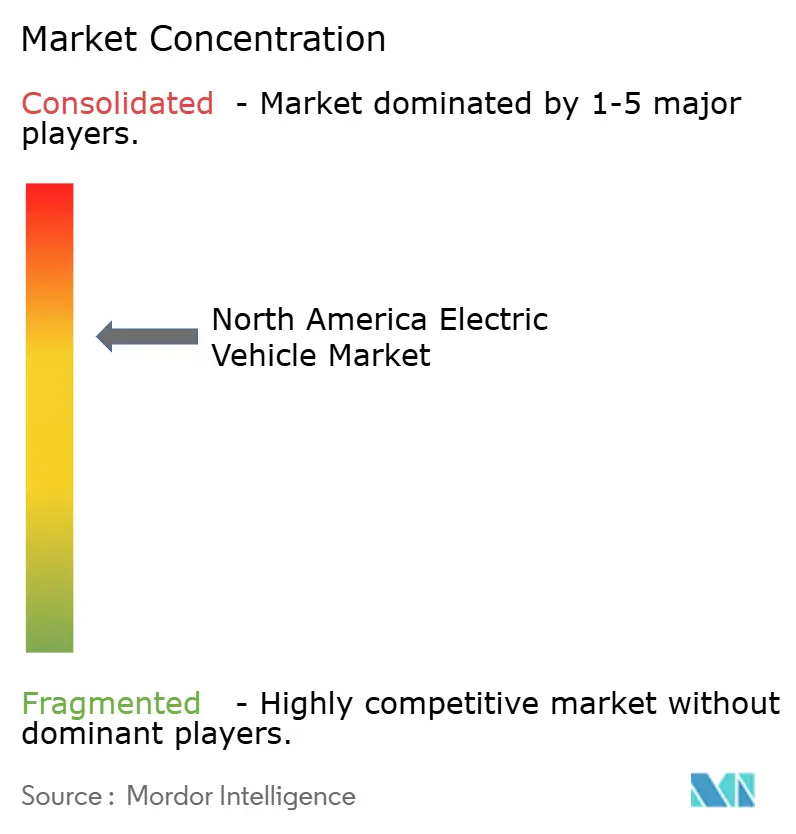
| Market Concentration | Medium |
Major Players *Disclaimer: Major Players sorted in no particular order Image © Mordor Intelligence. Reuse requires attribution under CC BY 4.0. | |
North America Electric Vehicle Market Analysis by Mordor Intelligence
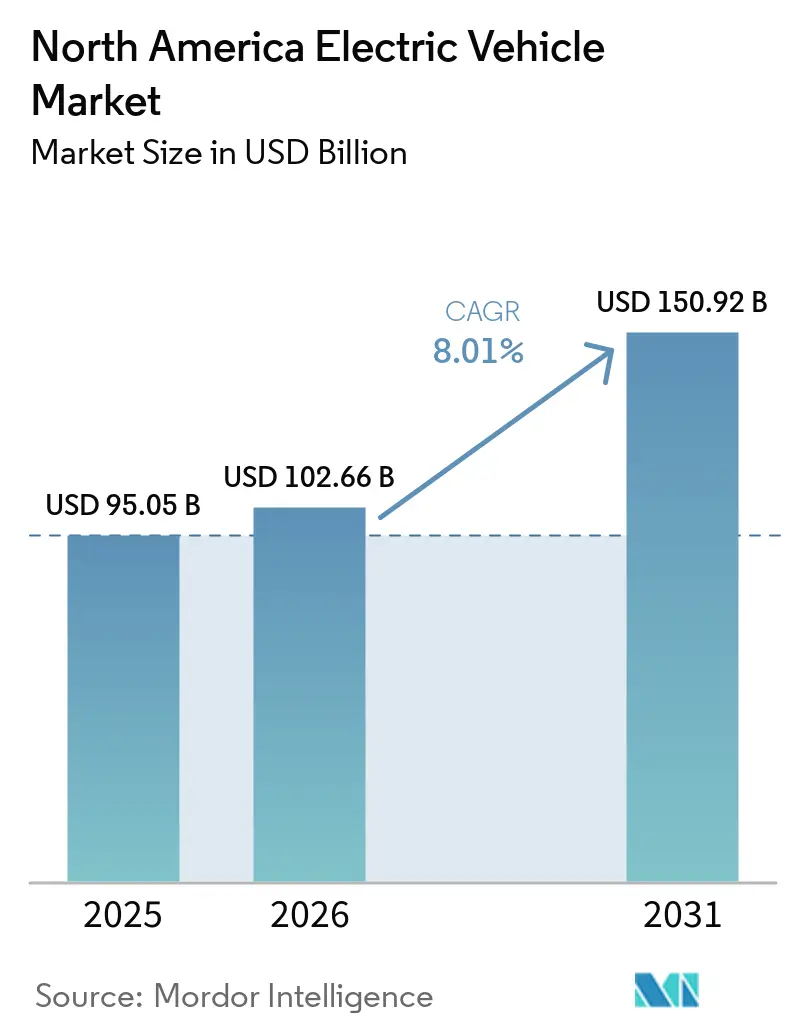
The North America electric vehicle market size is projected to expand from USD 95.05 billion in 2025 and USD 102.66 billion in 2026 to USD 150.92 billion by 2031, registering an 8.01% CAGR between 2026 and 2031. Federal incentives, automaker capital shifts, and tightening emissions rules are accelerating drivetrain electrification, pulling battery manufacturing onshore and splintering the once-unified supply chain into three distinct regulatory blocs. Passenger cars still dominate revenue, yet fleet operators are scaling procurement because total-cost-of-ownership advantages now outweigh initial price premiums for many duty cycles. Battery-only propulsion retains a decisive lead, but hydrogen fuel-cell pilot programs in heavy-duty and public-transit niches are gathering pace. Platform strategies favor dual-motor layouts that spread costs across multiple models, while performance-oriented powertrains remain a profitable halo for brands intent on funding mass-market launches.
Key Report Takeaways
- By vehicle type, passenger cars held 77.13% of the North America electric vehicle market share in 2025, while light commercial vehicles are forecast to grow at a 9.02% CAGR through 2031.
- By propulsion type, battery-electric vehicles accounted for 70.25% of 2025 revenue, whereas fuel-cell electric vehicles are projected to grow at a 11.22% CAGR through 2031.
- By drive type, all-wheel-drive configurations accounted for 46.19% of revenue in 2025 and are expected to grow at an 8.43% rate over the forecast horizon.
- By power output, systems rated 100 - 250 kW accounted for 55.33% of the market size in 2025; systems rated above 250 kW are expected to post the fastest growth at 9.54%.
- By geography, the United States accounted for 85.22% of regional demand in 2025, yet Mexico is poised for the fastest growth with an 8.71% CAGR through 2031.
Note: Market size and forecast figures in this report are generated using Mordor Intelligence’s proprietary estimation framework, updated with the latest available data and insights as of January 2026.
Market Trends and Insights
Drivers Impact Analysis of North America Electric Vehicle Market*
| Driver | (~) % Impact on CAGR Forecast | Geographic Relevance | Impact Timeline |
|---|---|---|---|
| Declining Battery Costs and Range | +2.1% | North America-wide, strongest in the United States and Canada | Long term (≥ 4 years) |
| Federal Tax and IRA Subsidies | +1.8% | United States with spillover to USMCA partners | Medium term (2-4 years) |
| Automaker Electrification Investments | +1.5% | United States and Mexico manufacturing hubs | Long term (≥ 4 years) |
| Domestic USMCA Battery Supply | +1.2% | United States-Mexico-Canada integrated supply chains | Long term (≥ 4 years) |
| Regional Vehicle-to-Grid Pilots | +0.7% | California, Massachusetts, Colorado | Medium term (2-4 years) |
| Integrated Battery-Recycling Ecosystems | +0.4% | Great Lakes region, Texas, Nevada | Long term (≥ 4 years) |
| Source: Mordor Intelligence | |||
Declining Battery Costs and Extended Range
Pack prices fell to USD 108/kWh in 2025[1] and are expected to ease further as lithium-iron-phosphate chemistries scale. Tesla and LG Energy Solution announced a Michigan LFP cell facility scheduled for 2027[2], underscoring the regional shift in chemistry production. Range anxiety is easing because most 2026 model launches clear the 300-mile mark, as seen in the Chevrolet Equinox EV at a USD 35,000 entry price. Cold-weather degradation, however, still trims roughly one-third of the rated range, particularly constraining Canadian uptake. Even so, every incremental cost reduction expands the addressable pool of buyers for whom total ownership savings eclipse sticker premiums.
Federal Tax Incentives and IRA Subsidies
The Inflation Reduction Act offers sizeable manufacturing credits, shortening payback periods for both consumers and automakers. Eligibility thresholds rise each year, forcing firms to realign their supply chains toward North American components. Treasury guidance issued in 2024 disqualified batteries with graphite from entities of concern, pushing OEMs toward Australian and Canadian contracts. Vertically integrated manufacturers with domestic cell lines meet these rules more easily, strengthening their cost position versus joint-venture-reliant peers. The commercial-vehicle credit of up to USD 40,000 per unit has spurred conversions of parcel and municipal fleets, enabling corporate buyers to fully monetize the subsidy. As the thresholds ratchet upward, compliance costs will favor suppliers with onshore refining and midstream capacity.
Automakers' Electrification Roadmaps and Investments
General Motors earmarked USD 35 billion for its Ultium program, anchoring new capacity in Michigan and Tennessee. Hyundai and LGES' joint Georgia plant began production in 2026, qualifying assembled models for domestic content credits even as cells are imported under a temporary waiver. These multibillion-dollar wagers lock OEMs into battery electric volume regardless of demand swings, making incentive capture and cost downs critical for breakeven. The capital pipeline also draws a network of suppliers, cathode, separator, and pack makers, into emerging U.S. battery corridors.
Domestic Battery Supply-Chain Localization Under USMCA Incentives
USMCA rules of origin demand 75% North American content for tariff-free trade, encouraging cell and cathode plants in all three member states. Honda and LG’s Ohio joint venture will add nearly 40 GWh of annual capacity by 2027. Ford is enlarging BlueOval Battery Park, Michigan, to feed F-150 Lightning output. Critical mineral refining remains a bottleneck; the region refines less than 5% of global lithium and cobalt, exposing producers to geopolitical supply shocks. The forthcoming 2026 USMCA review could tighten labor and environmental clauses, impacting the cost competitiveness of Mexican assembly.
Restraints Impact Analysis of North America Electric Vehicle Market*
| Restraint | (~) % Impact on CAGR Forecast | Geographic Relevance | Impact Timeline |
|---|---|---|---|
| Inadequate Public Charging Infrastructure | -1.4% | Rural areas, urban charging deserts | Short term (≤ 2 years) |
| High Upfront Purchase Price | -1.1% | North America-wide mid-market segments | Medium term (2-4 years) |
| BEV Resale Value Uncertainty | -0.8% | United States and Canada | Medium term (2-4 years) |
| Fast-Charging Grid Connection Delays | -0.6% | High-traffic corridors, constrained urban grids | Short term (≤ 2 years) |
| Source: Mordor Intelligence | |||
Inadequate Public Charging Infrastructure Density
NREL calculates a need for 28 million ports by 2030, but only 8 million existed at 2025’s close. Permitting bottlenecks limit roll-outs despite a USD 5 billion federal corridor program. Rural areas in the Midwest and Appalachia fall below one charger per 100 square miles, dissuading long-distance travel. Canada’s province-specific networks lack interoperability, requiring multiple payment systems for cross-border drives. Until density gaps shrink, consumer confidence and resale values will remain under pressure.
High Upfront Purchase Price vs. ICE Alternatives
Battery electric sticker prices remain USD 10,000–15,000 above comparable gasoline vehicles even after consumer credits. Automakers prioritize higher-margin trims to recoup platform costs, slowing mass-market penetration. In Mexico, import tariffs and patchy incentives widen the gap to roughly 40% over internal combustion models. Commercial fleets partly offset this premium through federal tax breaks and lower fuel and maintenance outlays, yet budget-constrained households defer purchases until parity narrows. The price delta will gradually compress as scale, chemistry shifts, and domestic supply cut logistics overhead.
*Our forecasts treat driver/restraint impacts as directional, not additive. The impact forecasts reflect baseline growth, mix effects, and variable interactions.
North America Electric Vehicle Market Segment Analysis
By Vehicle Type:
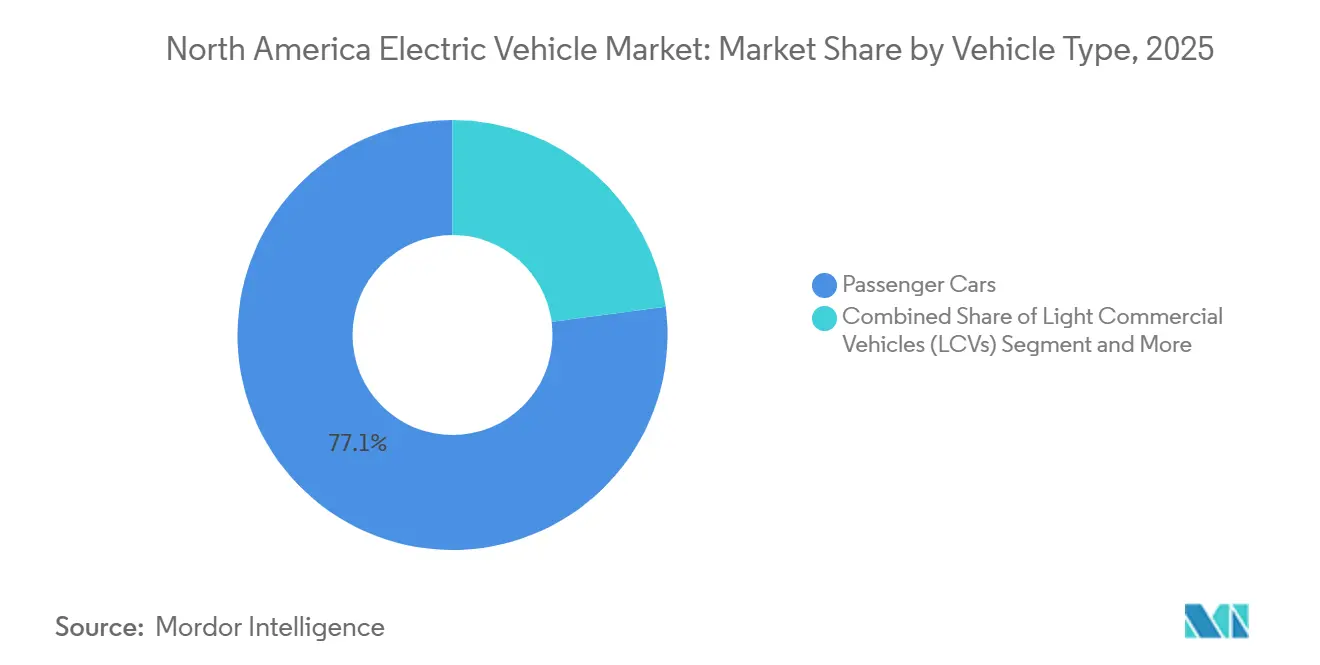
Commercial Momentum Reshapes MixPassenger cars held 77.13% of 2025 revenue but face a gentler growth curve as first-wave early adopters saturate. Light commercial vehicles, the fastest-growing slice, are slated for a 9.02% CAGR, reflecting parcel carriers and municipal fleets switching en masse to battery vans. Contract awards from the U.S. Postal Service and Amazon validate the durability of fleet demand, while municipal bus tenders extend electrification into public transit. The North American electric vehicle market size for commercial vans will therefore expand more quickly than for passenger sedans, even though the absolute base is smaller.
Fleet duty cycles amplify uptime gains: predictable routes enable depot charging and higher daily utilization, lowering cost per mile. Regulations mandating zero-emission municipal fleets intensify momentum in refuse collection and airport shuttle applications. Financing models are also evolving; leasing companies now bundle chargers and maintenance, flattening capital burdens for city agencies. As incentives taper, operators should still benefit from residual-value clarity because large-parcel fleets provide a secondary market for used vans in less-demanding roles.

By Propulsion Type:
Battery Dominance With Targeted Hydrogen UptakeBattery-electric platforms secured 70.25% of 2025 sales, anchoring the propulsion landscape of the North American electric vehicle market. Fuel-cell models will, however, chart the quickest percentage rise at 11.22% CAGR, albeit from a much smaller baseline. California’s network of 60-plus hydrogen stations and Canada’s pilot corridors lure heavy-duty operators wary of battery weight penalties. The North American electric vehicle market share of FCEVs will therefore inch upward in the long-haul freight and intercity coach niches, where rapid refueling unlocks asset utilization.
OEM resource allocation signals diverging bets: several legacy brands canceled plug-in hybrid updates to redeploy capital toward battery packs that meet content rules and qualify for credits. Meanwhile, partnerships between truck makers and industrial-gas suppliers demonstrate confidence in green-hydrogen cost curves. Market watchers expect fuel cells to remain complementary rather than competitive in light-duty segments unless hydrogen prices drop near the USD 2/kg parity threshold policymakers target.
By Drive Type:
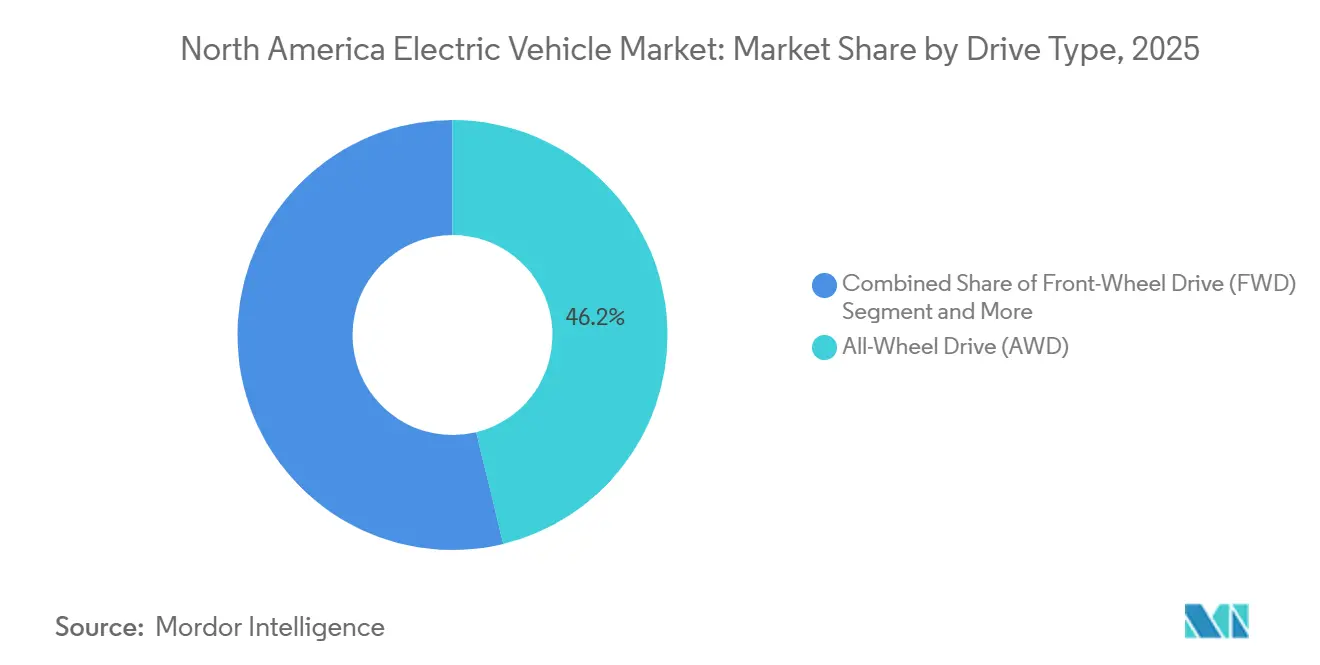
AWD Economics Trump Seasonal NeedAll-wheel-drive layouts captured 46.19% of sales in 2025 and will grow at 8.43% CAGR, making them the leader in the North American electric vehicle market. Dual-motor variants deliver higher margins because the incremental hardware expense is modest relative to the price premium, allowing automakers to average down battery costs across trim lines. Consumers in snow-belt states prize winter traction, yet the real driver is platform modularity that accommodates rear-, front-, or all-wheel powertrains with minimal re-engineering.
The North America electric vehicle market size for AWD trims will therefore outpace single-motor configurations even as charging coverage improves. Entry-level front-wheel-drive models remain critical for affordability, particularly in Mexico and southern U.S. regions where the weather is mild. Rear-wheel drive persists in luxury sedans aimed at driving-enthusiast buyers who value handling dynamics. Over time, software torque vectoring in AWD layouts may further tilt preferences by offering safety and performance benefits unavailable in single-motor designs.
By Power Output:
High-Performance Systems Gain TractionMass-market crossovers in the 100–250 kW range still dominate registrations, capturing 55.33% share in 2025, balancing cost, range, and insurance premiums. Systems above 250 kW are forecast to grow by 9.54%, reinforcing a bifurcation between high-performance flagships and mass-market commuters. Automakers harness these halo models to demonstrate technological leadership and justify premium pricing, which, in turn, funds the scaled procurement of batteries and power electronics. The North American electric vehicle market size is tied to high-output drivetrains; therefore, it grows faster than unit volumes alone would suggest.
Commercial freight needs also push power envelopes upward; electric Class 8 tractors require continuous 350 kW-plus to pull 80,000-pound loads. As grid-scale charging hubs proliferate, heavy trucks will eventually migrate from pilot to mainstream adoption. In passenger niches, acceleration times that eclipse internal-combustion sports cars help convert enthusiasts while maintaining profitable average selling prices.
Geography Analysis
United States Electric Vehicle Market
The United States generated 85.22% of regional sales in 2025, illustrating how federal credits and domestic-content rules anchor demand and manufacturing inside the world’s largest economy. California remains the lodestar, commanding roughly one-third of U.S. battery electric registrations thanks to aggressive ZEV quotas and a dense charging grid. Texas follows, buoyed by production footprints and lower tax burdens that stretch the value of federal incentives. Midwest battery corridors in Michigan, Tennessee, and Georgia attract multibillion-dollar cell-plant commitments, yet local adoption trails coastal states because retail gasoline stays cheaper, and public chargers are sparse.
Mexico Electric Vehicle Market
Mexico is on track for an 8.71% CAGR, the fastest in the bloc. Automakers exploit nearshoring economics to satisfy USMCA content thresholds while hedging against U.S. wage inflation. Nuevo León and San Luis Potosí plants position exports within one day’s trucking distance of U.S. distribution hubs, preserving just-in-time logistics. Domestic demand remains urban-centric because federal purchase incentives are absent, and charging deserts persist outside Mexico City and Monterrey. Over time, retail momentum may build as second-hand imports lower entry costs for middle-income households.
Canada Electric Vehicle Market
Canada’s federal mandate sets a phase-in that reaches 100% zero-emission light-duty sales by 2035. Quebec and British Columbia sweeten uptake with provincial rebates, yet Alberta and the Prairie provinces forgo such incentives, fragmenting inventory strategies for national dealers. Interoperability issues across proprietary charging networks impede seamless interprovincial travel. Investment flows concentrate in Ontario, where battery joint ventures and assembly lines locate within existing automotive clusters. These structural advantages position Canada as a critical pillar in the North America electric vehicle market even though population density limits absolute volume.
Competitive Landscape
The North American electric vehicle market exhibits moderate consolidation. Tesla leverages vertical integration, from cell manufacturing to its proprietary Supercharger ecosystem of 15,000-plus stalls, to impose switching costs that competitors struggle to match. General Motors deploys its Ultium skateboard across Chevrolet, GMC, and Cadillac, spreading R&D over multiple body styles. Ford concentrates on its own in-house platform after shelving a joint program with Volkswagen, aiming to preserve software control and lifetime monetization.
New entrants Rivian and Lucid address adventure and luxury niches where incumbents underserve specialized customer needs. Both companies, however, must rein in cash burn; Rivian secured a USD 5 billion lifeline from Volkswagen tied to software licensing, while Lucid angles for Middle-East sovereign backing. Chinese players such as BYD examine Mexican assembly as a tariff-mitigation path, but U.S. duties and ownership-limit questions under USMCA rules keep timelines fluid. Patent filings in solid-state batteries hint at a future reshuffle once energy density breakthroughs are commercialized.
Standardization advances favor incumbents with existing infrastructure. SAE’s 2024 adoption of Tesla’s NACS connector effectively crowned the format the continental fast-charge standard. Third-party networks paying for access bolster Tesla’s ancillary revenue and data advantages. Meanwhile, white-space opportunities persist below USD 30,000, in mid-size electric pickups under USD 50,000, and in hydrogen Class 8 tractors. Success in these segments hinges on cost-down roadmaps and public-policy support rather than pure technology differentiation.
North America Electric Vehicle Industry Leaders
-
Tesla, Inc.
-
General Motors Company
-
Ford Motor Company
-
Hyundai Motor Company
-
Rivian Automotive, Inc.
- *Disclaimer: Major Players sorted in no particular order
North America Electric Vehicle Market Companies Covered in this Report
- Tesla, Inc.
- General Motors Company
- Ford Motor Company
- Hyundai Motor Company
- Rivian Automotive, Inc.
- Stellantis N.V.
- Lucid Group, Inc.
- Nissan Motor Co., Ltd.
- Honda Motor Co., Ltd.
- BMW Group
- Mercedes-Benz Group AG
- Volvo Car AB
- BYD Auto Co., Ltd.
- Lion Electric Company
- Nikola Corporation
- Daimler Truck Holding AG
- PACCAR Inc.
Recent Industry Developments in North America Electric Vehicle Market
- April 2026: Lotus Tech launched the all-electric Eletre in Canada at CAD 119,900 and unveiled a limited-run Eletre X Black & Gold Edition at Auto China 2026.
- April 2026: General Motors shipped the 2027 Chevrolet Bolt from its Kansas plant, offering a 262-mile EPA range and a USD 28,995 base price, the lowest of any U.S. battery electric vehicle now on sale.
- February 2026: Toyota Motor North America premiered a three-row Highlander BEV as part of its multi-pathway carbon-neutral roadmap.
North America Electric Vehicle Market Report Scope
The North America Electric Vehicle market is analyzed across vehicle type, propulsion type, drive type, power output, and country. By Vehicle Type, the market is segmented into Passenger Cars, Light Commercial Vehicles, Medium and Heavy Commercial Vehicles, and Buses and Coaches. By Propulsion Type, the market is segmented into Battery Electric Vehicle (BEV), Plug-in Hybrid Electric Vehicle (PHEV), Hybrid Electric Vehicle (HEV), and Fuel-Cell Electric Vehicle (FCEV). By Drive Type, the market is segmented into Front-Wheel Drive, Rear-Wheel Drive, and All-Wheel Drive. By Power Output, the market is segmented into Below 100 kW, 100-250 kW, and Above 250 kW. By Country, the market is segmented into United States, Canada, and Mexico. Market forecasts are provided in terms of Value (USD) and Volume (Units).
Segmentation Overview
| Passenger Cars |
| Light Commercial Vehicles (LCVs) |
| Medium and Heavy Commercial Vehicles (M&HCVs) |
| Buses and Coaches |
| Battery Electric Vehicles (BEV) |
| Plug-in Hybrid Electric Vehicles (PHEV) |
| Hybrid Electric Vehicles (HEV) |
| Fuel-Cell Electric Vehicles (FCEV) |
| Front-Wheel Drive (FWD) |
| Rear-Wheel Drive (RWD) |
| All-Wheel Drive (AWD) |
| Below 100 kW |
| 100-250 kW |
| Above 250 kW |
| United States |
| Canada |
| Mexico |
| By Vehicle Type | Passenger Cars |
| Light Commercial Vehicles (LCVs) | |
| Medium and Heavy Commercial Vehicles (M&HCVs) | |
| Buses and Coaches | |
| By Propulsion Type | Battery Electric Vehicles (BEV) |
| Plug-in Hybrid Electric Vehicles (PHEV) | |
| Hybrid Electric Vehicles (HEV) | |
| Fuel-Cell Electric Vehicles (FCEV) | |
| By Drive Type | Front-Wheel Drive (FWD) |
| Rear-Wheel Drive (RWD) | |
| All-Wheel Drive (AWD) | |
| By Power Output | Below 100 kW |
| 100-250 kW | |
| Above 250 kW | |
| By Country | United States |
| Canada | |
| Mexico |
Key Questions Answered in the Report
How large is the North America electric vehicle market today?
The North America electric vehicle market size stood at USD 102.66 billion in 2026 and is forecast to reach USD 150.92 billion by 2031, growing at an 8.01% CAGR.
Which vehicle type is expanding fastest?
Light commercial vans are projected to post a 9.02% CAGR through 2031 as parcel, postal, and municipal fleets scale electrification.
What propulsion technology leads regional sales?
Battery electric powertrains held 70.25% of 2025 revenue, making them the dominant propulsion choice.
Which country inside North America grows quickest?
Mexico is expected to expand at an 8.71% CAGR, outpacing the United States and Canada on the back of nearshoring and new assembly investments.