
United States Electric Vehicle Leasing Market Size and Share
Market Overview
| Study Period | 2019 - 2031 |
|---|---|
| Forecast Data Period | 2026 - 2031 |
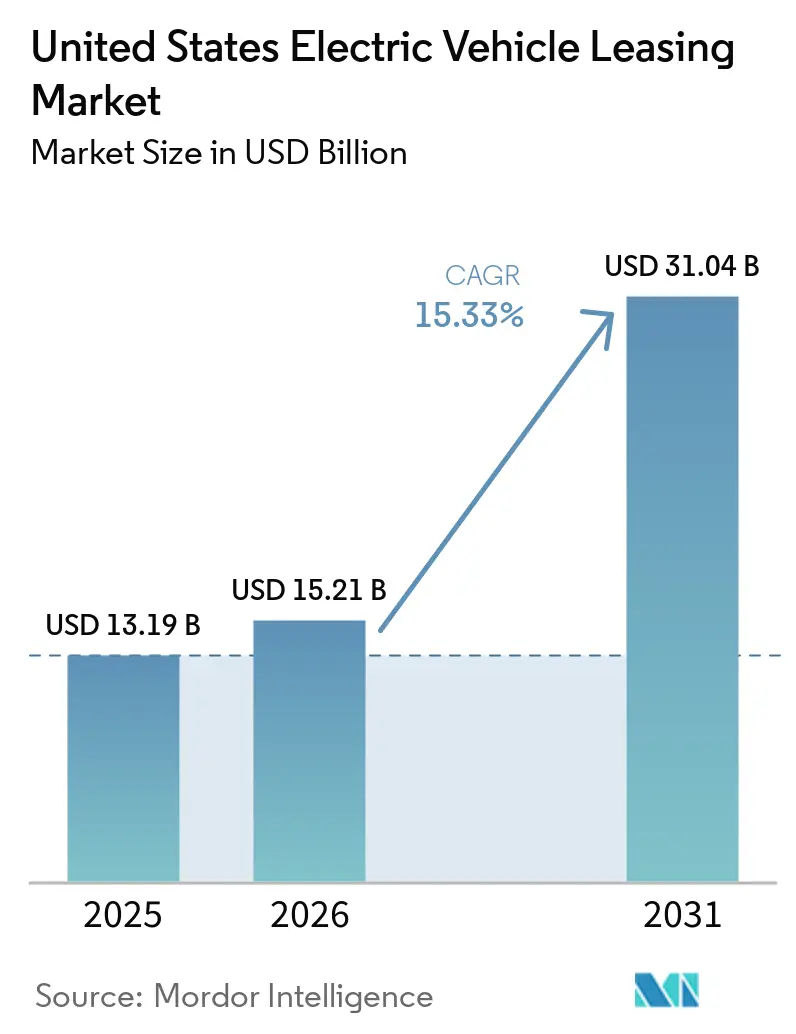
| Base Year Market Size (2025) | USD 13.19 Billion |
| Market Size (2026) | USD 15.21 Billion |
| Market Size (2031) | USD 31.04 Billion |
| Growth Rate (2026 - 2031) | 15.33 % |
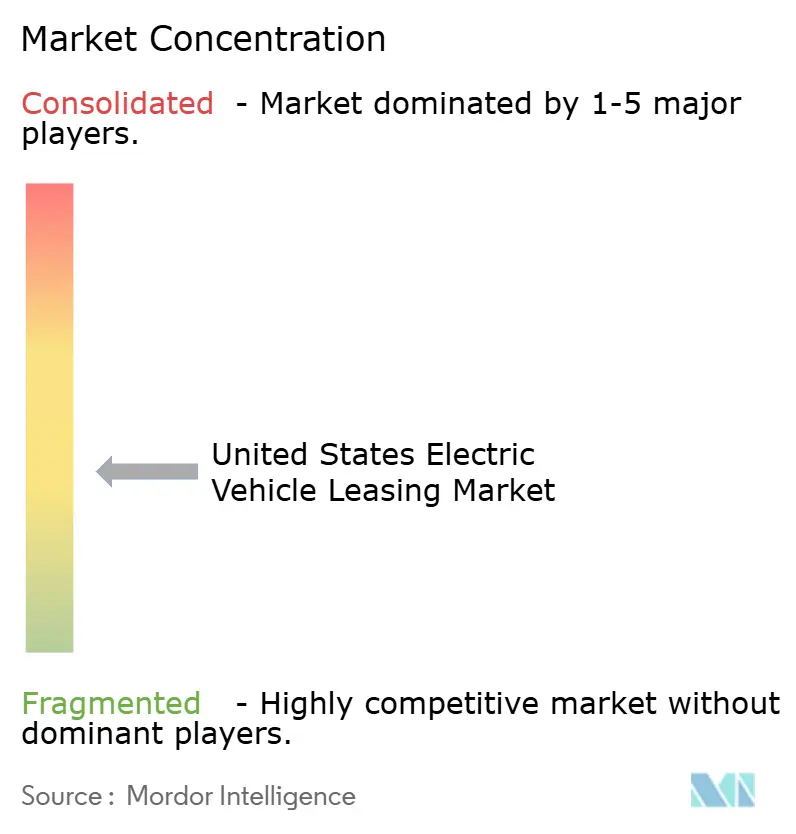
| Market Concentration | Medium |
Major Players *Disclaimer: Major Players sorted in no particular order Image © Mordor Intelligence. Reuse requires attribution under CC BY 4.0. | |
United States Electric Vehicle Leasing Market Analysis by Mordor Intelligence
The United States electric vehicle leasing market size was valued at USD 13.19 billion in 2025, is estimated at USD 15.21 billion in 2026, and is projected to reach USD 31.04 billion by 2031, growing at a CAGR of 15.33% over 2026-2031. Robust federal incentives that flow uniquely through lease contracts, widening model availability, and captive-finance residual-value guarantees underpin this multi-year expansion in the United States electric vehicle leasing market. Consumers and fleets are gravitating toward leases because Section 45W commercial credits remain uncapped by income or MSRP limits, effectively lowering capitalized cost and widening the payment gap versus loans. Leasing also shelters customers from technological obsolescence and depreciation risk as battery cost curves accelerate downward. At the same time, captive finance arms are subsidizing money factors to preserve sales momentum even in a high-rate environment, while independent lessors chase white space in rural corridors where charger scarcity once stalled adoption.
Key Report Takeaways
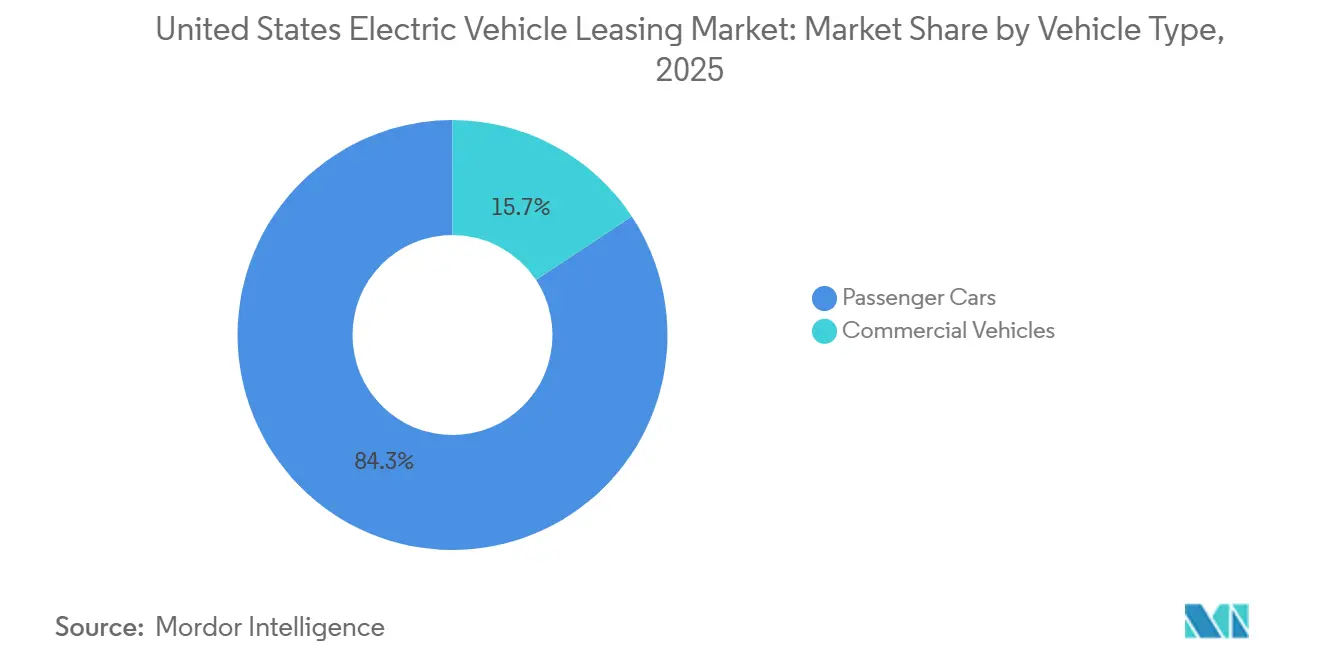
- By vehicle type, passenger cars held 84.25% of the United States electric vehicle leasing market share in 2025, while commercial vehicles are advancing at a 17.13% CAGR through 2031.
- By propulsion type, battery-electric vehicles captured 77.14% of the United States electric vehicle leasing market size in 2025, while fuel-cell electric vehicles are projected to grow at 15.91% CAGR through 2031.
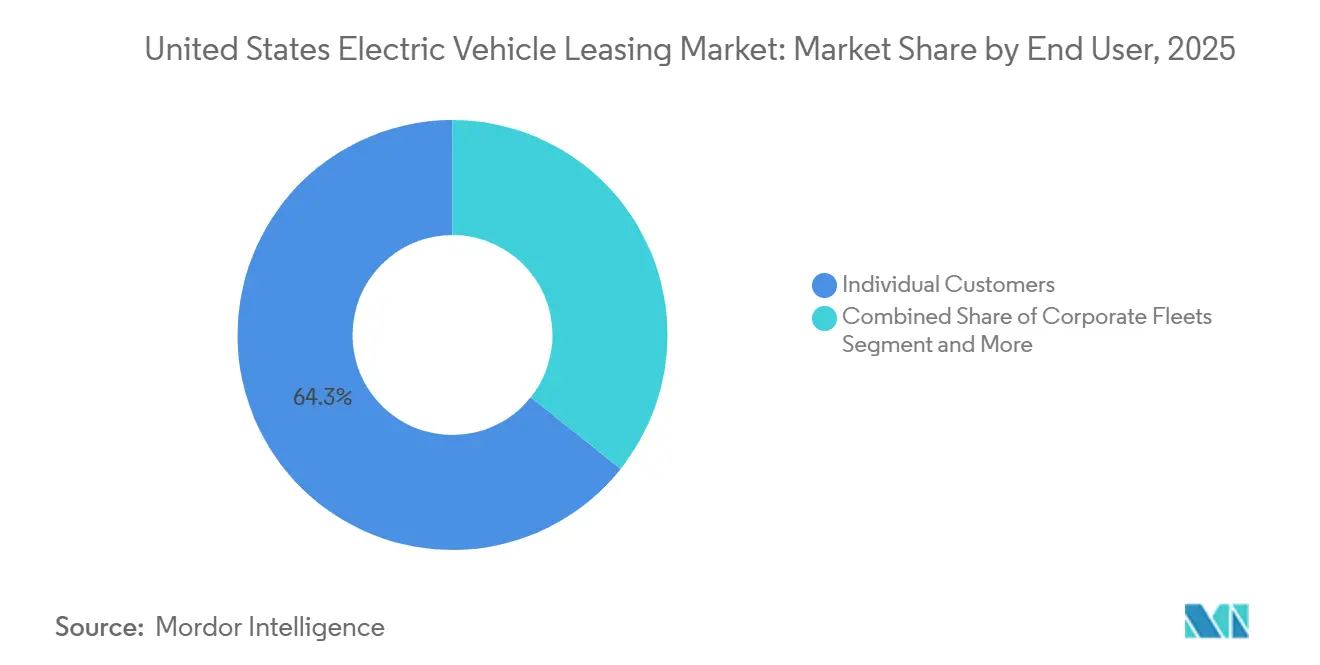
- By end user, corporate fleets held 64.28% of the United States electric vehicle leasing market share in 2025, while ride-sharing and delivery platforms are advancing at a 16.33% CAGR through 2031.
- By duration, mid-term (1-3 years) leases accounted for 57.11% share in 2025, whereas the short-term (below 12 months) segment will advance at a 16.72% CAGR.
Note: Market size and forecast figures in this report are generated using Mordor Intelligence’s proprietary estimation framework, updated with the latest available data and insights as of January 2026.
Global valuation is built by aggregating outputs from multiple countries and regions, with United states being one of the contributors. Our global electric vehicle leasing market size represents that cumulative total.
United States Electric Vehicle Leasing Market Trends and Insights
Drivers Impact Analysis*
| Driver | (~) % Impact on CAGR Forecast | Geographic Relevance | Impact Timeline |
|---|---|---|---|
| Federal Electric Vehicle Tax Credit | +3.5% | National | Short term (≤ 2 years) |
| Declining Battery Costs | +2.8% | National | Medium term (2-4 years) |
| Captive Finance Expand Offerings | +2.2% | National (Concentration in CA, TX, FL) | Medium term (2-4 years) |
| Cell-and-Pack Content Subsidy | +1.8% | National | Long term (≥ 4 years) |
| Subscription-Style “Flex” Contracts | +1.5% | Urban centers | Short term (≤ 2 years) |
| Battery Second-Life Revenue | +0.9% | National (Early CA and TX) | Long term (≥ 4 years) |
| Source: Mordor Intelligence | |||
Federal Electric Vehicle Tax Credit Applied to Leases
Section 45W lets commercial lessors claim the full USD 7,500 incentive and roll it directly into lower payments, bypassing income and MSRP caps that apply to outright purchases [1]. After consumer credits lapsed in 2025, leases surged to account for a significant portion of all electric vehicle (EV) transactions. This trend underscores the structural favoritism of the United States electric vehicle leasing market due to the existing subsidy framework. In a strategic move, captive finance arms pre-funded dealer inventories earlier in the year, securing credits for monetization throughout the final quarter. This maneuver effectively broadened the window of opportunity for customers. The payment advantage over loans not only counters rate pressures but also appeals to both retail and fleet buyers. This trend is likely to continue unless Congress amends the legislation or market interest rates drop significantly.
Declining Battery Costs Lower TCO
In 2024, pack prices fell significantly and are projected to decline further by 2026, surpassing a key parity threshold. This reduction in costs leads to higher residuals, allowing for tighter lease factors. Such dynamics bolster the United States electric vehicle leasing market, appealing even to budget-conscious fleet managers. Analyses reveal fleets incur a significantly lower total cost compared to gasoline, a difference that magnifies with increased mileage, propelling corporate mandates towards electrification. As depreciation curves flatten, lessors find themselves with enhanced pricing power, while customers benefit from quicker paybacks, especially in the face of fluctuating fuel prices.
OEM Captive Finance Arms Expand Lease Offerings
In Q3 2025, captive lenders played a significant role in originations, aggressively pushing into the EV leasing space with affordable capital from their parent companies. Tesla Financial Services, for instance, managed a substantial number of vehicle leases, generating notable annual revenue. By incorporating residual-value guarantees and utilizing Section 45W, these captive lenders are expanding the United States electric vehicle leasing market's reach, extending beyond just prime borrowers and bolstering demand amidst a general softness in the auto market.
IRA Cell-and-Pack Content Subsidy Passed Through to Lessees
Through the coming years, domestic-content thresholds are tightening. However, OEMs boasting United States battery plants remain eligible for commercial credits. Lessors favor compliant models, as they yield lower acquisition costs and higher residual prices. This advantage allows for more competitive money factor quotes. In contrast, non-compliant imports grapple with a pricing disadvantage, tilting the United States electric vehicle leasing market in favor of domestically sourced batteries.
Restraints Impact Analysis*
| Restraint | (~) % Impact on CAGR Forecast | Geographic Relevance | Impact Timeline |
|---|---|---|---|
| High Interest-Rate Environment | -1.2% | National | Short term (≤ 2 years) |
| Limited Rural Charging Infrastructure | -0.8% | Rural areas | Medium term (2-4 years) |
| Software Locks Create Risk | -0.6% | National (Tesla/GM/Ford focus) | Long term (≥ 4 years) |
| State Mileage-Tax Proposals | -0.4% | MI, OR, VT, HI, MD, ME | Medium term (2-4 years) |
| Source: Mordor Intelligence | |||
High Interest-Rate Environment Inflates Monthly Payments
In March 2026, the Fed maintained the funds rate at its current level. During the same period, new-car loan rates remained elevated. These rates, reflected in lease money factors, significantly increase monthly charges for electric vehicles (EVs) compared to lower-rate scenarios. This disparity limits the addressable demand in the United States electric vehicle leasing market, particularly among households sensitive to payment fluctuations.
Limited Rural Charging Infrastructure
In the United States, many areas have limited public charging infrastructure. For example, some states experience sparse charger availability. This inadequate coverage hampers fleet electrification beyond metropolitan areas and slows the growth of the United States electric vehicle leasing market in suburban regions, even with robust demand in urban centers.
*Our forecasts treat driver/restraint impacts as directional, not additive. The impact forecasts reflect baseline growth, mix effects, and variable interactions.
Segment Analysis
By Vehicle Type: Commercial Vans Outpace Passenger Cars
Commercial vans and light trucks expanded at 17.13% through 2031, even though passenger cars still held 84.25% share in 2025. Amazon’s deployment of 30,000 Rivian vans exemplifies how high-utilization routes rapidly justify electrification [2]. The United States electric vehicle leasing market size for commercial vehicles is forecast to compound faster than the passenger segments as fleet managers chase lower maintenance and fuel outlays. In parallel, passenger cars maintain momentum via model breadth and Section 45W pass-through benefits.
Passenger demand is gravitating towards the Tesla Model 3, Model Y, Honda Prologue, and Hyundai IONIQ 5. However, Hertz's recent writedown on Teslas highlights the volatility of residual values, especially when MSRP cuts meet software locks. Despite this setback, the commercial fleet remains undeterred. Vans, typically running to the end of their life, don't re-enter retail resale channels, bolstering confidence in lease economics.
By Propulsion Type: Fuel Cells Gain Despite BEV Dominance
Battery-electric units owned 77.14% share in 2025, supported by 192,000 public charging ports nationwide. Plug-in hybrids fill range-anxiety gaps, while fuel-cell vehicles—despite low share—are slated for 15.91% CAGR as Toyota and Hyundai expand hydrogen corridors. The United States electric vehicle leasing market share for BEVs will still dominate, yet second-mover propulsion options capture niche duty cycles, particularly in drayage and long-haul, where battery weight is punitive.
CARB’s Advanced Clean Fleets rule compels 100% zero-emission medium and heavy-duty purchases starting by model year 2036, lifting both BEV and FCEV leasing volume [3]. OEMs with domestic battery lines qualify for IRA credits, while European imports face subsidy gaps, a differential visible in lease penetration rates that favor compliant models.
By End User: Ride-Sharing Platforms Accelerate Electrification
Corporate fleets represented 64.28% of the United States electric vehicle leasing market in 2025 as they amortized charging over scale and monetized credits efficiently. Ride-sharing and delivery platforms are set to witness the fastest growth at a 16.33% CAGR through 2031. Uber grew active zero-emission drivers year-on-year to 286,000 in Q3 2025, with 136 million green trips logged. These platforms rely heavily on flexible leases to synchronize vehicle access with demand curves.
Individual lessees leverage subscription models to offset technology risk, while government fleets electrify under executive mandates. Lyft’s Express Drive program finances vehicles internally, although its balance sheet remains smaller than OEM captives. Delivery giants such as Amazon, FedEx, and UPS increasingly favor operating leases to conserve capital for network expansion.

By Duration: Short-Term Contracts Capture Flexibility Premium
Mid-term 24-36-month agreements held 57.11% share in 2025, but short-term contracts below 12 months are growing with 16.72% CAGR. Services like VW Flex and Hyundai Evolve+ bundle insurance and maintenance in 28-day increments, commanding premiums yet broadening the funnel for the United States electric vehicle leasing market.
Longer than 36-month leases remain niche because lessees hesitate to commit beyond battery-warranty horizons. Experian records EV lease terms holding at 36 months, shorter than ICE averages, reflecting rapid tech turnover. Fleets align lease-end with refresh cycles and depreciation schedules to preserve balance-sheet agility.
Geography Analysis
California, Texas, and Florida collectively contribute a notable share of the United States electric vehicle leasing market transactions thanks to charger density, aggressive OEM marketing, and supportive state incentives. California hosted a significant number of public charging ports, positioning it to achieve high lease penetration in 2025. Following closely is the Pacific Northwest, driven by renewable energy initiatives and corporate sustainability efforts, particularly in Seattle and Portland.
In the Northeast, states like New York, Massachusetts, and New Jersey are witnessing a surge in adoption. However, urban congestion poses challenges for home charging. To counteract the scarcity of garage space, subscription models are emerging, bundling public-charging credits and ensuring predictable daily costs. While the Midwest lags behind its coastal counterparts, cities like Chicago and Minneapolis are seeing a faster uptake. Here, utilities are sweetening the deal with discounted overnight rates, enhancing the total cost of ownership.
In the rural expanses of the Great Plains and Mountain West, electric vehicle adoption remains tepid. The region boasts sparse charger density, with limited availability of ports. While the National Electric Vehicle Infrastructure program is actively establishing fast-charging corridors along major highways, challenges like grid upgrades and permitting delays mean many of these stations won't be operational until 2027. As a result, the United States electric vehicle leasing market is initially focusing on electrifying fleets in urban centers, with plans to expand to exurban areas as infrastructure develops.
Coverage of the electric vehicle leasing market by Mordor Intelligence spans a wide geographic footprint, with regional analysis available for Europe, alongside detailed country-level intelligence for Japan, India, and South Korea, each shaped by local operating conditions.
Competitive Landscape
In the United States electric vehicle leasing market, banks hold a significant share, captives maintain a competitive position, and independents occupy the remainder, with no single entity dominating the market. While captive arms enjoy advantages in cost-of-capital and residual-value, Tesla Financial Services reported strong leasing revenue from its portfolio, all while emphasizing direct sales. Meanwhile, GM Financial and Ford Motor Credit strategically pre-funded dealer inventory, capitalizing on Section 45W benefits before the expiration in 2025.
Ally Financial and Santander Consumer USA, as independent lessors, cater to diverse brands but take on greater residual risks. In a move echoing Tesla’s integrated strategy, newcomers Rivian Financial Services and Lucid Financial Services debuted in 2024, aiming to manage lease economics internally. Ride-hailing giants are pivoting towards owning fleets: Uber’s initiative to roll out Lucid Gravity robotaxis by 2026 marks a shift away from third-party leasing, posing a challenge to traditional lessors.
The future of leasing lies in digital origination, telematics-driven risk assessments, and over-the-air upgrades. Captives are developing proprietary applications, allowing customers to adjust paid features mid-lease, deepening their integration into exclusive ecosystems and increasing customer retention costs. In contrast, independents are seeking collaborations with third-party telematics firms.
United States Electric Vehicle Leasing Industry Leaders
-
Tesla Financial Services
-
GM Financial
-
Ford Motor Credit Company LLC
-
Hyundai Capital Services
-
Volkswagen Financial Services
- *Disclaimer: Major Players sorted in no particular order
Recent Industry Developments
- March 2026: Rivian introduced lease discounts of up to USD 5,000 on its R1T electric pickup and R1S SUV following Ford's retreat from the F-150 EV segment. The Irvine, California-based electric vehicle manufacturer aims to capitalize on shifting dynamics in the electric pickup market segment across the United States.
- August 2026: California Governor Gavin Newsom will announce a USD 271 million statewide incentive program. Under the program, automakers will offer state residents an instant USD 3,500 rebate for purchasing or leasing their first new zero-emission vehicle. Customers purchasing or leasing used ZEVs will receive a USD 1,750 rebate.
- September 2025: Ford Credit and GM Financial rolled out dealer programs to prolong the USD 7,500 lease benefit until 31 Dec 2025.
- October 2025: Tesla raised the Model Y monthly lease to USD 529-599 after the USD 7,500 credit lapsed.
United States Electric Vehicle Leasing Market Report Scope
The scope includes segmentation by vehicle type (passenger cars and commercial vehicles), propulsion type (battery electric vehicles, plug-in hybrid electric vehicles, and fuel-cell electric vehicles), end user (individual customers, corporate fleets, government agencies, and ride-sharing and delivery platforms), and duration (short-term (less than 12 months), mid-term (1- 3 years), and long-term (more than 3 years)). Market size and growth forecasts are presented by value in USD.
| Passenger Cars |
| Commercial Vehicles |
| Battery Electric Vehicles |
| Plug-in Hybrid Electric Vehicles |
| Fuel-Cell Electric Vehicles |
| Individual Customers |
| Corporate Fleets |
| Government Agencies |
| Ride-Sharing and Delivery Platforms |
| Short-Term (Less than 12 months) |
| Mid-Term (1-3 years) |
| Long-Term (More than 3 years) |
| By Vehicle Type | Passenger Cars |
| Commercial Vehicles | |
| By Propulsion Type | Battery Electric Vehicles |
| Plug-in Hybrid Electric Vehicles | |
| Fuel-Cell Electric Vehicles | |
| By End User | Individual Customers |
| Corporate Fleets | |
| Government Agencies | |
| Ride-Sharing and Delivery Platforms | |
| By Duration | Short-Term (Less than 12 months) |
| Mid-Term (1-3 years) | |
| Long-Term (More than 3 years) |
Key Questions Answered in the Report
How large is the United States electric vehicle leasing market in 2026?
It is estimated at USD 15.21 billion in 2026, on track to reach USD 31.04 billion by 2031.
What CAGR is forecast for leases through 2031?
The market is set to expand at 15.33% CAGR between 2026-2031.
Why do corporate fleets dominate leasing?
Fleets capture federal commercial credits, spread charger costs across many vehicles, and hit lower total cost of ownership 2-3 years sooner than retail buyers.
Which propulsion type leads lease share?
Battery-electric vehicles held 77.14% of 2025 lease volume, far ahead of plug-in hybrids and fuel cells.