
Japan Electric Vehicle Leasing Market Size and Share
Market Overview
| Study Period | 2019 - 2031 |
|---|---|
| Forecast Data Period | 2026 - 2031 |
| Base Year Market Size (2025) | USD 1.11 Billion |
| Market Size (2026) | USD 1.31 Billion |
| Market Size (2031) | USD 2.97 Billion |
| Growth Rate (2026 - 2031) | 17.82 % |
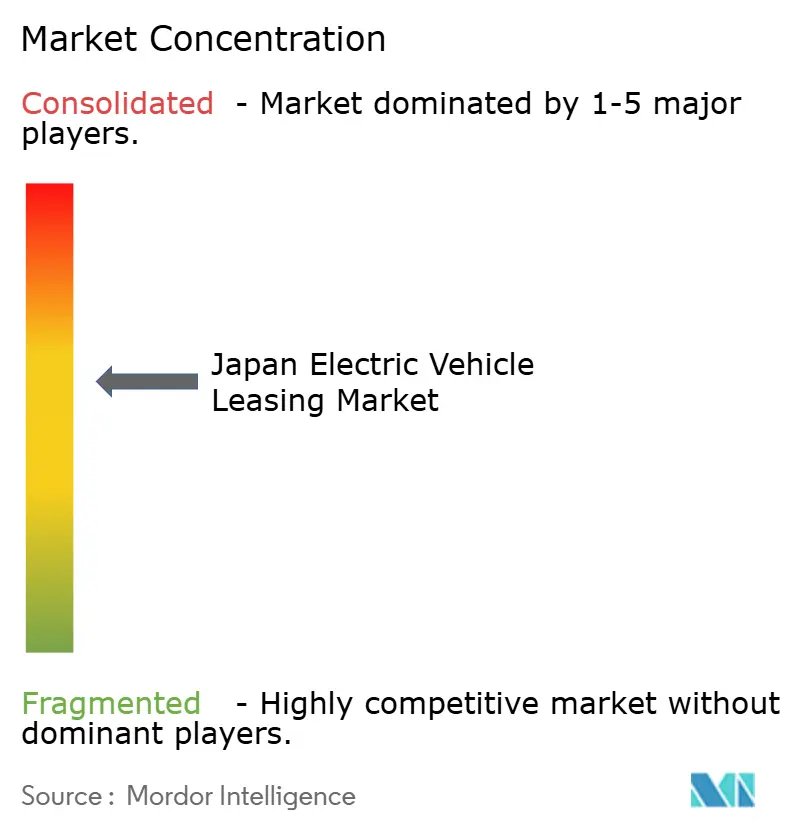
| Market Concentration | Medium |
Major Players *Disclaimer: Major Players sorted in no particular order Image © Mordor Intelligence. Reuse requires attribution under CC BY 4.0. | |
Japan Electric Vehicle Leasing Market Analysis by Mordor Intelligence
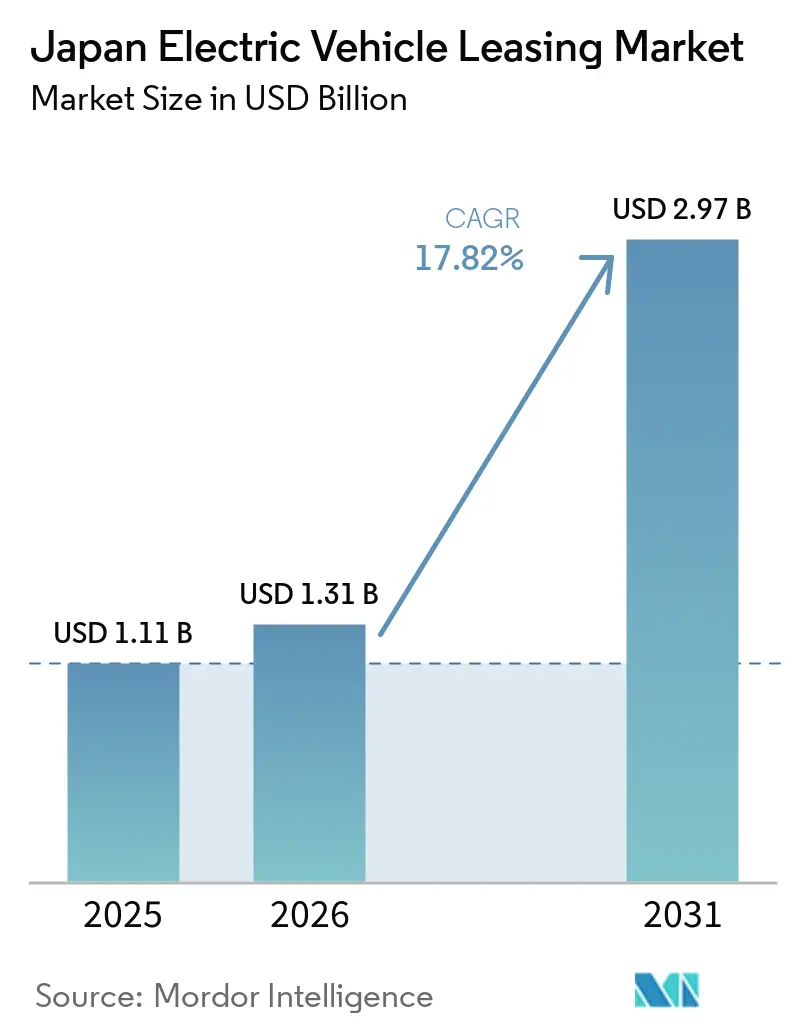
The Japanese electric vehicle leasing market size was valued at USD 1.11 billion in 2025, and is expected to grow from USD 1.31 billion in 2026 to USD 2.97 billion by 2031, growing at a CAGR of 17.82% over 2026-2031. Structural demand is gathering pace as corporate sustainability scorecards mandate zero-emission fleets, battery-health analytics reduce residual-value uncertainty, and national subsidies compress total cost-of-ownership gaps. Government agencies are anchoring early adoption, as procurement rules favor alternative powertrains, while logistics and ride-sharing platforms are now scaling orders in response to urban clean-air rules and last-mile efficiency targets. Lessors have begun marketing “energy-as-a-service” contracts that bundle vehicles, charging hardware, and end-of-life battery repurposing, a model that promises higher recurring revenue than conventional leases. International players such as Ayvens are leveraging global telematics platforms to challenge domestic incumbents on pricing transparency and fleet utilization optimization.
Key Report Takeaways
- By vehicle type, passenger cars accounted for 75.13% of the Japanese electric vehicle leasing market in 2025, while commercial vehicles are advancing at an 18.14% CAGR through 2031.
- By propulsion type, battery electric vehicles captured 67.34% share of the Japanese electric vehicle leasing market size in 2025, whereas fuel-cell electric vehicles are forecast to grow at 22.16% annually between 2026 and 2031.
- By end user, government agencies led with 32.61% of Japan's electric vehicle leasing market share in 2025, while ride-sharing and delivery platforms are projected to expand at a 19.33% CAGR through 2031.
- By duration, long-term contracts accounted for 36.44% of the Japanese electric vehicle leasing market in 2025, while short-term agreements under 1 year are rising at an 18.74% CAGR over 2026-2031.
Note: Market size and forecast figures in this report are generated using Mordor Intelligence’s proprietary estimation framework, updated with the latest available data and insights as of January 2026.
Worldwide, activity is shaped by contributions from multiple countries and regions, with Japan representing one among them. The global report on electric vehicle leasing market by Mordor Intelligence reflects how these countries and regional layers combine into a single system.
Japan Electric Vehicle Leasing Market Trends and Insights
Drivers Impact Analysis*
| Driver | (~) % Impact on CAGR Forecast | Geographic Relevance | Impact Timeline |
|---|---|---|---|
| Government Subsidies and Tax Incentives | +3.5% | National | Short term (≤ 2 years) |
| Corporate Targets Accelerating Electrification | +3.2% | Tokyo, Osaka, and Nagoya metropolitan areas | Medium term (2-4 years) |
| Expansion of Charging Infrastructure | +2.9% | Greater Tokyo, Kansai, Chubu | Medium term (2-4 years) |
| Falling EV Total Cost-of-Ownership | +2.8% | National | Medium term (2-4 years) |
| OEM Battery-Health Analytics | +2.1% | National | Long term (≥ 4 years) |
| Vehicle-to-Grid Tariff Pilots | +1.3% | Early pilots in Tokyo, Kanagawa, and Osaka | Long term (≥ 4 years) |
| Source: Mordor Intelligence | |||
Government Subsidies and Tax Incentives for EV Leases
Japan's Ministry of Economy, Trade, and Industry has allocated funds for the fiscal years 2024-2025. This funding will support charging projects and continue the Clean Energy Vehicle subsidy, which provides up to JPY 1.3 million per battery-electric vehicle. This figure can rise with green-steel bonuses [1]. Notably, this subsidy amount can increase with the addition of green-steel bonuses. In Tokyo, a grant that covers a significant portion of the costs for condominium chargers is making it easier for multi-unit dwellings to adopt these technologies. Additionally, a national weight-tax exemption, applicable after a vehicle's second inspection, enhances residual value projections. This is because secondary owners benefit from a lighter tax burden. Such time-sensitive incentives are prompting fleet managers to expedite their orders, especially before the criteria become stricter, thereby boosting the momentum of Japan's electric vehicle leasing market.
Corporate ESG Targets Accelerating Fleet Electrification
Corporations are now integrating electric vehicle adoption into their sustainability strategies, aligning with the Science Based Targets initiative and investor stewardship codes. Following NTT Group's EV100 commitment, turnkey leasing programs have been launched, serving numerous municipalities. This shift has transitioned procurement practices from being opportunistic to strictly compliance-driven. Notable deployments, such as Toyota fuel-cell vehicles showcased during the 2025 Hakone Ekiden relay, have underscored operational readiness at the national level. This visibility has spurred supply-chain partners to electrify their operations to secure contracts. Furthermore, demand has surged beyond initial orders, thanks to network effects from anchor tenants. This trend not only solidifies multi-year revenue streams for lessors but also turns ESG pressures into reliable lease pipelines.
Expansion of Public and Private Charging Infrastructure
The charging infrastructure base has expanded significantly, driven by the deployment of rapid chargers that substantially reduce charging times. Toyota plans to install additional fast chargers by 2026, while Tesla aims to expand its Supercharger network by 2027. Park24 has integrated chargers across parking sites nationwide, effectively transforming real estate into “range insurance” for subscription fleets. This broader coverage has reduced the total cost premium that previously limited the growth of the Japanese electric vehicle leasing market beyond urban centers.
Falling EV Total Cost-of-Ownership vs. ICE Vehicles
In 2026, battery pack prices dropped significantly, making the total cost of ownership for a mid-size electric sedan more affordable than that of its gasoline counterpart over a five-year lease. This calculation considered industrial electricity tariffs and government rebates for clean energy vehicles. Regenerative braking, which extends component life and eliminates the need for oil changes, contributed to substantial maintenance savings compared to internal combustion models. Lessors are capitalizing on this trend by bundling insurance, servicing, and charging credits into fixed monthly fees. This approach transfers the cost-of-ownership risk from smaller enterprises to leasing firms with strong balance sheets.
Restraints Impact Analysis*
| Restraint | (~) % Impact on CAGR Forecast | Geographic Relevance | Impact Timeline |
|---|---|---|---|
| Residual Values and Higher Depreciation | –2.4% | National | Medium term (2-4 years) |
| Limited Private-Charger Installation | –1.8% | Tokyo, Osaka, Yokohama, Nagoya | Short term (≤ 2 years) |
| Conservative Consumer Finance Culture | –1.5% | Rural prefectures | Long term (≥ 4 years) |
| Import-Driven Delivery Volatility | –1.1% | National | Short term (≤ 2 years) |
| Source: Mordor Intelligence | |||
Uncertain EV Residual Values and Higher Depreciation Risk
Battery electric vehicles (BEVs) have lower resale values than internal combustion engine vehicles due to battery health concerns and rapid model advancements. Lessors use battery-state telemetry to certify battery health and market off-lease vehicles with remaining warranty coverage. Limited actuarial data increases residual-value risk. If battery degradation exceeds projections, lessors absorb the loss, potentially raising lease payments and reducing demand in Japan’s electric vehicle leasing market. OEMs such as Toyota are exploring second-life energy storage to establish battery salvage values. However, fragmented monetization, limited secondary-market liquidity, and a lack of standardized battery-health disclosures continue to discourage longer lease terms.
Limited Private-Charger Installation in Multi-Unit Dwellings
In Tokyo, condominium owner associations must approve electrical upgrades. Although a 2024 rule change allows charger installations by simple majority vote, retrofits still require bylaw amendments, contractors, and cost allocation. Grants help, but older buildings often require costly panel, substation, or line upgrades, which extend break-even periods. Panasonic’s Resi-Charge simplifies procurement and maintenance, but adoption remains limited as boards prioritize elevators and façade repairs. Sumitomo Realty and Nomura Real Estate will include chargers in new projects from 2026, but aging housing stock will constrain on-site infrastructure and lease penetration until retrofit economics improve.
*Our forecasts treat driver/restraint impacts as directional, not additive. The impact forecasts reflect baseline growth, mix effects, and variable interactions.
Segment Analysis
By Vehicle Type: Commercial Logistics Drives Electrification Urgency
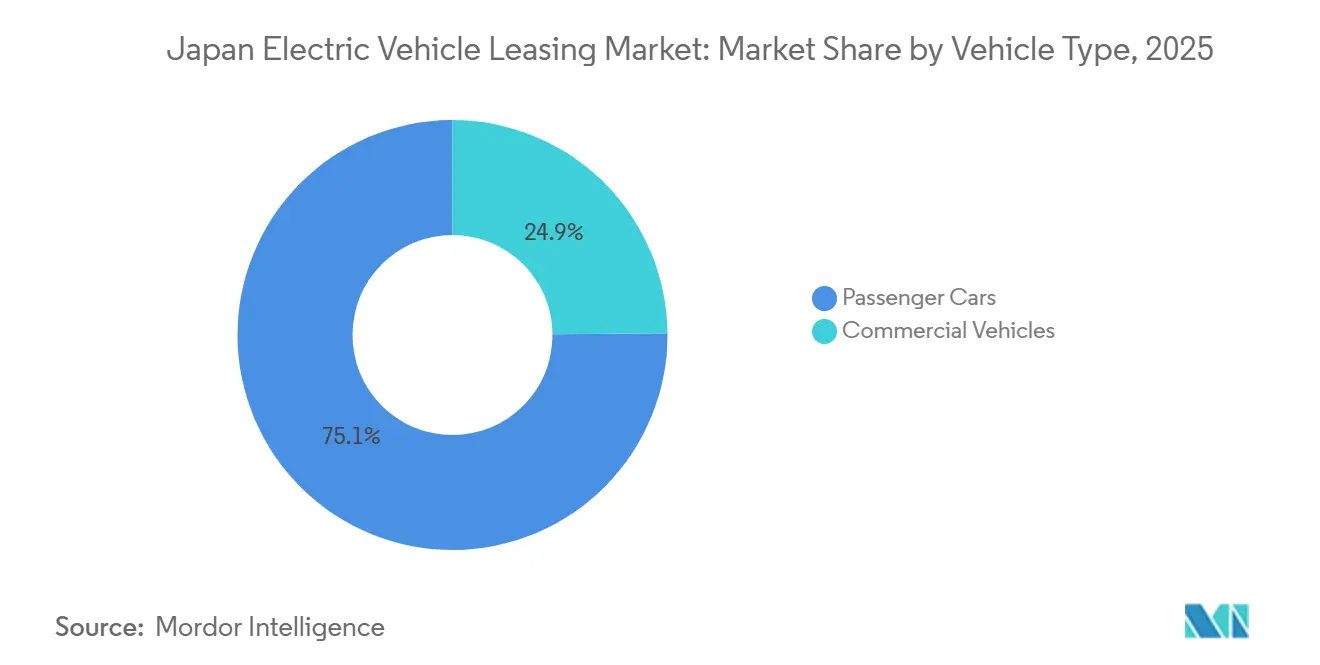
Passenger cars hold 75.13% of Japan's electric vehicle leasing market share in 2025, whereas the commercial vehicles are projected to grow at an 18.14% CAGR through 2031. Leveraging kei-class tax benefits, Suzuki and Toyota priced their mini-commercial van competitively, undercutting imported competitors. With a range suitable for most intra-city routes, the model meets the demands of micro-logistics hubs. Meanwhile, fuel-cell light-duty trucks, set to debut in fiscal 2027, promise to extend zero-emission capabilities to regional routes. This is significant, as battery weight and charging delays have previously hindered productivity in that range.
Passenger cars play a pivotal role in enhancing visibility for early adopters. Times Car, with a substantial membership base, utilizes data from electric units to refine residual algorithms and plan option packages. However, as technology evolves rapidly, corporate buyers are opting for shorter leases to minimize their risk of model-year obsolescence. This trend is driving a notable shift in Japan's electric vehicle leasing market, with an increasing focus on commercial asset classes.
By Propulsion Type: Hydrogen Infrastructure Unlocks FCEV Fleet Potential
Battery electric vehicles captured 67.34% share of the Japanese electric vehicle leasing market size in 2025. Fuel-cell electric vehicles are projected to expand at 22.16% annually over 2026-2031, the quickest pace among powertrains, supported by Toyota’s third-generation stack and Iwatani’s 52-station hydrogen network [2]. With green hydrogen supplies scaling up at the Fukushima Hydrogen Energy Research Field and cross-border OEM alliances forming, hydrogen prices are projected to decline significantly by 2030. Achieving this price parity could position fuel-cell vehicles as more cost-effective than their battery counterparts, especially for fleets covering substantial daily distances, thereby spurring growth in Japan's electric vehicle leasing market, particularly in long-haul logistics.
By End User: Policy Leads, Platforms Scale
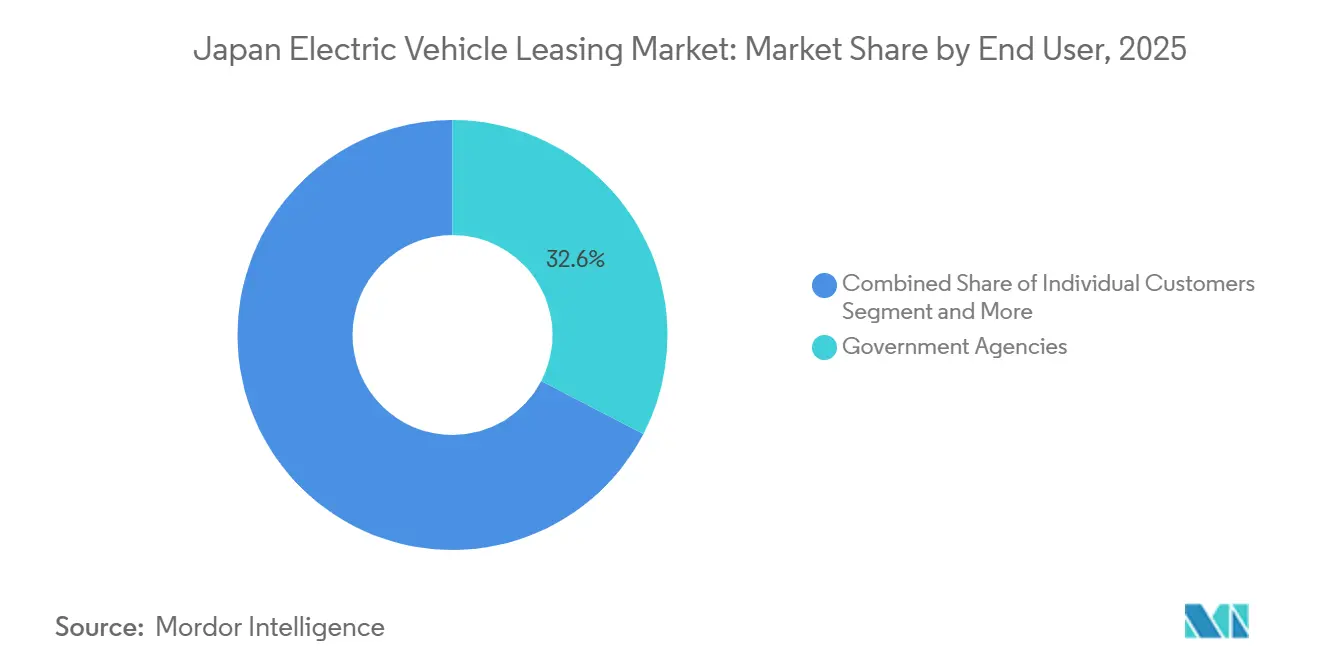
Government agencies accounted for 32.61% of Japan's electric vehicle leasing market share in 2025. Meanwhile, ride-sharing and delivery operators are projected to expand at a 19.33% CAGR through 2031, the fastest growth rate among end-user segments in the Japanese electric vehicle leasing market. Yamato Transport has ordered a substantial number of electric vans for fiscal years 2025–2026 and has also piloted battery-swapping vehicles that complete battery exchanges in five minutes, effectively eliminating charging downtime. Honda’s purpose-built MEV-VAN offers higher drop density than comparable gasoline vehicles, improving route economics and supporting premium lease rates. Although corporate fleets lag in infrastructure retrofits, they face increasing pressure to meet ESG standards. Individual consumers, meanwhile, remain price-sensitive. These factors indicate that platform operators will likely continue driving growth in Japan's electric vehicle leasing market.
Subcontractors must transition to electric vehicles to retain delivery contracts. As major players expand, regional courier cooperatives pool orders to negotiate fleet-wide lease packages, offering lessors larger opportunities despite thin per-unit margins. As battery-swapping standards advance, delivery fleets may bypass plug-in charging, reshaping infrastructure investment and strengthening the segment's dominance.

By Duration: Subscription Models Compress Commitment Horizons
Long-term contracts of more than 3 years still accounted for 36.44% of Japan's electric vehicle leasing market share in 2025 because public agencies and blue-chip fleets favor predictable budgeting. Mid-term leases of one to three years grow modestly, serving as a bridge for firms evaluating residual-value trends before locking in deeper commitments. Short-term agreements under 1 year are rising at an 18.74% CAGR, fueled by urban professionals who prize flexibility and corporate pilots that trial low-emission compliance without multi-year lock-ins. Even before adding commercial vehicles, KINTO attracted significant interest by allowing subscribers to swap models mid-term and bundling services, insurance, and taxes into a single fee.
Lessors counter early-termination risk with telematics-enabled usage caps that price mileage overages in real time, preserving residual targets while giving lessees flexibility. Aligning contract length with eight-year battery warranties ensures that off-lease units still carry factory coverage, supporting higher auction prices and safeguarding the economics of the Japanese electric vehicle leasing market.
Geography Analysis
Japan's electric vehicle leasing market concentration centers on Greater Tokyo, Kansai, and Chubu, where charger density, corporate headquarters, and public policy combine to create scale. Tokyo's initiative to subsidize condominium charger installation costs significantly removes an urban hurdle and aligns with the metro government's ambition of introducing fuel-cell taxis by fiscal 2030. This alignment is set to channel a consistent demand into leasing avenues. Furthermore, the establishment of rapid-charger corridors on the Tōmei, Chūō, and Meishin expressways facilitates same-day travel between these regions. This development positions electric vans as viable contenders for inter-city freight, prompting multi-regional fleets to transition towards electrification.
Secondary growth pockets emerge in Fukuoka and Hiroshima, where port authorities pursue green-shipping corridors and logistics tenants electrify drayage fleets. Renewable-hydrogen supply from the Fukushima Hydrogen Energy Research Field supports fuel-cell pilots in Tōhoku, a region otherwise disadvantaged by long average trip lengths and winter range penalties [3]. Leasing companies deploy mobile fast-charger trailers at rural depots to bridge network gaps, using telemetry to relocate assets dynamically as route density shifts.
Rural prefectures like Shimane and Tottori lag in the adoption of alternative fuels. This slow uptake is largely due to a limited number of public chargers and ingrained cultural norms around vehicle ownership. However, agricultural co-ops, which utilize light trucks on set routes, see potential in this shift. With domestic battery plants set to launch in the coming years and resale markets expanding, a shift towards cost parity could sway these hesitant adopters, potentially boosting the Japanese electric vehicle leasing market in its later stages.
Mordor Intelligence provides coverage of the electric vehicle leasing market across other key regional markets, including Europe, each with their regulatory frameworks and demand patterns. Detailed country-level analysis extends to India, South Korea, and United States incorporating local coverage and market participation, as required.
Competitive Landscape
In March 2024, ORIX Auto Corporation managed a significant fleet of vehicles, with a notable portion utilizing next-generation powertrains. The company also markets a comprehensive EV Conversion Pack that includes charger installation and carbon-reporting dashboards. Tokyo Century, overseeing a substantial number of units, aims to increase its electric vehicle fleet by fiscal 2030. They are leveraging partnerships with Yanekara for vehicle-to-building power flows and MIRAI-LABO for second-life battery sales, which help subsidize lease pricing. Sumitomo Mitsui Auto Service, which manages a large fleet, highlights fleet cost savings through route-optimization software and stationary storage revenue sharing, positioning its EV One-Stop Service as a model for others to emulate.
Despite notable growth, subscription-based micro-leases still account for a small portion of overall contracts, indicating a significant white-space opportunity. Park24’s Times Car service demonstrates that hourly rentals can turn vehicles multiple times daily, enhancing revenue per asset even after accounting for charger downtime. Leasing houses exploring similar strategies could boost utilization rates and attract younger demographics in Japan, who are increasingly moving away from traditional vehicle ownership. Additionally, pilot digital fleet-sharing exchanges are enabling lessors to sublet idle vehicles, creating secondary income streams and strengthening their position against conventional bank-loan financing.
Japan Electric Vehicle Leasing Industry Leaders
-
ORIX Corporation
-
Sumitomo Mitsui Auto Service Co., Ltd.
-
Nippon Car Solutions Co., Ltd.
-
Tokyo Century Corp. (Nippon Rent-A-Car)
-
Toyota Financial Services Corporation (KINTO)
- *Disclaimer: Major Players sorted in no particular order
Recent Industry Developments
- December 2025: Fukuoka Prefecture and Shinidemitsu launched “Sustaina EV,” Japan’s first municipality-backed used-EV leasing program that includes battery diagnostics and end-of-lease recycling.
- June 2024: Honda and Mitsubishi formed a 50-50 joint venture ALTNA to lease Honda N-VAN e: models while retaining battery ownership for life-cycle monitoring.
Japan Electric Vehicle Leasing Market Report Scope
The scope includes segmentation by Vehicle Type (Passenger Cars and Commercial Vehicles), Propulsion Type (Battery Electric Vehicles, Plug-In Hybrid Electric Vehicles, and More), End User (Individual Customers, Corporate Fleets, and More), and Duration (Short-Term (Less Than 1 Year), Mid-Term (1-3 Years), and More). The Market Forecasts are Provided in Terms of Value (USD).
| Passenger Cars |
| Commercial Vehicles |
| Battery Electric Vehicles |
| Plug-in Hybrid Electric Vehicles |
| Fuel-Cell Electric Vehicles |
| Individual Customers |
| Corporate Fleets |
| Government Agencies |
| Ride-Sharing and Delivery Platforms |
| Short-Term (Less than 1 year) |
| Mid-Term (1-3 years) |
| Long-Term (More than 3 years) |
| By Vehicle Type | Passenger Cars |
| Commercial Vehicles | |
| By Propulsion Type | Battery Electric Vehicles |
| Plug-in Hybrid Electric Vehicles | |
| Fuel-Cell Electric Vehicles | |
| By End User | Individual Customers |
| Corporate Fleets | |
| Government Agencies | |
| Ride-Sharing and Delivery Platforms | |
| By Duration | Short-Term (Less than 1 year) |
| Mid-Term (1-3 years) | |
| Long-Term (More than 3 years) |
Key Questions Answered in the Report
How large is Japan’s electric vehicle leasing opportunity over the next five years?
The Japanese electric vehicle leasing market size was valued at USD 1.11 billion in 2025, and is expected to grow from USD 1.31 billion in 2026 to USD 2.97 billion by 2031, growing at a CAGR of 17.82% over 2026-2031.
Which customer group is growing the fastest in new lease sign-ups?
Ride-sharing and delivery platforms are registering the quickest uptake, with lease volumes forecast to rise at a 19.33% annual pace through 2031.
What share of current lease contracts already involve battery electric vehicles?
Battery electric vehicles commanded 67.34% of total leased units in 2025, reflecting the maturity of Japan’s charging network and favorable total cost-of-ownership economics.
How are short-term subscription models performing compared with traditional multi-year leases?
Contracts under 1 year are advancing 18.74% annually, outpacing long-term agreements that held 36.44% share in 2025, as services like KINTO gain popularity with urban professionals.