
United States Customer Data Platform Market Size and Share
Market Overview
| Study Period | 2020 - 2031 |
|---|---|
| Forecast Data Period | 2026 - 2031 |
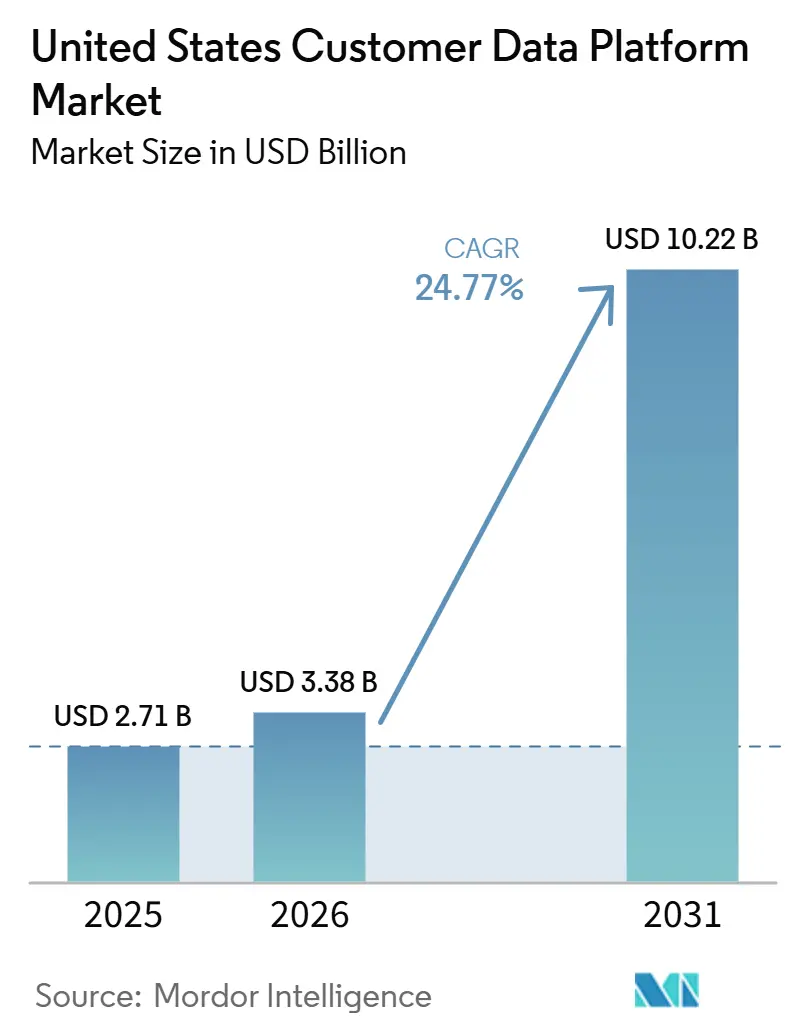
| Base Year Market Size (2025) | USD 2.71 Billion |
| Market Size (2026) | USD 3.38 Billion |
| Market Size (2031) | USD 10.22 Billion |
| Growth Rate (2026 - 2031) | 24.77 % |
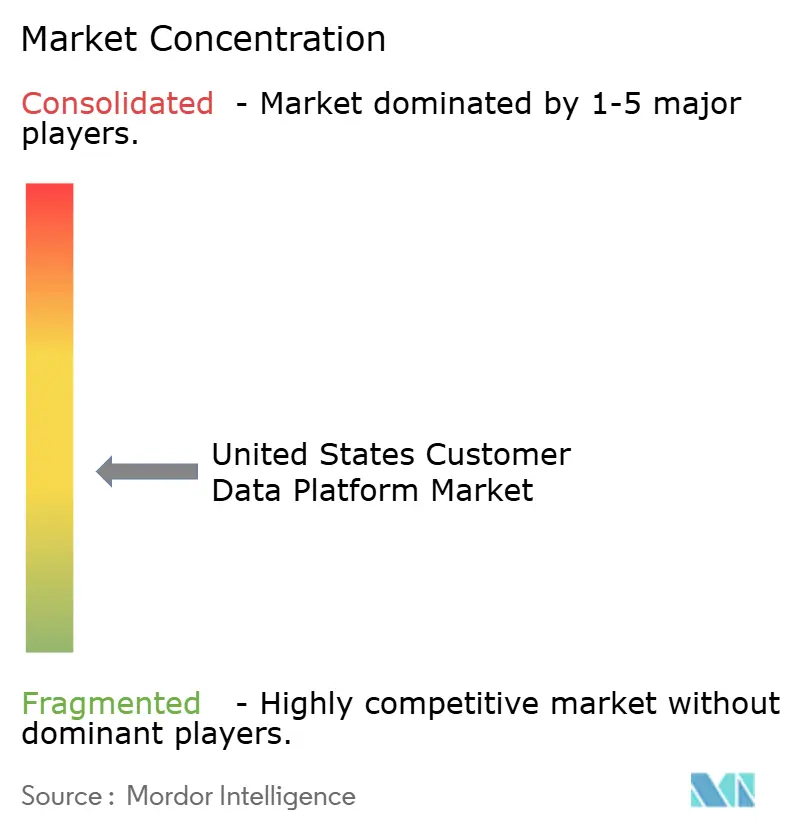
| Market Concentration | Medium |
Major Players *Disclaimer: Major Players sorted in no particular order Image © Mordor Intelligence. Reuse requires attribution under CC BY 4.0. | |
United States Customer Data Platform Market Analysis by Mordor Intelligence
The United States customer data platform market size was valued at USD 2.71 billion in 2025 and estimated to grow from USD 3.38 billion in 2026 to reach USD 10.22 billion by 2031, at a CAGR of 24.77% during the forecast period (2026-2031). The United States customer data platform market is expanding as enterprises invest in consent-governed, AI-ready systems that support both activation and control. The country remains the most mature customer data platform (CDP) environment due to its large digital advertising base, high enterprise software adoption, and expanding state privacy requirements that shape buying decisions. The decline of third-party cookies has also pushed CDPs beyond campaign support and into the center of the enterprise customer data stack. Competition is intensifying as large suite vendors bundle CDP functions into broader software portfolios, while composable specialists compete on speed, architecture, and pricing flexibility. The strongest opportunities are tied to service-heavy deployments, warehouse-native models, and regulated sectors where unified profiles, governance, and real-time action must work together.
Key Report Takeaways
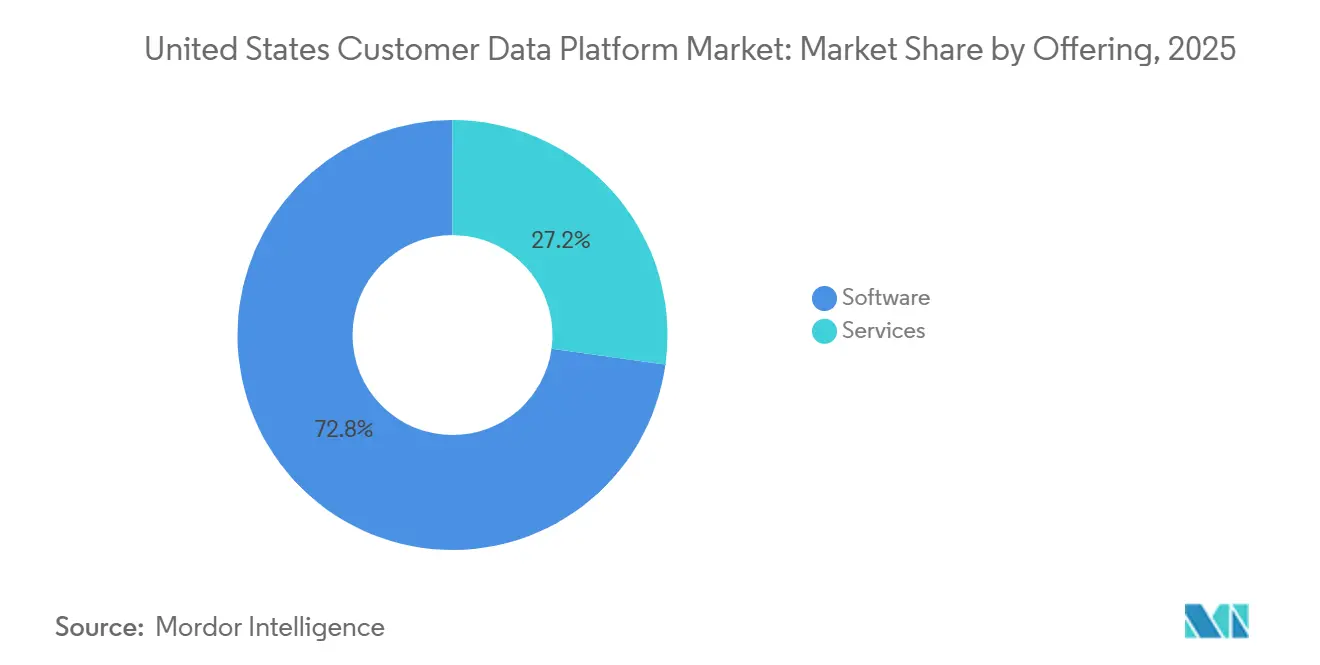
- By offering, software held 72.81% revenue share in the United States customer data platform market in 2025, while services are projected to expand at a 25.71% CAGR through 2031.
- By deployment mode, cloud accounted for a 69.15% share in 2025 and is projected to grow at a 25.83% CAGR through 2031, the fastest pace among deployment models.
- By organization size, large enterprises held 71.42% share in 2025, while SMEs are expected to expand at a 26.33% CAGR through 2031.
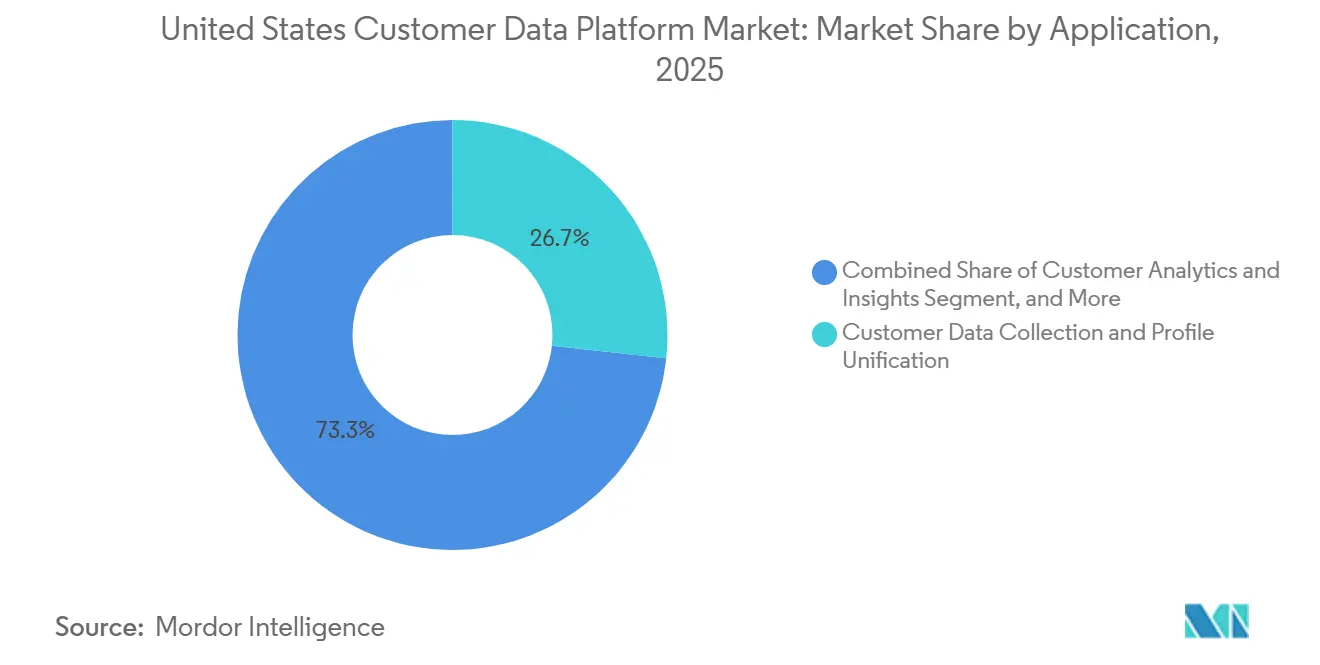
- By application, customer data collection and profile unification accounted for 26.73% share in 2025, while customer analytics and insights are projected to grow at a 27.24% CAGR through 2031.
- By end-user industry, retail and e-commerce held 24.63% share of the United States customer data platform market in 2025, while healthcare and life sciences are projected to expand at a 26.81% CAGR through 2031.
Note: Market size and forecast figures in this report are generated using Mordor Intelligence’s proprietary estimation framework, updated with the latest available data and insights as of January 2026.
United States Customer Data Platform Market Trends and Insights
Drivers Impact Analysis*
| DRIVER | (~) % IMPACT ON CAGR FORECAST | GEOGRAPHIC RELEVANCE | IMPACT TIMELINE |
|---|---|---|---|
| Rising Demand for Unified First-Party Data Strategies | +4.8% | Nationwide, with highest compliance intensity in California and all multi-state operators | Medium term (2-4 years) |
| AI-Driven Customer Graphs for Next-Best-Action Orchestration | +4.1% | Nationwide, with early adoption concentrated in West Coast and Northeast enterprise technology hubs | Medium term (2-4 years) |
| Growth of Warehouse-Native and Composable CDP Architectures | +3.6% | Nationwide, with strongest traction in mid-market technology and digital commerce enterprises | Long term (≥ 4 years) |
| Acceleration of Cookieless Media Measurement and Identity Stitching | +3.2% | Nationwide, with highest intensity in major digital advertising markets, including California and New York | Short term (≤ 2 years) |
| Real-Time Personalization Requirements Across Digital Commerce | +2.9% | Nationwide | Medium term (2-4 years) |
| Privacy-by-Design Feature Monetization Across Regulated Verticals | +2.4% | California, Texas, Connecticut, and states with active privacy enforcement | Long term (≥ 4 years) |
| Source: Mordor Intelligence | |||
Rising Demand for Unified First-Party Data Strategies
The deprecation of third-party cookies has pushed the United States customer data platform market toward first-party identity, consent, and profile control. Enterprises that once depended on external audience data are now reorganizing collection, tagging, and governance at the source so the customer data platform (CDP) can act as the system of record. This change has made CDP adoption more durable because the platform now supports infrastructure decisions rather than short campaign cycles. California’s 2026 rulemaking package reinforced that shift by tying cybersecurity audits and automated decision-making risk assessments more closely to enterprise data practices.[1]California Privacy Protection Agency, “CPPA Board Meeting - Final CCPA Rulemaking Package (Cybersecurity Audits, Risk Assessments, Automated Decision-Making Technology),” California Privacy Protection Agency, cppa.ca.gov The broader state privacy landscape also keeps first-party governance high on procurement agendas across multi-state operators.
AI-Driven Customer Graphs for Next-Best-Action Orchestration
AI is changing the United States customer data platform market from profile storage to active decision support. Unified customer graphs are now expected to feed recommendations, suppression rules, and next-best-action workflows in near real time. This raises the value of a CDP because the platform supports commercial action, not only reporting and audience management. Databricks reinforced this direction in June 2026 when it launched CustomerLake with Customer 360, agentic identity resolution, campaign agents, and zero-copy data access inside the Lakehouse.[2]Databricks, “Introducing CustomerLake: The Agentic CDP Embedded in Databricks,” Databricks, databricks.com Salesforce also moved in the same direction through its Summer 2026 release, which combined multi-agent orchestration, real-time offer management, and unified customer data capabilities in Marketing Cloud Next.
Growth of Warehouse-Native and Composable CDP Architectures
Warehouse-native design is reshaping the United States customer data platform market because many enterprises want customer data to remain inside governed cloud environments. This model appeals to buyers who already manage large volumes of customer information in Snowflake, BigQuery, or Databricks and want to avoid unnecessary replication. It also changes pricing expectations because usage-based models are often easier to justify than large per-profile licenses. The result is a market where specialists can compete by fitting into existing data stacks rather than replacing them. Databricks’ CustomerLake launch reflected this shift by presenting the CDP as a zero-copy layer embedded within the broader data and AI environment.
Acceleration of Cookieless Media Measurement and Identity Stitching
Cookieless measurement is becoming a direct growth factor for the United States customer data platform market because brands still need cross-channel identity and attribution after browser-based tracking weakens. Deterministic identity methods based on consented first-party signals are gaining importance because they support both targeting and governance. This is especially relevant in large advertising states where enterprises need stronger match rates across commerce, media, and service interactions. California’s active privacy rulemaking has raised the importance of transparent automated decision-making and defensible data handling, which strengthens demand for CDPs with visible consent and identity controls. As a result, identity quality and preference fidelity are becoming more important than raw data volume in platform evaluations.
Restraints Impact Analysis*
| RESTRAINT | (~) % IMPACT ON CAGR FORECAST | GEOGRAPHIC RELEVANCE | IMPACT TIMELINE |
|---|---|---|---|
| High Integration Complexity Across MarTech, AdTech, and Data Stacks | -3.8% | Nationwide | Short term (≤ 2 years) |
| Skill Shortages in Reverse-ETL, Identity Resolution, And Data Governance | -2.9% | Nationwide, most acute in mid-market and non-technology-sector enterprises | Medium term (2-4 years) |
| Long Enterprise Buy Cycles and Poorly Defined Attribution ROI | -2.3% | Nationwide | Short term (≤ 2 years) |
| Customer Data Fragmentation Across Legacy and Siloed Systems | -1.8% | Nationwide | Medium term (2-4 years) |
| Source: Mordor Intelligence | |||
High Integration Complexity Across Martech, Adtech, and Data Stacks
Integration remains one of the clearest barriers in the United States customer data platform market because customer records sit across CRM, commerce, service, media, and warehouse systems with different schemas and refresh cycles. Even when a vendor offers extensive connectors, enterprises still need to reconcile identity rules, event definitions, and governance models across teams. This issue is more severe in regulated sectors where access controls and data boundaries limit how systems can exchange information. Adobe’s March 2026 release notes showed that vendors are still investing in bridge features such as enhanced Change Data Capture for on-premises CRM sources, which highlights how persistent the integration problem remains. The practical effect is that many organizations approve CDP budgets before they are fully ready to connect the surrounding stack at production speed.
Skill Shortages in Reverse-ETL, Identity Resolution, and Data Governance
The United States customer data platform market also faces a talent constraint because production-grade CDP programs require data engineering, governance, and operational marketing skills at the same time. Mid-sized companies are affected most because they often want advanced orchestration without large internal engineering teams. This gap slows deployment, limits use-case expansion, and raises dependence on services even when software capability is strong. Vendors are responding by simplifying workflows and reducing technical effort through natural-language tools, guided configuration, and embedded AI assistance. Even so, many enterprises still struggle to turn platform features into stable operating processes at the pace their commercial teams expect.
*Our forecasts treat driver/restraint impacts as directional, not additive. The impact forecasts reflect baseline growth, mix effects, and variable interactions.
Segment Analysis
By Offering: Software Anchors Revenue While Services Rise With AI Complexity
Software captured 72.81% of the United States customer data platform market size in 2025, which shows how strongly revenue still centers on platform licensing and core product subscriptions. Much of this weight reflects enterprise buying patterns, because large customers often commit to multi-year agreements that keep the software line dominant in reported revenue. The United States customer data platform market continues to favor vendors that can position the CDP as part of a wider enterprise system rather than a standalone tool. Adobe, Salesforce, and Oracle benefit from that pattern because buyers often want customer data, activation, and analytics to sit within an already approved software estate. This also increases switching costs once customer identity, consent logic, and campaign orchestration are embedded in daily workflows.
Services are projected to grow at a 25.71% CAGR through 2031, which makes them the faster part of this segment, even though software remains larger. The need for integration work, connector support, governance setup, and model tuning keeps service demand high throughout the life of a deployment. That is becoming more pronounced as CDPs support AI use cases that need continuous testing and rule refinement rather than one-time implementation. Salesforce’s broader push around Data Cloud and Agentforce shows how product direction is expanding the amount of operational work that surrounds the platform after the initial sale.[3]Salesforce, “Salesforce Summer 2026 Product Release Announcement,” Salesforce, salesforce.com For buyers in the United States customer data platform industry, this means total ownership costs increasingly depend on ongoing expertise, not only on license value.


By Deployment Mode: Cloud Extends its Lead as Real-Time Processing Becomes Essential
Cloud held 69.15% of the United States customer data platform market share in 2025, and it is projected to grow at a 25.83% CAGR through 2031. Cloud remains the preferred model because it fits real-time event streaming, API-heavy software environments, and the large-scale compute needed for identity and decisioning workloads. Most enterprises also want CDPs to connect directly with SaaS applications and cloud warehouses that already run marketing, commerce, and customer support processes. Those requirements make cloud deployment the most natural fit for organizations that want speed, flexibility, and lower infrastructure management overhead. The United States customer data platform market is therefore seeing cloud strengthen its lead as AI and personalization use cases become more continuous.
On-premises systems still matter in government, defense, and some financial services settings where data control requirements remain strict. Even so, the addressable base for pure on-premises deployment is narrowing because hybrid approaches can preserve controls without losing activation speed. Adobe’s March 2026 release improved Change Data Capture support for on-premises CRM sources, which shows that leading vendors are solving for enterprises that need to bridge older data estates with cloud execution.[4]Adobe Experience Platform, “Release Notes, March 2026,” Adobe Experience Platform, experienceleague.adobe.com That bridge is important because many large U.S. companies still carry significant legacy infrastructure despite broader cloud adoption. Over time, hybrid models are likely to remain relevant mainly where compliance needs shape architecture more strongly than marketing speed.
By Organization Size: Large Enterprises Lead Revenue While SMEs Expand Faster
Large enterprises held 71.42% share in 2025, which reflects the scale of integration work, contract size, and change management involved in enterprise CDP programs. They also have the biggest need to connect CRM, marketing automation, commerce, analytics, and service records into a common customer view. That favors organizations with deeper budgets, mature procurement processes, and internal teams that can manage long deployments. In the United States customer data platform market, large companies also gain more value from broad audience activation because they operate across many brands, channels, and business units. Their size makes CDP economics easier to justify when the platform supports retention, cross-sell, compliance, and media efficiency at once.
SMEs are projected to grow at a 26.33% CAGR through 2031, which makes them the fastest-growing organizational segment. This shift is tied to warehouse-native and consumption-based models that reduce upfront commitment and let smaller firms scale use cases over time. The United States customer data platform market is opening more clearly to SMEs that already run on cloud data infrastructure and want activation without a full enterprise software stack. Databricks’ CustomerLake launch also supports this structural direction by framing CDP capabilities as part of a governed zero-copy environment, which can lower architecture complexity for users already inside the platform. The result is a wider buyer base, although smaller firms still face execution risk when internal data skills remain limited.
By Application: Profile Unification Leads While Customer Analytics and Insights Advances Fastest
Customer Data Collection and Profile Unification accounted for 26.73% of the United States customer data platform market size in 2025, which reflects its role as the starting point for nearly every deployment. Enterprises typically begin with identity resolution, event capture, and profile consolidation because downstream use cases depend on those layers working properly. That makes this application less discretionary than campaign optimization or advanced predictive features. In the United States customer data platform market, a stable unified profile remains the core requirement for segmentation, orchestration, attribution, and consent handling. Buyers, therefore, continue to treat profile quality as the foundation of platform value.
Customer Analytics and Insights is projected to expand at a 27.24% CAGR through 2031, which makes it the fastest-growing application area. The reason is that analytics output is moving closer to action as scores, recommendations, and propensity models feed directly into automated workflows. Salesforce’s Summer 2026 release and Databricks’ CustomerLake both reflect this shift by linking unified data more tightly to AI-enabled orchestration and decision support. Consent and preference management is also gaining strategic weight as enterprises try to coordinate opt-out and data rights expectations across multiple state regimes. For the United States customer data platform industry, this means analytics growth is no longer separate from governance, because useful insight must now be usable and defensible at the same time.

By End-User Industry: Retail And E-Commerce Holds the Largest Share While Healthcare and Life Sciences Grows Fastest
Retail and e-commerce held 24.63% of the United States customer data platform market share in 2025, which made it the leading end-user segment. Retailers need unified customer data to support omnichannel personalization, loyalty programs, audience suppression, and more accurate media activation. The growth of retail media networks has added another layer of complexity because brands increasingly need CDPs that can match first-party records against retailer audiences within controlled environments. This makes the sector an early adopter of real-time identity, segmentation, and consent-aware activation. The United States customer data platform market, therefore, remains closely tied to commerce use cases where customer behavior changes quickly, and media value depends on better first-party signal quality.
Healthcare and life sciences is projected to grow at a 26.81% CAGR through 2031, which is the fastest rate among end-user sectors. Telehealth growth and broader digital engagement have increased the volume of patient interaction data that needs to be unified across channels and systems. That creates demand for architectures that can combine behavioral and operational signals while respecting healthcare-specific control requirements. BFSI remains another important user group because institutions want stronger cross-sell targeting, customer segmentation, and unified records for regulated interactions. IT and telecom, media and entertainment, industrial manufacturing, and government each add demand through churn reduction, subscription personalization, customer engagement modernization, and digitized service delivery.
Geography Analysis
The West remains the most developed regional base within the United States customer data platform market because California combines vendor concentration, advanced enterprise demand, and the country’s most influential privacy framework. Many leading suppliers, large software buyers, and data engineering teams are located in this region, which helps shorten deployment cycles and speeds early adoption of new platform features. California’s active 2026 privacy rulemaking has kept cybersecurity audits, automated decision-making risk assessments, and related governance issues close to customer data architecture decisions. That has practical effects on procurement because enterprises operating across states often design to California’s standard even when they sell nationally. The region also benefits from strong cloud infrastructure, deep implementation talent, and a high concentration of digital commerce and advertising spend.
The Northeast is another major demand center for the United States customer data platform market because it brings together financial services, media, insurance, and large consumer brands. New York stands out as the region’s anchor because many large buyers there need unified customer views for cross-sell, audience management, and better governance across multiple channels. Enterprises in this region also tend to evaluate CDPs with strong attention to data lineage, operational control, and measurable commercial value. The regional buyer base is attractive for both suite vendors and specialist platforms because workloads often span marketing, service, and analytics at the same time. This keeps the Northeast central to higher-value deployments where governance and revenue use cases must move together.
The South and Midwest are growing parts of the United States customer data platform market with distinct demand patterns. Texas adds momentum because the Texas Data Privacy and Security Act has been in effect since July 2024, which raises the importance of consent handling and consumer rights support for businesses serving state residents. The Southeast also benefits from expanding technology, retail, and financial services activity that supports new buyer adoption. In the Midwest, Chicago and other major business centers support demand from retail, banking, and industrial firms that want stronger customer visibility across distributed operations. Illinois adds a specific control layer through the Biometric Information Privacy Act, which matters as enterprises use more voice, facial, and behavioral data in customer engagement systems.[5]Illinois General Assembly, “Biometric Information Privacy Act (740 ILCS 14),” Illinois General Assembly, ilga.gov
Competitive Landscape
The United States customer data platform market shows a mixed structure where large enterprise software vendors are strong at the top end, while the specialist field remains broad and fragmented. Adobe, Salesforce, Microsoft, Oracle, and SAP benefit from platform bundling, long customer relationships, and the ability to place CDP functions inside wider software contracts. Specialists respond by emphasizing real-time activation, architectural flexibility, and tighter alignment with cloud warehouses. This keeps competition active even when large vendors control the highest-value enterprise accounts. The United States customer data platform market is therefore not defined by one dominant model, but by a contest between suite depth and composable speed.
Strategic moves in 2026 showed how quickly positioning is changing. Salesforce used its Summer 2026 release to connect multi-agent orchestration, real-time offer management, and unified customer data more closely inside Marketing Cloud Next. Adobe expanded its partner ecosystem and introduced CX Enterprise and the CX Enterprise Coworker, which tied its Real-Time CDP more directly to agent-enabled customer experience workflows. Databricks entered more directly with CustomerLake, positioning the CDP as a governed zero-copy capability inside its Lakehouse rather than a separate application layer. These moves show that vendors are competing not only on profile unification, but also on how quickly unified data can drive live decisions.
Partnerships and acquisitions are also reshaping the field. BlueConic acquired Blueshift in June 2026, which linked real-time behavioral data capture with AI-powered cross-channel execution inside one combined platform. Zeta Global and Palantir announced a strategic partnership in June 2026 that reworked Zeta’s Data Cloud on Palantir Foundry’s ontology and governance infrastructure for more demanding enterprise buyers. White-space opportunities remain strongest in healthcare, government, and industrial use cases where no single vendor appears to own the market and certification requirements still limit smaller entrants.
United States Customer Data Platform Industry Leaders
Salesforce, Inc.
Adobe Inc.
Oracle Corporation
Twilio Inc.
Tealium, Inc.
- *Disclaimer: Major Players sorted in no particular order

Recent Industry Developments
- June 2026: Zeta Global and Palantir Technologies announced a strategic partnership to rearchitect Zeta's Data Cloud on Palantir Foundry's ontology and governance infrastructure, with Athena by Zeta serving as the AI intelligence and decisioning layer. Zeta's CEO cited potential for more than USD 100 million in annual revenue from the partnership, framing the initiative as an "operating system for agentic marketing" targeting regulated enterprise buyers.
- June 2026: Databricks launched CustomerLake, an agentic CDP natively embedded in the Databricks Lakehouse, at the Data and AI Summit. CustomerLake combines Customer 360, agentic identity resolution, campaign agents, and activation in a zero-copy, governed architecture, positioning Databricks as a direct competitor to standalone CDP vendors for enterprises already running data and AI workloads on its platform; HP, Getnet by Santander, and Zé Delivery (AB InBev) are among the brands building agentic marketing on the platform.
- June 2026: BlueConic acquired Blueshift, an AI-powered cross-channel marketing platform, creating a combined entity serving over 600 customers in CPG, retail, and direct-to-consumer sectors. The acquisition integrates Blueshift's AI decisioning engine and cross-channel execution, covering email, push, in-app, SMS, and web, into BlueConic's real-time behavioral data platform, closing the loop between first-party data capture and automated channel activation.
- June 2026: MoEngage acquired Aampe, a San Francisco-based AI infrastructure company deploying a dedicated autonomous AI agent for every individual customer of a brand, in an all-cash deal valued in the tens of millions of dollars. The acquisition unifies Aampe's per-user AI agent infrastructure with MoEngage's Merlin AI agents, creating an agentic customer engagement platform for over 1,350 consumer brands globally.


United States Customer Data Platform Market Report Scope
The United States customer data platform market comprises platforms and services that collect, integrate, and unify customer data from multiple sources into a single, centralized customer profile. These platforms enable identity resolution, real-time data integration, segmentation, personalization, and analytics, helping businesses deliver consistent omnichannel customer experiences. The market is driven by strong enterprise adoption of AI-powered personalization, compliance with data privacy regulations, and the need for scalable solutions that support marketing, sales, and customer service functions across diverse industries.
The United States Customer Data Platform Market Report is Segmented by Offering (Software, and Services), Deployment Mode (Cloud, On-Premises, and Hybrid) Organization Size (Large Enterprises, and Small and Medium Enterprises), Application (Customer Data Collection and Profile Unification, Audience Segmentation and Personalization, Marketing Campaign and Customer Journey Orchestration, Customer Analytics and Insights, Consent and Preference Management, and Other Applications), and End-User Industry (Retail and E-Commerce, Banking, Financial Services, and Insurance (BFSI), Healthcare and Life Sciences, IT and Telecom, Media and Entertainment, Industrial Manufacturing, Government and Public Administrationm and Other End-User Industries). The Market Forecasts are Provided in Terms of Value (USD).
| Software |
| Services |
| Cloud |
| On-Premises |
| Hybrid |
| Large Enterprises |
| Small and Medium Enterprises |
| Customer Data Collection and Profile Unification |
| Audience Segmentation and Personalization |
| Marketing Campaign and Customer Journey Orchestration |
| Customer Analytics and Insights |
| Consent and Preference Management |
| Other Applications |
| Retail and E-Commerce |
| Banking, Financial Services, and Insurance (BFSI) |
| Healthcare and Life Sciences |
| IT and Telecom |
| Media and Entertainment |
| Industrial Manufacturing |
| Government and Public Administration |
| Other End-User Industries |
| By Offering | Software |
| Services | |
| By Deployment Mode | Cloud |
| On-Premises | |
| Hybrid | |
| By Organization Size | Large Enterprises |
| Small and Medium Enterprises | |
| By Application | Customer Data Collection and Profile Unification |
| Audience Segmentation and Personalization | |
| Marketing Campaign and Customer Journey Orchestration | |
| Customer Analytics and Insights | |
| Consent and Preference Management | |
| Other Applications | |
| By End-User Industry | Retail and E-Commerce |
| Banking, Financial Services, and Insurance (BFSI) | |
| Healthcare and Life Sciences | |
| IT and Telecom | |
| Media and Entertainment | |
| Industrial Manufacturing | |
| Government and Public Administration | |
| Other End-User Industries |


Key Questions Answered in the Report
What is the size outlook for the United States customer data platform market?
The United States customer data platform market was valued at USD 2.71 billion in 2025, stands at USD 3.38 billion in 2026, and is forecast to reach USD 10.22 billion by 2031 at a 24.77% CAGR.
Which deployment model leads adoption in the United States?
Cloud led with 69.15% share in 2025 and is also the fastest-growing deployment model, with a projected 25.83% CAGR through 2031.
Which application is expanding the fastest?
Customer analytics and insights is projected to grow at a 27.24% CAGR through 2031, as unified data is being tied more directly to AI-driven decisions and automated workflows.
Which end-user sector contributes the most revenue today?
Retail and e-commerce held the largest share at 24.63% in 2025 because brands need stronger omnichannel identity, personalization, and retail media activation.
Why are services growing faster than software in customer data platform projects?
Services are projected to grow at a 25.71% CAGR because enterprises need ongoing integration support, governance setup, connector maintenance, and AI model tuning after the platform goes live.
What is the biggest challenge slowing adoption?
Integration complexity remains the main hurdle because enterprises must unify data across CRM, commerce, service, media, and warehouse systems while maintaining governance and operational consistency.
Page last updated on:


 Your data is secure and never sold or shared.


