
Nordic Customer Data Platform Market Size and Share
Market Overview
| Study Period | 2020 - 2031 |
|---|---|
| Forecast Data Period | 2026 - 2031 |
| Base Year Market Size (2025) | USD 0.22 Billion |
| Market Size (2026) | USD 0.28 Billion |
| Market Size (2031) | USD 1.08 Billion |
| Growth Rate (2026 - 2031) | 30.99 % |
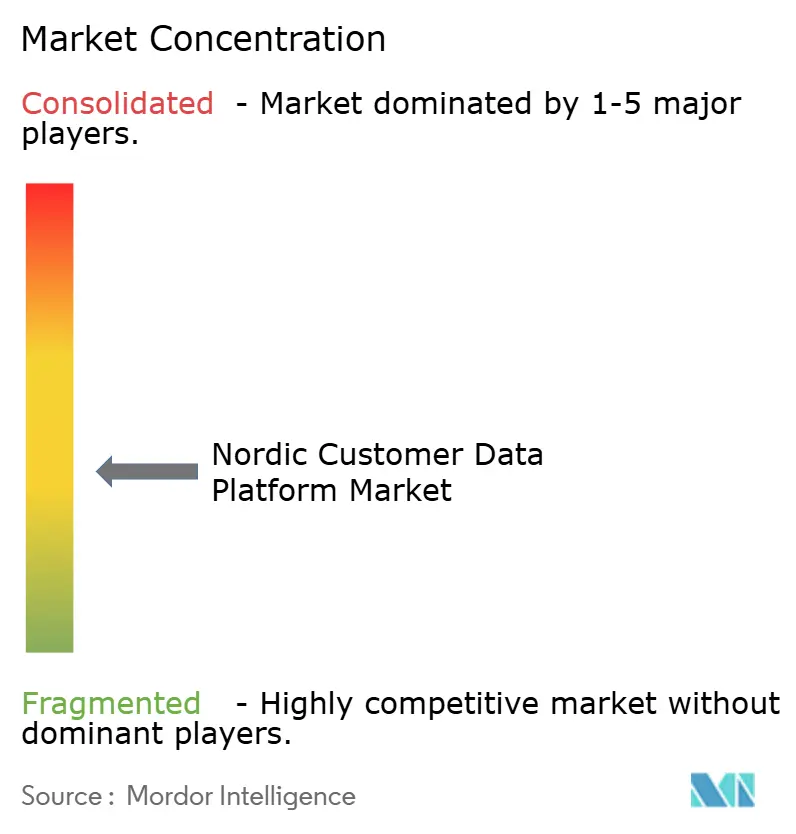
| Market Concentration | Medium |
Major Players *Disclaimer: Major Players sorted in no particular order Image © Mordor Intelligence. Reuse requires attribution under CC BY 4.0. | |
Nordic Customer Data Platform Market Analysis by Mordor Intelligence
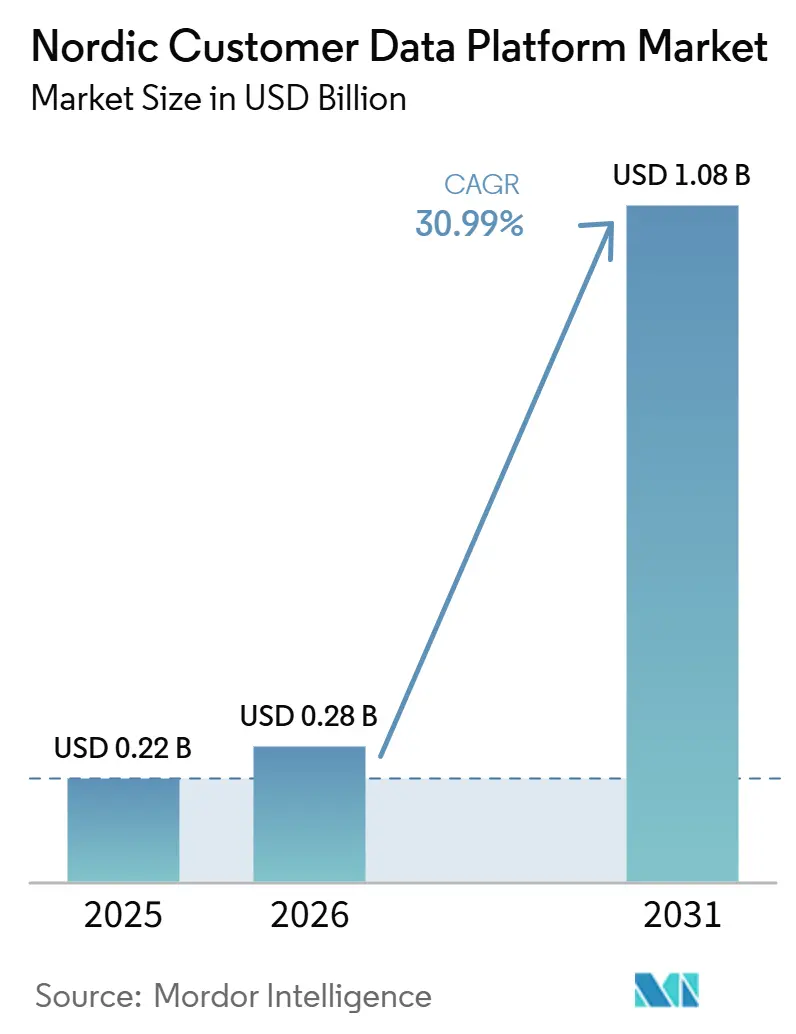
The Nordic customer data platform market size was valued at USD 0.22 billion in 2025 and estimated to grow from USD 0.28 billion in 2026 to reach USD 1.08 billion by 2031, growing at a CAGR of 30.99% from 2026 to 2031. Growth is being shaped by a privacy environment that now pushes enterprises to treat consent-governed first-party data as a commercial asset rather than only a legal requirement. That shift is raising demand for platforms that can unify profiles, manage consent, and support data lineage within the same operating layer. The region is also seeing stronger interest in managed implementation and ongoing support because platform integration remains difficult across retail, financial services, and health data environments. Cloud deployment continues to set the pace because regional infrastructure maturity is high, while local data residency expectations are changing how buyers choose vendors and architecture. The Nordic customer data platform market is also moving toward AI-native execution, which is tightening competition between global enterprise vendors and regional specialists with deeper retail and compliance alignment.
Key Report Takeaways
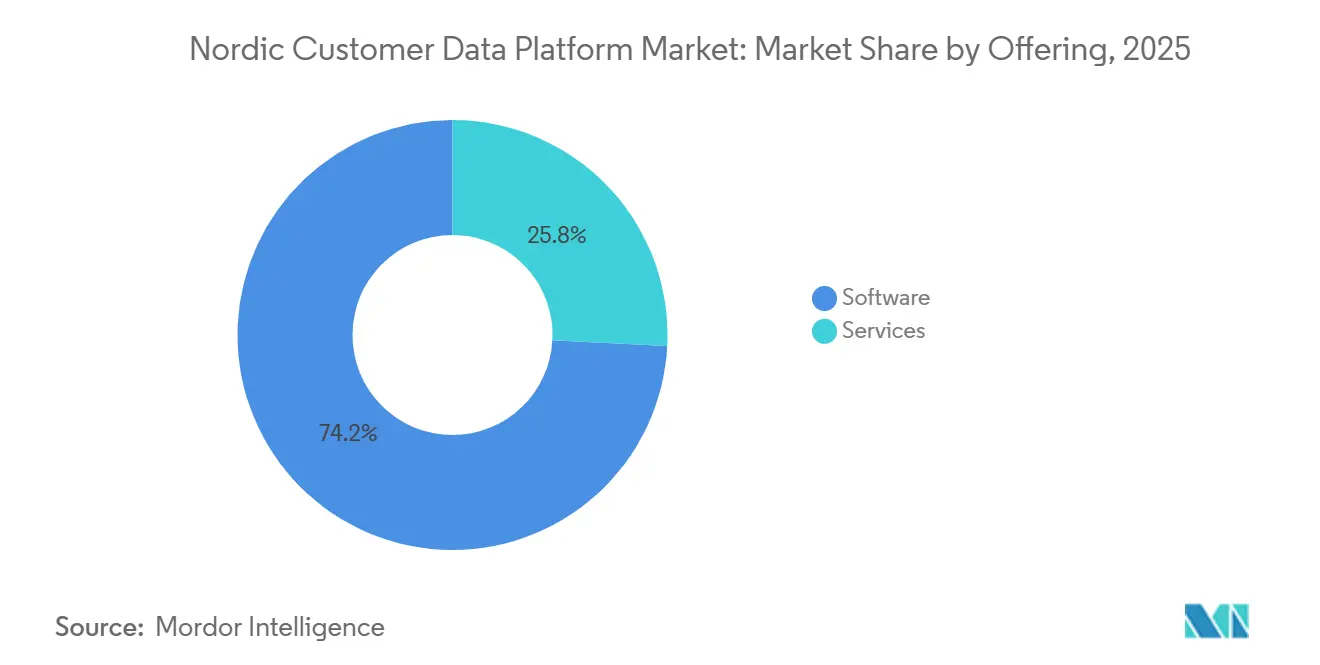
- By offering, software held 74.18% share in the Nordic customer data platform market in 2025, while services are projected to expand at 31.21% CAGR through 2031.
- By deployment mode, cloud held 73.81% of the Nordic customer data platform market share in 2025, and it is projected to expand at 32.21% CAGR through 2031.
- By organization size, large enterprises held 68.81% share in 2025, while small and medium enterprises are projected to expand at 31.46% CAGR through 2031.
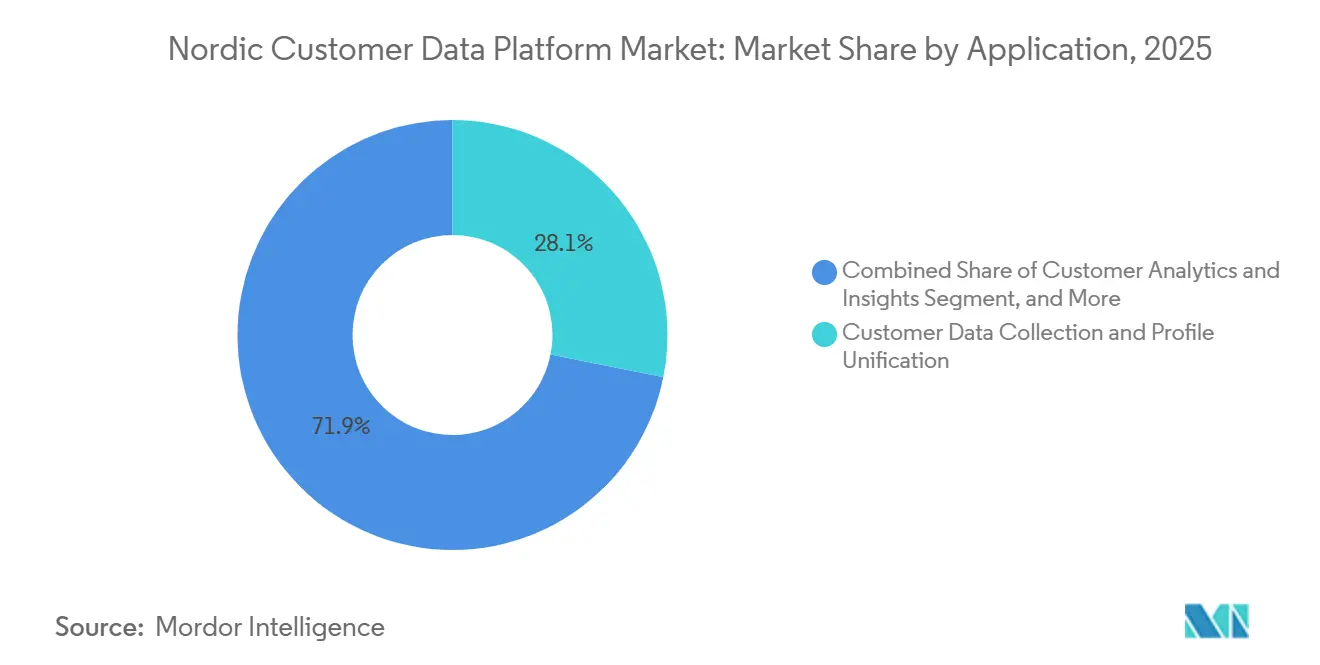
- By application, customer data collection and profile unification accounted for 28.13% of the Nordic customer data platform market size in 2025, while customer analytics and insights is projected to expand at 33.14% CAGR through 2031.
- By end-user industry, retail and e-commerce held 23.27% share in 2025, while healthcare and life sciences are projected to expand at 32.51% CAGR through 2031.
- By geography, Sweden held 38.61% share in 2025, while Finland is projected to expand at 32.43% CAGR through 2031.
Note: Market size and forecast figures in this report are generated using Mordor Intelligence’s proprietary estimation framework, updated with the latest available data and insights as of January 2026.
Market Trends and Insights
Drivers Impact Analysis of Nordic Customer Data Platform Market*
| DRIVER | (~) % IMPACT ON CAGR FORECAST | GEOGRAPHIC RELEVANCE | IMPACT TIMELINE |
|---|---|---|---|
| Privacy-First Personalization Mandates | +5.8% | Strongest in Sweden, Denmark, and Finland, where GDPR enforcement is most active | Medium term (2-4 years) |
| First-Party Data Migration After Third-Party Cookie Deprecation | +4.6% | Regional impact across the Nordics, with early adoption strongest in Sweden and Norway | Short term (≤ 2 years) |
| Composable Data Stacks in Enterprise IT | +4.1% | Strongest in Sweden, Norway, and Denmark among large enterprises with mature cloud data warehouse estates | Medium term (2-4 years) |
| Cross-Channel Retail Loyalty Orchestration Demand | +3.8% | Strongest in Sweden, Denmark, and Norway, where loyalty participation is high | Short term (≤ 2 years) |
| AI-Driven Identity Resolution in Multibrand Customer Journeys | +3.4% | Relevant across the region, with stronger impact in Sweden and Finland | Medium term (2-4 years) |
| Cross-Border Consent Governance Across Nordic Subsidiaries | +2.8% | Relevant across all Nordic countries as enterprises manage shared data environments across borders | Long term (≥ 4 years) |
| Source: Mordor Intelligence | |||
Privacy-First Personalization Mandates
Privacy-first personalization has moved beyond legal compliance and now sits closer to revenue generation in the Nordic customer data platform market. Sweden's IMY stated in 2025 that proposed GDPR amendments should not weaken purpose-limitation controls, which signaled that consent standards are likely to stay strict across customer data use cases.[1] That direction favors platforms that can manage consent orchestration directly inside profile unification rather than through later fixes. Nordlo and Radar found in 2025 that 48% of Swedish SMEs viewed governance, risk, and compliance issues as a barrier to data activation, which shows that privacy design now affects commercial execution as much as technical readiness.[2] Vendors that can offer modular consent controls across several legal entities are therefore better placed when Nordic groups run the same customer relationships across multiple jurisdictions. This is helping the Nordic customer data platform market reward platforms that combine data governance, audience activation, and consent logic in one operating model.
First-Party Data Migration After Third-Party Cookie Deprecation
The shift away from third-party data remains a strong growth engine for the Nordic customer data platform market even after Google changed its Chrome privacy approach in 2025. Experian noted in September 2025 that marketers still needed to adapt to a world of stronger privacy controls and lower dependence on third-party identifiers. That leaves brands with little room to delay investment in first-party identity and unified profile infrastructure. PubMatic reported that Scandinavian publisher Brain Nordic raised audience addressability from 35% to 97% after moving toward a first-party data collaboration model, which shows how quickly addressable value can improve when identity is rebuilt around owned data signals. In this setting, platforms built around deterministic identity resolution hold a more durable advantage than tools that still depend on weaker third-party matching logic. The result is a steadier replacement cycle as brands seek systems that can support audience activation without losing compliance control.
Composable Data Stacks in Enterprise IT
Enterprise IT teams across the region are moving toward warehouse-native and composable architectures, and that is changing how the Nordic customer data platform market is being built. TietoEVRY reported in April 2026 that Sweden's largest banks were already working through 12-24-month modernization programs to move core environments toward real-time processing, which aligns closely with the same infrastructure changes needed for composable CDP models. This matters because buyer preference is shifting away from closed external data stores and toward governed environments where enterprise data already sits. Bloomreach announced in June 2026 that it had partnered with Databricks CustomerLake so that AI personalization could run closer to governed enterprise data within the same environment. That model reduces reconciliation work between warehouse records and separate marketing profiles, which is especially relevant when residency and sovereignty rules shape procurement. As this pattern spreads, the Nordic customer data platform market is likely to give more weight to architecture choices than to standalone feature counts.
Cross-Channel Retail Loyalty Orchestration Demand
Retail loyalty programs have become a major first-party data collection layer, and that is supporting strong momentum for the Nordic customer data platform market. Antavo reported in February 2026 that Norwegian loyalty program owners allocated 58% of marketing budgets to loyalty and CRM, while 57% of Norwegian marketers already used AI in loyalty program management.[3] That level of operational commitment pushes retailers toward systems that can connect purchases, profiles, campaigns, and triggered offers across channels. IMPACT Commerce reported in 2025 that Danish footwear retailer Skoringen generated 31% growth in digital sales for its children's category and achieved 55% email open rates after deploying a CDP-powered lifecycle marketing setup. Retailers are also moving closer to real-time activation as payment and point-of-sale events start feeding directly into loyalty and engagement environments. This is giving vendors with strong retail orchestration depth a clearer route to defend share against broader enterprise platforms.
Restraints Impact Analysis of Nordic Customer Data Platform Market*
| RESTRAINT | (~) % IMPACT ON CAGR FORECAST | GEOGRAPHIC RELEVANCE | IMPACT TIMELINE |
|---|---|---|---|
| Complex Legacy Integration in Banking and Telecom Core Systems | -3.2% | Strongest in Sweden, Norway, and Denmark, where large banks and telecom operators still rely on older core platforms | Medium term (2-4 years) |
| High Enterprise Demand for Local Data Residency and Sovereignty Controls | -2.1% | Relevant across all Nordic countries as residency requirements shape enterprise procurement | Long term (≥ 4 years) |
| Skills Gap in CDP Data Modeling and Activation Workflows | -1.8% | Regional issue, with added pressure in smaller talent markets | Medium term (2-4 years) |
| Long Payback Cycles for Mid-Market Deployments | -1.4% | More visible in Denmark and Norway, where many prospective buyers need longer return timelines | Long term (≥ 4 years) |
| Source: Mordor Intelligence | |||
Complex Legacy Integration in Banking and Telecom Core Systems
Legacy integration remains one of the clearest adoption barriers in the Nordic customer data platform market, especially in regulated sectors. TietoEVRY noted in April 2026 that Swedish banks were simultaneously dealing with ISO 20022 migration, real-time settlement adoption, and new payment infrastructure changes, which placed direct pressure on data engineering capacity. Nordea also described in 2026 how the new Nordic payment infrastructure is being supported by ISO 20022, reinforcing the scale of change running through core financial systems. When banking cores, telecom billing systems, and branch or service records sit in separate proprietary schemas, profile unification becomes slower and harder to scale. That delay stretches time to value and can push mid-market buyers to postpone projects until broader modernization work is further along. The Nordic customer data platform market therefore continues to face uneven demand intensity across sectors with very different integration burdens.
High Enterprise Demand for Local Data Residency and Sovereignty Controls
Demand for local data residency has become more than a technical preference and now shapes procurement criteria across the Nordic customer data platform market. Lime Technologies stated in 2025 that customer data in its CRM environment was stored within AWS data centers in Sweden, which it presented as a core part of its GDPR-aligned positioning. That type of positioning has gained weight because buyers are no longer satisfied with generic assurances on compliance when the vendor's legal domicile remains outside the EU. Vendors without strong local-region infrastructure or clear contractual support for EU residency may still compete, but they face a narrower path in highly regulated bids. This restraint does not eliminate cloud demand, yet it does shape which cloud models are acceptable and which deployment designs win budget. Over time, the requirement for stronger sovereignty controls may help regional or EU-aligned vendors defend accounts that would otherwise move to larger global platforms.
*Our forecasts treat driver/restraint impacts as directional, not additive. The impact forecasts reflect baseline growth, mix effects, and variable interactions.
Nordic Customer Data Platform Market Segment Analysis
By Offering:
Software Dominance Sustains As Services ScaleSoftware accounted for 74.18% of the Nordic customer data platform market size in 2025, which showed that platform licensing still carried the larger revenue pool. This leadership reflected multi-year enterprise agreements across retail, banking, and healthcare environments where large buyers preferred to secure core platform capabilities first. Software also remained central because warehouse-native and composable models are still sold mainly as licensed modules rather than labor-heavy delivery structures. That pattern kept the revenue base stable even as enterprise data stacks became more distributed and more difficult to manage.
Services is projected to expand at 31.21% CAGR through 2031, which makes it the faster-growing part of the offering mix. Nordlo and Radar found in 2025 that 52% of Swedish enterprises lacked internal expertise for data activation work, which helps explain why implementation and managed support are gaining weight. In practice, many buyers can fund software but still need outside help to connect identity layers, marketing systems, consent controls, and sector-specific data stores. That is especially visible when projects stretch across multibrand retail groups or regulated health and financial environments. The Nordic customer data platform industry is therefore seeing total ownership shift toward a model where services shape success even when software remains the larger booked line item.
By Deployment Mode:
Cloud Leads While Sovereignty Shapes DesignCloud held 73.81% of the Nordic customer data platform market share in 2025, and it is also projected to expand at 32.21% CAGR through 2031. This dual position shows that cloud is not only the dominant installed model but also the main route for new deployments. The reason is practical because real-time data activation, AI-based segmentation, and cross-channel orchestration are harder to run efficiently in fully on-premises environments. The region's strong cloud maturity also supports faster rollout across business units that need common customer data access.
At the same time, the shape of cloud adoption is being influenced by sovereignty and audit needs rather than by simple cost logic. Lime Technologies emphasized in 2025 that EU-based data handling had become a direct part of its product value proposition, which reflects how buyer questions are moving closer to storage location and legal control. Hybrid models, therefore, retain a role among institutions that want governed activation in the cloud while keeping more sensitive records under tighter internal control. On-premises deployments remain smaller, but they still matter in segments where security rules or sector obligations make full migration slower. The Nordic customer data platform market is thus favoring cloud-led growth, but it is doing so through architecture choices that balance speed, compliance, and internal auditability.
By Organization Size:
Large Enterprises Anchor Revenue While SMEs Gain PaceLarge enterprises held 68.81% of market revenue in 2025, which kept them at the center of current spending in the Nordic customer data platform market. Their lead came from broader customer bases, more complex data estates, and larger transformation programs that often bundled CDP adoption into wider customer experience initiatives. Large buyers also had stronger incentives to unify consent records, transactional behavior, and campaign execution across several brands or countries. That combination supported higher contract values and longer platform commitments.
Small and medium enterprises are projected to expand at 31.46% CAGR through 2031, which points to the strongest structural growth opportunity in the region. Nordlo and Radar found in 2025 that 81% of Swedish SMEs named AI or machine learning as their top IT investment priority, while 53% also cited poor data quality and accessibility as a key barrier. That tension is pushing SMEs toward packaged tools that reduce engineering dependency and make customer data usable for nontechnical teams. Growth in this segment is therefore being driven less by late adoption and more by the arrival of simpler products with clearer deployment paths. The Nordic customer data platform industry is seeing SMEs become more relevant because the product model is moving closer to how smaller commercial teams actually work.
By Application:
Profile Unification Holds the Base While Analytics Advances FastestCustomer data collection and profile unification accounted for 28.13% of the Nordic customer data platform market size in 2025, which confirmed that most buyers still prioritized foundational data work. Identity resolution, consent management, and persistent customer profiles remained the first step because downstream activation depends on those layers being stable. This kept profile unification at the center of budget allocation even as vendors widened their activation features. It also showed that many enterprises were still building operational readiness rather than only seeking campaign lift.
Customer analytics and insights are projected to expand at 33.14% CAGR through 2031, which makes it the fastest-rising application area. Voyado introduced predictive intelligence dashboards with revenue-attributed A/B testing in April 2026, which showed how vendors are bringing analysis and action closer together inside a single user flow.[4] Audience segmentation and journey orchestration also remain important because brands increasingly expect profile changes to trigger action across web, email, stores, and loyalty programs. Consent and preference management is also becoming more visible as its own use case when shared customers interact with the same group across several Nordic markets. The Nordic customer data platform industry is therefore moving from basic profile assembly toward a model where insights are expected to feed execution without a separate reporting layer slowing the process.

By End-User Industry:
Retail and E-Commerce Leads While Healthcare and Life Sciences AcceleratesRetail and e-commerce held 23.27% share in 2025, which kept it as the largest vertical in the Nordic customer data platform market. Retailers were early adopters because loyalty participation is high, personalization expectations are strong, and omnichannel transaction data can be activated quickly. Talon.One reported in 2025 stated that Elkjøp selected its incentives engine to unify promotions and loyalty data for a multi-million-member customer club, which reflects how first-party activation is becoming operational at scale in the region.[5] Banking, financial services, insurance, and telecom also remain meaningful revenue contributors because contract sizes are large even when implementation is slower.
Healthcare and life sciences are projected to expand at 32.51% CAGR through 2031, which changes the long-term vertical growth picture. Sitra described the VALO program as a cross-border initiative running through October 2026 to unlock value from Nordic health data, and that creates a clearer route for governed analytics and profile-based use cases in healthcare settings. HippocrAItes also stated in 2025 that it was building an EHDS-compliant platform that combined national registries, provider records, wearable data, and patient-reported outcomes within a governed environment. These examples show why healthcare is moving beyond a policy discussion and into real deployment pathways that resemble advanced identity resolution and data activation models. The Nordic customer data platform market is likely to see this vertical gain weight because it combines strong data intensity with rising demand for secure cross-system coordination.
Geography Analysis
Sweden Customer Data Platform Market
Sweden held 38.61% of the regional revenue base in 2025, which made it the largest country in the Nordic customer data platform market. Its position reflects the scale of its digital commerce environment and the presence of large consumer brands that already work with advanced customer engagement platforms. Sweden also benefits from stronger enterprise readiness in retail, banking, and brand marketing operations, where first-party data programs have moved beyond testing. Privacy enforcement matters here as well because buyers increasingly want platforms that can support auditable consent, customer history, and activation controls within the same workflow. IMY's 2025 position on proposed GDPR changes reinforced the expectation that stricter data handling discipline will remain part of the operating environment.
Finland Customer Data Platform Market
Finland is projected to expand at 32.43% CAGR through 2031, which makes it the fastest-growing geography in the region. Its growth path is being supported by a mature health data infrastructure and by the way cross-border health data projects are being organized. Sitra's VALO program is running through October 2026 and is designed to operationalize value creation from Nordic health data across the region. Finland also stands out because national health data systems already provide a stronger base for governed identity and analytics use cases than many neighboring markets. HippocrAItes described in 2025 how it was building on this environment through an EHDS-compliant platform that brought together multiple health data sources within a controlled account structure.
Nordics Customer Data Platform Market
Denmark, Norway, Iceland, and the rest of the region formed the remaining revenue base in 2025, with demand shaped by loyalty intensity, cloud maturity, and compliance alignment. Antavo reported in February 2026 that 55% of Danish loyalty program participants preferred mobile apps, which raised the value of systems that can ingest real-time event data and support mobile personalization. The same report showed that Norwegian loyalty program owners allocated 58% of marketing budgets to loyalty and CRM, which supports stronger near-term retail demand for data activation tools. Smaller markets such as Iceland remain limited in absolute scale, yet regional regulatory coordination is reducing the administrative burden that once slowed multijurisdiction deployment design.
Competitive Landscape
The Nordic customer data platform market remains moderately fragmented, with global enterprise software vendors competing against regional specialists that have stronger retail alignment and closer familiarity with Nordic compliance needs. Competition is not centered only on profile unification anymore because buyers increasingly compare activation depth, AI readiness, data residency posture, and integration speed. Adobe strengthened its position in February 2025 when it made Real-Time CDP Collaboration generally available, which let advertisers and publishers work with first-party audience data in a privacy-safe setting without exposing directly identifiable information. That move matched a clear regional need because many Nordic buyers want tighter control over how shared audiences are activated. The result is a field where scale matters, but architecture trust matters just as much.
Strategic moves in 2026 show that vendors are trying to close the gap between intelligence and execution inside the same environment. BlueConic acquired Blueshift in June 2026 to add owned-channel messaging capabilities such as email, SMS, push, in-app, and web engagement to its profile unification base. Tealium launched the Context API in June 2026 so that AI agents and enterprise applications could query real-time customer context from deep historical data in milliseconds. Treasure Data rebranded as Treasure AI in April 2026 and repositioned itself around an agentic experience platform, which reflected the broader shift from data assembly toward autonomous execution models. These moves show that vendors are no longer competing only on data ingestion or storage logic. They are increasingly competing on how quickly customer context can be turned into governed action.
Regional specialists still hold defensible ground because they understand Nordic retail workflows, loyalty use cases, and local operating expectations more deeply. Voyado's product development in 2026 focused on predictive intelligence dashboards, conversational analytics, and faster multi-environment operations, which fits the needs of multibrand retail groups. That depth helps regional players stay relevant even when larger platforms broaden their feature sets. At the same time, no supplier has yet secured a decisive position across every vertical because explainability, consent, and sector-specific integration needs still vary widely from retail to healthcare and financial services.
Nordic Customer Data Platform Industry Leaders
-
Salesforce, Inc.
-
Adobe Inc.
-
Oracle Corporation
-
SAP SE
-
Microsoft Corporation
- *Disclaimer: Major Players sorted in no particular order
Nordic Customer Data Platform Market Companies Covered in this Report
- Salesforce, Inc.
- Adobe Inc.
- Oracle Corporation
- SAP SE
- Microsoft Corporation
- Twilio Inc.
- mParticle, Inc.
- Tealium, Inc.
- Amplitude, Inc.
- BlueConic, Inc.
- Bloomreach, Inc.
- Treasure Data, Inc.
- Acquia, Inc.
- SAS Institute Inc.
- Uniphore Technologies Inc.
- Contentstack, Inc.
- Lytics, Inc.
- Optimove Inc.
- NGDATA NV
- Voyado AB
- Nosto Solutions Oy
Recent Industry Developments in Nordic Customer Data Platform Market
- June 2026: BlueConic acquired Blueshift, an AI-powered cross-channel marketing platform, closing the gap between customer profile data and owned-channel execution, email, SMS, push, in-app, web, within a single CDP system. The acquisition positions BlueConic to serve as both intelligence and activation layer, targeting mid-market B2C brands that previously required separate marketing automation tools.
- June 2026: Rokt mParticle launched the Performance Engine, including an Audience Agent and Match Boost capability that transforms first-party data into measurable revenue lift, with match-rate improvements across Google and Meta ad platforms visible within 24 hours of activation.
- June 2026: Tealium launched the Context API, built on a managed Model Context Protocol server, enabling AI agents and enterprise applications to query real-time customer context from warehouse-stored historical data in milliseconds to power agentic commerce workflows.
- May 2026: Voyado released its May 2026 product update, adding flexible point redemption, conversational analytics, and predictive intelligence dashboards with A/B testing revenue attribution, giving retail marketers direct visibility into which campaign variants drive commercial outcomes.
Nordic Customer Data Platform Market Report Scope
The Nordic Customer Data Platform CDP Market is defined as the market for platforms and services that help organizations across Sweden, Denmark, Norway, Finland, and Iceland consolidate customer data into unified, centralized profiles. These solutions support identity resolution, real-time data integration, segmentation, personalization, and analytics, enabling Nordic enterprises to deliver consistent omnichannel customer experiences. Strong digital adoption, advanced e-commerce ecosystems, and strict compliance with the EU GDPR and national data protection laws shape the market. The market also reflects the region’s focus on sustainability, transparency, and AI-driven personalization in customer engagement.
The Nordic Customer Data Platform Market Report is Segmented by Offering (Software, and Services), Deployment Mode (Cloud, On-Premises, and Hybrid), Organization Size (Large Enterprises, and Small and Medium Enterprises), Application (Customer Data Collection and Profile Unification, Audience Segmentation and Personalization, Marketing Campaign and Customer Journey Orchestration, Customer Analytics and Insights, Consent and Preference Management, and Other Applications), End-User Industry (Retail and E-Commerce, Banking, Financial Services, and Insurance (BFSI), Healthcare and Life Sciences, IT and Telecom, Media and Entertainment, Industrial Manufacturing, Government and Public Administrationm and Other End-User Industries), and Geography (Sweden, Denmark, Norway, Finland, Iceland, and Rest of Nordic Countries). The Market Forecasts are Provided in Terms of Value (USD).
Segmentation Overview
| Software |
| Services |
| Cloud |
| On-Premises |
| Hybrid |
| Large Enterprises |
| Small and Medium Enterprises |
| Customer Data Collection and Profile Unification |
| Audience Segmentation and Personalization |
| Marketing Campaign and Customer Journey Orchestration |
| Customer Analytics and Insights |
| Consent and Preference Management |
| Other Applications |
| Retail and E-Commerce |
| Banking, Financial Services, and Insurance (BFSI) |
| Healthcare and Life Sciences |
| IT and Telecom |
| Media and Entertainment |
| Industrial Manufacturing |
| Government and Public Administration |
| Other End-User Industries |
| Sweden |
| Denmark |
| Norway |
| Finland |
| Iceland |
| Rest of Nordic Countries |
| By Offering | Software |
| Services | |
| By Deployment Mode | Cloud |
| On-Premises | |
| Hybrid | |
| By Organization Size | Large Enterprises |
| Small and Medium Enterprises | |
| By Application | Customer Data Collection and Profile Unification |
| Audience Segmentation and Personalization | |
| Marketing Campaign and Customer Journey Orchestration | |
| Customer Analytics and Insights | |
| Consent and Preference Management | |
| Other Applications | |
| By End-User Industry | Retail and E-Commerce |
| Banking, Financial Services, and Insurance (BFSI) | |
| Healthcare and Life Sciences | |
| IT and Telecom | |
| Media and Entertainment | |
| Industrial Manufacturing | |
| Government and Public Administration | |
| Other End-User Industries | |
| By Geography | Sweden |
| Denmark | |
| Norway | |
| Finland | |
| Iceland | |
| Rest of Nordic Countries |
Key Questions Answered in the Report
What is the size outlook for the Nordic customer data platform market?
The Nordic customer data platform market size was USD 0.22 billion in 2025, and USD 0.28 billion in 2026, and is projected to reach USD 1.08 billion by 2031 at a 30.99% CAGR from 2026-2031.
Which country leads regional revenue today?
Sweden led the region in 2025 with 38.61% share, supported by its mature digital commerce base and stronger enterprise adoption across retail and regulated sectors.
Which country is expected to grow the fastest through 2031?
Finland is projected to expand at 32.43% CAGR through 2031, supported by stronger health data infrastructure and cross-border health data programs.
Which deployment model is most important across the region?
Cloud is the leading model, holding 73.81% share in 2025, and it is also projected to be the fastest-growing deployment mode at 32.21% CAGR through 2031.
Which application area is expanding the fastest?
Customer analytics and insights is projected to grow at 33.14% CAGR through 2031 as vendors bring predictive analysis and activation closer together in the same workflow.
Which end-user group offers the strongest long-term upside?
Healthcare and life sciences is projected to expand at 32.51% CAGR through 2031 as governed health data environments create stronger use cases for identity resolution and analytics.