
United Arab Emirates Mining Equipment Market Size and Share
Market Overview
| Study Period | 2019 - 2031 |
|---|---|
| Forecast Data Period | 2026 - 2031 |
| Base Year Market Size (2025) | USD 0.45 Billion |
| Market Size (2026) | USD 0.48 Billion |
| Market Size (2031) | USD 0.68 Billion |
| Growth Rate (2026 - 2031) | 7.37 % |
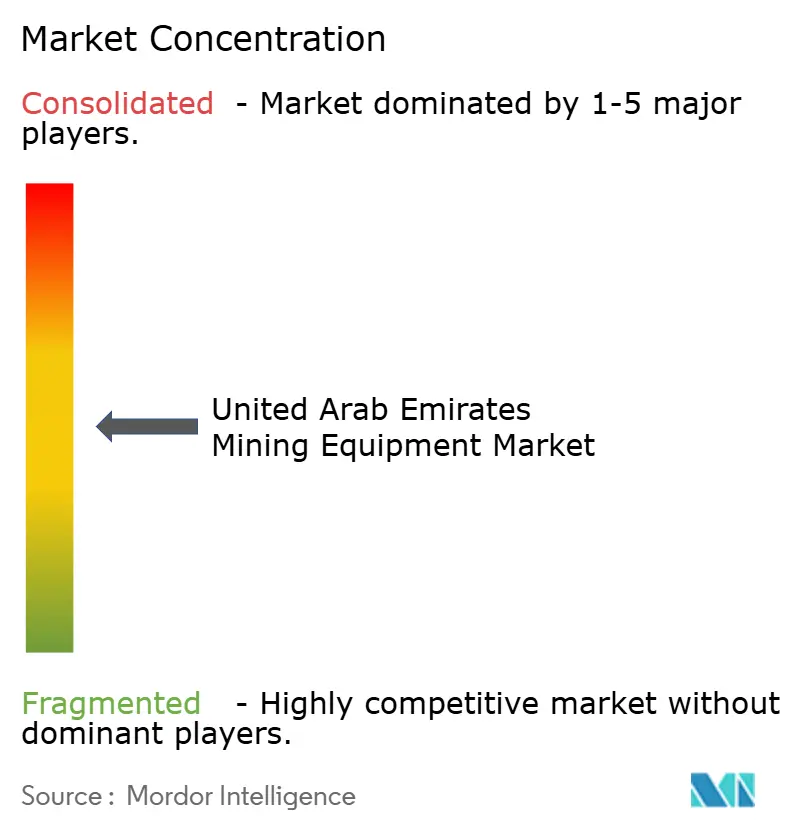
| Market Concentration | Medium |
Major Players
*Disclaimer: Major Players sorted in no particular order Image © Mordor Intelligence. Reuse requires attribution under CC BY 4.0. |
|
United Arab Emirates Mining Equipment Market Analysis by Mordor Intelligence
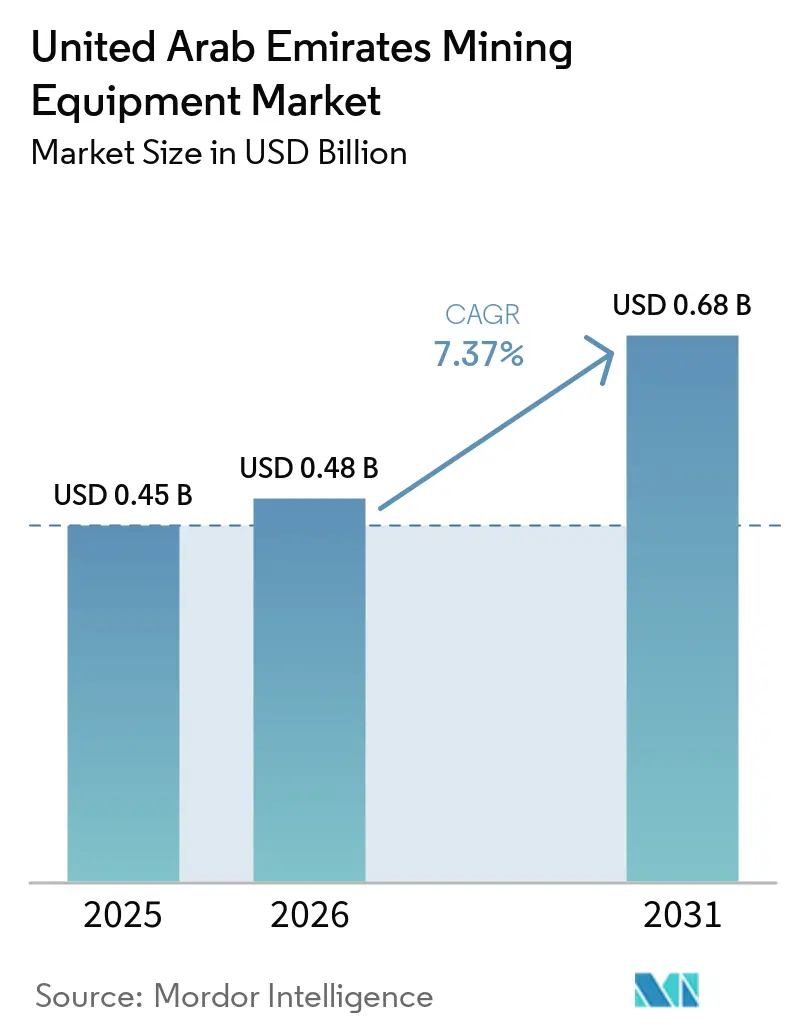
The UAE mining equipment market was valued at USD 0.45 billion in 2025, is estimated at USD 0.48 billion in 2026, and is projected to reach USD 0.68 billion by 2031, registering a CAGR of 7.37% between 2026 and 2031. The Emirates has adopted a "mining-without-mines" strategy, investing in overseas extraction, domestic mineral processing, and efficient logistics, rather than pursuing large-scale local ore development. Three key initiatives drive this growth: the "Operation 300bn" program, targeting a significant boost in manufacturing GDP; consistent expansion in the construction sector, bolstered by Etihad Rail and major airport/port projects; and the UAE-US framework aimed at mobilizing public-private capital for critical mineral activities [1]“UAE-US Critical Minerals Framework,”, UAE Embassy, uaeembassy.org. Supporting these demand drivers is a policy mix favoring imports, including customs duty exemptions for equipment, extended industrial loans, and in-country value targets, all of which shorten payback periods for new fleets and processing lines.
Key Report Takeaways
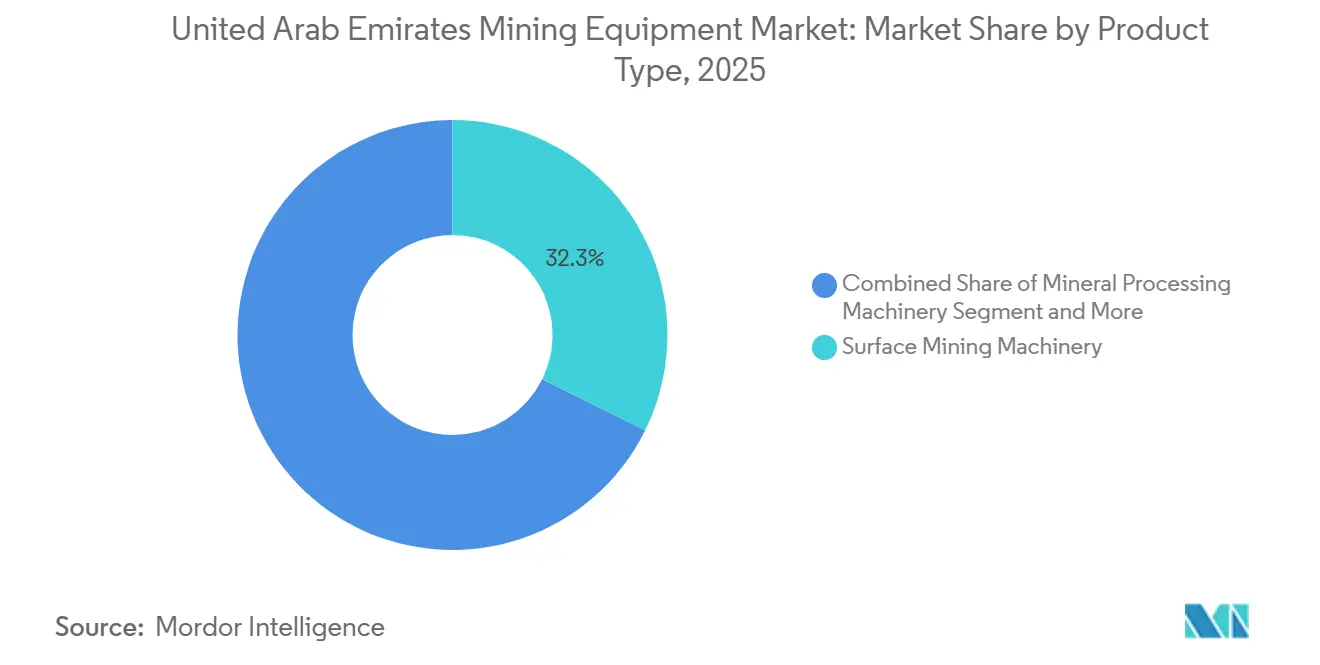
- By product type, surface mining machinery led the UAE mining equipment market with 32.31% share in 2025, while mineral processing machinery is forecast to grow at a 7.41% CAGR through 2031.
- By function, transportation equipment accounted for 43.22% of the UAE mining equipment market size in 2025, and processing equipment is projected to post a 7.56% CAGR over 2026-2031.
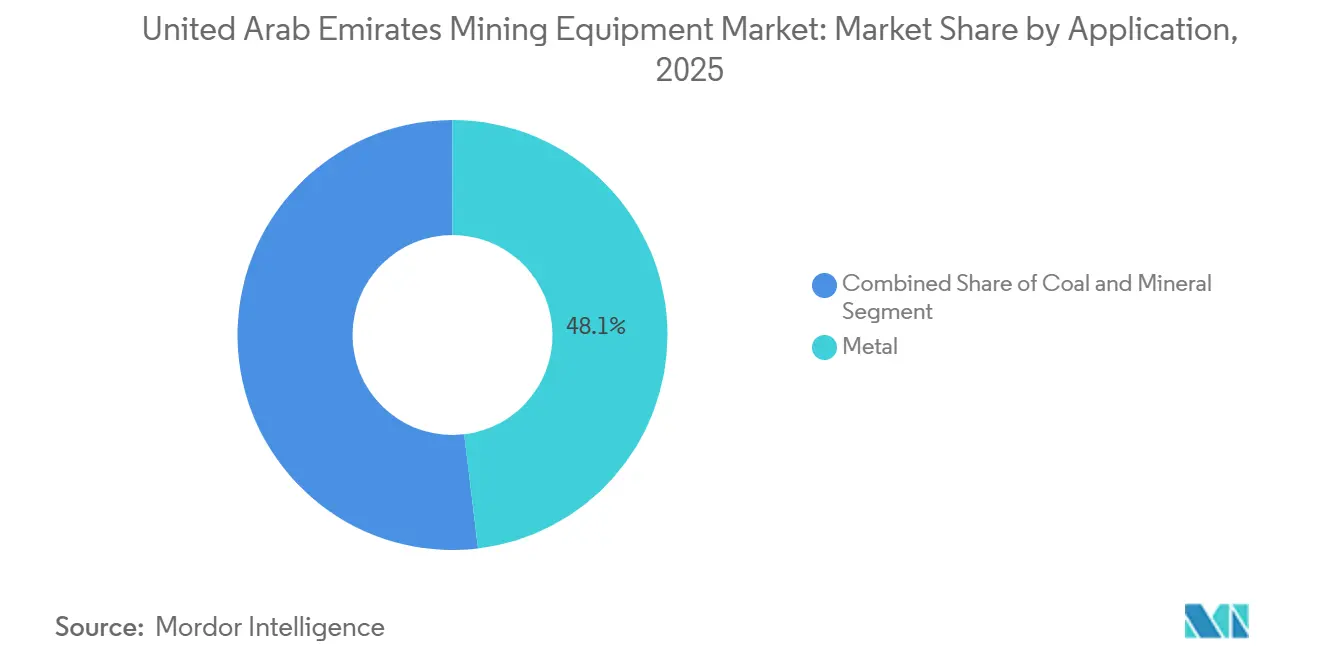
- By application, metal value chains captured 48.11% revenue in 2025; industrial minerals demand is set to climb at a 7.39% CAGR to 2031.
- By power source, diesel units accounted for 74.72% in 2025, yet fully electric and battery-electric fleets are forecast to expand at a 7.58% CAGR through 2031.
Note: Market size and forecast figures in this report are generated using Mordor Intelligence’s proprietary estimation framework, updated with the latest available data and insights as of January 2026.
United Arab Emirates Mining Equipment Market Trends and Insights
Drivers Impact Analysis*
| Driver | (~) % Impact on CAGR Forecast | Geographic Relevance | Impact Timeline |
|---|---|---|---|
| Rising Demand for Aggregates | +1.5% | National, with early gains in Dubai, Abu Dhabi, NEOM cross-border projects | Short term (≤ 2 years) |
| Government Investment | +1.2% | National, with concentration in Abu Dhabi and Dubai industrial zones | Medium term (2-4 years) |
| Expansion of Bauxite & Copper Exploration Projects | +0.9% | Global operations with UAE-based equipment procurement | Long term (≥ 4 years) |
| Adoption of Automation & Telematics | +0.8% | National deployment with technology transfer from global operations | Medium term (2-4 years) |
| Energy-Subsidy Reforms Driving Efficiency Upgrades | +0.7% | National, with higher impact in energy-intensive operations | Short term (≤ 2 years) |
| Growth of Mineral-Recycling Hubs | +0.6% | Concentrated in KEZAD, Jebel Ali, and Fujairah free zones | Long term (≥ 4 years) |
| Source: Mordor Intelligence | |||
Rising Demand for Aggregates From Mega-Projects
Etihad Rail is constructing a freight line, Al Maktoum International Airport is undergoing expansion, and marine works at Palm Jebel Ali are securing a multi-year workload for suppliers of crushers, screens, and articulated haul trucks [2]"Etihad Rail announces rail freight terminal", Etihad Rail, etihadrail.ae. This trend mitigates the industry's typical cyclicality. With rail connectivity significantly reducing haulage costs compared to road transport, quarry operators are rapidly adapting. They're moving to conveyor-to-rail loading and establishing automated stockpiles to leverage the freight tariff benefits. The concentration of these projects across multiple emirates is encouraging OEMs to set up local parts depots and training centers. This strategy not only reduces lead times but also strengthens lifecycle contracts. Consequently, this consistent and budget-supported infrastructure is reinforcing a stable order book for the UAE's mining equipment market.
Government Investment via UAE Industrial and Logistics Strategy
Customs-duty waivers, a soft-loan facility, and ICV scorecards are collectively alleviating capital challenges and promoting local assembly or servicing. This policy strategy blurs the lines between mining and industrial machinery. Channels once distinct are now converging, as alumina refiners, battery-recycling centers, and copper anode plants import crushers, mills, and filtration systems. In the UAE's mining equipment market, suppliers are gaining traction by merging local build-to-stock inventory with flexible financing options.
Expansion of Bauxite and Copper Exploration Projects
Overseas stakes in Ghana and Zambia, coupled with a gallium-extraction MoU at Al Taweelah, allow EGA to convert foreign ore into a local concentrate. This concentrate undergoes grinding, classification, and refinement within the industrial zones of the UAE. As a result, demand for grinding mills, flotation cells, and automated material-handling systems is surging, steering the UAE mining equipment market further into downstream processing.
Adoption of Automation andTelematics in Mining Fleet
Middle East units from Epiroc, Caterpillar, and Sandvik now come standard with autonomy-ready controls, hastening adoption. With emission rules set to take effect, on-board diagnostics will become mandatory, driving a regulatory demand for fleets rich in sensors and software. Initial trials indicate reduced fuel consumption and notable productivity gains, bolstering the business case for retrofit kits in current diesel fleets.
Restraints Impact Analysis*
| Restraint | (~) % Impact on CAGR Forecast | Geographic Relevance | Impact Timeline |
|---|---|---|---|
| Volatile Commodity Prices | -1.1% | Global impact affecting UAE-based mining investments | Short term (≤ 2 years) |
| Limited Domestic Ore Reserves | -0.8% | National, with higher impact on local mining operations | Long term (≥ 4 years) |
| Water-Scarcity Driven Permitting Delays | -0.6% | National, with acute impact in inland mining operations | Medium term (2-4 years) |
| New Stage V Diesel-Emission Standards | -0.4% | National implementation with compliance costs | Medium term (2-4 years) |
| Source: Mordor Intelligence | |||
Volatile Commodity Prices
Price fluctuations in aluminum and copper dictate when refineries debottleneck or when anode plants are constructed, leading to erratic ordering patterns for expensive processing lines. While long-term offtake agreements provide some protection against capital expenditures, original equipment manufacturer (OEM) backlogs are still vulnerable to short-term price drops. These drops can postpone fleet renewals in the UAE mining equipment market.
New Stage V Diesel-Emission Standards
The Euro 6B regulations introduce SCR and DPF systems, increasing unit prices and complicating maintenance for diesel-haulage fleets. These compliance costs push operators to either rent newer machines or shift towards battery-electric alternatives. This transition could impact diesel-unit deliveries in 2026-2027, but as charging networks mature, electric deployments are expected to rise.
*Our forecasts treat driver/restraint impacts as directional, not additive. The impact forecasts reflect baseline growth, mix effects, and variable interactions.
Segment Analysis
By Product Type: Processing Equipment Outpaces Extraction Gear
Surface mining machinery accounted for 32.31% of 2025 demand; however, mineral-processing lines are set to deliver the fastest clip at a 7.41% CAGR as new gallium, anode, and battery-recycling plants come onstream. The UAE mining equipment market for processing systems is supported by containerized, plug-and-play modules that reduce on-site civil work and enable factory acceptance testing within free zones before shipment. Suppliers that bundle lifecycle digital services alongside mills or filters lock in annuity-style revenues and raise switching costs for end users.
Surface extraction equipment still benefits from continuous quarry output feeding the construction value chain, yet demand growth moderates as installed fleets reach maturity. OEM differentiation shifts toward fuel-efficiency upgrades, autolube, and autonomous-haulage readiness. Advanced technology in drills—such as Sandvik’s DD312i with torque-optimized control—prepares suppliers for any potential underground expansion but remains a second-order driver within the UAE mining equipment market.



By Function Type: Transportation Equipment Leads Market Share
Transportation units claimed a 43.22% stake in 2025 thanks to haul-intensive quarry logistics tied to Etihad Rail hubs. Still, processing gear is projected to enjoy a 7.56% CAGR to 2031, lifted by value-added mineral plants that require fine grinding, classification, and thickening. The UAE mining equipment market share for haul trucks is therefore inching downward as processing capex accelerates.
Equipment innovation in transportation focuses on dual-fuel or hybrid drivetrains and embedded payload analytics that trim cycle times and improve fuel economics. Conversely, processing upgrades center on energy-efficient HPGRs, variable-speed drives, and smart controls that dovetail with the federal energy-efficiency accelerator program. Finance arms of major OEMs now underwrite both fleets and plant equipment, smoothing uptake across functions.
By Application: Metals Lead, Industrial Minerals Scale Rapidly
Metal chains—aluminum smelting, copper concentrates—delivered 48.11% of 2025 revenue. Yet industrial-mineral demand is on track for a 7.39% CAGR, buoyed by gypsum, limestone, and battery-recycling flows that favor smaller, modular plants with lower entry costs. Accordingly, the UAE mining equipment market for industrial minerals will capture rising venture capital and family office funding targeting circular economy projects.
A diversification play is brewing: desalination and geothermal brine extraction pilots are evaluating ion-exchange and membrane systems to harvest lithium, magnesium, or rare-earth elements. Should those pilots commercialize after 2028, they would create a new sub-niche requiring specialty columns, evaporators, and crystallizers, further broadening the UAE mining equipment market.
By Power Source: Diesel Still Dominant But Electrification Accelerates
Diesel motors held a 74.72% share in 2025, yet battery-electric and hybrid models are leading the charge with a 7.58% CAGR as operators seek lower total cost of ownership under Euro 6B rules. Early pilots of retrofit hybrid haul trucks at 30% fuel savings strengthen the ROI case, and grid-tied quarries near Abu Dhabi’s industrial zones can tap subsidized tariffs to power charge stations. OEMs that offer battery leasing or pay-per-ton energy contracts ease capital constraints and accelerate adoption in the UAE mining equipment market.
Hybrid drivetrains function as a transition bridge. They meet Stage V limits with smaller SCR systems and cut diesel usage without the infrastructure burden of full electrics, attracting mid-tier quarry owners who prefer incremental investments. Over time, the falling battery price trajectory will compress the diesel slice of the UAE mining equipment market share, especially for fixed-site crushers and stackers.
Geography Analysis
Abu Dhabi, Dubai, and the Northern Emirates together account for the majority of orders, yet each emirate has unique pull factors. Abu Dhabi’s heavy-industry cluster at Khalifa Industrial Zone hosts EGA’s smelter, anode JV, and gallium plant, stimulating demand for grinding mills, filtration presses, and automated conveyors. Dubai’s megaproject pipeline—Palm Jebel Ali, Dubai Creek Tower, The Loop—requires continuous aggregate output, sustaining loader, haul-truck, and mobile-crusher purchases. Ras Al Khaimah supplies cement-grade limestone and ceramic raw materials, creating a coastal belt of surface-mining machinery rental and rebuild centers.
Etihad Rail’s freight corridor reduces trucking costs from Fujairah quarries to Dubai ports, spurring investments in rail-compatible stockpile reclaimers and wagon tipplers along the route. Meanwhile, underutilized industrial land in Umm Al Quwain and Ajman hosts small recycling yards that buy refurbished crushers, expanding the secondary equipment loop within the UAE mining equipment market. Cross-border rentals into Saudi or Omani projects improve asset utilization for Dubai-based lessors, especially when Gulf emission rules converge.
The UAE-US critical minerals pact opens the possibility of new rare-earth or lithium pilot sites emerging within Emirati territory following enhanced geological mapping. If proven, this would redirect a slice of the UAE mining equipment market toward exploration rigs, core-logging systems, and small-scale beneficiation plants sited near desalination works or geothermal wells.
Competitive Landscape
Global giants like Caterpillar, Komatsu, Sandvik, Epiroc, and Liebherr lead in new-unit sales via distributor franchises and factory outlets [3]“Ranger DX1010i Press Release,”, Sandvik, sandvik.com. Localization is key to competitive positioning: Metso's service-hub expansion and training center agreement boost parts availability and help meet Emiratization quotas. Meanwhile, Komatsu's contract for Pakistan's Reko Diq copper-gold mine has elevated the Dubai free-zone warehouse to a regional hub, slashing transit times for GCC clients.
Technology bundling emerges as a pivotal strategy. CAT embeds autonomy-ready electronics in the Cat 775, while Sandvik and Epiroc standardize remote-drilling software, tipping the total cost of ownership balance towards digital-first platforms. Chinese players like XCMG and LGMG, with their competitive pricing and swift design cycles, are winning over budget-conscious buyers, especially in quarries in the Northern Emirates. Suppliers aligning their finance arms with green-equipment initiatives—such as offering per-ton leasing for battery-haul trucks—are positioning themselves well for upcoming fleet replacements in the UAE's mining equipment sector.
As water scarcity drives innovation, there's a surge in demand for dry-processing circuits, particularly air-classification and sensor-based ore sorting methods that bypass flotation. FLSmidth's eccentric-roll crusher and Metso's modular mills, designed to reduce energy consumption and civil costs, are increasingly favored by project sponsors striving to meet ESG KPIs. Consolidation trends continue: FLSmidth's acquisition of a mining unit has expanded its installed base, paving the way for cross-selling aftermarket wear parts and process optimization services.
United Arab Emirates Mining Equipment Industry Leaders
-
Caterpillar Inc.
-
Komatsu Ltd.
-
Sandvik AB
-
Epiroc AB
-
Liebherr-International AG
- *Disclaimer: Major Players sorted in no particular order

Recent Industry Developments
- May 2025: EPointZero and International Resources Holding signed an MoU to decarbonize Mopani Copper Mines in Zambia, prioritizing renewable-powered equipment rollouts.
- March 2025: The UAE announced a USD 1.4 trillion investment plan into the United States, including USD 1.2 billion targeted at mining collaborations to lock in critical mineral supplies.


United Arab Emirates Mining Equipment Market Report Scope
The United Arab Emirates mining equipment market report is segmented by product type (underground mining machinery, and more), function type (transportation, and more), application (coal, mineral, and metal), power source (diesel-powered equipment, hybrid (diesel-electric) equipment, and fully electric/battery-electric equipment), and geography. The market forecasts are provided in terms of value (USD) and volume (units).
| Underground Mining Machinery |
| Open-Pit Mining Machinery |
| Surface Mining Machinery |
| Drills & Breakers |
| Crushing, Grinding, Filtering Screening Equipment |
| Mineral Processing Machinery |
| Transportation |
| Processing |
| Excavation |
| Coal |
| Mineral (Industrial Minerals) |
| Metal (Ferrous and Non-ferrous) |
| Diesel-Powered Equipment |
| Hybrid (Diesel-Electric) Equipment |
| Fully Electric/Battery-Electric Equipment |
| By Product Type | Underground Mining Machinery |
| Open-Pit Mining Machinery | |
| Surface Mining Machinery | |
| Drills & Breakers | |
| Crushing, Grinding, Filtering Screening Equipment | |
| Mineral Processing Machinery | |
| By Function Type | Transportation |
| Processing | |
| Excavation | |
| By Application | Coal |
| Mineral (Industrial Minerals) | |
| Metal (Ferrous and Non-ferrous) | |
| By Power Source | Diesel-Powered Equipment |
| Hybrid (Diesel-Electric) Equipment | |
| Fully Electric/Battery-Electric Equipment |


Key Questions Answered in the Report
How fast is demand for electric mining fleets growing in the UAE?
Battery-electric and hybrid units are expected to grow at a 7.58% CAGR through 2031 as Euro 6B rules and net-zero targets push operators to lower-emission options.
Which emirates account for most equipment purchases?
Abu Dhabi, Dubai, and the Northern Emirates dominate because of heavy-industry clusters, megaproject construction, and quarry resource endowments.
What product category is expanding the quickest?
Mineral processing machinery posts the highest growth at a 7.41% CAGR, fueled by new gallium, anode, and recycling plants.
Why is processing equipment gaining share over transportation gear?
New downstream facilities require more grinding, classification, and filtration systems, whereas haulage demand plateaus as quarry expansion stabilizes.
Page last updated on:





