
Oman Mineral Processing Equipment Market Size and Share
Market Overview
| Study Period | 2019 - 2031 |
|---|---|
| Forecast Data Period | 2026 - 2031 |
| Base Year Market Size (2025) | USD 87.15 Million |
| Market Size (2026) | USD 90.92 Million |
| Market Size (2031) | USD 112.38 Million |
| Growth Rate (2026 - 2031) | 4.33 % |
| Market Concentration | Medium |
Major Players *Disclaimer: Major Players sorted in no particular order Image © Mordor Intelligence. Reuse requires attribution under CC BY 4.0. | |
Oman Mineral Processing Equipment Market Analysis by Mordor Intelligence
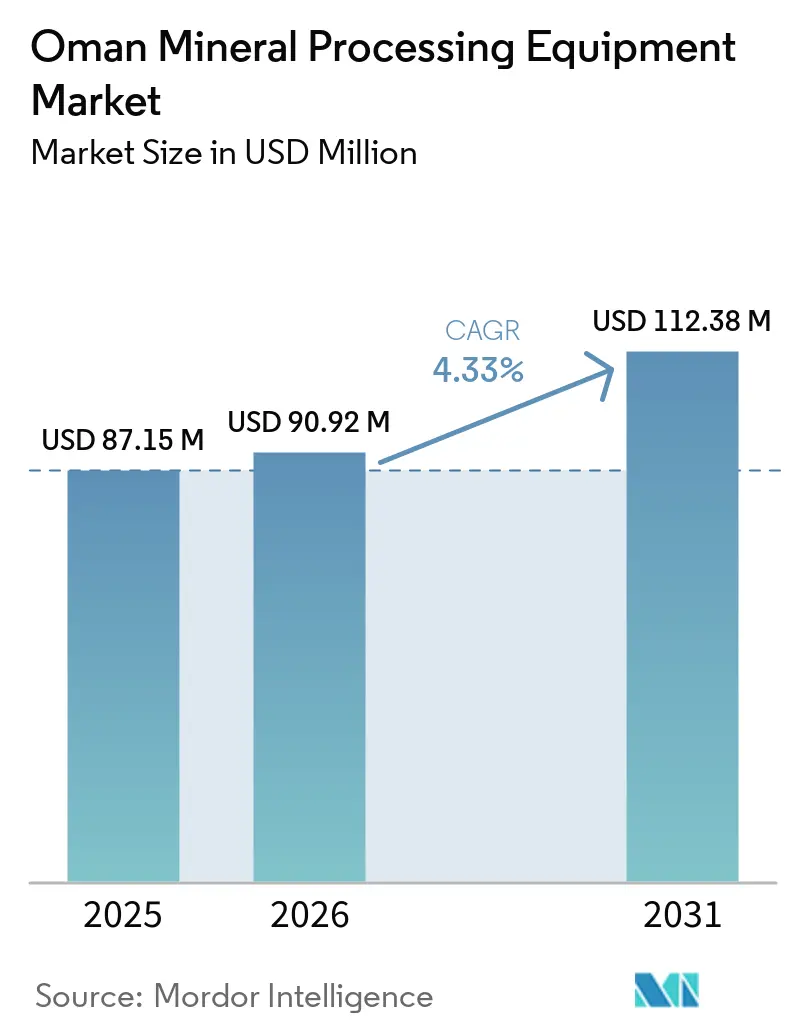
The Oman mineral processing equipment market size was valued at USD 87.15 million in 2025 and is estimated at USD 90.92 million in 2026, and is projected to reach USD 112.38 million by 2031 at a 4.33% CAGR over 2026-2031. Heightened capital spending on copper and chromite projects under Vision 2040, falling renewable-power tariffs that lower grinding costs, and duty-free import incentives inside the country’s free zones are together sustaining steady equipment orders. Demand is strongest for crushers, mills, and flotation cells that support beneficiation projects now moving from feasibility to construction. At the same time, rapid downstream investments in lithium-battery materials are triggering early procurement of fine-grinding and classification systems, signaling that technology adoption is accelerating even ahead of domestic lithium extraction. Vendors that bundle predictive maintenance, remote monitoring, and local training into their offerings are positioned to lock in multiyear service revenue and secure higher In-Country-Value (ICV) scores during public tenders.
Key Report Takeaways
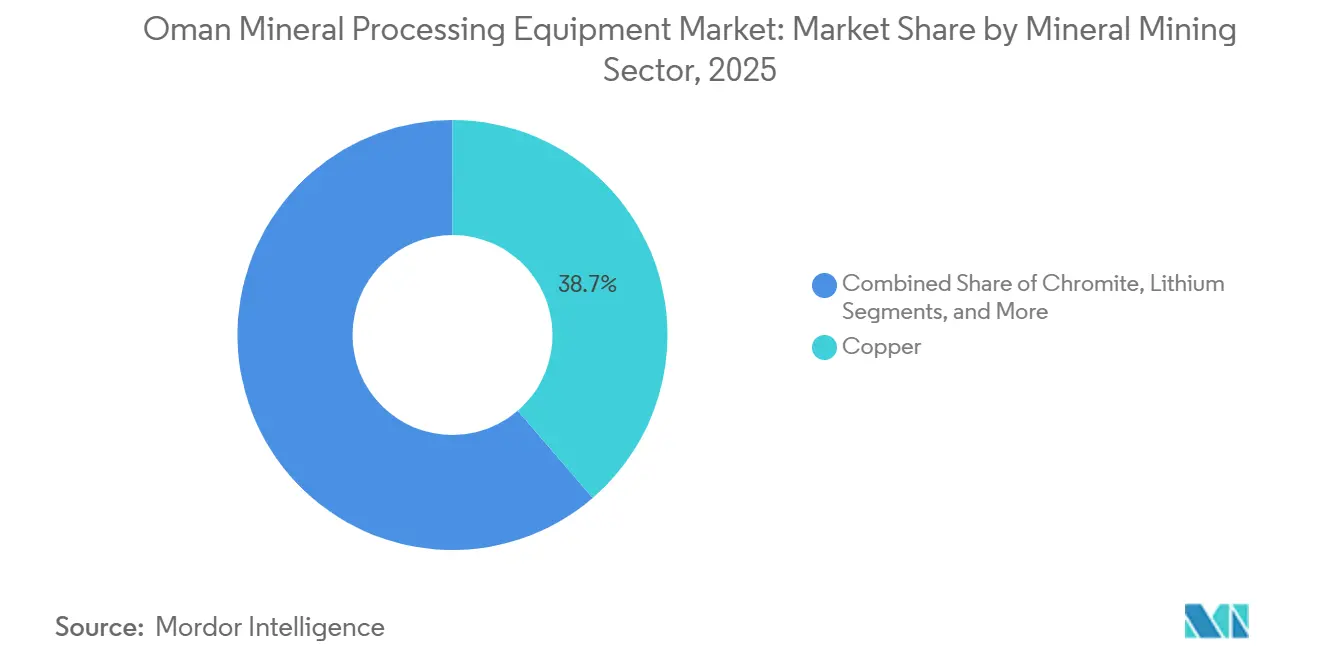
- By mineral sector, copper led with a 38.71% share of the Oman mineral processing equipment market in 2025, while lithium applications are forecast to expand at a 5.37% CAGR through 2031.
- By equipment type, crushers commanded 27.14% of the Oman mineral processing equipment market size in 2025, whereas drills and breakers are projected to grow at a 6.35% CAGR through 2031.
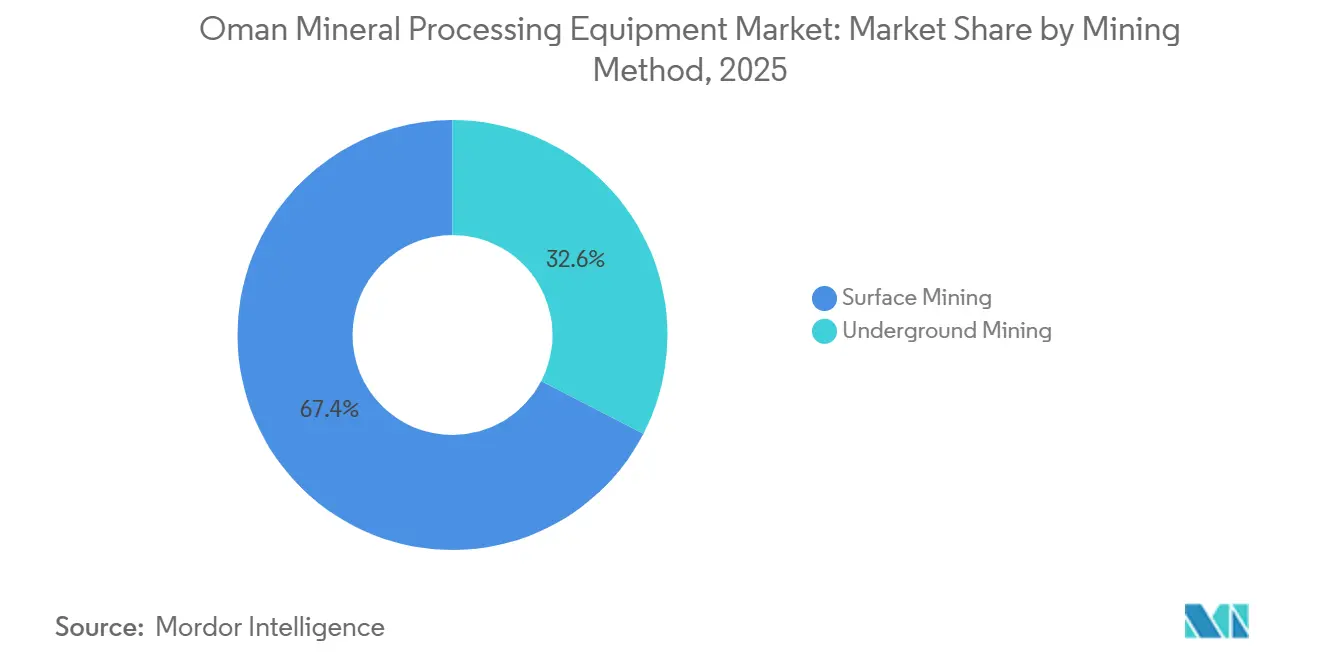
- By mining method, surface operations accounted for 67.37% of the Oman mineral processing equipment market share in 2025, yet underground techniques are advancing at a 6.41% CAGR through 2031.
- By automation level, manual systems represented 41.28% of equipment demand in 2025, but fully automated platforms are projected to grow at a 5.43% CAGR over 2026-2031.
Note: Market size and forecast figures in this report are generated using Mordor Intelligence’s proprietary estimation framework, updated with the latest available data and insights as of January 2026.
Global valuation is built by aggregating outputs from multiple countries and regions, with Oman being one of the contributors. Our global mineral processing equipment market size represents that cumulative total.
Oman Mineral Processing Equipment Market Trends and Insights
Drivers Impact Analysis*
| Driver | (~) % Impact on CAGR Forecast | Geographic Relevance | Impact Timeline |
|---|---|---|---|
| Surge In Copper and Chromite Expansion Projects Under Vision 2040 | +1.2% | National, concentrated in Sohar, Yanqul, Liwa wilayats | Medium term (2-4 years) |
| State-Backed Funding Via Minerals Development Oman (MDO) | +0.9% | National, across 14 MDO concession blocks spanning 23,763 km² | Long term (≥4 years) |
| In-Country-Value (ICV) Rules Driving Efficiency-Focused Upgrades | +0.7% | National, enforced via public procurement and concession agreements | Short term (≤2 years) |
| Falling Renewable-Power Tariffs Boosting Energy-Intensive Grinding | +0.6% | National, with early gains in Sohar Industrial City, Duqm Special Economic Zone | Medium term (2-4 years) |
| Exploration-Licensing Reforms Accelerating Mine Start-Ups | +0.5% | National, with priority in Al Wusta, A'Dhahirah, and Musandam governorates | Medium term (2-4 years) |
| Free-Trade Industrial Zones Waiving Import Duties on Heavy Machinery | +0.4% | Sohar Free Zone, Duqm Special Economic Zone, Salalah Free Zone | Short term (≤2 years) |
| Source: Mordor Intelligence | |||
Surge in Copper and Chromite Expansion Projects Under Vision 2040
Flagship builds such as the Mazoon Copper Project, delivering a 2.5 million t/y concentrator by early 2027, together with Gulf Alloys’ ferrochrome capacity hike toward 400,000 t/y by 2030, translate directly into multiyear procurement cycles for primary and fine-grinding circuits. Equipment packages already awarded include USD 30 million of crushers, SAG mills, and TankCell flotation units from Metso, signaling firm order visibility through 2026. Additional demand stems from the Al Baydha copper mine, slated for first ore in 2026, which is specifying mobile crushers and feeders to back initial ramp-up volumes. Project clustering inside Sohar-Liwa-Yanqul concentrates logistics, lowers service costs, and allows OEMs to leverage shared inventory pools. Altogether, more than USD 500 million in committed capital ensures a steady pipeline of installation work for global and local vendors alike.
State-Backed Funding via Minerals Development Oman (MDO)
MDO’s investment climb to OMR 102.5 million (USD 266 million) by year-end 2024 underscores the state’s willingness to co-finance early-stage exploration and downstream beneficiation. The company drilled 48,000 m in 2024, confirming sizeable chromite, silica, and dolomite resources that now feed feasibility studies for ferrosilicon, magnesium metal, and titanium-dioxide plants. Through its Ring-Fencing Program, 29% of procurement spending flowed to SME contractors, softening entry barriers for Omani service firms. These interventions shorten payback horizons for processing equipment, widen the qualified-bidder pool, and sustain tender activity past the current construction cycle [1]“Annual Report 2024,” Minerals Development Oman, mdo. om .
In-Country-Value (ICV) Rules Driving Efficiency-Focused Upgrades
Procurement scores that reward local service hubs and knowledge transfer are prompting OEMs to pair hardware with digital twins, simulator-based training, and remote monitoring. Metso’s Mazoon package includes a dedicated Omani service center, while Hitachi’s excavator supply to Galfar relies on dealer Al Fairuz for warranty and technician training. Stricter ICV audits, therefore, steer buyers toward suppliers capable of embedding predictive analytics and workforce development within a single contract, cementing after-sales relationships and improving equipment uptime [2]“ICV Employment Targets 2025,” Ministry of Labor, labour.gov.om .
Falling Renewable-Power Tariffs Boosting Energy-Intensive Grinding
Grid-connected solar and wind already cover 11.5% of Omani load, with a 30% target set for 2030. Jinnan Iron & Steel’s Sohar concentrator is installing roughly 25 MW of Vertimill capacity that can shift load to low-cost daytime solar, cutting operating power expenses by an estimated 10-15%. The parallel rollout of dry-grinding technology at Vulcan Pelletizing removes water entirely from circuit design, further aligning with green-power availability in arid governorates. As renewable share rises, differential tariffs will favor high-throughput, energy-efficient mills, driving retrofit orders across existing sites.
Restraints Impact Analysis*
| Restraint | (~) % Impact on CAGR Forecast | Geographic Relevance | Impact Timeline |
|---|---|---|---|
| Acute Water Scarcity Constraining Wet Processing | -0.5% | National, most severe in Al Wusta, A'Dhahirah, and interior governorates | Long term (≥4 years) |
| Logistics Gaps—Delayed Rail Link to Interior Mining Clusters | -0.4% | National, concentrated in A'Dhahirah, Al Wusta, and Musandam governorates | Medium term (2-4 years) |
| Stringent Dust and Emissions Regulations | -0.3% | National, enforced by Ministry of Environment and Climate Affairs | Short term (≤2 years) |
| Limited Skilled Mechatronics Workforce for Plant Automation | -0.3% | National, with acute shortages in Sohar, Duqm, and Salalah industrial zones | Medium term (2-4 years) |
| Source: Mordor Intelligence | |||
Acute Water Scarcity Constraining Wet Processing
Freshwater resources of barely 1.4 km³ force miners to weigh dry versus wet circuit economics carefully. Mazoon has opted for a zero-liquid-discharge design built around high-density thickeners and Larox filter presses, while Vulcan Pelletizing switched to dry mills that use air classification. Although such hardware carries a 20-30% capital premium, it eliminates hydro-cyclone process water and reduces tailings pond footprints, a decisive advantage under tightening environmental permits.
Logistics Gaps—Delayed Rail Link to Interior Mining Clusters
Until the 435 km mining spur comes online in 2028, operators hauling copper concentrate from Yanqul or chromite from A’Dhahirah will continue to depend on road transport, which costs up to USD 0.12 per ton-kilometer. These elevated logistics costs make long-distance haulage less economical, particularly for mines in remote districts with limited access to rail or port-linked infrastructure. High trucking tariffs limit throughput expansions, increase the cost sensitivity of new mining projects, and drive demand for mobile or modular processing trains that can be deployed closer to extraction sites. By reducing the need for fixed downstream infrastructure before the rail link becomes operational, these solutions help operators lower stranded infrastructure risk and maintain greater flexibility in scaling production.
*Our forecasts treat driver/restraint impacts as directional, not additive. The impact forecasts reflect baseline growth, mix effects, and variable interactions.
Segment Analysis
By Mineral Mining Sector: Copper Dominates, Lithium Accelerates
Copper captured 38.71% of the Oman mineral processing equipment market size in 2025, underpinned by the Mazoon, Lasail, and Al Baydha mines that collectively sustain orders for crushers, SAG/ball mills, and TankCell flotation lines. The Lasail restart alone processes 500,000 t/y of ore grading 18-22 % Cu and needs mobile crushers and apron feeders to handle massive-sulfide material. Mazoon’s 2.5 million t/y concentrator adds Larox FFP 3512 filters and high-rate thickeners as part of its zero-liquid-discharge flow sheet.
Chromite holds second place, supported by Gulf Alloys’ ambition to reach 400,000 t/y of ferrochrome by 2030, which drives demand for magnetic separators and dense-medium cyclones. Lithium’s current contribution is small, yet its 5.37% CAGR makes it the fastest-growing segment as cathode and anode material plants in Salalah and Sohar pre-order attritors, spray dryers, and calcination kilns in anticipation of future domestic brine projects. The Oman mineral processing equipment market share, therefore, tilts toward copper in the near term, while lithium’s momentum flags a strategic pivot toward battery-value chains within a decade.



By Equipment Type: Crushers Lead, Drills Accelerate
Crushers commanded 27.14% of 2025 spending, reflecting sustained open-pit production that moves ore from 1,000 mm down to sub-25 mm feed for grinding. Metso’s Nordberg C130 and HP200e units at Mazoon exemplify this demand. Grinding mills remain the number-two category and gain a competitive edge through Vertimill installations that cut power use by 20-30% and capitalize on cheaper daytime solar tariffs.
Drills and breakers post the fastest CAGR at 6.35% through 2031 as exploration meters multiply under the streamlined 2025 Licensing Round, pulling in Epiroc surface rigs and hydraulic hammers. Pumps, thickeners, screens, and separators comprise the process-support backbone, while the “others” segment—flotation cells, filters, and online analyzers—captures incremental spend linked to automation and water conservation. The micro-mix of orders points to a gradual shift from bulk-tonnage crushing toward smarter, sensor-equipped separation equipment that slots into advanced control loops.
By Mining Method: Surface Dominates, Underground Emerges
Surface operations accounted for 67.37% of 2025 demand as shallow copper and chromite pits leverage low strip ratios and free-zone import incentives for excavators and haul trucks. Hitachi’s August 2024 delivery of 22 ZX490LC-7G excavators to Galfar exemplifies scale and efficiency improvements, with 16-17% fuel savings versus prior models.
Underground techniques, however, register the briskest growth at 6.41% CAGR, driven by deeper ore below Lasail and Al Baydha. Mechanized jumbos, LHDs, and paste-backfill systems—areas where Epiroc and Sandvik specialize—are now written into prefeasibility budgets. As tailings footprints face tighter scrutiny, underground stoping combined with paste fill limits waste rock on the surface and helps projects clear environmental hurdles sooner.
By Automation Level: Manual Persists, Fully Automated Gains
Manual controls still make up 41.28% of installed equipment as expatriate operators remain plentiful, yet semi- and fully automated systems are rising on the back of ICV credits that reward technology transfer. Metso’s PSI500i particle-size analyzers and Courier 6X SL elemental analyzers furnish live data streams that enable closed-loop mill and flotation control, trimming recovery losses by up to 5%.
Fully automated platforms post a 5.43% CAGR as OEMs package remote diagnostics, cloud dashboards, and AI-driven maintenance into core hardware. The growth curve hinges on closing the mechatronics skills gap; public-private training modules are therefore becoming contractual prerequisites, aligning workforce development with capex deployment.
Geography Analysis
Sohar-Liwa-Yanqul anchors the Oman mineral processing equipment market, with a substantial pipeline of committed projects across copper, iron ore, ferrochrome, anode material, and titanium dioxide processing. Sohar Port’s bulk terminal expansion, signed with C. Steinweg Oman, significantly expands storage capacity and streamlines concentrate exports, reducing demurrage risk for new entrants. The Mazoon and Al Baydha mines, located inland, rely on ASYAD road haulage until the rail spur becomes operational, sustaining demand for mobile in-pit units and modular plants that limit stranded assets.
The Duqm Special Economic Zone, located on the central coast, benefits from a major port upgrade announced recently. The upgrade positions Duqm to serve the Ash Shuwaymiyah industrial minerals project once feasibility and port infrastructure studies conclude. Free-zone incentives mirror those in Sohar, making Duqm attractive for limestone, gypsum, and silica flowsheets that require rotary dryers and air classifiers rather than large-scale comminution lines.
Salalah Free Zone in the south supports the battery materials narrative, with GFCL EV’s cathode plant and adjacent projects importing fine-grinding attritors duty-free. The interior governorates of Al Wusta and A’Dhahirah hold significant silica and dolomite resources. However, acute water scarcity and the deferred rail link continue to delay large-scale developments, keeping project pipelines concentrated along coastal logistics hubs for now.
Coverage of the mineral processing equipment market by Mordor Intelligence spans a wide geographic footprint, with detailed country-level intelligence for Morocco, South Africa, Italy, Brazil, Saudi Arabia, Australia, China, Canada, and Germany, each shaped by local operating conditions.
Competitive Landscape
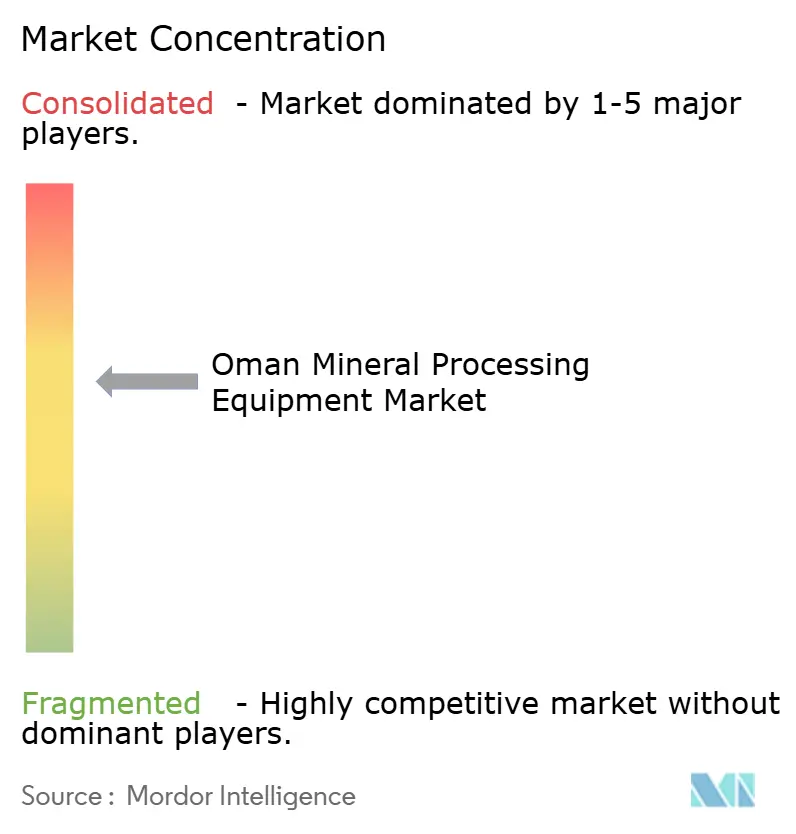
The Oman mineral processing equipment market remains moderately concentrated. Global OEMs secure most primary supply contracts, while local dealers capture maintenance and parts business. Metso is positioned to lead, supported by a significant copper-concentrator hardware contract and an undisclosed but material Vertimill and thickener package for Jinnan Iron & Steel. FLSmidth differentiates itself through dry-grinding lines that eliminate water use, aligning with the country’s water scarcity constraints. Hitachi’s sizable excavator order, channeled through Al Fairuz, highlights the role of dealer networks and ICV-driven training commitments in influencing heavy mobile equipment tenders.
Epiroc, through Bin Salim Enterprises, is positioning itself for underground growth by offering drill jumbos and rock-reinforcement kits calibrated for deeper copper orebodies, now moving into the design phase. TAKRAF’s DELKOR unit is targeting demand for tailings filtration, while its IPCC systems support lower carbon intensity for open-pit operations facing fuel-price volatility.
Chinese entrants offer budget-priced crushers and screens. However, limited after-sales coverage and ICV penalties restrict their market share. Hardware-plus-software integration, including predictive maintenance, digital twins, and remote trending, is emerging as the winning strategy for OEMs seeking stable aftermarket revenue.
Oman Mineral Processing Equipment Industry Leaders
Metso Outotec
Sandvik AB
FLSmidth A/S
Weir Group PLC
Komatsu Ltd.
- *Disclaimer: Major Players sorted in no particular order

Recent Industry Developments
- August 2026: Oman Minerals Trading Company launched its first integrated shipment of Omani chromite ore through Sohar Port, exceeding 50,000 tons. This milestone marks a new phase in the export of Omani chromite ore.
- June 2026: Gulf Metal Materials Company expanded its chrome processing capacity at its Samail plant in Oman. Developed with an investment of approximately USD 5.2 million (OMR 2 million), the facility is one of the largest chrome ore processing and purification plants in Oman and the wider region.
- March 2025: Metso introduced a sustainable leaching process for low-grade copper concentrates that uses less process water and achieves higher recovery, which is timely for Omani projects facing water-use curbs.
- November 2025: Minerals Development Oman (MDO) signed an OMR 204 million (USD 530 million) partnership agreement with India's JSW Group for the South Minerals Project. The project spans three concession zones covering 1,500 sq km and requires substantial integrated extraction and processing machinery for gypsum and limestone.


Oman Mineral Processing Equipment Market Report Scope
The scope of the report includes the mineral mining sector (Copper, Chromite, Lithium, Iron Ore, and Others), equipment type (Crushers, Grinding Mills, Feeders and Conveyors, Drills & Breakers, Screens & Separators, Pumps & Thickeners, and Others), mining method (Surface Mining and Underground Mining), and automation level (Manual, Semi-Automated, and Fully-Automated). The Market Forecasts are Provided in Terms of Value (USD) and Volume (Units).
| Copper |
| Chromite |
| Lithium |
| Iron Ore |
| Others |
| Crushers |
| Grinding Mills |
| Feeders & Conveyors |
| Drills & Breakers |
| Screens & Separators |
| Pumps & Thickeners |
| Others |
| Surface Mining |
| Underground Mining |
| Manual |
| Semi-Automated |
| Fully-Automated |
| By Mineral Mining Sector | Copper |
| Chromite | |
| Lithium | |
| Iron Ore | |
| Others | |
| By Equipment Type | Crushers |
| Grinding Mills | |
| Feeders & Conveyors | |
| Drills & Breakers | |
| Screens & Separators | |
| Pumps & Thickeners | |
| Others | |
| By Mining Method | Surface Mining |
| Underground Mining | |
| By Automation Level | Manual |
| Semi-Automated | |
| Fully-Automated |


Key Questions Answered in the Report
How large is the Oman mineral processing equipment market today?
It is valued at USD 90.92 million in 2026 and is projected to reach USD 112.38 million by 2031.
Which mineral drives the bulk of equipment demand?
Copper represents the largest slice at 38.71% of 2025 spending, reflecting several open-pit and concentrator builds.
What is the fastest-growing equipment category?
Drills and breakers, boosted by renewed exploration drilling, post a 4.35% CAGR through 2031.
Where are most processing plants located?
The Sohar-Liwa-Yanqul corridor hosts the majority of current and planned concentrators, taking advantage of port and free-zone incentives.
How are water constraints being addressed?
New projects are adopting dry-grinding circuits, high-density thickeners, and filter-press tailings systems to achieve zero-liquid-discharge flowsheets.
What role does automation play in future growth?
Fully automated systems, supported by online analyzers and remote diagnostics, are forecast to expand at a 4.43% CAGR as ICV rules favor technology transfer.
Page last updated on:


 Your data is secure and never sold or shared.


