
United Arab Emirates Mineral Processing Equipment Market Size and Share
Market Overview
| Study Period | 2019 - 2031 |
|---|---|
| Forecast Data Period | 2026 - 2031 |
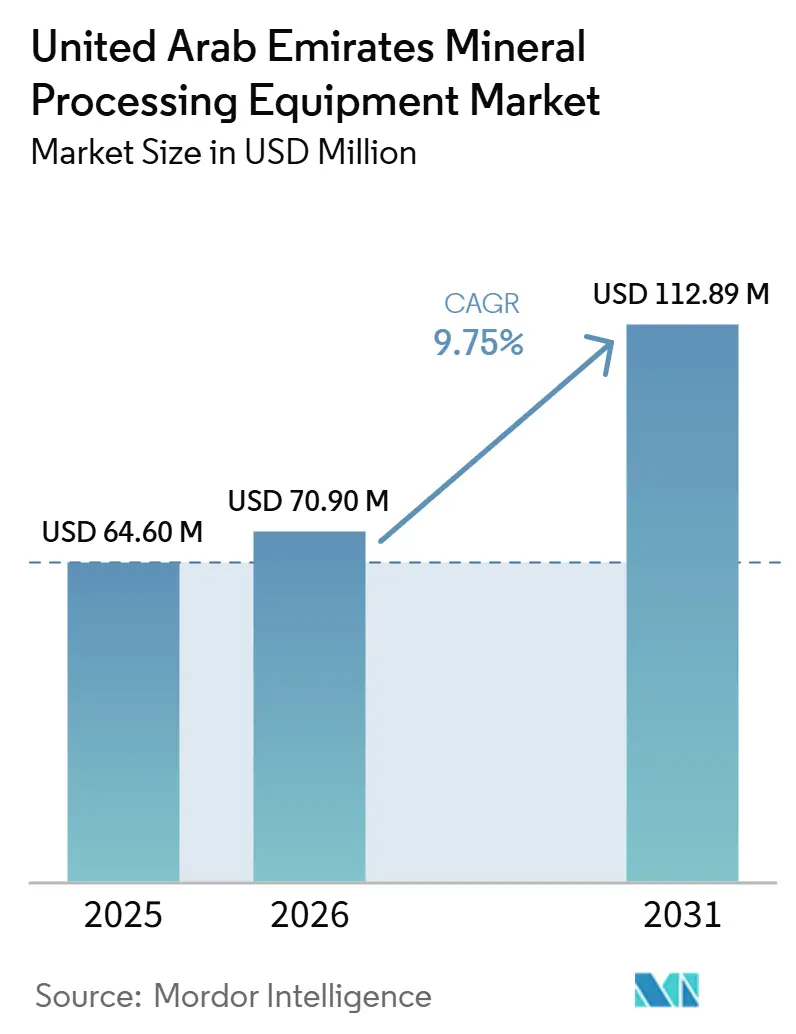
| Base Year Market Size (2025) | USD 64.60 Million |
| Market Size (2026) | USD 70.90 Million |
| Market Size (2031) | USD 112.89 Million |
| Growth Rate (2026 - 2031) | 9.75 % |
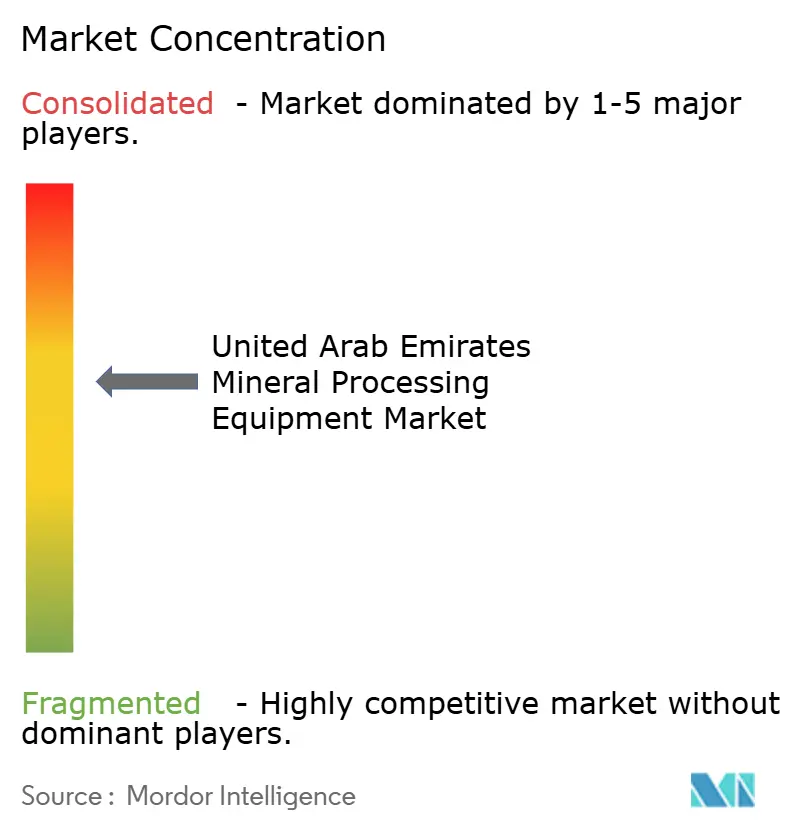
| Market Concentration | Medium |
Major Players *Disclaimer: Major Players sorted in no particular order Image © Mordor Intelligence. Reuse requires attribution under CC BY 4.0. | |
United Arab Emirates Mineral Processing Equipment Market Analysis by Mordor Intelligence
The UAE mineral processing equipment market size was valued at USD 64.6 million in 2025 and is estimated to grow from USD 70.9 million in 2026 to reach USD 112.89 million by 2031, at a CAGR of 9.75% during the forecast period (2026-2031). The UAE mineral processing equipment market is moving in tandem with the country’s industrial pivot away from hydrocarbons toward aluminum, steel, and battery-grade minerals, a shift reinforced by Operation 300bn investment incentives. Bauxite processing remains the revenue anchor, while lithium refining is advancing fastest on the back of Titan Lithium’s AED 5 billion facility in KEZAD. Crushers dominate current spending, yet autonomous, cable-electric drills and battery-electric underground loaders are gaining traction as operators pursue productivity, safety, and decarbonization in tandem. Sovereign policy support insulates suppliers from short-term commodity swings, although strict dust, noise, and water controls raise capital intensity and favor OEMs with robust environmental credentials.
Key Report Takeaways
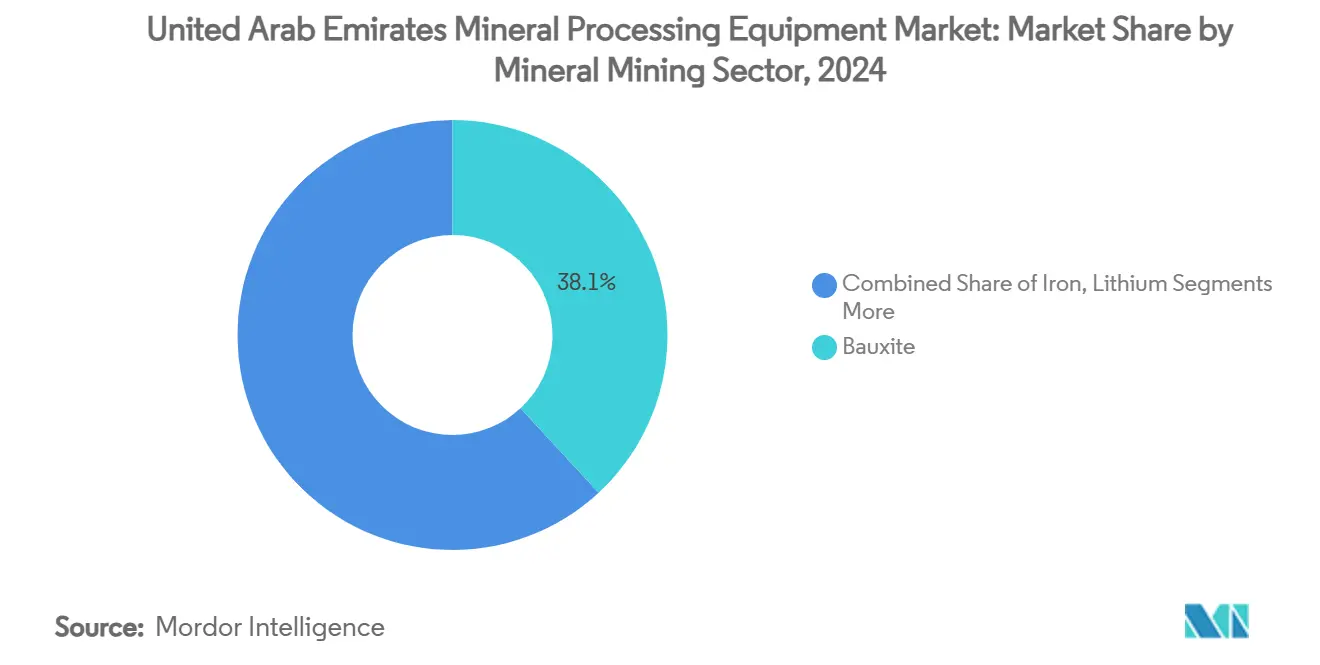
- By mineral type, bauxite led the UAE mineral processing equipment market with a 38.12% share in 2025, while lithium processing is forecast to expand at a 10.43% CAGR through 2031.
- By equipment type, crushers accounted for 41.08% of the UAE mineral processing equipment market in 2025, and drills and breakers are projected to grow at an 11.72% CAGR through 2031, led by autonomous platforms.
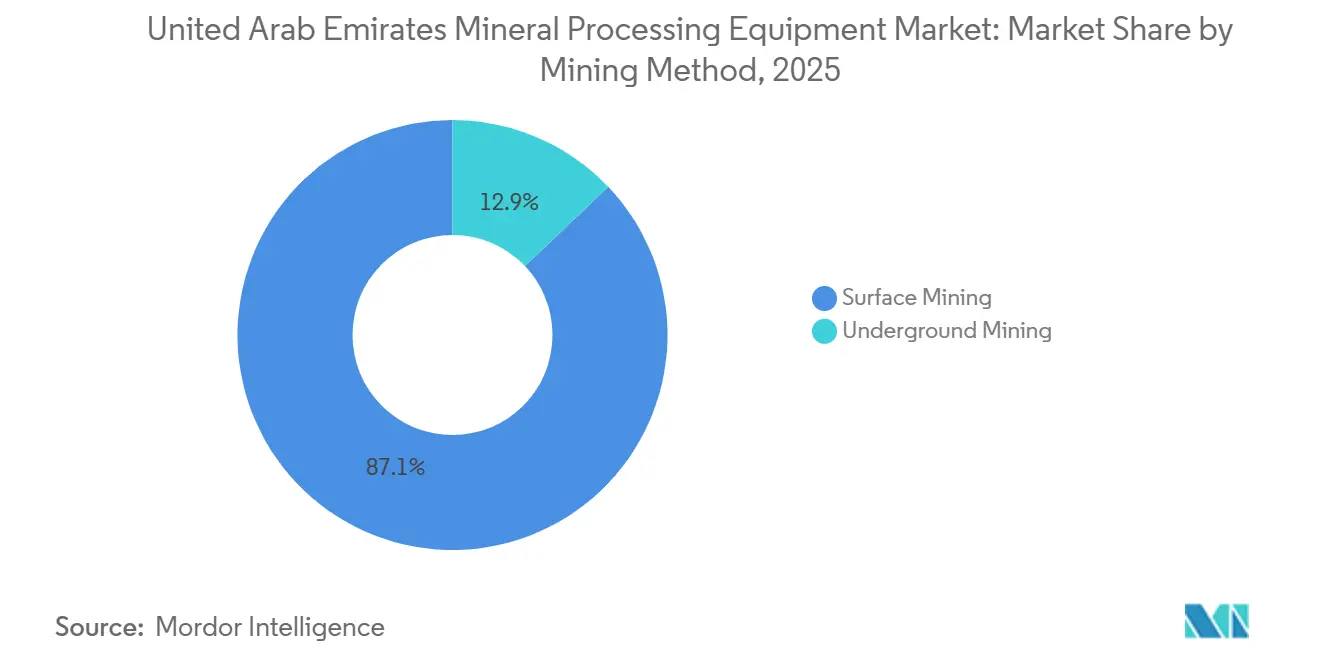
- By mining method, surface operations accounted for 87.14% in 2025, yet underground equipment demand is set to grow at a 10.57% CAGR over the forecast period.
- By automation level, semi-automated platforms captured 64.06% of revenue in 2025, and fully automated systems are anticipated to grow at an 11.11% CAGR through 2031.
- By geography, Abu Dhabi accounted for 41.34% of 2025 revenue, while Fujairah is expected to record the fastest CAGR of 9.81% through 2031.
Note: Market size and forecast figures in this report are generated using Mordor Intelligence’s proprietary estimation framework, updated with the latest available data and insights as of January 2026.
United Arab Emirates Mineral Processing Equipment Market Trends and Insights
Drivers Impact Analysis*
| Driver | (~) % Impact on CAGR Forecast | Geographic Relevance | Impact Timeline |
|---|---|---|---|
| Construction-Led Demand for Crushed Aggregates | +2.8% | Dubai, Abu Dhabi, Sharjah | Short Term (≤ 2 Years) |
| Industrial Diversification and Operation 300 billion Incentives | +2.1% | National, concentrated in Abu Dhabi | Medium Term (2–4 Years) |
| Expansion of Aluminum and Steel Capacity | +1.9% | Abu Dhabi, with spillover to other emirates | Medium Term (2–4 Years) |
| Regional Hub Strategy for Critical-Mineral Refining | +1.6% | Abu Dhabi KEZAD, Dubai DMCC | Long Term (≥ 4 Years) |
| Renewable-Powered Processing and Green-Hydrogen Integration | +0.8% | Abu Dhabi, Fujairah | Long Term (≥ 4 Years) |
| Mandatory Recycled-Aggregate Targets in Dubai | +0.5% | Dubai, with potential expansion to other emirates | Short Term (≤ 2 Years) |
| Source: Mordor Intelligence | |||
Construction-led Demand for Crushed Aggregates
High demand for gabbro, limestone, and dune-sand processing equipment is being driven by urban planning initiatives, infrastructure development projects, and legacy projects from major events. Ready-mix producers are specifying smaller fractions, leading to increased purchases of mobile crushers and high-capacity screens. In Ras Al Khaimah, Terex MPS highlighted the importance of single-site scale requirements by installing a large limestone plant for JSW Cement. Regulations now mandate enclosed plants and continuous dust monitoring, pushing quarry owners to seek out OEMs that can integrate suppression systems right from the design stage.
Industrial Diversification and Operation 300 Billion Incentives
Operation 300 billion aims to significantly increase manufacturing GDP, offering tax breaks, subsidized land, and streamlined licensing for projects in metals, machinery, and chemicals [1]“Operation 300bn Strategy,”, UAE Ministry of Industry and Advanced Technology, moiat.gov.ae. Emirates Steel Arkan's Asset Enhancement Program demonstrates the direct impact of policy on orders for furnaces, conveyors, and beneficiation lines[2]“Asset Enhancement Programme,”, Emirates Steel Arkan, emsteel.com. Additionally, the program fosters refurbishment and spare parts hubs, enabling local distributors to capture aftermarket demand.
Expansion of Aluminum and Steel Capacity
Al Taweelah's pilot project is pivotal in priming the technology for widespread industrial adoption. This initiative not only lays the groundwork for EGA's future expansion in low-carbon primary aluminum production but also bolsters EGA's stature as the preferred smelting technology provider in the global aluminum arena. Furthermore, the pilot aims to validate cutting-edge Industry 4.0 features within the aluminum sector. EGA plans to integrate all its current Industry 4.0 applications into this new technology, while also pioneering advanced digital solutions, emphasizing artificial intelligence and sophisticated data analytics. Meanwhile, Emirates Steel’s pilot for green-hydrogen direct-reduced iron achieved a substantial reduction in CO₂ emissions, highlighting the growing demand for low-emission material-handling equipment.
Regional Hub Strategy for Critical-Mineral Refining
The UAE-US Critical Minerals Framework, signed in February 2026, positions Abu Dhabi as a refining hub for lithium, cobalt, and rare earths. Titan Lithium’s AED 5 billion KEZAD plant will handle 120,000 t/y of Zimbabwean spodumene, requiring rotary kilns, flotation cells, and hydrometallurgical reactors, thereby broadening the UAE mineral processing equipment market. Parallel research on brine mining could diversify feedstock and spark demand for membrane-based systems
Restraints Impact Analysis*
| Restraint | (~) % Impact on CAGR Forecast | Geographic Relevance | Impact Timeline |
|---|---|---|---|
| Stringent Dust- and Noise-Emission Regulations | -1.4% | National, particularly urban areas | Short Term (≤ 2 Years) |
| High Upfront Capex and Long Payback Periods | -1.1% | National, affecting all market segments | Medium Term (2–4 Years) |
| Water Scarcity Inflating Wet-Processing OPEX | -0.9% | National, acute in inland operations | Long Term (≥ 4 Years) |
| Volatile Utilization Due to Limited Domestic Ore Reserves | -0.7% | National, concentrated in Fujairah | Medium Term (2–4 Years) |
| Source: Mordor Intelligence | |||
Stringent Dust- and Noise-Emission Regulations
Cabinet resolutions and ministerial directives have set EU-equivalent standards for crushers and quarries. These standards mandate the installation of baghouses and acoustic enclosures, and they restrict drilling hours near residential areas. These measures aim to minimize environmental and noise pollution, ensuring sustainable operations in the industry. Consequently, compliance with these regulations substantially raises greenfield capital expenditures, discouraging smaller entrants from joining the market and amplifying the importance of OEMs that possess environmental management systems.
Water Scarcity Inflating Wet-Processing OPEX
In arid basins, Mazoon Copper of Oman, along with its regional counterparts, underscores the hefty capital demands of desalination, paste tailings, and zero-discharge systems. These technologies are essential for addressing water scarcity challenges in the region, ensuring sustainable operations in resource-intensive industries. Concurrently, processors in the UAE, grappling with high costs for process water, are turning to thickeners and filter presses, leading to a marked decrease in freshwater consumption. This shift not only reduces operational costs but also aligns with environmental sustainability goals by minimizing water wastage.
*Our forecasts treat driver/restraint impacts as directional, not additive. The impact forecasts reflect baseline growth, mix effects, and variable interactions.
Segment Analysis
By Mineral Mining Sector: Bauxite Dominance Amid Lithium Surge
Lithium processing is projected to grow at a 10.43% CAGR to 2031. This growth is driving demand for high-temperature rotary kilns, specialty flotation cells, and corrosion-resistant hydromet reactors. Bauxite retained 38.12% of the UAE mineral processing equipment market share in 2025, driven by EGA's strong alumina output. However, as production capacity approaches its limit, future growth will rely more on improvements in smelting efficiency than on increases in raw tonnage. Demand for iron processing equipment is supported by Emirates Steel's capacity expansion, sustaining orders for crushers, magnetic separators, and pelletizers. Minerals such as limestone, gabbro, and copper, while subject to cyclical trends, continue to create consistent replacement demand across various quarry clusters.
Technology Innovation Institute's brine-mining initiative aims to contribute a notable portion of lithium feedstock in the future. This development could redirect capital expenditure from traditional comminution methods to advanced membrane and electrodialysis units. Additionally, EGA's recognition as an Industry 4.0 Lighthouse highlights the importance of end-to-end IoT and analytics, setting a benchmark that suppliers must meet. The iron sector is poised to benefit from the growing demand for premium "green steel," which commands higher export prices due to evolving carbon regulations. This trend is further driving the adoption of high-efficiency processing lines.



By Equipment Type: Crusher Leadership Versus Autonomous Innovation
Crushers accounted for 41.08% of the UAE mineral processing equipment market size in 2025, serving quarry output that exceeded 100 million tons in Fujairah. Autonomous drills are forecast to clock a 11.72% CAGR through 2031 as high-precision blasthole patterns cut powder costs and enhance fragmentation quality.
Next-generation haulers, such as the Cat 775, integrate driverless kits and analytics dashboards, nudging fleet owners to favor interoperable platforms across the UAE's mineral processing equipment market. Conveyors, feeders, and classification screens follow crushers in value contribution, yet the highest margin lies in aftermarket liners, automation retrofits, and sensor packages.
By Mining Method: Surface Dominance With Underground Acceleration
Surface fleets held 87.14% of the UAE mineral processing equipment market share in 2025, due to abundant limestone and gabbro quarries. However, the 10.57% CAGR posted by underground units indicates rising interest in deeper basalt, copper, and polymetallic veins. The UAE mineral processing equipment market is thus witnessing stronger quotes for low-profile loaders, bolters, and tele-operated drilling jumbos that fit narrower headings. IoT-enabled ventilation controls and collision-avoidance suites are integral to these underground packages.
By Automation Level: Semi-Automated Present Versus Fully Automated Future
In 2025, semi-automated machines accounted for 64.06% of the revenue, underscoring the rising adoption of digital payload scales, condition-monitoring sensors, and remote-control stations.
As sites increasingly turn to autonomous drills, loaders, and haulage fleets to cut labor costs and enhance safety, the market for fully automated systems is set to expand at a 11.11% CAGR. This growth is further fueled by 5G coverage in industrial zones nearing 98% and regulatory nods to driverless drill concepts. Major OEMs are committing to a zero-emission catalog by 2030, seamlessly integrating automation and electrification into a unified capital expenditure cycle.
Geography Analysis
Abu Dhabi captured 41.34 % of 2025 revenue by hosting EGA’s Al Taweelah alumina refinery and Emirates Steel Arkan’s expanding Mussafah complex, both of which require large-scale crushers, conveyors, and grinding circuits. The new Titan Lithium plant in KEZAD adds hydromet processing lines and, together with EGA’s EX smelter pilot, cements Abu Dhabi’s role as the federal hub for critical-mineral investment. OEMs maintain technical centers near Khalifa Port to provide 24/7 support to these anchor accounts.
Fujairah is forecast to post a 9.81% CAGR through 2031 as more than 90 active quarries in the Hajar Mountains retrofit their crushing plants to comply with dust limits. Dense clustering reduces service response times, prompting distributors such as Galadari and Al Marwan to establish local parts depots and workshops. Ras Al Khaimah shares the same geology and benefits from high-capacity limestone plants serving regional cement demand.
Dubai contributes a small share of revenue but holds significant regulatory influence. Laws in Dubai require contractors to purchase mobile crushers and screens for on-site concrete recycling, driving unit sales despite limited primary-ore reserves. Meanwhile, Sharjah and other emirates have established markets centered on secondary steel, block production, and ready-mix activities, primarily in industrial zones.
Competitive Landscape
In the UAE's mineral processing equipment market, global giants and regional distributors play pivotal roles, resulting in moderate concentration. Caterpillar, a global leader, highlighted its focus on hybrid retrofits, electrified haulers, and SaaS analytics, marking significant sales. Meanwhile, Komatsu Middle East, with a substantial share in the construction segment, emphasizes the importance of total cost of ownership, supported by its strong after-sales and remanufacturing centers.
Epiroc, which primarily earns from the aftermarket, aligns with the service-centric trend by delivering autonomous rigs and battery-electric surface units through long-term agreements. Al Marwan Machinery, a domestic distributor, enhances accessibility for small quarry operators by offering extensive rental options, supporting fleets from Kobelco and Volvo.
Key strategic focuses include autonomous drilling, green-hydrogen-ready kilns, and handling of critical minerals. EPointZero's strategy of bundling solutions such as renewables and high-efficiency comminution aligns with the UAE operator's priorities.
United Arab Emirates Mineral Processing Equipment Industry Leaders
Caterpillar Inc.
Komatsu Ltd.
Metso
Sandvik AB
FLSmidth
- *Disclaimer: Major Players sorted in no particular order

Recent Industry Developments
- February 2026: With the backing of the UAE–US Critical Minerals Framework, the Emirates has cemented its status as a key center for lithium and rare-earth refining. This framework aims to strengthen bilateral cooperation in securing critical mineral supply chains, ensuring sustainable development, and fostering innovation in refining technologies.
- January 2026: Al Marwan, a prominent player in the industry, has renewed its exclusive distribution agreement with Powerscreen, a move that significantly expands its mobile-crushing service capabilities.


United Arab Emirates Mineral Processing Equipment Market Report Scope
The United Arab Emirates mineral processing equipment market report is segmented by mineral type (bauxite, iron, lithium, rare-earth oxides, and others), equipment type (crushers, conveyors, drills & breakers, feeders, and others), mining method (surface mining and underground mining), automation level (manual, semi-automated, and fully automated), and geography. The market forecasts are provided in terms of value (USD).
| Bauxite |
| Iron |
| Lithium |
| Others |
| Crushers |
| Conveyors |
| Drills and Breakers |
| Feeders |
| Others |
| Surface Mining |
| Underground Mining |
| Manual |
| Semi-Automated |
| Fully Automated |
| Abu Dhabi |
| Dubai |
| Fujairah |
| Ras Al Khaimah |
| Sharjah |
| Others |
| By Mineral Mining Sector | Bauxite |
| Iron | |
| Lithium | |
| Others | |
| By Equipment Type | Crushers |
| Conveyors | |
| Drills and Breakers | |
| Feeders | |
| Others | |
| By Mining Method | Surface Mining |
| Underground Mining | |
| By Automation Level | Manual |
| Semi-Automated | |
| Fully Automated | |
| By Geography | Abu Dhabi |
| Dubai | |
| Fujairah | |
| Ras Al Khaimah | |
| Sharjah | |
| Others |


Key Questions Answered in the Report
How large will the UAE mineral processing equipment market be by 2031?
UAE mineral processing equipment market size is projected to reach USD 112.89 million by 2031, expanding at a 9.75 % CAGR from 2026 to 2031.
Which mineral segment is growing fastest in the Emirates?
Lithium processing equipment is forecast to grow at a 10.43 % CAGR, fueled by Titan Lithium’s 120,000 t/y KEZAD refinery and supportive critical-minerals policy.
How dominant is crusher equipment in United Arab Emirates operations?
Crushers accounted for 41.08% of 2025 revenue, reflecting their central role across quarrying, alumina, and steel value chains.
How will automation influence equipment demand to 2031?
Fully automated systems are expected to climb at an 11.11 % CAGR as sites deploy autonomous drills, loaders, and haulage fleets to curb labor costs and enhance safety, lifting total market value.
Which emirate leads spending on mineral processing equipment?
Abu Dhabi contributed 41.34 % of 2025 revenue due to major alumina and steel complexes and upcoming lithium refining capacity.
Page last updated on:





