
Morocco Mining Equipment Market Size and Share
Market Overview
| Study Period | 2019 - 2031 |
|---|---|
| Forecast Data Period | 2026 - 2031 |
| Base Year Market Size (2025) | USD 1.03 Billion |
| Market Size (2026) | USD 1.07 Billion |
| Market Size (2031) | USD 1.26 Billion |
| Growth Rate (2026 - 2031) | 3.46 % |
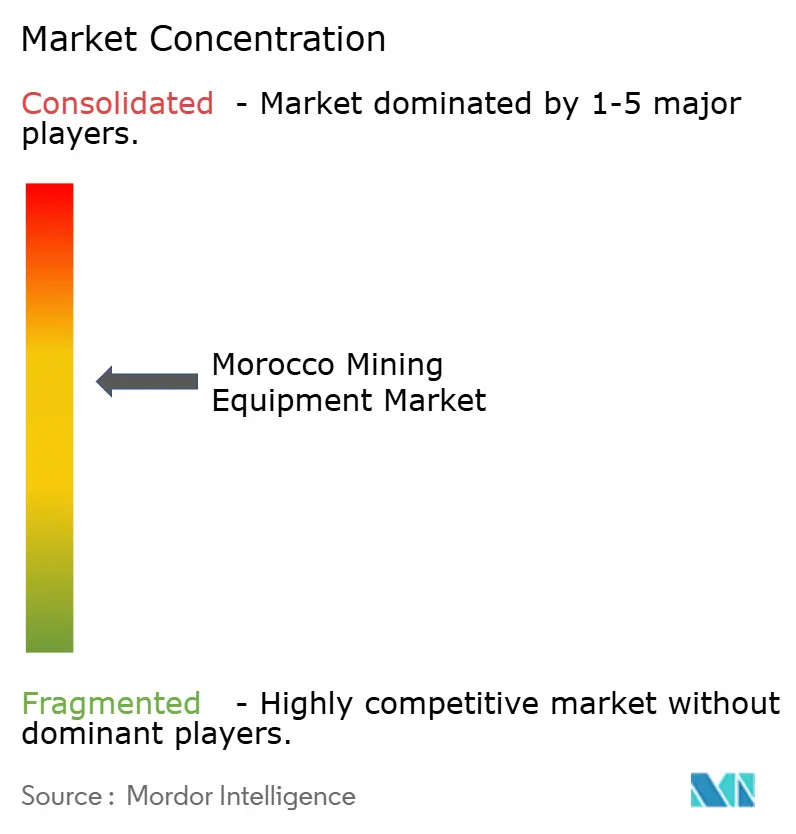
| Market Concentration | Medium |
Major Players *Disclaimer: Major Players sorted in no particular order Image © Mordor Intelligence. Reuse requires attribution under CC BY 4.0. | |
Morocco Mining Equipment Market Analysis by Mordor Intelligence
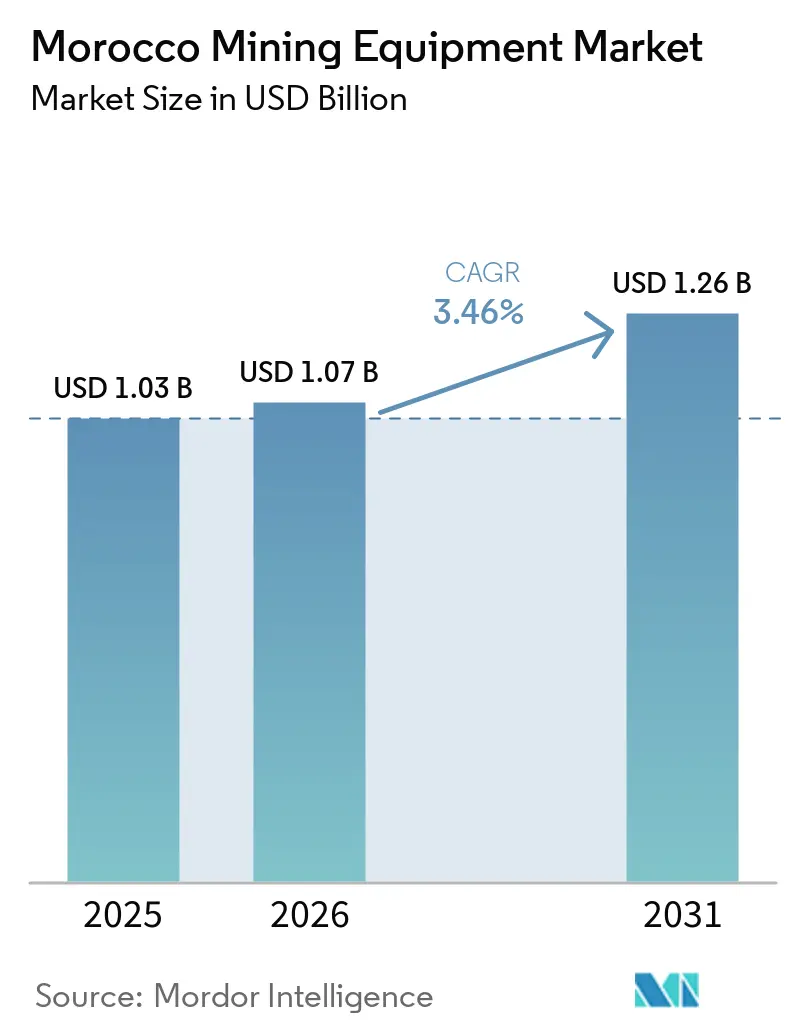
The Morocco mining equipment market size was valued at USD 1.03 billion in 2025 and is estimated to grow from USD 1.07 billion in 2026 to reach USD 1.26 billion by 2031, at a CAGR of 3.46% during the forecast period (2026-2031). The Moroccan mining equipment market is supported by OCP Group’s long-term investment program, which links phosphate capacity expansion with renewable energy, water management, and lower-emission operations. Public policy also supports broader mineral exploration through the Morocco Mines Plan 2021–2030, including measures related to exploration equipment, mining titles, funding, and skills development [1]“Morocco Mines Plan 2021–2030,” International Energy Agency, iea.org. These conditions create a steadier base of demand than is typical in a mining economy that depends only on short-term commodity prices. Growth is also shifting toward copper and cobalt projects, where underground equipment, processing systems, and digital mine tools are more relevant. Suppliers must balance this opportunity against uneven project financing, commodity-price exposure, water requirements, and a limited pool of automation specialists.
Key Report Takeaways
- By equipment type, surface mining equipment held 38.63% of the Moroccan mining equipment market share in 2025, while underground mining equipment is projected to grow at a 6.91% CAGR through 2031.
- By automation level, manual equipment held 67.26% of the Moroccan mining equipment market share in 2025, while fully autonomous equipment is projected to grow at an 8.23% CAGR through 2031.
- By powertrain type, ICE vehicles accounted for 91.21% of the Moroccan mining equipment market in 2025, while battery-electric vehicles are projected to grow at a 10.28% CAGR through 2031.
- By power output, the 500–1,000 HP class accounted for 56.19% of the Moroccan mining equipment market in 2025, while the below-500 HP class is projected to grow at a 6.37% CAGR through 2031.
- By application, metal mining accounted for 48.12% of the Moroccan mining equipment market in 2025 and is projected to grow at a 5.65% CAGR through 2031.
Note: Market size and forecast figures in this report are generated using Mordor Intelligence’s proprietary estimation framework, updated with the latest available data and insights as of January 2026.
Morocco Mining Equipment Market Trends and Insights
Drivers Impact Analysis*
| Driver | (~) % Impact on CAGR Forecast | Geographic Relevance | Impact Timeline |
|---|---|---|---|
| Phosphate-Sector CAPEX Boom | +1.5% | Khouribga, Benguerir, Youssoufia, Gantour Basin | Short-term (≤ 2 years) |
| "Plan Maroc Mines 2021-30" Incentives | +0.7% | Drâa-Tafilalet, Souss-Massa, Anti-Atlas | Medium-term (2–4 years) |
| Demand for Cobalt and Copper | +0.6% | Anti-Atlas, Bou-Azzer, Taroudant | Medium-term (2–4 years) |
| Uptake of Mine-Site Automation | +0.4% | Khouribga, Benguerir, Taroudant (Tizert) | Medium-term (2–4 years) |
| Mine-Fleets Initiatives | +0.3% | Khouribga, Benguerir, Tarfaya | Long-term (≥ 4 years) |
| Polymetallic-Nodule Exploration Prospects | +0.2% | Gharb, Tarfaya, Boujdour (Atlantic offshore) | Long-term (≥ 4 years) |
| Source: Mordor Intelligence | |||
Phosphate-sector CAPEX Boom by OCP Group
OCP Group’s investment program remains the primary near-term anchor of demand for the Moroccan mining equipment market. Its mining, renewable energy, water security, and fertilizer projects are creating coordinated demand for crushing, screening, pumping, conveying, and haulage equipment across key phosphate sites[2]“Our Green Investment Program,” OCP Group, ocpgroup. ma. Suppliers that meet operational and environmental requirements can support new installations, replacements, commissioning, parts availability, maintenance, and performance tracking, while lower-emission compatibility is becoming central to purchasing decisions.
Government "Plan Maroc Mines 2021-30" Incentives
The Morocco Mines Plan gives non-phosphate exploration and mining a clearer policy framework by supporting exploration, mining title management, investment structures, and local capability development. Temporary customs treatment for eligible exploration equipment can reduce early-stage cost burdens, while a national development fund can improve access to capital for smaller developers. These measures expand equipment demand beyond the phosphate value chain and encourage suppliers to engage explorers earlier. This direction benefits the Anti-Atlas and emerging mineral districts, where explorers need drill rigs, geophysical tools, core-handling systems, and light support vehicles before production begins.
EV-Linked Demand for Cobalt and Copper
Cobalt and copper projects are increasing the demand for specialized mining and processing equipment in Morocco. Battery materials development strengthens the case for local mineral processing rather than raw material exports. Projects such as Tizert and Bou-Azzer highlight the need for underground drills, loaders, trucks, ventilation systems, beneficiation systems, process controls, and reliable support equipment. Operators prioritize ore recovery, safety, reliability, quality control, energy use, and maintenance. Suppliers that combine machinery, spares, site data, and technical assistance can better support mines from extraction through processing.
Uptake of Mine-Site Automation and Digital Twins
Automation is gaining relevance as operators seek better control over production, maintenance, safety, and energy use. The Tizert project has integrated digital tools for underground operations, while OCP’s sites provide a platform for testing automated mining practices. Epiroc’s work with Managem shows how suppliers can combine mining machinery with digitalization support[3]“Epiroc partners with Managem for digitalization of Tizert project in Morocco,” Epiroc, epiroc.com. These systems integrate vehicle, personnel, and operating data, helping managers improve maintenance, equipment allocation, safety monitoring, and response to changing underground conditions. Digital adoption does not eliminate skilled workers; it changes the required skills. Demand is rising for engineers and technicians who connect operational technology, equipment data, and maintenance processes. This skills gap may slow adoption at smaller mines. Suppliers offering training, remote support, data services, practical demonstrations, accessible materials, and dependable local service are better positioned to support Moroccan operators making a first automation investment.
Restraints Impact Analysis*
| Restraint | (~) % Impact on CAGR Forecast | Geographic Relevance | Impact Timeline |
|---|---|---|---|
| Commodity-Price Cyclicality | -0.7% | Global, with regional amplification in Morocco | Short term (≤ 2 years) |
| High CAPEX of Advanced Equipment | -0.5% | National, affecting smaller operators disproportionately | Medium term (2–4 years) |
| Water-Scarcity Compliance Costs | -0.4% | National, concentrated in inland mining regions | Long term (≥ 4 years) |
| Scarcity of Autonomous-Mining Skill Sets | -0.3% | National, with regional variations in technical education | Long term (≥ 4 years) |
| Source: Mordor Intelligence | |||
Commodity-price Cyclicality
Commodity price swings can affect equipment purchases in Morocco. Weak phosphate prices can delay fleet replacement or expansion at large operators, while copper and cobalt movements matter more for externally financed smaller developers. In a lower-price environment, operators preserve cash, slow tenders, limit optional technology, and prioritize inspections, component rebuilding, and repairs. The impact varies by customer type. Established phosphate producers offer steadier maintenance demand, while early-stage critical-mineral projects have less flexibility. Leasing, rebuild services, and maintenance agreements ease pressure, but suppliers need aligned terms.
High CAPEX of Advanced Equipment
Advanced equipment presents a clear investment challenge for operators with limited financial capacity. Battery-electric and automated machines require spending on charging, power, communications, training, and maintenance systems. Large operators can absorb these needs through modernization programs, while smaller copper and cobalt projects may prioritize conventional equipment until they establish production. Suppliers are responding with service packages, performance guarantees, and financing arrangements. However, adoption depends on credit strength, production outlook, and stable offtake access. The Moroccan mining equipment market will likely shift to advanced fleets gradually through phased deployment.
*Our forecasts treat driver/restraint impacts as directional, not additive. The impact forecasts reflect baseline growth, mix effects, and variable interactions.
Segment Analysis
By Equipment Type: Surface Operations Remain Central While Underground Demand Expands
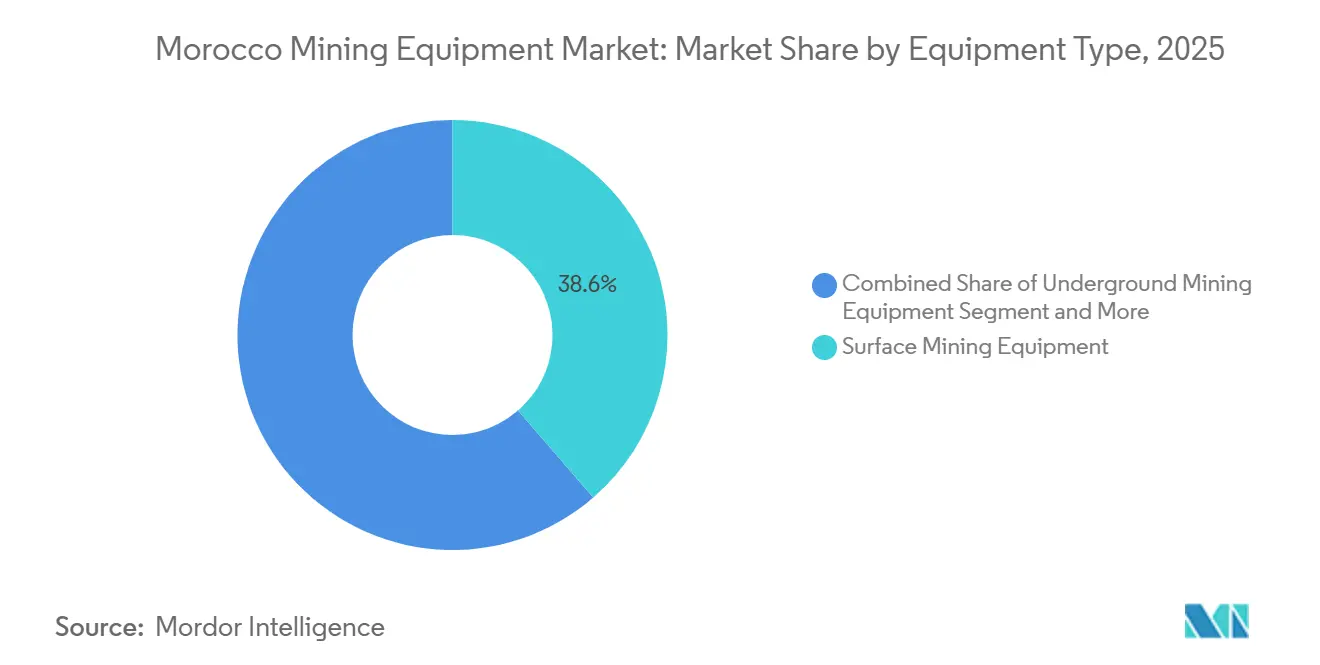
Surface mining equipment accounted for 38.63% of the Moroccan mining equipment market in 2025. Open-pit phosphate operations remain the core source of demand for haulage, loading, conveying, crushing, and screening equipment. Khouribga, Benguerir, and Youssoufia require equipment capable of operating continuously under high-volume conditions. Loaders and haul trucks are important because they support the daily movement of material across several large sites. This preference gives established manufacturers an advantage when they can demonstrate reliable access to service personnel and components throughout the equipment's expected working life. Processing equipment also remains necessary as mine expansion is linked to beneficiation and fertilizer production. Equipment purchases in this segment are closely linked to site reliability, as disruptions in material movement can affect the broader production chain.
Underground mining equipment is projected to grow at a 6.91% CAGR through 2031. Copper and cobalt projects in the Anti-Atlas are increasing the need for underground drills, compact loaders, trucks, and ventilation systems. This shift allows suppliers to apply experience from underground mining regions to Moroccan site conditions. Service coverage is critical because downtime can have a greater effect on a developing underground mine. The Moroccan mining equipment market is likely to become more balanced as underground projects advance alongside phosphate operations. Suppliers must also adapt their offer to narrower work areas, different safety requirements, and customers that may need closer technical support during the early stages of production.



By Automation Level: Manual Fleets Create a Long Transition Path
Manual equipment accounted for 67.26% of the Moroccan mining equipment market in 2025. This position reflects the established fleet base in large phosphate operations and the practical value of conventional machines at many sites. Manual units will remain relevant because operators cannot replace entire fleets simultaneously. Their maintenance history and operator familiarity continue to support use across current operations. Suppliers can serve this base through parts, rebuilds, upgrades, and training. The installed fleet also gives dealers an ongoing reason to maintain workshops, field technicians, and inventories near operating locations.
Fully autonomous equipment is projected to grow at an 8.23% CAGR through 2031. Mine operators are considering autonomy where it can improve safety, equipment utilization, and production coordination. Semi-autonomous functions offer a practical intermediate option for customers who are not ready for fully automated fleets. Adoption depends on reliable communications, data systems, and trained personnel at the mine site. The Moroccan mining equipment industry can support this transition by combining equipment supply with software, service, and workforce development. Operators are likely to adopt functions in stages, beginning with monitoring and safety tools before moving toward more extensive remote or autonomous equipment control.
By Powertrain Type: Conventional Fleets Remain Important During Electrification
ICE vehicles accounted for 91.21% of the Moroccan mining equipment market in 2025. The installed base reflects the power needs of open-pit phosphate fleets and the long operating life of diesel machinery. Conventional units will continue to support heavy-duty work where charging infrastructure is still developing. Operators are likely to retain ICE equipment while assessing the reliability and operating requirements of alternative systems. Replacement decisions will depend on site power, haul distance, and the availability of suitable equipment. Maintenance networks for existing fleets will remain commercially important because many operators will continue to rely on these machines during the transition period.
Battery-electric vehicles are projected to grow at a 10.28% CAGR through 2031. Underground operations offer a strong use case because reduced diesel emissions can improve working conditions and lower ventilation needs. Renewable-energy investment at mining sites can also support the broader case for electric equipment. Hybrid systems may provide a transition option for equipment where full electrification is not yet practical. The Moroccan mining equipment market will therefore contain several powertrain options rather than a single immediate technology change. Site design, charging access, maintenance skills, and equipment availability will determine which option is practical for a given mine.
By Power Output: Established Mid-Range Equipment Retains a Broad Role
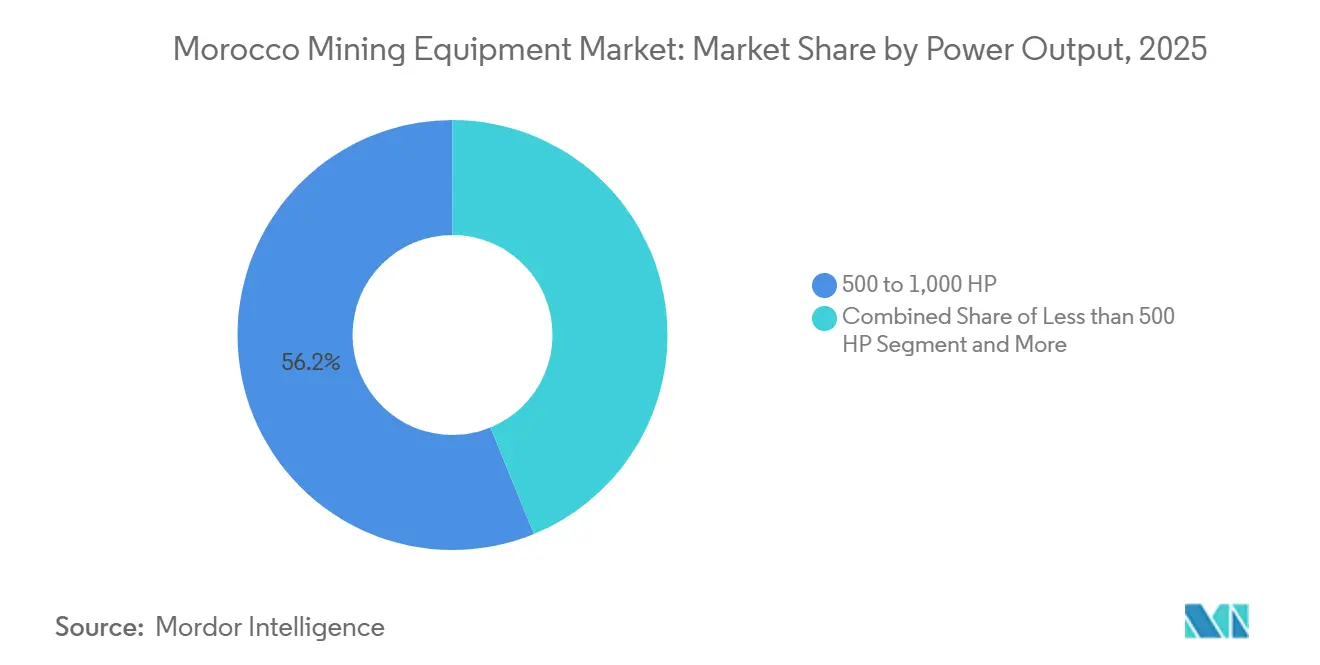
The 500–1,000 HP class accounted for 56.19% of the Moroccan mining equipment market in 2025. This power range fits much of the equipment used in large phosphate operations and in several mine-development activities. Its installed base supports demand for maintenance, replacement parts, and engine rebuild services. Standardization can also help operators manage training and spare parts planning. Suppliers with dependable local support are likely to retain an advantage in this category. Customers in this range often value predictable operating performance because equipment must fit established haulage and material-handling routines at large sites.
The below-500 HP class is projected to grow at a 6.37% CAGR through 2031. Lighter equipment is relevant to underground development, exploration work, support tasks, and narrower mining areas. The category can benefit from demand for compact drills, utility vehicles, and remote-capable machines. Its growth is linked to the wider development of copper and cobalt projects outside traditional phosphate districts. The Moroccan mining equipment industry will need to offer flexible service models because smaller operators may have different procurement needs from major phosphate producers. Equipment that is easy to transport, maintain, and adapt to changing field conditions can be particularly useful during exploration and mine-development work.
By Application: Metal Mining Adds a New Source of Equipment Demand
Metal mining accounted for 48.12% of the Moroccan mining equipment market share in 2025. Copper and cobalt activity is expanding the demand base beyond phosphate, requiring equipment suited to underground extraction and mineral processing. Equipment providers that understand these linked needs can offer solutions that support the mine from extraction through the point where material enters the processing circuit. These projects can require closer coordination between mining, ore handling, and processing systems. Operators also need reliable maintenance support because emerging mines may have limited in-house technical resources. This creates opportunities for suppliers to deliver an integrated equipment-and-service offering. The need for operational consistency can make technical support important from initial commissioning through routine production and later equipment upgrades.
Metal mining is projected to grow at a 5.65% CAGR through 2031. Mineral mining remains important because phosphate operations provide the country with an established operating base and a large installed fleet. Coal mining has limited relevance to current equipment procurement in Morocco. Metal projects are likely to raise the importance of digital monitoring, underground equipment, and lower-emission operating models. The Moroccan mining equipment market can benefit from this broader application mix without compromising the operational importance of phosphate. A broader mining base can also give distributors and service providers more reasons to expand their technical capabilities beyond conventional surface-equipment support.
Geography Analysis
The Khouribga–Gantour corridor remains the main center of equipment demand because it hosts Morocco’s largest phosphate extraction and beneficiation activities. OCP’s investment program supports work across mining, processing, water systems, and energy infrastructure in this area. The corridor creates steady needs for haulage, material handling, pumps, crushers, and maintenance services. Benguerir and Youssoufia also support equipment activity because they are closely linked to the country’s phosphate production chain. Suppliers must therefore consider not only individual machine performance but also how equipment availability affects crushers, conveyors, processing plants, and downstream operations. Environmental requirements in this region make energy use, water management, and equipment reliability important considerations in purchasing. Suppliers that already understand the operating schedules and maintenance practices of these sites can have a practical advantage when replacement or expansion requirements arise.
The Anti-Atlas is becoming an increasingly important area for equipment suppliers as copper and cobalt projects move through development and into production. Tizert in Taroudant provides a reference point for underground operations that use connected operating systems. The region needs equipment for underground operations, including drills, loaders, trucks, support vehicles, and monitoring tools. Exploration work can also create earlier demand for drill rigs, core-handling equipment, and field services. Suppliers that can provide local technical support may be better positioned as projects move from exploration to operations. Their ability to build relationships early can help them understand site conditions and develop service plans before a mine begins full production.
The Atlantic coast and southern provinces form a third equipment area through phosphate operations, planned industrial projects, and early-stage offshore activity. Bou Craa supports demand for large-scale material-handling and conveyance equipment because of its open-pit mining profile. Tarfaya, Essaouira, and coastal areas may create future requirements for new mine fleets, energy-linked equipment, and survey tools. The scale and timing of these opportunities depend on project approvals, financing, and operating plans. The Moroccan mining equipment market has a broader geographic base when coastal and southern projects are considered alongside the established phosphate and Anti-Atlas areas. This spread can create opportunities for suppliers that can serve sites with different logistics conditions, equipment needs, and stages of project maturity.
Competitive Landscape
The Moroccan mining equipment market is served by global original equipment manufacturers, regional distributors, and specialized service providers. Competition is based on product reliability, local service capacity, parts availability, financing support, and the ability to meet site-specific requirements. Caterpillar, Komatsu, Sandvik, Epiroc, Hitachi Construction Machinery, and Weir are relevant across equipment or processing categories. Their roles differ because phosphate mines, underground metal projects, and processing plants have different operating needs. Local dealer networks remain important because customers value short response times and dependable maintenance support. A supplier’s position can therefore depend as much on its service organization and parts planning as on the initial specification of its equipment.
Suppliers are expanding beyond individual machine sales toward longer service relationships. Epiroc’s digitalization work with Managem at Tizert illustrates the value of combining equipment with tracking, data integration, and operational support. Caterpillar’s local dealer presence supports access to parts and service for heavy equipment users. Komatsu can build on its experience in fleet management and automated haulage as Moroccan operators evaluate automation. Weir remains relevant to processing projects where pumps and separation systems are central to plant performance. These approaches show that vendors are seeking to remain involved after delivery through maintenance, digital support, training, and operating advice.
Regional competitors and Chinese suppliers add pressure through price-focused offers and bundled financing. This can be attractive to smaller copper and cobalt developers with limited access to capital. Established suppliers can respond through better maintenance coverage, technical training, and lifecycle support. The most open competitive space is likely to be in compact underground equipment, electrification support, and remote monitoring services. The supplier base remains competitive because leading brands operate alongside regional distributors, specialist service providers, and lower-cost challengers. Competition is likely to remain active because operators can compare equipment packages on upfront cost, service terms, financing, and the supplier’s willingness to support new operating practices.
Morocco Mining Equipment Industry Leaders
Caterpillar Inc.
Komatsu Ltd.
Sandvik AB
Epiroc AB
Hitachi Construction Machinery Co., Ltd.
- *Disclaimer: Major Players sorted in no particular order

Recent Industry Developments
- July 2026: Tractafric Equipment Maroc delivered Cat 707 wide-body trucks to Société de Travaux Agricoles Marocains for infrastructure, mining, earthworks, road construction, civil engineering, and dam projects.
- May 2026: FAWDE officially entered the Moroccan market and debuted its JH6 8×4 Dump Truck at Logismed 2026. The JH6 8×4 Dump Truck is a heavy-duty vehicle designed for demanding construction, mining, and infrastructure transportation applications.


Morocco Mining Equipment Market Report Scope
The Moroccan mining equipment market is segmented by equipment type, automation level, powertrain type, power output, and application. By Equipment Type, the market is segmented into Surface Mining Equipment, Underground Mining Equipment, Mineral Processing Equipment, Drills and Breakers, Crushing, Pulverizing & Screening Equipment, and Loaders and Haul Trucks. By Automation Level, the market is segmented into Manual, Semi-Autonomous, and Fully Autonomous Equipment. By Powertrain Type, the market is segmented into Internal-Combustion Engine, Battery-Electric Vehicles, and Hybrid Vehicles. By Power Output, the market is segmented into Less than 500 HP, 500 to 1,000 HP, and above 1,000 HP. By Application, the market is segmented into Metal Mining, Mineral Mining, and Coal Mining. Market forecasts are provided in terms of Value (USD) and Volume (Units).
| Surface Mining Equipment |
| Underground Mining Equipment |
| Mineral Processing Equipment |
| Drills and Breakers |
| Crushing, Pulverizing and Screening |
| Loaders and Haul Trucks |
| Manual Equipment |
| Semi-Autonomous Equipment |
| Fully Autonomous Equipment |
| Internal-Combustion Engine Vehicles |
| Battery-Electric Vehicles |
| Hybrid Vehicles |
| Less than 500 HP |
| 500 to 1,000 HP |
| Above 1,000 HP |
| Metal Mining |
| Mineral Mining |
| Coal Mining |
| By Equipment Type | Surface Mining Equipment |
| Underground Mining Equipment | |
| Mineral Processing Equipment | |
| Drills and Breakers | |
| Crushing, Pulverizing and Screening | |
| Loaders and Haul Trucks | |
| By Automation Level | Manual Equipment |
| Semi-Autonomous Equipment | |
| Fully Autonomous Equipment | |
| By Powertrain Type | Internal-Combustion Engine Vehicles |
| Battery-Electric Vehicles | |
| Hybrid Vehicles | |
| By Power Output | Less than 500 HP |
| 500 to 1,000 HP | |
| Above 1,000 HP | |
| By Application | Metal Mining |
| Mineral Mining | |
| Coal Mining |


Key Questions Answered in the Report
What is the current market size and growth rate of the Moroccan mining equipment market?
The Morocco mining equipment market size was valued at USD 1.03 billion in 2025 and is estimated to grow from USD 1.07 billion in 2026 to reach USD 1.26 billion by 2031, at a CAGR of 3.46% during the forecast period (2026-2031).
Which equipment category has the largest position in Morocco?
Surface mining equipment held the largest position, with 38.63% share in 2025, supported by established phosphate operations. The category includes the equipment needed to move, crush, screen, and process large volumes of mined material at open-pit sites.
Which mining equipment category is growing fastest in Morocco?
Underground mining equipment is projected to grow at a 6.91% CAGR through 2031 as copper and cobalt projects develop. Demand is expected to include compact drills, loaders, trucks, ventilation equipment, and service support suited to underground conditions.
What is driving demand for mining equipment in Morocco?
Phosphate investment, mineral exploration policy, copper and cobalt development, and mine digitalization are important demand factors. Demand is also influenced by water and energy requirements, project financing, equipment reliability, and the availability of trained technical workers.
How is electrification affecting mining fleets in Morocco?
Battery-electric vehicles are projected to grow at a 10.28% CAGR through 2031, particularly where underground conditions favor reduced diesel use. Adoption will depend on charging access, mine power, equipment availability, maintenance capability, and each operator’s planned replacement cycle.
Page last updated on:


 Your data is secure and never sold or shared.


