
Europe Mining Equipment Market Size and Share
Market Overview
| Study Period | 2019 - 2031 |
|---|---|
| Forecast Data Period | 2026 - 2031 |
| Base Year Market Size (2025) | USD 8.93 Billion |
| Market Size (2026) | USD 9.23 Billion |
| Market Size (2031) | USD 10.95 Billion |
| Growth Rate (2026 - 2031) | 3.47 % |
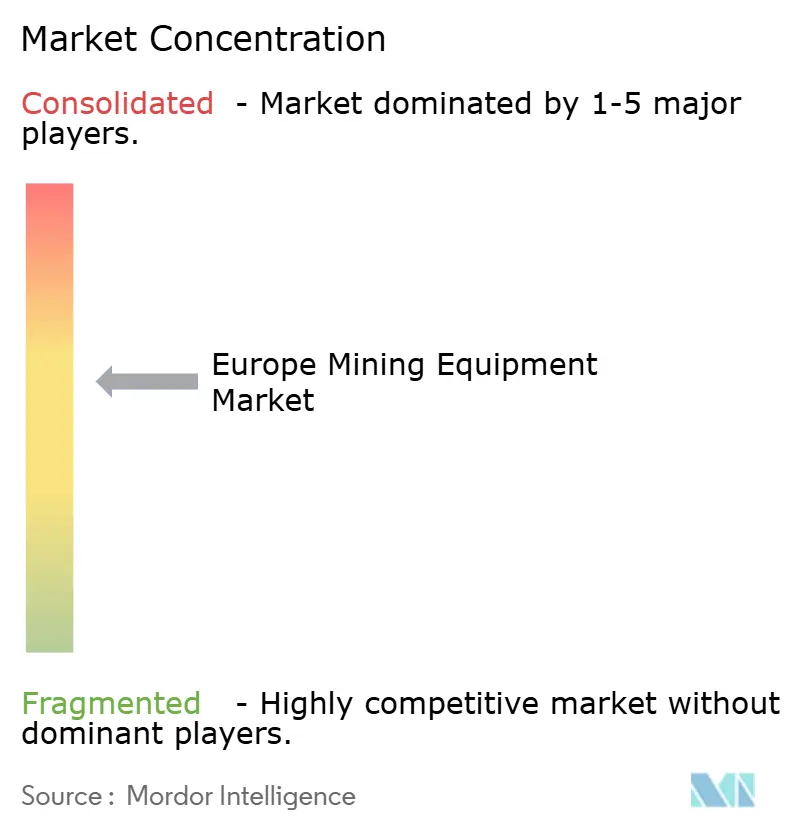
| Market Concentration | Medium |
Major Players *Disclaimer: Major Players sorted in no particular order Image © Mordor Intelligence. Reuse requires attribution under CC BY 4.0. | |
Europe Mining Equipment Market Analysis by Mordor Intelligence
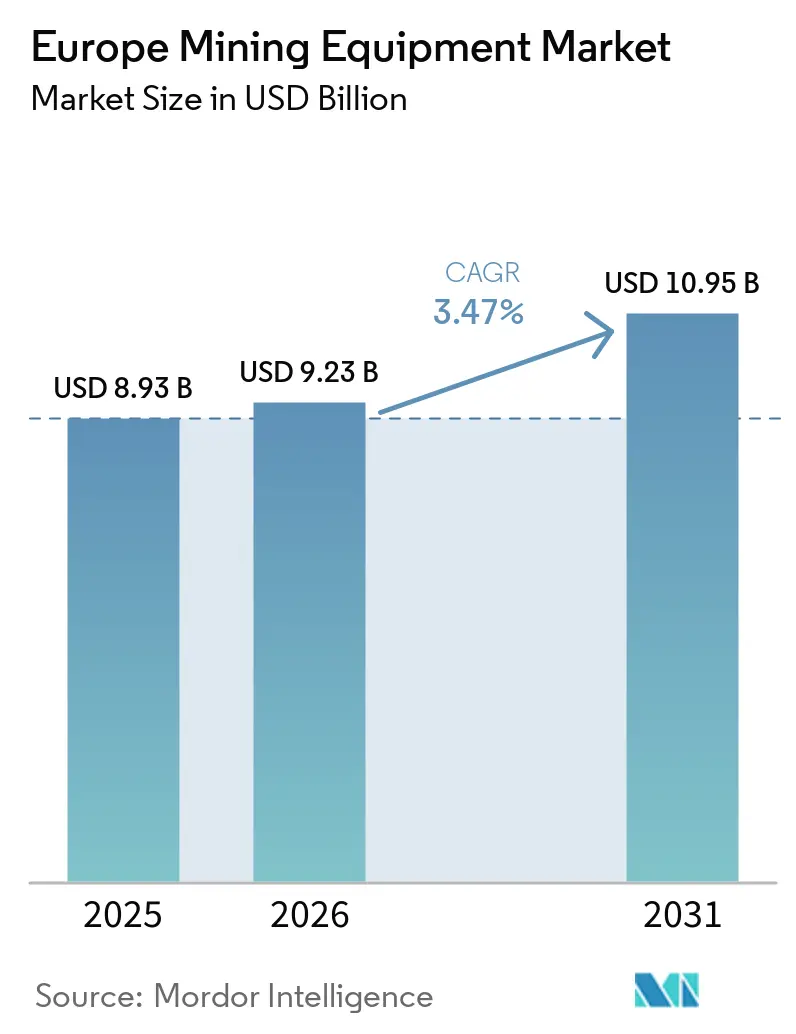
The European mining equipment market size was valued at USD 8.93 billion in 2025, is estimated at USD 9.23 billion in 2026, and is projected to reach USD 10.95 billion by 2031 at a 3.47% CAGR over 2026-2031. Demand is pivoting toward battery-electric vehicles, autonomous haulage, and digital-twin software as the EU Critical Raw Materials Act obliges miners to localize 10% of supply and cut on-site emissions. Accelerated adoption of loaders and haul trucks that comply with Stage V standards is most visible at new copper and lithium pits in France, Spain, and Poland, while Nordic operations champion full autonomy to ease a 15% skilled-labor shortfall. Sub-3% financing from the European Investment Bank tilts the competitive field toward incumbents with proven ESG credentials, whereas permitting delays and expensive grid upgrades slow project mobilization. Rental-as-a-service contracts and real-time analytics convert equipment from capital items into data platforms, lowering OPEX by more than 12% in pilot programs.
Key Report Takeaways
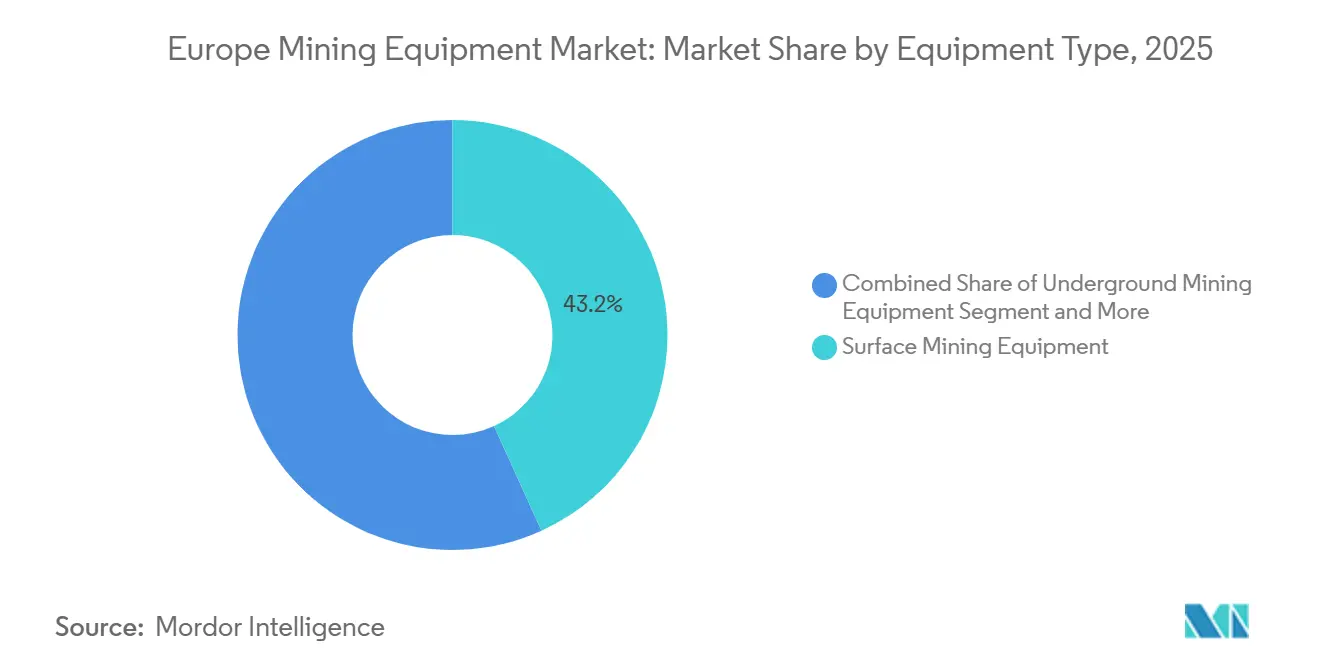
- By equipment type, surface mining led with 43.18% of the European mining equipment market share in 2025, while loaders and haul trucks posted the fastest 3.49% CAGR to 2031.
- By automation level, manual equipment commanded a 67.71% share of the European mining equipment market size in 2025, whereas fully autonomous platforms advance at a 3.53% CAGR through 2031.
- By powertrain, internal-combustion units retained a 65.27% share in 2025; battery-electric vehicles expand at a 3.64% CAGR to 2031.
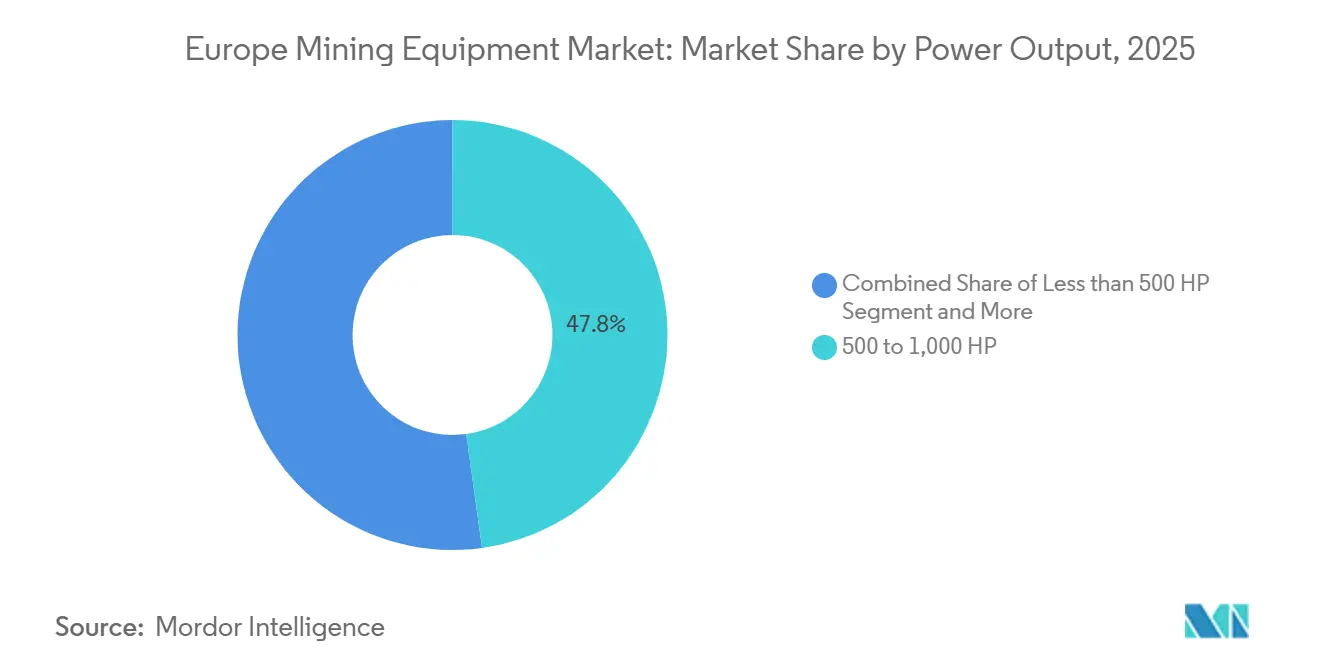
- By power output, the 500-to-1,000 HP class captured a 47.81% share in 2025, as sub-500 HP machines delivered the highest 3.57% CAGR.
- By application, metal mining held 53.26% revenue share in 2025 and remains the fastest-growing at a 3.59% CAGR through 2031.
- By geography, Germany led with a 26.17% revenue share in 2025, while France recorded the highest national growth at a 3.62% CAGR through 2031.
Note: Market size and forecast figures in this report are generated using Mordor Intelligence’s proprietary estimation framework, updated with the latest available data and insights as of January 2026.
Europe Mining Equipment Market Trends and Insights
Drivers Impact Analysis*
| Driver | (~) % Impact on CAGR Forecast | Geographic Relevance | Impact Timeline |
|---|---|---|---|
| Surge in Critical-Raw-Material Demand | +1.2% | France, Spain, Poland, Finland, Sweden | Long term (≥ 4 years) |
| Rapid Adoption of Battery-Electric and Trolley-Assist Haulage | +0.9% | Nordic countries, Germany | Medium term (2-4 years) |
| Automation to Offset Skilled-Labor Shortages | +0.7% | Sweden, Finland, Norway | Medium term (2-4 years) |
| EU Green Deal Grants and EIB Green-Asset Financing | +0.5% | Pan-European | Short term (≤ 2 years) |
| Mine-to-Mill Digital Twins Cutting OPEX More Than 12% | +0.4% | Sweden, Finland, Germany, Poland | Medium term (2-4 years) |
| Rental-as-a-Service Models Boosting SME Equipment Access | +0.3% | Norway, Germany, Netherlands | Short term (≤ 2 years) |
| Source: Mordor Intelligence | |||
Surge in Critical Raw Material Demand for EU Battery and Wind Supply Chains
Gigafactory capacity exceeding 1 TWh by 2030 compels miners to secure lithium, nickel, and rare-earth feedstock, lifting orders for high-tonnage loaders, electric haul trucks, and automated mills. The Imerys EMILI lithium project alone allocates EUR 1.8 billion (USD 2.10 billion) to battery-ready equipment packages, while Spain’s EUR 414 million (USD 483.51 million) strategy funds seven strategic deposits. Poland’s shaft program expands drill-jumbo demand, and wind-turbine magnet suppliers widen the call for domestic rare-earth extraction [1]“EMILI Lithium Project Factsheet,” Imerys, imerys.com .
Rapid Adoption of Battery-Electric and Trolley-Assist Haulage
Boliden’s Aitik mine operates Epiroc battery-electric loaders and ABB trolley-assist trucks, reducing ventilation costs and regenerating power during downhill hauls. Although capital expenditure premiums apply, lower electricity costs offset these investments over time, as electricity costs less than diesel energy. Rental Group AS operates a fleet of battery-electric vehicles (BEVs), providing small and medium-sized enterprises (SMEs) with access to zero-emission equipment trials without placing strain on their balance sheets.
Automation to Offset Skilled-Labor Shortages in Nordic Mines
Komatsu’s FrontRunner fleet achieves high utilization by eliminating shift-change downtime. Sandvik’s AutoMine tests in Tampere combine tele-remote drilling with collision-avoidance capabilities to support continuous operations. Nordic mines address operator shortages by enabling a single control hub to supervise multiple autonomous trucks, validating the economics of software licenses despite required connectivity investments.
EU Green Deal Grants and EIB Green-Asset Financing
The EIB’s EUR 500 million (USD 584 million) financing line for Sandvik and EUR 90 million (USD 105.01 million) financing line for METLEN reduce the weighted average cost of capital (WACC) for projects that deploy electrified fleets. By providing long-term financing on favorable terms, these funding lines can improve project economics and support the adoption of electric equipment across mining and related industrial operations. InvestEU’s guarantee and ResourceEU’s risk pool further de-risk exploration activities by reducing the financial exposure associated with early-stage projects, thereby encouraging private-sector participation and co-financing. For example, France’s investment in Imerys helped unlock EUR 1.75 billion (USD 2.04 billion) in external capital, demonstrating how public support can mobilize substantial private investment for strategic mineral projects [2]“Sandvik Green-Asset Financing Press Release,” European Investment Bank, eib.org .
Restraints Impact Analysis*
| Restraint | (~) % Impact on CAGR Forecast | Geographic Relevance | Impact Timeline |
|---|---|---|---|
| Lengthy Environmental-Permit Lead-Times Post-2025 CRMA | -0.6% | France, Spain, Italy, Germany | Medium term (2-4 years) |
| Capex Premium for Next-Gen BEV Loaders and Trucks | -0.5% | Pan-European | Short term (≤ 2 years) |
| Power-Grid Constraints at Remote Mine Sites | -0.4% | Northern Sweden, Finland, rural Spain, Poland | Short term (≤ 2 years) |
| Volatile Nickel and Copper Prices Denting Investment Planning | -0.3% | Global spillover | Short term (≤ 2 years) |
| Source: Mordor Intelligence | |||
Lengthy Environmental-Permit Lead-Times Post-2025 CRMA
Although the Act targets a 24-month approval cycle, France’s EMILI project required three years to obtain consent, highlighting the gap between the proposed regulatory timeline and actual permitting processes. In Spain, regional veto powers can add up to 18 months to approval timelines, creating additional uncertainty for project developers. Italy’s multi-level approval process further extends project timelines by requiring sign-offs from multiple administrative authorities. As a result, only seven of the 34 strategic projects have secured final permits, delaying downstream investment decisions and the procurement of essential mining equipment, including crushers and haul trucks [3]“Critical Raw Materials Act,” European Commission, europa.eu .
Capex Premium for Next-Gen BEV Loaders and Trucks
Epiroc’s Scooptram ST10 G carries a substantially higher upfront cost than its diesel equivalent, which can limit adoption among cost-sensitive mining operators. Small and medium-sized enterprises (SMEs), particularly those without access to European Investment Bank (EIB) financing, often defer purchases until rental options or second-hand units become available. The need to invest in dedicated fast-charging infrastructure further increases the initial capital requirement and operational complexity. Although battery prices are declining, the combined cost of electric equipment and charging infrastructure remains a significant barrier to wider adoption.
*Our forecasts treat driver/restraint impacts as directional, not additive. The impact forecasts reflect baseline growth, mix effects, and variable interactions.
Segment Analysis
By Equipment Type: Surface Dominates, Loaders Surge
Surface equipment secured 43.18% of the European mining equipment market share in 2025 as open-pit lignite and copper pits relied on haul trucks and excavators. Loaders and haul trucks now post a 3.49% CAGR, fueled by BEV variants that slash ventilation outlays and meet Stage V norms. Underground fleets grow on deeper Nordic copper shafts, while mineral-processing lines scale to handle lower-grade ore, boosting demand for higher-capacity crushers.
Loaders lead growth because articulated frames cut tire costs on 8% gradients and battery packs remove diesel particulate matter underground. A secondary market for refurbished surface units lengthens replacement cycles, yet greenfield lithium and tungsten sites prioritize electric models bundled with digital twins that raise throughput by 8% and lift residual values.



By Automation Level: Manual Prevails, Autonomy Accelerates
Manual machines still hold 67.71% of the European mining equipment market size, but semi-autonomous features are becoming mandatory as the updated EU Machinery Directive enforces collision avoidance from 2025. Fully autonomous fleets advance at a 3.53% CAGR, validated by 1.2 billion tonnes hauled driver-free at Aitik.
Retrofit costs of USD 150,000 per decade-old loader deter upgrades, steering purchases toward factory-integrated autonomy. Control-room oversight of 20 units magnifies labor savings, and telematics subscriptions of USD 50,000 per truck create recurring OEM revenue while shrinking labor arbitrage gaps.
By Powertrain Type: ICE Dominates, BEVs Lead Growth
Internal-combustion engines command 65.27% of the European mining equipment market share in 2025, yet battery-electric vehicles expand at a 3.64% CAGR as trolley lines and 300 kWh packs converge. Hybrids bridge intermittent-grid operations but suffer payload penalties.
Stage V after-treatment adds 10% to diesel costs and trims fuel efficiency, nudging fleets toward BEVs whose TCO equalizes within five years thanks to half-price energy and doubled maintenance intervals. Rising cell energy density and sub-2-hour charging unlock multi-shift deployment, quickening ICE displacement.
By Power Output: Mid-Range Leads, Compact Units Gain
Equipment rated 500-1,000 HP captured 47.81% of 2025 revenue, reflecting workhorse trucks and shovels deployed at European open pits. Sub-500 HP BEV loaders and drill rigs grow at a 3.57% CAGR because narrow-vein mines favor maneuverability and zero-emission operation.
Ultra-class machines above 1,000 HP remain niche as Europe lacks mega-scale pits, while mid-range models boost fuel efficiency by 5% via idle-shutdown logic. Compact loaders such as the 270 kWh Scooptram ST10 G cut 262 t of CO₂ annually, proving productivity parity with diesel in stopes under 4 m wide.
By Application: Metal Mining Commands, Sustains Lead
Metal mining held a 53.26% share in 2025 and advances at a 3.59% CAGR, driven by copper, nickel, and lithium needs for batteries and wind turbines. Mineral mining ticks upward with GDP, and coal tapers as the EU retires lignite by 2038.
France’s EMILI and Spain’s Masa Valverde projects collectively order more than EUR 2 billion (USD 2.34 billion) in electric haul trucks, crushers, and drill rigs, while Poland’s tax relief frees PLN 4.1 billion (USD 1.11 billion) for new shafts. Coal equipment demand fades, stranding draglines at Garzweiler, yet potash miners in Germany still upgrade continuous miners to sustain 7 Mt output.
Geography Analysis
Germany led with 26.17% of the European mining equipment market in 2025, anchored by lignite, potash, and aggregates, but a 2038 coal exit compresses future capex cycles. France grows fastest at 3.62% CAGR, supported by substantial investments in lithium and geothermal-brine extraction in Alsace. State equity participation has unlocked private financing and accelerated these initiatives. Poland benefits from levy reductions that free capital for underground infrastructure investments. These investments are increasing demand for drill jumbos and ventilation systems.
Spain’s critical raw materials plan and exploration fund are advancing strategic projects, positioning the country as the bloc’s second-largest copper source. In Italy, fragmented permitting processes continue to delay lithium and rare-earth projects despite regional research programs, thereby dampening equipment orders. The Netherlands is increasing spending on mobile crushers to recycle demolition waste in line with its circular-economy objectives.
The rest of Europe, including the Nordic countries, Austria, and smaller markets, is tracking the regional average. Boliden’s Aitik expansion and Finland’s Sokli project are stimulating orders for autonomous haulage systems and drill rigs. Sweden’s test mine near Tampere is validating Sandvik AutoMine for continuous stope operations, while Norway’s Rental Group is introducing battery-electric vehicle (BEV) technology to small and medium-sized enterprise (SME) pits, increasing equipment utilization across the region.
Competitive Landscape
Scandinavian OEMs, Epiroc, Sandvik, and Atlas Copco, collectively hold a significant share of the European mining equipment market. They leverage extensive R&D capabilities and proximity to Nordic copper and iron ore majors. Caterpillar and Komatsu continue to expand their digital offerings but lag in integrated autonomy, while Metso enhances its crushers using extensive field telemetry.
Epiroc’s 3D haulage system enables a single technician to oversee a large fleet of trucks, generating revenue from autonomy licenses while addressing operator shortages. Sandvik’s EIB loan accelerates battery-loader rollouts ahead of schedule. Its patent filings for thermal management and vision algorithms protect margins as hardware becomes increasingly commoditized.
Rental-focused disruptors, such as Rental Group AS, and AI specialists, including Imubit, capture white-space opportunities by embedding analytics into legacy fleets. Incumbents with verified ESG profiles benefit from financing advantages, creating a two-tier market in which smaller suppliers face higher borrowing spreads and struggle to fund rapid R&D cycles.
Europe Mining Equipment Industry Leaders
Caterpillar Inc.
Komatsu Ltd.
Sandvik Group
Epiroc AB
Liebherr Group
- *Disclaimer: Major Players sorted in no particular order

Recent Industry Developments
- June 2026: Sweden-based Sandvik AB acquired Italy-based Diemme Filtration and established a new Filtration division within its Rock Processing Solutions business area.
- May 2026: Sweden-based Epiroc AB launched an integrated suite of digital mine planning tools globally. Building on previous software acquisitions, including MineRP, the system featured five integrated components: Work Manager, SimulatOre, Drill Quality Manager, InterOp, and OreInventory. These tools supported mixed-fleet pit safety and diagnostics through a single closed-loop ecosystem.
- February 2026: Sandvik AB announced a EUR 15 million (approximately USD 17.7 million) expansion of the main site in Tampere, Finland. Construction was scheduled to begin in late 2026 and conclude by 2028, supporting production, innovation, and future growth. However, the reference to “next-generation digital extraction solutions” slightly reinterpreted the stated objective, which focused on general R&D, production, and broader rock drilling, crushing, and automation capabilities.
- April 2025: Liebherr showcased the future of construction and mining at Bauma 2025 with over 100 exhibits, including the battery-electric, autonomous T 264 mining truck and the electric R 9400 E mining excavator, both designed for zero emissions. The company emphasized digitalization with autonomous machines and intelligent assistance systems, collaborating with Fortescue to develop emissions-free mining machines for sustainable operations.
- March 2025: The European Commission selected 47 Strategic Projects under the Critical Raw Materials Act to enhance domestic raw material capacities, requiring EUR 22.5 billion total investment across 13 EU Member States. Projects include 25 extraction, 24 processing, 10 recycling, and 2 substitution activities focusing on lithium, nickel, cobalt, manganese, and graphite essential for EU battery raw material value chain.
- January 2025: Epiroc and ABB signed a Memorandum of Understanding to collaborate on underground trolley equipment, enhancing electrification solutions in the mining industry. The partnership focuses on increasing productivity and achieving decarbonization targets, building on previous successes in Swedish mines, with 76% of global mining companies seeing benefits in vehicle electrification.


Europe Mining Equipment Market Report Scope
The scope of the report includes equipment type (Surface Mining Equipment, Underground Mining Equipment, Mineral Processing Equipment, Drills and Breakers, Crushing, Pulverizing and Screening, and Loaders and Haul Trucks), Automation Level (Manual Equipment, Semi-Autonomous Equipment, and Fully Autonomous Equipment), Powertrain (Internal-Combustion Engine Vehicles, Battery-Electric Vehicles, and Hybrid Vehicles), Power Output (Less Than 500 HP, 500 to 1 000 HP, and Above 1 000 HP), Application (Metal Mining, Mineral Mining, and Coal Mining), and Country (Germany, Italy, France, Netherlands, Spain, Poland, and Rest of Europe. The Market Forecasts in Value (USD) and Volume (Units).
| Surface Mining Equipment |
| Underground Mining Equipment |
| Mineral Processing Equipment |
| Drills and Breakers |
| Crushing, Pulverizing and Screening |
| Loaders and Haul Trucks |
| Manual Equipment |
| Semi-Autonomous Equipment |
| Fully Autonomous Equipment |
| Internal-Combustion Engine Vehicles |
| Battery-Electric Vehicles |
| Hybrid Vehicles |
| Less than 500 HP |
| 500 to 1 000 HP |
| Above 1 000 HP |
| Metal Mining |
| Mineral Mining |
| Coal Mining |
| Germany |
| Italy |
| France |
| Netherlands |
| Spain |
| Poland |
| Rest of Europe |
| By Equipment Type | Surface Mining Equipment |
| Underground Mining Equipment | |
| Mineral Processing Equipment | |
| Drills and Breakers | |
| Crushing, Pulverizing and Screening | |
| Loaders and Haul Trucks | |
| By Automation Level | Manual Equipment |
| Semi-Autonomous Equipment | |
| Fully Autonomous Equipment | |
| By Powertrain Type | Internal-Combustion Engine Vehicles |
| Battery-Electric Vehicles | |
| Hybrid Vehicles | |
| By Power Output | Less than 500 HP |
| 500 to 1 000 HP | |
| Above 1 000 HP | |
| By Application | Metal Mining |
| Mineral Mining | |
| Coal Mining | |
| By Country | Germany |
| Italy | |
| France | |
| Netherlands | |
| Spain | |
| Poland | |
| Rest of Europe |


Key Questions Answered in the Report
How large is the European mining equipment market in 2026?
The market is expected to reach USD 9.23 billion in 2026, on its way to USD 10.95 billion by 2031.
Which equipment category is growing fastest in Europe?
Loaders and haul trucks lead growth at a 3.49% CAGR as operators adopt articulated battery-electric models.
What role do battery-electric vehicles play in European mines?
BEVs cut ventilation costs up to 30% and, despite a 20-40% capex premium, reach cost parity within five years due to lower energy and maintenance expenses.
Why are permitting delays a restraint on equipment demand?
Only seven of 34 CRMA strategic projects have final approvals, so many miners postpone ordering major crushers and trucks until licenses are secured.
Which country shows the fastest growth rate for equipment sales?
France records the highest 3.62% CAGR through 2031, fueled by its EMILI lithium project and supportive state financing.
How are rental models changing procurement strategies?
Short-term leases convert upfront equipment capex into predictable operating fees, letting SMEs trial zero-emission fleets without balance-sheet exposure.
Page last updated on:


 Your data is secure and never sold or shared.


