
Oman Mining Equipment Market Size and Share
Market Overview
| Study Period | 2019 - 2031 |
|---|---|
| Forecast Data Period | 2026 - 2031 |
| Base Year Market Size (2025) | USD 0.35 Billion |
| Market Size (2026) | USD 0.36 Billion |
| Market Size (2031) | USD 0.45 Billion |
| Growth Rate (2026 - 2031) | 4.17 % |
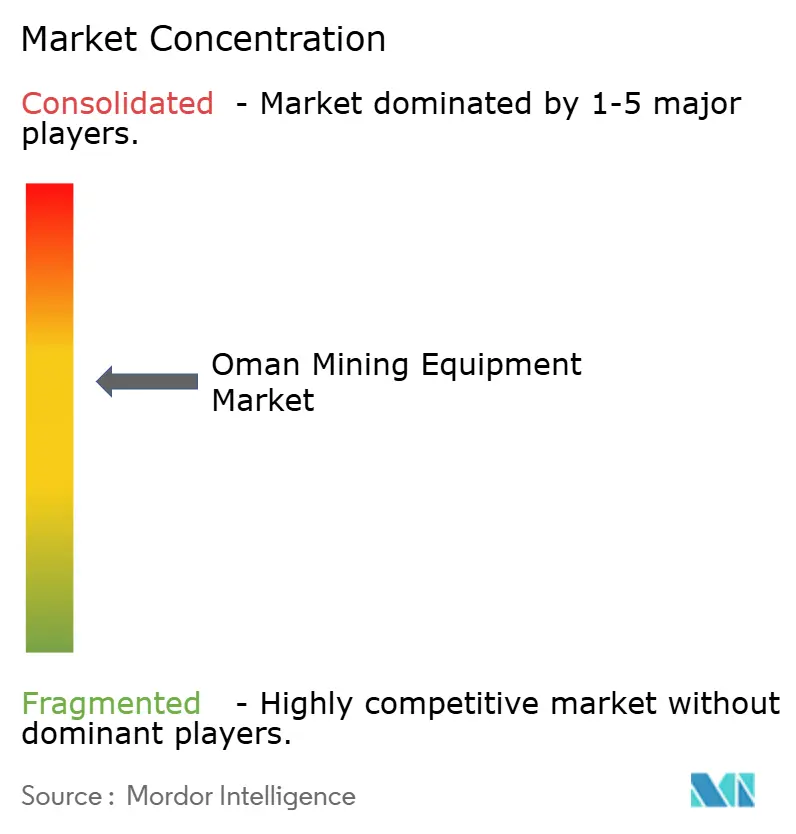
| Market Concentration | Medium |
Major Players *Disclaimer: Major Players sorted in no particular order Image © Mordor Intelligence. Reuse requires attribution under CC BY 4.0. | |
Oman Mining Equipment Market Analysis by Mordor Intelligence
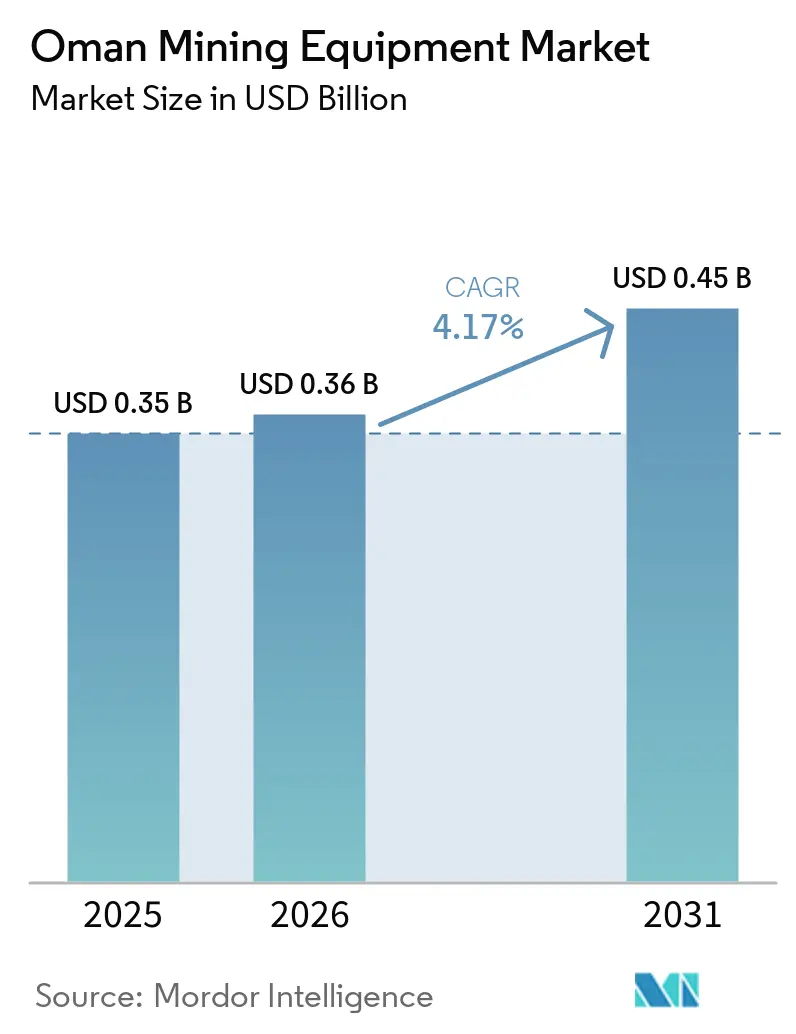
The Oman mining equipment market size was USD 0.35 billion in 2025 and is projected to be USD 0.36 billion in 2026, reaching USD 0.45 billion by 2031, growing at a CAGR of 4.17% from 2026 to 2031. Minerals Development Oman (MDO) is spearheading a significant multi-year investment to shape the growth trajectory. Coupled with the Ministry of Energy and Minerals' local-procurement mandate and a burgeoning array of concessions in copper, chromite, limestone, and gypsum, the landscape is evolving. State-backed capital is shifting the focus from traditional bulk-haul equipment to more specialized tools, such as concentrators, flotation cells, and downstream processing lines. In response, international original-equipment manufacturers (OEMs) are establishing service hubs in Sohar, Duqm, and Salalah. Simultaneously, local fabricators are eyeing contracts for wear parts and components. As emission caps tighten, battery-electric haulage is making its debut in pilot services. However, diesel fleets continue to dominate, with operators gradually phasing in upgrades during routine replacements. Despite the optimistic outlook, concerns linger: currency risks tied to gypsum and limestone export prices and the rising costs of desalinated water for dust suppression.
Key Report Takeaways
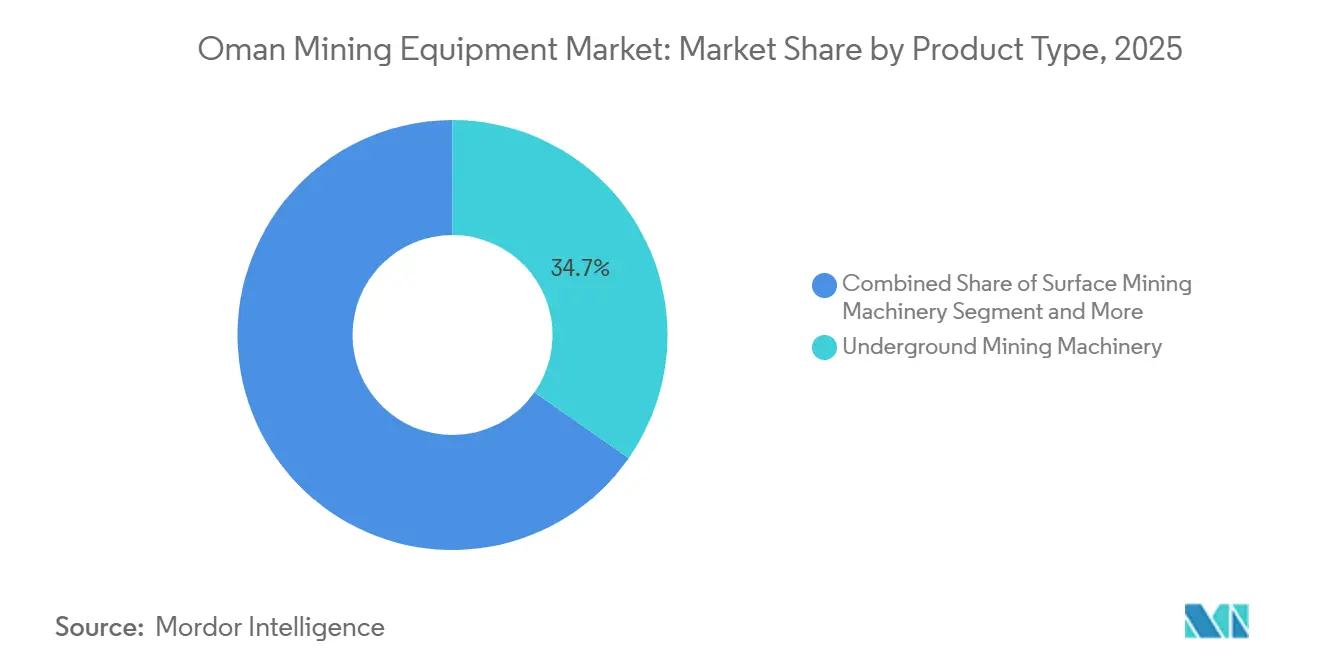
- By product type, underground mining machinery led with 34.72% of the Oman mining equipment market share in 2025, while mineral processing machinery is forecast to expand at a 4.71% CAGR to 2031.
- By function, transportation equipment captured 45.11% share of the Oman mining equipment market size in 2025 and is projected to grow at a 4.33% CAGR through 2031.
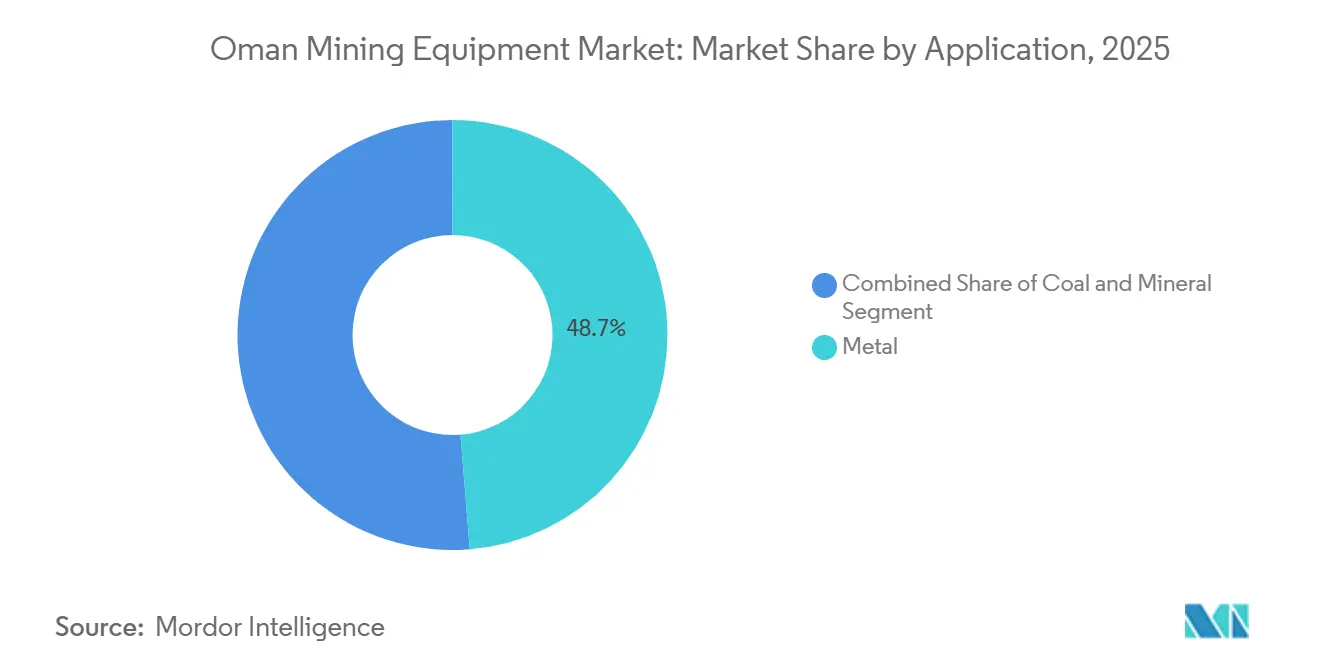
- By application, the metal segment accounted for 48.73% of the Oman mining equipment market in 2025 and is projected to grow at a 4.28% CAGR to 2031.
- By propulsion, diesel systems dominated with 71.26% share in 2025; battery-electric units are projected to rise at a 9.16% CAGR between 2026 and 2031.
Note: Market size and forecast figures in this report are generated using Mordor Intelligence’s proprietary estimation framework, updated with the latest available data and insights as of January 2026.
Oman Mining Equipment Market Trends and Insights
Drivers Impact Analysis*
| Driver | (~) % Impact on CAGR Forecast | Geographic Relevance | Impact Timeline |
|---|---|---|---|
| Rising Government Expenditure | +0.8% | National, concentrated in Batinah and Dhofar | Medium term (2-4 years) |
| Accelerated Copper-gold Discoveries | +0.7% | Batinah and Dhofar regions, spillover to adjacent areas | Long term (≥ 4 years) |
| Mandatory "In-Country Value" Clauses | +0.6% | National, with emphasis on industrial zones | Medium term (2-4 years) |
| Fleet Renewal Prompted | +0.5% | National, priority in urban-adjacent mining sites | Short term (≤ 2 years) |
| Surge in Small-Scale Chromite Mine Leasing | +0.4% | Semail Ophiolite Belt, concentrated around Sohar | Medium term (2-4 years) |
| Pilot Adoption of Autonomous Hauling | +0.3% | Ghubrah region, potential expansion to other limestone sites | Long term (≥ 4 years) |
| Source: Mordor Intelligence | |||
Rising Government Expenditure on Mining & Quarrying Projects
The Oman Investment Authority has allocated significant funding to key sectors, with a portion specifically designated for export credit support for mining equipment acquisitions. MDO has made substantial investments in both upstream and downstream operations across multiple concessions[1]“Annual Report 2025,”, Minerals Development Oman, mdo.om. These include the Shuwaimiyah integrated mining area and the Mazoon copper complex. Improvements to roads and ports have reduced freight costs for interior regions, supporting demand for open-pit excavators, haul trucks, crushing, and conveying services[2]“Investment Pact Boosts Mining Projects,” Ministry of Transport, Communications and Information Technology, mtcit.gov.om.
Accelerated Copper-Gold Discoveries in the Batinah & Dhofar Belts
Power Arabia's assays at Al Maidar recorded a notable copper content. Meanwhile, MDO has verified a substantial amount of copper ore at Yanqul and is accelerating operations at the Al Baydha mine, targeting near-term output. The recommissioning of the Lasail mine, coupled with the commissioning of the Al Washihi-Majaza concentrator, has heightened the demand for drills, loaders, and processing trains. This urgency is further emphasized by Metso's significant technology package deal with Mazoon Mining.
Mandatory In-Country Value Clauses Favoring Local Service Contracts
Every mining tender now mandates a local-procurement floor, with smaller contracts specifically reserved for Omani SMEs. Responding to these changes, OEMs are taking action: Nordic Machinery has inaugurated a workshop in Ghala, while Metso is considering setting up an assembly in Sohar for wear parts. Additionally, local fabrication of liners, hydraulic cylinders, and harnesses is attracting significant investor interest.
Fleet Renewal Prompted by 2025 Diesel-Emission Caps
New particulate ceilings prompt an expedited retirement of older engine models. Sales of battery-electric loaders, trucks, and utility vehicles, already experiencing significant growth, gain an additional boost as operators act early to avoid penalties. Global precedents, such as Sandvik’s substantial battery-electric order for South32, underscore the business rationale for reduced ventilation costs. Liebherr’s major zero-emission haul-truck agreement with Fortescue highlights miners' view of electrification as a safeguard against fuel price fluctuations. Oman’s expansion of solar and wind energy supports low-carbon charging, making it a more economical choice over diesel. Pioneering players not only gain carbon-offset credits but also enjoy social-license advantages, easing their financing journey.
Restraints Impact Analysis*
| Restraint | (~) % Impact on CAGR Forecast | Geographic Relevance | Impact Timeline |
|---|---|---|---|
| High Cost of Desalinated Water | -0.3% | National, acute in inland mining areas | Long term (≥ 4 years) |
| Limited Local Component-Manufacturing Ecosystem | -0.2% | National, concentrated in industrial zones | Medium term (2-4 years) |
| Delays in Mining-law Secondary Regulations Issuance | -0.2% | National, affecting all mining concessions | Short term (≤ 2 years) |
| Fluctuating Export Prices | -0.1% | National, with emphasis on coastal mining operations | Medium term (2-4 years) |
| Source: Mordor Intelligence | |||
High Cost of Desalinated Water for Dust Suppression
Oman’s annual water gap forces mines to purchase desalinated output, a cost well above global drill-site norms. Every open-pit haul road demands thousands of cubic meters daily for dust control, raising opex and curbing capital budgets. Batinah groundwater salinization intensifies the squeeze, competing with agriculture. Although hybrid solar-RO plants are planned, relief is medium-term, so operators pivot to dry-fog nozzles, surfactant additives, and enclosed conveyor belts that lower spray requirements. OEMs selling water-efficient crushers and sizers gain a comparative advantage in the Oman mining equipment market.
Limited Local Component-Manufacturing Ecosystem
High-precision gears, sensor arrays, and alternators still arrive via Jebel Ali, adding freight, duty, and currency exposure. Sohar’s metalworks sector mainly fabricates structural steel, not Tier-1 machine parts. Repair turnarounds stretch while components clear customs, prolonging downtime and inflating the total cost of ownership. Government incentives for OEM‐backed machining centers exist, yet technology transfer lags because volumes remain modest. Suppliers that bankroll in-country CNC workshops or consignment hubs reduce machine idle time and win long‐term service contracts, partly offsetting this structural drag on the Oman mining equipment market.
*Our forecasts treat driver/restraint impacts as directional, not additive. The impact forecasts reflect baseline growth, mix effects, and variable interactions.
Segment Analysis
By Product Type: Underground Machinery Leads Specialized Extraction
Underground machinery accounted for 34.72% of the Oman mining equipment market in 2025, buoyed by legacy copper and chromite operations. However, mineral processing machinery is set to log the fastest CAGR of 4.71% as MDO channels capital into onshore beneficiation. In Oman, the mining equipment market is set to expand alongside Mazoon Mining's concentrator and the Shuwaimiyah calcination lines. While operators continue to use open-pit shovels and drills for limestone and gypsum extraction, they are now complementing these with crushers, SAG mills, and flotation cells.
Metso's Jaw-HP-SAG train installation at Mazoon highlights the increasing complexity of equipment specifications. Additionally, the introduction of new safety codes, such as CEMS compliance and GSO EN standards, is prompting upgrades in both surface and underground fleets[3]“Mazoon Mining Order Press Release,”, Metso Corporation, metso.com.



By Function Type: Transportation Dominates Dispersed Operations
Transportation assets commanded 45.11% market share in 2025 and will maintain a 4.33% CAGR, as 40 Mt of annual minerals output must be moved from inland pits to Sohar, Duqm, and Salalah ports. Conveyor links under construction at Shuwaimiyah and new dual-carriageways in Al Dhahirah lower per-tonne logistics costs, reinforcing demand for high-horsepower trucks and ship-loaders.
Processing equipment is catching up thanks to copper and ferrochrome projects. On-site power lines, acid plants, and water-treatment units are bundled into EPC packages, lifting order values and inviting OEM finance support.
By Application: Metal Mining Drives Strategic Focus
Metal extraction accounted for 48.73% of the Oman mining equipment market in 2025 and is projected to grow at a 4.28% CAGR through 2031 as copper, gold, and silver concessions mature. The restart of Lasail and commissioning of Al Washihi-Majaza secure near-term offtake for concentrators and tailings filters.
Industrial-mineral operators factor gypsum and limestone price swings into capex pacing. Still, the Oman mining equipment market share linked to industrial minerals benefits from four new gypsum blocks tendered in 2024, each requiring mobile crushers and stacker-reclaimers.
By Propulsion Type: Electric Transition Accelerates
Diesel platforms kept 71.26% of 2025 turnover, yet battery-electric grows 9.16% annually, double the headline Oman mining equipment market. Sandvik’s fleet management suite tracks battery cycles and charger utilization, demonstrating payback in under 5 years on a 10-level mine plan. Hybrid systems are closing the gap by combining smaller engines with regenerative braking. Caterpillar, in collaboration with CRH, is testing these drivetrains in heavy-duty trucks at a limestone pit near Ibri.
To facilitate the transition to electric fleets, the government is set to provide a significant number of solar panels and turbines that will generate green electricity. Liebherr's studies on the R 9600-E concept reveal notable reductions in life-cycle operational expenses when solar Power Purchase Agreements (PPAs) secure electricity at a fixed rate.
Geography Analysis
A deep-water port in Sohar and Al Batinah North, which handled substantial mineral exports, has become the focal point for the bulk of Oman’s copper and chromite output. This strategic location has strengthened the Oman mining equipment market, particularly in copper-concentrate haulage and port material-handling systems.
Al Dhahirah’s Yanqul copper complex, supported by significant investment in zone infrastructure, is benefiting from reduced lead times for spare-part deliveries. Additionally, a newly established dry port has reduced border transit times to Saudi Arabia, resulting in lower diesel consumption for inbound equipment convoys.
In Dhofar, Shuwaimiyah features an integrated quarry, with its conveyors directly feeding a dedicated minerals port. The auctioning of several gypsum leases to local firms has driven increased demand for wheel loaders, stackers, and mobile crushers.
Duqm Special Economic Zone is positioning itself as a downstream hub, attracting major investments for salt and silica projects. Furthermore, a large-scale port expansion is expected to boost future demand for ship loaders, stacker-reclaimers, and container handlers.
Competitive Landscape
Caterpillar, Komatsu, Sandvik, Epiroc, Hitachi, Liebherr, and Metso command a significant share of the Oman mining equipment market, indicating moderate concentration. Notable transactions include Metso's substantial order from Mazoon and Hitachi's sale of multiple units to Galfar, underscoring direct OEM engagements in key projects.
Local dealers, Nordic Machinery and Hassan Mushtaq International, bolster aftermarket services with workshops in Muscat and Sohar. Meanwhile, Chinese firms XCMG and SANY, offering competitively priced alternatives, are steadily carving out a niche in the light earthmoving segment.
Guided by ICV regulations, industry players are pivoting towards enhancing local value. Metso and Sandvik are delving into in-country liner casting, Komatsu is operating training simulators in Sohar, and Epiroc is collaborating with Omani SMEs for drill-rig upkeep. There's untapped potential for local production of crusher liners, hydraulic cylinders, and emissions-control kits.
Oman Mining Equipment Industry Leaders
Caterpillar Inc.
Komatsu Ltd
Sandvik AB
Epiroc AB
Liebherr-International AG
- *Disclaimer: Major Players sorted in no particular order

Recent Industry Developments
- June 2025: South West Pinnacle Exploration Ltd clinched a contract worth around INR 30 crore for the exploration and mining of minerals, including gold, in Oman. This development is expected to drive demand in the Oman mining equipment market, as the project, awarded by Minerals Development Oman (MDO), will require advanced machinery and tools. The contract is set to unfold over the next two years.
- January 2025: Metso inked a deal with Mazoon Mining, a fully owned arm of Minerals Development Oman (MDO), to deliver essential process equipment for a copper concentrator plant in Yanqul, close to Sohar Industrial City.


Oman Mining Equipment Market Report Scope
The Oman mining equipment market report is segmented by product type (underground mining machinery, and more), function type (transportation, and more), application (coal, mineral, and metal), propulsion type (diesel-powered equipment, battery-electric equipment, and hybrid equipment), and geography. The market forecasts are provided in terms of value (USD) and volume (units).
| Underground Mining Machinery |
| Open-Pit Mining Machinery |
| Surface Mining Machinery |
| Drills and Breakers |
| Crushing, Grinding, Filtering and Screening Equipment |
| Mineral Processing Machinery |
| Transportation |
| Processing |
| Excavation |
| Coal |
| Mineral (Industrial) |
| Metal (Base & Precious) |
| Diesel-Powered Equipment |
| Battery-Electric Equipment |
| Hybrid Equipment |
| By Product Type | Underground Mining Machinery |
| Open-Pit Mining Machinery | |
| Surface Mining Machinery | |
| Drills and Breakers | |
| Crushing, Grinding, Filtering and Screening Equipment | |
| Mineral Processing Machinery | |
| By Function Type | Transportation |
| Processing | |
| Excavation | |
| By Application | Coal |
| Mineral (Industrial) | |
| Metal (Base & Precious) | |
| By Propulsion Type | Diesel-Powered Equipment |
| Battery-Electric Equipment | |
| Hybrid Equipment |


Key Questions Answered in the Report
What is the forecast value of Oman's mining equipment market by 2031?
It is projected to reach USD 0.45 billion by 2031.
Which product category is expected to grow fastest to 2031?
Mineral processing machinery, advancing at a 4.71% CAGR.
Which region is emerging as Oman's next copper hub?
Al Dhahirah, anchored by the Yanqul concentrator and new dry-port logistics.
What geographic areas see the heaviest demand?
Batinah and Dhofar belts dominate due to copper-gold discoveries, while Duqm and interior governorates grow as new rail links unlock deposits.
Page last updated on:


 Your data is secure and never sold or shared.


