
Underwear Market Size and Share
Market Overview
| Study Period | 2021 - 2031 |
|---|---|
| Market Size (2026) | USD 104.74 Billion |
| Market Size (2031) | USD 134.92 Billion |
| Growth Rate (2026 - 2031) | 5.19 % |
| Fastest Growing Market | Asia Pacific |
| Largest Market | North America |
| Market Concentration | Medium |
Major Players
*Disclaimer: Major Players sorted in no particular order Image © Mordor Intelligence. Reuse requires attribution under CC BY 4.0. |
|
Underwear Market Analysis by Mordor Intelligence
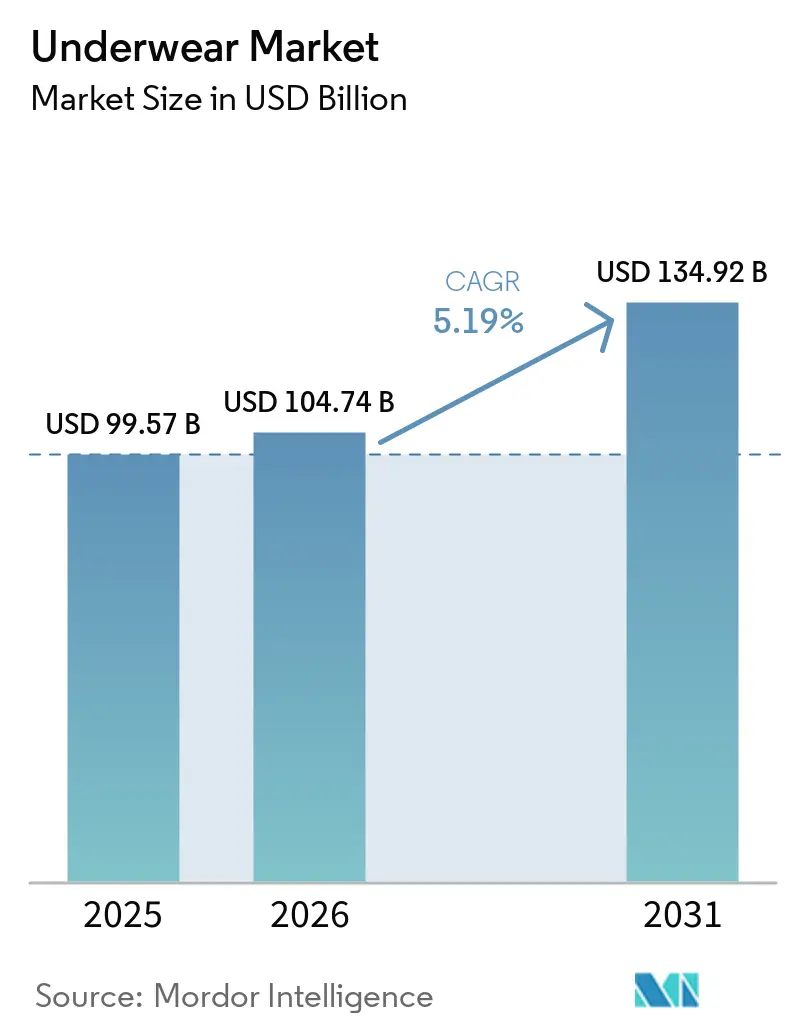
The Underwear Market size was valued at USD 99.57 billion in 2025 and is estimated to grow from USD 104.74 billion in 2026 to reach USD 134.92 billion by 2031, at a CAGR of 5.19% during the forecast period (2026-2031). Growth is being driven by increasing disposable incomes in emerging economies, rapid advancements in fabric innovation, and the expansion of e-commerce, which now accounts for nearly 15% of global apparel transactions. Additional momentum comes from the integration of athleisure functionality into everyday intimates, sustainability initiatives promoting circular-fiber sourcing, and consolidation among major players seeking procurement and logistics efficiencies. However, fluctuations in raw material prices, such as cotton and synthetics, continue to pressure gross margins for brands without vertically integrated operations. Brands that secure long-term fiber contracts, diversify production across Vietnam and Bangladesh, and invest in privacy-focused data architectures for emerging smart-garment lines are well-positioned to outperform sector averages.
Key Report Takeaways
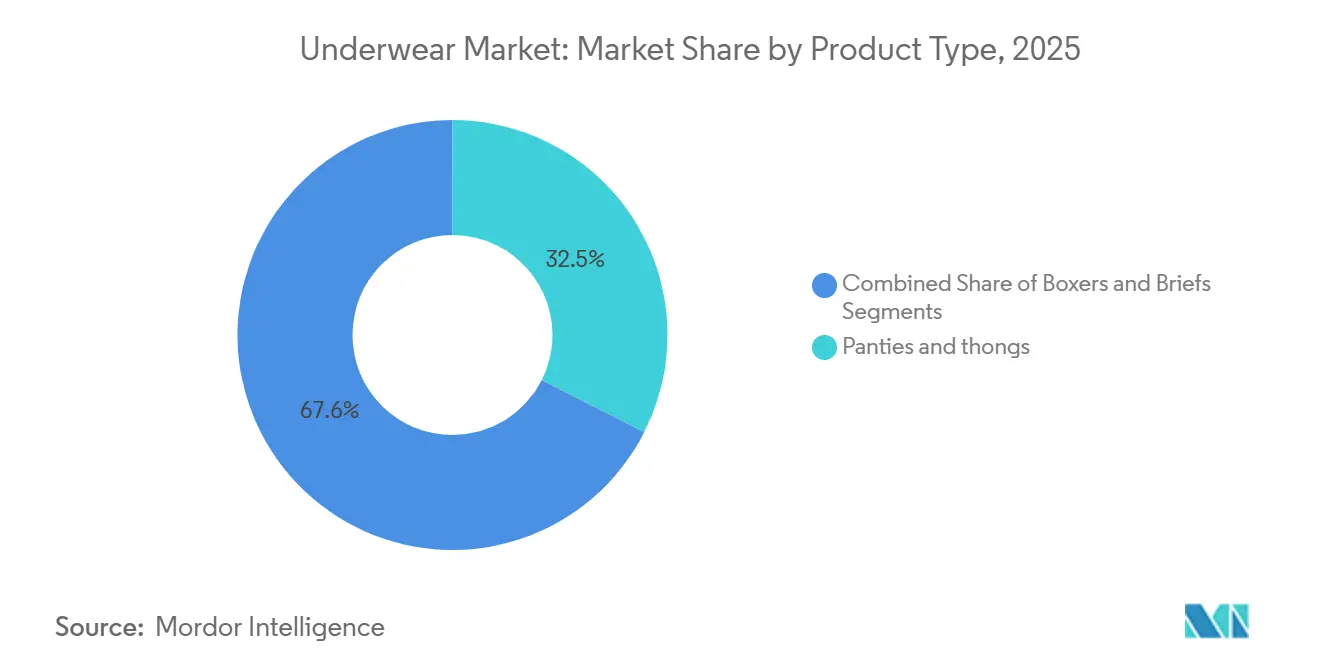
- By product type, panties led with 32.45% revenue share in 2025, while boxers are projected to expand at a 6.10% CAGR through 2031.
- By end user, men held 51.79% of the Underwear market share in 2025, whereas the women’s segment is forecast to grow at a 6.35% CAGR to 2031.
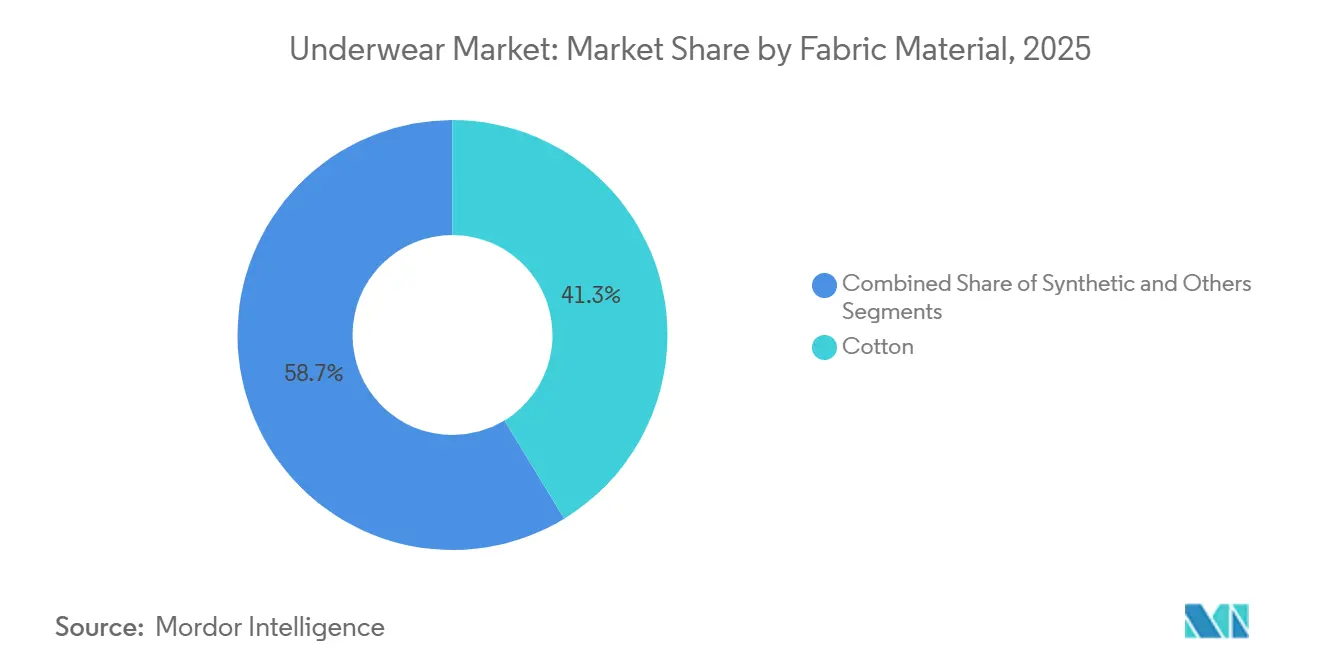
- By fabric material, cotton accounted for 41.17% of the 2025 Underwear market size, and synthetic blends are set to advance at a 6.25% CAGR during 2026-2031.
- By distribution channel, specialty stores captured 40.12% of 2025 sales, yet online retail stores are on track for a 6.54% CAGR through 2031.
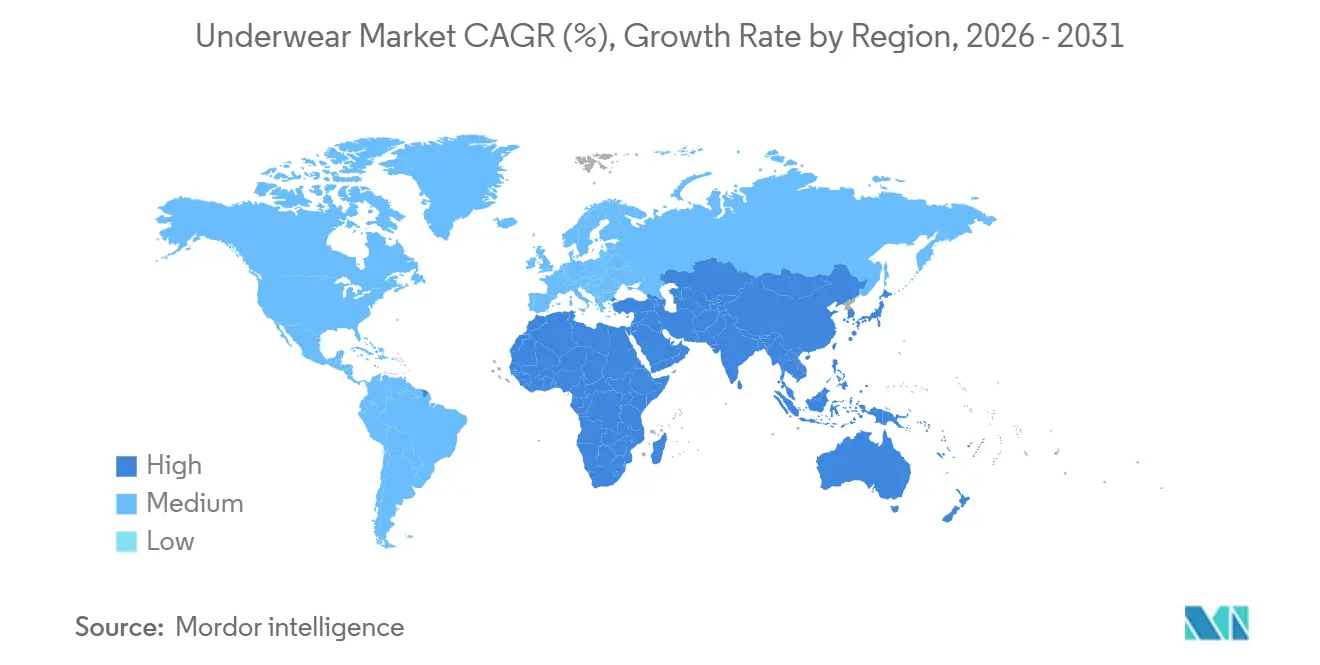
- By geography, North America commanded 37.34% revenue in 2025, but Asia-Pacific is expected to register the fastest regional CAGR at 6.91% over the same horizon.
Note: Market size and forecast figures in this report are generated using Mordor Intelligence’s proprietary estimation framework, updated with the latest available data and insights as of 2026.
Global Underwear Market Trends and Insights
Drivers Impact Analysis*
| Driver | (~) % Impact on CAGR Forecast | Geographic Relevance | Impact Timeline |
|---|---|---|---|
| Athleisure-inspired functional underwear gains popularity | +1.2% | Global, with early adoption in North America and Western Europe | Medium term (2-4 years) |
| E-commerce's apparel push broadens global reach | +1.5% | Global, accelerated in Asia-Pacific and Latin America | Short term (≤ 2 years) |
| Rising disposable income and heightened fashion awareness | +0.9% | Asia-Pacific core, spill-over to Middle East and Africa | Long term (≥ 4 years) |
| Advances in fabric technology (seamless, moisture-wicking) | +0.8% | Global, with R and D hubs in Japan, Germany, and United States | Medium term (2-4 years) |
| Sustainability trends favoring bamboo and recycled fibers | +0.6% | Europe and North America, expanding to Asia-Pacific | Long term (≥ 4 years) |
| Introduction of smart health-monitoring underwear | +0.4% | North America and select Asia-Pacific markets (Japan, South Korea) | Long term (≥ 4 years) |
| Source: Mordor Intelligence | |||
Athleisure-inspired functional underwear gains popularity
Brands are incorporating features like compression panels, four-way stretch fabrics, and flatlock seams, previously exclusive to sportswear, into everyday underwear, merging activewear with intimate apparel. In February 2025, Nike collaborated with Skims to capitalize on this trend. Their objective is to appeal to consumers who prioritize performance attributes, such as breathability and anti-chafe designs, in garments suitable for both athleisure and professional wear. Increasing sports participation is driving the demand for athleisure-inspired functional underwear. For instance, in 2024, the Ministry of Internal Affairs and Communications reported that 77.4% of individuals in Japan participated in sports[1]Source: Ministry of Internal Affairs and Communications, "Survey on sports FY 2024", soumu.go.jp . Brands capable of quickly adapting their manufacturing processes are benefiting from the athleisure trend. Uniqlo's AIRism line, which wicks sweat and reduces odors, became known as the "national uniform" in Singapore. This popularity spread across Southeast Asia, highlighting how functional basics can evolve into lifestyle essentials rather than simple commodities when marketed effectively.
E-commerce's apparel push broadens global reach
Digital channels are becoming the go-to for underwear purchases, hinting at a vast potential yet to be tapped in the broader apparel online market. Subscription models are proving their worth in driving consistent revenue: Savage X Fenty's monthly membership, priced at USD 49.95, translates to store credits, bolstering annual sales by over USD 150 million. ThirdLove's innovative selfie-based fit app not only enhances the shopping experience but also fosters repeat purchases, showcasing the power of algorithmic personalization in the online intimate wear market. In the culturally conservative landscape of India, Zivame has successfully made online lingerie shopping mainstream. Through discreet packaging and influencer-led education, they've demonstrated that with the right approach, market-specific challenges can be effectively addressed. Even traditional retailers are evolving: In April 2025, Marks and Spencer expanded its online marketplace by introducing brands like Calvin Klein and Tommy Hilfiger, aiming to enhance traffic and diversify its offerings. The surge in internet penetration is further fueling online sales. Data from the International Telecommunication Union (ITU) indicates that in 2025, around 6 billion people, roughly three-quarters of the global populace, were navigating the digital realm[2]Source: International Telecommunication Union (ITU), "ITU's Facts and Figures 2025", itu.int.
Rising disposable income and heightened fashion awareness
Rising per-capita incomes in Asia-Pacific and Latin America are transforming underwear from a basic necessity into a fashion-forward purchase. Consumers are increasingly dedicating a larger portion of their spending to premium fabrics and designer collaborations, reflecting a shift in preferences. In early 2025, Statistics of China indicated that the nationwide per capita disposable income reached CNY 21,840, highlighting the growing purchasing power in the region[3]Source: Statistics of China, "Households' Income and Consumption Expenditure", stats.gov,cn. Capitalizing on this trend, Calvin Klein introduced a shapewear collection in February 2025, priced between USD 34 and USD 104. This launch strategically combines body-shaping functionality with the brand's established reputation for luxury and style, catering to this evolving consumer segment. The interplay between rising incomes and fashion preferences also explains the anticipated 6.35% CAGR growth in the women's underwear market. Although men currently hold a larger absolute market share, women demonstrate stronger brand loyalty and a higher willingness to invest in products that offer superior comfort and aesthetic appeal. This dynamic particularly rewards brands that focus on inclusive sizing and body-positive marketing strategies, aligning with the values of modern consumers.
Advances in fabric technology
Textile innovation is significantly reducing product lifecycles, enabling brands to prioritize performance differentiation over competing solely on price. Teijin Frontier unveiled a stretch fabric designed for the Autumn/Winter 2026 collections, which features superior elasticity and enhanced shape retention. This development effectively addresses common consumer issues, such as waistband roll-down and fabric pilling that occur after repeated washing, thereby improving overall product durability and customer satisfaction. In February 2025, Nature published groundbreaking research on infrared-transparent Nylon 6 textiles. These advanced textiles allow wearable sensors to accurately detect biometrics through the fabric, a feature that smart-underwear developers are actively incorporating into prototypes aimed at providing continuous health monitoring solutions. Additionally, Spanx's strategic partnership with Lycra in January 2025 highlights the transformative potential of material science collaborations. By integrating FitSense technology, innovative fibers that dynamically adjust compression based on body movement, Spanx has secured a proprietary advantage that is both innovative and difficult for competitors to replicate, further solidifying its position in the market.
Restraints Impact Analysis*
| Restraint | (~) % Impact on CAGR Forecast | Geographic Relevance | Impact Timeline |
|---|---|---|---|
| Volatility in raw-material prices (cotton, synthetics) | -0.7% | Global, with acute impact in cotton-dependent economies (India, Pakistan, United States) | Short term (≤ 2 years) |
| Fragmentation and fierce price competition | -0.5% | Global, intensified in e-commerce channels | Medium term (2-4 years) |
| Concerns over data privacy in sensor-based smart underwear | -0.2% | North America and Europe, where GDPR and consumer protection laws are stringent | Long term (≥ 4 years) |
| Geopolitical trade shocks affecting cotton supply | -0.4% | Global, with supply disruptions concentrated in Central Asia and Sub-Saharan Africa | Short term (≤ 2 years) |
| Source: Mordor Intelligence | |||
Volatility in raw-material prices
In 2025, cotton futures ranged between 68 and 75 cents per pound, representing a 10% fluctuation that pressured margins for brands unable to pass on costs to price-sensitive consumers. The U.S. Department of Agriculture's December 2025 report attributed the volatility to erratic monsoon patterns in India, the world's largest cotton producer, and drought-driven acreage reductions in Texas, which collectively tightened global supply by an estimated 2.3 million bales year-over-year. Vietnam's textile industry, which recorded USD 46 billion in apparel exports in 2025, relies significantly on imported cotton and polyester. This dependency makes it susceptible to input-cost shocks, undermining its competitiveness against lower-cost rivals like Bangladesh. Brands with vertically integrated supply chains, such as the merged Gildan-Hanesbrands, are better equipped to manage such volatility. Conversely, smaller players reliant on spot-market fabric procurement face greater risks, potentially accelerating industry consolidation.
Fragmentation and fierce price competition
The underwear market's low barriers to entry have resulted in the rise of numerous direct-to-consumer brands. This surge has fragmented market share and increased promotional activities, weakening pricing power. Although Victoria's Secret achieved a 9% growth in same-store sales in Q3 2025, it continues to face margin pressures from competitors like ThirdLove and Savage X Fenty. These digitally native brands bypass wholesale markdowns and operate with more efficient cost structures. Fast Retailing's Uniqlo, producing about 6,000 styles annually, compared to Zara's 9,000 and Shein's staggering 165,000, demonstrates that maintaining SKU discipline can help counter fragmentation. By concentrating marketing efforts on key products, Uniqlo achieves greater scale. In this fragmented market, platforms such as Amazon and Zalando, which consolidate demand and charge fulfillment fees, hold a competitive edge. Meanwhile, individual brands struggle with high customer acquisition costs, often exceeding USD 50 per first-time buyer in competitive categories.
*Our forecasts treat driver/restraint impacts as directional, not additive. The impact forecasts reflect baseline growth, mix effects, and variable interactions.
Segment Analysis
By Product Type: Performance Boxers Accelerate Among Younger Men
In 2025, panties contributed 32.45% of total revenue, highlighting their variety across briefs, thongs, hipsters, and boyshorts. Premium lace and seamless designs command higher average selling prices compared to basic men's options. However, boxers are expected to witness the fastest growth, with a projected CAGR of 6.10%. This growth is driven by Gen Z males favoring athletic fits and moisture-wicking materials over traditional woven styles. PSD's pricing of USD 25-112 for boxer briefs reflects the market's willingness to pay a premium for techno-fabric advancements. As performance differentiation expands, the market size for boxers is forecasted to grow significantly. Furthermore, seamless waistbands made with Teijin Frontier’s stretch yarn are addressing roll-down issues, encouraging greater adoption.
Shifting dress codes are also impacting demand. As office attire becomes more casual, briefs are losing preference to styles that remain inconspicuous under relaxed trousers. Thong usage is also declining outside formal settings. Consumers today, who prioritize values, are more drawn to brand messaging that emphasizes functional comfort over overt sex appeal. Calvin Klein’s shapewear illustrates this trend by combining body-sculpting features with breathable fabrics, appealing to those seeking versatility. The broader Underwear market is adapting to these product-specific changes, emphasizing that innovations in fit and inclusive merchandising will play a key role in redistributing market shares, surpassing the importance of aesthetics alone.



By End User: Inclusive Women’s Lines Drive Future Growth
In 2025, men's underwear accounted for 51.79% of sales, driven by higher unit volumes and shorter replacement cycles. While multipacks priced between USD 12 and 18 remain staples in mass channels, their commoditization limits margin expansion. Men's labels benefit from lower online return rates compared to women's, easing reverse-logistics challenges. However, women's lines are projected to grow at a 6.35% CAGR, the industry's fastest pace. This surge is attributed to size-inclusive direct-to-consumer models that blend data science with comfort. Brands like ThirdLove, with its 78-size algorithm, and Savage X Fenty, offering an XS-to-3XL range, showcase how algorithmic fitting and body-positive messaging can transform digital engagement into brand loyalty.
Nike-Skims and Lululemon's foray into active underwear highlights a competitive push for female spending, emphasizing performance fabrics. Victoria's Secret's shift towards bralettes marks a departure from traditional push-up designs. Additionally, the women's underwear market is set to expand, driven by a quicker purchasing frequency influenced by fashion trends and a rising demand for maternity and post-surgery adaptations.
By Fabric Material: Synthetic Recycling Opens New Volume
In 2025, cotton accounted for a 41.17% market share, but its water-intensive production and price volatility challenge sustainability initiatives. Supima and organic cotton variants achieve a 20-30% premium; however, supply constraints limit their market presence. Synthetic blends are expected to grow at a 6.25% CAGR, marking the fastest growth among material layers. This expansion is driven by Radici InNova's recycling innovation, which enables closed-loop recovery of polyamide-elastane while maintaining its hand-feel. Uniqlo's AIRism line, made with polyester and spandex, highlights strong consumer acceptance due to its odor-control and sweat-wicking benefits. The Underwear segment's market share growth will also benefit from EU Digital Product Passport regulations that promote traceable recycled content.
Nylon 6 fabrics, which are infrared-transparent, add a smart-garment capability by enabling biometric sensing without the need for uncomfortable sensor pods. Bamboo, modal, and Tencel appeal to eco-conscious consumers willing to pay a 20-30% premium for biodegradability, though limited feedstock availability restricts their short-term market expansion. Overall, diversifying fiber sources serves as both a safeguard against cotton price volatility and a strategy to meet growing consumer expectations for performance and ethical standards.
By Distribution Channel: Digital Subscription Models Scale Rapidly
Specialty stores, known for their expertise and curated premium assortments, contributed 40.12% to the 2025 turnover. These stores achieve gross margins of 50-60%, but consumer foot traffic is increasingly shifting online. Virtual try-ons and guaranteed returns are helping to reduce selection anxieties for shoppers. Marks and Spencer's recent initiative to feature third-party underwear brands on its online platform highlights the growing importance of an omnichannel strategy for legacy players. On the other hand, supermarkets continue to hold their ground in value segments but face challenges in differentiation, particularly when fabric technology becomes a key factor.
Online retail is anticipated to grow at the fastest pace, with a projected CAGR of 6.54%. Subscription services, such as Savage X Fenty, are helping to stabilize revenue fluctuations while lowering customer acquisition costs. Additionally, smartphone fitting applications are addressing size-related concerns. As reverse-logistics networks advance in emerging markets, the online share of the underwear market is expected to expand further. Moreover, alternative channels like pop-up shops and brand-specific webstores are emerging as effective tools for storytelling and achieving full-price sales. This shift underscores a distribution model that is increasingly focused on digital engagement.
Geography Analysis
In 2025, North America held a 37.34% revenue share, driven by an annual per-capita underwear expenditure of approximately USD 120 and a strong presence of heritage brands. Gildan's USD 2.2 billion acquisition of Hanesbrands created a vertically integrated leader producing over 1 billion units annually, providing a significant advantage in the volatile cotton market. Victoria's Secret's shift towards comfort-focused products and Uniqlo's plan to expand to 200 locations by 2027 highlight ongoing domestic growth opportunities. While Canada and Mexico contribute modestly, they benefit from cross-border e-commerce, offering consumers access to United States pricing and a broader assortment.
Asia-Pacific, with a projected CAGR of 6.91%, remains the global demand driver. India's apparel growth, reflected in double-digit gains by H and M and Uniqlo, showcases the aspirations of a middle class seeking international quality at affordable prices. China's market, though mature, is moving towards premiumization, while Japan's early adoption of sensor-embedded underwear, valued at USD 190.87 million in 2024, highlights the region's interconnected demand and supply dynamics. As brands shift production away from China, Southeast Asian countries are emerging as key manufacturing hubs, boosting local employment and domestic consumption.
Europe, preparing for the 2027 Digital Product Passport, is prioritizing investments in recycled fibers and traceability systems to meet sustainability goals. The United Kingdom faces logistics challenges post-Brexit, while the eurozone deals with rising inflation. In South America, currency volatility limits discretionary spending, though niche exporters are exploring tariff-advantaged opportunities. The Middle East and Africa are experiencing early-stage growth: Gulf countries favor luxury imports, while Sub-Saharan Africa's demand leans towards affordable basics, requiring brands to tailor their offerings to diverse income levels.

Competitive Landscape
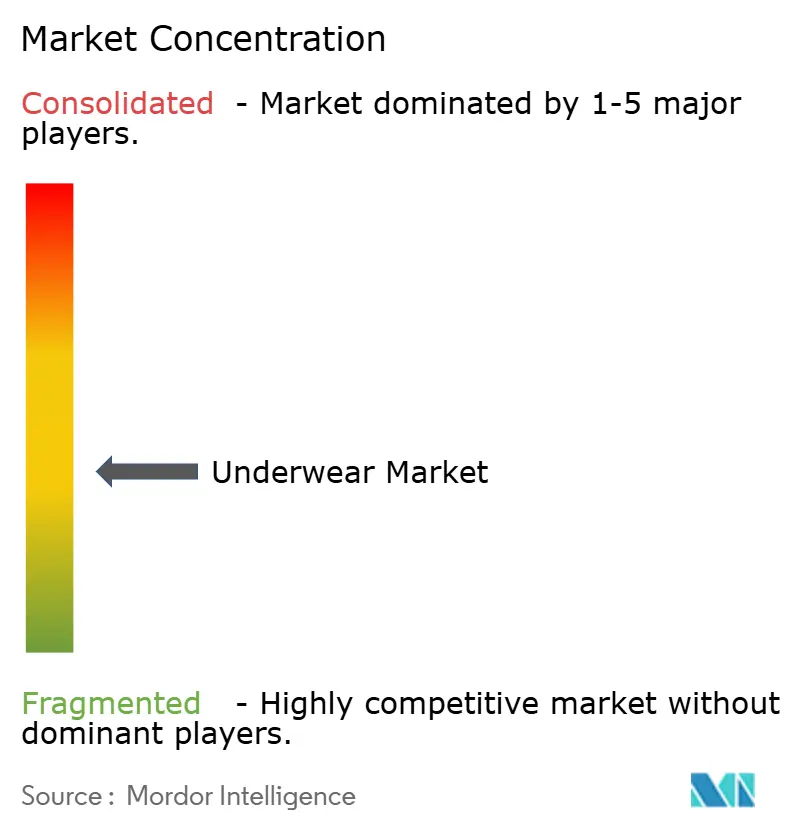
The underwear market is moderately fragmented, with the top five players, such as Gildan Activewear Inc., Jockey International Inc., PVH Corp., Fruit of the Loom, and Victoria’s Secret and Co., holding a significant share. The Gildan-Hanesbrands merger, scheduled for December 2025, will deliver unmatched manufacturing capacity, enabling yarn-forward sourcing to mitigate cotton price volatility. Meanwhile, PVH's decision to exit Heritage Brands redirects resources toward premium strategies for Calvin Klein and Tommy Hilfiger, leveraging emotion-driven marketing to maintain price premiums.
Sustainability is emerging as a critical differentiator. Marks and Spencer and H and M are advancing fiber-to-fiber recycling initiatives to reduce textile waste and promote circular fashion. Adidas, in collaboration with Finnish startup Spinnova, is exploring wood-based alternatives to lower the environmental impact of production. Although the adoption of smart fabrics faces challenges related to privacy and cost, Calvin Klein's partnership with Myant highlights the potential of sensor-equipped men's trunks for monitoring vital signs, showcasing the advantages of early adoption in wearable technology. These developments reflect the industry's increasing focus on innovation and eco-conscious practices.
Athleisure leaders, Nike Inc., Adidas AG, Lululemon, and Under Armour, are introducing performance fabrics that blur traditional category lines. Material-science innovations such as Radici InNova’s polyamide-elastane recycling and Spanx-Lycra’s adaptive compression create strong competitive barriers, delaying imitation by fast followers. Data capabilities also differentiate market players: Uniqlo, for example, processes 31 million annual RFID feedback points, streamlining design iterations and improving inventory accuracy. As a result, competitive dynamics are shaped by a dual strategy spectrum, cost-leadership consolidation on one side and premium, innovation-driven niches on the other.
Underwear Industry Leaders
-
PVH Corp.
-
Jockey International Inc.
-
Gildan Activewear Inc.
-
Victoria’s Secret and Co.
-
Fruit of The Loom, Inc.
- *Disclaimer: Major Players sorted in no particular order

Recent Industry Developments
- December 2025: Gildan Activewear Inc. has finalized the acquisition of HanesBrands Inc. (“HanesBrands”), establishing itself as a global leader in the apparel industry. By combining their strengths in activewear and innerwear, along with an extensive presence across various channels and geographies, the unified company is well-positioned to enhance customer service and deliver sustainable, long-term value to its shareholders.
- March 2025: The Hanky Panky company unveiled its new leak-proof panty collection. Teaming up with Saalt, a brand founded by women and committed to sustainability, they've seamlessly integrated lace with cutting-edge technology. Saalt’s gusset technology stands out as the market's thinnest, driest, and most absorbent, all without any added PFAS. This collaboration highlights the growing trend of combining fashion with functionality, catering to the increasing demand for sustainable and innovative intimate wear.
- March 2025: Johann Vera, a leading pop artist from Latin America, debuted his new men's underwear line. To promote the collection, he featured it prominently in his latest music video, "Closet". The collection reflects Vera's unique style and aims to appeal to a younger demographic, blending comfort with modern design. This launch also underscores the growing influence of celebrity endorsements in the intimate apparel market.
- February 2025: HanesBrands finalized its USD 583 million acquisition of Maidenform Brands, bolstering its global intimate portfolio with Maidenform, Flexees, and Lilyette labels. This strategic acquisition is expected to strengthen HanesBrands' market position by expanding its product offerings and leveraging Maidenform's established brand equity in the intimate wear segment.


Global Underwear Market Report Scope
Underwear is clothing or an article of clothing worn next to the skin and under other clothing. The underwear market is segmented by product type, end user, fabric material, distribution channel, and geography. By product type, the market is segmented into briefs, boxers, panties, and thongs. By end-user, the market is segmented into women, men, and children. By fabric material, the market is segmented into cotton, synthetic, and others. By distribution channel, the market is segmented into supermarkets/hypermarkets, online retail stores, specialty stores, and others. By geography, the market is segmented into North America, South America, Europe, Asia-Pacific, the Middle East and Africa. Market forecasts are provided in value (USD) for all the above segments.
| Briefs |
| Boxers |
| Panties and thongs |
| Women |
| Men |
| Children |
| Cotton |
| Synthetic |
| Others |
| Supermarkets/Hypermarkets |
| Online Retail Stores |
| Specialty Stores |
| Others |
| North America | United States |
| Canada | |
| Mexico | |
| Rest of North America | |
| South America | Brazil |
| Argentina | |
| Colombia | |
| Chile | |
| Rest of South America | |
| Europe | United Kingdom |
| Germany | |
| France | |
| Italy | |
| Spain | |
| Russia | |
| Sweden | |
| Belgium | |
| Poland | |
| Netherlands | |
| Rest of Europe | |
| Asia-Pacific | China |
| Japan | |
| India | |
| Thailand | |
| Singapore | |
| Indonesia | |
| South Korea | |
| Australia | |
| New Zealand | |
| Rest of Asia-Pacific | |
| Middle East and Africa | United Arab Emirates |
| South Africa | |
| Saudi Arabia | |
| Nigeria | |
| Egypt | |
| Morocco | |
| Turkey | |
| Rest of Middle East and Africa |
| By Product Type | Briefs | |
| Boxers | ||
| Panties and thongs | ||
| By End-User | Women | |
| Men | ||
| Children | ||
| By Fabric Material | Cotton | |
| Synthetic | ||
| Others | ||
| By Distribution Channel | Supermarkets/Hypermarkets | |
| Online Retail Stores | ||
| Specialty Stores | ||
| Others | ||
| By Geography | North America | United States |
| Canada | ||
| Mexico | ||
| Rest of North America | ||
| South America | Brazil | |
| Argentina | ||
| Colombia | ||
| Chile | ||
| Rest of South America | ||
| Europe | United Kingdom | |
| Germany | ||
| France | ||
| Italy | ||
| Spain | ||
| Russia | ||
| Sweden | ||
| Belgium | ||
| Poland | ||
| Netherlands | ||
| Rest of Europe | ||
| Asia-Pacific | China | |
| Japan | ||
| India | ||
| Thailand | ||
| Singapore | ||
| Indonesia | ||
| South Korea | ||
| Australia | ||
| New Zealand | ||
| Rest of Asia-Pacific | ||
| Middle East and Africa | United Arab Emirates | |
| South Africa | ||
| Saudi Arabia | ||
| Nigeria | ||
| Egypt | ||
| Morocco | ||
| Turkey | ||
| Rest of Middle East and Africa | ||


Key Questions Answered in the Report
What was the global Underwear market size in 2025 and how fast is it growing?
The sector was valued at USD 99.57 billion in 2025 and is tracking a 5.19% CAGR toward USD 134.92 billion by 2031.
Which region will contribute the most incremental revenue through 2031?
Asia-Pacific, supported by urbanization in India and China, is projected for the fastest 6.91% CAGR over 2026-2031.
Which product type is poised for the highest growth?
Performance-oriented boxer briefs are expected to expand at a 6.10% CAGR as younger men favor moisture-wicking fabrics.
Why are synthetic blends gaining share over cotton?
Breakthrough recycling processes lower environmental impact while adding stretch, odor control, and durability features that cotton cannot match.
Page last updated on:





