
Turkey HVAC Market Size and Share
| Study Period | 2019 - 2030 |
| Forecast Data Period | 2025 - 2030 |
| Historical Data Period | 2019 - 2023 |
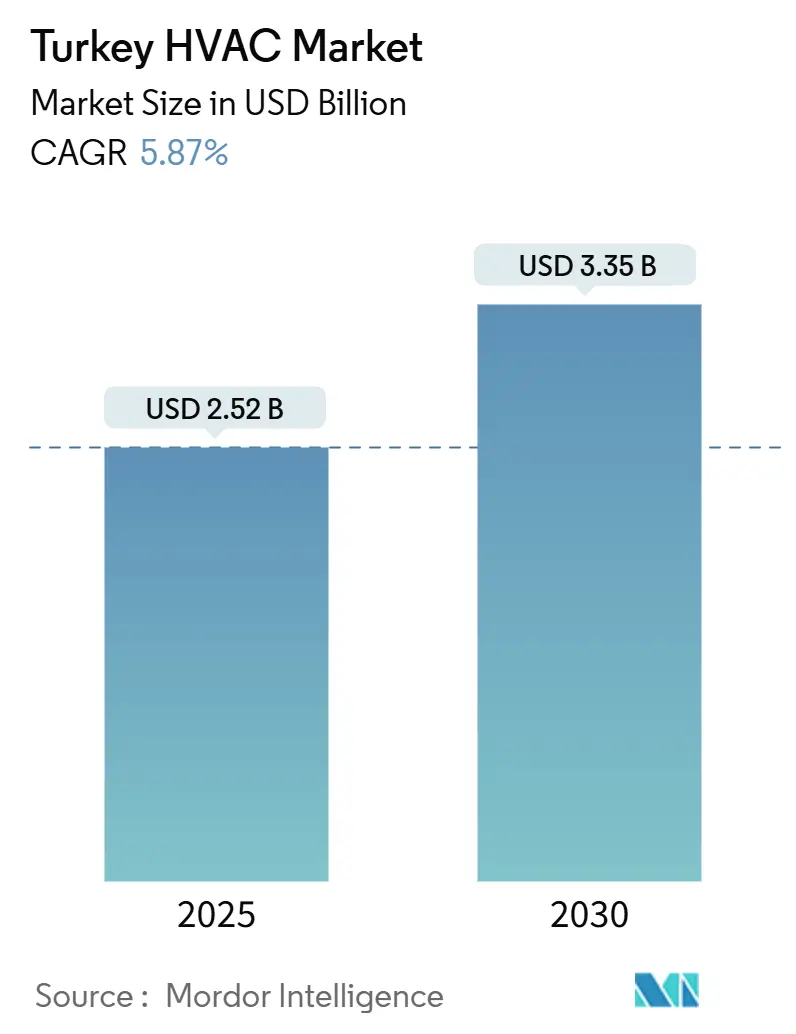
| Market Size (2025) | USD 2.52 Billion |
| Market Size (2030) | USD 3.35 Billion |
| CAGR (2025 - 2030) | 5.87% |
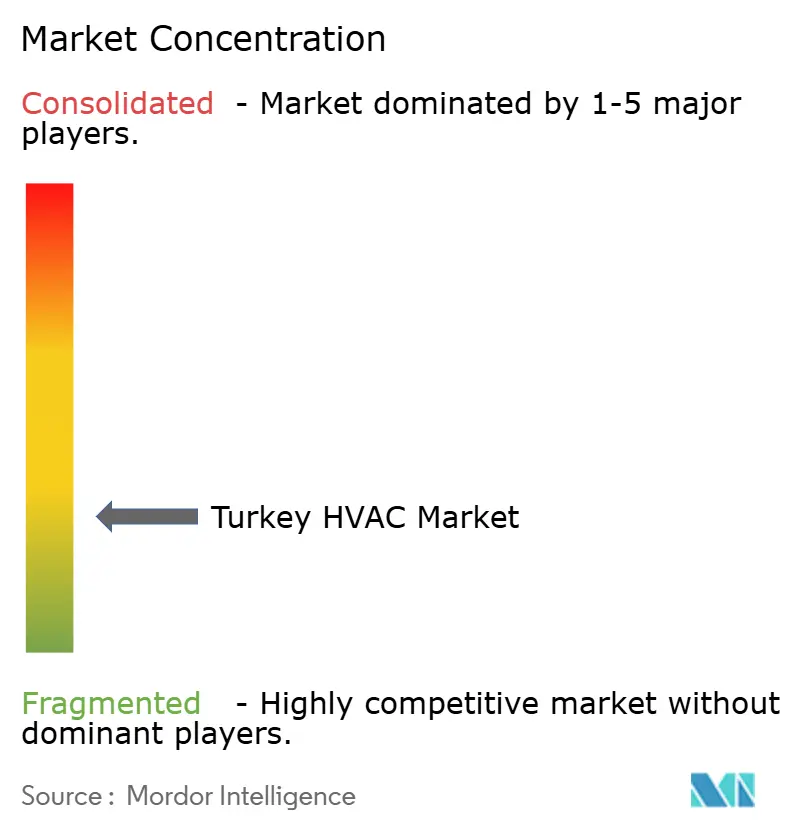
| Market Concentration | Low |
Major Players *Disclaimer: Major Players sorted in no particular order |
Turkey HVAC Market Analysis by Mordor Intelligence
The Turkey HVAC Market size is estimated at USD 2.52 billion in 2025, and is expected to reach USD 3.35 billion by 2030, at a CAGR of 5.87% during the forecast period (2025-2030).
- Turkey's booming construction activities are driving a significant rise in HVAC (Heating, Ventilation, and Air Conditioning) consumption. As urbanization accelerates and construction and site renovations surge, Turkey's appetite for HVAC products continues to expand. In response to tightening energy efficiency standards and regulations, both consumers and businesses in Turkey are increasingly opting for energy-efficient HVAC systems, aiming to reduce operating costs and comply with new regulations.
- Urbanization and housing developments in cities like Istanbul, Ankara, and Izmir are spurring demand for HVAC systems in residential and commercial buildings. Major undertakings, such as airports and office complexes, are consistently driving the demand for advanced HVAC systems. These large public structures require central HVAC systems that prioritize redundancy, safety compliance, and stringent energy efficiency standards.
- Technological innovations in HVAC, including smart thermostats, variable refrigerant flow (VRF) systems, and energy-efficient components, are boosting market growth by enhancing performance and promoting energy savings. Additionally, the growing trend of merging renewable energy sources, like solar and geothermal, with HVAC systems is further propelling this market expansion.
- With proper maintenance, HVAC systems can endure for over a decade. Regularly cleaning filters to eliminate dust and sediment is vital to avert potential damage and system failures. Components such as filters, motors, refrigerants, and coolants in HVAC units often need frequent replacement or repair due to their limited lifespan. While energy-efficient HVAC systems offer long-term savings, their high initial costs can overshadow these benefits in the short term. As a result, the substantial upfront and maintenance expenses tied to HVAC systems are likely to stunt the growth of the HVAC equipment market.
- Turkey's HVAC industry, which leans heavily on imports, faces hurdles due to macroeconomic factors. Rising costs for refrigerants, semiconductors, and HVAC units have triggered price increases for end users, dampening their purchasing enthusiasm. Additionally, Turkey has been subject to significant energy price fluctuations, a consequence of the European energy crisis and its geopolitical ties. These rising electricity prices not only inflate the operational costs of HVAC systems but also dissuade both residential and commercial clients from investing in or upgrading their systems.
Turkey HVAC Market Trends and Insights
Commercial Sector is Expected to Hold a Largest Market Share
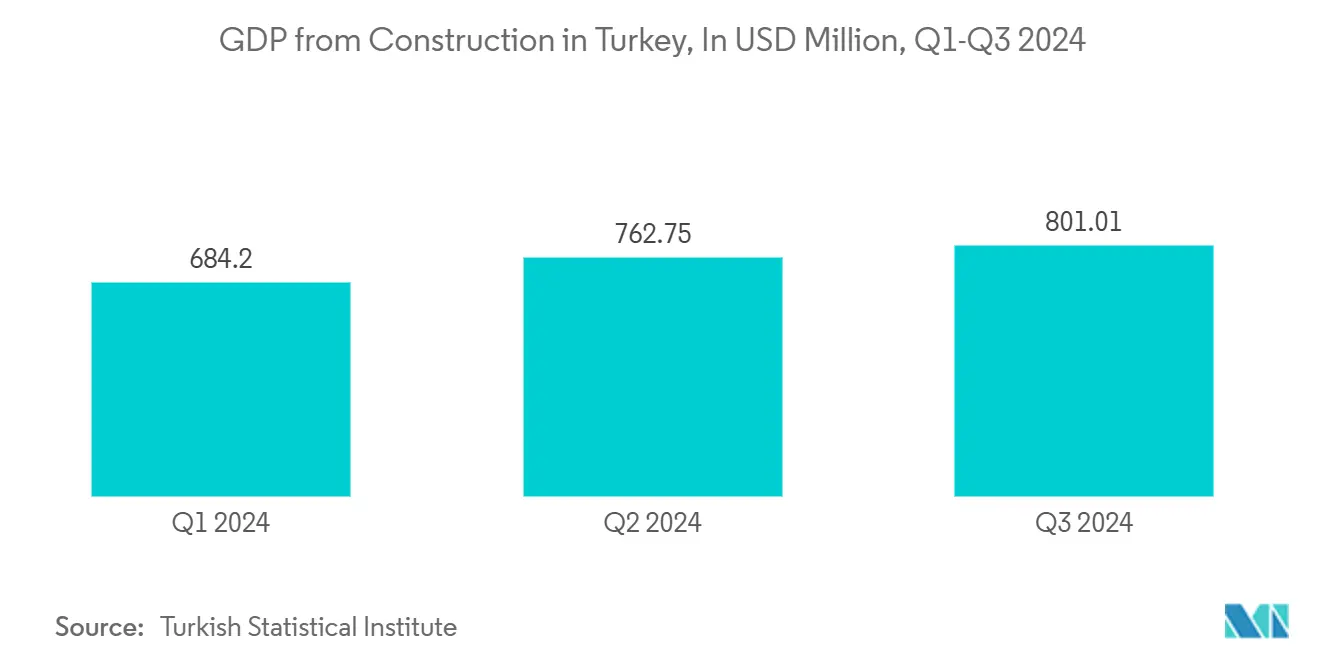
- Turkey's commercial construction boom is fueling a heightened demand for Heating, Ventilation, and Air Conditioning equipment (HVAC) systems. New constructions prioritize energy efficiency, comfort, and air quality. With urbanization on the rise, Turkish cities are witnessing a surge in modern office buildings, shopping malls, and transportation hubs—all reliant on HVAC systems for optimal operation and user satisfaction. Data from the Turkish Statistical Institute indicates that in Q3 2024, Turkey's construction GDP hit TRY 31,400 Million (USD 801.01 million), up from TRY 29,900 Million (USD 762.75 million) in Q2 2024.
- Moreover, the burgeoning retail and mixed-use developments in suburban areas and tier-2 cities like Bursa and Gaziantep are amplifying the demand for HVAC systems. These developments require zoning flexibility to blend diverse environments—from retail to entertainment—all under one roof. This complexity is driving the adoption of VRF systems, modular rooftop units, and energy recovery ventilation systems, ensuring efficient climate control throughout various sections of a facility.
- Turkey's e-commerce and logistics boom has spurred the construction of warehouses, distribution centers, and data facilities, particularly near industrial hubs like Bursa and Kocaeli. These facilities demand stringent temperature and humidity control to safeguard goods, servers, and equipment, bolstering the need for efficient HVAC installations.
- A pivotal factor reshaping HVAC innovation in Turkey's commercial realm is the nation's growing commitment to sustainability and green building practices. Developers are increasingly pursuing certifications like Building Research Establishment Environmental Assessment Method and Leadership in Energy and Environmental Design. Achieving these certifications mandates the integration of high-efficiency, eco-friendly HVAC technologies. Consequently, there's a marked shift towards inverter-based systems, heat pumps, and IoT-enabled smart controls, all designed to enhance performance and minimize carbon footprints.


Heating Equipment is Expected to Witness a Significant Growth
- Heat pumps play a crucial role in HVAC (Heating, Ventilation, and Air Conditioning Equipment) systems, transferring heat from cooler areas to warmer ones through a refrigeration cycle. This process not only cools the designated area but also raises the temperature of the target space. Heat pumps extract warmth from the increasing cold outside air to heat homes during the winters. Conversely, in summer, they can be set to release heat from the home to the warmer outside air. This distinctive capability of transferring heat, rather than merely generating it, positions heat pumps as a more energy-efficient alternative to conventional heating and cooling methods.
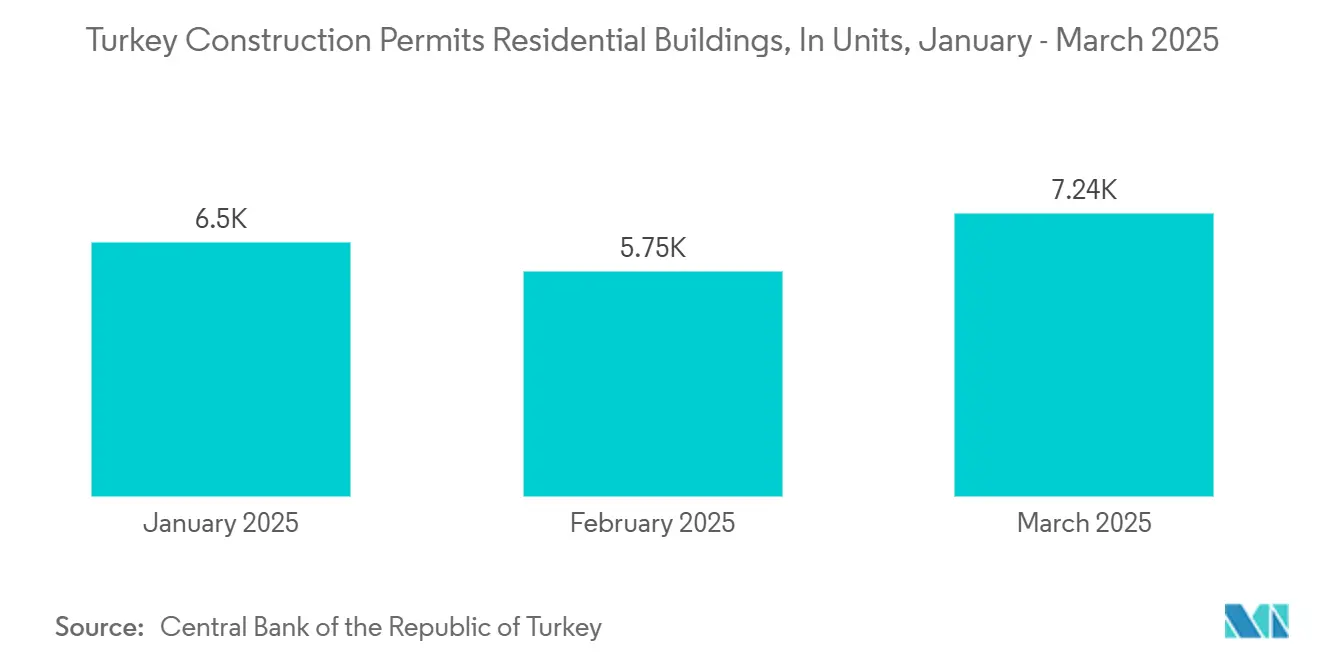
- Historically, Turkey's residential heating landscape has been dominated by natural gas boilers and district heating systems. Yet, surging energy prices, particularly for natural gas imports, are steering homeowners and developers towards high-efficiency, electric-based heating solutions. Air-to-water and air-to-air heat pumps, in particular, are gaining traction due to their promise of significant long-term energy savings. As reported by the Central Bank of the Republic of Turkey, housing starts in Turkey saw an uptick, rising to 7,240 units in March from 5,750 units in February 2025.
- In June 2024, Solimpeks, a Turkish heating solutions provider, introduced a versatile air-to-water heat pump system tailored for domestic hot water. Aiming at both residential and commercial markets, the new Varm Boiler Circulation Pump (BCP) series is designed to be compatible with both new and existing tanks. The manufacturer emphasizes that the system comes with a water tank boasting a genuine capacity of 286 liters. Additionally, the heat pump, equipped with a thermostatic expansion valve, utilizes R410 as its refrigerant.
- Turkey is witnessing a surge in heat pump adoption, bolstered by various electrification policies and government-backed initiatives. A study by SHURA, titled "Net Zero 2053: A Roadmap for the Turkish Electricity Sector," predicts that by 2053, heat pumps will dominate residential heating in Turkey, accounting for a substantial 67% share. Given their critical role in decarbonizing homes, it's imperative to identify and implement the right policies to facilitate this transition. With their remarkable efficiency and the increasing integration of renewable energy sources into power grids, heat pumps stand out as a formidable ally in the fight against climate change.

Competitive Landscape
The Turkey HVAC market is fragmented, with specialized players and regional conglomerates operating across various segments. While multiple large multinational companies dominate certain high-value segments, numerous regional and niche players contribute to the overall competition, making the market highly diverse. This competition is driven by the wide range of applications for HVAC equipment, allowing both small and large companies to coexist and thrive in the market.
Several leading companies in the Turkey HVAC market include Johnson Controls International PLC, Carrier Corporation, Robert Bosch GmbH, Daikin Industries, Ltd., Trane Inc, and many others. With strong brand recognition and extensive regional operations, these companies command a significant market share. Their strengths include innovation, a broad solutions portfolio, and robust distribution networks. To maintain their competitive edge and broaden their market reach, these leaders frequently pursue strategic acquisitions and partnerships.
In the competitive landscape of the Turkey HVAC market, companies are increasingly prioritizing innovation across key product categories: heating, ventilation, and air conditioning equipment. As industries seek out advanced solutions, HVAC equipment is set to become a pivotal differentiator. Additionally, expanding service offerings and enhancing customer support are essential for fostering enduring relationships and securing repeat business. Firms that invest in emerging markets and tailor their products to regional needs are poised to gain a significant advantage in this fragmented arena.
Turkey HVAC Industry Leaders
Johnson Controls International PLC
Carrier Corporation
Robert Bosch GmbH
Daikin Industries, Ltd.
Trane Inc.
- *Disclaimer: Major Players sorted in no particular order

Recent Industry Developments
- October 2024: JJohnson Controls International PLC is ramping up production at its Izmir plant in Turkey. With a hefty investment of three million dollars, the company aims to boost its output of commercial heat pumps, catering to the surging demand in the European market. This expansion not only enhances production efficiencies but also promises quicker delivery times for HVAC solutions, benefiting commercial clients across Europe.
- March 2024: Panasonic Corporation's Heating & Ventilation A/C Company (HVAC) introduced three new models of commercial air-to-water (A2W) heat pumps. These pumps, designed for multi-dwelling units, stores, offices, and light commercial properties, utilize eco-friendly natural refrigerants. Boasting compact designs that set industry standards, these models expand Panasonic's offerings, complementing their existing lineup tailored for stand-alone homes. A2W harnesses ambient air heat to produce hot water for building use.


Turkey HVAC Market Report Scope
HVAC is a comprehensive system designed to create and maintain comfortable indoor environmental conditions in residential, commercial, and industrial spaces. Heating is the first component, which involves warming interior spaces during cold weather through various methods such as furnaces, heat pumps, and radiant heating systems. These technologies convert energy into heat, distributing warmth evenly throughout a building to ensure occupant comfort and prevent temperature-related issues.
Ventilation represents the critical process of exchanging indoor and outdoor air, ensuring proper air circulation, removing pollutants, controlling humidity, and maintaining air quality. This aspect of HVAC involves mechanical and natural ventilation techniques that introduce fresh air, filter contaminants, and regulate oxygen levels. Proper ventilation is essential for preventing the buildup of harmful gases, reducing moisture-related problems, and creating a healthy indoor environment.
Air Conditioning focuses on cooling and dehumidifying interior spaces during warm weather. Modern air conditioning systems use refrigeration cycles to remove heat and moisture from the air, creating a comfortable and controlled climate. These systems range from central air conditioning units to ductless mini-splits, providing precise temperature management and improving overall indoor comfort. The integration of these three components- heating, ventilation, and air conditioning- creates a sophisticated environmental control system that adapts to changing weather conditions and occupant needs.
The study tracks the revenue accrued through the sale of HVAC product types by various players in Turkey. The study also tracks the key market parameters, underlying growth influencers, and major vendors operating in the industry, which supports the market estimations and growth rates over the forecast period. The study further analyses the overall impact of macroeconomic factors on the market. The report's scope encompasses market sizing and forecasts for the various market segments.
The Turkey HVAC Market is Segmented by product type (heating equipment [heat pumps (air source, ground source), furnaces (gas, electric, oil), boilers (condensing, non-condensing), unit heaters, and others (radiators & baseboard heaters, solar water heating systems)], ventilation equipment [air handling units (AHUs), energy recovery ventilators (ERVs)/heat recovery, ventilators (HRVs), exhaust and supply fans, dehumidifiers/humidifiers], air conditioning equipment [unitary air conditioners, variable refrigerant flow (VRF) systems, chillers (air-cooled, water-cooled), fan coil units (FCUs), and others (window and portable air conditioners)]) and end-user industry (residential, commercial, and industrial). The market sizes and forecasts are provided in terms of value (USD) for all the above segments.
| Heating Equipment | Heat Pumps (Air Source, Ground Source) | |
| Furnaces (Gas, Electric, Oil) | ||
| Boilers (Condensing, Non-condensing) | ||
| Unit Heaters | ||
| Others (Radiators & Baseboard Heaters, Solar Water Heating Systems) | ||
| Ventilation Equipment | Air Handling Units (AHUs) | |
| Energy Recovery Ventilators (ERVs) / Heat Recovery Ventilators (HRVs) | ||
| Exhaust and Supply Fans | ||
| Dehumidifiers / Humidifiers | ||
| Air Conditioning Equipment | Unitary Air Conditioners | Split Air Conditioners |
| Packaged Terminal ACs (PTACs) | ||
| Rooftop Packaged Units (RTUs) | ||
| Variable Refrigerant Flow (VRF) Systems | ||
| Chillers (Air-Cooled, Water-Cooled) | ||
| Fan Coil Units (FCUs) | ||
| Others (Window and Portable Air Conditioners) | ||
| Residential |
| Commercial |
| Industrial |
| By Product Type | Heating Equipment | Heat Pumps (Air Source, Ground Source) | |
| Furnaces (Gas, Electric, Oil) | |||
| Boilers (Condensing, Non-condensing) | |||
| Unit Heaters | |||
| Others (Radiators & Baseboard Heaters, Solar Water Heating Systems) | |||
| Ventilation Equipment | Air Handling Units (AHUs) | ||
| Energy Recovery Ventilators (ERVs) / Heat Recovery Ventilators (HRVs) | |||
| Exhaust and Supply Fans | |||
| Dehumidifiers / Humidifiers | |||
| Air Conditioning Equipment | Unitary Air Conditioners | Split Air Conditioners | |
| Packaged Terminal ACs (PTACs) | |||
| Rooftop Packaged Units (RTUs) | |||
| Variable Refrigerant Flow (VRF) Systems | |||
| Chillers (Air-Cooled, Water-Cooled) | |||
| Fan Coil Units (FCUs) | |||
| Others (Window and Portable Air Conditioners) | |||
| By End-user Industry | Residential | ||
| Commercial | |||
| Industrial | |||


Key Questions Answered in the Report
How big is the Turkey HVAC Market?
The Turkey HVAC Market size is expected to reach USD 2.52 billion in 2025 and grow at a CAGR of 5.87% to reach USD 3.35 billion by 2030.
What is the current Turkey HVAC Market size?
In 2025, the Turkey HVAC Market size is expected to reach USD 2.52 billion.
Who are the key players in Turkey HVAC Market?
Johnson Controls International PLC, Carrier Corporation, Robert Bosch GmbH, Daikin Industries, Ltd. and Trane Inc. are the major companies operating in the Turkey HVAC Market.
What years does this Turkey HVAC Market cover, and what was the market size in 2024?
In 2024, the Turkey HVAC Market size was estimated at USD 2.37 billion. The report covers the Turkey HVAC Market historical market size for years: 2019, 2020, 2021, 2022, 2023 and 2024. The report also forecasts the Turkey HVAC Market size for years: 2025, 2026, 2027, 2028, 2029 and 2030.
Page last updated on:
Turkey HVAC Market Report
Statistics for the 2025 Turkey HVAC market share, size and revenue growth rate, created by Mordor Intelligence™ Industry Reports. Turkey HVAC analysis includes a market forecast outlook for 2025 to 2030 and historical overview. Get a sample of this industry analysis as a free report PDF download.





