
Canada HVAC Market Size and Share
| Study Period | 2019 - 2030 |
| Forecast Data Period | 2025 - 2030 |
| Historical Data Period | 2019 - 2023 |
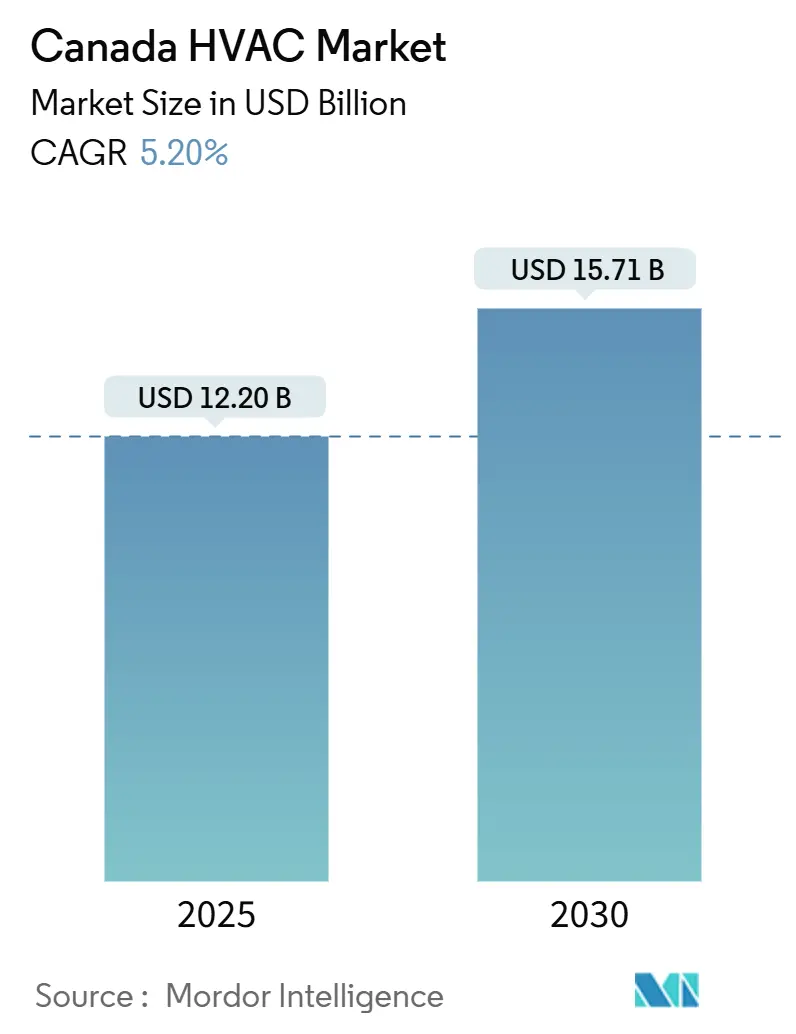
| Market Size (2025) | USD 12.20 Billion |
| Market Size (2030) | USD 15.71 Billion |
| CAGR (2025 - 2030) | 5.20% |
| Market Concentration | Low |
Major Players *Disclaimer: Major Players sorted in no particular order |
Canada HVAC Market Analysis by Mordor Intelligence
The Canada HVAC Market size is estimated at USD 12.20 billion in 2025, and is expected to reach USD 15.71 billion by 2030, at a CAGR of 5.20% during the forecast period (2025-2030).
- The Canada HVAC market is expected to have a steady trajectory that reflects robust replacement demand for aging systems, stricter efficiency codes, and federal incentives that reward low-carbon upgrades.
- Heating equipment sets the pace in the Canada HVAC market because space heating accounts for nearly two-thirds of household energy use nationwide. Regulation‐driven turnover from legacy furnaces to condensing models, together with a surge in cold-climate heat pumps, is lifting revenue even as unit prices edge down.
- Simultaneously, installers are rushing to re-train as the phase-down of high-GWP refrigerants forces a redesign of air-conditioning and heat-pump lines. Digitalisation adds an additional growth layer: connected sensors and cloud analytics have turned preventative maintenance into a subscription service, raising life-cycle value per installation.
- Canada's stringent environmental policies are driving market growth. The "Pan-Canadian Framework on Clean Growth and Climate Change" underscores the nation's commitment to curbing greenhouse gas emissions and championing sustainability. As a result, the government has rolled out rebates, tax incentives, and other financial supports, motivating both residential and commercial entities to embrace Energy Star-rated, energy-efficient HVAC systems.
- In urban centers like Toronto, Vancouver, and Montreal, a bustling construction sector is evident. These cities are pouring substantial investments into modern infrastructure. Notably, retrofit projects are on the rise, with stakeholders prioritizing enhanced energy management and superior indoor environmental quality.
Canada HVAC Market Trends and Insights
Advancement in HVAC technology is expected to drive the market
- HVAC systems are undergoing a transformation, thanks to advancements in sensor technology, real-time monitoring, and IoT integration. Today's HVAC units boast smart sensors and connectivity features, allowing for remote control, automated adjustments, and predictive maintenance. Such integration not only optimizes energy consumption by adjusting performance based on real-time data but also cuts down on downtime and maintenance expenses. Moreover, integrating these systems with a building's overarching management platform enhances efficiency and reliability, benefiting both new constructions and retrofitting projects.
- HVAC systems are becoming more energy-efficient, thanks to innovations like variable refrigerant flow (VRF) systems, inverter-driven compressors, and advanced heat pump technologies. With tightening environmental regulations and rising energy costs, these state-of-the-art systems play a pivotal role in minimizing carbon footprints through reduced energy consumption. In Canada, government-backed initiatives and rebates for energy-efficient installations are bolstering these technological advancements, enhancing their appeal for commercial and residential use alike.
- A hybrid VRF architecture that substitutes water for refrigerant within occupied rooms removes flammability risk yet preserves energy benefits—an appealing proposition for clinics, laboratories, and schools. Together, these breakthroughs raise capital costs by 8-10% but shorten payback to under five winters, ensuring consistent demand among facility managers in the Canadian HVAC market acording to National Resources Canada.
- Canada's diverse climate, swinging from frigid winters to balmy summers, demands HVAC systems adept at navigating these extremes. Thanks to recent technological strides, manufacturers are crafting modular, scalable systems that excel in any weather. Customized solutions, including zoned systems and adaptive controls, smartly direct energy where it's most essential, enhancing both comfort and efficiency.
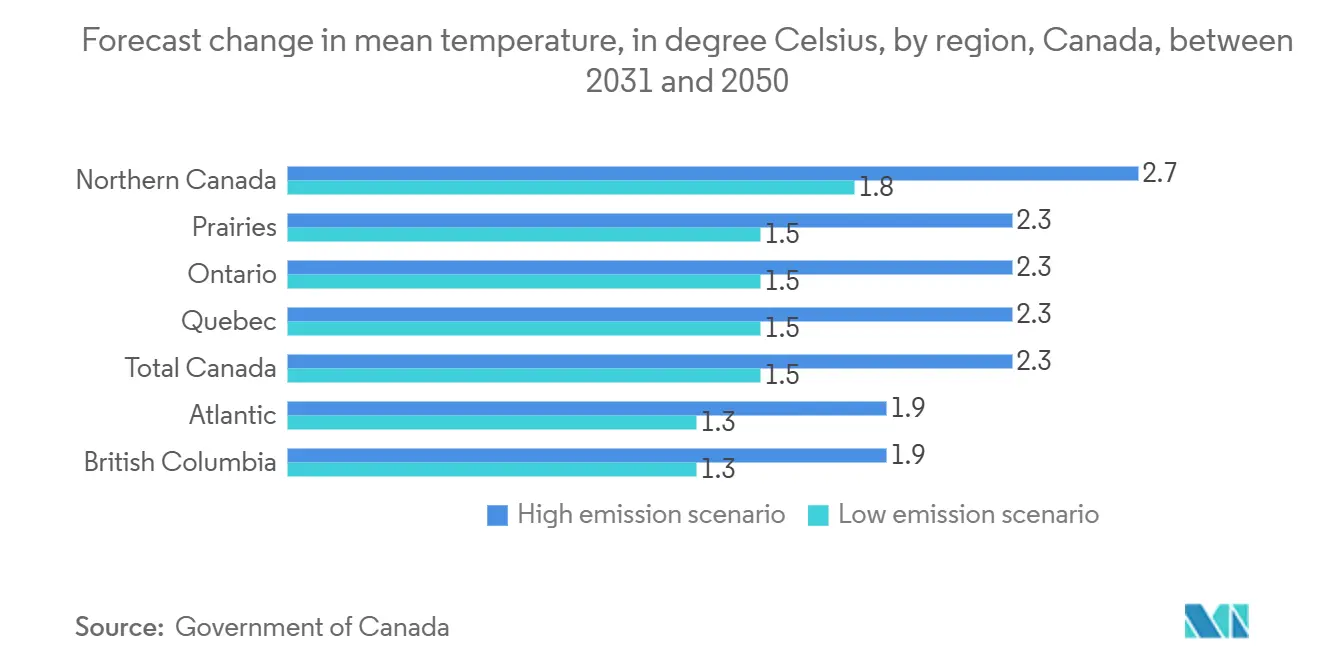
- According to a high emissions forecast from the Government of Canada, Canada's average temperature is expected to increase by 2.3 degrees Celsius between 2031 and 2050. Northern Canada will see even sharper temperature changes, ranging from 1.8 to 2.7 degrees Celsius, depending on emission levels. This underscores the pressing need for advanced HVAC systems.


Residential Segment is expected to hold a major share
- The residential sector accounted for 48% of Canada's HVAC market share in 2024, owing to steady population growth and a brisk renovation cycle in suburban zones. Homeowners adopting smart zoning thermostats cut utility bills by 26% in the first year, encouraging peer-to-peer referrals that lower marketing spend for manufacturers.
- Residential heat-pump upgrades are on track to grow at 6.2% CAGR to 2030 as the federal Oil-to-Heat-Pump Affordability program now rebates up to USD 15,000 per dwelling. The cumulative Canada HVAC market size within the residential bracket is forecast to reach USD 8.1 billion in 2030.
- Municipal retrofit grants in the Greater Toronto Area award USD 2 per kWh saved in the first year of operation, effectively halving payback periods for premium condensing boilers. These interventions support roughly USD 4.9 billion in annual revenue, or 32% of the total Canada HVAC market.
- British Columbia leads the electrification push, with heat-pump penetration climbing from 7% in 2017 to 13% in 2024, thanks to stacked CleanBC rebates worth up to USD 16,000 per household. Builders targeting Step 5 of the provincial Energy Step Code increasingly specify integrated heat-recovery ventilators as a prerequisite, migrating procurement toward all-electric, low-GWP packages.
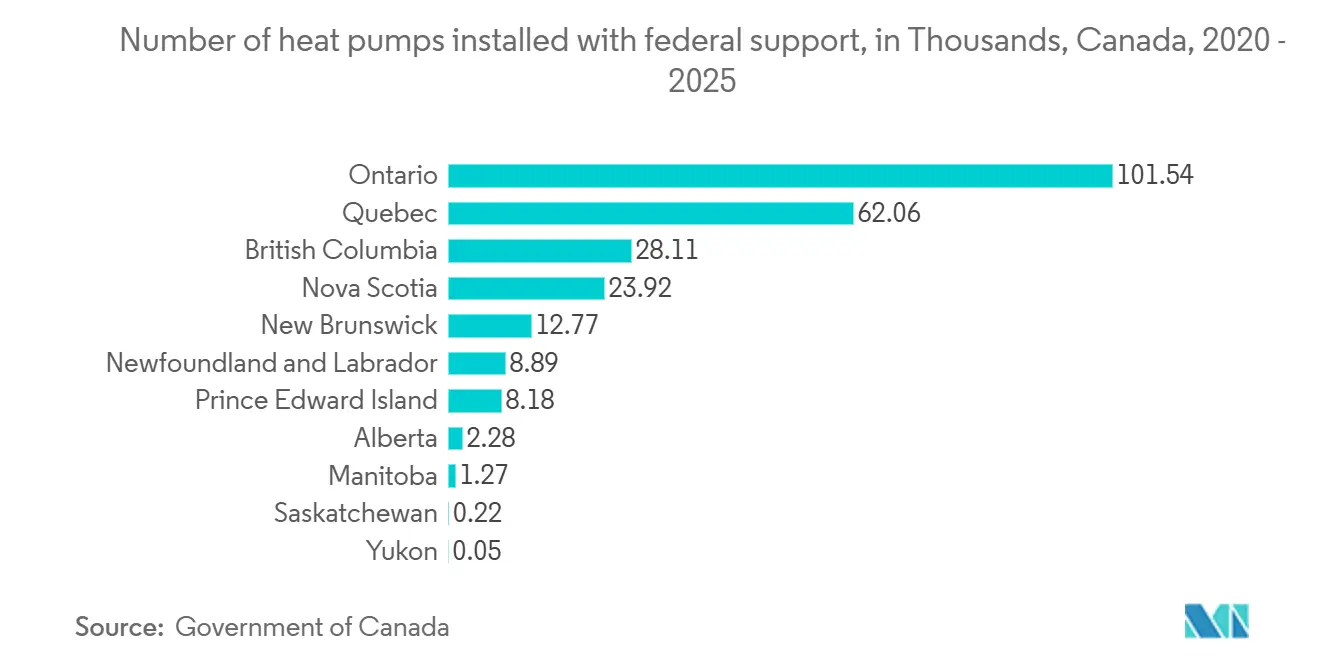
- According to Government of Canada, From 2020 to April 2025, the number of heat pumps installed with federal support in Canada was highest in Ontario. During this period, roughly 101,540 heat pumps were installed in Ontario with government backing, a much higher number than in Quebec, the province with the second-highest number.

Competitive Landscape
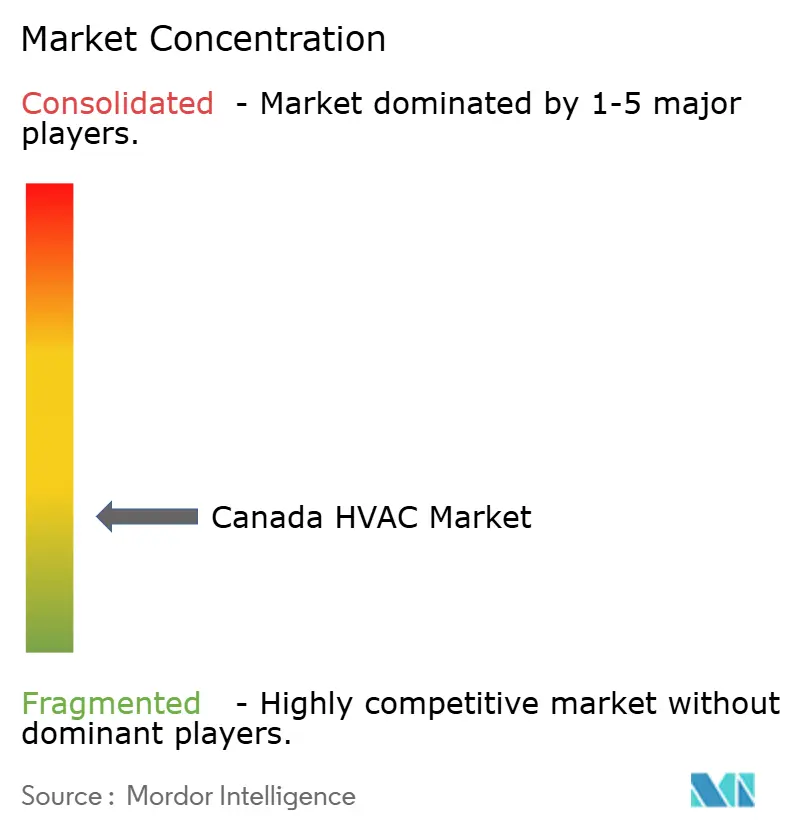
The Canada HVAC market is fragmented, with specialized players and regional conglomerates operating across various segments. While multiple large multinational companies dominate certain high-value segments, numerous regional and niche players contribute to the overall competition, making the market highly diverse. This competition is driven by the wide range of applications for HVAC equipment, allowing both small and large companies to coexist and thrive in the market.
Several leading companies in the Canada HVAC market include Mitsubishi Electric Corporation, Carrier Corporation, LG Electronics Inc., Johnson Controls, Daikin Industries, Ltd., Trane Technologies plc, and many others. With strong brand recognition and extensive regional operations, these companies command a significant market share. Their strengths include innovation, a broad solutions portfolio, and robust distribution networks. To maintain their competitive edge and broaden their market reach, these leaders frequently pursue strategic acquisitions and partnerships.
In the Canada HVAC market, companies that prioritize innovation in heating, ventilation, and air conditioning equipment are more likely to succeed. As industries increasingly seek advanced solutions, HVAC equipment is set to become a key differentiator. Additionally, expanding service offerings and enhancing customer support will be essential for building long-term relationships and securing repeat business. Firms that invest in emerging markets and tailor their products to regional needs can gain a competitive advantage in this fragmented landscape.
Canada HVAC Industry Leaders
Bosch Thermotechnology (Robert Bosch GmbH)
Daikin Industries Ltd.
Mitsubishi Electric Corp.
Trane Technologies plc
Johnson Controls
- *Disclaimer: Major Players sorted in no particular order

Recent Industry Developments
- April 2025: Trane Technologies acquired artificial-intelligence specialist BrainBox AI to fold self-learning algorithms into its building-automation stack, a move that strengthens predictive maintenance and opens subscription revenue in the Canada HVAC market.
- April 2025: Master Group broadened its catalogue by adding Hitachi residential lines through an alliance with Johnson Controls-Hitachi, granting Canadian contractors access to FrostWash evaporators that self-clean coil surfaces and extend service intervals.


Canada HVAC Market Report Scope
HVAC is a comprehensive system designed to create and maintain comfortable indoor environmental conditions in residential, commercial, and industrial spaces. Heating is the first component, which involves warming interior spaces during cold weather through various methods such as furnaces, heat pumps, and radiant heating systems. These technologies convert energy into heat, distributing warmth evenly throughout a building to ensure occupant comfort and prevent temperature-related issues.
Ventilation represents the critical process of exchanging indoor and outdoor air, ensuring proper air circulation, removing pollutants, controlling humidity, and maintaining air quality. This aspect of HVAC involves mechanical and natural ventilation techniques that introduce fresh air, filter contaminants, and regulate oxygen levels. Proper ventilation is essential for preventing the buildup of harmful gases, reducing moisture-related problems, and creating a healthy indoor environment.
Air Conditioning focuses on cooling and dehumidifying interior spaces during warm weather. Modern air conditioning systems use refrigeration cycles to remove heat and moisture from the air, creating a comfortable and controlled climate. These systems range from central air conditioning units to ductless mini-splits, providing precise temperature management and improving overall indoor comfort. The integration of these three components- heating, ventilation, and air conditioning- creates a sophisticated environmental control system that adapts to changing weather conditions and occupant needs.
The C HVAC Market is Segmented by product type (heating equipment [heat pumps (air source, ground source), furnaces (gas, electric, oil), boilers (condensing, non-condensing), unit heaters, and others (radiators & baseboard heaters, solar water heating systems)], ventilation equipment [air handling units (AHUs), energy recovery ventilators (ERVs)/heat recovery, ventilators (HRVs), exhaust and supply fans, dehumidifiers/humidifiers], air conditioning equipment [unitary air conditioners, variable refrigerant flow (VRF) systems, chillers (air-cooled, water-cooled), fan coil units (FCUs), and others (window and portable air conditioners)]) and end-user industry (residential, commercial, and industrial). The market sizes and forecasts are provided in terms of value (USD) for all the above segments.
The Canada HVAC Market is Segmented by product type (heating equipment [heat pumps (air source, ground source), furnaces (gas, electric, oil), boilers (condensing, non-condensing), unit heaters, and others (radiators & baseboard heaters, solar water heating systems)], ventilation equipment [air handling units (AHUs), energy recovery ventilators (ERVs)/heat recovery, ventilators (HRVs), exhaust and supply fans, dehumidifiers/humidifiers], air conditioning equipment [unitary air conditioners, variable refrigerant flow (VRF) systems, chillers (air-cooled, water-cooled), fan coil units (FCUs), and others (window and portable air conditioners)]) and end-user industry (residential, commercial, and industrial). The market sizes and forecasts are provided in terms of value (USD) for all the above segments.
| Heating Equipment | Heat Pumps (Air Source, Ground Source) | |
| Furnaces (Gas, Electric, Oil) | ||
| Boilers (Condensing, Non-condensing) | ||
| Unit Heaters | ||
| Others (Radiators & Baseboard Heaters, Solar Water Heating Systems) | ||
| Ventilation Equipment | Air Handling Units (AHUs) | |
| Energy Recovery Ventilators (ERVs) / Heat Recovery Ventilators (HRVs) | ||
| Exhaust and Supply Fans | ||
| Dehumidifiers / Humidifiers | ||
| Air Conditioning Equipment | Unitary Air Conditioners | Split Air Conditioners |
| Packaged Terminal ACs (PTACs) | ||
| Rooftop Packaged Units (RTUs) | ||
| Variable Refrigerant Flow (VRF) Systems | ||
| Chillers (Air-Cooled, Water-Cooled) | ||
| Fan Coil Units (FCUs) | ||
| Others (Window and Portable Air Conditioners) | ||
| Residential |
| Commercial |
| Industrial |
| By Product Type | Heating Equipment | Heat Pumps (Air Source, Ground Source) | |
| Furnaces (Gas, Electric, Oil) | |||
| Boilers (Condensing, Non-condensing) | |||
| Unit Heaters | |||
| Others (Radiators & Baseboard Heaters, Solar Water Heating Systems) | |||
| Ventilation Equipment | Air Handling Units (AHUs) | ||
| Energy Recovery Ventilators (ERVs) / Heat Recovery Ventilators (HRVs) | |||
| Exhaust and Supply Fans | |||
| Dehumidifiers / Humidifiers | |||
| Air Conditioning Equipment | Unitary Air Conditioners | Split Air Conditioners | |
| Packaged Terminal ACs (PTACs) | |||
| Rooftop Packaged Units (RTUs) | |||
| Variable Refrigerant Flow (VRF) Systems | |||
| Chillers (Air-Cooled, Water-Cooled) | |||
| Fan Coil Units (FCUs) | |||
| Others (Window and Portable Air Conditioners) | |||
| By End-User | Residential | ||
| Commercial | |||
| Industrial | |||


Key Questions Answered in the Report
How big is the Canada HVAC Market?
The Canada HVAC Market size is expected to reach USD 12.20 billion in 2025 and grow at a CAGR of 5.20% to reach USD 15.71 billion by 2030.
What is the current Canada HVAC Market size?
In 2025, the Canada HVAC Market size is expected to reach USD 12.20 billion.
Who are the key players in Canada HVAC Market?
Bosch Thermotechnology (Robert Bosch GmbH), Daikin Industries Ltd., Mitsubishi Electric Corp., Trane Technologies plc and Johnson Controls are the major companies operating in the Canada HVAC Market.
What years does this Canada HVAC Market cover, and what was the market size in 2024?
In 2024, the Canada HVAC Market size was estimated at USD 11.57 billion. The report covers the Canada HVAC Market historical market size for years: 2019, 2020, 2021, 2022, 2023 and 2024. The report also forecasts the Canada HVAC Market size for years: 2025, 2026, 2027, 2028, 2029 and 2030.
Page last updated on:
Canada HVAC Market Report
Statistics for the 2025 Canada HVAC market share, size and revenue growth rate, created by Mordor Intelligence™ Industry Reports. Canada HVAC analysis includes a market forecast outlook for 2025 to 2030 and historical overview. Get a sample of this industry analysis as a free report PDF download.





