
Europe Commercial HVAC Market Size and Share
| Study Period | 2019 - 2030 |
| Forecast Data Period | 2025 - 2030 |
| Historical Data Period | 2019 - 2023 |
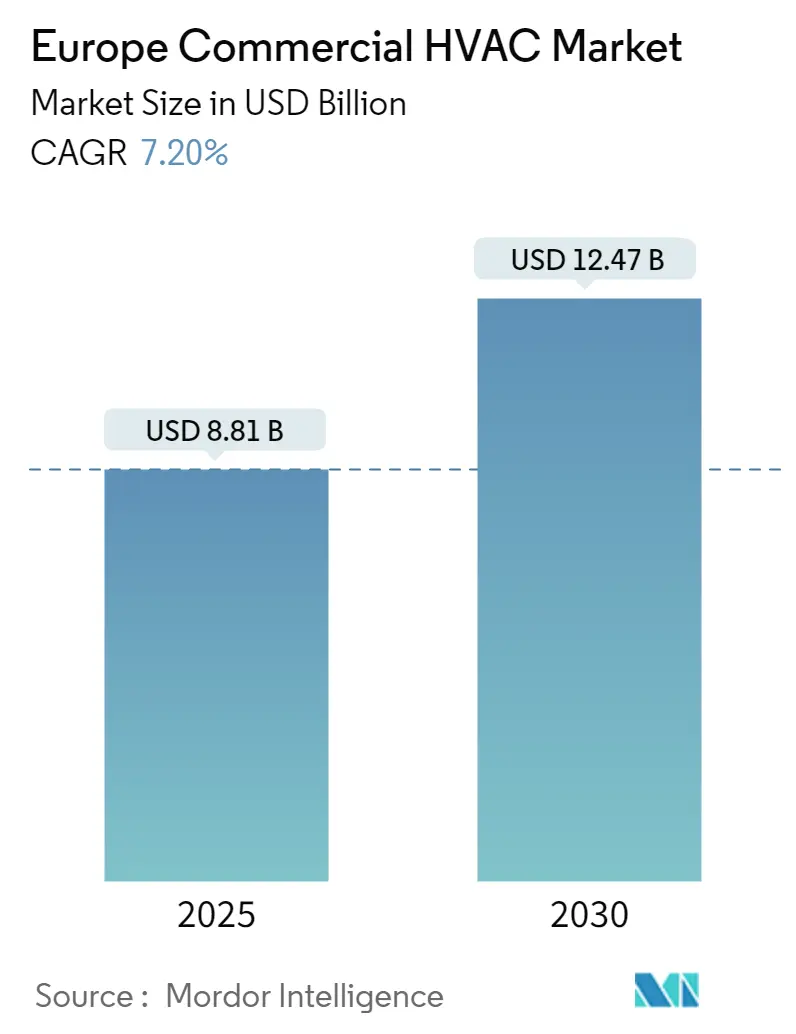
| Market Size (2025) | USD 8.81 Billion |
| Market Size (2030) | USD 12.47 Billion |
| CAGR (2025 - 2030) | 7.20% |
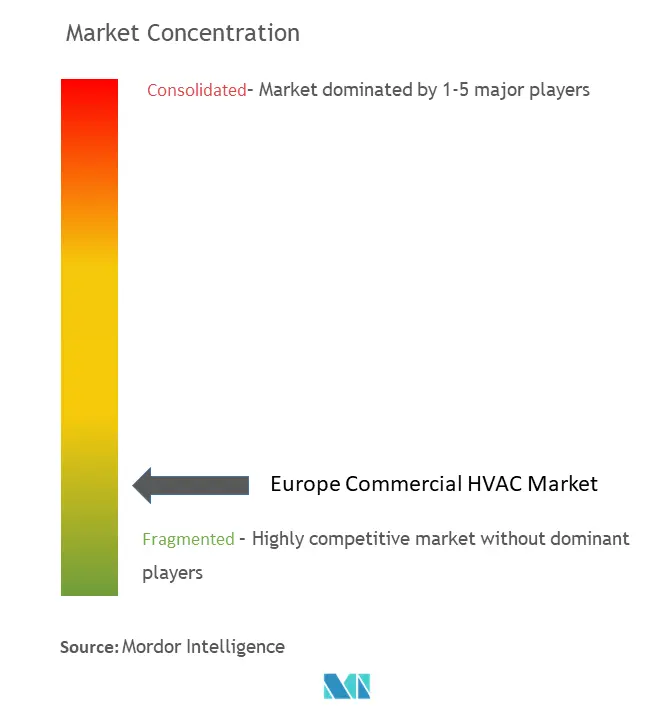
| Market Concentration | Low |
Major Players *Disclaimer: Major Players sorted in no particular order |
Europe Commercial HVAC Market Analysis by Mordor Intelligence
The Europe Commercial HVAC Market size is estimated at USD 8.81 billion in 2025, and is expected to reach USD 12.47 billion by 2030, at a CAGR of 7.2% during the forecast period (2025-2030).
- HVAC systems are widely preferred in commercial buildings due to their numerous benefits. AC systems are becoming increasingly popular in commercial buildings for various reasons. Air conditioning units are crucial in maintaining a comfortable environment in modern commercial buildings. These units effectively lower the temperature by circulating air through refrigerant or water-cooled systems, eliminating excess moisture from the air. The rising need for commercial spaces, including office buildings, hospitals, malls, and hotels, has significantly contributed to the growing demand for AC systems.
- HVAC systems are essential for any commercial structure to provide occupants with a comfortable atmosphere. For example, HVAC systems are frequently utilized in many offices to offer suitable temperature and ventilation settings, which helps to improve employee productivity and working conditions and minimize health risks brought on by inadequate humidity levels. This need for HVAC solutions will increase demand for HVAC equipment such as air handling units.
- The region's market-driving elements include the construction boom in emerging countries, energy conservation measures, and investment in smart homes. Additionally, the development of HVACs that reduce climate change and the use of renewable energy for home heating systems have the potential to establish new trends in the EU ventilation equipment demand. The commercial HVAC market in Europe is experiencing a surge in demand for air conditioner equipment due to various factors. These factors include climate change, urbanization, lifestyles, and technological advancements. Additionally, Europe is witnessing a rise in cooling demand as salaries and living standards improve.
- Market players are bringing forth novel low-emission boilers and innovating advanced boilers to enhance energy operations with greater efficiency and environmental friendliness. These advancements in boiler technology, coupled with stricter pollution regulations for enterprises, fuel the growing demand for low-emission boilers. The surge in adopting eco-friendly practices across various industries is anticipated to propel the requirement for boilers in the region's Industrial sector.
- The International Energy Agency (IEA) states that implementing heat pumps will significantly reduce Europe's gas consumption for heating purposes by a minimum of 21 billion cubic meters by 2030. Notably, the sales of air-to-water models, compatible with conventional radiators and underfloor heating systems, experienced a substantial increase of almost 50% in Europe. Moreover, the implementation of heat pumps will be facilitated through the introduction of new financial tools. In 2026, all European Union member states will have access to the Social Climate Fund, a newly established EU Fund with a budget of EUR 86.7 billion. This fund will enable EU countries to support energy efficiency initiatives and the transition to low-carbon heating and cooling systems in buildings.
- The high initial cost of HVAC equipment can be challenging for its demand because the high price may deter some customers from purchasing or upgrading the systems. This is especially true for homeowners or small business owners who may have limited budgets and need help to afford the upfront costs of a new system. Secondly, the high cost of HVAC equipment can result in long customer payback periods. This means that the cost savings resulting from the new system's improved energy efficiency may not offset the initial investment for several years.
- The commercial HVAC market relies heavily on construction activities, government regulations, and new government initiatives to enhance infrastructure and industrial sectors. Changes in the growth of the commercial industry can directly affect the demand for HVAC equipment. Furthermore, an increase in inflation results in higher costs for materials, labor, and energy required for manufacturing and installing HVAC systems. As a result, there may be a rise in prices for HVAC installation and increased expenses for maintenance and repairs, leading to fluctuations in market demand.
Worldwide, activity is shaped by contributions from multiple regions, with Europe representing one of the more structurally developed among them. The global report on commercial hvac market by Mordor Intelligence reflects how these regional layers combine into a single system.
Europe Commercial HVAC Market Trends and Insights
HVAC Equipment to Witness a Significant Growth
- A heat pump is a crucial HVAC device that refrigerates heat from colder to warmer areas. Unlike air conditioners and furnaces, heat pumps offer a highly efficient alternative in any climate. Heat pumps use electricity to move heat, resulting in a cooler cold space and a warmer warm space. The heat pump's efficiency is determined by its coefficient of performance (COP) or seasonal coefficient of performance (SCOP), with a higher number indicating greater efficiency. Regarding space heating, heat pumps generally surpass electric resistance heaters and other heater types in terms of energy efficiency.
- Various factors, including government measures and policies, influence the adoption of heat pumps in the region. For instance, the UK government has taken steps to speed up the expansion of heat pump installation. In October 2023, the government raised heat pump subsidies by 50%, from EUR 5,000 (EUR 5,795) to EUR 7,500 (EUR 8,692). The Boiler Upgrade Scheme offers financial assistance to incentivize individuals to switch from fossil fuel heating to more effective, environmentally friendly heating systems. These options may entail air and ground source heat pumps and biomass boilers.
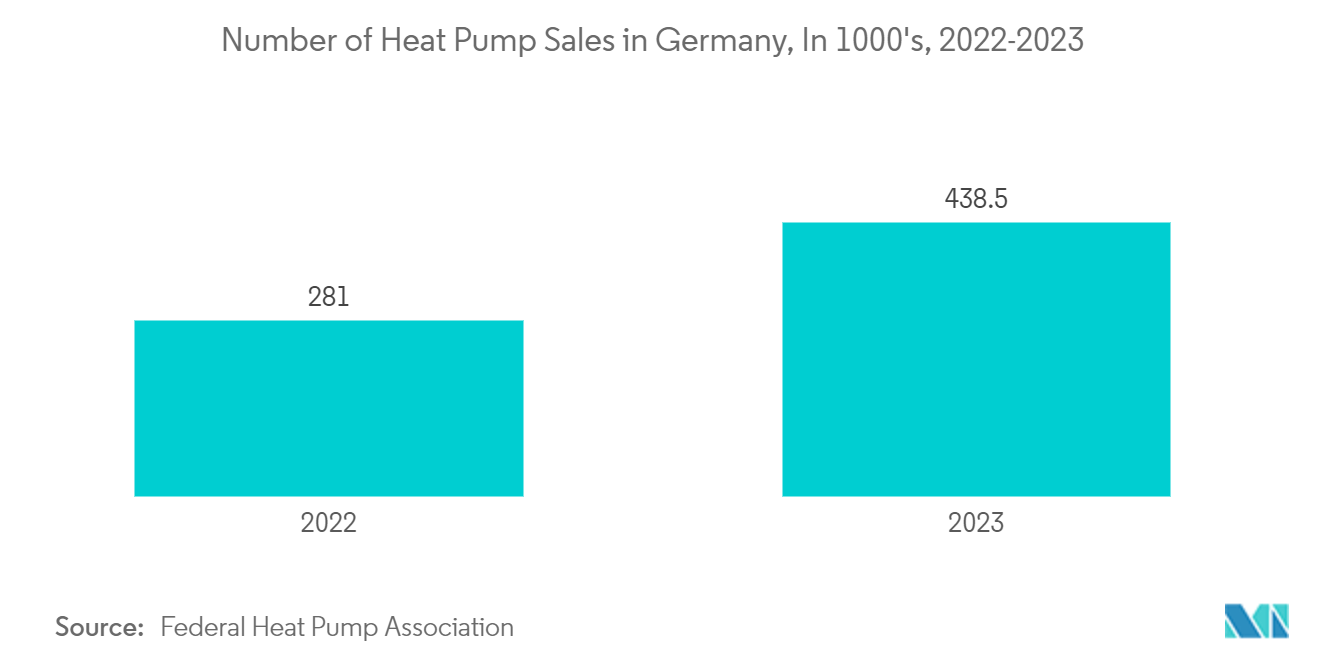
- Electric heat pumps are anticipated to be more prominent in this transition. In the last two decades, there has been a gradual change in heating practices in European homes, leading to the increased popularity of heat pumps in the country. For instance, in 2023, Bosch Home Comfort Group generated a revenue of EUR 5 billion. The sales of heat pumps in Germany rose by 84%, while the business with heat pump hybrids saw a 46% increase. The company plans to invest EUR 1 billion in its European development and production network by 2030.
- Moreover, in December 2023, Johnson Controls unveiled a water-to-water compound centrifugal heat pump called the York Cyk. This innovative heat pump is designed for commercial buildings and can provide high-temperature hot water up to 77°C, making it ideal for high-head conditions. According to the manufacturer, the York Cyk can significantly reduce water and operational costs by up to 50% compared to traditional boiler and chiller applications. Currently, this product comes with a cooling capacity of 400 tons. It offers an impressive output of 1,406 kW for cooling and 2,051 kW for heating. Such developments by the local vendors will increase the demand for heat pumps.
- Furthermore, the growth of the market has been bolstered by government efforts to encourage energy efficiency and the adoption of renewable energy sources. Measures such as subsidies, tax incentives, and regulations aim to reduce carbon footprints and have incentivized consumers to invest in unitary heaters that align with these objectives. The product's growth is anticipated to receive a further boost from the increasing expenditure on building construction and the rise in maintenance and replacement activities.
- Carrier states that the majority of contemporary boilers utilize natural gas or oil as the primary fuel source. The purpose of a boiler is to heat water in order to generate steam or hot water. This steam or hot water is then distributed through pipes to radiators located throughout the home, such as radiant flooring systems or baseboard radiators. Additionally, modern boiler systems are equipped with safety features to prevent accidents and damage. These safety features may include pressure relief valves, temperature monitors, and automatic power shutdown systems. The growing acceptance of these boilers in commercial sectors is anticipated to propel the market forward.
France to Hold a Significant Market Share
- The government of France has stringent energy efficiency regulations and environmental standards for buildings, which drive the demand for the commercial HVAC market. Building operators and owners must comply with these regulations by implementing energy-efficient heating and cooling systems, ventilation solutions, and air quality management technologies. The need to meet regulatory requirements and achieve energy performance targets creates a significant demand for the HVAC market focused on energy efficiency upgrades, retrofits, and compliance assessment.
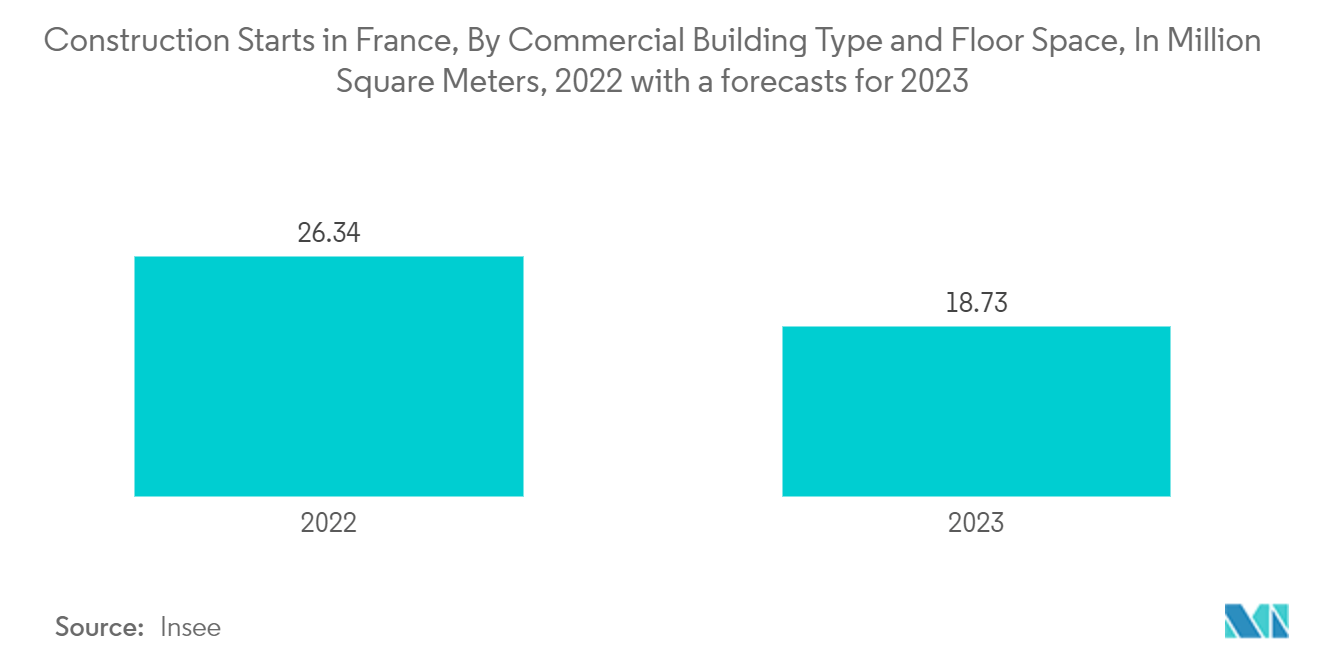
- According to the United Kingdom's non-profit organization MSC, France's success can be attributed to factors like a strong preference for electric heating systems over gas, a domestic air conditioning industry that has transitioned to heat pumps, and the implementation of government initiatives to promote heat pump installation, including grant schemes like FranceRenov which provides up to EUR 10,000 per household. New energy-efficiency standards for new homes have also played a role in France's achievements. Moreover, the rise in commercial construction in France is expected to drive the studied market. For instance, according to the FIEC EU (European Construction Industry Federation), despite the war in Ukraine and its consequences, the construction sector in France showed resilience.
- France currently has 27 heat pump factories, with the government's goal to have 1 million new heat pumps produced annually by 2027. France is the primary market and producer of heat pumps in Europe, with heat accounting for 45% of final energy consumption in the country and nearly two-thirds of this heat being produced from fossil fuels. Heat pumps are seen as a significant solution in lowering emissions related to heating. Depending on the specific area, the systems use about three times less energy than gas boilers or electric radiators. The production of many heat pumps stimulates demand for the HVAC market.
- In line with the changing regulations in the region, the companies have been investing in introducing new services, mergers, and acquisitions in the market. For instance, in November 2023, Sonepar announced the acquisition of Hydeclim, a French specialist distributing equipment and solutions for AC and air treatment. Following the group's recent French acquisitions, notably Alliantz (photovoltaics) and CD Sud, this operation will enable Sonepar to expand in the HVAC market and extend its offering to AC and heating installers, particularly in Western and Northern France.
Mordor Intelligence provides coverage of the commercial hvac market across other key regional markets, including North America, Middle East and Africa, and Asia, each with their regulatory frameworks and demand patterns. Detailed country-level analysis extends to United Kingdom, Italy, France, Germany, Canada, and Japan incorporating local coverage and market participation, as required.
Competitive Landscape
The European commercial HVAC market is very competitive. It is highly concentrated due to various large and small players. All the major players account for a significant market share and focus on expanding the global consumer base. Some significant players in the market are Johnson Controls Corporation, Midea Group, Carrier Corporation, Daikin Industries Limited, and Bosch Thermotechnology Corporation. Several companies are increasing their market share by forming collaborations, partnerships, and acquisitions and introducing new and innovative products to earn a competitive edge during the forecast period.
- April 2024: Mitsubishi Electric Corporation declared its subsidiaries Mitsubishi Electric Hydronics & IT Cooling Systems. Mitsubishi Electric Europe BV fully acquired AIRCALO, a French air-conditioning company. Mitsubishi Electric plans to utilize AIRCALO's wide range of products and excellent customization abilities to enhance and grow its hydronic HVAC systems business in the changing European market, including meeting the high demand for customized products and environmental consciousness.
- March 2024: Daikin Europe NV, a European subsidiary of Daikin Industries Ltd, announced the acquisition of BKF Klima, a Danish heating, ventilation, and air conditioning (HVAC) distributor and previously part of Beijer REF. At Daikin's new offices in Brøndby, Denmark, the company will also open two new facilities, including a Daikin Training Center for installers and a Daikin Experience Center for consumers. This strategic acquisition will further enable Daikin to leverage its extensive R&D expertise in low-carbon HVAC solutions for the region.
Europe Commercial HVAC Industry Leaders
-
Johnson Controls Corporation
-
Midea Group
-
Carrier Corporation
-
Daikin Industries
-
Bosch Thermotechnology Corporation
- *Disclaimer: Major Players sorted in no particular order
Recent Industry Developments
- May 2024: Lennox International Inc., a company offering climate control solutions, revealed the launch of a new range of HVAC products, including refrigerants with low global warming potential (GWP). This move was in line with the company's dedication to sustainability and in preparation for the 2025 requirements that will require the utilization of refrigerants with low GWP. The new series will consist of light commercial HVAC systems that will use R-454B refrigerant, which has a lower global warming potential of up to 78% compared to standard refrigerants.
- March 2024: Midea Building Technologies presented its complete range of heating solutions at MCE 2024, including the innovative MARS series R290 commercial heat pump. This heat pump received Intertek's highly regarded Ultra-High-Temperature Hot Water Performance Certification. Midea Building Technologies introduced the iEasyEnergy energy management system to meet the changing demands for clean heating, energy management, and digital integration in the European market. This system utilizes advanced control technology based on heat pumps and dynamic algorithms to help European households improve their building energy efficiency ratings, qualify for more subsidies, and reach up to 90% energy self-sufficiency.
Europe Commercial HVAC Market Report Scope
The market estimation tracks the revenue generated from the sale of heating equipment and air conditioning/ventilation equipment offered by different market players for a diverse range of applications. The market trends are evaluated by analyzing the investments made in product innovation, diversification, and expansion. Further, the advancements in hospitality, commercial, and residential buildings are also crucial in determining the growth of the market studied.
The European commercial HVAC Market is segmented by type of component (HVAC equipment [heating equipment, air conditioning/ventilation equipment], HVAC services), end-user industry (hospitality, commercial building, public building, other end-user industries), and country (United Kingdom, Germany, France, Italy). The market sizes and forecasts are provided in terms of value (USD) for all the above segments.
| HVAC Equipment | Heating Equipment |
| Air Conditioning/Ventilation Equipment | |
| HVAC Services |
| Hospitality |
| Commercial Building |
| Public Building |
| Other End-user Industries |
| United Kingdom |
| Germany |
| France |
| Italy |
| By Type of Component | HVAC Equipment | Heating Equipment |
| Air Conditioning/Ventilation Equipment | ||
| HVAC Services | ||
| By End-user Industry | Hospitality | |
| Commercial Building | ||
| Public Building | ||
| Other End-user Industries | ||
| By Country | United Kingdom | |
| Germany | ||
| France | ||
| Italy |
Key Questions Answered in the Report
How big is the Europe Commercial HVAC Market?
The Europe Commercial HVAC Market size is expected to reach USD 8.81 billion in 2025 and grow at a CAGR of 7.20% to reach USD 12.47 billion by 2030.
What is the current Europe Commercial HVAC Market size?
In 2025, the Europe Commercial HVAC Market size is expected to reach USD 8.81 billion.
Who are the key players in Europe Commercial HVAC Market?
Johnson Controls Corporation, Midea Group, Carrier Corporation, Daikin Industries and Bosch Thermotechnology Corporation are the major companies operating in the Europe Commercial HVAC Market.
What years does this Europe Commercial HVAC Market cover, and what was the market size in 2024?
In 2024, the Europe Commercial HVAC Market size was estimated at USD 8.18 billion. The report covers the Europe Commercial HVAC Market historical market size for years: 2019, 2020, 2021, 2022, 2023 and 2024. The report also forecasts the Europe Commercial HVAC Market size for years: 2025, 2026, 2027, 2028, 2029 and 2030.
Europe Commercial HVAC Market Report
Statistics for the 2025 Europe Commercial HVAC market share, size and revenue growth rate, created by Mordor Intelligence™ Industry Reports. Europe Commercial HVAC analysis includes a market forecast outlook for 2025 to 2030 and historical overview. Get a sample of this industry analysis as a free report PDF download.