
Transcatheter Pulmonary Valve Market Size and Share
Market Overview
| Study Period | 2020 - 2031 |
|---|---|
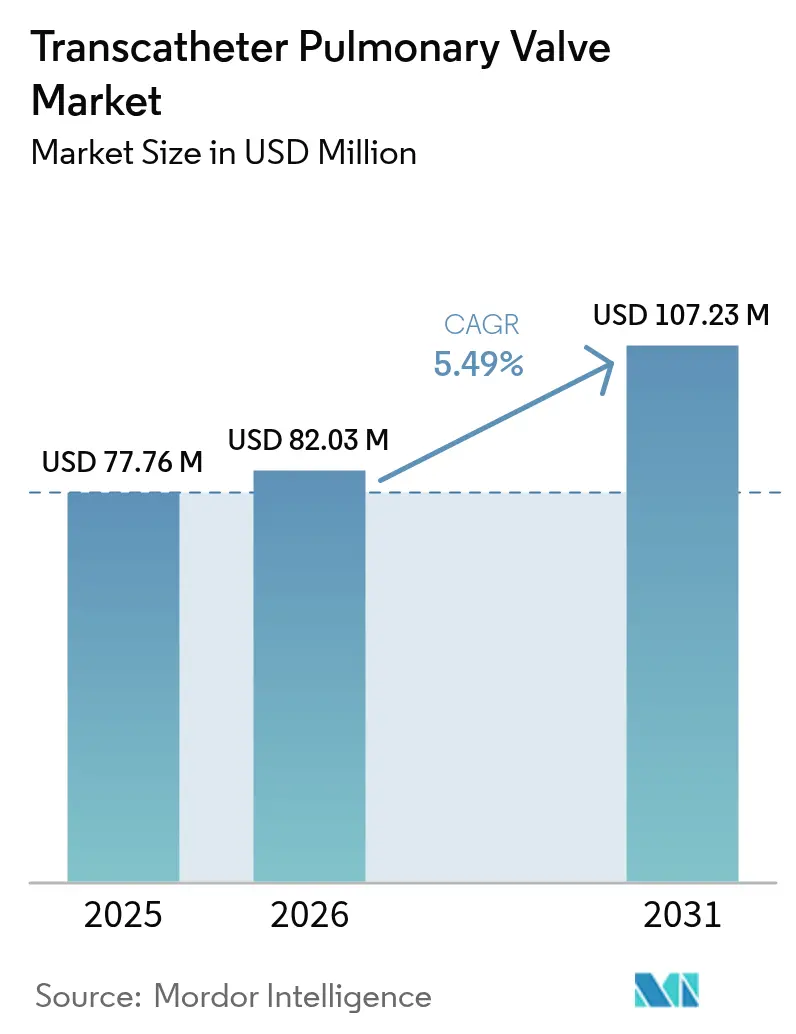
| Market Size (2026) | USD 82.03 Million |
| Market Size (2031) | USD 107.23 Million |
| Growth Rate (2026 - 2031) | 5.49 % |
| Fastest Growing Market | Asia Pacific |
| Largest Market | North America |
| Market Concentration | Medium |
Major Players *Disclaimer: Major Players sorted in no particular order Image © Mordor Intelligence. Reuse requires attribution under CC BY 4.0. | |
Transcatheter Pulmonary Valve Market Analysis by Mordor Intelligence
The global transcatheter pulmonary valve market size was valued at USD 77.76 million in 2025 and estimated to grow from USD 82.03 million in 2026 to reach USD 107.23 million by 2031, at a CAGR of 5.49% during the forecast period (2026-2031). An expanding cohort of adult survivors of congenital heart disease (CHD), rapid device approvals, and supportive reimbursement updates are sustaining demand. Self-expanding platforms are doubling the addressable patient pool by treating large native right ventricular outflow tracts (RVOT), while balloon-expandable valves remain indispensable for conduit-based anatomies. Payer policies increasingly reward outpatient cath-lab procedures, accelerating the shift from tertiary surgical centers to ambulatory facilities. Regulatory vigilance around durability and endocarditis continues to temper near-term adoption but also drives sustained R&D investment in advanced tissue processing and anti-calcification technologies.
Key Report Takeaways
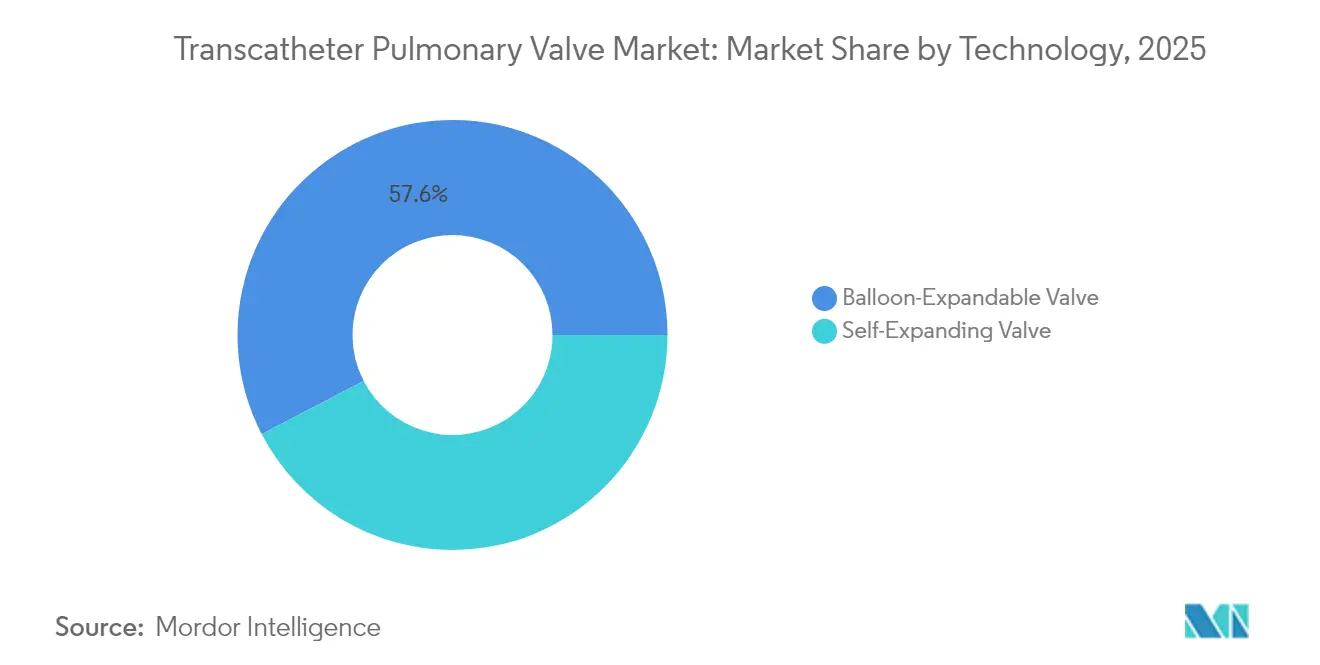
- By technology, balloon-expandable valves led with 57.62% of the transcatheter pulmonary valve market share in 2025, whereas self-expanding devices are forecast to register the fastest 11.92% CAGR through 2031.
- By application, pulmonary regurgitation accounted for 45.02% share of the transcatheter pulmonary valve market size in 2025; pulmonary stenosis procedures are set to advance at a 10.67% CAGR to 2031.
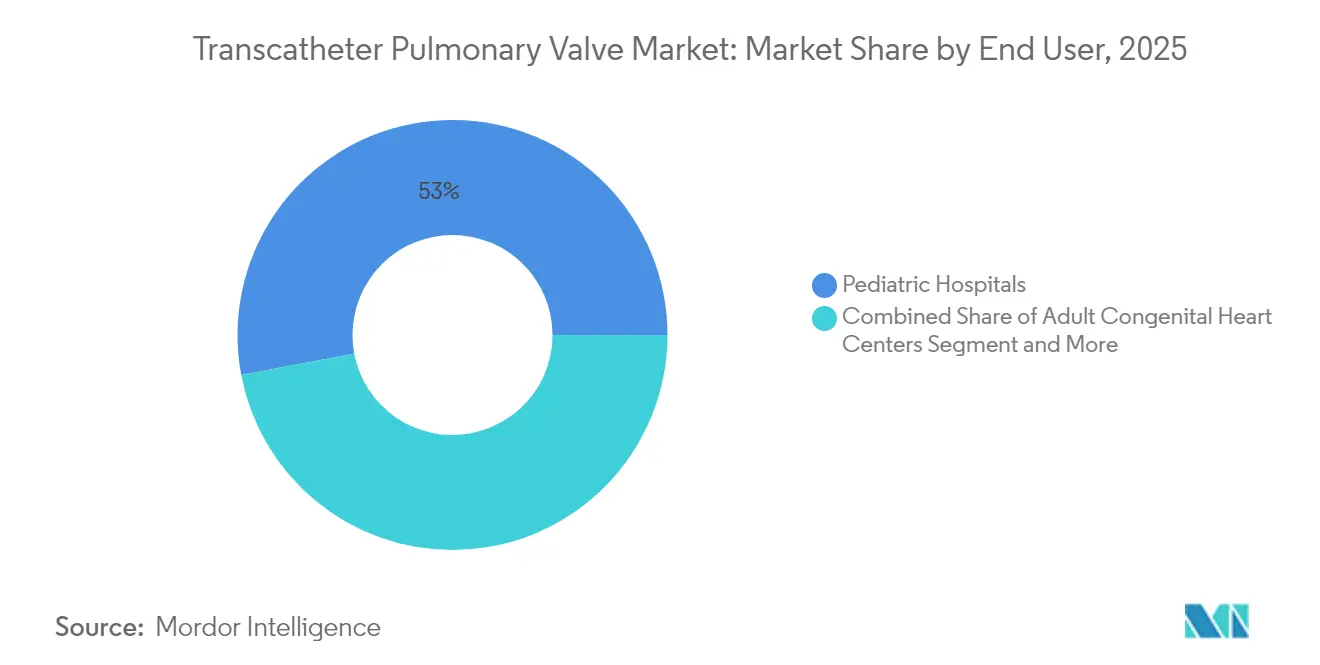
- By end user, pediatric hospitals held 52.98% of 2025 revenue, yet ambulatory surgical centers are expanding at 12.15% CAGR, the quickest across settings.
- By RVOT anatomy, conduit-based interventions represented 58.95% of global volume in 2025, while native/enlarged RVOT treatments are growing at an 11.03% CAGR.
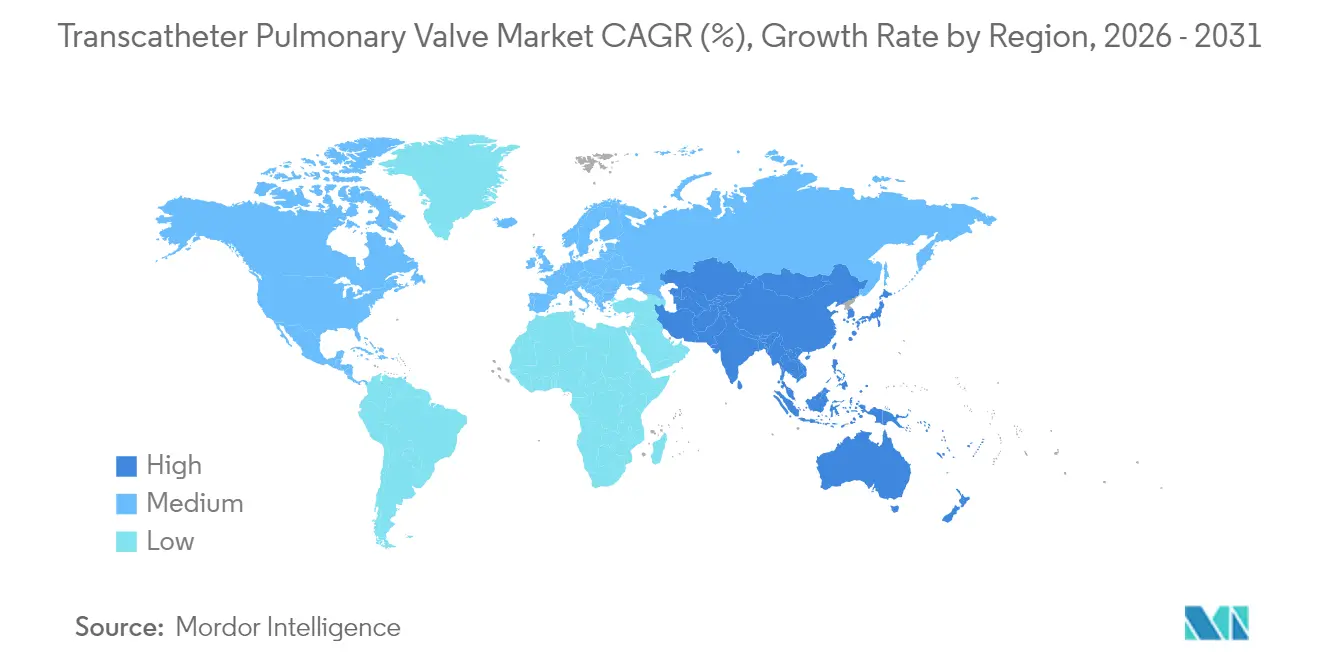
- By geography, North America contributed 38.30% of revenue in 2025; Asia-Pacific is expected to grow the quickest at 10.44% CAGR to 2031.
Note: Market size and forecast figures in this report are generated using Mordor Intelligence’s proprietary estimation framework, updated with the latest available data and insights as of 2026.
Market Trends and Insights
Drivers Impact Analysis of Transcatheter Pulmonary Valve Market*
| Driver | (~) % Impact on CAGR Forecast | Geographic Relevance | Impact Timeline |
|---|---|---|---|
| Rising Adult-Survivor CHD Population | +1.8% | Global, with concentration in North America & Europe | Long term (≥ 4 years) |
| Rapid Approvals Of Self-Expanding TPV Platforms | +1.2% | North America & EU, expanding to APAC | Medium term (2-4 years) |
| Patient & Clinician Shift To Minimally-Invasive Therapies | +1.0% | Global | Medium term (2-4 years) |
| Investment Surge From Leading Med-Tech Strategics | +0.8% | North America & EU core, spill-over to APAC | Short term (≤ 2 years) |
| Expansion Of Outpatient Cath-Lab Reimbursement Codes | +0.7% | North America, with EU adoption following | Short term (≤ 2 years) |
| Source: Mordor Intelligence | |||
Rising Adult-Survivor CHD Population
Adults living with congenital heart defects now exceed 1 million in the United States, 20% of whom require complex cardiac re-interventions. Hospitalizations are 91% higher and average USD 81,332 per stay versus USD 49,000 for non-congenital heart failure, incentivizing payers to endorse less invasive options. Strong long-term tissue durability—99.3% freedom from structural deterioration over eight years—supports device longevity expectations[1]Edwards Lifesciences, “Eight-Year Data Confirm Long-Term Durability of Edwards' RESILIA Tissue,” ir.edwards.com. The demographic trajectory ensures persistent case flow across developed markets.
Rapid Approvals of Self-Expanding TPV Platforms
Multicenter registry data covering 243 U.S. patients recorded 98% acceptable hemodynamics and 99% freedom from major composite events at one-year follow-up[2]Doff B. McElhinney, “Early Outcomes From a Multicenter Transcatheter Self-Expanding Pulmonary Valve Replacement Registry,” jacc.org. UK regulators granted exceptional approval for the Venus P-valve despite a pending CE mark, signaling readiness to fast-track solutions addressing unmet needs. Ability to land securely in large native RVOT anatomies effectively doubles the clinical universe.
Patient and Clinician Shift to Minimally Invasive Therapies
The American Heart Association’s 2024 statement positions transcatheter replacement as preferred care for conduit longevity. Thirty-day functional status improved in 83.9% of recipients, and procedural success reached 95% with only 2.4% major adverse events. Spanish cost-utility analyses placed incremental cost-effectiveness at EUR 6,952 per QALY, well below national willingness-to-pay thresholds.
Investment Surge from Leading Med-Tech Strategics
Edwards Lifesciences targets USD 4.1–4.4 billion in 2025 transcatheter aortic revenue and continues to fund pulmonary innovations, including SAPIEN 3 Ultra RESILIA. Venus Medtech secured FDA Breakthrough Device status for Cardiovalve, illustrating investor appetite for structural heart expansions.
Restraints Impact Analysis of Transcatheter Pulmonary Valve Market*
| Restraint | (~) % Impact on CAGR Forecast | Geographic Relevance | Impact Timeline |
|---|---|---|---|
| Durability & Strict Post-Market Surveillance | -1.5% | Global | Long term (≥ 4 years) |
| Surgical Alternatives (Ross, Homografts) Remain Viable | -0.8% | Europe & North America | Medium term (2-4 years) |
| Endocarditis Uptick Triggering Caution In Key Centers | -1.2% | Global, with higher impact in pediatric centers | Medium term (2-4 years) |
| Source: Mordor Intelligence | |||
Durability and Strict Post-Market Surveillance
FDA registries logged 631 adverse events for Melody implants, including stent fragment embolization. Ten-year freedom from dysfunction sits at 53% in pediatric cohorts, driving regulatory calls for harmonized durability definitions. Although RESILIA tissue shows encouraging eight-year durability, pulmonary positioning evidence remains early stage.
Endocarditis Uptick Triggering Caution in Key Centers
Multicenter data reveal 9.5% cumulative endocarditis at five years and 16.9% at eight years, equivalent to 2.2 events per 100 patient-years. ESC guidelines now recommend valve-specific antimicrobial regimens. Institutions adopting stringent prophylaxis report declining incidence, but heightened vigilance persists.
*Our forecasts treat driver/restraint impacts as directional, not additive. The impact forecasts reflect baseline growth, mix effects, and variable interactions.
Transcatheter Pulmonary Valve Market Segment Analysis
By Technology:
Self-Expanding Platforms Reshape Treatment ParadigmsGlobal revenue remains anchored by balloon-expandable devices, which commanded 57.62% of the transcatheter pulmonary valve market share in 2025. Precise conduit sizing, immediate anchoring, and robust long-term data sustain clinician confidence. The Edwards SAPIEN 3 system achieved 98.1% device success and 100% freedom from surgical reintervention at one year. At the same time, self-expanding solutions are advancing at 11.92% CAGR through 2031, transforming therapeutic possibilities for enlarged native RVOT anatomies. One-year registry follow-up showed 96% freedom from composite events with acceptable hemodynamics in 98% of cases. The Venus P-valve and Harmony systems now anchor treatment algorithms in Asia and North America respectively, with CE certification further broadening access.



By Application:
Stenosis Cases Fuel Growth Despite Regurgitation DominancePulmonary regurgitation generated 45.02% of 2025 procedure volume, reflecting historical focus on volume-overload correction. Nonetheless, pulmonary stenosis indications are forecast to post a 10.67% CAGR, the strongest trajectory within the transcatheter pulmonary valve market. Earlier intervention strategies that aim to pre-empt right-ventricular compromise underpin this acceleration, especially for repaired Tetralogy of Fallot patients. Comparative trials such as COMPASS will clarify optimal timing and modality selection, potentially increasing stenosis-related volumes.
By End User:
Ambulatory Centers Lead TransformationPediatric hospitals retained 52.98% revenue in 2025 but ambulatory surgical centers are registering a 12.15% CAGR, reshaping care delivery. CMS reimbursement revisions and strong safety data—95% procedural success with 2.4% major adverse events—support same-day discharge protocols. Adult congenital heart centers are expanding multidisciplinary programs to handle the growing adult CHD population, estimated to reach 510,000 U.S. patients by 2050.
By RVOT Anatomy:
Native-Tract Technologies Expand EligibilityConduit-based interventions account for 58.95% of global cases, yet native/enlarged RVOT treatments will outpace at an 11.03% CAGR. Harmony earned FDA approval for native RVOTs, and early use demonstrates 98.2% procedural success with significant right-ventricular volume reductions. Screening perimeter plot analyses are refining candidate selection, even as false negatives highlight the need for iterative imaging protocols.
Geography Analysis
North America Transcatheter Pulmonary Valve Market
North America generated 38.30% of global revenue in 2025, buoyed by advanced centers, widespread payer support, and active clinical-trial pipelines. CMS’s 2.9% outpatient payment hike and new device categories accelerate catheter-lab uptake. Canada and Mexico are scaling specialist capabilities, supported by cross-border training and regional clinical studies.
Europe Transcatheter Pulmonary Valve Market
Europe sustains mid-single-digit growth, underpinned by mature infrastructure and adaptable regulators willing to expedite devices with demonstrable need. Exceptional UK approval of Venus P-valve underscores demand-driven flexibility. Health-economic studies from Spain showed favorable EUR 6,952 per QALY, reinforcing payer confidence.
APAC Transcatheter Pulmonary Valve Market
Asia-Pacific represents the fastest regional expansion at 10.44% CAGR. Domestic innovators such as Venus Medtech tailor self-expanding valves for prevalent anatomical features in Chinese and Indian populations. Japan’s registry exceeding 8,000 transcatheter aortic cases provides a procedural blueprint for pulmonary adoption. Government initiatives to expand cardiac catheterization labs in South Korea and Australia further catalyze uptake.
MEA and South America Transcatheter Pulmonary Valve Market
South America and the Middle East & Africa trail but show rising interest as referral pathways mature. Partnerships with global device makers and training exchanges with European centers are improving procedural readiness. Incremental gains in reimbursement coverage, especially for pediatric CHD, are expected to translate into a steady but smaller share of the transcatheter pulmonary valve market by 2030.

Competitive Landscape
The transcatheter pulmonary valve market remains moderately concentrated. Edwards Lifesciences’ balloon-expandable SAPIEN platform and Medtronic’s self-expanding Harmony system collectively accounted for over 70% of 2024 revenue. Edwards recorded USD 1 billion structural heart sales in Q3 2024, an 8% year-on-year rise, driven partly by pulmonic implants. Medtronic secured CE Mark for Harmony in January 2025, reinforcing its first-mover advantage in native RVOT therapy [news.medtronic.com].
Boston Scientific’s 2025 withdrawal of the Acurate TAVR line after unsuccessful FDA review illustrates high regulatory hurdles and has marginally eased competitive pressure. Meanwhile, Venus Medtech pursues Western approvals for its P-valve and Cardiovalve systems, aiming to disrupt incumbents in enlarged RVOT and tricuspid niches.
Strategic priorities revolve around durability, expanded size matrices, and simplified delivery systems. Intellectual-property extensions, such as the FDA-granted review period for SAPIEN 3 Ultra, highlight the importance of patent longevity. AI-guided imaging and valve-in-valve software modules are emerging differentiators as providers seek to minimize screening failures and enhance procedural planning.
Transcatheter Pulmonary Valve Industry Leaders
Boston Scientific Corporation
Braile Biomedica
Medtronic PLC
Edwards Lifesciences Corporation
Artivion, Inc
- *Disclaimer: Major Players sorted in no particular order

Transcatheter Pulmonary Valve Market Companies Covered in this Report
- Medtronic
- Edward Lifesciences
- Boston Scientific
- Abbott Laboratories
- Venus MedTech (Hangzhou) Inc.
- Artivion, Inc.
- Jenavalve Technology
- LivaNova
- Braile Biomedica
- PolyVascular Inc.
- Xeltis AG
- MicroPort CardioFlow Medtech Corp.
- Terumo
- Meril Life Sciences Pvt Ltd (MyVal)
- T&N Medical (Pulsta Valve)
- Lepu Medical
- BIOTRONIK
- Peijia Medical Ltd.
- OrbusNeich Medical Group

Market Opportunities and Future Outlook
Device and workflow optimization for native or enlarged right ventricular outflow tract anatomies remains a primary whitespace. This focus is reinforced by five-year Harmony TPV data presented at CSI Frankfurt in June 2026, where durability signals pointed to mostly mild or less pulmonary regurgitation (about 93% for TPV22 and 96% for TPV25) and low reintervention rates.
Regulatory actions in 2026 also create practical adoption openings for imaging and planning. In the US, the FDA cleared labeling updates for Edwards SAPIEN 3 Transcatheter Heart Valve System (MRI safety information and valve-in-valve sizing) and approved an MRI-conditional labeling update for the Alterra Adaptive Prestent. Alongside payer and provider interest in cath-lab and outpatient workflows, these updates support broader screening pathways and clearer post-implant surveillance planning.
Recent Industry Developments in Transcatheter Pulmonary Valve Market
- July 2026: Medtronic initiated a Class I recall of the delivery catheter system used with its Harmony Transcatheter Pulmonary Valve System due to a risk of distal tip detachment during implantation. The action affected more than 1,800 devices, and previously implanted Harmony valves were not impacted. The recall increases scrutiny on delivery-system reliability and may temporarily shift hospital purchasing and case scheduling toward alternatives while field actions are in progress.
- June 2026: FDA cleared labeling updates for Edwards SAPIEN 3 Transcatheter Heart Valve System, including MRI safety information and valve-in-valve sizing recommendations, and approved an MRI-conditional labeling update for Alterra Adaptive Prestent. The updates reduce operational friction for follow-up imaging and procedure planning.
- May 2026: Boston Scientific announced a USD 1.5 billion strategic investment in MiRus LLC, taking a 34% equity stake and securing an exclusive option to acquire MiRus' balloon-expandable transcatheter aortic valve system (SIEGEL). The deal highlights continued investor appetite for structural heart platform expansion.


Transcatheter Pulmonary Valve Market Report Scope and Research Methodology
Market Definition and Coverage
This market covers the revenue generated from transcatheter pulmonary valve systems used to replace a dysfunctional pulmonary valve through a catheter-based procedure in pediatric and adult congenital heart disease patients.
Scope exclusions: Surgical pulmonary valve prostheses, repair kits, and delivery catheters sold as standalone components are excluded from the sizing.
Segments Covered in This Report
- By Technology
- Balloon-Expandable Valve
- Self-Expanding Valve
- By Application
- Pulmonary Stenosis
- Pulmonary Regurgitation
- Tetralogy-of-Fallot Post-Repair
- Others
- By End-User
- Pediatric Hospitals
- Adult Congenital Heart Centers
- Ambulatory Surgical Centers
- By RVOT Anatomy
- Conduit-Based RVOT
- Native / Enlarged RVOT
- Geography
- North America
- United States
- Canada
- Mexico
- Europe
- Germany
- United Kingdom
- France
- Italy
- Spain
- Rest of Europe
- Asia-Pacific
- China
- Japan
- India
- South Korea
- Australia
- Rest of Asia-Pacific
- Rest of the World
- North America
Data Sources, Market Sizing, and Validation
Desk Research
Desk work starts by fixing the clinical use case and the adoption signals that can be tracked year to year. We refer to public sources such as the US FDA device databases and safety communications, the US Centers for Medicare and Medicaid Services payment and procedure references, and the US CDC for congenital heart disease context and related cardiac care volumes.
To avoid sizing on assumptions alone, the evidence base is widened using sources such as OECD health statistics and World Bank macro indicators (population and health spend direction), along with peer reviewed cardiology and congenital heart disease journals for procedure trends and treated cohorts. We also review company annual reports, investor presentations, and reputable medical press to capture launch timing, geographic availability, and how the therapy is positioned.
When needed, we use paid subscription sources for company financials and a patent database to cross-check product activity and timing. Model inputs are then aligned to what can be defended from these references. These desk sources are illustrative only, and many other public references were used for data collection, validation, and clarification.
Primary Interviews and Surveys
Primary work is used to validate how the therapy is actually used in the field. This includes confirming which patient profiles come up most often, what typical procedure volumes look like by center type, and how pricing moves with hospital contracts and regional buying patterns. Interviews are conducted with a mix of clinicians, hospital procurement teams, distributors, and device industry roles across APAC, EMEA, and the Americas, so desk research assumptions can be challenged and then tightened.
Distribution of primary research fieldwork respondents
| Company type | Respondent position | Region |
|---|---|---|
| Top tier: 27% | CXOs: 12% | APAC: 44% |
| Mid tier: 59% | Functional/Unit leaders: 43% | EMEA: 30% |
| Smaller Players: 14% | Managers: 45% | Americas: 26% |
Market-Sizing & Forecasting
Sizing is built using a top-down demand pool approach where treated patients are reconstructed from congenital heart disease care patterns, interventional procedure activity, and the practical share that can be served by transcatheter replacement. Once that demand pool is shaped, it is converted to value using average selling price ranges that reflect hospital contracts and the typical bundle boundaries discussed by respondents.
To keep the totals realistic, results are checked with selective bottom-up approximations, such as rolling up a sample of supplier volumes by major regions and then validating implied prices against what hospitals and distributors report. Key model inputs include procedure volumes by center type, the share of eligible pulmonary valve dysfunction cases routed to catheter-based replacement, revision and re-intervention patterns, geographic availability and reimbursement readiness, and ASP movement (including currency timing and discounting practices). When data gaps show up, especially in smaller countries where volumes are not published, proxy indicators like cardiology cath lab density and tertiary-care hospital concentration are applied and then re-checked through interviews.
Forecasts rely on scenario analysis supported by expert views on adoption pace, reimbursement momentum, and clinical guideline comfort, and then the scenarios are reconciled back to plausible procedure and price ranges. This keeps the projection grounded in real-world activity rather than assuming a smooth CAGR in every geography.
Data Validation & Update Cycle
Validation is done by comparing the model output against independent signals, including procedure trend direction, stated regional adoption momentum, and whether the implied ASP sits inside interview-backed ranges. Outliers are investigated, and we re-check the drivers when the model creates sudden jumps that do not align with clinical rollout timing or reimbursement realities.
Before sign-off, the work is reviewed in multiple steps, where assumptions, unit logic, and currency conversion timing are checked again to reduce avoidable variance. The report is refreshed annually, and interim updates are made when there are material events such as new approvals, reimbursement changes, or clear shifts in procedure practice. Right before delivery, a final pass is done so clients receive the latest updated view based on the most recent public signals and expert feedback.
Mordor Intelligence's Transcatheter Pulmonary Valve Market Size Compared With Other Published Estimates
Published market sizes for transcatheter pulmonary valves can look different even when they sound like the same topic, because the counted items and the year definitions are often not aligned. Differences usually come from what is included in the device revenue, how procedure eligibility is built, and how pricing is carried forward in the forecast.
The main gap comes from whether standalone delivery components and adjacent surgical valve revenues are blended into the same total. In this baseline, Mordor Intelligence counts only transcatheter pulmonary valves used for permanent replacement, and keeps standalone delivery catheters and surgical prostheses outside the market value.
Benchmark comparison
| Source | Market Size | Gaps in Research Methodology |
|---|---|---|
| Mordor Intelligence | USD 82.03 M (2026) | |
| Trade Publisher A | USD 73.97 M (2024) | Uses an earlier base year and a broader device definition tied to application and end-user splits, which can shift totals when procedure eligibility and pricing are not anchored to the same year and scope. |
| Industry Research Group B | USD 69.70 M (2023) | Anchors the model to a different base year and often applies a smoother price and adoption progression to 2030, which can understate near-term uptake if reimbursement and center readiness improve faster than the assumed curve. |
The spread across the three values is mainly explained by year alignment and what gets counted as valve revenue versus adjacent components, and then by how price and adoption are carried through the forecast. By keeping the scope tight and tying assumptions back to procedure-driven demand and interview-checked ASP ranges, our estimate stays easier to reproduce and easier to audit when new clinical or reimbursement signals appear.


Key Questions Answered in the Report
What is the current size of the transcatheter pulmonary valve market?
The transcatheter pulmonary valve market is valued at USD 82.03 million in 2026 and is forecast to reach USD 107.23 million by 2031.
Which technology segment is growing fastest?
Self-expanding valves are expanding at a 11.92% CAGR through 2031 as they enable treatment of large native RVOT anatomies.
Why are ambulatory surgical centers gaining share?
CMS payment upgrades and strong safety data allow same-day discharge, prompting a 12.15% CAGR for procedures in ambulatory settings.
How significant is endocarditis risk after implantation?
Registry data show a cumulative 9.5% incidence at five years, driving enhanced prophylaxis protocols in high-volume centers.
Which regions will drive future growth?
Asia-Pacific will post the fastest 10.44% CAGR thanks to domestic innovation, expanding cath-lab infrastructure, and rising CHD awareness.
Page last updated on:


 Your data is secure and never sold or shared.


