
Hemostasis Valve Market Size and Share
Market Overview
| Study Period | 2020 - 2031 |
|---|---|
| Market Size (2026) | USD 203.9 Million |
| Market Size (2031) | USD 263.18 Million |
| Growth Rate (2026 - 2031) | 5.24 % |
| Fastest Growing Market | Asia Pacific |
| Largest Market | North America |
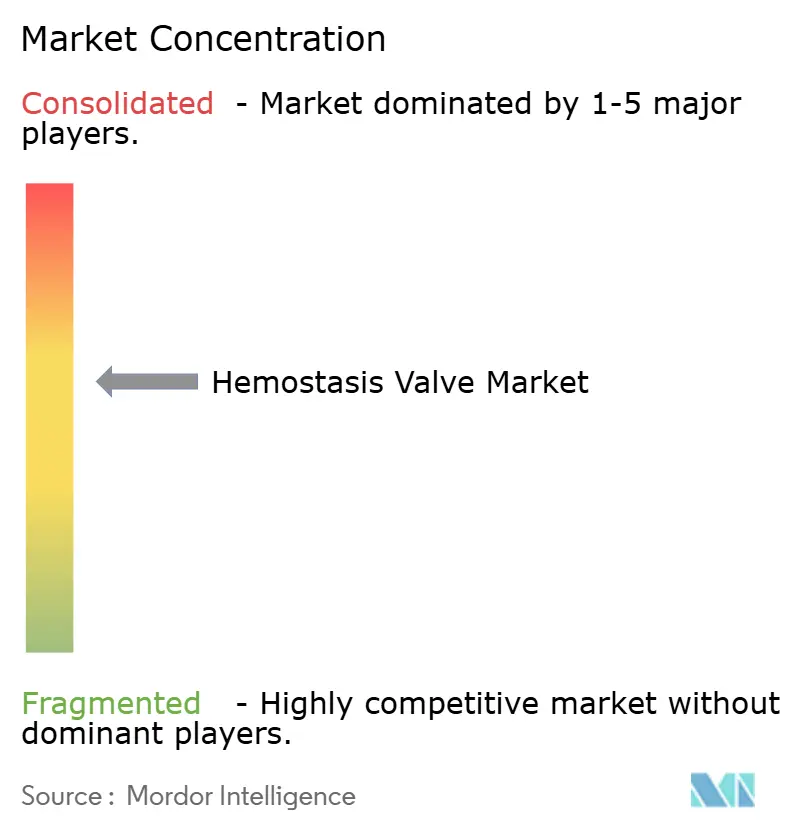
| Market Concentration | Medium |
Major Players *Disclaimer: Major Players sorted in no particular order Image © Mordor Intelligence. Reuse requires attribution under CC BY 4.0. | |
Hemostasis Valve Market Analysis by Mordor Intelligence
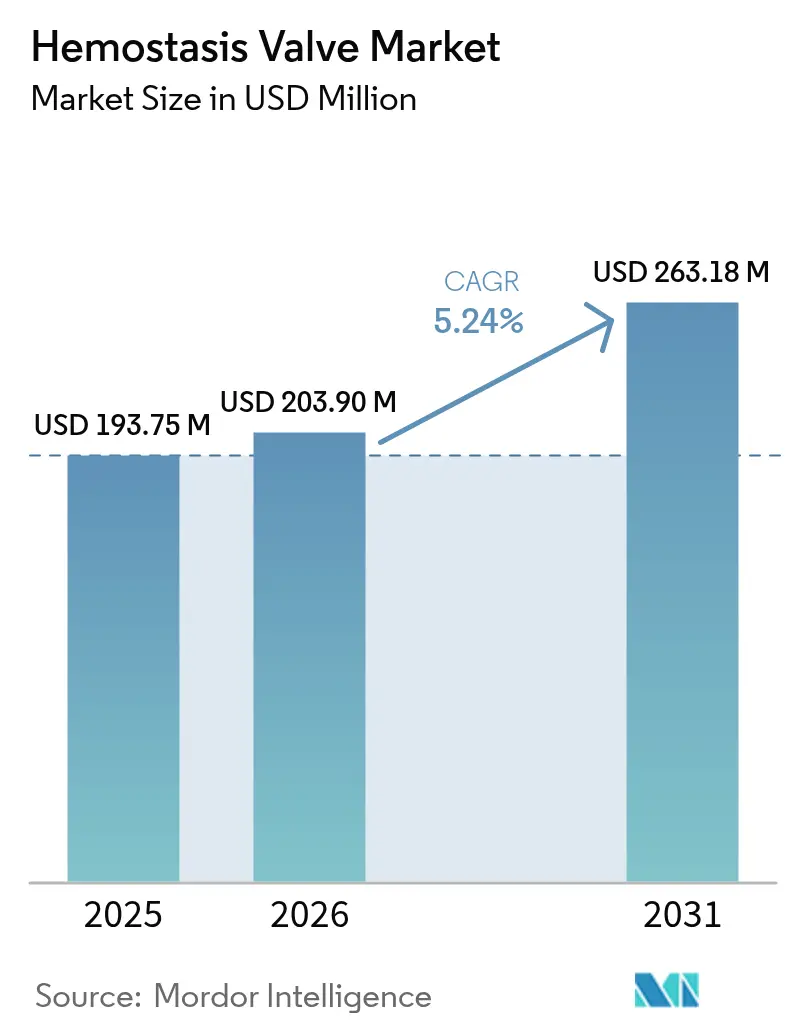
The hemostasis valve market size is expected to grow from USD 193.75 million in 2025 to USD 203.9 million in 2026 and is forecast to reach USD 263.18 million by 2031 at 5.24% CAGR over 2026-2031. Growth accompanies a 20.9% jump in interventional cardiology procedure volumes reported by Boston Scientific in Q1 2025, underscoring robust device utilization. The continuing transition from femoral to radial access drives demand for low-profile valves that maintain seal integrity with smaller French sizes. Product innovation now centers on single-handed operation and pressure-responsive “smart” valves able to relay real-time intraluminal pressure. Regulatory costs tied to EU-MDR re-certification and raw-material shortages of medical-grade silicone pose cost pressures, yet rising adoption of same-day discharge protocols in ambulatory settings offsets these hurdles through higher procedural throughput.
Key Report Takeaways
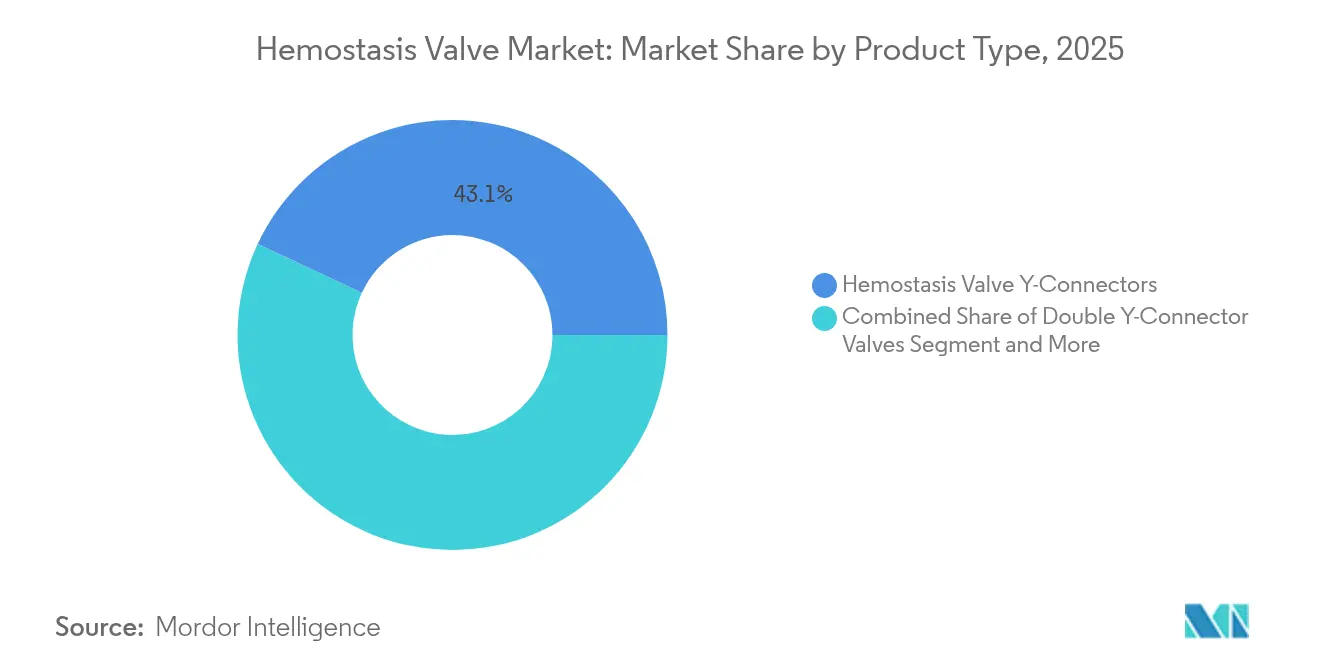
- By product type, hemostasis Valve Y-Connectors led with 43.05% of hemostasis valve market share in 2025; One-Handed Hemostasis Valves are forecast to expand at a 9.10% CAGR through 2031.
- By application, angiography captured 39.13% revenue share in 2025, while neuro-interventional procedures are advancing at a 10.56% CAGR to 2031.
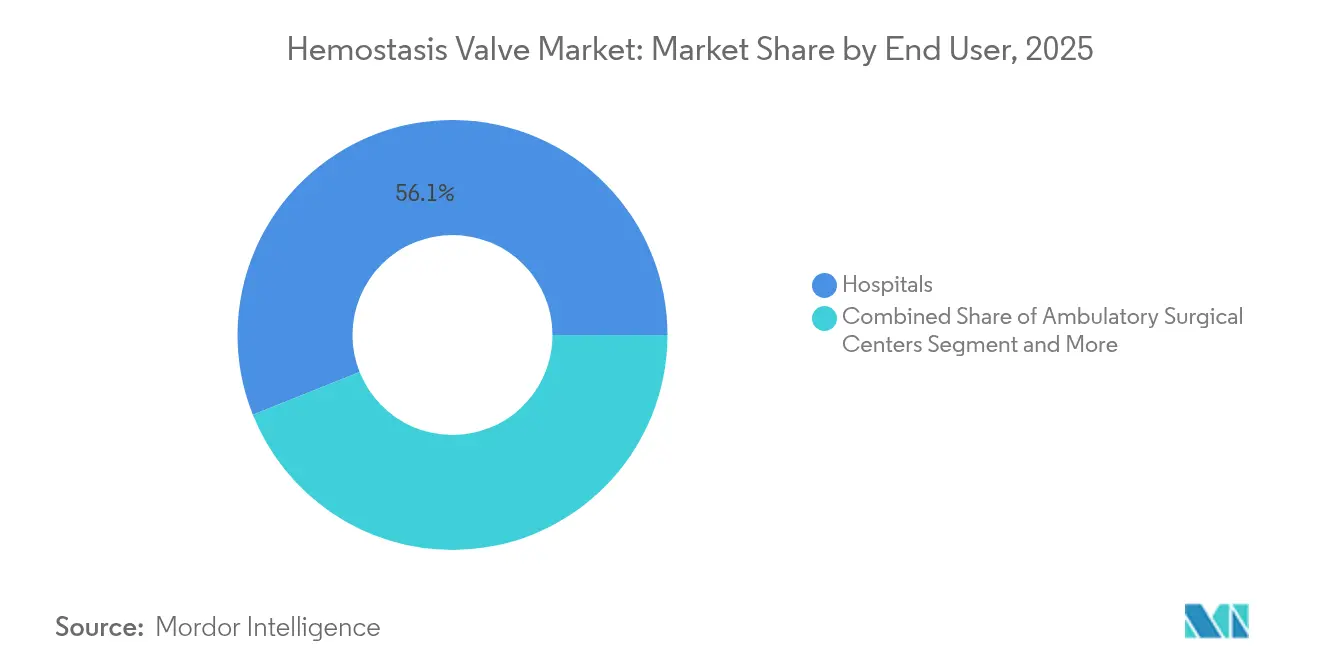
- By end user, hospitals held 56.05% of the hemostasis valve market size in 2025; ambulatory surgical centers record the fastest growth at 8.38% CAGR through 2031.
- By geography, North America accounted for 37.55% revenue share in 2025, yet Asia-Pacific is set to rise at an 8.18% CAGR between 2026 and 2031.
Note: Market size and forecast figures in this report are generated using Mordor Intelligence’s proprietary estimation framework, updated with the latest available data and insights as of 2026.
Market Trends and Insights
Drivers Impact Analysis of Hemostasis Valve Market*
| Driver | (~) % Impact on CAGR Forecast | Geographic Relevance | Impact Timeline |
|---|---|---|---|
| Surging volume of interventional cardiology & radiology procedures | +1.8% | Global, concentrated in North America & Europe | Medium term (2-4 years) |
| Rising global burden of cardiovascular & chronic metabolic diseases | +1.2% | Global, highest in Asia-Pacific & emerging markets | Long term (≥ 4 years) |
| Growing adoption of minimally-invasive endovascular surgeries | +1.0% | North America & EU leading, Asia-Pacific following | Medium term (2-4 years) |
| Rapid shift to radial access & lower-French devices | +0.8% | Global, accelerated in developed markets | Short term (≤ 2 years) |
| Proliferation of day-case cath-labs in emerging economies | +0.6% | Asia-Pacific core, spill-over to MEA & Latin America | Long term (≥ 4 years) |
| Commercialization of pressure-responsive “smart” valves | +0.4% | North America & EU early adoption | Medium term (2-4 years) |
| Source: Mordor Intelligence | |||
Surging Volume of Interventional Cardiology & Radiology Procedures
Q1 2025 results showed a 20.9% year-over-year sales rise for Boston Scientific attributable to higher catheterization activity[1]Boston Scientific, “Boston Scientific Announces Results for First Quarter 2025,” news.bostonscientific.com. Complex procedures require multiple device exchanges, elevating the need for reliable hemostasis valves that minimize blood loss. Operators now favor premium seals for high-risk neuro-interventions, where middle meningeal artery embolization volumes could hit 79,483 cases by 2029. Increased procedure counts translate directly into recurring demand for disposable valves. In addition, supportive reimbursement schemes in the United States continue to reward radial access, sustaining device utilization. These factors collectively add 1.8 percentage points to the anticipated CAGR.
Rising Global Burden of Cardiovascular & Chronic Metabolic Diseases
Age-standardized ischemic heart disease prevalence remains high even as mortality declines, leading to more repeat interventions over a patient’s lifetime. Asia already records 722.45 heart-failure cases per 100,000 population, intensifying catheter-based therapy needs. A growing hypertensive population further drives electrophysiology volumes, pushing adoption of specialized hemostasis solutions. Procedure repetitions for chronic disease monitoring secure a durable growth runway. Lower-cost disposable kits aimed at emerging markets broaden access. The combined effect raises the growth trajectory by 1.2 percentage points.
Growing Adoption of Minimally-Invasive Endovascular Surgeries
Endovascular aneurysm repair now surpasses open surgery across many vascular centers, reducing recovery times yet increasing annual procedure counts per facility. Same-day discharge after transradial PCI saved up to USD 1,480 per patient in Trinidad and Tobago, illustrating the economic incentive for higher turnover. Robot-assisted vascular platforms add precision to these minimally invasive techniques, though capital cost slows adoption. Valves that maintain seal integrity during extended dwell times underpin this surgical shift. Broader procedural eligibility expands the addressable patient base, supporting a 1.0 percentage-point positive CAGR contribution.
Rapid Shift to Radial Access & Lower-French Devices
Radial access complications are minimal at 0.58%, compared with 3.71% for femoral approaches. The American Heart Association now endorses radial access for peripheral interventions, boosting operator confidence[2]American Heart Association, “Radial Access Approach to Peripheral Vascular Interventions,” ahajournals.org. However, radial artery occlusion remains a concern, prompting demand for valves compatible with lower French sizes that limit vessel trauma. Neuro-intervention’s fast embrace of distal radial routes reinforces this trend. The resulting preference for compact seals accelerates product substitution, adding 0.8 percentage points to CAGR expectations.
Restraints Impact Analysis of Hemostasis Valve Market*
| Restraint | (~) % Impact on CAGR Forecast | Geographic Relevance | Impact Timeline |
|---|---|---|---|
| Operational complexity & supervision challenges in high-throughput cath-labs | -0.7% | Global, acute in high-volume centers | Short term (≤ 2 years) |
| Availability of alternative vascular closure technologies | -0.5% | North America & EU leading adoption | Medium term (2-4 years) |
| Volatile supply of medical-grade silicone & polycarbonate resins | -0.4% | Global manufacturing impact | Short term (≤ 2 years) |
| Cost escalation linked to EU-MDR Class IIb/III re-certification | -0.3% | EU primary impact, global compliance costs | Medium term (2-4 years) |
| Source: Mordor Intelligence | |||
Operational Complexity & Supervision Challenges in High-Throughput Cath-Labs
Physicians now execute more than 100 procedures each year, but case complexity climbs, raising staff fatigue and radiation exposure concerns. Workforce shortages oblige tailored education programs to sustain competencies. Real-time perception systems promise automation yet remain experimental. Maintaining diverse valve inventories for varied sheath sizes complicates logistics and can delay procedures. Collectively, these operational hurdles shave 0.7 percentage points off expected CAGR growth.
Availability of Alternative Vascular Closure Technologies
Devices such as MYNX CONTROL achieved 100% procedural success with hemostasis in 2.1 minutes, challenging manual compression and traditional valves for large-bore venous access[3]Cordis, “Cordis Receives FDA Approval for MYNX CONTROL™ Venous Vascular Closure Device,” cordis.com. Abbott’s StarClose SE likewise offers rapid arterial closure without major vascular complications. Bioabsorbable technology eliminates foreign material retention, appealing to health systems concerned about late complications. The expanding closure toolkit diverts purchasing budgets, subtracting 0.5 percentage points from growth.
*Our forecasts treat driver/restraint impacts as directional, not additive. The impact forecasts reflect baseline growth, mix effects, and variable interactions.
Hemostasis Valve Market Segment Analysis
By Product Type:
One-Handed Innovation Drives Market EvolutionHemostasis Valve Y-Connectors retained a 43.05% hemostasis valve market share in 2025, confirming their entrenched role in dual-port access for diagnostic angiography. The segment’s stability underpins a sizable installed base that ensures repeat purchases. Operator feedback, however, increasingly favors single-handed manipulation to cut exchange times, triggering rapid adoption of One-Handed Hemostasis Valves that post a 9.10% CAGR through 2031. The shift influences procurement policies at teaching hospitals where efficiency metrics are closely tracked.
One-Handed valves incorporate cross-slit seals that maintain integrity at elevated pressures, exemplified by the WATCHDOG system. Double Y-Connectors target niche procedures needing simultaneous guidewire and microcatheter access, whereas Integrated Extension-Line valves gain momentum for chronic total occlusion work. Push-Pull designs survive in legacy setups but face cannibalization. Material advances, including high-durometer silicone, reduce valve fatigue during lengthy rotational atherectomy, further boosting adoption among high-volume centers keen on workflow streamlining.



By Application:
Neuro-Interventional Surge Reshapes Market DynamicsAngiography remained the backbone application with 39.13% revenue share in 2025, driven by its role in both diagnostic and therapeutic settings. Repeat coronary angiographies for chronic coronary syndrome patients sustain base demand, anchoring the hemostasis valve market. Parallel growth in complex percutaneous coronary interventions reinforces the need for robust Y-Connector valves capable of multiple device exchanges.
Neuro-interventional procedures register the fastest growth at 10.56% CAGR, propelled by marked expansion in middle meningeal artery embolization for chronic subdural hematoma management. Radial adoption within neuro-intervention fosters demand for ultra-low-profile seals compatible with 4F and 5F sheath sizes. Peripheral vascular interventions also witness higher uptake as endovascular aneurysm repair captures larger aneurysm-repair volumes, creating incremental opportunities. Electrophysiology benefits from atrial fibrillation prevalence, but venous access requires valves tailored for larger bore sizes, adding complexity to product portfolios.
By End User:
Ambulatory Centers Drive Efficiency RevolutionHospitals dominated revenue with 56.05% in 2025, reflecting their capacity for complex multi-disciplinary interventions and intensive care backup. Purchasing committees within large academic centers typically negotiate multi-year contracts favoring vendors offering integrated valve portfolios. Despite this dominance, ambulatory surgical centers lead growth at 8.38% CAGR amid healthcare cost-containment reforms. Same-day discharge studies validate economic savings and patient satisfaction, incentivizing payers to steer suitable cases to these facilities.
Catheterization laboratories embedded within tertiary hospitals focus on throughput optimization, often adopting reusable seals to manage consumable budgets. Specialty clinics target electrophysiology and peripheral procedures, demanding valves compatible with dedicated mapping or atherectomy systems. Mobile cath-lab pilots in rural China trial low-profile valve kits designed for rapid deployment. Across end users, suppliers that harmonize product codes and training programs gain competitive advantage.
Geography Analysis
North America and Europe Hemostasis Valve Market
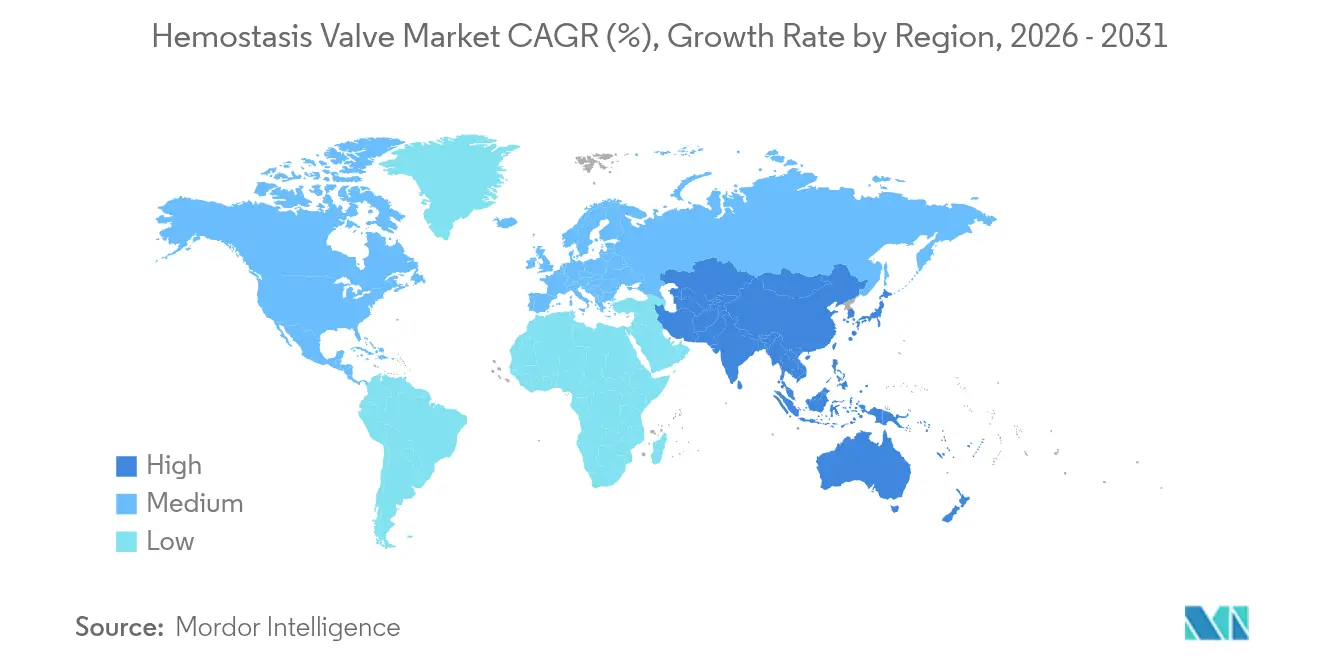
North America captured 37.55% of the hemostasis valve market in 2025, bolstered by high procedural volumes and advanced reimbursement structures. Extensive radial adoption combined with an aging population maintains steady unit demand. Europe follows with consistent spending, although EU-MDR compliance introduces cost headwinds that may temper near-term growth.
APAC Hemostasis Valve Market
Asia-Pacific is the standout, poised for an 8.18% CAGR as domestic manufacturers scale production of cost-effective valves aligned with regional price sensitivities. Government-funded cath-lab rollouts in Indonesia and the Philippines emphasize day-case capacity, creating demand for durable valves that tolerate sterilization cycles. Japan and South Korea continue to set quality benchmarks, spurring local suppliers to adopt high-precision molding technologies. The hemostasis valve market size for Asia-Pacific is therefore projected to close the decade at roughly USD 88.6 million, representing meaningful share gains.
MEA and South America Hemostasis Valve Market
The Middle East and Africa show latent potential, hinged on national cardiac-center programs emerging in Saudi Arabia and the United Arab Emirates. South America gradually advances as Brazil lifts capital-equipment import barriers, yet currency volatility moderates momentum. Collectively, these regions provide diversification opportunities for multinationals hedging against saturated developed markets.

Competitive Landscape
The hemostasis valve market features moderate fragmentation, with the top five firms controlling significant global revenue. Boston Scientific leverages broad cardiovascular portfolios and the 2024 acquisition of Silk Road Medical to widen neurovascular access. Teleflex agreed to purchase BIOTRONIK’s vascular intervention unit for EUR 760 million, instantly adding drug-coated balloons and scaffolds that complement its valve line. Merit Medical continues to grow share through incremental innovations in low-profile seals optimized for radial access.
Terumo capitalizes on Asia-Pacific growth by co-developing reusable valves with regional distributors, focusing on sterilization durability. Nordson’s USD 800 million acquisition of Atrion signals a push into integrated infusion and cardiovascular components. Smaller innovators focus on smart valves with embedded pressure sensors, aiming to license technology to incumbents rather than compete on scale.
Competitive factors now revolve around seal reliability, ergonomic design, and supply-chain resilience. Vendors offering training modules on radial access and sustainability claim differentiation in procurement bids. The proliferation of alternative vascular closure devices forces traditional valve suppliers to underline cost-effectiveness in multi-device cycles rather than single-use economics. Firms adept at bundling valves with guidewires or sheath kits secure higher average selling prices.
Hemostasis Valve Industry Leaders
Boston Scientific Corporation
Merit Medical Systems
Teleflex Incorporated
Terumo Corporation
Freudenberg Medical
- *Disclaimer: Major Players sorted in no particular order
Hemostasis Valve Market Companies Covered in this Report
- Boston Scientific
- Merit Medical Systems
- Teleflex
- Terumo
- Freudenberg
- Argon Medical Devices
- B. Braun
- Antmed
- Abbott Laboratories
- DeRoyal Industries
- Minivalve International
- Asahi Intecc Co. Ltd.
- Cook Group
- Medtronic
- Nipro
- Qosina Corp.
- Galt Medical Corp.
- Becton Dickinson & Co.
- Cardionovum
- Nordson Medical
- Smiths Group

Market Opportunities and Future Outlook
Demand is clustering around hemostasis valves that support faster, lower-profile cath-lab workflows as transradial access expands and procedure complexity rises in neuro-interventions and structural heart. Buyers are increasingly looking for one-handed, low-profile designs that help maintain seal integrity in 4F to 5F workflows, while also covering larger-bore access where multiple device exchanges and higher pressures make reliable sealing more valuable. Kit-based commercialization is also gaining traction as a route to standardize valve selection across angiography and ambulatory protocols. Merit Medical's May 2024 basixSKY inflation device launch positioned AccessPLUS, Honor, and PhD hemostasis valves within kit-based setups, aligning valve procurement with defined procedural packs.
Adjacent catheter-based therapy categories are creating additional pull for accessory suppliers that can demonstrate performance during higher-pressure, longer-dwell use cases and support integration with next-generation systems. Boston Scientific's May 2026 strategic investment in MiRus LLC, including an exclusive option tied to the SIEGEL balloon-expandable TAVR system, points to ongoing structural heart platform refreshes, which can raise requirements for access and hemostasis components during device delivery and exchanges. At the same time, EU-MDR compliance costs and material availability constraints, particularly for medical-grade silicone, keep the focus on supply-chain resilience and design-for-compliance, creating an opening for manufacturers that can sustain validated materials while improving ergonomics and enabling pressure-responsive smart valves for real-time intraluminal monitoring.
Recent Industry Developments in Hemostasis Valve Market
- May 2026: Boston Scientific announced a USD 1.5 billion strategic investment for an approximately 34% equity stake in MiRus LLC, along with an exclusive option related to the SIEGEL balloon-expandable TAVR system. The investment supports access to next-generation structural heart technologies that rely on specialized catheter-based delivery workflows. It also reinforces demand for compatible access accessories, including advanced hemostasis solutions, across complex transcatheter procedures.
- February 2025: Merit Medical introduced the 10Fore Hemostasis Valve, designed around a 10F (0.131 inch) inner lumen with a one-turn compression mechanism. The launch adds options for higher-lumen interventional workflows where reliable sealing and quick manipulation help reduce interruptions during device exchanges. It also supports Merit Medical's approach to covering both standard angiography and more demanding endovascular use cases through differentiated valve designs.
- May 2024: Merit Medical launched the basixSKY Inflation Device and positioned it for use with AccessPLUS, Honor, and PhD hemostasis valves in procedural kits. The release supports kit-based procurement and standardization trends in cath labs and ambulatory settings by linking valves to a broader workflow component. It also increases the competitive emphasis on bundled solutions rather than stand-alone valve selling.


Hemostasis Valve Market Report Scope and Research Methodology
Market Definition and Coverage
For this report, the hemostasis valve market is defined as the revenue generated from hemostasis valves used to control bleeding and maintain access during catheter based interventional procedures across major healthcare settings.
Scope exclusions: We exclude disposable vascular closure plugs and active flow-control introducers so the sizing stays limited to hemostasis valves and closely related valve configurations.
Segments Covered in This Report
- By Product Type
- Hemostasis Valve Y-Connectors
- Double Y-Connector Valves
- One-Handed Hemostasis Valves
- Integrated Extension-Line Valves
- Push-Pull Hemostasis Valves
- Others
- By Application
- Angiography
- Angioplasty
- Electrophysiology Procedures
- Neuro-interventional Procedures
- Peripheral Vascular Interventions
- Other Applications
- By End User
- Hospitals
- Ambulatory Surgical Centers
- Catheterization Laboratories
- Specialty Clinics
- Other End Users
- Geography
- North America
- United States
- Canada
- Mexico
- Europe
- Germany
- United Kingdom
- France
- Italy
- Spain
- Rest of Europe
- Asia-Pacific
- China
- Japan
- India
- South Korea
- Australia
- Rest of Asia-Pacific
- Middle East and Africa
- GCC
- South Africa
- Rest of Middle East and Africa
- South America
- Brazil
- Argentina
- Rest of South America
- North America
Data Sources, Market Sizing, and Validation
Desk Research
Desk research was used to anchor the clinical and procedure side of demand, and then to make sure the product scope stays consistent across regions. We referenced public sources such as the US FDA device databases and safety communications, the US Centers for Disease Control and Prevention (CDC) for cardiovascular and procedure related indicators, the World Health Organization (WHO) for epidemiology context, and OECD health statistics for system level utilization signals.
To pressure test the supply side, we also reviewed company annual reports, investor presentations, and product catalogs, along with association websites and peer reviewed clinical publications that describe angiography and angioplasty workflows and typical accessory use. For structured company financials, news coverage, and patent landscaping (to understand design shifts such as one-handed valves or integrated extension line designs), we used paid database subscriptions that support company intelligence and patent lookups. The desk research sources listed here are illustrative only, and many other public materials were used to collect data, validate assumptions, and resolve unclear points.
Primary Interviews and Surveys
Primary work was done through expert interviews and short surveys with a mix of manufacturers, distributors, catheter lab and procurement stakeholders, and clinicians who routinely use valve based access systems. We used these conversations to confirm adoption patterns by procedure type, typical replacement rates, and the pricing spread by valve configuration, and then to sanity check regional growth drivers across APAC, EMEA, and the Americas.
Distribution of primary research fieldwork respondents
| Company type | Respondent position | Region |
|---|---|---|
| Top tier: 35% | CXOs: 12% | APAC: 39% |
| Mid tier: 43% | Functional/Unit leaders: 30% | EMEA: 37% |
| Smaller Players: 22% | Managers: 58% | Americas: 24% |
Market-Sizing & Forecasting
Our sizing model starts with a top-down demand pool build using procedure volumes and catheter lab activity, which are then translated into expected hemostasis valve consumption through usage rates by procedure and typical valve replacement frequency. Since procedure intensity differs by region, the demand build is adjusted using indicators such as angiography and angioplasty case mix, growth in interventional cardiology and neuro-interventional activity, expansion of ambulatory surgical centers, and installed base direction for cath lab capacity.
After the top-down totals are formed, they are corroborated with selective bottom-up approximations so the totals do not drift away from real world selling patterns. These checks include sampled price points by valve type (for example Y-connector, double Y-connector, and one-handed designs), distributor and channel feedback on unit throughput, and a limited supplier roll up in markets where product availability is concentrated. When a country level data gap exists, we use proxy variables such as hospital procedure growth, import-export signals for relevant device categories, and expert provided penetration ranges, and then we revisit the assumptions during validation calls.
For forecasting, scenario analysis is applied around procedure growth and price movement, and the final trajectory is selected based on the most repeated expectations shared by interviewees. The model also reflects practical items that move yearly results, such as product mix shifts toward integrated extension line valves, procurement driven pricing pressure, and changes in interventional volumes due to policy or capacity additions.
Data Validation & Update Cycle
Validation is done by triangulating the model outputs against multiple independent checks, including regional procedure direction, expected unit consumption per procedure, and realistic price bands for common valve configurations. If a region shows an unusual step change, the inputs are rechecked, the calculation chain is reviewed by another analyst, and targeted re-contacts are triggered to clarify what changed and whether it is structural or temporary.
Before sign-off, variance checks are run across years and geographies so outliers are explained with clear drivers rather than left as residuals. The report is refreshed annually, and interim updates are made when a material event impacts procedure volumes, regulatory status, or pricing. Right before delivery, we do a final pass to ensure the latest public signals and interview feedback are reflected in the numbers.
Mordor Intelligence's Hemostasis Valve Market Sizing Compared With Other Published Estimates
Published market sizes for hemostasis valves can vary even when the topic sounds identical, because each publisher sets its own product inclusions, year definitions, and assumptions for procedure growth and pricing. Differences also show up when one study relies more on a single anchor year, and another study spreads the build across procedure indicators and then cross checks against pricing reality.
Some external estimates appear to bundle adjacent access management items more loosely, or to treat all interventional procedure settings as uniform when they are not. For Mordor Intelligence, disposable vascular closure plugs and active flow-control introducers are kept out, and the totals are tied back to procedure led demand signals and validated price bands by valve configuration, which narrows the room for overcounting when categories sit close together.
Benchmark comparison
| Source | Market Size | Gaps in Research Methodology |
|---|---|---|
| Mordor Intelligence | USD 203.9 M (2026) | |
| Industry Publisher A | USD 195.2 M (2025) | Uses a different base year and forecast window, and the year shift can change how price inflation and procedure rebound effects are captured in the starting value. |
| Industry Publisher B | USD 184.5 M (2024) | Anchors the sizing earlier, and the earlier year can understate later uptake from growing interventional volumes and mix shift toward premium valve designs in high throughput labs. |
Looking across the table, the spread is mainly explained by timing and scope alignment more than by a true disagreement on demand direction. When we keep the product list tight and then connect units and pricing back to procedure activity, the result becomes easier to replicate and to update when new utilization signals arrive.


Key Questions Answered in the Report
What is the current value of the hemostasis valve market?
The hemostasis valve market generated USD 203.9 million in 2026 and is forecast to reach USD 263.18 million by 2031.
Which product type leads revenue in the hemostasis valve market?
Hemostasis Valve Y-Connectors led with 43.05% market share in 2025.
Why are ambulatory surgical centers growing faster than hospitals?
Same-day discharge protocols and cost advantages drive an 8.38% CAGR for ambulatory surgical centers, outpacing hospital growth.
Which region is expected to experience the highest growth?
Asia-Pacific is projected to grow at an 8.18% CAGR through 2031 due to expanding day-case catheterization laboratories.
How do smart hemostasis valves differ from traditional models?
Smart valves incorporate pressure sensors that provide real-time feedback, improving seal management and potentially enhancing patient safety.
Page last updated on:


 Your data is secure and never sold or shared.


