
Track-and-Trace, Serialization And Anti-Tamper For CPG/Pharma Packaging Market Size and Share
Market Overview
| Study Period | 2019 - 2030 |
|---|---|
| Market Size (2025) | USD 1.93 Billion |
| Market Size (2030) | USD 3.20 Billion |
| Growth Rate (2025 - 2030) | 10.64 % |
| Fastest Growing Market | Asia Pacific |
| Largest Market | North America |
| Market Concentration | Medium |
Major Players *Disclaimer: Major Players sorted in no particular order Image © Mordor Intelligence. Reuse requires attribution under CC BY 4.0. | |

Track-and-Trace, Serialization And Anti-Tamper For CPG/Pharma Packaging Market Analysis by Mordor Intelligence
The track-and-trace, serialization, and anti-tamper solutions for the CPG/pharma packaging market size are projected to reach USD 3.20 billion by 2030, expanding at a 10.64% CAGR from USD 1.93 billion in 2025. Surging regulatory enforcement in the United States, Europe, China, and India, combined with brand-protection strategies and rapid digital transformation, continues to keep capital flowing into integrated hardware, software, and managed-service offerings. Pharmaceutical applications continue to drive global demand, yet rising counterfeit risks in premium food, beauty, and infant nutrition categories are accelerating the adoption of consumer goods. Cloud-native platforms that reduce upfront costs, the widespread rollout of GS1 2-D barcoding, and sensor-enabled cold-chain visibility further expand the addressable base for serialization providers. Competitive dynamics remain fragmented as system integrators, packaging-line OEMs, and authentication specialists battle for market share, while multi-technology solutions, including barcode, RFID/NFC, and blockchain, gain traction as the de facto standard for future-proof compliance and consumer engagement.
Key Report Takeaways
- By technology, track-and-trace, serialization and anti-tamper for CPG/pharma packaging market size for RFID/NFC is projected to grow at 12.84% CAGR between 2025–2030.
- By solution type, hardware captured 47.13% of the track-and-trace, serialization and anti-tamper for CPG/pharma packaging market share in 2024.
- By packaging level, track-and-trace, serialization and anti-tamper for CPG/pharma packaging market size for secondary packaging is projected to grow at 12.27% CAGR between 2025–2030.
- By application, pharmaceuticals captured 52.94% of the track-and-trace, serialization and anti-tamper for CPG/pharma packaging market share in 2024.
- By geography, North America captured 36.27% of the track-and-trace, serialization and anti-tamper for CPG/pharma packaging market share in 2024.
Note: Market size and forecast figures in this report are generated using Mordor Intelligence’s proprietary estimation framework, updated with the latest available data and insights as of January 2026.
Market Trends and Insights
Drivers Impact Analysis of Track-and-Trace, Serialization And Anti-Tamper For CPG/Pharma Packaging Market*
| Driver | (~) % Impact on CAGR Forecast | Geographic Relevance | Impact Timeline |
|---|---|---|---|
| Regulatory Serialization Mandates Accelerating Global Compliance Spend | +2.8% | Global, with concentrated impact in North America and the EU | Medium term (2-4 years) |
| Brand-Protection Focus Among CPG And Pharma Majors | +2.1% | Global, with premium segments in developed markets | Long term (≥ 4 years) |
| Retailer-Led "Sunrise 2027" Shift To 2-D Codes | +1.9% | North America and EU core, spill-over to APAC | Short term (≤ 2 years) |
| Cloud-Native Serialization Platforms Lowering Total Cost of Ownership | +1.7% | Global, with early adoption in North America | Medium term (2-4 years) |
| Blockchain-Anchored Authenticity Programs for High-Value SKUs | +1.2% | Global, concentrated in premium pharmaceutical segments | Long term (≥ 4 years) |
| Sensor-Enabled Cold-Chain Visibility | +0.9% | Global, with a temperature-sensitive pharmaceutical focus | Medium term (2-4 years) |
| Source: Mordor Intelligence | |||
Regulatory Serialization Mandates Accelerating Global Compliance Spend
The full enforcement of the United States Drug Supply Chain Security Act in November 2024 now obliges unit-level serialization across every distribution tier, while the European Union’s Falsified Medicines Directive continues to drive investments in tamper-evident features.[1]China National Medical Products Administration, “Drug Traceability System Implementation Guidelines,” NMPA.gov.cn China’s National Medical Products Administration mandates serialization for prescription drugs by December 2025, affecting both domestic and multinational manufacturers. India’s draft framework, aimed at protecting USD 25 billion in annual exports, mirrors global best practices and tightens compliance timelines. Collectively, these mandates eliminate discretionary spending decisions and lock in multi-year budgets for printing, inspection, and data-exchange upgrades. Suppliers that can certify equipment and software for multiple regions gain preferential status in vendor shortlists.
Brand-Protection Focus Among CPG and Pharma Majors
Counterfeit medicines siphon an estimated USD 200 billion annually, forcing pharmaceutical leaders to pair serialization with holograms, tamper-evident caps, and blockchain verification. Luxury beauty and infant-nutrition brands face similar risks, where a single falsified batch can erode consumer trust built over decades. Multi-layered authentication integrates overt, covert, and digital checks, enabling field inspectors and shoppers to confirm provenance with a smartphone scan. Brand owners convert compliance systems into direct-to-consumer engagement tools, linking codes to loyalty programs and recall alerts. This revenue-protection angle elevates investment priority well beyond the regulatory minimum.
Retailer-Led “Sunrise 2027” Shift to 2-D Codes
GS1’s Sunrise 2027 program compels retailers to read 2D barcodes at the point of sale, capturing batch, expiry, and sustainability data in a single scan. Walmart and large European chains have already begun accepting 2-D codes on pilot lines, prompting CPG suppliers to upgrade their printers, scanners, and labeling software three years ahead of schedule. Early movers report faster product recalls, reduced shrinkage, and enhanced consumer-app linkages, demonstrating commercial upside. Small and medium-sized brands benefit from standardized implementation guides that lower entry barriers. The mandate, therefore, accelerates hardware refresh cycles and drives uniform data-capture practices across markets.
Cloud-Native Serialization Platforms Lowering Total Cost of Ownership
Subscription-based platforms hosted on validated public clouds reduce site-level investment from USD 500,000 to USD 2 million to monthly fees of around USD 10,000. Providers bundle ready-made connectors for ERP and MES systems, reducing deployment timelines by half while ensuring compliance with FDA 21 CFR Part 11 and EU Annex 11 regulations. Real-time analytics enhance line throughput, predictive maintenance, and targeted recalls, resulting in operational savings that offset subscription fees. Regional data centers in Germany, Singapore, and India address privacy and sovereignty rules, broadening the addressable customer base. As upgrades roll out automatically, users avoid the expensive and disruptive version migrations associated with legacy on-premise systems.
Restraints Impact Analysis of Track-and-Trace, Serialization And Anti-Tamper For CPG/Pharma Packaging Market*
| Restraint | (~) % Impact on CAGR Forecast | Geographic Relevance | Impact Timeline |
|---|---|---|---|
| High Capex for Line-Level Retrofit in Legacy Plants | -1.8% | Global, with concentrated impact in mature manufacturing regions | Short term (≤ 2 years) |
| Global Shortage and Tariff-Driven Cost Surge in RFID Chipsets | -1.4% | Global, with supply chain concentrated in APAC | Medium term (2-4 years) |
| Cyber-Security and Data-Sovereignty Concerns Over Cloud Traceability | -0.9% | Global, with regulatory focus in EU and China | Long term (≥ 4 years) |
| Fragmented Standards Across Emerging Economies | -0.7% | Emerging markets, particularly in Africa and Latin America | Long term (≥ 4 years) |
| Source: Mordor Intelligence | |||
High Capex for Line-Level Retrofit in Legacy Plants
Facilities built before 2015 often lack the mechanical clearances and network bandwidth needed for modern printers, cameras, and rejection units. Line-level upgrades can cost USD 150,000-400,000 per packaging line, a burden that equals 15-25 % of annual revenue for many small contract manufacturers. Capital constraints delay go-lives and may force plant consolidation as firms weigh whether to upgrade or relocate production. Extended shutdown windows needed for validation further erode margins in multi-product sites. Consequently, some manufacturers defer the adoption of advanced technologies, dampening near-term uptake despite strong regulatory pressure.
Global Shortage and Tariff-Driven Cost Surge in RFID Chipsets
Semiconductor shortages increased RFID component prices by 40-60% in 2024, while U.S. Section 301 tariffs added a further 25% premium on Chinese imports. Lead times ballooned from eight to twenty-four weeks, forcing converters to ration inlay supply and prioritize high-value orders. CPG brands that are pursuing item-level NFC tags for consumer engagement are now delaying launches or scaling back pilot volumes. Pharmaceutical firms shift budgets toward low-cost 2-D codes when real-time tracking is non-essential, slowing RFID penetration. Unless capacity expansions in Southeast Asia come online on schedule, price instability is likely to persist into 2026.
*Our forecasts treat driver/restraint impacts as directional, not additive. The impact forecasts reflect baseline growth, mix effects, and variable interactions.
Track-and-Trace, Serialization And Anti-Tamper For CPG/Pharma Packaging Market Segment Analysis
By Technology:
RFID Innovation Drives Next-Generation AuthenticationThe track-and-trace, serialization, and anti-tamper solutions for the CPG/pharma packaging market, attributable to RFID/NFC applications, are projected to grow at a 12.84% CAGR, outpacing barcode incumbents. RFID’s capacity for simultaneous, line-of-sight-free reads supports fast aggregation of vials, cases, and pallets, unlocking real-time inventory insights. Temperature-sensing inlays address biologics and vaccine logistics, where excursions can destroy USD 1 million shipments in hours. Despite chipset shortages and tariff pressures, falling antenna costs and the rollout of Gen2V2 standards sustain adoption momentum. Complementary blockchain ledgers now incorporate RFID event streams, generating immutable audit trails that are valued by regulators and insurers.
Barcode and 2D codes retain a 42.57% share of the 2024 revenue, favored for their universality and low printing costs. Next-generation 2-D symbols, especially GS1 Digital Link, encode URLs that route consumers to recall notices, instruction videos, and carbon footprint dashboards. Hybrid solutions dominate RFPs; printers apply serialized 2-D codes while case-level RFID tracks distribution. ISO 12931 harmonization accelerates this convergence, endorsing multi-layered packaging authentication.




By Solution Type:
Services Growth Reflects Implementation ComplexityHardware integration accounted for 47.13% of 2024 revenue. Vision systems, thermal printers, and conveyors remain foundational, yet their commoditization shifts profit pools toward services. Implementation, line validation, and managed-compliance subscriptions are forecasted to grow at a 13.18% CAGR, reflecting skills gaps in mid-market manufacturers. Vendors bundle 24-hour remote support, change-control documentation, and recurring system performance audits into annual contracts, thereby boosting recurring revenue visibility.
Software orchestrates serialization hierarchies, regulatory reporting, and analytics, bridging factory IoT layers with wholesale and pharmacy portals. Edge-to-cloud architectures reduce latency for in-line print-inspect-verify loops, yielding throughput gains of 3-5 %. Continuous software updates keep pace with evolving XML schema issued by regulators, maintaining compliance without disruptive line shutdowns.
By Packaging Level:
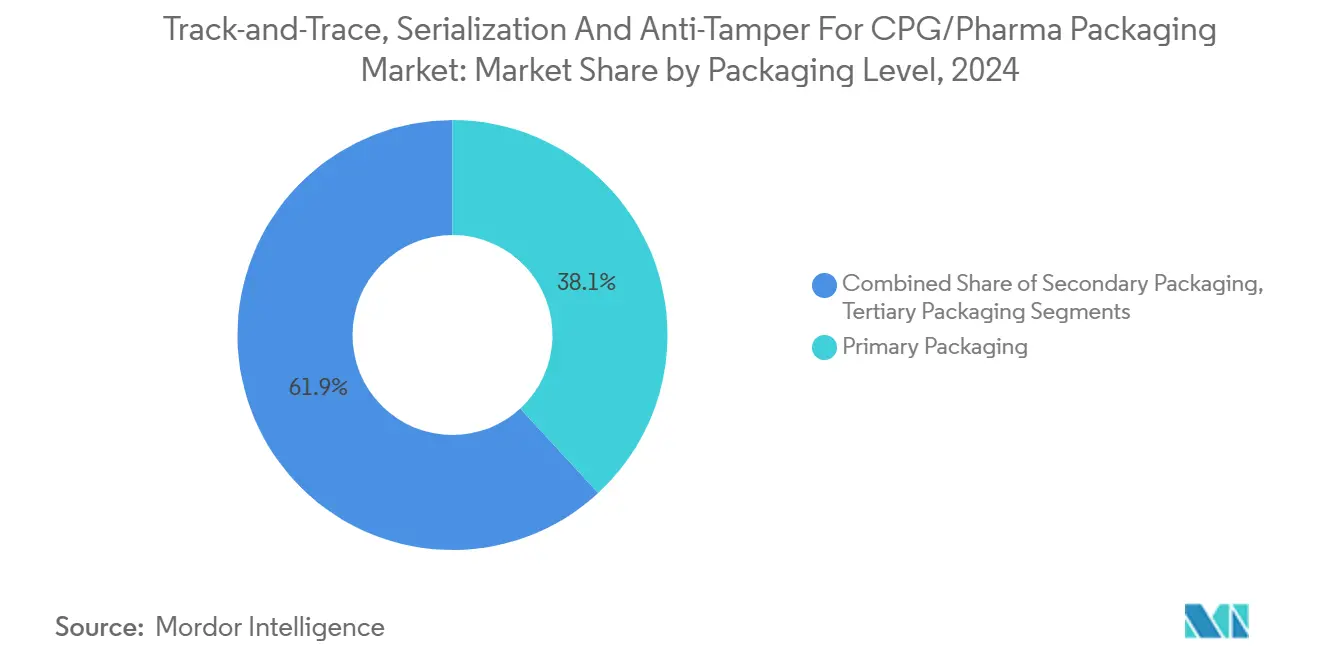
Secondary Packaging Gains Strategic ImportanceSecondary formats, cartons, and cases are on track for a 12.27% CAGR as retailers and 3PLs demand distribution-level verification. Enhanced case serialization expedites inbound receiving, slashes mis-picks, and supports sustainability reporting at the shipment level. Meanwhile, unit-level primary packaging holds a 38.14% share, which is indispensable for patient-level traceability and targeted drug recalls under the Drug Supply Chain Security Act.
Tertiary serialization underpins warehouse automation, feeding data to autonomous forklifts and robotic palletizers. Pharmaceutical majors increasingly deploy multi-level serialization, maintaining regulatory compliance while collecting granular supply-chain intelligence. This layered approach limits total bar-code density on small blisters, offloading aggregation demands to outer cartons without diluting consumer-side authentication.
By Application:
CPG Segment Accelerates Beyond CompliancePharmaceuticals controlled a 52.94% share in 2024; however, CPG use cases are forecast to rise at a 12.74% CAGR as brand owners combat gray-market diversion. Luxury goods incorporate NFC seals that authenticate ownership and unlock VIP content, effectively turning anti-counterfeiting into a loyalty monetization strategy. Infant formula makers integrate QR-linked educational portals, winning a share in trust-sensitive markets. Sustainability claims, such as organic sourcing and low-carbon transport, are verified through serialization data, reinforcing premium positioning and justifying price differentials.
On the pharmaceutical side, rising biologics volumes and personalized therapies, such as CAR-T treatments, require a serialized chain of identity from leukapheresis to reinfusion. Tamper-evident syringes with embedded microtaggants ensure dose integrity, strengthening reimbursement confidence with payers and regulators alike.
Geography Analysis
APAC Track-and-Trace, Serialization and Anti-Tamper for CPG/Pharma Packaging Market
The Asia-Pacific region is set for a 13.41% CAGR, supported by China’s serialization rollout and India’s export-driven compliance efforts. Government funding for smart manufacturing lines, tax incentives, and domestic consumer awareness programs accelerates local adoption. Regional providers form joint ventures with European integrators, ensuring the transfer of technology and localized after-sales service.
North America and Europe Track-and-Trace, Serialization and Anti-Tamper for CPG/Pharma Packaging Market
North America anchors global revenue with a 36.27% share, benefiting from early compliance deadlines and a high mix of value-added biologics. Cloud migrations outpace other regions as data-residency rules permit U.S. hosting, lowering TCO for medium-sized contract manufacturers.[2]U.S. Trade Representative, “Section 301 Tariffs on Chinese Imports,” USTR.gov Europe sustains steady growth on the back of post-implementation optimization, where firms refine the accuracy of aggregation and extend serialization to veterinary medicines.
MEA Track-and-Trace, Serialization and Anti-Tamper for CPG/Pharma Packaging Market
In the Middle East and Africa, although nascent, green-field pharmaceutical plants are specifying serialization from day one. Multilateral agencies fund capability building in Nigeria and Kenya, preparing for regional harmonization aligned with the African Medicines Agency.


Competitive Landscape
The track-and-trace, serialization, and anti-tamper solutions for the CPG/pharma packaging market remain moderately fragmented, with the top five vendors accounting for roughly 35-40% of global revenue. TraceLink leverages its extensive cloud network to provide real-time compliance updates and multi-enterprise data sharing, securing long-term contracts with over 400 pharmaceutical companies. Antares Vision Group, bolstered by its 2024 acquisition of RFID Global Solution, now delivers turnkey lines that merge machine vision, laser coding, and NFC authentication in a single cabinet. OPTEL Group’s blockchain-ready platform differentiates itself through open APIs that integrate with existing ERP systems, thereby reducing the risk of a "rip-and-replace" approach.
Equipment OEMs, such as Wipotec-OCS and Mettler-Toledo PCE, expand their offerings via modular retrofits that are adaptable to legacy lines, thereby shortening downtime from weeks to days. Component shortages drive vertical integration: Zebra Technologies invests in in-house antenna production, while Avery Dennison Smartrac opens new label capacity in Thailand to hedge supply-chain risk. Niche players Applied DNA Sciences and Authentix commercialize molecular tagging and spectral markers, winning pilots in oncology meds susceptible to high-margin counterfeits.[3]Applied DNA Sciences, “Molecular Tagging Technology Patent Portfolio,” Adnas.com
Emerging competition arises from platform-agnostic SaaS providers targeting underserved mid-tier CPG firms. These challengers bundle GS1 Digital Link encoding, smartphone verification, and consumer loyalty dashboards at entry-level pricing, placing margin pressure on incumbent license models. Nonetheless, regulatory expertise and global validation services remain high barriers to entry, anchoring incumbent defensibility.
Track-and-Trace, Serialization And Anti-Tamper For CPG/Pharma Packaging Industry Leaders
TraceLink Inc.
Antares Vision Group
OPTEL Group
SEA Vision S.r.l.
Zebra Technologies Corporation
- *Disclaimer: Major Players sorted in no particular order

Track-and-Trace, Serialization And Anti-Tamper For CPG/Pharma Packaging Market Companies Covered in this Report
- TraceLink Inc.
- Antares Vision Group
- OPTEL Group
- SEA Vision S.r.l.
- Kezzler AS
- Arvato Systems GmbH
- Laetus GmbH
- Mettler-Toledo PCE
- Siemens AG
- Zebra Technologies Corporation
- Avery Dennison Smartrac
- Uhlmann Pac-Systeme GmbH & Co. KG
- Xyntek Inc.
- Wipotec-OCS GmbH
- Axway Software SA
- Adents High-Tech International SA
- SICPA Holding SA
- Authentix Inc.
- Applied DNA Sciences Inc.
- Thinfilm Electronics ASA
- SML Group Ltd.

Recent Industry Developments in Track-and-Trace, Serialization And Anti-Tamper For CPG/Pharma Packaging Market
- March 2025: Zebra Technologies introduced a high-speed, dual-symbol printer capable of simultaneous 2-D code and RFID inlay encoding at 500 packs per minute.
- February 2025: OPTEL Group has partnered with a leading vaccine manufacturer in India to deploy blockchain-backed cold-chain traceability across six plants, with a scheduled go-live in Q3 2025.
- January 2025: Antares Vision Group released an AI-driven inspection module that self-tunes image-analysis parameters, cutting false rejects by 20 %.
- January 2025: TraceLink opened a new data-center cluster in Frankfurt, enabling EU-hosted cloud serialization services that comply with GDPR transfer restrictions.


Global Track-and-Trace, Serialization And Anti-Tamper For CPG/Pharma Packaging Market Report Scope
| Barcode / 2-D Code |
| RFID / NFC |
| Blockchain-Enabled Digital Trackers |
| Smart Sensors and IoT Tags |
| Hybrid / Integrated Platforms |
| Hardware |
| Software |
| Services |
| Primary Packaging |
| Secondary Packaging |
| Tertiary Packaging |
| Pharmaceuticals |
| Consumer Packaged Goods (CPG) |
| North America | United States | |
| Canada | ||
| Mexico | ||
| South America | Brazil | |
| Argentina | ||
| Chile | ||
| Rest of South America | ||
| Europe | United Kingdom | |
| Germany | ||
| France | ||
| Italy | ||
| Spain | ||
| Russia | ||
| Rest of Europe | ||
| Asia-Pacific | China | |
| India | ||
| Japan | ||
| South Korea | ||
| Australia | ||
| Rest of Asia-Pacific | ||
| Middle East and Africa | Middle East | Saudi Arabia |
| United Arab Emirates | ||
| Turkey | ||
| Rest of Middle East | ||
| Africa | South Africa | |
| Nigeria | ||
| Rest of Africa | ||
| By Technology | Barcode / 2-D Code | ||
| RFID / NFC | |||
| Blockchain-Enabled Digital Trackers | |||
| Smart Sensors and IoT Tags | |||
| Hybrid / Integrated Platforms | |||
| By Solution Type | Hardware | ||
| Software | |||
| Services | |||
| By Packaging Level | Primary Packaging | ||
| Secondary Packaging | |||
| Tertiary Packaging | |||
| By Application | Pharmaceuticals | ||
| Consumer Packaged Goods (CPG) | |||
| By Geography | North America | United States | |
| Canada | |||
| Mexico | |||
| South America | Brazil | ||
| Argentina | |||
| Chile | |||
| Rest of South America | |||
| Europe | United Kingdom | ||
| Germany | |||
| France | |||
| Italy | |||
| Spain | |||
| Russia | |||
| Rest of Europe | |||
| Asia-Pacific | China | ||
| India | |||
| Japan | |||
| South Korea | |||
| Australia | |||
| Rest of Asia-Pacific | |||
| Middle East and Africa | Middle East | Saudi Arabia | |
| United Arab Emirates | |||
| Turkey | |||
| Rest of Middle East | |||
| Africa | South Africa | ||
| Nigeria | |||
| Rest of Africa | |||


Key Questions Answered in the Report
What is the size of the track-and-trace, serialization, and anti-tamper market for CPG/pharma packaging in 2025?
The market is expected to reach USD 1.93 billion in 2025 and is projected to grow to USD 3.20 billion by 2030, with a 10.64% CAGR.
Which region grows fastest through 2030 for serialization solutions?
The Asia-Pacific region leads with a projected 13.41% CAGR, driven by new mandates in China and India, alongside manufacturing capacity expansion.
Why are services the fastest-growing solution type?
Growing regulatory complexity and limited in-house expertise push companies to outsource system integration, validation, and managed compliance, fueling a 13.18% CAGR in services revenue.
What technology segment offers the highest growth potential?
RFID/NFC technologies are forecasted to grow at a 12.84% CAGR, as they enable real-time authentication and environmental monitoring that surpasses barcode capabilities.
How does the Sunrise 2027 initiative influence the market?
The retail adoption of GS1 2-D codes compels CPG manufacturers to upgrade their packaging lines, lowers the barrier to entry for serialization, and creates a short-term boost in hardware and software demand.
What is driving investment in blockchain-based traceability?
High-value biologics and specialty drugs require immutable audit trails for patient safety and insurer confidence, prompting pharmaceutical companies to adopt blockchain-integrated serialization platforms.
Page last updated on:





