
Dispensing Pharmacy Packaging Machine Market Size and Share
Market Overview
| Study Period | 2020 - 2031 |
|---|---|
| Market Size (2026) | USD 1.92 Billion |
| Market Size (2031) | USD 2.44 Billion |
| Growth Rate (2026 - 2031) | 4.83 % |
| Fastest Growing Market | Asia Pacific |
| Largest Market | Asia Pacific |
| Market Concentration | Medium |
Major Players *Disclaimer: Major Players sorted in no particular order Image © Mordor Intelligence. Reuse requires attribution under CC BY 4.0. | |
Dispensing Pharmacy Packaging Machine Market Analysis by Mordor Intelligence
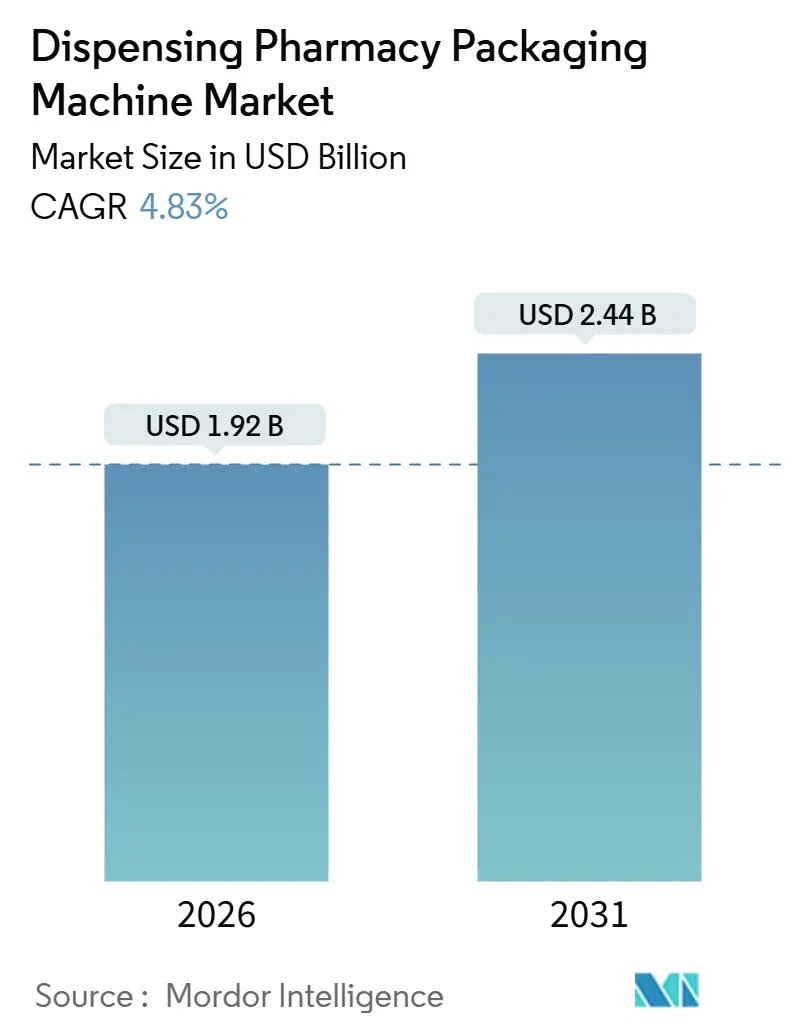
The dispensing pharmacy packaging machine market size stands at USD 1.92 billion in 2026 and is projected to reach USD 2.44 billion by 2031, reflecting a 4.83% CAGR. Demand is consolidating into fewer, high-throughput hubs as retail chains close storefronts and redirect prescriptions to automated central-fill sites that can process up to 500 scripts per hour. Asia-Pacific operators are transitioning directly to fully automated lines that incorporate track-and-trace serialization, driven by government cost-containment reforms and the rapid growth of prescription volumes. North American and European hospital pharmacies continue to automate to reduce labor and minimize medication errors, while personalized oncology regimens drive the adoption of mixing-and-split modules that ensure unit-dose precision. Serialization mandates in the United States and Europe further favor high-speed equipment with inline vision inspection. Competitive intensity is intensifying as Japanese incumbents defend their domestic market share against Swisslog and Omnicell, both of which market cloud-enabled analytics that shorten payback times.
Key Report Takeaways
- By product type, fully automatic systems captured 52.38% of the dispensing pharmacy packaging machine market share in 2025.
- By function, the dispensing pharmacy packaging machine market size for mixing-and-split modules is projected to grow at a 5.93% CAGR from 2026 to 2031.
- By speed, standard captured 48.39% of the dispensing pharmacy packaging machine market share in 2025.
- By application, the dispensing pharmacy packaging machine market size for central-fill pharmacies is projected to grow at a 6.47% CAGR between 2026 and 2031.
- By geography, Asia-Pacific captured 34.81% of the dispensing pharmacy packaging machine market share in 2025.
Note: Market size and forecast figures in this report are generated using Mordor Intelligence’s proprietary estimation framework, updated with the latest available data and insights as of January 2026.
Market Trends and Insights
Drivers Impact Analysis of Dispensing Pharmacy Packaging Machine Market*
| Driver | (~) % Impact on CAGR Forecast | Geographic Relevance | Impact Timeline |
|---|---|---|---|
| Rapidly Growing Pharmaceutical Industry Globally | +1.2% | Global, with pronounced effect in Asia-Pacific and North America | Medium term (2-4 years) |
| Increasing Precision-Dose Demand for Personalized Therapies | +0.9% | North America and Europe core, expanding to APAC urban centers | Long term (≥ 4 years) |
| Aging Population and Chronic Disease Prevalence | +1.1% | Japan, Europe, China; secondary impact in North America | Long term (≥ 4 years) |
| Growth In Outpatient Retail-Pharmacy Models | +0.7% | North America and Europe, with spillover to South America | Medium term (2-4 years) |
| Convergence With RFID/IoT Enabling Track-And-Trace | +0.8% | Global, led by U.S. DSCSA compliance and EU Falsified Medicines Directive | Short term (≤ 2 years) |
| Hospital Automation Mandates to Cut Medication Errors | +0.6% | North America, Europe, Middle East (Saudi Arabia, UAE) | Medium term (2-4 years) |
| Source: Mordor Intelligence | |||
Rapidly Growing Pharmaceutical Industry Globally
Global medical spending reached USD 1.48 trillion in 2024 and is projected to rise 5-8% annually, overwhelming manual pharmacy workflows. Networks such as India’s Jan Aushadhi have added dozens of stores, yet they still count tablets by hand, making automated packaging an attractive solution. China’s policy, which bars hospitals from profiting on drug markups, has shifted nearly one-third of prescriptions to retail pharmacies, which now automate to maintain their margins. Specialty drugs needing cold-chain handling further tilt demand toward fully automatic systems with sensor monitoring.
Increasing Precision-Dose Demand for Personalized Therapies
The United States Food and Drug Administration cleared 55 novel drugs in 2024, with one-third targeting biomarker-defined subsets. Each case requires unit-dose blister packs with patient-specific labels, fueling a 5.93% annual rise in mixing-and-split modules. Japan updated its community-pharmacy guidance, focusing on polypharmacy in seniors, which has spurred the adoption of machines that print schedules and embed QR codes for caregiver checks.
Aging Population and Chronic Disease Prevalence
Japan’s 65-plus share hit 29.1% in 2024 and will keep climbing. Chronic diseases create a constant demand for refills, and automated dispensers reduce labor per script from three minutes to forty-five seconds.[1] China and Europe face similar demographics, while pharmacist wages continue to rise, further supporting the need for automation.
Growth in Outpatient Retail-Pharmacy Models
Walgreens and CVS shuttered more than 2,000 stores between 2024 and 2025, redirecting fills to high-speed hubs and lowering the cost per prescription by up to 40%. Swisslog and Cardinal Health opened new micro-fulfillment centers that pair robotic picking with same-day delivery. European regulators back similar hub-and-spoke models to serve pharmacy-desert regions.
Restraints Impact Analysis of Dispensing Pharmacy Packaging Machine Market*
| Restraint | (~) % Impact on CAGR Forecast | Geographic Relevance | Impact Timeline |
|---|---|---|---|
| High Technological and Integration Costs | -0.8% | Global, acute in small independent pharmacies and emerging markets | Short term (≤ 2 years) |
| Regulatory Approval Delays for New Automated Systems | -0.5% | Europe (EU MDR), North America (FDA 510(k)), China (NMPA) | Medium term (2-4 years) |
| Cyber-Security and Data-Privacy Concerns | -0.6% | North America, Europe, and rising awareness in Asia-Pacific | Short term (≤ 2 years) |
| Skills Gap in Operating Sophisticated Machinery | -0.4% | Global, most severe in rural and emerging markets | Long term (≥ 4 years) |
| Source: Mordor Intelligence | |||
Cyber-Security and Data-Privacy Concerns
The February 2024 ransomware strike on Change Healthcare crippled claims at 70,000 pharmacies and exposed vulnerabilities in connected devices. A subsequent breach at Ascension forced 140 hospitals back to manual dispensing. The Food and Drug Administration now requires detailed cybersecurity plans with every device submission, which can add up to a year to the approval process.
Skills Gap in Operating Sophisticated Machinery
Technician employment in the United States is projected to grow at a rate of only 4% from 2024 to 2034, which is below the overall job growth rate, despite the increasing complexity of machines. A majority of hospital pharmacy directors cite turnover as a barrier to adoption. Vendors offer remote diagnostics, yet those features raise capital cost by USD 15,000-25,000 and still require a trained on-site operator.
*Our forecasts treat driver/restraint impacts as directional, not additive. The impact forecasts reflect baseline growth, mix effects, and variable interactions.
Dispensing Pharmacy Packaging Machine Market Segment Analysis
By Product Type:
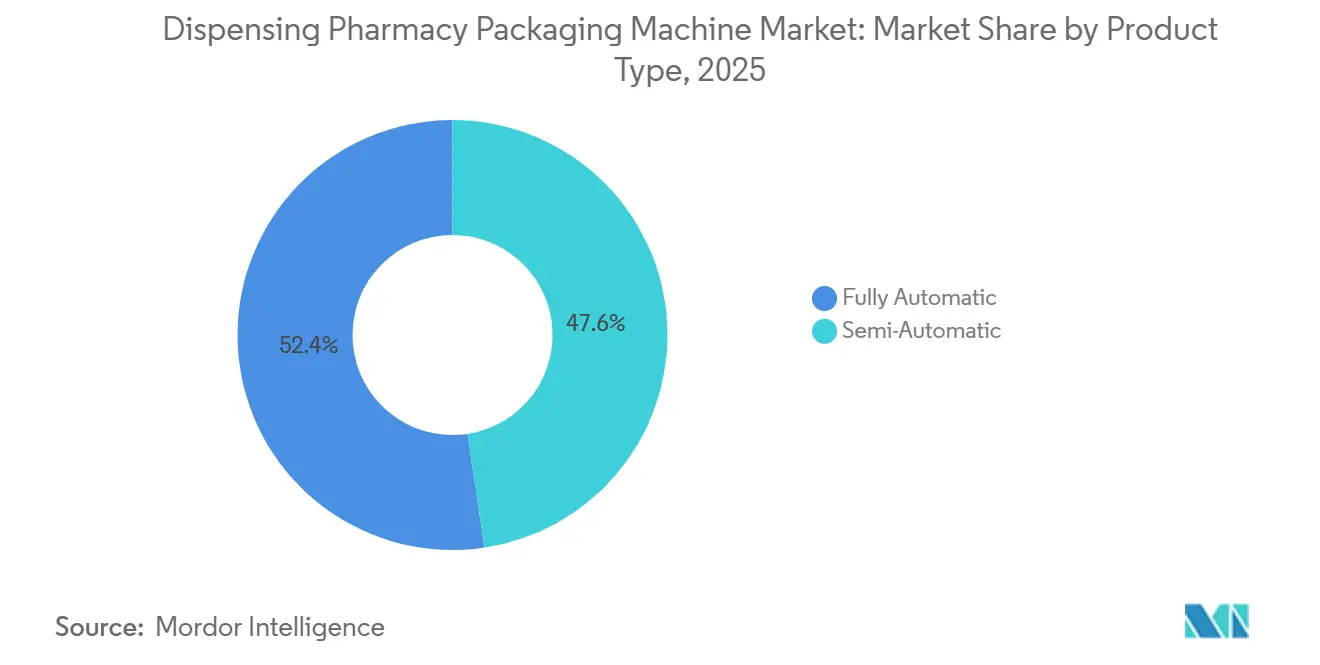
Fully Automatic Systems Dominate Amid Labor ShortagesFully automatic platforms captured 52.38% of the dispensing pharmacy packaging machine market share in 2025 and are projected to expand at a rate of 6.27% annually. Japan, where technician headcount fell 3% in 2024, exemplifies the shift as chains deploy equipment that needs one operator for 400 scripts. Omnicell’s compact VBM 200F processes 120 prescriptions per hour in a 12 m² space, solving space limitations for independent pharmacies.
Semi-automatic machines still appeal to India’s independents, which account for 85% of outlets, and they prefer USD 8,000-12,000 tablet counters over USD 80,000-plus full lines. Flexibility also keeps semi-automatic units relevant in compounding settings, where modular heads handle multiple vial sizes. Component vendors are responding with plug-and-play servo drives that enable operators to upgrade to fully automatic performance without requiring frame swaps. Together, these trends are expected to lift semi-automatic demand by 3.4% annually, preventing a winner-takes-all outcome and keeping the dispensing pharmacy packaging machine market size diversified across product classes
By Function:
Mixing-and-Split Modules Surge on Personalized MedicineFilling operations held a 36.93% share in 2025; however, mixing-and-split modules are growing at a rate of 5.93% annually, thanks to the adoption of precision oncology regimens. Japanese rules require adherence packs for patients on six or more drugs, and Takazono’s LiQ Model S completes 60 personalized cards per hour.[2] Wrapping modules gained ground after the 2024 deadline for unit-level traceability under the Drug Supply Chain Security Act forced U.S. pharmacies to upgrade their blister sealing capabilities with inline printers.
Vision inspection is now standard because the European Medicines Agency requires in-process verification. Next-generation systems combine ultraviolet ink verification with real-time cloud logging, shrinking recall investigations from weeks to hours. Labeling, capping, and inspection are converging into single-frame cells that shave 25% off floor-space needs in tight urban pharmacies. Vendors see a path to double-digit growth by bundling these features under a common software license, further lifting the overall dispensing pharmacy packaging machine market share held by multifunction workcells.
By Speed:
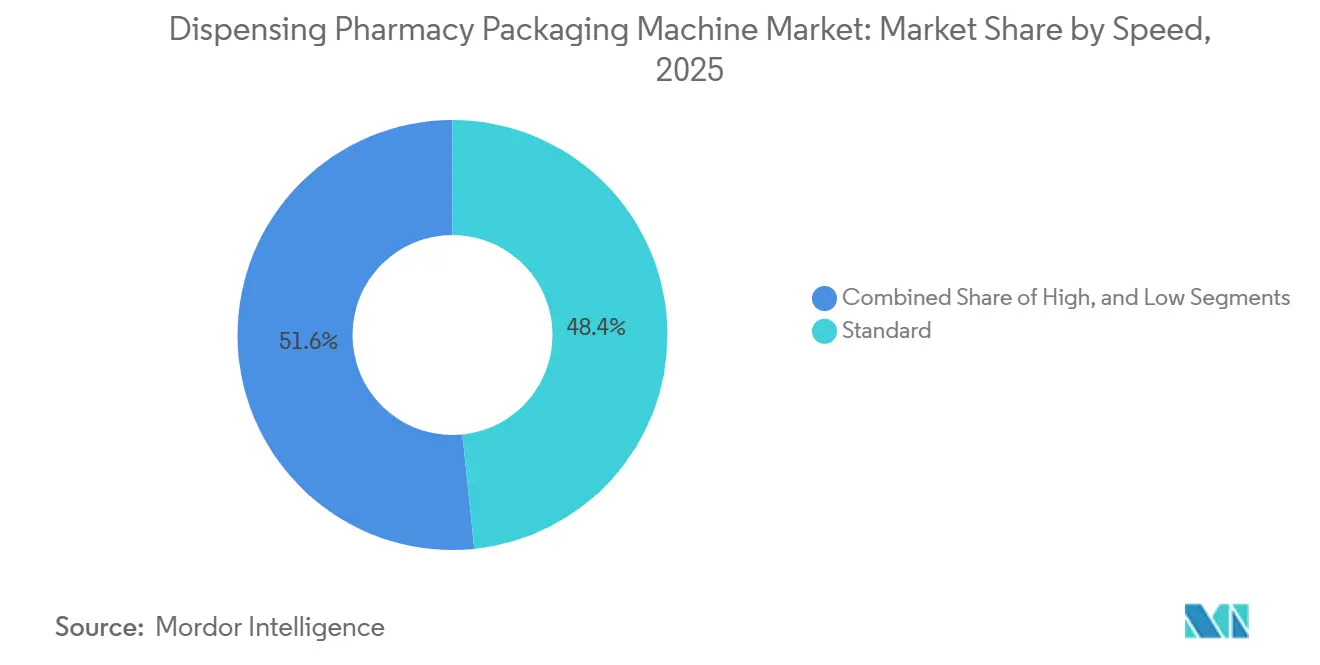
High-Speed Lines Gain as Central-Fill Economics ImproveStandard-speed units covered 48.39% of installations in 2025, but high-speed lines processing 500-800 scripts per hour are growing at a rate of 6.08% per year. Swisslog and Cardinal Health demonstrated 35% lower cost per prescription in new centers that serve dozens of satellites. Machine builders now bundle Internet of Things gateways that push uptime data to cloud dashboards, enabling predictive part replacement ten days before failure.
Low-speed equipment remains pragmatic for rural clinics and Jan Aushadhi stores; yet, modular upgrades, such as Capsa’s plug-in barcode scanners, allow operators to boost throughput later without scrapping assets. Hybrid lines that toggle between 200 and 500 scripts hourly are emerging for medium-volume sites seeking flexibility. Europe’s community-pharmacy consolidators are piloting hub-and-spoke models where a single high-speed core serves multiple satellite outlets through overnight courier.

By Application:
Central-Fill Pharmacies AccelerateHospital pharmacies led with a 42.67% share in 2025, as early mandates focused on reducing inpatient errors, and most tertiary centers now integrate robots into closed-loop medication systems. Central-fill hubs, however, are the fastest-growing at 6.47% because Walgreens and CVS are migrating scripts to robotic hubs that batch fill and save real estate. Mail-order operators harness similar infrastructure to meet two-day delivery guarantees, further raising equipment utilization to 85% of nameplate speed.
Community pharmacies upgrading to small-footprint fully automatic machines see a 15% rise in daily fill capacity without adding staff, supporting store survival in rural areas. European regulators permit remote verification by off-site pharmacists, enabling central-fill facilities to legally serve cross-border regions within the European Union. These dynamics suggest that central-fill and long-term care sites, together, could exceed 40% of the dispensing pharmacy packaging machine market share by 2031, rebalancing demand away from single-store setups while creating opportunities for specialized workflow software.
Geography Analysis
APAC Dispensing Pharmacy Packaging Machine Market
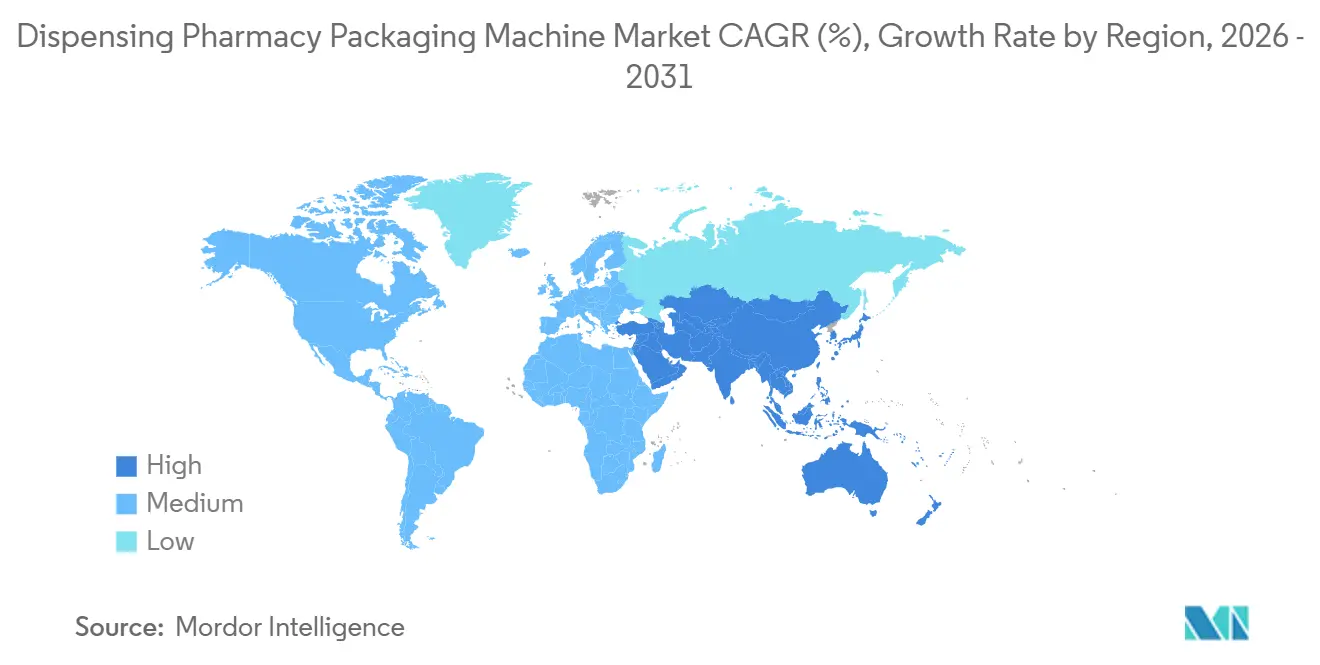
The Asia-Pacific region accounted for 34.81% of the dispensing pharmacy packaging machine market size in 2025 and is projected to grow at a 5.59% CAGR until 2031. Japan’s 65-plus cohort is expected to reach one-third of its population by the end of the decade, driving demand for an additional 200 million annual fills.
APAC, North America and Europe Dispensing Pharmacy Packaging Machine Market
China’s diagnosis-related group payments force hospitals to cut costs, prompting orders for automated lines that can reduce dispensing expenses by up to 20%. North America and Europe together hold a roughly 45% share of the market. The United States serialization deadline in 2024 created a 22% spike in equipment sales, while German community pharmacies consolidate into regional chains that adopt hub-and-spoke models.[3]
MEA and South America Dispensing Pharmacy Packaging Machine Market
The Middle East and Africa, at 12%, are smaller but catching up. Saudi Arabia has purchased 120 automated systems for its state hospitals, which require Arabic interfaces. South America still faces currency volatility, so pharmacies prefer modular, scalable equipment.
Competitive Landscape
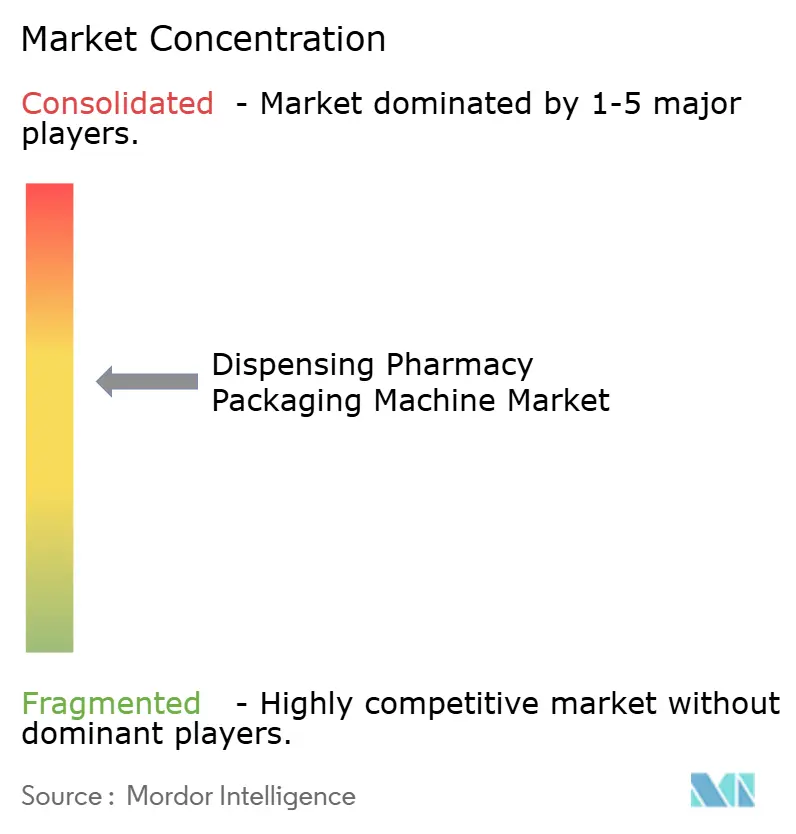
The top five suppliers account for nearly half of global revenue, placing the dispensing pharmacy packaging machine market in a moderately concentrated state. Yuyama, Tosho, and Takazono remain strong in Japan due to their integration with domestic software and wholesaler systems. Omnicell targets independent pharmacies with equipment-as-a-service, cutting upfront cost.
Swisslog integrates robotics into Cardinal Health’s network, enabling same-day fulfillment in U.S. urban corridors. Marchesini Group, historically a primary packaging firm, is acquiring to grow beyond EUR 600 million (USD 678 million) and has unveiled 600-cycle-per-minute blister lines that meet central-fill needs. Technological differentiation centers on serialization, cloud analytics, and predictive maintenance.
BD’s Rowa solution delivers end-to-end traceability in European hospitals. Smaller entrants leverage artificial intelligence for inspection, and ARxIUM claims 99.7% accuracy in defect detection. European Union Medical Device Regulation slows software-heavy launches, stretching approval windows to two years.
Dispensing Pharmacy Packaging Machine Industry Leaders
-
Yuyama Manufacturing Co., Ltd.
-
Takazono Corporation
-
Swisslog Holding AG
-
Omnicell, Inc.
-
Becton, Dickinson and Company
- *Disclaimer: Major Players sorted in no particular order
Dispensing Pharmacy Packaging Machine Market Companies Covered in this Report
- Yuyama Manufacturing Co., Ltd.
- Tosho Inc.
- Takazono Corporation
- Swisslog Holding AG
- Omnicell, Inc.
- Becton, Dickinson and Company
- ScriptPro LLC
- ARxIUM Inc.
- Capsa Solutions, LLC
- JVM Co., Ltd.
- Bausch + Stroebel Maschinenfabrik Ilshofen GmbH + Co. KG
- Marchesini Group S.p.A.
- Jiangsu Hanbon Science & Technology Co., Ltd.
- Famar Automation S.A.
Recent Industry Developments in Dispensing Pharmacy Packaging Machine Market
- September 2025: Swisslog Healthcare opened a micro-fulfillment center in Indianapolis with Cardinal Health, processing 500 scripts per hour and cutting per-prescription cost by 35%.
- September 2025: Capsa Healthcare upgraded its RoboWall for the United Kingdom, adding real-time wholesaler inventory links.
- May 2025: Omnicell introduced the VBM 200F in the United Kingdom and Ireland with monthly subscription pricing.
- February 2025: Swisslog and Cardinal Health launched a central-fill facility in Fort Worth, Texas, capable of 400 prescriptions per hour.
Global Dispensing Pharmacy Packaging Machine Market Report Scope
The scope of the study on the Dispensing Pharmacy Packaging Machine Market includes an in-depth analysis of automated systems designed for medication dispensing and packaging. It covers various machine types such as automated pouch packagers, blister packaging systems, and robotic dispensing units that streamline prescription fulfillment. The study examines technological advancements, including barcode verification, RFID integration, and IoT-enabled monitoring, for enhancing medication safety and compliance.
The Dispensing Pharmacy Packaging Machine Market Report is Segmented by Product Type (Fully Automatic, and Semi-Automatic), Function (Filling, Wrapping, Mixing and Split, and Other Functions), Speed (Low, Standard, and High), Application (Hospital Pharmacies, Retail Chain Pharmacies, Long-Term Care, and Central-Fill Pharmacies), and Geography (North America, South America, Europe, Asia-Pacific, Middle East and Africa). The Market Forecasts are Provided in Terms of Value (USD).
Segmentation Overview
| Fully Automatic |
| Semi-Automatic |
| Filling |
| Wrapping |
| Mixing and Split |
| Other Functions |
| Low |
| Standard |
| High |
| Hospital Pharmacies |
| Retail Chain Pharmacies |
| Long-Term Care |
| Central-Fill Pharmacies |
| North America | United States | |
| Canada | ||
| Mexico | ||
| South America | Brazil | |
| Argentina | ||
| Chile | ||
| Rest of South America | ||
| Europe | United Kingdom | |
| Germany | ||
| France | ||
| Italy | ||
| Spain | ||
| Rest of Europe | ||
| Asia-Pacific | China | |
| India | ||
| Japan | ||
| South Korea | ||
| Australia | ||
| Rest of Asia-Pacific | ||
| Middle East and Africa | Middle East | Saudi Arabia |
| United Arab Emirates | ||
| Turkey | ||
| Rest of Middle East | ||
| Africa | South Africa | |
| Nigeria | ||
| Rest of Africa | ||
| By Product Type | Fully Automatic | ||
| Semi-Automatic | |||
| By Function | Filling | ||
| Wrapping | |||
| Mixing and Split | |||
| Other Functions | |||
| By Speed | Low | ||
| Standard | |||
| High | |||
| By Application | Hospital Pharmacies | ||
| Retail Chain Pharmacies | |||
| Long-Term Care | |||
| Central-Fill Pharmacies | |||
| By Geography | North America | United States | |
| Canada | |||
| Mexico | |||
| South America | Brazil | ||
| Argentina | |||
| Chile | |||
| Rest of South America | |||
| Europe | United Kingdom | ||
| Germany | |||
| France | |||
| Italy | |||
| Spain | |||
| Rest of Europe | |||
| Asia-Pacific | China | ||
| India | |||
| Japan | |||
| South Korea | |||
| Australia | |||
| Rest of Asia-Pacific | |||
| Middle East and Africa | Middle East | Saudi Arabia | |
| United Arab Emirates | |||
| Turkey | |||
| Rest of Middle East | |||
| Africa | South Africa | ||
| Nigeria | |||
| Rest of Africa | |||
Key Questions Answered in the Report
What is the projected value of the dispensing pharmacy packaging machine market by 2031?
The market is forecast to reach USD 2.44 billion by 2031.
Which region leads current equipment demand?
The Asia-Pacific region holds the largest share, at 34.81%, primarily due to demographic pressures and policy reforms.
Why are fully automatic systems gaining traction?
They cut labor needs and integrate serialization, delivering payback even in tight labor markets.
How will serialization regulations influence equipment upgrades?
Mandates in the United States and European Union require inline printing and vision inspection, favoring high-speed machines.
What is the fastest-growing application segment?
Central-fill pharmacies are expanding at a rate of 6.47% annually as retail chains centralize their dispensing operations.
Which factor poses the greatest restraint to adoption?
Rising cybersecurity risks add cost and delay new-system approvals, especially in North America and Europe.