
Child Resistant Packaging (CRP) Market Size and Share
Market Overview
| Study Period | 2019 - 2030 |
|---|---|
| Market Size (2025) | USD 24.67 Billion |
| Market Size (2030) | USD 33.89 Billion |
| Growth Rate (2025 - 2030) | 6.56 % |
| Fastest Growing Market | Asia Pacific |
| Largest Market | North America |
| Market Concentration | Medium |
Major Players *Disclaimer: Major Players sorted in no particular order Image © Mordor Intelligence. Reuse requires attribution under CC BY 4.0. | |
Child Resistant Packaging (CRP) Market Analysis by Mordor Intelligence
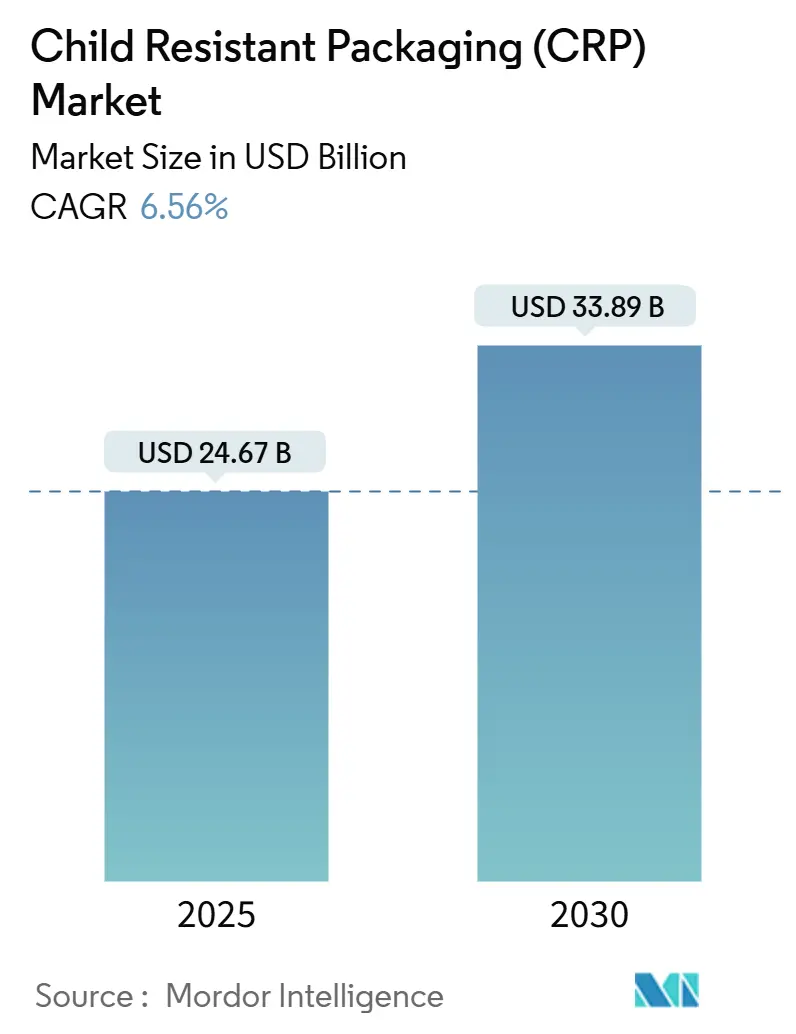
The Child-Resistant Packaging market size is estimated at USD 24.67 billion in 2025 and is projected to reach USD 33.89 billion by 2030, representing a 6.56% CAGR over the forecast period. Evolving from basic compliance concepts, the sector now blends child safety with senior accessibility and sustainability, a shift driven by global regulatory harmonization, rising cannabis demand, and the logistics pressure of e-commerce. Standardized testing under PPPA, ISO 8317, and the EU PPWR reduces duplication costs while favoring producers with in-house labs. Cannabis legalization across 38 U.S. states alone triggered USD 2.8 billion in specialized demand in 2024, spawning micro-markets for customized formats. Pharmaceutical dominance masks rapid adoption by cosmetics and personal-care brands seeking liability protection, while material science innovation enables recyclable paperboard solutions that retain torque resistance.
Key Report Takeaways
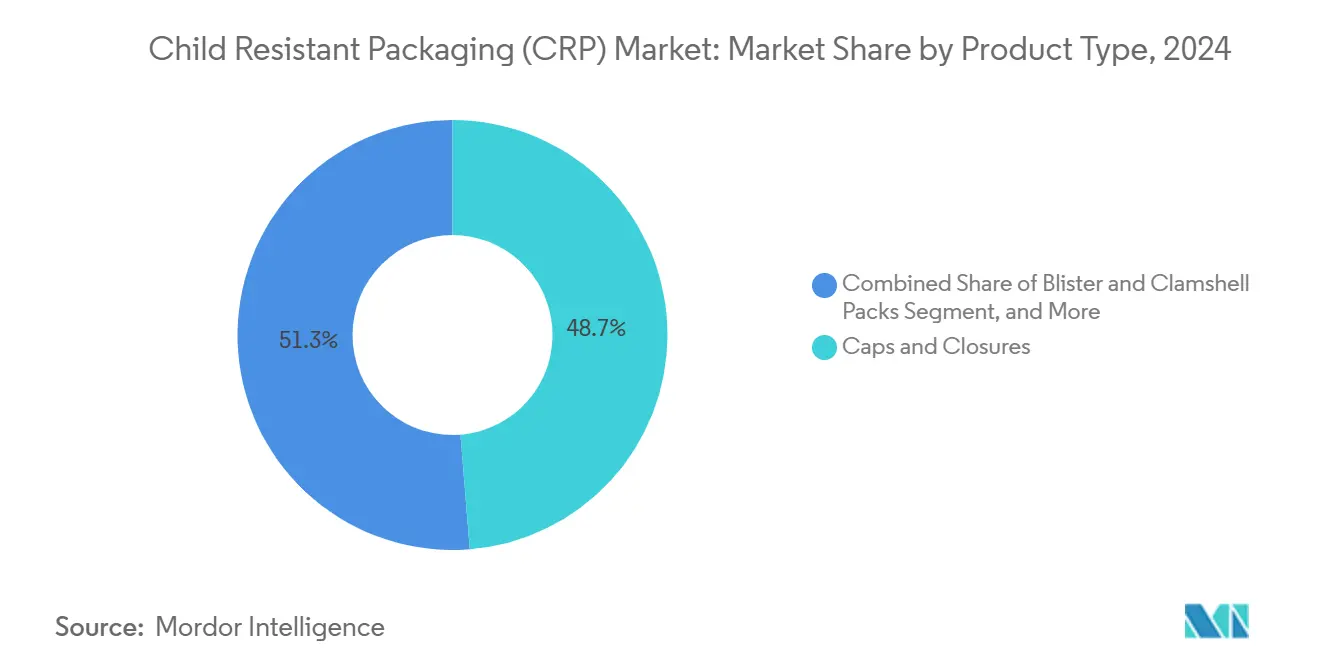
- By product type, caps and closures captured 48.72% of the child-resistant packaging market share in 2024.
- By material, the child-resistant packaging market size for paper and paperboard is projected to grow at 8.73% CAGR between 2025–2030.
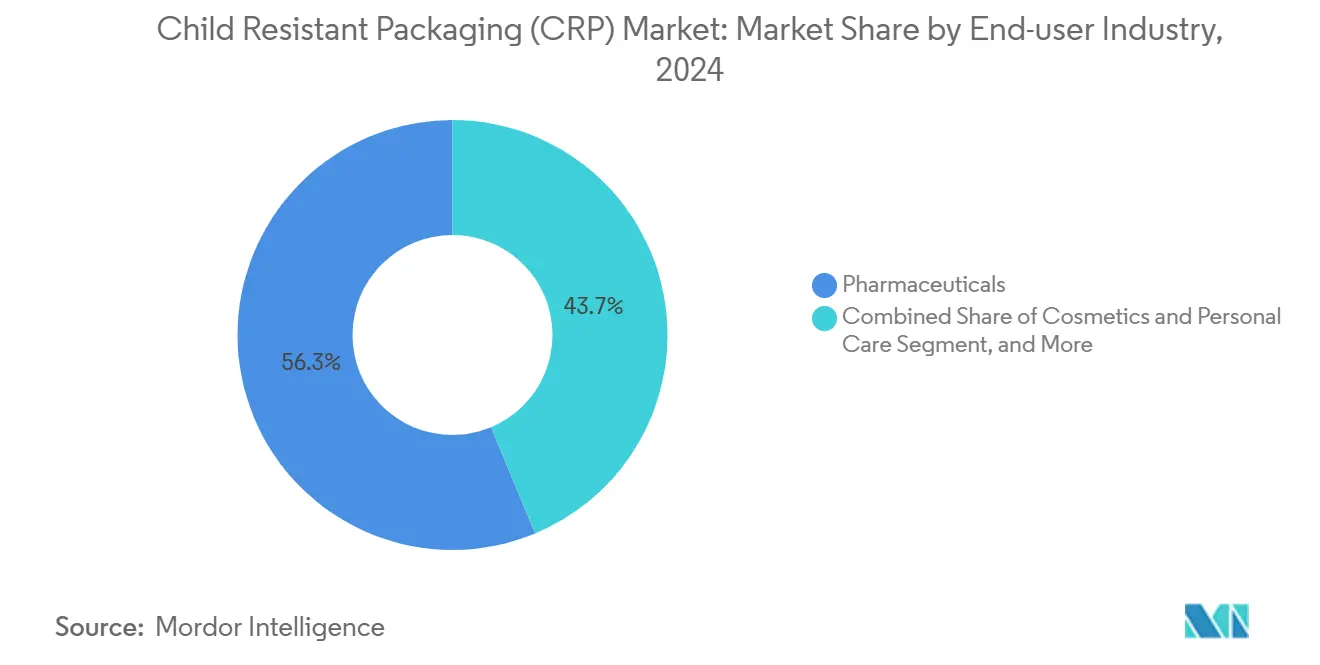
- By end-user, pharmaceuticals captured 56.28% of the child-resistant packaging market share in 2024.
- By geography, the child-resistant packaging market size for Asia-Pacific is projected to grow at a 9.28% CAGR between 2025–2030.
Note: Market size and forecast figures in this report are generated using Mordor Intelligence’s proprietary estimation framework, updated with the latest available data and insights as of January 2026.
Market Trends and Insights
Drivers Impact Analysis of Child Resistant Packaging (CRP) Market*
| Driver | (~) % Impact on CAGR Forecast | Geographic Relevance | Impact Timeline |
|---|---|---|---|
| Stringent global child-safety regulations | +1.8% | North America and EU | Long term (≥ 4 years) |
| Rapid growth of cannabis and CBD products | +1.4% | North America, EU, APAC | Medium term (2-4 years) |
| Shift toward sustainable, recyclable materials | +1.2% | EU, North America, APAC | Long term (≥ 4 years) |
| Rise of e-commerce needs ISTA-certified formats | +1.0% | North America and APAC | Short term (≤ 2 years) |
| Integration of smart/connected features | +0.8% | North America and the EU | Medium term (2-4 years) |
| An aging population and a senior-friendly design | +0.6% | Developed markets | Long term (≥ 4 years) |
| Source: Mordor Intelligence | |||
Stringent Global Child-Safety Regulations
Regulatory convergence across PPPA, ISO 8317, and the EU PPWR provides manufacturers with economies of scale while expanding compliance requirements to cosmetics and personal-care lines.[1]European Commission, “Packaging and Packaging Waste Regulation,” ec.europa.eu The 2024 PPPA protocol update introduced digital force measurement and senior-access testing, raising certification budgets by 15-20% while improving usability for older adults. ISO alignment trims duplicate testing, yet companies must adapt to different child-age cohorts in regional protocols. The PPWR overlays recyclability mandates onto safety requirements, intensifying design complexity. State cannabis rules further diversify test criteria, benefiting large firms that absorb higher audit costs while erecting barriers against small entrants.
Cannabis Market Growth Accelerates Specialized Demand
Legalization momentum added USD 2.8 billion in 2024 specialized demand, as states like New York required child-resistant packs for all products above 0.3% THC and senior-accessible formats for medical users over 65. California now mandates tamper-evident seals on top of child-resistant packaging, pushing multi-layer solutions. Germany's uptick in medical cannabis and looming recreational approval extend opportunities to the European Medicines Agency. Brands also seek bio-based substrates; however, strength limitations tilt the field toward incumbents with robust R&D. Cross-jurisdictional compliance widens premium-price windows for suppliers that master overlapping rules.
E-Commerce Growth Demands Integrated Safety
Amazon’s latest SIOC criteria require child-resistant packs to withstand distribution without outer cartons, necessitating solutions that integrate ISTA-6 transit durability and safety within the same structure. Direct-to-consumer pharmaceutical shipments jumped 34% during 2024, intensifying the need for packaging formats that can tolerate thermal swings and vibrations. Tamper evidence became non-negotiable online, while QR and NFC tags enable authenticity checks and supply-chain visibility. Vendors able to embed such multi-attribute performance are displacing single-feature suppliers.
Smart Technology Integration Enhances Compliance
NFC-enabled closures launched in 2024 transform passive packages into active adherence monitors, feeding real-time usage data to pharmaceutical stakeholders. RFID layers enable seed-to-sale traceability for cannabis, thwarting counterfeits and meeting statutory tracking requirements. Digital authentication combats low-grade knockoffs that endanger children and undercut pricing, but smart systems inflate the bill of materials by 25-40%, limiting uptake to high-value SKUs. Over time, declining sensor costs are expected to broaden adoption.
Restraints Impact Analysis of Child Resistant Packaging (CRP) Market*
| Restraint | (~) % Impact on CAGR Forecast | Geographic Relevance | Impact Timeline |
|---|---|---|---|
| High compliance and retooling costs | -1.2% | Emerging markets | Short term (≤ 2 years) |
| Trade-off between recyclability and performance | -0.8% | EU and North America | Medium term (2-4 years) |
| Regulatory fragmentation complicates design | -0.6% | North America | Long term (≥ 4 years) |
| Counterfeit low-cost alternatives | -0.4% | APAC and emerging markets | Medium term (2-4 years) |
| Source: Mordor Intelligence | |||
High Compliance Costs Create Market Entry Barriers
New testing rigs, priced between USD 150,000 and USD 300,000, plus skilled labor, drive fixed-cost burdens that dissuade small firms. ISO 8317 requires separate validations for each size and demographic, multiplying expenses. Re-tooling adds 20–35% to capital budgets, prolonging ROI in lower-volume niches. As a result, the Child-Resistant Packaging market consolidates around incumbents with dedicated regulatory departments.
Material Performance Trade-offs Constrain Sustainable Innovation
Torque-resistant closures often rely on multi-layer plastics, which complicate recycling, while fiber solutions require barrier coatings that hinder circularity goals. Bio-based substrates still struggle with consistent mechanical strength. EU recyclability targets add uncertainty that elongates R&D timelines, slowing the adoption of greener options despite consumer and legislative pressure.
*Our forecasts treat driver/restraint impacts as directional, not additive. The impact forecasts reflect baseline growth, mix effects, and variable interactions.
Child Resistant Packaging (CRP) Market Segment Analysis
By Product Type:
Caps and Closures Dominate Through InnovationCaps and closures accounted for 48.72% of the Child-Resistant Packaging market share in 2024. Their adaptability to bottles and jars preserves existing filling lines, minimizing changeover costs for brand owners. Innovations, such as Aptar’s SnapSlide cap, combine senior-friendly single-handed openings with PPPA compliance, broadening their appeal. Blister and clamshell packs are forecast to post the fastest growth rate of 8.59%, driven by unit-dose pharmaceutical formats and tamper-evident drug delivery. Flexible pouches are gaining traction in cannabis edibles by leveraging child-resistant zippers that strike a balance between safety and convenience.
Second-generation blister solutions, such as TabTec CR, incorporate push-through-and-slide mechanics that ease opening forces for arthritis patients while maintaining stringent testing standards. Cartons and boxes utilize mechanical interlocks that eliminate the need for adhesives, aligning with recyclability mandates. The Child-Resistant Packaging market size for bags and pouches is projected to increase steadily as e-commerce sellers opt for flexible substrates that reduce dimensional weight charges. Integrated tamper-evidence further aligns these packs with regulatory and consumer expectations.



By Material Type:
Plastic Dominance Faces Sustainable AlternativesPlastics delivered 68.39% of 2024 revenue, underpinned by polypropylene’s torque retention and polyethylene’s processability. However, paper and paperboard are set to register the quickest 8.73% CAGR as mechanical locking innovations maintain safety without plastic coatings, a breakthrough validated by Constantia’s EcoSafe CR line launched in June 2024. The Child-Resistant Packaging market size for paper-based formats remains small but attracts premium pricing in ESG-sensitive categories.
Glass retains niche pharma and premium cosmetic use cases, yet it requires specialized closures that increase system complexity. Metal aerosols utilize child-resistant actuators for household chemicals. Bio-based polymers show promise, but extended humidity testing delays commercialization. Regulators are increasingly favoring mono-material solutions, prompting converters to redesign plastic closures around single resin families to simplify recycling streams.
By End-user Industry:
Pharmaceutical Leadership Faces Multi-Industry ExpansionPharmaceuticals accounted for 56.28% of the revenue in 2024, reflecting the entrenched presence of PPPA and ISO mandates. Over-the-counter guidance issued by the FDA in late 2024 expands the Child-Resistant Packaging market into previously exempt segments, encouraging wider deployment. Cosmetics and personal care, projected to grow at an 8.16% CAGR, are adopting safety locks on concentrated serums and essential-oil skincare products to mitigate accidental ingestion risks.
Dietary supplements with high caffeine or vitamins now require safety formats in several jurisdictions, driven by growing demand within the food and beverage industry. Home care cleaners maintain a steady volume based on poison-prevention statutes, while agrochemicals utilize child-resistant triggers and caps to meet worker-safety codes. Cross-industry convergence enables converters to amortize pharma-grade tooling across consumer SKUs, thereby lowering per-unit costs and accelerating standardization adoption.
Geography Analysis
North America Child Resistant Packaging (CRP) Market
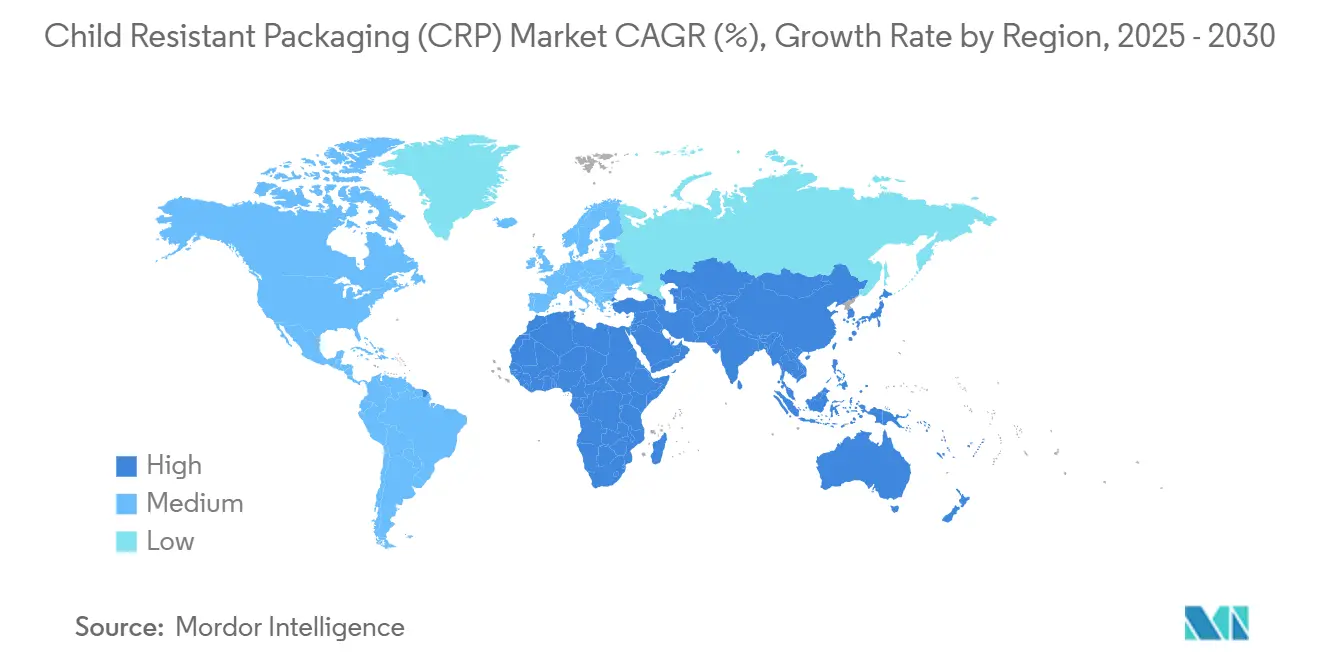
North America generated 38.49% of 2024 revenue, buoyed by PPPA enforcement and cannabis expansion across 38 states. E-commerce volume amplifies the need for ISTA-6 compliant formats that can withstand the rigors of parcel networks without relying on shippers.[2]International Safe Transit Association, “ISTA 6-Amazon.com-SIOC,” ista.org Senior-friendly design gains traction as the median age climbs, prompting producers to fine-tune opening torque without sacrificing child resistance.
APAC Child Resistant Packaging (CRP) Market
Asia-Pacific leads growth at a 9.28% CAGR to 2030, as per China’s pharmaceutical consolidation and India’s generic drug export drive. Updated NMPA guidelines align with ISO 8317, reducing trade barriers for global suppliers. Japan’s rapidly aging population demands ergonomic solutions, while Australia debates nationwide cannabis rules that could unlock fresh volume.
Europe Child Resistant Packaging (CRP) Market
Europe focuses on aligning recyclability with safety as PPWR deadlines approach. Germany’s medical-cannabis boom and potential recreational approval pressure packaging lines to satisfy both pharma and consumer regulations. Post-Brexit U.K. standards largely shadow EU norms but permit flexible approval pathways, creating selective opportunities for agile vendors. Southern and Eastern Europe gradually integrate child-safe mandates into national codes, unlocking incremental demand.

Competitive Landscape
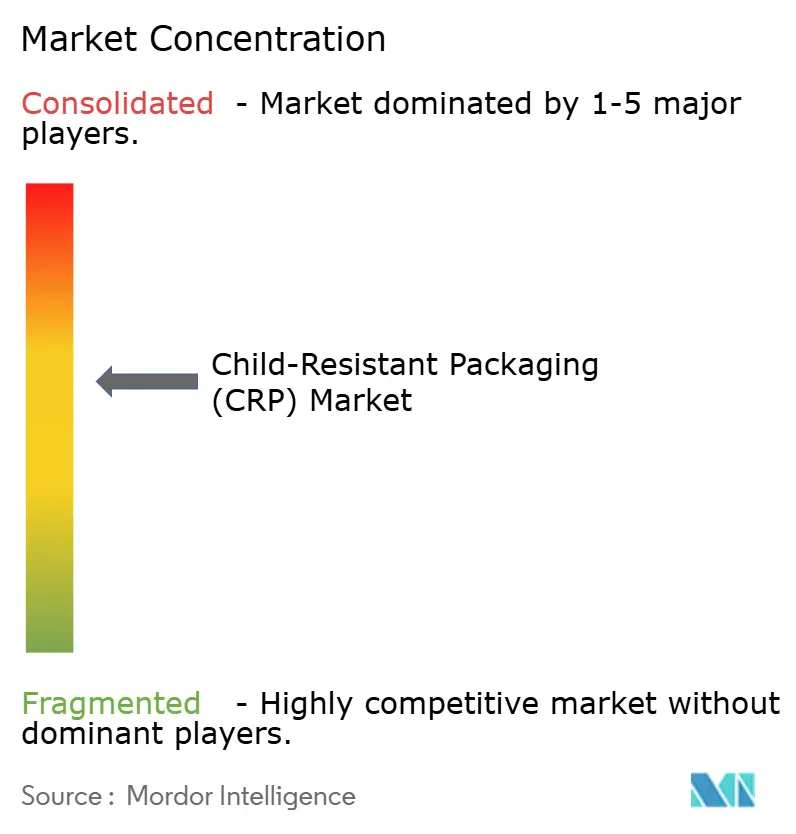
The Child-Resistant Packaging market exhibits moderate fragmentation, with the leading five suppliers collectively holding around 45% of the revenue, while regional converters compete on cost and service depth. Strategic differentiation centers on vertical integration, with Silgan’s 2024 acquisition of European CR assets adding senior-friendly technology to its global closure platform. Amcor’s AmLite Ultra pouch combines flexible film expertise with patented locking ribs, showcasing innovation at the intersection of sustainability and safety.
AptarGroup’s USD 45 million smart-closure program embeds NFC chips for drug-adherence tracking, reinforcing its premium positioning.[3]Schreiner MediPharm, “Smart Blister Wallet with NFC Technology,” schreiner-medipharm.com Gerresheimer’s India facility demonstrates cost-optimized scalability, targeting export pharmaceutical hubs. Disruptors like Smurfit WestRock utilize fiber engineering to produce recyclable cartons that meet ISO standards, appealing to ESG-oriented cannabis brands.
Counterfeit, low-grade imports challenge premium pricing in the APAC region, motivating incumbents to bundle authentication layers. Technology licensing accelerates scale: closure specialists partner with sensor start-ups to embed electronics without re-tooling entire lines. Overall, competition tilts toward firms combining R&D heft, regulatory fluency, and global footprint.
Child Resistant Packaging (CRP) Industry Leaders
Amcor plc
Silgan Holdings Inc.
Smurfit WestRock plc
Gerresheimer AG
AptarGroup, Inc.
- *Disclaimer: Major Players sorted in no particular order
Child Resistant Packaging (CRP) Market Companies Covered in this Report
- Amcor plc
- AptarGroup, Inc.
- Silgan Holdings Inc.
- Smurfit WestRock plc
- Gerresheimer AG
- Constantia Flexibles GmbH
- Closure Systems International Inc.
- Winpak Ltd.
- Bemis Manufacturing Company
- Bilcare Ltd.
- Origin Pharma Packaging
- Mold-Rite Plastics, LLC
- O.Berk Company, LLC
- ProAmpac LLC
- Dymapak LLC
- Sanner GmbH

Recent Industry Developments in Child Resistant Packaging (CRP) Market
- September 2025: Chubby Gorilla introduced child-resistant pouch containers featuring a 3-way closure system and a leak-proof liner.
- September 2025: Fresh-Lock introduced Child-Guard track & slider closures made from post-consumer recycled materials.
- September 2025: Amcor launched a hybrid CRP with QR tamper-evident technology and multi-layer barrier films.
- January 2025: Closure Systems International began U.S. commercial rollout of its SnapSlide child-resistant, arthritis-friendly cap, targeting prescription liquids.


Global Child Resistant Packaging (CRP) Market Report Scope
| Caps and Closures |
| Blister and Clamshell Packs |
| Bags and Pouches |
| Cartons and Boxes |
| Jars |
| Other Product Types |
| Plastic |
| Paper and Paperboard |
| Glass |
| Metal |
| Pharmaceutical |
| Food and Beverage |
| Home Care |
| Cosmetics and Personal Care |
| Chemicals |
| Other End-user Industries |
| North America | United States | |
| Canada | ||
| Mexico | ||
| South America | Brazil | |
| Argentina | ||
| Chile | ||
| Rest of South America | ||
| Europe | United Kingdom | |
| Germany | ||
| France | ||
| Italy | ||
| Spain | ||
| Russia | ||
| Rest of Europe | ||
| Asia-Pacific | China | |
| India | ||
| Japan | ||
| South Korea | ||
| Australia | ||
| Rest of Asia-Pacific | ||
| Middle East and Africa | Middle East | Saudi Arabia |
| United Arab Emirates | ||
| Turkey | ||
| Rest of Middle East | ||
| Africa | South Africa | |
| Nigeria | ||
| Rest of Africa | ||
| By Product Type | Caps and Closures | ||
| Blister and Clamshell Packs | |||
| Bags and Pouches | |||
| Cartons and Boxes | |||
| Jars | |||
| Other Product Types | |||
| By Material Type | Plastic | ||
| Paper and Paperboard | |||
| Glass | |||
| Metal | |||
| By End-user Industry | Pharmaceutical | ||
| Food and Beverage | |||
| Home Care | |||
| Cosmetics and Personal Care | |||
| Chemicals | |||
| Other End-user Industries | |||
| By Geography | North America | United States | |
| Canada | |||
| Mexico | |||
| South America | Brazil | ||
| Argentina | |||
| Chile | |||
| Rest of South America | |||
| Europe | United Kingdom | ||
| Germany | |||
| France | |||
| Italy | |||
| Spain | |||
| Russia | |||
| Rest of Europe | |||
| Asia-Pacific | China | ||
| India | |||
| Japan | |||
| South Korea | |||
| Australia | |||
| Rest of Asia-Pacific | |||
| Middle East and Africa | Middle East | Saudi Arabia | |
| United Arab Emirates | |||
| Turkey | |||
| Rest of Middle East | |||
| Africa | South Africa | ||
| Nigeria | |||
| Rest of Africa | |||


Key Questions Answered in the Report
How large is the Child-Resistant Packaging market in 2025?
The sector is valued at USD 24.67 billion in 2025, with a projected USD 33.89 billion by 2030.
What is the expected CAGR for child-resistant packs through 2030?
Market value is forecast to grow at a 6.56% CAGR during 2025-2030.
Which product type leads global sales?
Caps and closures held 48.72% of 2024 revenue thanks to their versatility across industries.
Which region is poised for the fastest expansion?
The Asia-Pacific region is projected to grow at a 9.28% CAGR, driven by pharmaceutical manufacturing in China and India.
What material is gaining popularity for sustainable child resistance?
Paper and paperboard formats, featuring mechanical locks, are projected to grow at an 8.73% CAGR through 2030.
How are smart technologies changing CR packaging?
NFC and RFID integrations enable authentication and adherence tracking, although they increase package costs by 25-40%.
Page last updated on:





