
Touch Probe Market Size and Share
Market Overview
| Study Period | 2019 - 2030 |
|---|---|
| Market Size (2025) | USD 718.5 Million |
| Market Size (2030) | USD 865.40 Million |
| Growth Rate (2025 - 2030) | 3.80 % |
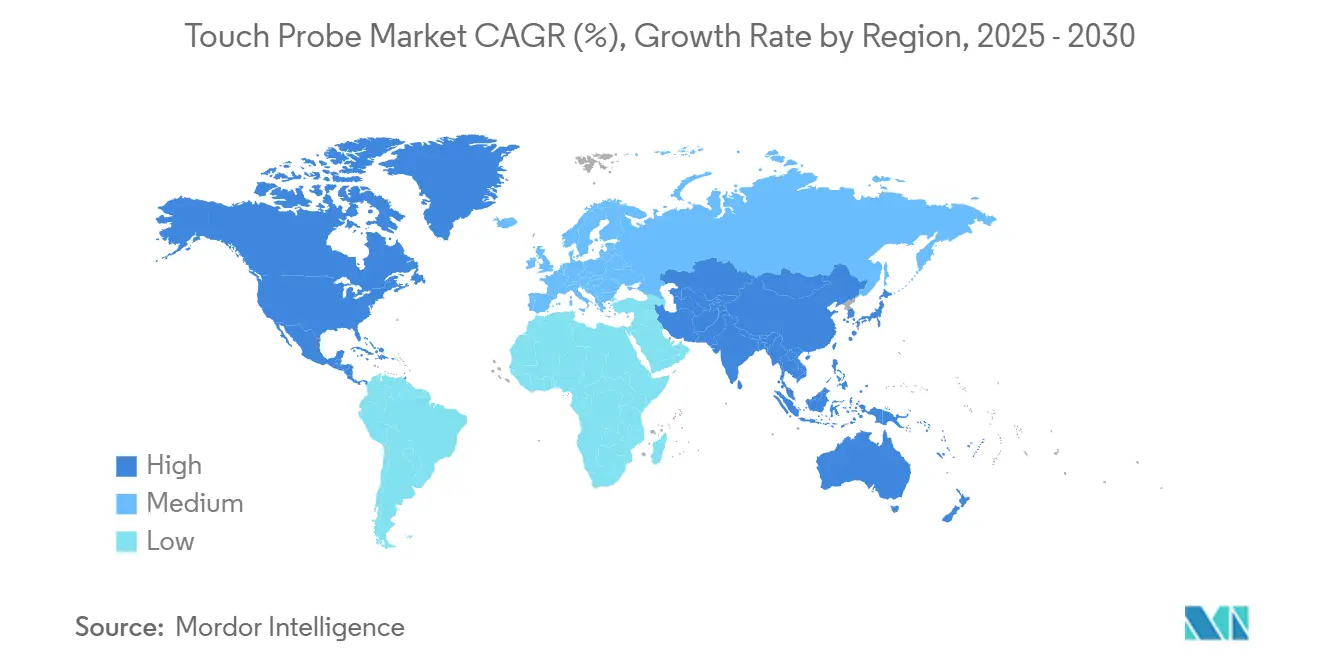
| Fastest Growing Market | North America |
| Largest Market | Asia Pacific |
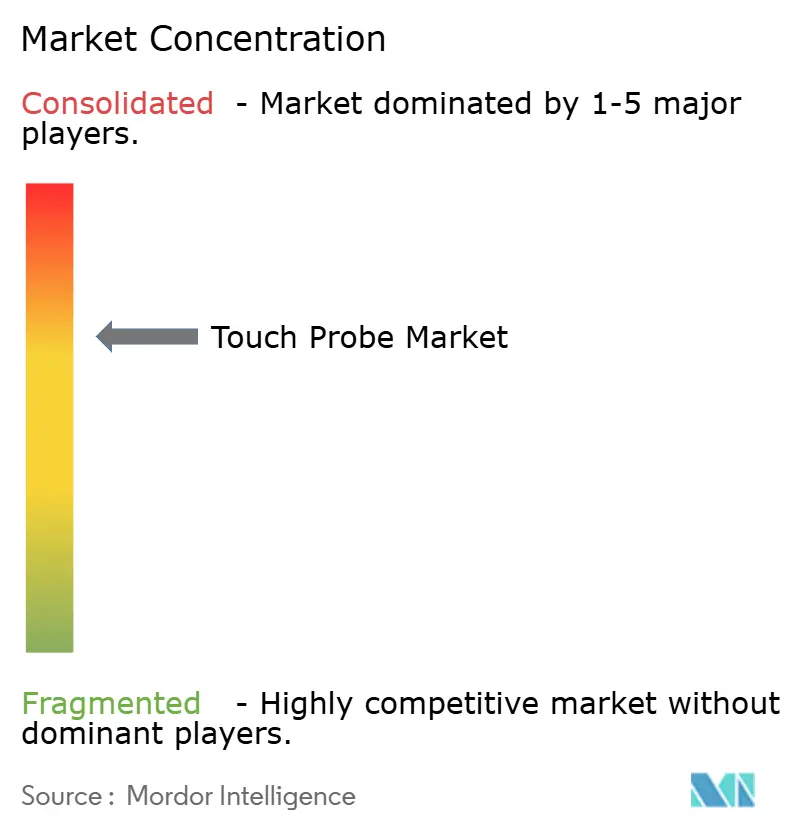
| Market Concentration | Medium |
Major Players *Disclaimer: Major Players sorted in no particular order Image © Mordor Intelligence. Reuse requires attribution under CC BY 4.0. | |
Touch Probe Market Analysis by Mordor Intelligence
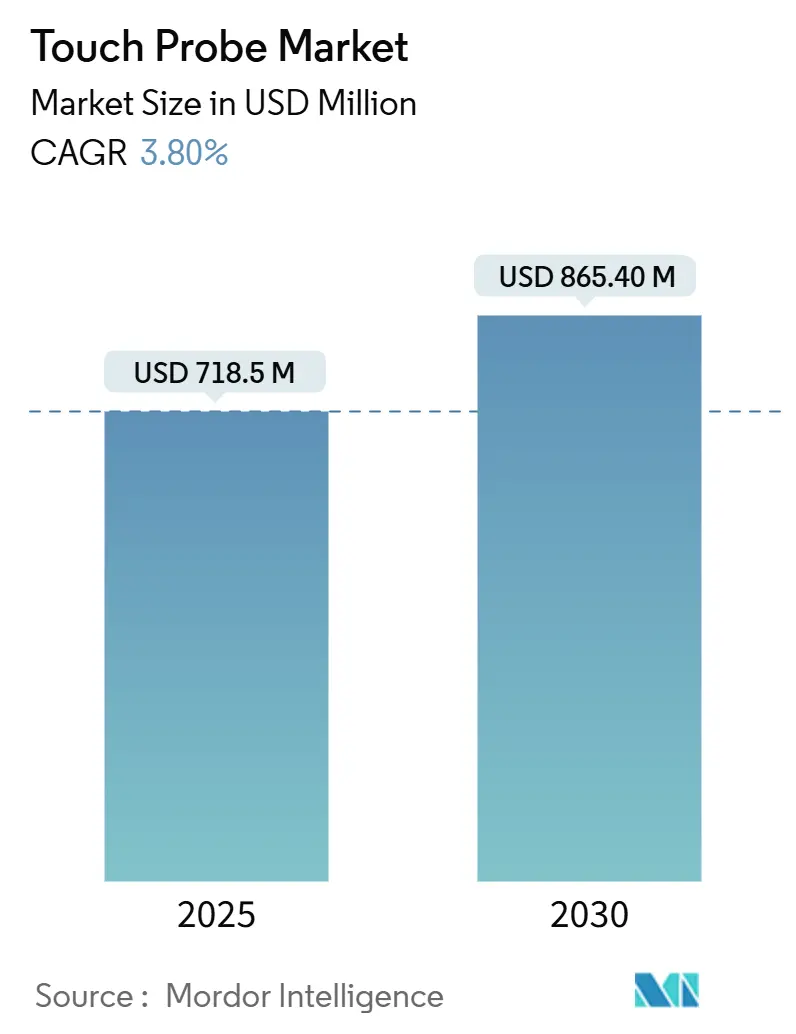
The touch probe market size stood at USD 718.5 million in 2025 and is forecast to reach USD 865.4 million by 2030, advancing at a 3.8% CAGR over the period. Growing reliance on precision machining in electric-vehicle drivetrains, next-generation aircraft engines, and miniaturized medical implants sustains solid—yet measured—expansion for the touch probe market. Manufacturers now pair 5-axis CNC platforms with digital-twin frameworks, so demand migrates toward on-machine metrology that delivers sub-micron repeatability without slowing cycle time.[1]Source: RENISHAW PLC, “Improve My Process,” renishaw.com Asia-Pacific’s large installed base of advanced machine tools and generous robotics subsidies under China’s Made in China 2025 plan and Japan’s New Robot Strategy keep the region at the forefront. North America, meanwhile, leverages reshoring incentives embedded in the CHIPS and Science Act and the Inflation Reduction Act to generate the fastest regional uptake. Expanding measurements for turbine-blade grinding, EV gearbox noise abatement, and orthopedic implant fit drive product innovation, while hybrid optical-radio transmission platforms hedge against line-of-sight disruptions on shop floors.
Key Report Takeaways
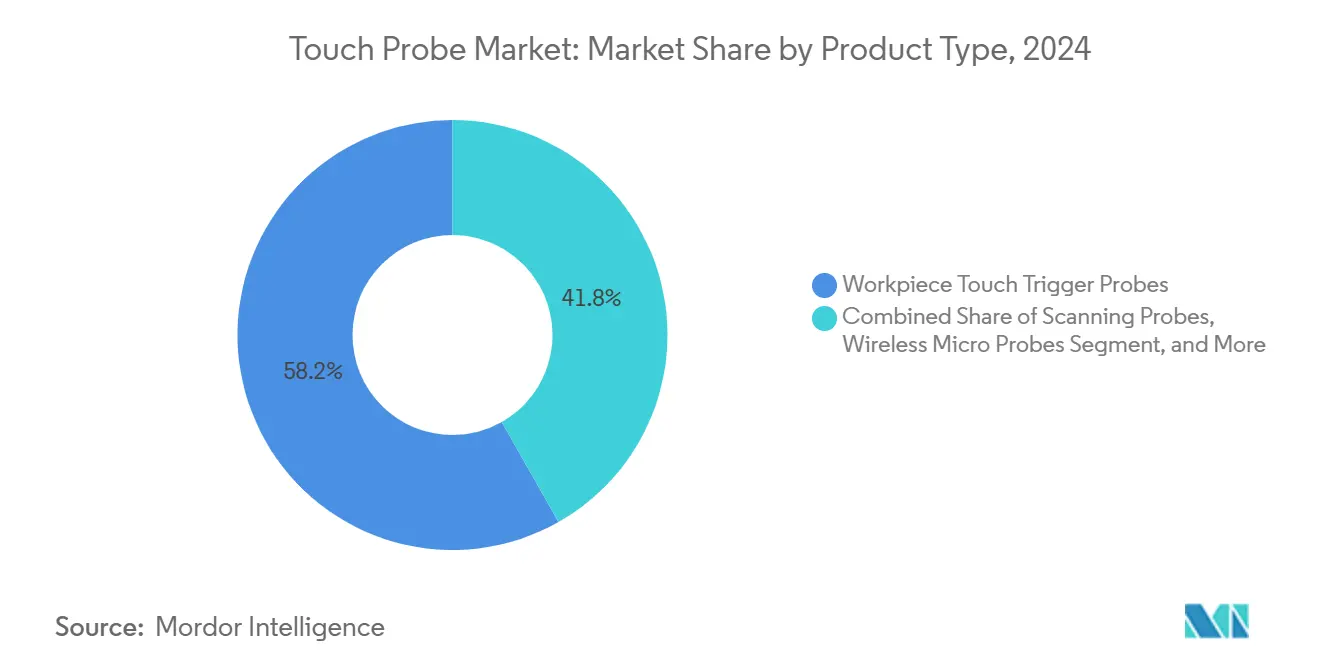
- By product type, workpiece probes captured 58.2% of the touch probe market share in 2024; wireless micro-probes are projected to record a 4.7% CAGR through 2030.
- By transmission technology, optical systems accounted for a 45.1% share of the touch probe market size in 2024, whereas hybrid optical-radio solutions are anticipated to post a 5.1% CAGR between 2025 and 2030.
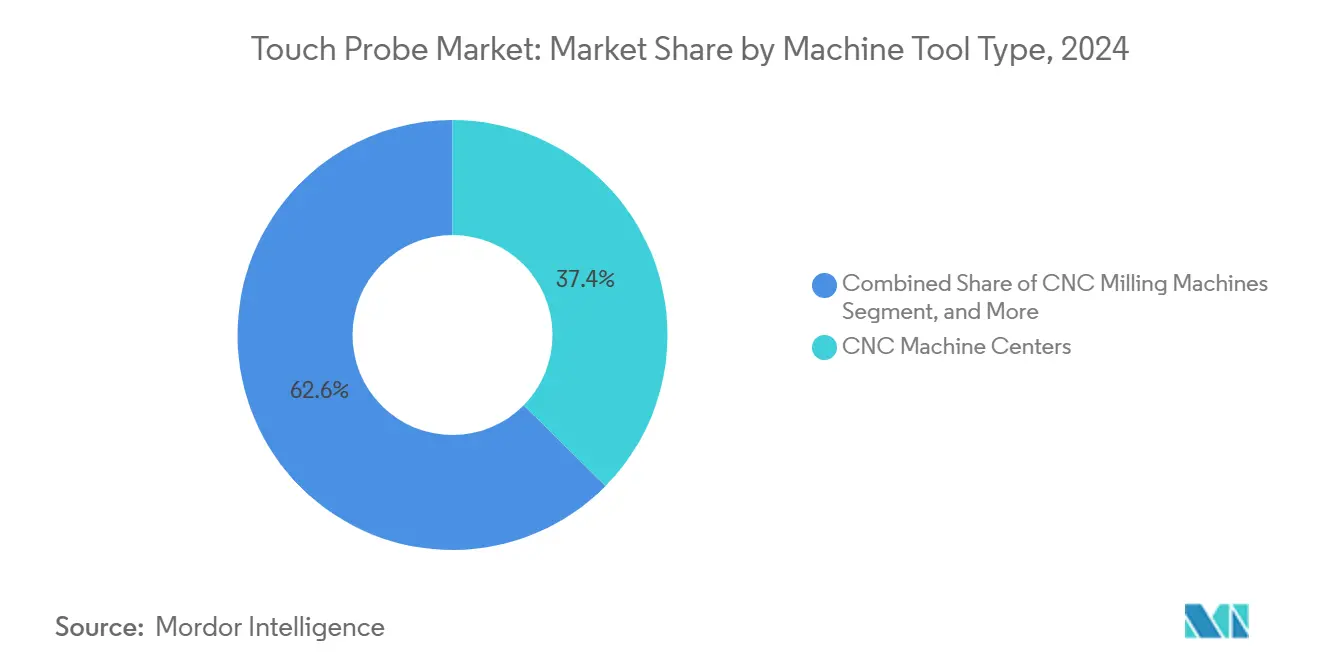
- By machine tool type, CNC machining centers held a 37.4% share of the touch probe market size in 2024, while grinding and honing machines are advancing at a 5.4% CAGR through 2030.
- By end-user industry, automotive contributed 26.1% touch probe market share in 2024; medical devices are forecast to grow at a 4.9% CAGR to 2030.
- By geography, Asia-Pacific contributed 34.10% touch probe market share in 2024; North America is forecast to grow at a 5.50% CAGR to 2030.
Note: Market size and forecast figures in this report are generated using Mordor Intelligence’s proprietary estimation framework, updated with the latest available data and insights as of January 2026.
Market Trends and Insights
Driver Imapct Analysis of Touch Probe Market*
| DRIVER | (~) % IMPACT ON CAGR FORECAST | GEOGRAPHIC RELEVANCE | IMPACT TIMELINE |
|---|---|---|---|
| Surge in 5-axis and multi-tasking CNC installations | +1.2% | Global; strongest in Asia-Pacific and North America | Medium term (2-4 years) |
| Automotive EV drivetrain precision needs | +0.9% | China, Germany, United States | Short term (≤ 2 years) |
| Tightening aerospace GD and T tolerances | +0.7% | North America and Europe; spillover to APAC | Long term (≥ 4 years) |
| Factory-floor digital twins demand in Asia-Pacific | +0.8% | Core Asia-Pacific; spillover to North America and EU | Medium term (2-4 years) |
| Growth of micro-machining for medical implants | +0.6% | Global, with concentration in United States, Germany, Switzerland | Long term (≥ 4 years) |
| Government Industry-4.0 subsidies (Germany, Japan, China) | +0.5% | Germany, Japan, China, with indirect global impact | Short term (≤ 2 years) |
| Source: Mordor Intelligence | |||
Surge in 5-axis and Multi-tasking CNC Installations
5-axis and multi-tasking CNC platforms reshuffle measurement requirements by introducing compound tool paths that standard three-axis setups cannot verify efficiently. Automated probing now closes the loop on position, orientation, and feature checks during a single unattended cycle, trimming setup time from 90 minutes to under 10 minutes.[2]Source: RENISHAW PLC, “Touch-Trigger Probes,” renishaw.com In the touch probe market, every new rotary or tilt axis raises the number of critical datums, so probe density per machine is climbing. Automotive battery-housing machining lines illustrate the payoff: integrated probes flag dimensional drift in-process, preventing downstream pack-assembly rework. Medical-implant shops also exploit simultaneous five-axis cutting with laser-calibrated probes to keep positional error below 2 microns during weekend lights-out shifts. This intersection of multi-axis machining, high-speed spindle growth, and quick-change workholding acts as a force multiplier for the touch probe market.
Automotive EV Drivetrain Precision Needs
Electric-vehicle gearboxes spin faster than their internal-combustion predecessors, so surface-finish tolerances are dropping below 0.5 micrometers. Touch probes integrated with optical gear-measurement modules now verify lead, pitch, and runout parameters within seconds, letting line controllers adjust tool offsets before chatter-induced noise emerges.[3]Source: GEAR TECHNOLOGY, “Technology Advancements in EV Inspection,” geartechnology.com Marposs’ OptoCloud EDU validates 240 stator contacts in 30 seconds, a throughput impossible with manual gauges, underscoring why the touch probe market gains traction on EV assembly lines.[4]Source: MMSONLINE, “Precision Inspection System for EV Components,” mmsonline.comBeyond gears, probes support laser-welded battery trays where stack-up error threatens pack integrity. As OEMs chase quieter cabins and higher motor efficiency, investment flows into on-machine metrology that guarantees nanometer-scale coil alignment, pushing the touch probe market deeper into drivetrain value chains.
Tightening Aerospace GD and T Tolerances
Next-generation aero-engines require turbine blades holding form within 5 micrometers across complex curvatures. Closed-door machining strategies embed probe routines in every roughing-finishing sequence, eliminating part transfers that once caused thermal distortion. Touch probes compliant with ISO 14253-1:2017 now deliver repeatability better than 1 micrometer, enabling statistical process control certificates accepted by prime contractors. Moreover, point-cloud capture from scanning probes feeds digital-twin simulators that forecast creep life and vibration damping. As engine OEMs compress lead times for fuel-efficient narrow-body programs, suppliers view robust probing capability as a prerequisite for bid eligibility, keeping the touch probe market on aerospace critical-path procurement lists.
Factory-floor Digital Twins Demand in APAC
Robot density in China surged from 97 to 392 units per 10,000 workers between 2017 and 2023, creating sensor-rich cells tuned for closed-loop analytics. Digital-twin architectures ingest gigabytes of measurement data per shift; touch probes act as authoritative geometry nodes feeding these virtual replicas. Toyota and BMW plants in the region now orchestrate adaptive machining via real-time deviation maps, letting controllers refine feeds, speeds, and tool vectors on the fly. Semiconductor fabs extend the concept, where touch-probe feedback dictates wafer-handling gripper alignment to avert die rotation error. As APAC governments continue funneling subsidies—USD 45.2 million in China and USD 440 million in Japan—into Industry 4.0, the ecosystem value of probe-generated data cements long-term pull for the touch probe market.
Restraints Impact Analysis of Touch Probe Market*
| RESTRAINTS | (~) % IMPACT ON CAGR FORECAST | GEOGRAPHIC RELEVANCE | IMPACT TIMELINE |
|---|---|---|---|
| Depressed ICE-oriented machine tool CAPEX | -0.8% | Global, with particular impact in traditional automotive regions | Short term (≤ 2 years) |
| High initial probe retro-fit costs for SMEs | -0.6% | Global; highest in developing manufacturing hubs | Medium term (2-4 years) |
| Radio-frequency compliance hurdles (U.S./EU) | -0.4% | United States and Europe, with spillover effects globally | Short term (≤ 2 years) |
| Skilled-operator shortage for on-machine metrology | -0.7% | Global; acute in North America and Europe | Long term (≥ 4 years) |
| Source: Mordor Intelligence | |||
High Initial Probe Retro-fit Costs for SMEs
Retro-fit packages for legacy VMCs can exceed USD 50,000 per spindle, representing up to 60% of overall micromachining equipment outlay for small shops. Integration often demands ladder-logic alterations, macro programming, and crash-mapping sessions that SMEs struggle to source. Capital-equipment grant schemes such as Germany’s EUR 1.75 billion (USD 2.04 billion) AI Action Plan offer relief, but compliance paperwork remains daunting. Consequently, payback horizons stretch beyond three years, prompting many job shops to delay adoption even as prime contractors tighten quality requirements. This cost-benefit hesitation tempers near-term growth momentum for the touch probe market.
Skilled-operator Shortage for On-machine Metrology
Modern probe systems require technicians versed in mechanical alignment, statistical process control, and CNC macro writing, yet academic curricula still focus on conventional machining basics. North American vacancy rates for manufacturing technologists hover near record highs, with 2.1 million positions potentially unfilled by 2030, according to NIST.[5]Source: NIST, “Research Opportunities for Advancing Measurement Science,” nist.gov Europe faces a parallel demographic squeeze as seasoned toolmakers retire. Even in automation-dense China, complex five-axis probe calibration depends on scarce metrology engineers, limiting scale-up speed. Shortfalls inflate labor costs and extend machine-commissioning timelines, posing a sustained drag on the touch probe market’s expansion curve.
*Our forecasts treat driver/restraint impacts as directional, not additive. The impact forecasts reflect baseline growth, mix effects, and variable interactions.
Touch Probe Market Segment Analysis
By Product Type:
Workpiece Probes Underpin DemandWorkpiece touch-trigger probes anchored 58.2% of touch probe market share in 2024, confirming their status as the industry’s baseline technology for automated part setup and verification. The touch probe market benefits when manufacturers slash setup time by up to 90% through programmable measurement routines that replace dial-indicator work. As multivariate dimensional tolerances shrink, scanning probes grow relevant for turbine blade and orthopedic joint geometries that require continuous path measurement. In parallel, tool-setting probes guard against catastrophic scrap by flagging cutter wear mid-cycle, proving indispensable for lights-out machining cells.
Wireless micro-probes, although a niche in volume, are racing ahead at 4.7% CAGR thanks to medical-device firms that machine titanium screws smaller than 2 millimeters in diameter. Their 10-nanometer resolution in cramped cavities expands the touch probe market size for high-value micro-machining clusters in Switzerland, Germany and Massachusetts. Styli and ruby-ball tips form an aftermarket revenue stream; specialized diamonds verify thin-film electrode slots without scratching surfaces, underscoring consumables’ strategic importance.



By Transmission Technology:
Optical Leadership and Hybrid MomentumOptical communication owns 45.1% of the touch probe market size, prized for immunity to coolant splash and metallic chip interference. Systems such as Renishaw’s OLP40 retain 1 micrometer repeatability even under high-pressure flush, explaining widespread uptake in automotive block machining lines. Hard-wired probes still dominate mold-making, where absolute signal integrity trumps flexibility, yet cable routing constrains five-axis head articulation.
Hybrid optical-radio platforms address blind-spot issues on multi-spindle machines, marrying the reliability of infrared with the reach of 2.4 GHz backup links. Projected 5.1% CAGR for hybrids reflects risk-averse aerospace contractors willing to pay a premium for communication redundancy that avoids scrapping USD 20,000 titanium forgings. This redundancy emphasis increases average selling price and lifts revenue contribution within the touch probe market.
By Machine Tool Type:
Grinding Machines Accelerate PrecisionCNC machining centers commanded a 37.4% share of the touch probe market size in 2024; their integrated probing macros long ago moved from an optional accessory to a default specification. Turning centers and mill-turns extend the logic, letting shops inspect internal diameters and axial run-out without pulling parts off chucks, thereby safeguarding concentricity in high-speed EV rotor shafts.
Grinding and honing machines, however, deliver the highest growth at 5.4% CAGR as OEMs chase sub-0.1 micrometer Ra values. Touch probes mounted on hydrostatic slides feed back wheel-wear data that adaptive control loops convert into real-time dwell adjustments, eliminating spark-out guesswork. Aerospace turbine disk grinding further fuels adoption; one mis-ground fir-tree slot condemns an entire USD 80,000 blank, so on-machine verification is non-negotiable.
By End-user Industry:
Medical Devices Expand RapidlyAutomotive retained 26.1% touch probe market share in 2024, anchored by powertrain machining cells that require every housing bore, dowel pocket, and gear alignment to fall within single-digit micron windows for NVH optimization. As EV content rises, stator lamination stacks and e-axle casings add new probe checkpoints, keeping vehicle OEMs the largest revenue pool for the touch probe market.
Medical devices, advancing at a 4.9% CAGR, illustrate future upside. Hip stems and cranial plates must match patient-specific CT scans, so probe-verified milling paths ensure conformity while documenting ISO 13485:2016 compliance. Additive-subtractive hybrid machines producing trabecular implant surfaces now pair laser sintering with contact probes to certify critical sealing planes post-milling. This regulatory-driven rigor enhances stickiness for probe suppliers, lengthening service contracts and software-upgrade lifecycles inside the touch probe market.
Geography Analysis
APAC Touch Probe Market
Asia-Pacific dominated with a 34.1% share of the touch probe market in 2024, underpinned by dense machine-tool installations and government funding. China’s 14th Five-Year Plan earmarked USD 45.2 million for robotics R&D, directly subsidizing integrated metrology add-ons. Japan’s USD 440 million New Robot Strategy mirrors this commitment, while Korean chip-fabrication clusters demand micro-probe architectures that operate inside vacuum-load locks. Coupled with workforce shortages, these policies accelerate the adoption of software-guided probes that minimize operator intervention, elevating Asia-Pacific’s role as both a manufacturing hub and a test-bed for emerging touch-probe functionalities.
Europe Touch Probe Market
Europe remains a technology leader with Germany’s EUR 369.2 million (USD 430.97 million) High-Tech Strategy 2025 and the EU’s USD 100 billion Horizon Europe initiative channeling resources into digital manufacturing. Aerospace primes require audited gauge R&R studies before approving suppliers, so Italian turbine shops and French airframe machining houses integrate multi-sensor probes to meet PPAP documentation rules. Brexit-related customs friction nudges U.K. subcontractors toward on-machine inspection to avoid cross-border CMM delays, sustaining steady demand despite currency volatility.
North America Touch Probe Market
North America registers the quickest climb at 5.5% CAGR to 2030. Reshoring created more than 480,000 factory jobs across 2022-2023, lifting machine-tool shipments and retrofit programs. Semiconductor fabs backed by the CHIPS Act trigger procurement of hybrid probe systems for front-end equipment alignment. Hexagon’s partnership with Elliott Matsuura doubles regional service coverage, reducing downtime risk for Canadian users and reinforcing confidence in probe deployment. Persistent labor shortages, however, pressure integrators to bundle turnkey probe training into machine purchases.

Competitive Landscape
The touch probe market exhibits moderate concentration. Renishaw, Hexagon, ZEISS, Marposs, and Blum-Novotest comprise a top-tier cohort that couples hardware, software, and global after-sales service. Renishaw’s long-range optical-radio RP3 system broadens transmission resilience, reinforcing its installed-base moat. Hexagon’s AI-enabled ProPlanAI reduces CAM programming labor by 75%, marrying probe data with cloud analytics to shrink time-to-production. ZEISS CONNECTED QUALITY centralizes metrology datasets across factories, locking customers into the vendor’s ecosystem with subscription analytics.
Second-tier suppliers like Heidenhain and DR. JOHANNES HEIDENHAIN GmbH differentiate through ultra-rigid probe bodies that tolerate high-acceleration collision events, carving space in mold-and-die fields where crash protection counts. Micro-probe specialists chase medical implants and semiconductor sockets, but limited distribution networks hamper scale. M&A appetite is rising as established players look to acquire wireless-chipset IP that eases FCC and CE certification burdens. Over the forecast horizon, competition pivots on delivering data-rich workflows rather than standalone styli, pushing firms to expand API libraries that feed MES and ERP suites.
Touch Probe Industry Leaders
Renishaw plc
Hexagon AB (MI)
Blum-Novotest GmbH
Marposs S.p.A.
Heidenhain GmbH
- *Disclaimer: Major Players sorted in no particular order
Touch Probe Market Companies Covered in this Report
- Renishaw plc
- Hexagon AB (Manufacturing Intelligence Div.)
- Blum-Novotest GmbH
- Marposs S.p.A.
- Heidenhain GmbH
- Carl Zeiss Industrial Metrology LLC
- Mitutoyo Corp.
- FARO Technologies Inc.
- Nikon Metrology NV
- Siemens Digital Industries Software
- Dr. Johannes Heidenhain GmbH
- Etalon AG
- GOM Metrology GmbH
- API Services Inc.
- Lion Precision Inc.
- Koma Precision Inc. (Elbo Controlli)
- POKOLM Frästechnik GmbH
- Harbin Measuring and Cutting Tool Group Co.
- JCY Precision Hardware Co.
- Steinbichler Optotechnik GmbH
- Measurement Solutions Ltd.
- Unisensor Sensorsysteme GmbH
- Metrol Co., Ltd.
- Status Metrology Solutions
- Ideal Measurement Systems Ltd.
- API Metrology Asia

Recent Industry Developments in Touch Probe Market
- December 2024: Hexagon Manufacturing Intelligence forged a reseller and service alliance with Elliott Matsuura Canada, doubling local support coverage in Ontario, Quebec, Alberta and British Columbia.
- November 2024: Hexagon debuted ProPlanAI, an Azure-enabled automation suite claimed to cut machine-tool programming hours by 75%, available commercially in Q1 2025.
- June 2024: Renishaw updated technical documentation across its touch-trigger and scanning probe lines, highlighting crash-protection upgrades.
- May 2024: Takumi integrated Renishaw’s Set and Inspect app on FANUC controls, streamlining probe-cycle generation for job-shop users.


Global Touch Probe Market Report Scope
| Workpiece Touch-Trigger Probes |
| Tool-Setting Probes |
| Scanning Probes |
| Wireless Micro-Probes |
| Styli and Accessories |
| Optical |
| Radio |
| Hard-Wired |
| Hybrid (Optical + Radio) |
| CNC Machining Centers |
| CNC Milling Machines |
| CNC Lathes and Turning Centers |
| Grinding and Honing Machines |
| Other Machine Tool Type (EDM, Additive Hybrid) |
| Automotive |
| Aerospace and Defense |
| Electronics and Semiconductor |
| Medical Devices |
| General Engineering and Other |
| North America | United States | |
| Canada | ||
| Mexico | ||
| South America | Brazil | |
| Argentina | ||
| Rest of South America | ||
| Europe | Germany | |
| United Kingdom | ||
| France | ||
| Russia | ||
| Rest of Europe | ||
| Asia-Pacific | China | |
| Japan | ||
| India | ||
| South Korea | ||
| Rest of Asia-Pacific | ||
| Middle East and Africa | Middle East | Saudi Arabia |
| United Arab Emirates | ||
| Rest of Middle East | ||
| Africa | South Africa | |
| Egypt | ||
| Rest of Africa | ||
| By Product Type | Workpiece Touch-Trigger Probes | ||
| Tool-Setting Probes | |||
| Scanning Probes | |||
| Wireless Micro-Probes | |||
| Styli and Accessories | |||
| By Transmission Technology | Optical | ||
| Radio | |||
| Hard-Wired | |||
| Hybrid (Optical + Radio) | |||
| By Machine Tool Type | CNC Machining Centers | ||
| CNC Milling Machines | |||
| CNC Lathes and Turning Centers | |||
| Grinding and Honing Machines | |||
| Other Machine Tool Type (EDM, Additive Hybrid) | |||
| By End-user Industry | Automotive | ||
| Aerospace and Defense | |||
| Electronics and Semiconductor | |||
| Medical Devices | |||
| General Engineering and Other | |||
| By Geography | North America | United States | |
| Canada | |||
| Mexico | |||
| South America | Brazil | ||
| Argentina | |||
| Rest of South America | |||
| Europe | Germany | ||
| United Kingdom | |||
| France | |||
| Russia | |||
| Rest of Europe | |||
| Asia-Pacific | China | ||
| Japan | |||
| India | |||
| South Korea | |||
| Rest of Asia-Pacific | |||
| Middle East and Africa | Middle East | Saudi Arabia | |
| United Arab Emirates | |||
| Rest of Middle East | |||
| Africa | South Africa | ||
| Egypt | |||
| Rest of Africa | |||


Key Questions Answered in the Report
What is the projected value of the touch probe market by 2030?
The touch probe market size is forecast to reach USD 865.4 million by 2030.
Which region is expected to grow fastest in touch-probe adoption?
North America is set to post a 5.5% CAGR through 2030, driven by reshoring and semiconductor investments.
Why are wireless micro-probes gaining attention?
Wireless micro-probes achieve sub-10 nanometer resolution in confined features, making them ideal for medical-implant and semiconductor inspection.
How do digital twins influence probe demand?
Digital-twin platforms rely on real-time measurement data from touch probes to adjust machining parameters and predict quality outcomes.
Page last updated on:


 Your data is secure and never sold or shared.


