
Time Tracking Software Market Size and Share
Market Overview
| Study Period | 2019 - 2030 |
|---|---|
| Market Size (2025) | USD 6.10 Billion |
| Market Size (2030) | USD 11.43 Billion |
| Growth Rate (2025 - 2030) | 13.38 % |
| Fastest Growing Market | Asia Pacific |
| Largest Market | North America |
| Market Concentration | Medium |
Major Players *Disclaimer: Major Players sorted in no particular order Image © Mordor Intelligence. Reuse requires attribution under CC BY 4.0. | |
Time Tracking Software Market Analysis by Mordor Intelligence
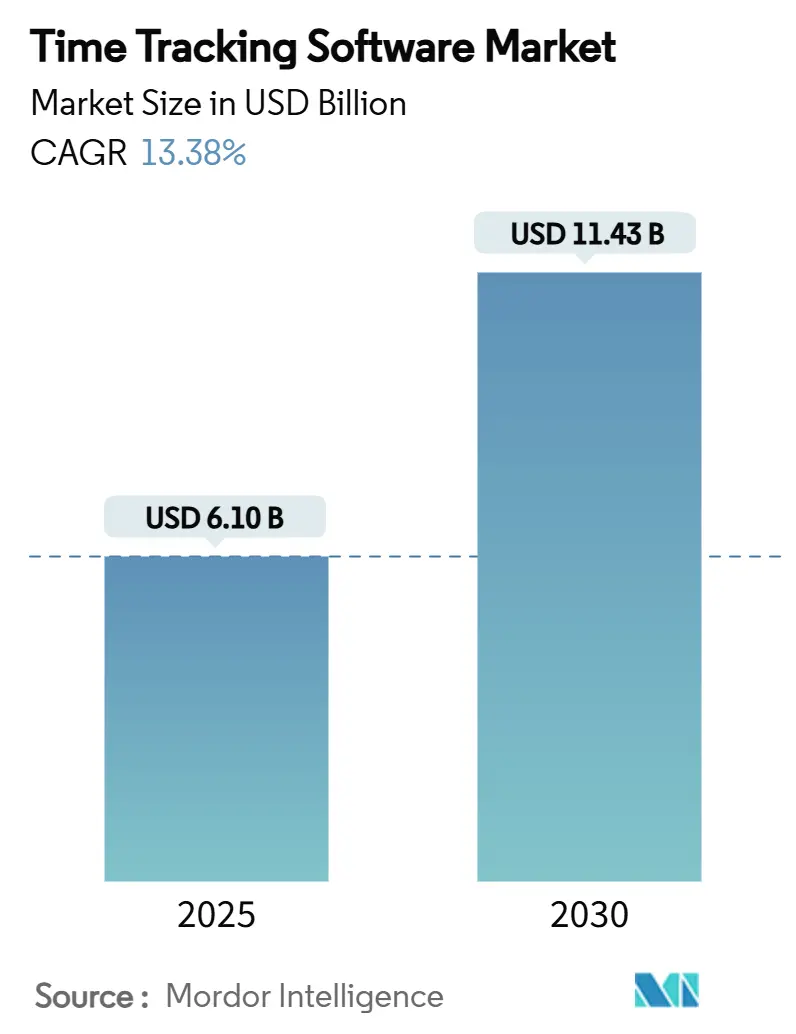
The time tracking software market size stood at USD 6.1 billion in 2025 and is forecast to reach USD 11.43 billion by 2030, reflecting a 13.38% CAGR over the period. This expansion rides on rapidly growing remote-and-hybrid workforces, the need for airtight compliance reporting, and continuous upgrades in SaaS-based HR technology. Cloud deployment retains a commanding 77.8% market share, while hybrid models, which blend on-premise control with cloud scalability, post the fastest 16.2% CAGR. SMEs account for 62.8% of global revenues and also register the highest 12.5% CAGR, signaling that the time tracking software market is no longer the preserve of large enterprises. Sector uptake is broadening: IT and telecom leads adoption at 28.3% share, but healthcare grows quickest at 15.1% CAGR as audit-ready staff scheduling becomes a clinical necessity. Across regions, North America contributes 43.8% of global revenues, yet Asia-Pacific is the fastest climber, lifted by digital factory programs and professional-services outsourcing.
Key Report Takeaways
- By deployment mode, cloud solutions commanded 77.8% of total time tracking software market share in 2024, while hybrid systems are forecast to advance at 16.2% CAGR through 2030.
- By organization size, SMEs accounted for 62.8% of the time tracking software market size in 2024 and are expanding at a 12.5% CAGR over the same horizon.
- By end-user industry, IT and telecom held 28.3% revenue share in 2024; healthcare is projected to post the highest 15.1% CAGR to 2030.
- By platform, Web / Browser Extension held 48.2% revenue shares in 2024, while Mobile (Android / iOS) is projected to expand at a rate of 14.8% to 2030.
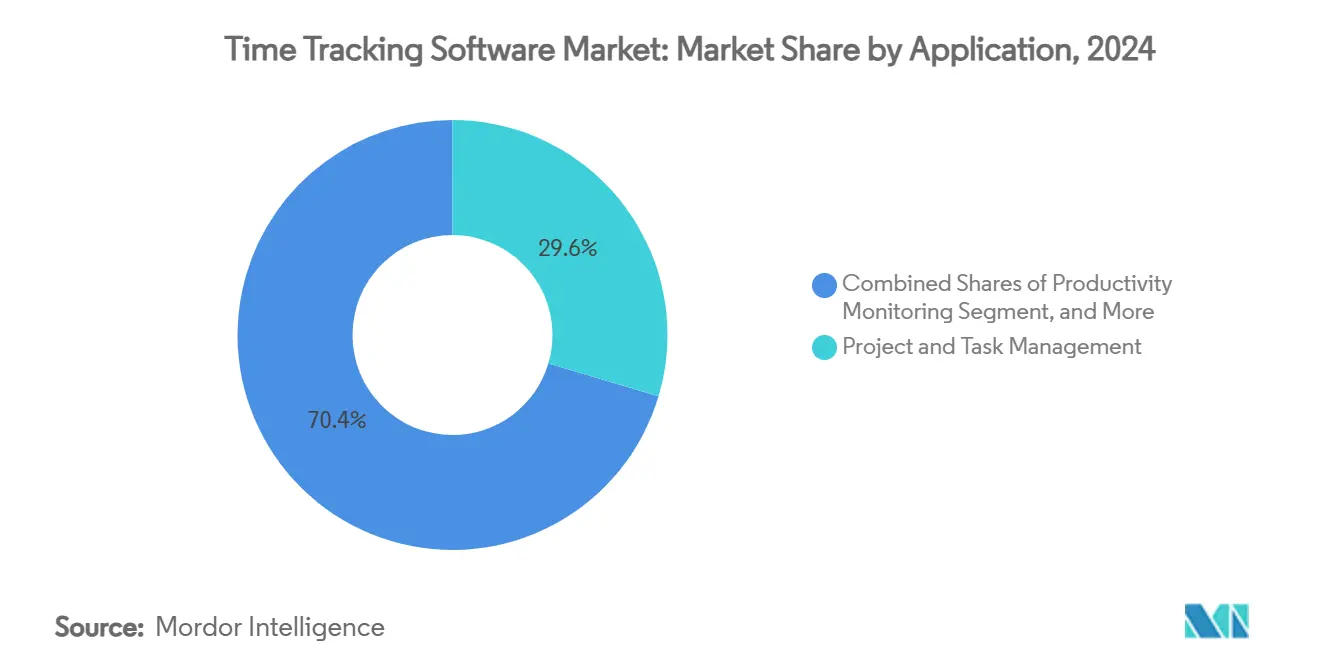
- By application, Project & Task Management held 29.6% revenue shares in 2024, while Field-Service Tracking is expected to expand at a rate of 16.4% CAGR to 2030.
- By pricing model, Subscription (Per-User) held 54.7% revenue shares in 2024, while the Pay-As-You-Go is forecasted to expand at a rate of 14% CAGR to 2030.
- By geography, North America captured 43.8% of the global time tracking software market size in 2024, but Asia-Pacific is projected to lead growth.
Global Time Tracking Software Market Trends and Insights
Drivers Impact Analysis*
| Driver | (~) % Impact on CAGR Forecast | Geographic Relevance | Impact Timeline |
|---|---|---|---|
| Remote and hybrid workforce proliferation | +3.20% | Global, led by North America & Europe | Short term (≤ 2 years) |
| Stricter labor-law and overtime compliance | +2.80% | Europe & North America, expanding into APAC | Medium term (2-4 years) |
| Adoption of SaaS-centric HR stacks | +2.10% | Global, with North American lead | Medium term (2-4 years) |
| Deep payroll / project-management integration | +1.90% | North America & Europe, emerging in APAC | Long term (≥ 4 years) |
| AI-powered burnout-prevention analytics | +1.70% | North America & Europe | Long term (≥ 4 years) |
| Micro-billing accuracy for gig work | +1.50% | Urban centers worldwide | Short term (≤ 2 years) |
| Source: Mordor Intelligence | |||
Proliferation of Remote and Hybrid Workforces
A permanent tilt toward hybrid offices forces companies to capture hours independently of physical location. Employers now favor mobile apps with GPS stamping and biometric log-ins that block proxy clock-ins. The shift has been strongest in professional services and software engineering, where value hinges on deliverables rather than desk presence[1]Computerworld Reporters, “How AI-enabled ‘Bossware’ Is Being Used to Track and Evaluate Your Work,” Computerworld, Mar 13 2025, computerworld.com. User experience dictates adoption-vendors that minimize manual input through single-tap mobile interfaces are winning scalability deals.
Growing Compliance Requirements for Labor-Law and Overtime Reporting
Regulators demand timestamp accuracy, evidenced by the European Court of Justice’s 2019 mandate and Germany’s fines of up to EUR 30,000 (USD 32,000) for faulty records[2]Calamari Team, “Time Tracking in European Labor Laws,” Calamari, Jul 13 2023, calamari.io. U.S. employers likewise deploy geofenced apps to satisfy Fair Labor Standards Act audits. Automated rule engines now calculate complex overtime bands, cutting payroll teams’ administrative hours and shielding firms from penalties.
Rising Adoption of SaaS-Based HR Stacks
Large employers are retiring point solutions in favor of unified, cloud-hosted suites, replacing 90% of legacy HR systems within four years, according to CIO surveys[3]CIO Staff, “Why SaaS HR Software Is Ready to Take Off,” CIO, Feb 6 2023, cio.com. Integrated time modules feed live data into talent analytics, giving CFOs real-time labor-cost visibility. Subscription models convert CapEx to OpEx, easing budget approval cycles even as overall IT spend flattens.
AI-Driven Insights for Proactive Burnout Prevention
Machine learning modules surface anomalies like excessive overtime or meeting overload, prompting managers to redistribute workloads before attrition risks spike. Early adopters in software development report measurable declines in unplanned absences after layering sentiment analytics onto timesheet patterns[4]Tempo Software, “Revolutionizing Time-Tracking with AI-Powered Timesheets,” Tempo, Jul 19 2024, tempo.io.
Restraints Impact Analysis*
| Restraint | (~) % Impact on CAGR Forecast | Geographic Relevance | Impact Timeline |
|---|---|---|---|
| Employee privacy backlash against monitoring | -1.8% | Europe & North America, growing in APAC | Short term (≤ 2 years) |
| Data-security and sovereignty risks | -1.2% | Global, acute in regulated verticals | Medium term (2-4 years) |
| AI mis-capture and hallucination errors | -0.9% | Global, in highly automated deployments | Medium term (2-4 years) |
| SaaS-subscription fatigue | -0.7% | North America & Europe | Long term (≥ 4 years) |
| Source: Mordor Intelligence | |||
Employee Privacy Concerns and Monitoring Backlash
“Bossware” that screenshots or logs keystrokes faces pushback from unions and knowledge workers. GDPR’s data-minimization rule requires firms to track only what is proportionate, compelling vendors to add granular permission settings and opt-in flows[5]WorkTime Product Team, “WorkTime Is GDPR Compliant,” WorkTime, Dec 1 2020, worktime.com. Companies that balance transparency with oversight keep engagement scores higher and reduce turnover risk.
Data-Security / Sovereignty Risks in Multi-Tenant Cloud
Highly regulated industries, including healthcare and government contractors, often store sensitive records on local servers to satisfy sovereignty laws. Hybrid-cloud architectures are therefore rising as a compromise, but encryption at rest and full audit trails remain vendor selection prerequisites[6]SAP SE, “What Is Employee Time Tracking?,” SAP, Jun 22 2025, sap.com.
*Our forecasts treat driver/restraint impacts as directional, not additive. The impact forecasts reflect baseline growth, mix effects, and variable interactions.
Segment Analysis
By Deployment Mode: Cloud Dominance Accelerates Hybrid Innovation
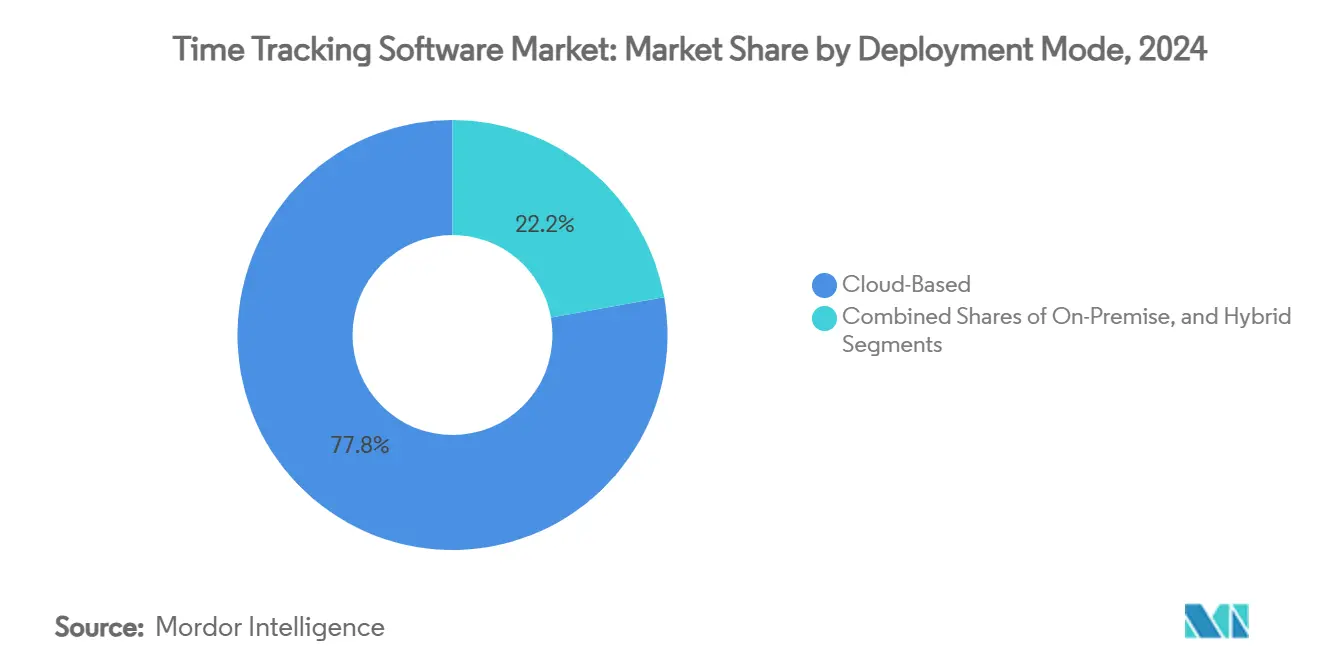
Cloud products generated 77.8% of the total 2024 revenues. Their near-zero infrastructure footprint, constant updates, and any-device access are decisive for global project teams. Hybrid configurations, however, are scaling fastest at 16.2% CAGR as banks and hospitals split sensitive personally identifiable information onto private servers while pushing mobile functionality into the public cloud. This architecture lets IT maintain encryption keys on-premise yet benefit from elastic compute in the cloud—a trade-off that resonates with chief information-security officers. Within this context, the time tracking software market size attributable to hybrid deployments is projected to more than double by 2030.



By Organization Size: SMEs Drive Market Democratization
SMEs controlled 62.8% of 2024 billings and will expand at a 12.5% CAGR. Freemium lanes from Clockify and Jibble shorten adoption cycles and help mid-market firms avoid upfront license fees[7]Jibble Marketing, “Home,” Jibble, Feb 6 2023, jibble.io. Meanwhile, large enterprises, though slower growing, continue to secure multi-year, seven-figure contracts requiring deep ERP integration and SSO. Because implementation complexity is declining, the time tracking software market share of SMEs is likely to widen further as micro-businesses add usage-based plans.
By End-User Industry: Healthcare Emerges as Growth Leader
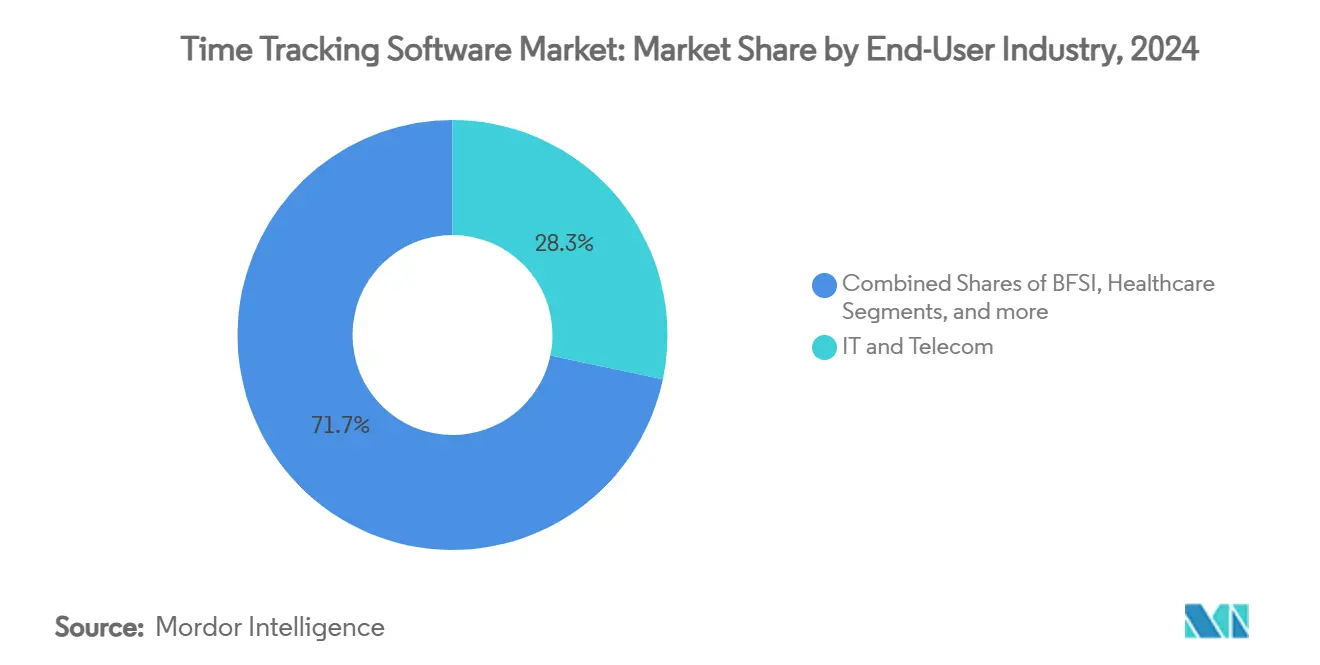
IT and telecom remain the single largest slice at 28.3%, driven by resource-billing accuracy for agile sprints. Healthcare’s 15.1% CAGR stems from shift-pattern complexity, mandated audit trails, and the need to tie labor directly to patient-care KPIs[8]ClockShark Team, “GPS Time Clock for Field Workers,” ClockShark, Jan 6 2025, clockshark.com. Construction continues to digitize field crews via GPS punch-ins, replacing paper cards and reducing over-reported hours. Professional services maintain steady uptake for client billing, while manufacturing uses real-time dashboards to benchmark labor efficiency across assembly lines.
By Platform: Mobile Acceleration Reflects Field-Service Growth
Web/browser extension retains 48.2% revenue share, but mobile apps chart the fastest 14.8% CAGR, fueled by site-based industries. ExakTime alone logs more than 1 million GPS clock-ins daily, underscoring the demand for smartphone ergonomics[9]ExakTime Resources, “Demo the #1 GPS Time & Attendance Tracking Solution,” ExakTime, Jan 1 2024, exaktime.com. Desktop clients persist in engineering and creative studios where deep offline editing and granular task tagging matter, yet are gradually folding into cross-platform subscriptions.
By Application: Field-Service Tracking Disrupts Traditional Models
Project & Task Management still leads at 29.6%, but field-service tracking skyrockets at 16.4% CAGR as home-health aides, delivery fleets, and maintenance crews abandon manual sheets for location-verified mobile apps. Payroll and billing integrations remain mission-critical in professional services because even fractional mis-capture cascades into revenue leakage. Compliance modules see accelerating healthcare and construction take-up as regulators intensify safety logs.
By Pricing Model: Pay-As-You-Go Gains Gig-Economy Traction
Subscription (Per-User) comprises 54.7% of the market, offering predictable cost and vendor cash flow. Pay-as-you-go, however, is leaping 14.0% CAGR by mirroring variable gig workflows. Firms with seasonally oscillating headcounts can thus sidestep under-utilized seat licenses. Freemium stays vital for brand awareness, and perpetual licenses keep shrinking as CIOs refuse to host cumbersome on-premise upgrades.
Geography Analysis
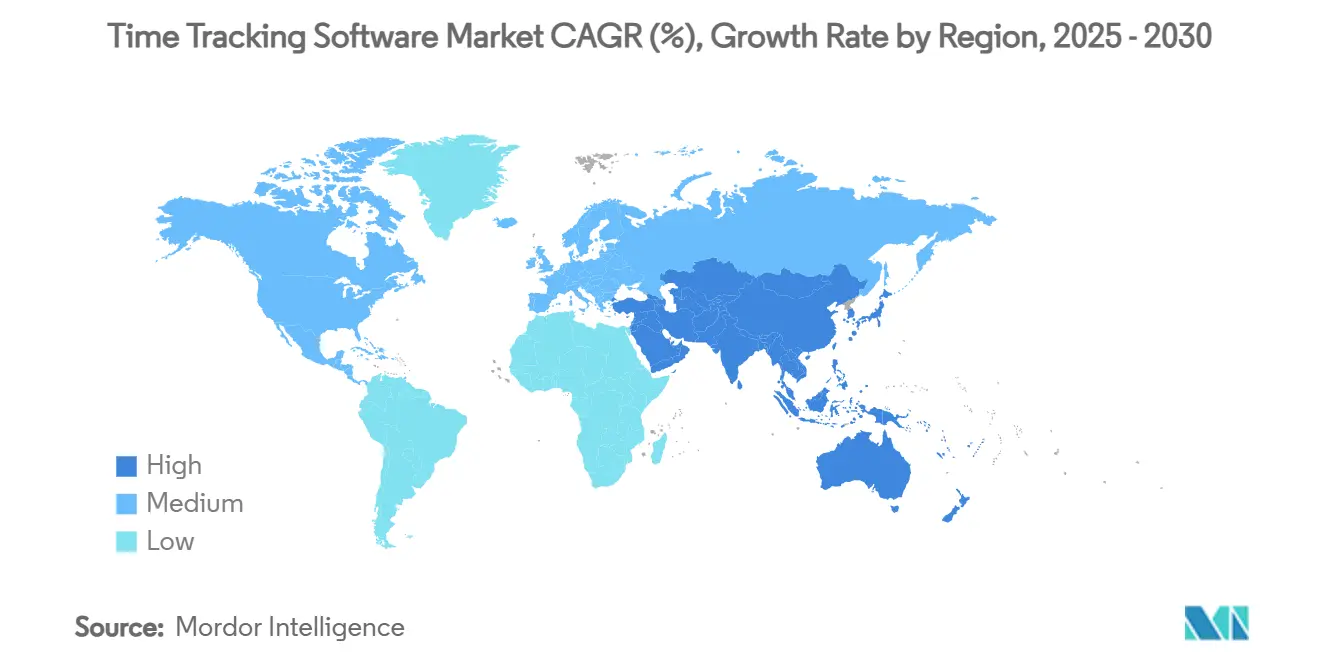
North America delivered 43.8% of 2024 revenue and remains the benchmark for new feature adoption, thanks to strict wage-and-hour laws and early SaaS penetration. U.S. developers report up to 50% less time spent recording hours after deploying AI pre-filled timesheets[10]Tempo Software, “Revolutionizing Time-Tracking with AI-Powered Timesheets,” Tempo, Jul 19 2024, tempo.io. Canada’s consulting firms prioritize DCAA compliance, while Mexico’s maquiladoras turn to mobile geo-fencing to verify shift changes.
Europe continues steady expansion on the back of statutory time-recording directives. In Germany and Spain, substantial non-compliance fines triggered rapid vendor uptake, forcing even legacy manufacturers to digitize punch cards[11]TrackingTime Editorial, “Time Tracking and Legal Compliance: What You Need to Know,” TrackingTime, Dec 20 2024, trackingtime.co. GDPR’s privacy ceilings have spurred vendors to introduce anonymized analytics and stringent access controls, features that later trickle into North American releases.
Asia-Pacific is the fastest riser. Japan’s KING OF TIME counts 3.9 million active users across 62,000 firms, a testament to SMEs’ willingness to cloud-source HR functions[12]Human Technologies, “KING OF TIME Ranks in Best Software Japan 2025,” PR Times, Jun 17 2025, prtimes.jp. China’s industrial clusters integrate time capture into MES dashboards to monitor labor ROI, while India’s IT outsourcers use granular activity tags for transparent client invoices. Australia and South Korea show mounting field-services demand as tight construction schedules raise cost-of-delay penalties.

Competitive Landscape
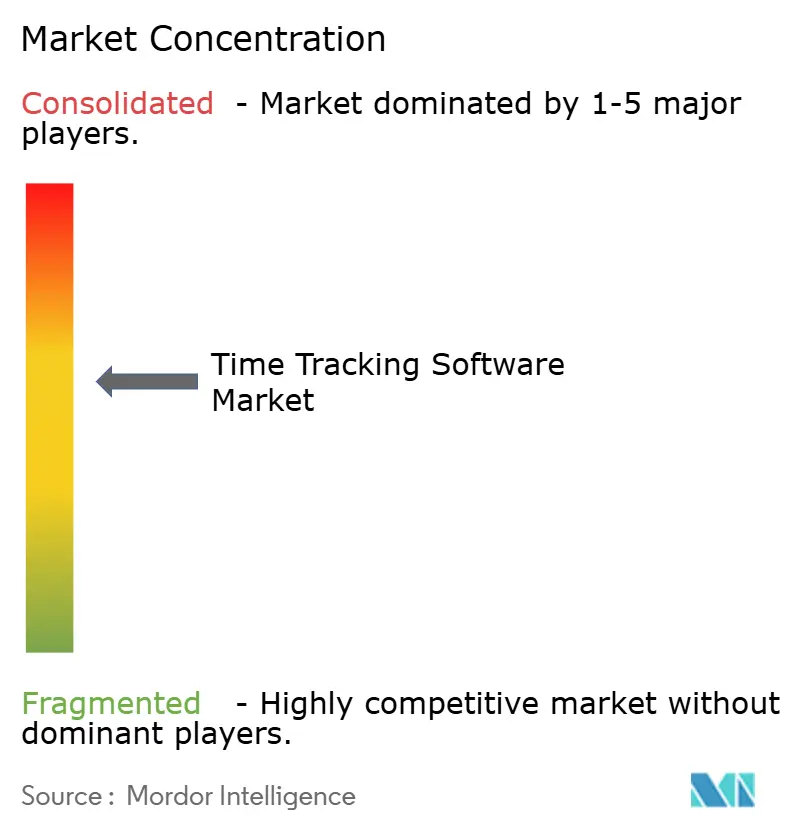
Competition is moderate, with the top five players holding a combined 48% share. Toggl leads at 17%, closely tailed by Velocity and Timesheets, leaving ample headroom for niche disruptors. Larger vendors differentiate via AI-assisted autofill, privacy-first monitoring, and pre-built connectors to ERP, CRM, and BI stacks.
Consolidation is accelerating. Deltek’s acquisition of Replicon folds mature time intelligence into its GovCon project suite, while Visma’s TimeChimp deal strengthens its Nordic professional-services footprint. Private-equity-backed Appfire brought 7pace Timetracker into the Atlassian marketplace, embedding time capture within DevOps pipelines. Emerging players such as Laurel, which secured USD 153 million to automate legal timesheets, focus on sector-specific pain points and promise hands-free capture to cut revenue leakage.
Vendors now push predictive analytics that flag burnout signals or margin slippage, shifting the conversation from historic reporting to forward-looking workforce optimization. Those pairing mobile simplification with ironclad compliance appear best positioned to steal share as the time tracking software market continues to scale globally.
Time Tracking Software Industry Leaders
CAKE.com Inc. (Clockify)
Toggl OÜ
Hubstaff Inc.
Iridion LLC (Harvest)
Replicon Inc.
- *Disclaimer: Major Players sorted in no particular order

Recent Industry Developments
- July 2025: Tempo Software launched AI-powered timesheets that fill entries automatically, halving manual effort. The move deepens stickiness among Jira-centric teams and upsell potential into resource-planning modules.
- June 2025: Laurel raised USD 100 million Series C to refine its legal-sector machine-learning engine, signaling investor appetite for verticalized, automation-first models.
- January 2025: Appfire added 7pace Timetracker to Atlassian Marketplace, embedding time capture into DevOps workflows and widening cross-sell pathways within Atlassian’s 300,000-plus customer base.
- December 2024: Visma acquired TimeChimp, bolstering its European SMB position and integrating project-billing capabilities into its ERP stack.


Global Time Tracking Software Market Report Scope
| Cloud-Based |
| On-Premise |
| Hybrid |
| Small and Medium Enterprises (SMEs) |
| Large Enterprises |
| IT and Telecom |
| BFSI |
| Retail and E-Commerce |
| Healthcare |
| Construction and Field Services |
| Professional Services |
| Manufacturing |
| Desktop |
| Web / Browser Extension |
| Mobile (Android / iOS) |
| Multi-Platform Integrated |
| Project and Task Management |
| Payroll and Billing |
| Productivity Monitoring |
| Compliance and Audit |
| Field-Service Tracking |
| Freemium |
| Subscription (Per-User) |
| Pay-As-You-Go |
| Perpetual License |
| North America | United States | |
| Canada | ||
| Mexico | ||
| South America | Brazil | |
| Argentina | ||
| Colombia | ||
| Rest of South America | ||
| Europe | United Kingdom | |
| Germany | ||
| France | ||
| Italy | ||
| Spain | ||
| Russia | ||
| Rest of Europe | ||
| Asia-Pacific | China | |
| Japan | ||
| South Korea | ||
| India | ||
| Australia | ||
| Rest of Asia-Pacific | ||
| Middle East and Africa | Middle East | Saudi Arabia |
| United Arab Emirates | ||
| Rest of Middle East | ||
| Africa | South Africa | |
| Egypt | ||
| Rest of Africa | ||
| By Deployment Mode | Cloud-Based | ||
| On-Premise | |||
| Hybrid | |||
| By Organization Size | Small and Medium Enterprises (SMEs) | ||
| Large Enterprises | |||
| By End-user Industry | IT and Telecom | ||
| BFSI | |||
| Retail and E-Commerce | |||
| Healthcare | |||
| Construction and Field Services | |||
| Professional Services | |||
| Manufacturing | |||
| By Platform | Desktop | ||
| Web / Browser Extension | |||
| Mobile (Android / iOS) | |||
| Multi-Platform Integrated | |||
| By Application | Project and Task Management | ||
| Payroll and Billing | |||
| Productivity Monitoring | |||
| Compliance and Audit | |||
| Field-Service Tracking | |||
| By Pricing Model | Freemium | ||
| Subscription (Per-User) | |||
| Pay-As-You-Go | |||
| Perpetual License | |||
| By Geography | North America | United States | |
| Canada | |||
| Mexico | |||
| South America | Brazil | ||
| Argentina | |||
| Colombia | |||
| Rest of South America | |||
| Europe | United Kingdom | ||
| Germany | |||
| France | |||
| Italy | |||
| Spain | |||
| Russia | |||
| Rest of Europe | |||
| Asia-Pacific | China | ||
| Japan | |||
| South Korea | |||
| India | |||
| Australia | |||
| Rest of Asia-Pacific | |||
| Middle East and Africa | Middle East | Saudi Arabia | |
| United Arab Emirates | |||
| Rest of Middle East | |||
| Africa | South Africa | ||
| Egypt | |||
| Rest of Africa | |||


Key Questions Answered in the Report
What is the current value of the time tracking software market?
The global time tracking software market size reached USD 6.1 billion in 2025 and is projected to rise to USD 11.43 billion by 2030.
Which deployment model is growing fastest?
Hybrid deployments are expanding at a 16.2% CAGR as firms blend on-premise security with cloud mobility.
Why is healthcare adoption accelerating?
Hospitals require audit-ready logs and sophisticated shift scheduling, driving a 15.1% CAGR for healthcare users.
How concentrated is vendor competition?
The top five suppliers hold about 48% of global revenue, giving the market a moderate concentration score of 6.
What pricing models are resonating with gig-economy employers?
Pay-as-you-go plans are seeing 14.0% CAGR because they align costs with fluctuating contractor hours.
Page last updated on:





