
Time And Attendance Software Market Size and Share
Market Overview
| Study Period | 2020 - 2031 |
|---|---|
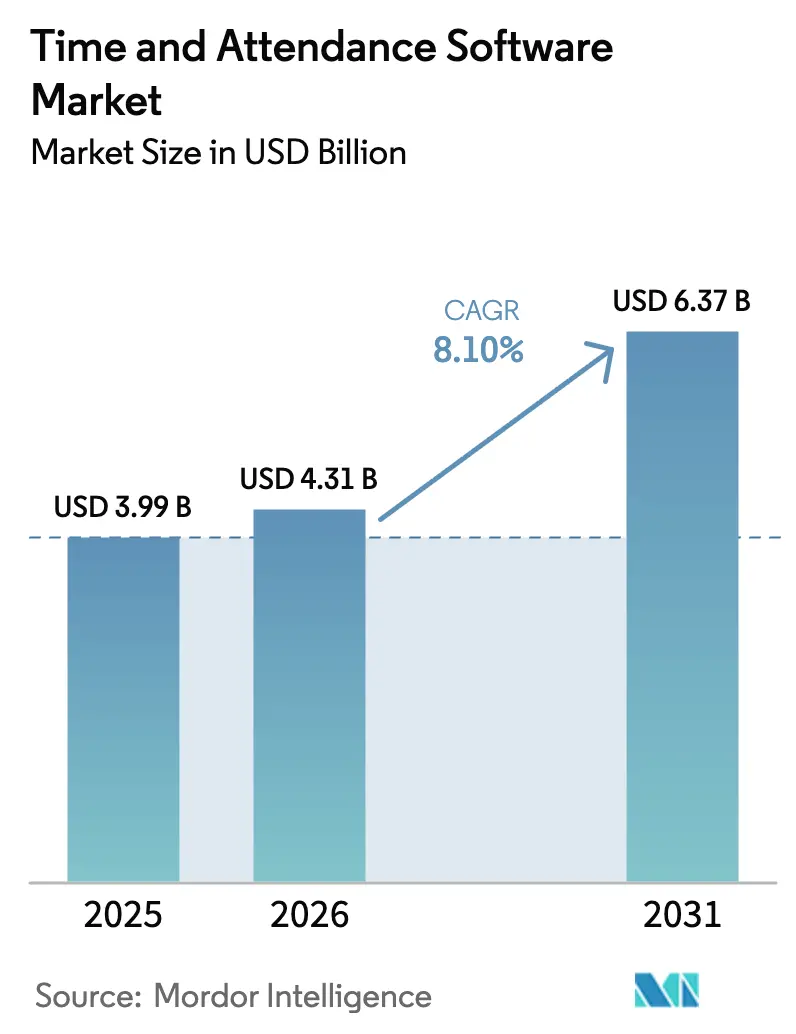
| Market Size (2026) | USD 4.31 Billion |
| Market Size (2031) | USD 6.37 Billion |
| Growth Rate (2026 - 2031) | 8.10 % |
| Fastest Growing Market | Asia-Pacific |
| Largest Market | North America |
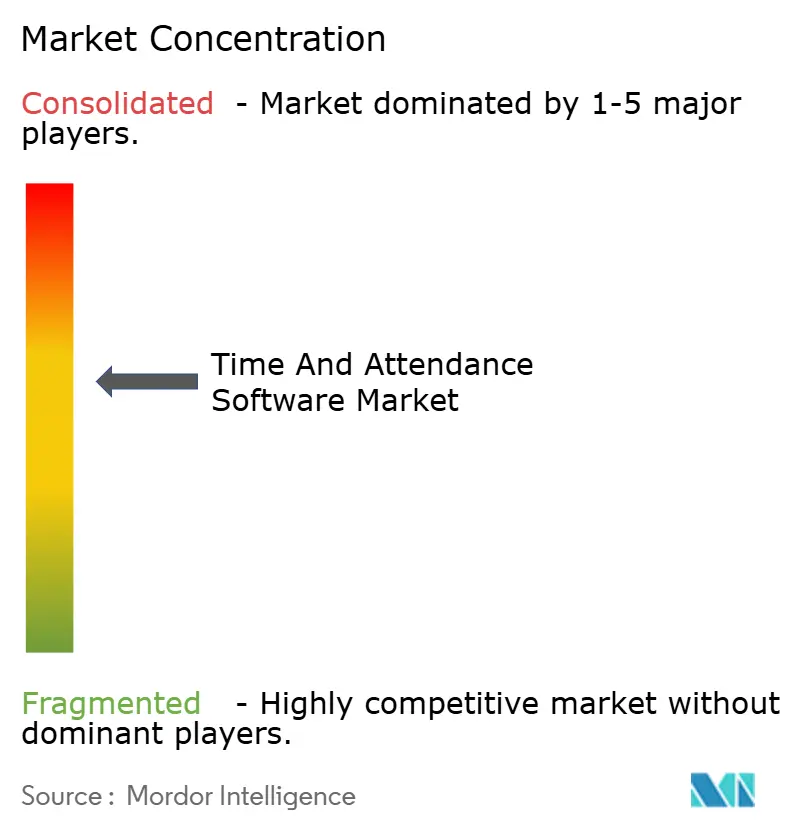
| Market Concentration | Medium |
Major Players *Disclaimer: Major Players sorted in no particular order Image © Mordor Intelligence. Reuse requires attribution under CC BY 4.0. | |
Time And Attendance Software Market Analysis by Mordor Intelligence
Time and attendance software market size in 2026 is estimated at USD 4.31 billion, growing from 2025 value of USD 3.99 billion with 2031 projections showing USD 6.37 billion, growing at 8.1% CAGR over 2026-2031. Robust demand is anchored in hybrid work adoption, sharper enforcement of labor-compliance rules, and the shift to cloud-delivered workforce-management platforms. Vendors are expanding AI-driven analytics that predict staffing needs, while biometric authentication and IoT devices raise accuracy and security. North America retains early-mover advantage, yet Asia-Pacific delivers the fastest regional growth as manufacturing and services firms accelerate digitization. Competitive dynamics remain moderate: large HCM-suite providers leverage embedded ecosystems, whereas niche players specialize in vertical solutions and advanced biometrics.
Key Report Takeaways
- By component, software retained a 67.35% revenue share in 2025; services represent the fastest component growth at a 11.8% CAGR to 2031.
- By deployment mode, cloud held 71.25% of the time and attendance software market share in 2025 and is projected to expand at an 11.35% CAGR through 2031.
- By organization size, large enterprises accounted for 44.35% of the 2025 market; the micro- and small-enterprise segment is accelerating but remains unquantified in the revised data set.
- By application, workforce management and scheduling contributed 39.40% of the time and attendance software market size in 2025, whereas payroll-integration and compliance applications are growing at a 12.8% CAGR to 2031.
- By end-user industry, IT and telecommunications led with an 17.65% share in 2025, while healthcare and life sciences post the highest industry CAGR at 12.29% through 2031.
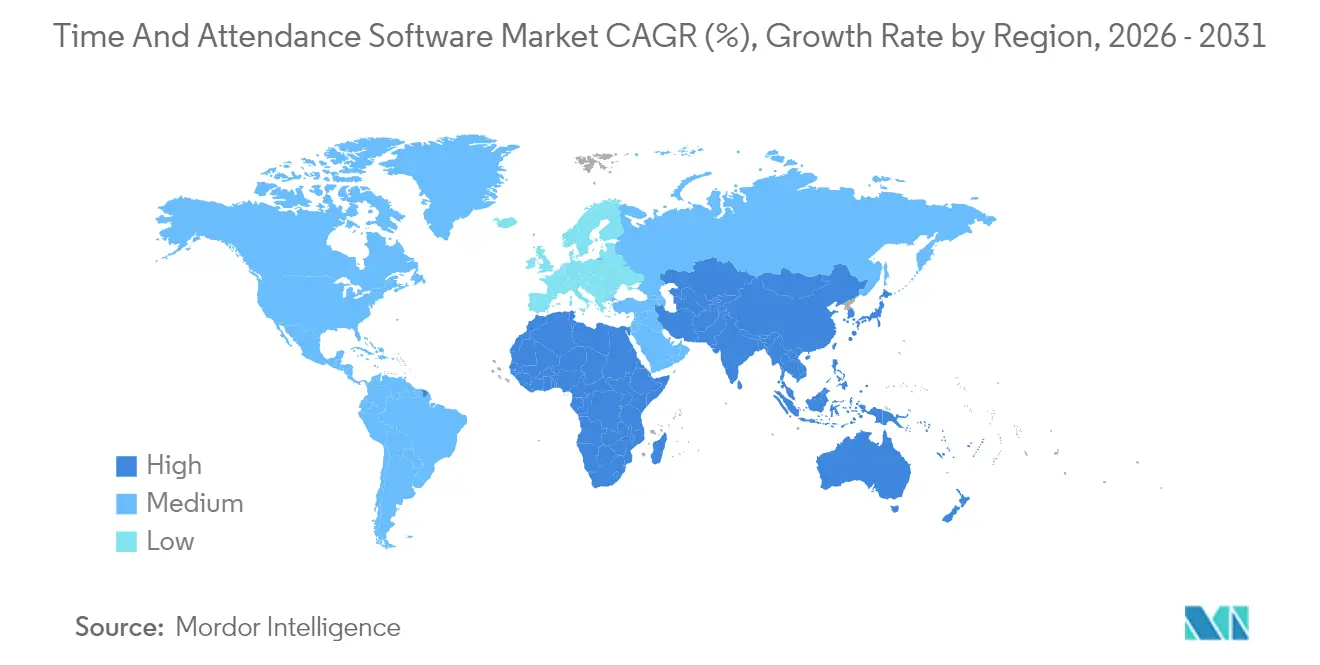
- By geography, North America commanded 34.55% of 2025 revenue; Asia-Pacific is the fastest-growing region with an 11.02% CAGR to 2031.
Note: Market size and forecast figures in this report are generated using Mordor Intelligence’s proprietary estimation framework, updated with the latest available data and insights as of 2026.
Market Trends and Insights
Drivers Impact Analysis of Time And Attendance Software Market*
| Driver | (~) % Impact on CAGR Forecast | Geographic Relevance | Impact Timeline |
|---|---|---|---|
| Stringent Labor-Compliance Mandates (FLSA, EU Working Time Directive) | +2.1% | Global, with concentration in North America and EU | Medium term (2-4 years) |
| Hybrid and Remote Workforce Expansion Requiring Cloud/Mobile Time Capture | +1.8% | Global, led by North America and APAC urban centers | Short term (≤ 2 years) |
| AI-Driven Productivity Analytics for Labor-Cost Optimization | +1.4% | North America and EU core, expanding to APAC | Long term (≥ 4 years) |
| SMB Digitization of Payroll and Time-Tracking via SaaS Platforms | +1.2% | Global, with rapid adoption in APAC and Latin America | Medium term (2-4 years) |
| Consolidation of HCM Modules to Reduce HR-Tech Stack Cost | +0.9% | North America and EU primarily, selective APAC markets | Medium term (2-4 years) |
| Source: Mordor Intelligence | |||
Stringent Labor-Compliance Mandates Drive Adoption
Recent U.S. Department of Labor guidance on AI-based monitoring heightens record-keeping expectations, while the 2024 FLSA overtime threshold rules require more granular hour classification. European companies face parallel pressure under the Working Time Directive, spurring replacement of legacy systems that cannot automate multi-jurisdictional rules. AI monitoring amplifies legal complexity as firms balance productivity insights with worker privacy rights under GDPR and related statutes. [1]Ogletree Deakins, “Navigating AI-Based Workforce Monitoring,” ogletree.com
Hybrid and Remote Workforce Expansion Requires Cloud/Mobile Capture
With 80% of large organizations supporting mixed work patterns, demand has shifted to mobile-first systems that geofence location, authenticate biometrics, and sync data in real time. [2]FlowForma, “Hybrid Workforce Management Survey 2024,” flowforma.com Cloud deployment removes on-premise constraints and aligns payroll across time zones. Vendors embed palm-vein and facial recognition to curb fraud while preserving convenience.
AI-Driven Productivity Analytics Optimize Labor Costs
Machine-learning engines mine historical attendance to forecast staffing gaps, yielding up to 30% productivity gains and overtime savings, according to industry case studies. [3]ResearchGate, “IoT-Enabled Attendance Management: A Review,” researchgate.net Large retailers deploy dynamic scheduling that aligns labor with demand spikes, improving wage efficiency and employee satisfaction.
SMB Payroll Digitization via SaaS Platforms
Affordable subscription models—typically 200-400 JPY (USD 1.4-2.8) per user per month—allow small firms to access features once reserved for enterprises. [4]Aspic Japan, “SaaS Subscription Pricing Trends 2024,” aspicjapan.org Government e-record mandates across APAC accelerate uptake by making electronic attendance a prerequisite for compliance filings.
Restraints Impact Analysis of Time And Attendance Software Market*
| Restraint | (~) % Impact on CAGR Forecast | Geographic Relevance | Impact Timeline |
|---|---|---|---|
| Data-Privacy and Biometric Regulations (GDPR, BIPA) | -1.6% | Global, with highest impact in EU and select U.S. states | Medium term (2-4 years) |
| Integration Complexity with Legacy ERP and Payroll Systems | -1.1% | North America and EU primarily, emerging in mature APAC markets | Short term (≤ 2 years) |
| Price Sensitivity in Developing Economies Drives Manual/Freemium Use | -0.8% | APAC emerging markets, Latin America, MEA | Medium term (2-4 years) |
| Labor-Union Pushback on Perceived "Surveillance" Features | -0.5% | North America and EU, selective APAC manufacturing hubs | Long term (≥ 4 years) |
| Source: Mordor Intelligence | |||
Data-Privacy and Biometric Regulations
Illinois’ BIPA mandates explicit consent and imposes statutory damages, prompting firms to add consent workflows and local storage, thereby doubling some rollout budgets. GDPR further requires privacy-impact assessments and restricts cross-border data transfers, fragmenting system architectures.
Integration Complexity with Legacy Systems
Many large enterprises run payroll applications that lack open APIs, forcing costly middleware or manual reconciliation. Dual-running old and new systems during cutover inflates operating costs and can stall modernization until broader ERP refresh cycles justify the investment.
*Our forecasts treat driver/restraint impacts as directional, not additive. The impact forecasts reflect baseline growth, mix effects, and variable interactions.
Time And Attendance Software Market Segment Analysis
By Component:
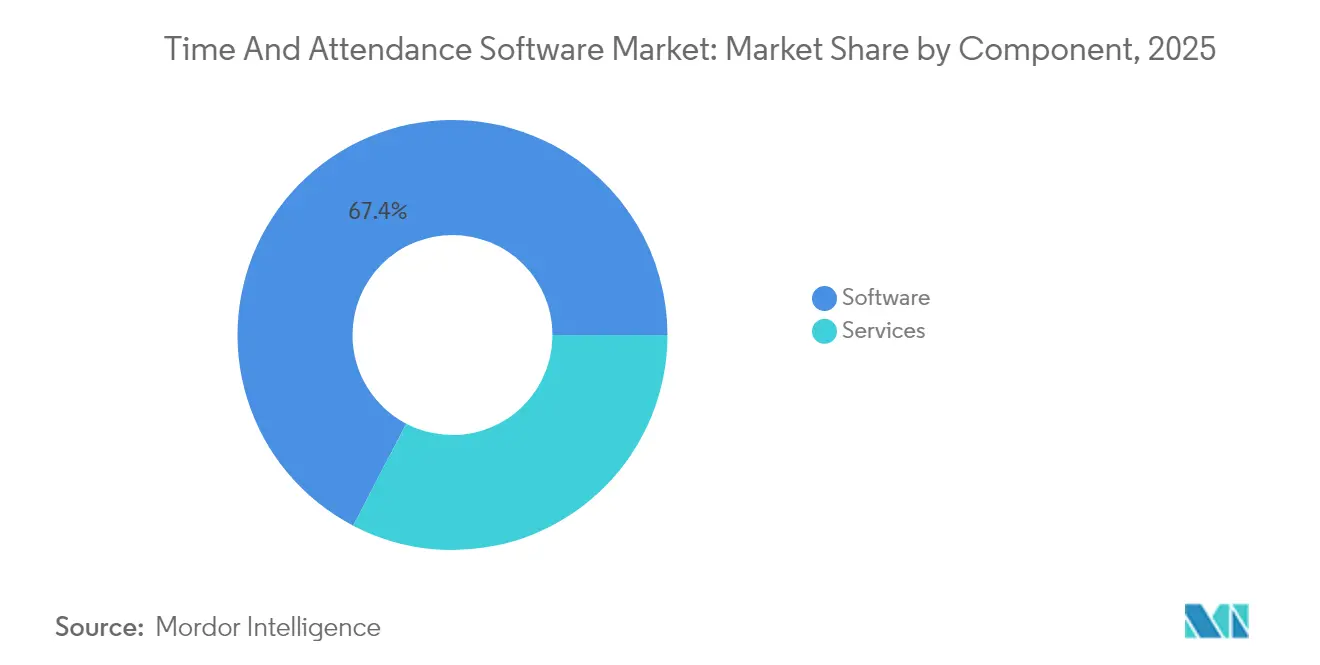
Services Expand Amid Software LeadershipSoftware held 67.35% of 2025 revenue, underscoring the primacy of cloud-native platforms in the time and attendance software market. Professional-services revenue is growing at 11.8% CAGR as organizations seek integration skills, biometric expertise, and compliance consulting. The services surge illustrates how complex deployments elevate demand for managed offerings that handle updates, rule changes, and mobile device management.
Services also differentiate vendors in an environment where core timekeeping functionality is commoditized. Managed services for SMEs outsource maintenance at predictable fees, freeing scarce IT staff. For global enterprises, consultancies configure multi-jurisdictional rule engines that codify overtime, break periods, and union agreements.



By Deployment Mode:
Cloud Ascendancy Reshapes InfrastructureCloud accounted for 71.25% of 2025 revenue and is expanding at an 11.35% CAGR, confirming that scalability and mobile accessibility outweigh legacy fears. Cloud platforms provide native smartphone apps with geofencing and biometric login, eliminating punch-clock hardware. Continuous software updates enable automatic compliance with evolving labor codes, an advantage on-premise systems cannot match.
Hybrid architectures persist where data sovereignty is critical, yet even those designs integrate public-cloud analytics for AI-driven insights. Vendors leverage cloud ecosystems to bundle payroll, onboarding, and analytics, deepening customer lock-in and extending average contract terms.
By Organization Size:
SME Adoption Democratizes CapabilityLarge enterprises captured 44.35% of 2025 spending, but growth momentum has shifted toward micro- and small-business buyers empowered by low-cost SaaS. Flexible monthly fees and free trials remove cap-ex hurdles, while pre-built connectors slot into popular accounting suites. SMEs in retail, healthcare, and field services adopt mobile clocks that replace paper timesheets and streamline labor-law reporting.
Enterprises continue to favor integrated HCM suites that unify talent, learning, and scheduling. Their focus is shifting to predictive analytics and scenario planning, where attendance data feeds strategic workforce-planning algorithms.
By Application:
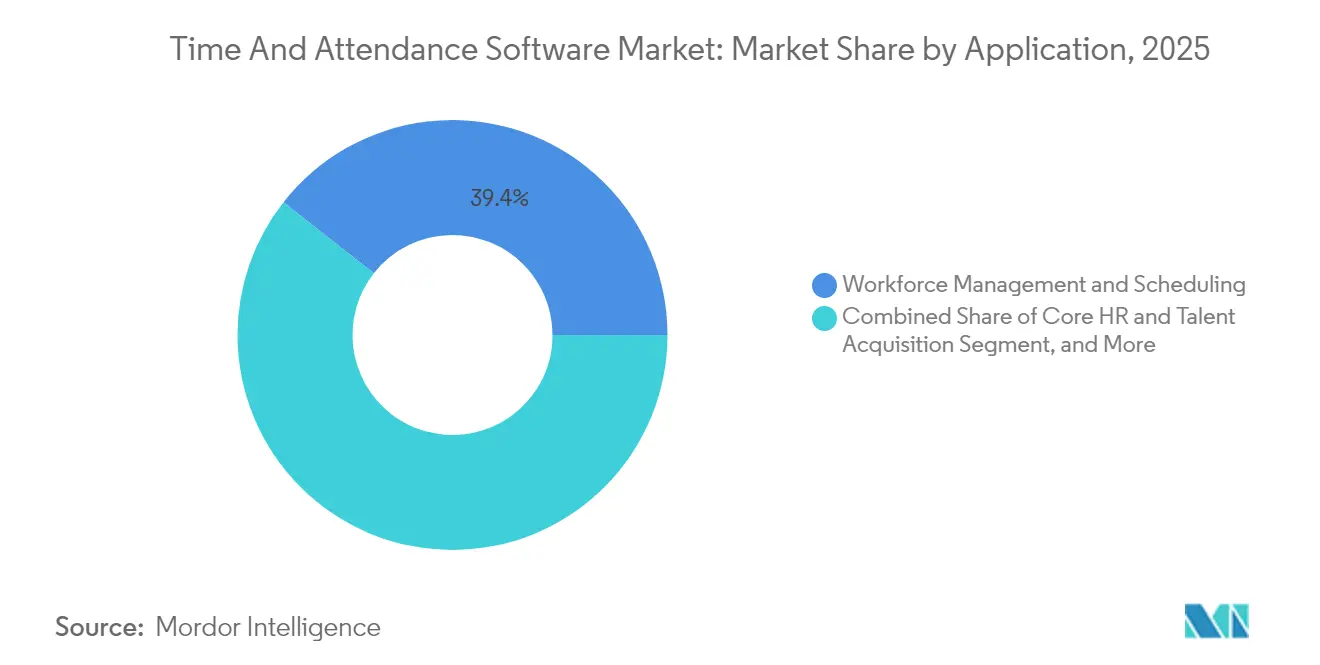
Compliance-Centric Growth Outpaces SchedulingWorkforce management and scheduling represented 39.40% of 2025 revenue, reflecting core demand for shift optimization. The payroll-integration and compliance segment is advancing at a 12.8% CAGR as fines for mis-classification mount. Healthcare providers integrate attendance with payroll engines to handle shift differentials, while service industries embed regulatory rules to automate break compliance.
Elsewhere, project-time tracking gains traction in professional services, and attendance data increasingly feeds performance-management dashboards to correlate presence with outcomes.
By End-User Industry:
Healthcare Accelerates on Safety MandatesIT and telecommunications held 17.65% share in 2025, leveraging early cloud adoption to manage dispersed talent. Healthcare and life sciences grow fastest at 12.29% CAGR as staffing-ratio regulations and patient-safety protocols demand minute-level accuracy. Manufacturing leverages attendance data to align labor with Just-In-Time production, while public-sector modernization programs stipulate electronic time logs for audit transparency.
Banking institutions value audit trails for regulatory exams, and universities extend systems to monitor student attendance, illustrating the breadth of vertical use cases fueling sustained adoption.
Geography Analysis
North America Time and Attendance Software Market
North America commanded 34.55% of 2025 revenue, benefitting from strict overtime rules and advanced enterprise IT environments. Vendors such as UKG and Oracle iterate AI features rapidly, yet customer acquisition moderates as installed bases mature. Growth increasingly comes from upselling analytics, biometrics, and industry-specific modules rather than net-new logos.
APAC Time and Attendance Software Market
Asia-Pacific is projected to grow at an 11.02% CAGR through 2031, propelled by government digitization drives and SME cloud readiness. Digital services trade in the region rose from USD 403.4 billion in 2005 to USD 1.4 trillion in 2019, underscoring a structural shift toward digital workflows. Local champions such as ZKTeco and Matrix pair competitive pricing with region-specific compliance features, while multinationals deepen channel partnerships.
EMEA and LATAM Time and Attendance Software Market
Europe maintains steady expansion as GDPR enforces stringent biometric safeguards and the Working Time Directive continues to tighten record-keeping obligations. Public-sector digitization accelerates adoption, and manufacturing clusters in Germany and the Nordics deploy integrated attendance-and-shop-floor systems to lift productivity. Emerging markets in Latin America, the Middle East, and Africa remain earlier in the adoption curve, but cloud availability and mobile-first deployments lower entry barriers.

Regulatory Landscape
Regulation affecting time and attendance software centers on labor record-keeping, privacy, and biometric governance across jurisdictions. In North America and the EU, overtime and working-time rules (for example, FLSA enforcement and the EU Working Time Directive) increase requirements for granular, auditable time capture, while GDPR adds obligations such as Records of Processing Activities (ROPA), cross-border transfer mechanisms, and 72-hour breach notification timelines for systems processing employee data.
From 2026 onward, multi-country payroll and workforce compliance requirements increase configuration complexity and reporting cadence. That reinforces demand for jurisdiction-specific rule engines and strong audit trails, particularly in programs that need time and attendance outputs to support compliance filings such as France's DSN and Brazil's eSocial, as well as verification requirements like the UK right-to-work checks (with higher civil penalties as of 2026).
Value Chain Analysis
The value chain starts with platform development, including cloud time capture, scheduling, analytics, and compliance rule engines. It then extends through implementation, integration, and ongoing managed services that keep rules current and maintain connectivity to payroll and HR stacks. Upstream dependencies include mobile OS ecosystems, identity and biometric components, and security and privacy controls needed for regulated data processing; downstream value shows up in payroll-ready time data, auditability, and exception management for labor-law adherence.
Ecosystem integration and partnerships increasingly shape differentiation, as time and attendance modules are embedded within broader HCM and ERP environments through APIs and marketplaces. ADP and SAP, for example, have described an approach where ADP Global Payroll is hosted within SAP Cloud ERP infrastructure, and ADP SmartCompliance uses compliance-specific APIs and policy intelligence to connect with HCM environments such as SAP and Oracle, reflecting how vendors, integrators, and compliance layers deliver outcomes for multi-jurisdiction employers.
Competitive Landscape
The time and attendance software market shows moderate concentration. SAP, Oracle, and UKG leverage broad HCM suites, embedded analytics, and large installed bases to sustain competitive moats. Switching costs rise as attendance data feeds performance, payroll, and learning modules across the same platform.
Specialist vendors differentiate through vertical depth and biometric innovation. ZKTeco’s third-place finish in the 2025 Fingerprint Verification Competition affirms algorithmic prowess supported by a 900-plus patent portfolio, enabling OEM partnerships with global HCM providers. Matrix tailors multi-location compliance tools for banking and fintech, while ATOSS capitalizes on European labor-law expertise to expand managed services revenue.
New entrants attack the SME tier with freemium mobile apps and consumer-grade UX, shrinking implementation times from months to days. Larger incumbents counter by offering trimmed cloud packages and marketplace ecosystems that integrate niche extensions. Patent activity remains intense around multimodal biometrics and AI-driven scheduling, signalling technology as the prime battleground over pure feature parity.
Time And Attendance Software Industry Leaders
SAP SE
FingerCheck
NETtime Solutions
ADP, Inc.
Oracle Corporation
- *Disclaimer: Major Players sorted in no particular order
Time And Attendance Software Market Companies Covered in this Report
- SAP SE
- FingerCheck
- NETtime Solutions
- ADP, Inc.
- Oracle Corporation
- Reflexis Systems Inc.
- Replicon
- Ultimate Kronos Group (UKG)
- Paycor
- Paycom Software, Inc.
- Rippling
- Civica
- Ramco Systems
- Workday, Inc.
- Ceridian HCM
- ATOSS Software AG
- BambooHR LLC
- Zoho Corporation (Zoho People)
- Deputy Group Pty Ltd
- isolved HCM LLC
- Time Doctor LLC
- Kronotek

Market Opportunities and Future Outlook
White-space continues to open up around compliance automation that converts raw time punches into payroll-ready, jurisdiction-specific outcomes, especially for employers operating across multiple countries, states, or union agreements. In Europe, dated policy milestones create specific near-term requirements for HR and time systems, including the EU Pay Transparency Directive obligations by June 7, 2026 (driving tighter pay-rule governance and reporting workflows) and the EU AI Act's high-risk obligations for workplace AI from August 2, 2026, which supports demand for transparency notices, documentation, and controls around AI-driven monitoring or scheduling.
Vendors have an opportunity to package compliance into configurable rule-engine architectures that are supported by implementation and managed services, rather than relying on one-size-fits-all templates. Evidence cited in global payroll compliance programs points to operational benefits when compliance logic is modular, and moves such as ADP SmartCompliance enhancements and SAP-ADP ecosystem alignment suggest continued demand for pre-built integrations that reduce onboarding time, standardize audit trails, and keep up with regulatory change without extensive custom development.
Recent Industry Developments in Time And Attendance Software Market
- June 2026: BambooHR launches Time and Attendance with Shift Scheduling integration. The new feature set combines attendance, scheduling, and payroll workflows to streamline operations. The consolidation expands cloud-based WFM capabilities across SMBs and SMEs, strengthening BambooHR's position in the small business market.
- March 2026: Deputy Payroll in the U.S. launched in collaboration with Paycor. The move unifies workforce management and payroll for shift-based businesses in the U.S. The ecosystem expansion with Paycor enables faster payroll-ready time data and broader market reach.
- March 2026: Accu-Time Systems Strategic integration with Connecteam for seamless workforce management. The integration links hardware time clocks with Connecteam software for streamlined time data collection. This enhances accuracy and verifiability of time data for distributed workforces through hardware-software integration.


Time And Attendance Software Market Report Scope and Research Methodology
Market Definition and Coverage
This market covers software used to record employee time, manage attendance rules, and generate auditable records for payroll and labor compliance, across cloud and on-premise delivery. We size it on a revenue basis from software licensing and subscriptions tied to time and attendance use.
Scope exclusions: We exclude outsourced payroll processing, general HR consulting, and physical time-clock hardware revenue unless it is bundled and priced as part of the software contract.
Segments Covered in This Report
- By Component
- Software
- Stand-alone Time and Attendance Software
- Integrated HCM Suite Modules
- Services
- Professional Services
- Implementation and Integration
- Consulting and Training
- Managed Services
- Professional Services
- Software
- By Deployment Mode
- On-premise
- Cloud
- By Organization Size
- Small and Medium Enterprises
- Large Enterprises
- By Application
- Workforce Management and Scheduling
- Core HR and Talent Acquisition
- Payroll Integration and Compliance
- Other Applications
- By End-User Industry
- BFSI
- Retail and E-commerce
- IT and Telecommunications
- Government and Public Sector
- Healthcare and Life Sciences
- Manufacturing
- Education
- Other End-user Industries
- By Geography
- North America
- United States
- Canada
- Mexico
- Europe
- United Kingdom
- Germany
- France
- Italy
- Rest of Europe
- Asia-Pacific
- China
- Japan
- India
- South Korea
- Rest of Asia-Pacific
- South America
- Brazil
- Argentina
- Rest of South America
- Middle East and Africa
- Middle East
- GCC
- Turkey
- Israel
- Rest of Middle East
- Africa
- South Africa
- Nigeria
- Kenya
- Rest of Africa
- Middle East
- North America
Data Sources, Market Sizing, and Validation
Desk Research
Desk work starts by setting the demand context and the compliance drivers that make time capture a baseline requirement for many employers. Public sources that help here include labor and employment statistics and guidance from bodies such as the US Bureau of Labor Statistics, the US Department of Labor, the European Commission, and national labor ministries that publish working time and recordkeeping rules.
We also use company filings, investor decks, reputable press, and association websites to map product positioning and buying patterns, especially around cloud migration and mobile workforce use. In addition, paid subscriptions are used selectively for company financials and intelligence, news and financials, patent databases, and global contracts and tenders to confirm revenue ranges and major deal signals. The sources mentioned are illustrative rather than exhaustive, and additional public references are reviewed to collect inputs, validate assumptions, and clarify any data gaps.
Primary Interviews and Surveys
Primary work is used to stress-test pricing, packaging, and adoption assumptions, since published information often groups time, scheduling, and broader HR suites in different ways. We speak with software providers, channel partners, implementation specialists, and enterprise and mid-market buyers across APAC, EMEA, and the Americas to confirm what is purchased and how it is priced, including how cloud subscriptions are structured versus on-premise renewals.
Distribution of primary research fieldwork respondents
| Company type | Respondent position | Region |
|---|---|---|
| Top tier: 26% | CXOs: 14% | APAC: 50% |
| Mid tier: 56% | Functional/Unit leaders: 31% | EMEA: 29% |
| Smaller Players: 18% | Managers: 55% | Americas: 21% |
Market-Sizing & Forecasting
Sizing begins with a top-down build that reconstructs the addressable spend by connecting employed workforce volumes, formal sector mix, and software adoption intensity in time recording workflows (including mobile use where it changes the subscription value). We then check these totals using selective bottom-up approximations, such as sampled vendor revenue ranges, channel feedback on subscription pricing, and simple ASP times employee-seat volumes for typical deployments.
Key model inputs include employee counts by industry, payroll and working-time compliance pressure, cloud versus on-premise preference, average subscription price per employee per month, and replacement cycles tied to legacy punch processes moving into digital workflows. Forecasting relies mainly on scenario analysis supported by expert consensus on hiring direction, remote or hybrid policy persistence, and the pace of cloud migration, which is then translated into yearly revenue paths. Where bottom-up signals are thin for smaller vendors or local markets, we handle gaps through penetration assumptions validated through interviews and then cap the results with plausibility checks against HR software allocation ranges.
Data Validation & Update Cycle
Validation is done through a series of practical checks so the final number stays explainable and repeatable. We compare outputs against independent signals such as employment growth, HR software spending direction, and the observed shift toward subscription billing, and then investigate outliers like unusually high implied pricing or abrupt regional share changes.
Before sign-off, the model and key assumptions go through multi-step analyst reviews, and respondents are re-contacted if a major variance appears in pricing, adoption rates, or deployment mix. Reports are refreshed annually, with interim updates when material events occur, and a final freshness pass is completed right before delivery so clients receive the latest updated view.
Mordor Intelligence's Time and Attendance Software Market Sizing Compared With Other Published Estimates
Published market sizes for time and attendance software can look far apart because the included feature set is not consistent, and because vendors bundle time capture with scheduling, payroll, or wider HR suites. Currency timing, the base year chosen, and how cloud subscriptions are annualized also influence the final value.
Some external estimates fold in broader workforce management modules like scheduling, labor analytics, and even payroll services in the same bucket, which naturally pushes the market number up. In contrast, pure time capture and attendance-focused software revenue is counted, and hardware and outsourced services are excluded unless they are bundled as software-priced line items, which is the scope applied by Mordor Intelligence for the 2026 value.
Benchmark comparison
| Source | Market Size | Gaps in Research Methodology |
|---|---|---|
| Mordor Intelligence | USD 4.31 B (2026) | |
| Global Consultancy A | USD 5.10 B (2026) | Uses an expanded scope that groups time and attendance with adjacent workforce management functions, and applies higher blended subscription pricing without separating pure time-capture modules. |
| Industry Association B | USD 3.60 B (2026) | Leans on member-reported vendor revenue and undercounts smaller SaaS providers, and it often omits add-on compliance reporting and mobile workforce features priced as software modules. |
The spread across publishers is mainly explained by what is included in the product scope and how subscription revenue is normalized across buyer types. By tying the model to clear demand signals like employee-seat volumes, adoption intensity, and practical pricing ranges, the estimate remains traceable to assumptions that can be checked and updated year to year.


Key Questions Answered in the Report
What is the current size of the time and attendance software market?
The time and attendance software market is valued at USD 4.31 billion in 2026.
How fast is the market expected to grow?
It is forecast to expand at an 8.1% CAGR, reaching USD 6.37 billion by 2031.
Which region is growing the fastest?
Asia-Pacific posts the highest regional CAGR at 11.02% through 2031 due to rapid digitization and SME cloud adoption.
Why is cloud deployment overtaking on-premise solutions?
Cloud platforms offer scalability, continuous compliance updates, and mobile access, capturing 71.25% of 2025 revenue and growing at an 11.35% CAGR.
How do labor-compliance rules influence buying decisions?
Updated overtime thresholds (FLSA) and EU Working Time Directive enforcement add +2.1% to forecast CAGR by pushing firms toward granular, automated time tracking.
What technologies are redefining attendance management?
AI-driven scheduling, geofenced mobile clocks, and multimodal biometrics (palm-vein, facial recognition) are now mainstream features enhancing accuracy and security.
Page last updated on:





