
Thailand Two Wheeler Market Size and Share
Market Overview
| Study Period | 2019 - 2031 |
|---|---|
| Forecast Data Period | 2026 - 2031 |
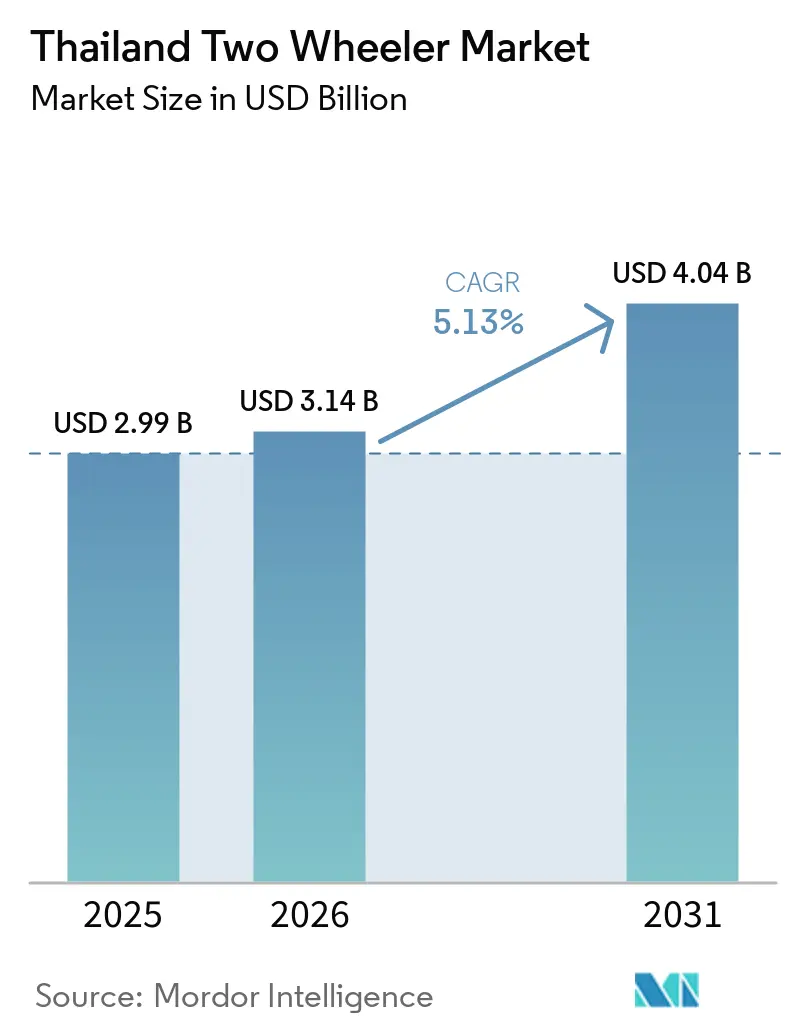
| Base Year Market Size (2025) | USD 2.99 Billion |
| Market Size (2026) | USD 3.14 Billion |
| Market Size (2031) | USD 4.04 Billion |
| Growth Rate (2026 - 2031) | 5.13 % |
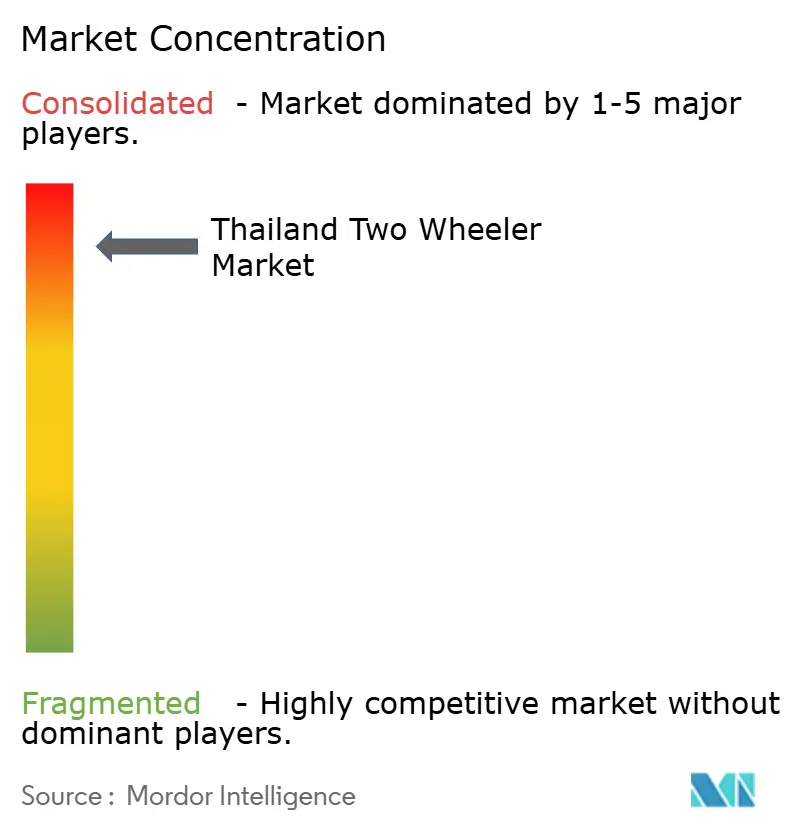
| Market Concentration | High |
Major Players *Disclaimer: Major Players sorted in no particular order Image © Mordor Intelligence. Reuse requires attribution under CC BY 4.0. | |
Thailand Two Wheeler Market Analysis by Mordor Intelligence
The Thailand two-wheeler market size was valued at USD 2.99 billion in 2025 and is estimated to grow from USD 3.14 billion in 2026 to reach USD 4.04 billion by 2031, at a CAGR of 5.13% during the forecast period (2026-2031). Steady economic recovery, a subsidy under the EV3.5 scheme, and a last-mile logistics boom are reinforcing unit demand despite tighter consumer credit. Rapid installation of several PTT battery-swap stations shortens charging downtime, making electric models viable for delivery fleets [1]“Arun Plus Battery Swap Rollout,” PTT Public Company Limited, pttplc.com. In January 2026, Honda launched the locally designed UC3 electric motorcycle, demonstrating the market leader’s shift toward electrification while maintaining its significant presence in internal combustion engine segments. Meanwhile, online storefronts on Shopee and Lazada offer bundled 0% installment plans, reducing purchasing barriers and expanding the addressable customer base in provincial cities.
Key Report Takeaways
- By vehicle type, motorcycles led with 72.33% of Thailand's two-wheeler market share in 2025, while scooters are projected to advance at a 6.48% CAGR through 2031.
- By propulsion type, internal-combustion engines retained a 91.25% of Thailand's two-wheeler market share in 2025, while electric two-wheelers are forecast to grow at an 11.25% CAGR through 2031.
- By drive type, chain systems accounted for 76.11% of Thailand's two-wheeler market share in 2025, and belt drives are expected to grow at a 7.36% CAGR through 2031.
- By end use, personal riding accounted for 79.04% of Thailand's two-wheeler market share in 2025, while delivery and fleet services are set to expand at an 8.45% CAGR through 2031.
- By sales channel, offline outlets accounted for 85.22% of Thailand's two-wheeler market share in 2025, while online transactions are forecast to grow at a 7.89% CAGR through 2031.
- By region, Bangkok and Central Thailand commanded 38.04% of Thailand's two-wheeler market share in 2025, while the Eastern Economic Corridor is poised to register a 6.95% CAGR through 2031.
Note: Market size and forecast figures in this report are generated using Mordor Intelligence’s proprietary estimation framework, updated with the latest available data and insights as of January 2026.
Thailand Two Wheeler Market Trends and Insights
Drivers Impact Analysis*
| Driver | (~) % Impact on CAGR Forecast | Geographic Relevance | Impact Timeline |
|---|---|---|---|
| Demand for Last-Mile Delivery | +1.2% | Bangkok and Central Thailand, spillover to EEC | Medium term (2-4 years) |
| Government EV Subsidy Scheme | +0.9% | National, focus in Bangkok, Chonburi, Rayong | Short term (≤ 2 years) |
| Expansion of Battery-Swap Station | +0.7% | Bangkok and Central Thailand, expanding northward | Medium term (2-4 years) |
| Adoption of Motorcycle Financing | +0.6% | National, higher in large cities | Short term (≤ 2 years) |
| Tourism Rebound Boosting Rental | +0.5% | Southern and Northern tourist hubs | Short term (≤ 2 years) |
| Subscription-Based Motorcycle Leasing | +0.4% | Bangkok and Central Thailand, resort pilots | Medium term (2-4 years) |
| Source: Mordor Intelligence | |||
Rising Demand for Last-Mile Delivery Motorcycles
E-commerce logistics operators are rewriting fleet strategies around low-maintenance electric units that cut fuel spend and idle time. Thailand Post field-tested several electric bikes as part of a 25,000-unit fleet in 2025 and plans wider rollouts tied to carbon-neutral goals. As of April 2026, Grab Thailand had added more than 30,000 electric vehicles to its platform, increased EV rides by 35%, and introduced competitive daily pricing. These initiatives made EVs cost-competitive for drivers traveling 100–150 km per day [2]“2025 Thailand Mobility Report,” Grab Holdings, grab.com. The food delivery segment experienced substantial growth during the year, maintaining strong demand for stop-and-go bikes, where electric torque offers distinct advantages. GrabBike Saver trips saw a significant increase, highlighting the growing shift toward electric mobility. While Bangkok remains at the forefront of this transition, the trend is expected to expand to Laem Chabang port and U-Tapao airport hubs over the coming years.
Government EV Subsidy Scheme Reducing Upfront Cost of E2Ws
The EV3.5 framework offers rebates for electric bikes within a specified price range and aims to achieve significant registrations by 2027. Amendments introduced in 2025 extended program deadlines and enhanced export credits, strengthening confidence among assemblers. Honda's UC3 qualifies for the subsidy, positioning it below the mass-market price threshold. The framework concentrates benefits during the mid-decade period, encouraging first-time EV buyers before the policy concludes.
Expansion of Battery-Swap Station Networks by Oil and Energy Majors
PTT’s Arun Plus arm invested THB 1.85 billion (~ USD 55.91 million) in a cell-to-pack facility. It deployed more than 500 battery-swapping kiosks that replace depleted battery packs in under two minutes. In January 2026, Honda partnered with Tesco Lotus and Central Group to install CHAdeMO charging points, with further expansion planned through 2029. Meanwhile, Gogoro’s extensive battery-swapping model in Taiwan indicates its ambitions in Southeast Asia. However, divergent charging and battery-swapping standards could fragment the regional ecosystem. By establishing widespread networks early, these companies enable couriers to adopt electric vehicles, particularly those who cannot accommodate lengthy charging downtime. Over the next few years, secondary cities are expected to develop a critical density of charging stations.
Rapid Adoption of Digital Motorcycle Financing Via Mobile Apps
Fintech lenders, like Siam Digital Lending, are offering loans at competitive rates, significantly undercutting traditional hire-purchase norms, and ensuring approvals within hours through smartphone applications. Grab, leveraging ride-hailing income data, is packaging bike leases with enticing terms. Tidlor Title Loans is stepping in to provide liquidity to gig workers, charging reasonable rates. Krungsri Auto, while maintaining positive portfolio growth through digital channels and partnerships with numerous dealers, has adjusted its rates, tightening the squeeze on marginal borrowers. In urban areas, where smartphone ownership is widespread, financing has become seamless. In contrast, rural users continue to navigate the traditional route, relying on dealer paperwork.
Restraints Impact Analysis*
| Restraint | (~) % Impact on CAGR Forecast | Geographic Relevance | Impact Timeline |
|---|---|---|---|
| Tightening of Hire-Purchase Credit | −0.8% | National, heavier in Northeast and North | Short term (≤ 2 years) |
| Limited Fast-Charging Infrastructure | −0.6% | Outlying provinces | Medium term (2-4 years) |
| High Motorcycle Fatality Rate | −0.5% | Nationwide, strict zones in Bangkok, Phuket, Chiang Mai | Short term (≤ 2 years) |
| Lithium-Ion Cell Supply Gap | −0.4% | National, EEC assemblers | Medium term (2-4 years) |
| Source: Mordor Intelligence | |||
Tightening of Hire-Purchase Credit Approval Criteria
In 2025, lenders grew cautious as household debt reached significant levels. Krungsri Auto increased rates and required larger down payments, excluding many entry-level buyers. While AEON offered competitive rates, Siam Digital targeted a smaller customer base with higher pricing. The impact is most severe in farming provinces, where incomes are considerably lower compared to urban areas like Bangkok. Consequently, consumers are extending ownership cycles, delaying upgrades, and reducing purchases of new units over the forecast period.
Limited Public Fast-Charging Infrastructure Outside Urban Cores
CHAdeMO chargers are concentrated in Bangkok and key resort hubs. Although Honda aims to establish a significant number of charging points by 2029, it has delayed its rural expansion plans. PTT has not committed to timelines for its rollout in the Northeast. Consequently, range anxiety primarily restricts electric bike use to urban commuting, delaying adoption for intercity travel until dedicated highway charging corridors are developed.
*Our forecasts treat driver/restraint impacts as directional, not additive. The impact forecasts reflect baseline growth, mix effects, and variable interactions.
Segment Analysis
By Vehicle Type: Scooters Gain Urban Share
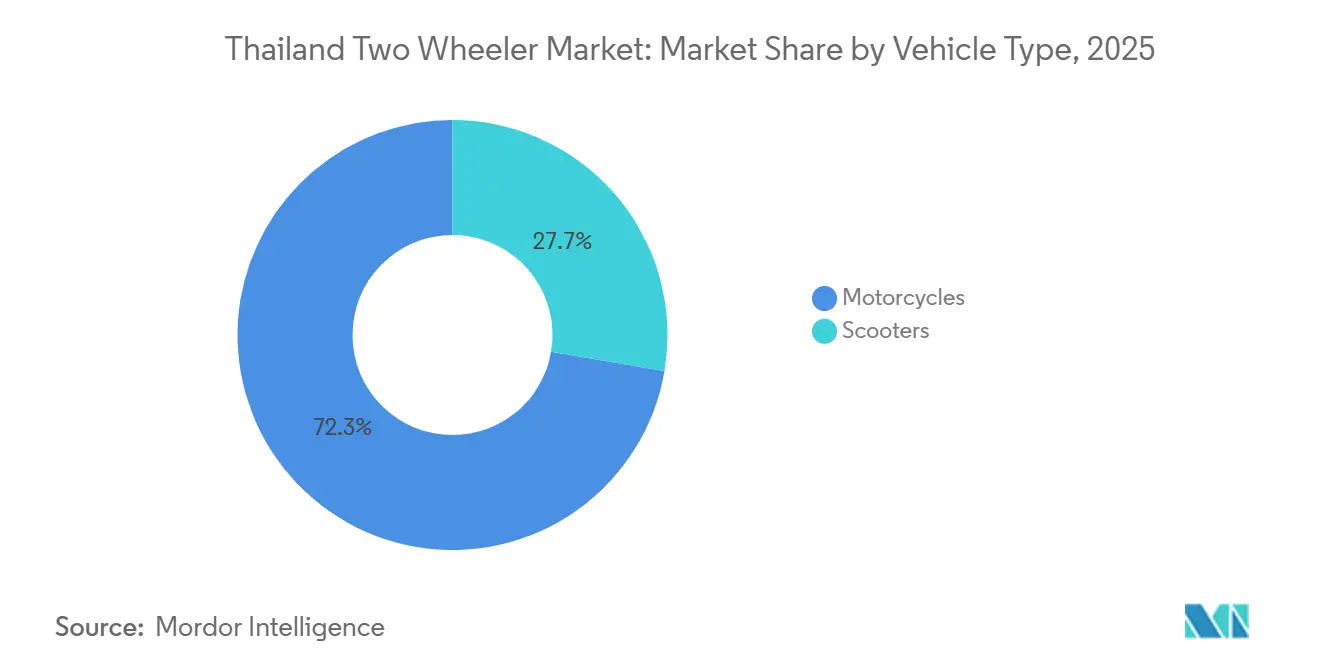
Motorcycles controlled 72.33% of Thailand's two-wheeler market share in 2025, a legacy of rural manual-shift preference, yet Bangkok congestion amplifies scooter advantages such as automatic gearing and under-seat storage. Honda’s limited-edition Scoopy and ADV160 refreshes appeal to image-conscious millennials, while Yamaha’s NMAX Connected competes on Blue Core efficiency. The push into fashion-forward designs, plus smartphone pairing, is expanding female ridership, which has historically been underrepresented in manual segments.
The scooter segment is expected to grow at a CAGR of 6.48% during the forecast period. The recovery in tourism is driving demand for scooter rentals in Phuket and Chiang Mai, while rising delivery volumes are increasing demand for step-through models that can accommodate large rear boxes. Honda is positioning its WN7 electric concept to combine scooter convenience with motorcycle styling at next-generation price points.


By Propulsion Type: E2W Surge Amid ICE Dominance
Internal-combustion bikes account for a 91.25% of Thailand's two-wheeler market share in 2025, though their dominance is gradually declining. Zontes recorded notable growth in early 2026 by pricing its products below those of Japanese competitors. Electric two-wheelers are projected to grow at a CAGR of 11.25% through 2031. Battery-swapping programs and government subsidies are expected to support this growth in electric two-wheeler sales.
Delivery fleets operating 100–150 km daily can achieve payback within 18 months when accounting for fuel savings and reduced service intervals. The electric segment of Thailand's two-wheeler market could expand further by 2031 if planned battery manufacturing facilities address the current cell supply gap. Alternative fuels remain negligible, as policy focus and infrastructure investment continue to prioritize battery-electric solutions.
By Drive Type: Belt Gains on Maintenance Edge
Chains remained dominant, with a 76.11% of Thailand's two-wheeler market share in 2025, due to low costs and entrenched supply chains. Thai Motor Chain has launched a new 520-size product for the big-bike aftermarket, underscoring its continued investment in the sector. However, belt kits designed for long lifespans and reduced lubrication needs are becoming increasingly popular and are expected to grow at a CAGR of 7.36%. Enfield Tech is offering conversion packages, promoting their near-silent operation to city dwellers.
Royal Enfield's CKD facility is ramping up production, adding more units annually. This expansion boosts the number of units eligible for belt upgrades. Meanwhile, electric motorcycles, typically equipped with either belt or direct drive, are seeing a surge in adoption, driven by the rapid growth of the E2W segment. The Thailand two-wheeler market share for belt systems is on track to break into double digits by 2031, especially in coastal cities where corrosion shortens chain life.
By End Use: Delivery Fleets Electrify Faster
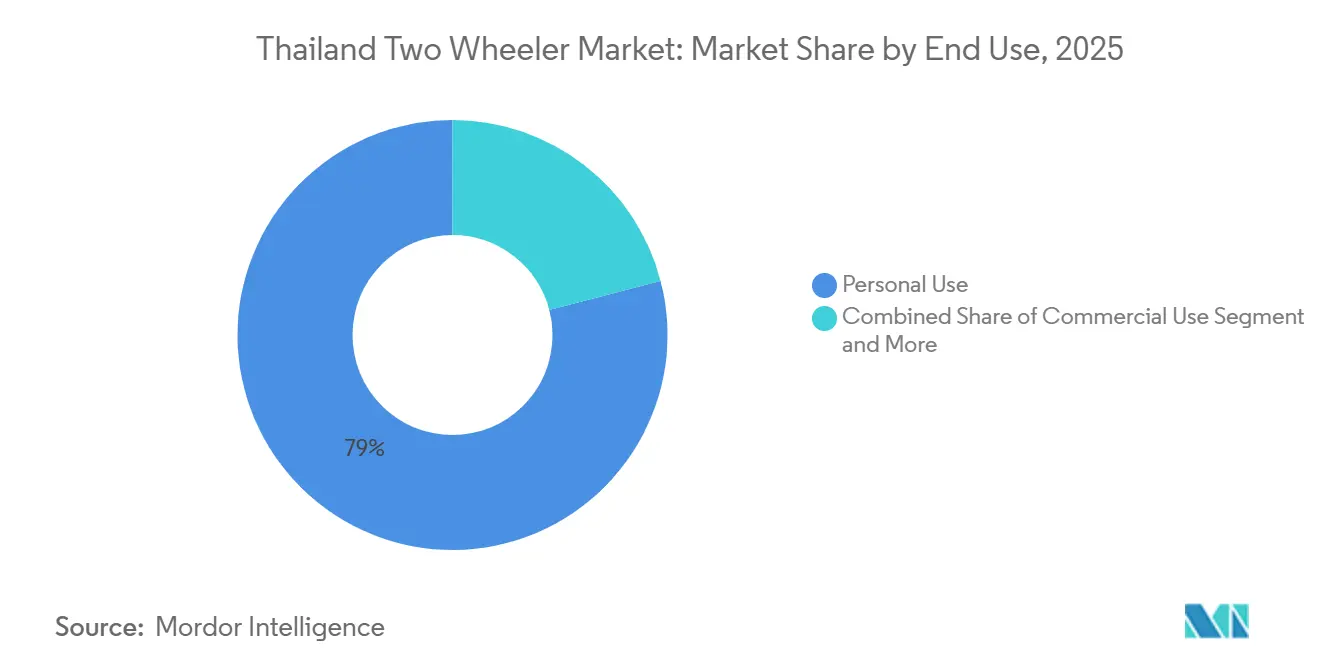
Personal use accounted for a 79.04% of Thailand's two-wheeler market share in 2025, though growth in this segment is plateauing. In contrast, delivery and fleet services are expanding at an 8.45% CAGR, driven by growth in food delivery and ride-hailing incentives. Companies such as Thailand Post and Grab have deployed a significant number of electric vehicles, reducing operating costs compared to gasoline-powered alternatives. Flexible subscription plans have also enabled gig workers to adopt electric options without long-term financial commitments, making the transition more accessible for those relying on two-wheelers for daily income.
Regulatory incentives add to the economic appeal. Rebates reduce capital expenditures, and battery-swap stations minimize downtime, allowing couriers to increase daily utilization. Commercial operators are emerging as the primary adopters of electric two-wheelers in Thailand, outpacing individual consumers. This shift reflects a broader pattern in which businesses, motivated by cost savings and policy support, are driving adoption faster than the general public, reshaping how the market evolves in the near term.

By Sales Channel: Online Gains Via Fintech Integration
Offline dealers still accounted for 85.22% of Thailand's two-wheeler market share in 2025, driven by trust, test rides, and trade-in negotiations. Yet online storefronts that feature immersive 360-degree product views and 0% financing are eroding this moat. Kawasaki’s Shopee and Lazada pages allow buyers to reserve a Ninja ZX-25R with only a nominal down payment and doorstep delivery. More than 20 Honda and Yamaha dealers now list live inventory online.
E-commerce familiarity with car parts primes consumers for whole-bike transactions. Fintech credit checks inside shopping apps are approved within minutes, and courier partners deliver plates and paperwork ready for registration. The Thailand two-wheeler market is therefore expected to see digital share rise significantly, with a 7.89% CAGR by 2031. However, high-touch premium segments will still value physical showrooms for brand experience.
Geography Analysis
Bangkok and Central Thailand captured 38.04% of Thailand's two-wheeler market share in 2025 and remain the epicenter of the Thailand two-wheeler market. Higher disposable incomes and daily traffic speeds below 25 km/h make two-wheelers indispensable. With numerous PTT swap kiosks and Honda's planned CHAdeMO points, the capital boasts the densest charging grid. Meanwhile, the food-delivery economy continues to bolster the appeal of urban-optimized models through repeat purchases.
The Eastern Economic Corridor ranks as the fastest-growing region with a 6.95% CAGR outlook. BOI incentives attract battery and vehicle plants to Chonburi, Rayong, and Chachoengsao, creating well-paid factory jobs that sustain middle-class motorcycle upgrades [3]“Investment Incentive Guide 2026,” Eastern Economic Corridor Office, eec.go.th.
Northern tourism hubs such as Chiang Mai draw premium rental demand for scenic mountain routes. At the same time, Southern beach provinces depend on seasonal tourist flows that are sensitive to helmet-law enforcement. Northeastern Isan lags due to lower incomes and sparse charging points, with budget ICE bikes financed at double-digit interest rates maintaining dominance. Regional gaps, therefore, drive a two-speed adoption curve in Thailand's two-wheeler market.
Competitive Landscape
In 2025, Thai Honda dominated the market, achieving significant sales. The company adeptly utilized a three-tier channel, BigWing, Wing Centers, and CUB House, to cater to customers across various price bands. Yamaha, on the other hand, is banking on its Y-Connect smartphone integration to justify premium pricing during mid-cycle refreshes. Kawasaki is appealing to enthusiasts by offering multi-cylinder sport bikes through online sales. Meanwhile, Zontes underscores the competitive pressure from Chinese imports with its disruptive pricing strategy.
Royal Enfield commenced its CKD operations in December 2024, enabling price reductions that have helped the company capture a notable share of the mid-size 250–750 cc segment.[4]“Thailand CKD Plant Press Release,” Royal Enfield, royalenfield.com. Additionally, Enfield Tech is monetizing the expanding installed base with its belt-drive kits. ZendrianTech is a subscription platform that serves riders who prioritize flexibility over ownership, a segment that mainstream OEMs have largely overlooked.
Strategic maneuvers are increasingly focused on controlling infrastructure. PTT's proprietary swap network ensures fleet compatibility with its Arun Plus brand, putting pressure on competitors to either adopt similar standards or negotiate roaming agreements. Honda, betting on the open CHAdeMO standard, is optimistic that regulatory influences will push the market towards greater interoperability. Furthermore, financing innovations—ranging from Siam Digital's instant-app loans to Grab's leasing within its ecosystem—are intensifying competition, shifting the focus from mere sticker prices to broader customer acquisition costs.
Thailand Two Wheeler Industry Leaders
Honda Motor Co., Ltd.
Yamaha Motor Co., Ltd.
GP Motor Thailand Company Limited
Suzuki Motor Corporation
Kawasaki Motors, Ltd.
- *Disclaimer: Major Players sorted in no particular order

Recent Industry Developments
- February 2026: Bangkok Metropolitan Administration and Germany’s GIZ launched a pilot program to transition motorcycle-taxi riders to electric vehicles, broadening public-sector support for electrification.
- February 2026: Honda BigBike launched the retro-styled GB350C at the Honda Megafesto 2026 event, positioning the motorcycle under the theme “The Soul of Classic.” The launch highlights Honda BigBike’s focus on combining classic motorcycle styling with modern performance and features.
- January 2026: Thai Honda introduced its first electric motorcycle, the UC3, reinforcing Thailand’s role as an export hub for electric two-wheelers. It features Honda’s first fixed-type lithium iron phosphate (LFP) battery and an in-house wheel-side motor with a maximum output of 6.0 kW. Optimized regenerative control and magnetic circuit design provide a cruising range of 122 km per charge.


Thailand Two Wheeler Market Report Scope
The Thailand Two-Wheeler market is segmented by vehicle type, propulsion type, drive type, end use, sales channel, and region. By Vehicle Type, the market is segmented into Motorcycles and Scooters. By Propulsion Type, the market is segmented into Internal Combustion Engine (Below 100 cc, 101-125 cc, 126-250 cc, and Above 250 cc), Electric Two-Wheelers (Below 1 kW, 1 kW - 3 kW, 3 kW - 7.5 kW, and Above 7.5 kW), and Other Alternative Fuels (CNG/LPG). By Drive Type, the market is segmented into Chain Drive, Belt Drive, and Shaft Drive. By End Use, the market is segmented into Personal Use, Commercial Use, and Delivery and Fleet Services. By Sales Channel, the market is segmented into Online and Offline. By Region, the market is segmented into Bangkok and Central Thailand, Eastern Economic Corridor, Northern Thailand, Northeastern Thailand, and Southern Thailand. Market Forecasts are Provided in Value (USD) and Volume (Units).
| Motorcycles |
| Scooters |
| Internal Combustion Engine (ICE) | Below 100 cc |
| 101-125 cc | |
| 126-250 cc | |
| Above 250 cc | |
| Electric Two-Wheelers (E2W) | Below 1 kW |
| 1 kW - 3 kW | |
| 3 kW - 7.5 kW | |
| Above 7.5 kW | |
| Other Alternative Fuels (CNG, LPG, etc.) |
| Chain Drive |
| Belt Drive |
| Shaft Drive |
| Personal Use |
| Commercial Use |
| Delivery and Fleet Services |
| Online |
| Offline |
| Bangkok and Central Thailand |
| Eastern Economic Corridor |
| Northern Thailand |
| Northeastern Thailand |
| Southern Thailand |
| By Vehicle Type | Motorcycles | |
| Scooters | ||
| By Propulsion Type | Internal Combustion Engine (ICE) | Below 100 cc |
| 101-125 cc | ||
| 126-250 cc | ||
| Above 250 cc | ||
| Electric Two-Wheelers (E2W) | Below 1 kW | |
| 1 kW - 3 kW | ||
| 3 kW - 7.5 kW | ||
| Above 7.5 kW | ||
| Other Alternative Fuels (CNG, LPG, etc.) | ||
| By Drive Type | Chain Drive | |
| Belt Drive | ||
| Shaft Drive | ||
| By End Use | Personal Use | |
| Commercial Use | ||
| Delivery and Fleet Services | ||
| By Sales Channel | Online | |
| Offline | ||
| By Region | Bangkok and Central Thailand | |
| Eastern Economic Corridor | ||
| Northern Thailand | ||
| Northeastern Thailand | ||
| Southern Thailand | ||


Key Questions Answered in the Report
What is the current value of the Thailand two wheeler market?
The Thailand two-wheeler market size was valued at USD 2.99 billion in 2025 and is estimated to grow from USD 3.14 billion in 2026 to reach USD 4.04 billion by 2031, at a CAGR of 5.13% during the forecast period (2026-2031).
How fast will electric motorcycles grow in Thailand?
Electric models are forecast to expand at an 11.25% CAGR between 2026 and 2031, almost double the overall market pace, helped by EV3.5 subsidies and battery-swap networks.
Which region is the fastest-growing for two-wheelers?
The Eastern Economic Corridor in Chonburi, Rayong, and Chachoengsao is projected to record a 6.95% CAGR through 2031, supported by EV manufacturing incentives.
Are online motorcycle sales gaining ground?
Yes, online channels that pair virtual showrooms with instant fintech loans are expected to rise at a 7.89% CAGR, lifting digital share by 2031.
Page last updated on:





