
Thailand Mining Equipment Market Size and Share
Market Overview
| Study Period | 2019 - 2031 |
|---|---|
| Forecast Data Period | 2026 - 2031 |
| Base Year Market Size (2025) | USD 512.23 Million |
| Market Size (2026) | USD 539.02 Million |
| Market Size (2031) | USD 695.51 Million |
| Growth Rate (2026 - 2031) | 5.23 % |
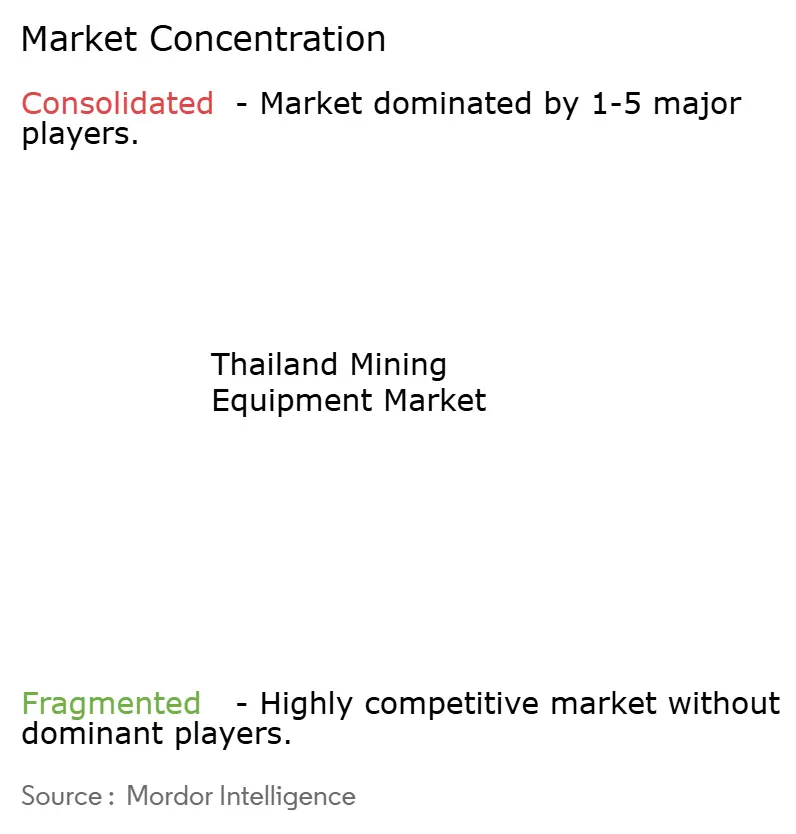
| Market Concentration | Medium |
Major Players *Disclaimer: Major Players sorted in no particular order Image © Mordor Intelligence. Reuse requires attribution under CC BY 4.0. | |
Thailand Mining Equipment Market Analysis by Mordor Intelligence
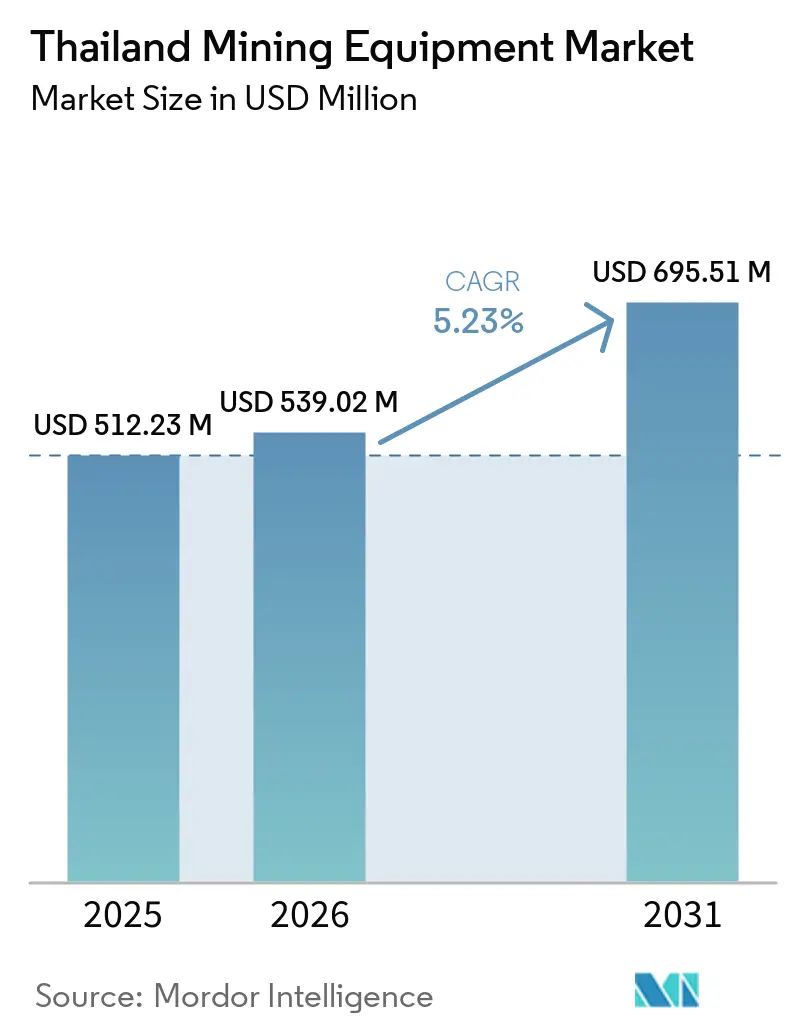
The Thailand Mining Equipment Market is expected to grow from USD 512.23 million in 2025 to USD 539.02 million in 2026 and reach USD 695.51 million by 2031, at a CAGR of 5.23% during the forecast period (2026-2031). Robust limestone quarrying for infrastructure build-out, early-stage potash mobilization in the Northeast, and a measured shift toward battery-electric and semi-autonomous fleets underpin this trajectory. The required aggregate for the 990-billion-baht Southern Land Bridge and the U-Tapao Airport expansion is sustaining demand for mid-size excavators, crushers, and articulated trucks, while Board of Investment (BOI) duty exemptions are accelerating pilot deployments of zero-emission loaders. OEMs are localizing parts hubs near Bangkok to curb lead times, and Chinese entrants are using concessional financing to court mid-tier quarries, intensifying price competition. Financing delays on three large potash concessions temper near-term orders, yet each funding milestone sparks procurement cycles for continuous miners and ventilation fans. Across the ownership landscape, quarry operators are upgrading fleets to meet mandatory ISO 14001 standards that accompany public-sector contracts.
Key Report Takeaways
- By equipment type, surface mining equipment led with a 43.48% revenue share in 2025, while loaders are forecast to post the fastest CAGR at 5.27% through 2031.
- By automation level, manual fleets held 67.71% of the Thailand mining equipment market share in 2025, whereas fully autonomous systems are projected to advance at a 5.29% CAGR between 2026 and 2031.
- By powertrain, internal-combustion units captured 77.83% share in 2025, yet battery-electric vehicles are expected to expand at a 5.32% CAGR to 2031.
- By power output, the 500-1,000 HP bracket accounted for 48.71% of the Thailand mining equipment market in 2025, and sub-500 HP machinery is on track for the strongest 5.35% CAGR through 2031.
- By application, metal mining accounted for 48.37% of demand in 2025, while mineral mining is positioned to grow at a 5.38% CAGR as potash projects near construction.
Note: Market size and forecast figures in this report are generated using Mordor Intelligence’s proprietary estimation framework, updated with the latest available data and insights as of January 2026.
Thailand Mining Equipment Market Trends and Insights
Drivers Impact Analysis*
| Driver | (~) Impact on CAGR Forecast | Geographic Relevance | Impact Timeline |
|---|---|---|---|
| Expansion Of Limestone and Quarry Operations for Domestic Construction | +1.2% | National, with early gains in Chonburi, Rayong, and Nakhon Ratchasima | Short term (≤ 2 years) |
| Surging Investment in Potash Projects in Northeast Thailand | +1.1% | Northeast (Udon Thani, Chaiyaphum, Nakhon Ratchasima) | Long term (≥ 4 years) |
| Rising Demand for Metal Ores From Electronics and EV Supply Chains | +0.9% | National, with concentration in Phuket (tin), Tak (tungsten), and Chiang Mai (rare earths) | Medium term (2-4 years) |
| Adoption Of Semi-Autonomous Haulage for Safety & Cost Reduction | +0.8% | National, pilot deployments in large quarries and potash tunneling sites | Medium term (2-4 years) |
| Government Incentives for Battery-Electric Mining Equipment | +0.7% | National, strongest uptake in Eastern Seaboard and EEC zones | Short term (≤ 2 years) |
| ASEAN Trade Integration: Reducing Import Duties On Capital Equipment | +0.5% | National, benefiting importers across all provinces | Long term (≥ 4 years) |
| Source: Mordor Intelligence | |||
Expansion of Limestone and Quarry Operations for Domestic Construction
Megaprojects such as the land bridge corridor and high-speed rail network elevate aggregate demand, prompting Siam City Cement and Southern Group to add 36-tonne excavators, wheel loaders, and jaw crushers. Compliance with ISO 14001 accelerates fleet renewal because public-sector bids now require certified environmental management [1]“ISO 14001 Audit Requirements,” International Organization for Standardization, iso.org . Notice to Proceed for the U-Tapao Airport upgrade on April 2026 guarantees multi-year material off-take.
Surging Investment in Potash Projects in Northeast Thailand
With a significant annual output target, ASEAN Potash, Asia Pacific Potash, and Thai Kali concessions are placing substantial orders for continuous miners, roof bolters, and conveyor systems, with a total value estimated to be in the hundreds of millions of dollars. The pipeline is further validated by government-approved funding for Udon Thani in a previous year and a major subcontract for Chaiyaphum infrastructure scheduled for late 2024, even as community consultations continue to extend critical-path schedules.
Rising Demand for Metal Ores from Electronics and EV Supply Chains
Growing electronics exports and the 30 out of 30 EV policy are propelling tin, tungsten, and rare-earth extraction. Producers in Phuket, Tak, and Chiang Mai are scaling hydraulic excavator fleets and deploying deeper-reach dredges. The United States Geological Survey recorded 7,500 tonnes of Thai tin output in 2021, and renewed licenses are unlocking fresh pits [2]“Mineral Commodity Summary: Tin 2026,” United States Geological Survey, usgs.gov . Each domestic battery-plant announcement triggers linked exploration programs, yet stricter environmental assessments can delay fleet mobilization by up to 18 months.
Adoption of Semi-Autonomous Haulage for Safety & Cost Reduction
Komatsu’s FrontRunner, Caterpillar MineStar Command, and Sandvik AutoMine systems are benchmarked in Thai tenders after global fleets logged billions of autonomous tonnes. The Department of Primary Industries and Mines is writing guidelines for remote underground operation, positioning potash tunnels as early candidates. Retrofit costs add 30-40% to base-unit prices, so uptake correlates with labor-scarcity hotspots.
Restraints Impact Analysis*
| Restraint | (~) % Impact on CAGR Forecast | Geographic Relevance | Impact Timeline |
|---|---|---|---|
| Ban On Gold Mining Limiting Equipment Demand | -0.6% | National, concentrated in Phichit, Phetchabun, and Loei provinces | Short term (≤ 2 years) |
| Volatile Thermal-Coal Royalties Dampening Projects | -0.4% | National, primarily Lampang (Mae Moh) and southern lignite basins | Medium term (2-4 years) |
| High Grid-Power Tariffs Slowing Electrification in Remote Pits | -0.3% | Northeast (Udon Thani, Nakhon Ratchasima, Chaiyaphum) and northern provinces | Long term (≥ 4 years) |
| Community Opposition to New Rare-Earth Exploration Blocks | -0.2% | Northern provinces (Chiang Mai, Loei, Kanchanaburi) | Medium term (2-4 years) |
| Source: Mordor Intelligence | |||
Ban on Gold Mining Limiting Equipment Demand
A March 2026 court ruling that held Chatree operators liable for environmental damage heightened scrutiny on cyanide leach processes, curbing new hard-rock gold exploration. Drilling-rig and crusher suppliers are redeploying assets to limestone and potash clients while awaiting clearer permitting guidance.
Volatile Thermal-Coal Royalties Dampening Projects
EGAT retired Mae Moh units 8-9 in 2025 and will decommission units 10-13 after 2025, cutting dragline demand. Replacement combined-cycle capacity reduces lignite offtake, and shifting royalty rates discourage fleet renewals in satellite pits, reinforcing a structural downswing for coal equipment [3]“Mae Moh Plant Retirement Plan,” Electricity Generating Authority of Thailand, egat.co.th .
*Our forecasts treat driver/restraint impacts as directional, not additive. The impact forecasts reflect baseline growth, mix effects, and variable interactions.
Segment Analysis
By Equipment Type: Surface Dominance Continues but Loaders Surge
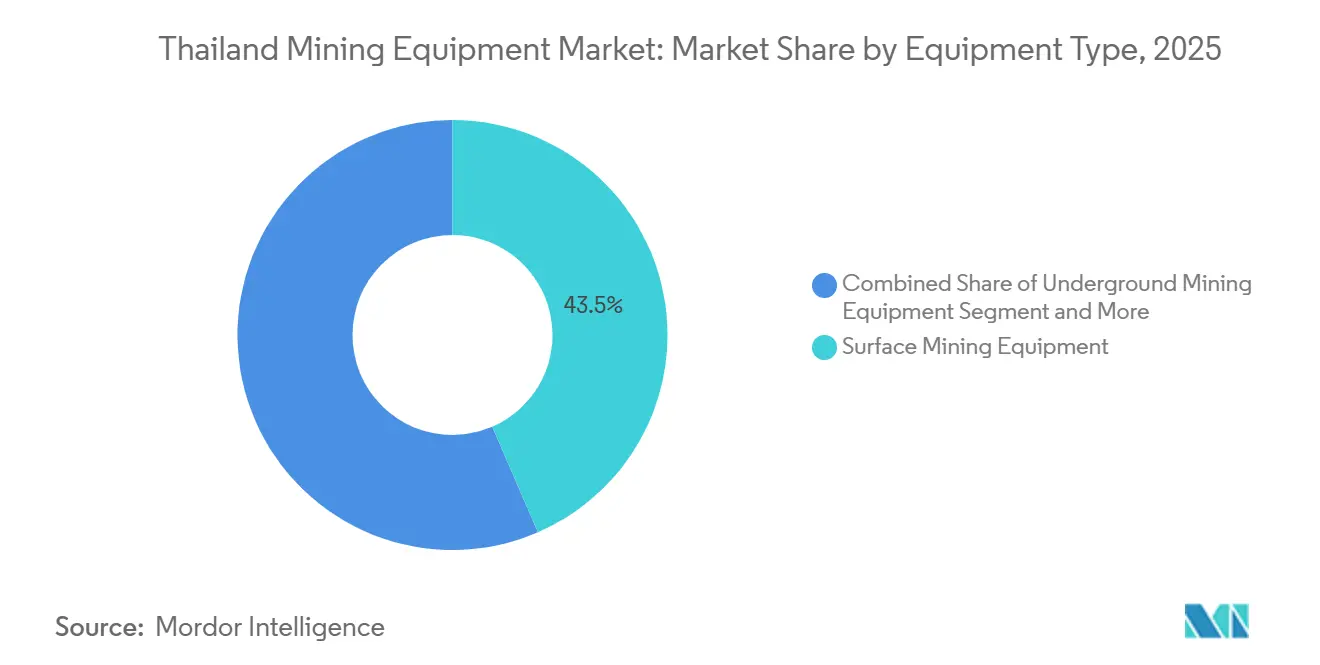
Surface machinery captured 43.48% of 2025 revenue, confirming the Thailand mining equipment market as quarry centric. Loaders are on pace for a 5.27% CAGR through 2031 as modular crushing spreads across mid-size pits. Underground demand remains limited until potash shafts reach full construction phases, yet purchase orders for continuous miners and roof bolters are tied to 2027-2028 delivery windows. Mineral-processing lines support both granite aggregate and potassium chloride beneficiation, with OEMs offering turnkey crusher-screen packages that comply with ISO 14001 dust-emission limits.
The Thailand mining equipment market continues to favor drill rigs rated for 2,000-4,000 m exploration depths, even though most domestic holes remain shallow. Loader OEM portfolios now include 120-480 kW battery-electric variants that appeal to limestone operators with grid access. Large rigid trucks above 100 tonnes are scarce, reflecting an absence of ultra-class open pits, yet sales teams keep demonstrator units on standby should potash ramp-ups warrant higher payload capacity.



By Automation Level: Manual Majority, Autonomous Upswing
Manual fleets still predominate with 67.71% share in 2025 because Thailand hosts numerous small quarries employing skilled operators. Fully autonomous adoption is forecast at a 5.29% CAGR as safety regulations tighten and labor costs climb in remote regions. Tele-remote loaders bridge the gap by lowering exposure in confined headings without full ICT infrastructure. The Thailand mining equipment market now counts at least three pilot potash headings where operators run loaders from surface control rooms. Ongoing standard-setting by DPIM will cement confidence in remote protocols and unlock broader financing for autonomy retrofits.
Semi-autonomous kits provide collision avoidance and operator-assist features that raise productivity 8-12% in limestone quarries. Financing models include per-hour subscription packages that lower entry barriers for family-owned pits. ESG reporting by publicly traded cement producers is also nudging adoption because autonomous systems cut incident rates, a material risk metric for investors.
By Powertrain Type: Diesel Stronghold Faces BEV Pilots
Internal-combustion engines commanded nearly four-fifths of deliveries in 2025, anchored by refueling speed and ubiquitous service parts. Battery-electric units nonetheless show the quickest 5.32% CAGR, backed by BOI import-duty exemptions and a policy tilt toward low-emission mineral extraction in watersheds. The Thailand mining equipment industry records its first commercial deployment of a 10-tonne battery loader in a gypsum drift near Saraburi, where ventilation fans were downsized after diesel retreat. Hybrid drivetrains remain experimental; most quarries prefer either conventional diesel or full battery to simplify maintenance.
Ancillary charging infrastructure is emerging along the Eastern Economic Corridor where renewable penetration is highest. A pilot on-site solar farm paired with 2 MWh battery storage cut grid draw by 28% at a Chonburi granite pit, helping validate the economics of daytime charging for loaders that operate in two-shift patterns. Despite progress, lack of standard charging connectors among OEMs slows broader fleet electrification.
By Power Output: Mid-Range Core, Sub-500 HP Fastest
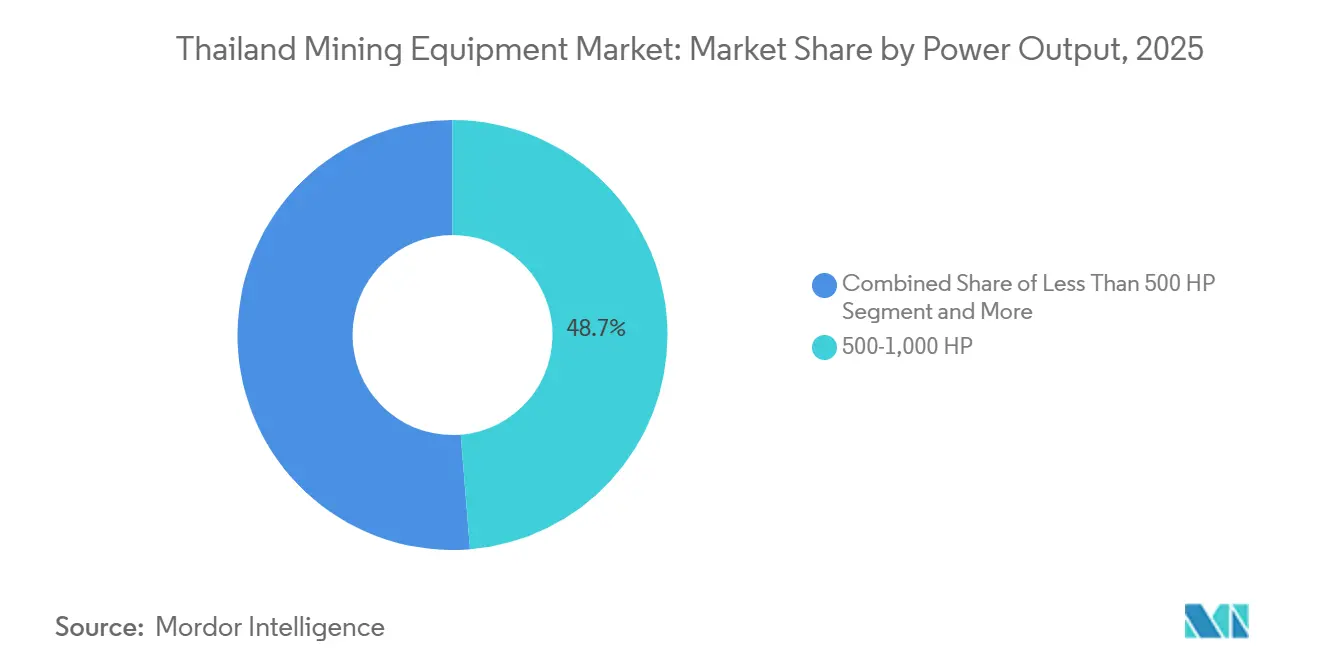
Equipment rated 500-1,000 HP, notably 36-tonne excavators and 60-tonne trucks, accounted for 48.71% of the Thailand mining equipment market size in 2025. These units match limestone face heights and potash drift profiles. Sub-500 HP machines, including compact loaders for reclamation benches, will see the highest 5.35% CAGR as ISO 14001 pushes small pits to formalize closure plans that require grading and seeding. Ultra-class shovels above 1,000 HP remain rare but could appear if potash output scales beyond the current 3.2 million-tonne target.
OEMs differentiate mid-range models via telematics platforms that deliver live fuel-burn analytics, driving up-selling opportunities for productivity consulting services. For sub-500 HP classes, Chinese brands compete aggressively on price and bundle three-year parts warranties, shifting procurement patterns among budget-sensitive operators.
By Application: Metal Leads Today, Minerals Propel Growth
Metal mining generated 48.37% of 2025 demand as tin dredging in Phuket and tungsten extraction in Tak continued supplying electronics feedstock. Mineral mining is projected to outpace at a 5.38% CAGR on the back of potash, gypsum, and limestone projects that anchor domestic fertilizer and cement self-sufficiency. The Thailand mining equipment market will pivot toward underground continuous miners and roof-support systems once potash sites clear financing hurdles. Coal machinery remains a shrinking niche because Mae Moh decommissioning removes the nation’s largest lignite sink.
Quarry producers of limestone for the land bridge and smart-city builds sustain high utilization of wheel loaders and crushers. Potash ventures, while behind schedule, are issuing long-lead tenders for shaft hoists and paste-fill plants that could move by late 2026, providing OEMs with visible pipelines despite macro headwinds.
Geography Analysis
In Thailand's mining equipment market, potash concessions in Udon Thani, Chaiyaphum, and Nakhon Ratchasima are establishing the Northeast as the fastest-growing cluster. Once financing milestones transition into engineering, procurement, and construction contracts, we anticipate a surge in the procurement of continuous miners. The Eastern Seaboard, aligning with corridor megaprojects, boasts the largest installed quarry fleet due to heightened aggregate demand. Pits in Chonburi and Rayong are outfitted with heavy-duty excavators, articulated trucks, and in-pit crushers, all tailored for a premium concrete supply.
While Phuket and Ranong in the south uphold Thailand's storied tin dredging tradition, dwindling resources mean equipment orders are more incremental than revolutionary. In the north, Chiang Mai and Loei eye rare-earth and tungsten opportunities, but community pushback is lengthening their gear deployment timelines.
Bangkok and the Eastern Economic Corridor (EEC) act as pivotal distribution hubs. Major players like Komatsu, Hitachi, and Volvo have set up central parts depots, ensuring they're within a short truck journey to most quarry belts. Meanwhile, local distributors are ramping up their branch networks significantly, a move aimed at ensuring technician dispatches in a timely manner – a key service-level differentiator in the market.
Competitive Landscape
In Thailand's mining equipment market, a moderate concentration prevails. The top five global OEMs command a significant share, achieving a notable concentration score. Caterpillar and Komatsu lead in high-value autonomous haulage bids. Meanwhile, Hitachi and Volvo differentiate themselves in the mid-size excavator segment through telematics. XCMG and Sany, on the other hand, leverage pricing strategies and bundle concessional financing to clinch mid-tier quarry contracts.
In recent years, Sumitomo-Leadway has achieved considerable sales in excavators and is significantly expanding its service branches to enhance parts availability. Epiroc is promoting its battery-electric loader as an eco-friendly choice for potash shafts, while Sandvik is pushing its AutoMine retrofit kits, highlighting a quick payback period in tight headings.
In the near future, OEMs plan to ramp up competition by strategically pre-staging inventory in the Northeast. This move targets the potash capex cycles, positioning OEMs to effectively respond to demand surges. Yet, the unpredictable nature of funding timelines adds a forecasting risk, potentially swaying market dynamics.
Thailand Mining Equipment Industry Leaders
Caterpillar Inc.
Komatsu Ltd.
Hitachi Construction Machinery
Sandvik AB
Epiroc AB
- *Disclaimer: Major Players sorted in no particular order

Recent Industry Developments
- March 2025: Sunwoda has invested more than USD 1 billion in a lithium-ion battery plant located in Chonburi, driving increased upstream demand for precision ore equipment.
- January 2025: Volvo Construction Equipment unveiled its New Generation Excavator line, the EC210, and forged a partnership with a new dealer in Thailand, heightening competition in the mid-market segment.


Thailand Mining Equipment Market Report Scope
The scope of the report includes Equipment Type (Surface Mining Equipment and More), Automation Level (Manual and More), Powertrain Type (ICE and More), Power Output (Less than 500 HP and More), Application (Metal and More), and Geography.
| Surface Mining Equipment |
| Underground Mining Equipment |
| Mineral Processing Equipment |
| Drills & Breakers |
| Crushing, Pulverizing & Screening |
| Loaders |
| Mining Trucks |
| Manual Equipment |
| Semi-Autonomous Equipment |
| Fully Autonomous Equipment |
| Internal-Combustion Engine Vehicles |
| Battery-Electric Vehicles |
| Hybrid Vehicles |
| Less than 500 HP |
| 500 - 1,000 HP |
| Above 1,000 HP |
| Metal Mining |
| Mineral Mining |
| Coal Mining |
| By Equipment Type | Surface Mining Equipment |
| Underground Mining Equipment | |
| Mineral Processing Equipment | |
| Drills & Breakers | |
| Crushing, Pulverizing & Screening | |
| Loaders | |
| Mining Trucks | |
| By Automation Level | Manual Equipment |
| Semi-Autonomous Equipment | |
| Fully Autonomous Equipment | |
| By Powertrain Type | Internal-Combustion Engine Vehicles |
| Battery-Electric Vehicles | |
| Hybrid Vehicles | |
| By Power Output | Less than 500 HP |
| 500 - 1,000 HP | |
| Above 1,000 HP | |
| By Application | Metal Mining |
| Mineral Mining | |
| Coal Mining |


Key Questions Answered in the Report
What is the current value of Thailand mining equipment and how fast is it growing?
The Thailand mining equipment market is expected to reach USD 539.02 million in 2026 and is projected to hit USD 695.51 million by 2031, implying a 5.23% CAGR over 2026-2031.
Which equipment class contributes the most revenue?
Surface mining equipment led with 43.48% revenue share in 2025, anchored by high limestone-quarry activity.
How quickly will battery-electric units penetrate fleets?
Battery-electric vehicles are forecast to post a 5.32% CAGR through 2031, driven by BOI duty waivers and ventilation-cost savings.
Which Thai region is expected to record the sharpest demand increase?
The Northeast—Udon Thani, Chaiyaphum, and Nakhon Ratchasima—should see the fastest growth as three large potash concessions move from permitting to construction.
What project milestone will most shape procurement between 2026 and 2028?
Final financing on the Udon Thani and Chaiyaphum potash mines will trigger bulk orders for continuous miners, roof bolters, and conveyor systems.
How competitive is the supplier landscape?
Five global OEMs control roughly more than half of sales, yielding a moderate concentration score of 6; Caterpillar, Komatsu, Hitachi, Volvo, and Sandvik set technology benchmarks while XCMG and Sany compete on price.
Page last updated on:





