
Sustainable AI Model Training Platform Market Size and Share
Market Overview
| Study Period | 2020 - 2031 |
|---|---|
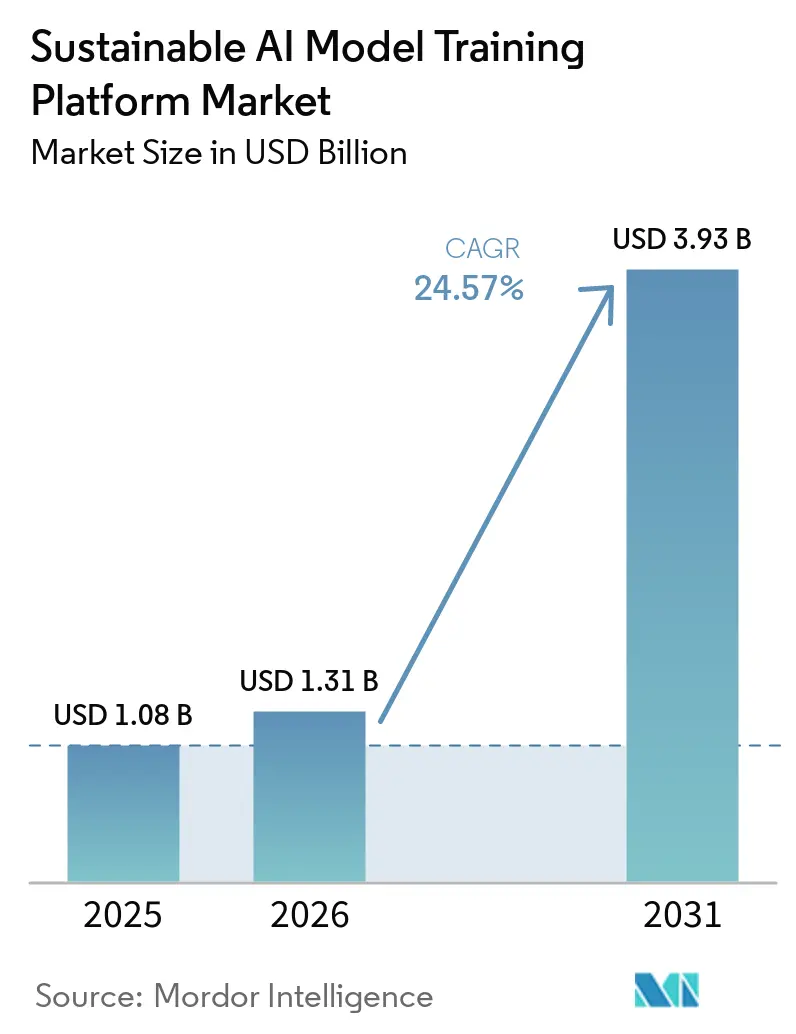
| Market Size (2026) | USD 1.31 Billion |
| Market Size (2031) | USD 3.93 Billion |
| Growth Rate (2026 - 2031) | 24.57 % |
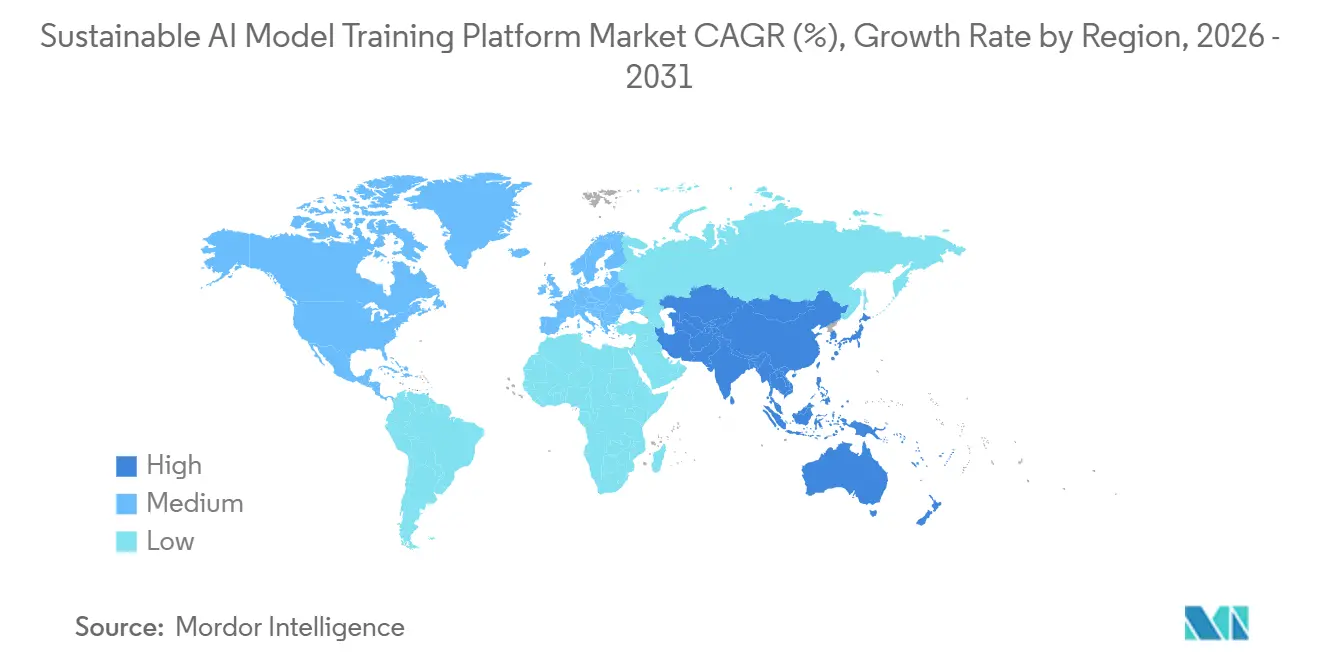
| Fastest Growing Market | Asia-Pacific |
| Largest Market | North America |
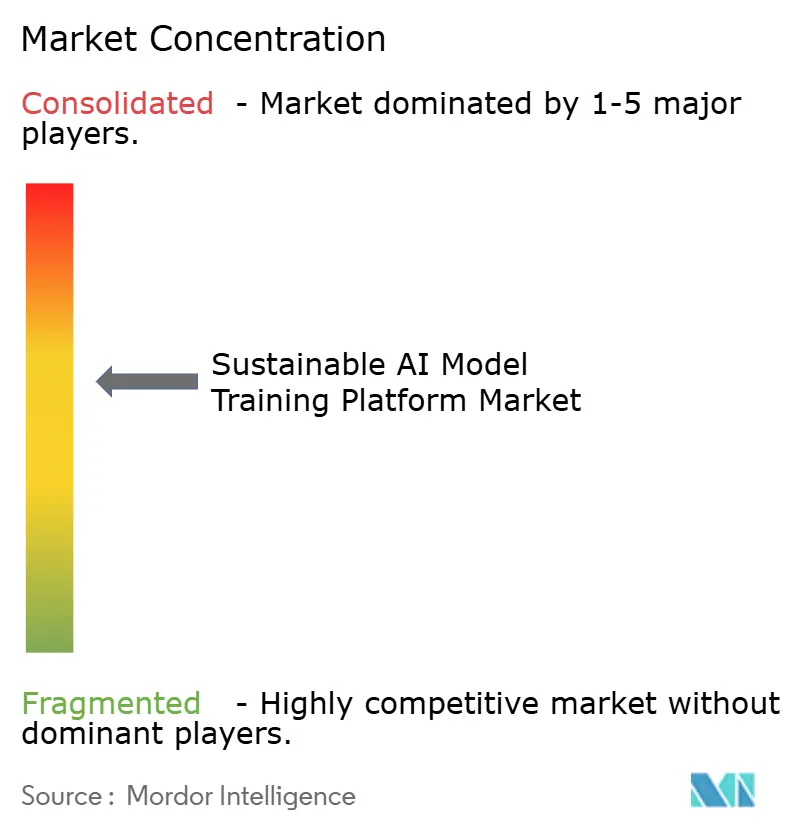
| Market Concentration | Medium |
Major Players *Disclaimer: Major Players sorted in no particular order Image © Mordor Intelligence. Reuse requires attribution under CC BY 4.0. | |
Sustainable AI Model Training Platform Market Analysis by Mordor Intelligence
The sustainable AI model training platform market size was valued at USD 1.08 billion in 2025 and is estimated to grow from USD 1.31 billion in 2026 to reach USD 3.93 billion by 2031, at a CAGR of 24.57% during the forecast period (2026-2031). The market is expanding because compute efficiency now affects the economics of every major training run, and buyers are treating energy use as a direct budget item rather than a side objective. Sovereign AI programs are also in increasing demand because governments want training infrastructure that stays within regional boundaries and demonstrates clear energy accountability. Regulatory pressure is adding to that demand, especially where model developers must disclose or document energy use at the platform level. Competition is tightening as infrastructure providers, MLOps software vendors, specialized AI clouds, and chip-linked optimization players all move toward more integrated offerings. The main risk remains a mix of hardware supply tightness and unsettled carbon-accounting rules, which raises the value of platforms that can deliver auditable efficiency gains even when standards and hardware availability remain unstable.
Key Report Takeaways
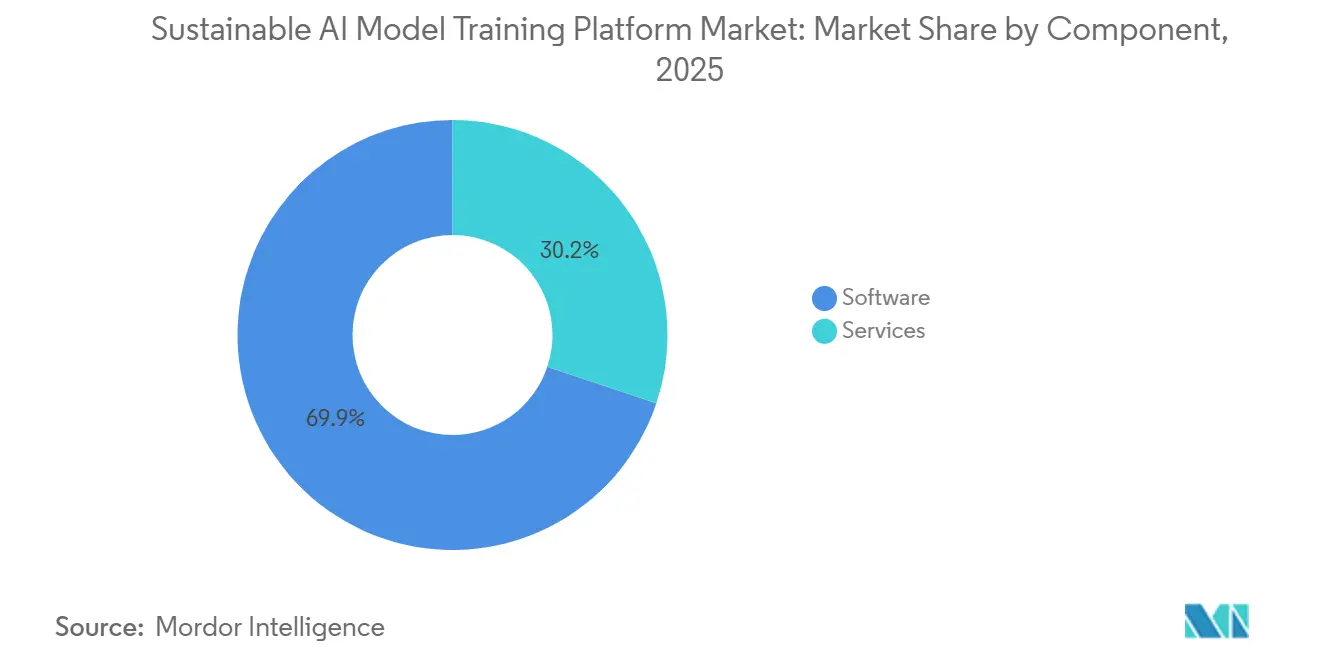
- By component, software led with 69.85% share of the sustainable AI model training platform market in 2025, while services are projected to expand at a 25.34% CAGR through 2031.
- By deployment mode, cloud-based deployment held 67.12% share in 2025, while hybrid deployment is expected to grow at a 25.89% CAGR through 2031.
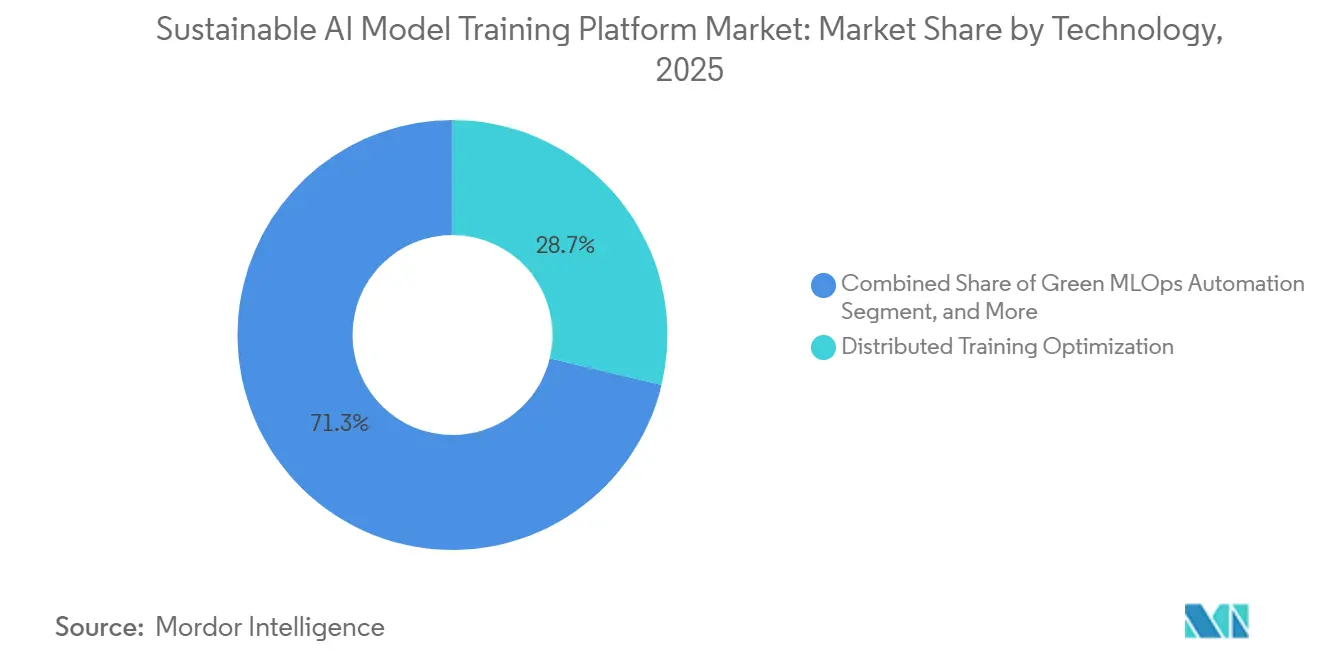
- By technology, distributed training optimization accounted for 28.74% of the market share in 2025, while Green MLOps automation is projected to grow at a 26.12% CAGR through 2031.
- By end user, hyperscale cloud and AI infrastructure providers captured 30.41% share of the sustainable AI model training platform market in 2025, while AI startups and model developers are expected to record the highest CAGR at 25.92% through 2031.
- By geography, North America held 34.56% share in 2025, while Asia-Pacific is projected to expand at a 26.45% CAGR through 2031.
Note: Market size and forecast figures in this report are generated using Mordor Intelligence’s proprietary estimation framework, updated with the latest available data and insights as of January 2026.
Market Trends and Insights
Drivers Impact Analysis of Sustainable AI Model Training Platform Market*
| Driver | (~) % Impact on CAGR Forecast | Geographic Relevance | Impact Timeline |
|---|---|---|---|
| Foundation Model Scale Forces Optimization of Compute per Token | +7.8% | Global, with concentration in North America, China, and United Kingdom | Short term (≤ 2 years) |
| Rising Demand for Carbon-Aware Model Training Workflows | +5.4% | North America and EU, with growing relevance in APAC core markets | Medium term (2-4 years) |
| Enterprise MLOps Teams Prioritize Energy Telemetry and Cost Governance | +3.2% | Global, with early gains in North America enterprise accounts | Short term (≤ 2 years) |
| Sovereign AI Buildouts Favor Regional Training Efficiency | +2.8% | Middle East core, APAC, and EU sovereign programs, spill-over to South America | Medium term (2-4 years) |
| AI Governance Programs Push Traceable, Auditable Training Pipelines | +1.9% | EU (compliance-led), North America (voluntary), with global spill-over | Medium term (2-4 years) |
| Renewable-Powered Data Center Procurement Becomes a Differentiator | +1.6% | Nordic, North America, and APAC renewables-rich corridors | Long term (≥ 4 years) |
| Source: Mordor Intelligence | |||
Foundation Model Scale Forces Optimization of Compute Per Token
Training large language models at frontier scale has changed the cost logic of the sustainable AI model training platform market, as electricity use now directly affects every major procurement decision.[1] A scenario-based modeling study published in PLOS ONE showed that GPT-3 training consumed 1,287MWh of electricity, later model generations consumed 50-70GWh, and that training could account for as much as 68.5% of lifecycle AI carbon emissions under business-as-usual conditions. Researchers from MIT CSAIL and the Max Planck Institute also showed that compressing models during training with CompreSSM removes the extra training pass required by post-hoc pruning, thereby changing how optimization modules are designed. That result favors platform vendors that place compression and efficiency controls within the training loop rather than treating them as a cleanup step after the run is complete. Buyers are responding to the same pressure in commercial terms, with CoreWeave reporting a USD 66.8 billion revenue backlog at the end of 2025, which shows how strongly AI labs are locking in costly capacity ahead of time. In the sustainable AI model training platform market, vendors that reduce waste per token during training are moving closer to the center of platform selection and contract renewal decisions.
Rising Demand for Carbon-Aware Model Training Workflows
Carbon-aware scheduling is becoming a core requirement in the sustainable AI model training platform market because location, power source, and workload timing now shape both emissions and operating cost.[2] A 2026 systematic review in Energy Informatics found that data center location, grid carbon intensity, PUE, and workload scheduling can shift total training emissions by more than an order of magnitude, and carbon-aware scheduling with geo-routing can cut emissions by 20% to 70%, depending on the grid mix. This demand is reaching the commercial layer quickly because the EU AI Act obligations for general-purpose AI took effect in August 2025 and require providers to document and disclose known or estimated model energy consumption. AWS responded in March 2026 by launching its Sustainability console with Scope 1–3 reporting and near-real-time regional-level emissions visibility, which gives MLOps teams a clearer operating view as they prepare for reporting timelines. Research is also moving toward production relevance, with CarbonGearRL demonstrating up to 52% CO2 reduction without throughput loss on 70-billion-parameter LLaMA-style models by adjusting cluster width and arithmetic precision against live grid signals. The commercial opening in the sustainable AI model training platform market lies in turning those promising research methods into workflows that are usable, auditable, and easy for buyers to deploy at scale.
Enterprise MLOps Teams Prioritize Energy Telemetry and Cost Governance
Energy telemetry is moving into core platform buying criteria in the sustainable AI model training platform market because training efficiency is now reviewed with the same scrutiny as compute utilization and experiment success. This shift is widening the buyer set beyond sustainability teams, as finance and engineering groups increasingly want clearer visibility into the cost profile of long training runs. Weights and Biases, after its integration into CoreWeave’s platform, added telemetry relay and GPU straggler detection through Mission Control, giving teams a way to find underperforming nodes and adjust workloads before waste compounds across a cluster. In large multi-node jobs, a single weak node can hold up the entire run, so node-level visibility is becoming financially important rather than operationally optional. Vendors that embed energy and performance telemetry into experiment-tracking dashboards, rather than isolating it in separate reporting screens, are strengthening their position in the sustainable AI model training platform market. That operating model also makes it easier for enterprise buyers to justify platform spend on cost-governance grounds, even before a formal sustainability mandate is imposed.
Sovereign AI Buildouts Favor Regional Training Efficiency
Sovereign AI programs are creating a durable demand stream for the sustainable AI model training platform market, as governments seek to keep compute, data, and model development within trusted regional boundaries. The Gulf Cooperation Council committed more than USD 200 billion over five years to sovereign AI infrastructure, underscoring the scale of the public-sector opportunity for platforms that can support accountable regional training environments. In Canada, TELUS and the Government of Canada advanced sovereign AI infrastructure in Vancouver, using facilities powered by 98% renewable energy and liquid-cooling systems projected to reduce cooling energy use by 80% compared to conventional designs. These programs are not simply copying hyperscaler models inside national borders, because they also require traceable energy provenance, auditable job histories, and carbon attribution that government authorities can verify. In January 2026, Tamil Nadu signed an INR 10,000 crore (USD 1.16 billion) MoU with Sarvam AI to build India’s first full-stack Sovereign AI Park in Chennai, with data, models, and compute required to remain within the state’s trust boundary.[3] In the sustainable AI model training platform market, vendors that can meet these governance requirements while maintaining competitive training efficiency are likely to gain a stronger position in one of the fastest-expanding procurement categories.
Restraints Impact Analysis of Sustainable AI Model Training Platform Market*
| Restraint | (~) % Impact on CAGR Forecast | Geographic Relevance | Impact Timeline |
|---|---|---|---|
| High Power Density and Cooling Constraints Limit Training Throughput | -3.4% | Global, most acute in North America and APAC dense urban markets | Short term (≤ 2 years) |
| GPU Supply Tightness Delays Sustainable Infrastructure Rollouts | -2.8% | Global, hyperscalers absorb constrained supply, SME and sovereign programs most affected | Short term (≤ 2 years) |
| Carbon Accounting Fragmentation Complicates Platform Standardization | -1.9% | EU (ESRS compliance pressure), North America (SEC and California SB 253) | Medium term (2-4 years) |
| Premium Pricing Of Green Compute Slows SME Adoption | -1.3% | Global, with most severe impact on emerging-market AI startups and research institutions | Long term (≥ 4 years) |
| Source: Mordor Intelligence | |||
High Power Density And Cooling Constraints Limit Training Throughput
Power density and cooling limitations are slowing the sustainable AI model training platform market, as many legacy facilities cannot host the latest AI racks without major retrofit work. This means renewable procurement alone does not unlock training capacity if the physical plant still cannot support sustained high-density loads. Crusoe’s Abilene campus was designed to an annualized PUE of 1.2-1.4 for Phase 1, and its 2026 project sustainability requirements tightened the target to 1.1-1.25, which shows how precise the infrastructure design now has to be.[4] The platform-level consequences are equally important because throttled compute due to thermal saturation can appear as software inefficiency unless thermal headroom is monitored in real time. Preferred Networks, IIJ, and JAIST reinforced that link in March 2026 when they deployed direct-liquid-cooled, high-density AI servers in a purpose-built, modular data center designed as a reference case for water-cooled infrastructure energy metrics. The sustainable AI model training platform market will therefore depend not only on better software controls but also on tighter coordination between orchestration layers and the thermal limits of the facilities where those workloads run.
GPU Supply Tightness Delays Sustainable Infrastructure Rollouts
Hardware bottlenecks continue to restrain the sustainable AI model training platform market because advanced AI systems still face supply constraints across memory, optics, networking, and fully configured servers. NVIDIA chief executive Jensen Huang said in June 2026 that demand still exceeded supply and that tight conditions could persist into 2027. That environment favors hyperscalers with established allocation access, while smaller enterprises and sovereign programs face slower buildouts and later access to efficient hardware. It also delays the rollout of software gains, because buyers cannot fully benefit from newer optimization layers if their hardware refresh is pushed back. As a result, vendors are placing greater emphasis on techniques such as mixed precision, gradient checkpointing, and more efficient hyperparameter tuning so buyers can increase output per allocated GPU, even in a constrained supply environment. The sustainable AI model training platform market still has strong demand, but supply tightness is stretching deployment timelines and raising the commercial value of software that extracts more useful work from limited hardware
*Our forecasts treat driver/restraint impacts as directional, not additive. The impact forecasts reflect baseline growth, mix effects, and variable interactions.
Sustainable AI Model Training Platform Market Segment Analysis
By Component:
Software Anchors Revenue As Services ScaleSoftware held 69.85% of the sustainable AI model training platform market share in 2025, indicating that buyers still place the greatest value on orchestration, optimization, and carbon intelligence layers before committing to physical infrastructure. Core training platform software remains the largest sub-segment because training orchestration, job scheduling, and resource allocation are the foundation of every large training run in the sustainable AI model training platform market. Carbon intelligence modules are commercializing quickly because they support both cost control and compliance readiness, where buyers need clearer records of model energy use. NVIDIA’s DSX OS, released as open-source modular software in May 2026, illustrates this shift by bringing tokens-per-watt telemetry directly into the operating layer for AI factories. That move also shows how hardware-linked companies are pushing up the software stack to capture more of the optimization value in the sustainable AI model training platform market.
Services are projected to grow at a 25.34% CAGR from 2026 to 2031, making them the fastest-growing component of the sustainable AI model training platform market. This growth reflects a practical gap, because many enterprises can buy the platform but still need help turning telemetry into changes that improve run efficiency and reporting quality. Managed services, sustainability advisory, and model efficiency consulting are therefore gaining ground as companies try to operationalize the data generated by software tools. The pattern resembles the earlier development of cloud MLOps, where organizations first adopted the tooling and then added service partners to translate platform outputs into day-to-day decisions. That service pull also suggests that the sustainable AI model training platform industry is moving from an early tooling phase toward an execution-focused phase, where software and human expertise are increasingly sold together.
By Deployment Mode:
Cloud Dominance Masks Hybrid MomentumCloud-based deployment accounted for 67.12% of the sustainable AI model training platform market in 2025, as most organizations still cannot replicate hyperscale training capacity in their own facilities. The cloud remains the default mode for frontier workloads that require heavy GPU access, rapid scaling, and close integration with broader infrastructure services in the sustainable AI model training platform market. Microsoft’s FY2025 Environmental Sustainability Report stated that the company contracted 34GW of carbon-free electricity across 24 countries, an 18-fold increase since 2020, which helps cloud customers access lower-carbon training compute without managing power sourcing themselves. That renewable-backed infrastructure is part of the reason cloud platforms continue to dominate the sustainable AI model training platform market even when buyers care more about energy accountability. On-premises deployment still matters, but it is concentrated in regulated sectors such as financial services, healthcare, and defense, where sensitive data cannot be moved freely into shared cloud environments.
Hybrid deployment is expected to grow at a 25.89% CAGR from 2026 to 2031, making it the fastest-rising mode in the sustainable AI model training platform market. The main reason is structural, not stylistic, because sovereign AI programs and regulated industries need local control over where data is stored and processed while still needing access to hyperscale-grade tooling. AWS AI Factories reflect that design response by placing dedicated AWS AI infrastructure in customer data centers and operating it as a private AWS Region. This architecture gives enterprise and sovereign buyers a path to combine locality, policy control, and hyperscale training workflows inside the sustainable AI model training platform market. It is also becoming more relevant for colocation operators that want to offer GPU-dense, sustainably powered capacity to customers who own the models but cannot build dedicated infrastructure quickly enough on their own.
By Technology:
Distributed Optimization Leads While Green MLOps SurgesDistributed training optimization accounted for 28.74% of the sustainable AI model training platform market size in 2025, as it sits at the center of any training run spanning multiple GPUs or nodes. In the sustainable AI model training platform market, this layer determines how well clusters handle gradient synchronization, tensor parallelism, and inter-node communication overhead under real operating conditions. The difference between weak and strong cluster utilization directly affects energy use per token, so buyers continue to treat this technology as a first-order requirement rather than a feature add-on. Specialized hardware approaches are also reinforcing the importance of this layer, as vendors seek to reduce communication overhead and improve scaling efficiency through tighter system design. Research presented at AAAI 2026 added to that direction, with SEAP showing 50% sparsity and less than 1.5% performance decline across most tasks, suggesting a larger role for pruning and compression in future optimization modules.
Green MLOps automation is projected to grow at a 26.12% CAGR from 2026 to 2031, making it the fastest-growing technology segment in the sustainable AI model training platform market. This growth is tied to the move from static reporting to active carbon-aware scheduling, which changes when and where workloads run. CarbonFlex, a Kubernetes-native carbon-aware scheduler integrated with the WattTime API, achieved carbon savings of up to 57% compared to carbon-agnostic baselines in AWS ParallelCluster deployments. Enterprises are also looking for auditable workload carbon trails, which is increasing demand for automation layers that can connect emissions data to specific experiments, model versions, and compute settings. At the same time, federated and distributed learning tools are gaining relevance in the sustainable AI model training platform industry because they help organizations train across dispersed data environments without centralizing sensitive information.

By End User:
Hyperscalers Lead As Startups AccelerateHyperscale cloud and AI infrastructure providers accounted for 30.41% of the sustainable AI model training platform market share in 2025, as they run the largest training workloads and realize the greatest direct benefits from efficiency gains. The business case is straightforward in the sustainable AI model training platform market, since small percentage improvements in energy efficiency create very large cost savings when active power reaches utility-scale levels. CoreWeave reported surpassing 1GW of active power in Q1 2026, demonstrating the scale at which platform efficiency starts to translate into material operating leverage. Colocation data center operators are the next major user group, as they use platform capabilities to differentiate multi-tenant GPU capacity based on energy efficiency and governance attributes. That positioning matters more as enterprise and sovereign buyers place tighter sustainability and reporting conditions inside procurement requests.
AI startups and model developers are expected to grow at a 25.92% CAGR from 2026 to 2031, which makes them the fastest-growing end-user group in the sustainable AI model training platform market. Their growth reflects the rise of venture-backed labs that view per-token training efficiency as a direct factor in runway management and investor scrutiny. This user group is often more willing to adopt aggressive optimization techniques because training costs have an immediate impact on speed to release and fundraising confidence. Research institutions are also emerging as a meaningful high-growth class, especially where public-private projects link AI compute to broader energy systems. Denmark’s energy-efficient AI supercomputer project with Danfoss and HPE illustrates that direction by combining advanced compute with waste heat recovery into Sønderborg Municipality’s district energy network.
Geography Analysis
North America Sustainable AI Model Training Platform Market
North America accounted for 34.56% of the sustainable AI model training platform market in 2025, making it the largest regional contributor. The United States remains the core demand center because it hosts hyperscalers, frontier model developers, specialized AI clouds, and a dense vendor base across infrastructure and MLOps layers. CoreWeave’s Q1 2026 results showed capacity was effectively sold out for all of 2026, with contract visibility stretching into 2027, reflecting the strong training demand in the region. Canada is emerging as a distinct sub-market through sovereign- and renewable-led infrastructure, with TELUS and the Government of Canada advancing facilities in Vancouver powered by 98% renewable energy and liquid-cooling systems, projected to reduce cooling energy use by 80% compared to traditional data centers. Mexico remains earlier in development, with growth tied more to nearshore AI service delivery and proximity to U.S. demand than to frontier-scale domestic training infrastructure.
APAC Sustainable AI Model Training Platform Market
Asia-Pacific is expected to record the fastest CAGR at 26.45% from 2026 to 2031 in the sustainable AI model training platform market. The region is advancing through a mix of sovereign AI investment, hyperscale buildouts, and policy attention to greener compute systems. China’s data center electricity consumption reached 1,660 billion kWh in 2024, equal to 1.68% of national power consumption and linked to 85.9 million tonnes of CO2 emissions, while some advanced facilities reached renewable electricity use rates of 80% under the country’s East-to-West computing push. India is also becoming structurally important, with Adani Group committing USD 100 billion to renewable-energy-powered AI-ready data centers by 2035 and Google beginning construction in 2026 on a USD 15 billion AI hub in Visakhapatnam described as one of its greenest data center projects. Japan adds another important path, with Eurus Energy and Toyota Tsusho commencing construction in April 2026 on a green data center directly connected to a wind power plant through a private power line.
EMEA and South America Sustainable AI Model Training Platform Market
Europe held the third-largest regional share in 2025, and compliance requirements under the EU AI Act heavily shape procurement in the sustainable AI model training platform market. The Nordic countries stand out because Denmark’s national AI supercomputer links waste heat recovery to a municipal CO2-neutral energy system, providing the region with a strong reference model for efficient training infrastructure. The Middle East and Africa are more uneven, with the Gulf states driving most sovereign AI demand while other countries are earlier in deployment, creating room for vendors that can combine traceable energy performance with regional compliance needs. Brazil leads South America, but adoption remains limited by thinner local MLOps talent pools and higher cross-border data transfer costs than buyers face in more mature regions.
Competitive Landscape
The sustainable AI model training platform market has a layered structure, with a small group of integrated providers sitting above a broader field of specialists focused on optimization, telemetry, governance, or infrastructure efficiency. This means the market is competitive but not fully consolidated, as buyers can still assemble their own stack from different software and infrastructure providers. CoreWeave’s May 2025 acquisition of Weights and Biases was one of the clearest moves in this direction, combining GPU-scale cloud infrastructure with experiment tracking and observability in a single commercial stack. That integration gained more weight in 2026, when CoreWeave reported 1GW of active power under management, showing that platform-level efficiency matters much more as training infrastructure reaches utility-scale intensity. Space remains open in job-level carbon attribution, third-party-auditable carbon intelligence APIs, and sovereign-ready platform editions built for regional governance requirements.
NVIDIA is also pushing the competitive line higher in the sustainable AI model training platform market by moving from silicon-level control to operating-layer control. Its DSX OS release in May 2026 introduced open, modular software for multi-tenant AI factory operations and brought tokens-per-watt telemetry into the operating environment itself. That move matters because it ties hardware-aware optimization more closely to the software layer that governs throughput, utilization, and tenant management. Over time, that kind of integration could narrow the space for stand-alone optimization vendors that do not control a broader training stack. It also lowers adoption barriers for operators seeking a more unified framework for running large training environments without stitching together multiple tools.
Emerging challengers are approaching the sustainable AI model training platform market from the physical efficiency side rather than the traditional software side. Lambda Labs, working with EdgeCloudLink, deployed NVIDIA GB300 NVL72 systems at a hydrogen-powered, zero-water data center using direct-to-chip liquid cooling and a centralized CDU fed by water created as a byproduct of hydrogen power production. Crusoe Energy Systems is pressing a similar case through strict 2026 sustainability requirements that target a PUE range of 1.1-1.25 for new builds, positioning infrastructure-first operators as credible alternatives for buyers with hard energy and carbon commitments. As a result, the sustainable AI model training platform market remains contested because leading buyers can still choose between fully integrated stacks and mixes of specialized tools, depending on whether they prioritize scale, sovereignty, observability, or physical efficiency.
Sustainable AI Model Training Platform Industry Leaders
-
NVIDIA Corporation
-
Microsoft Corporation
-
Alphabet Inc.
-
Amazon.com, Inc.
-
International Business Machines Corporation
- *Disclaimer: Major Players sorted in no particular order
Sustainable AI Model Training Platform Market Companies Covered in this Report
- NVIDIA Corporation
- Microsoft Corporation
- Google LLC
- Amazon.com, Inc.
- International Business Machines Corporation
- Databricks, Inc.
- Hugging Face, Inc.
- CoreWeave, Inc.
- Lambda Labs, Inc.
- Crusoe Energy Systems LLC
- DataRobot, Inc.
- C3.ai, Inc.
- H2O.ai, Inc.
- Weights and Biases, Inc.
- Snorkel AI, Inc.
- Anyscale, Inc.
- SkyPilot (Sky Computing Lab),
- Stability AI Ltd.
- Cerebras Systems Inc.
- Advanced Micro Devices, Inc
Recent Industry Developments in Sustainable AI Model Training Platform Market
- June 2026: NVIDIA unveiled Omniverse DSX at GTC Washington D.C., a comprehensive open blueprint for designing and operating gigawatt-scale AI factories incorporating DSX Boost (token throughput per megawatt optimization) and DSX Flex (renewable generation and adaptive grid balance), directly embedding sustainable training efficiency into AI factory design from the outset. The blueprint was validated at Digital Realty's Manassas, Virginia site using the NVIDIA Vera Rubin platform.
- May 2026: SoftBank Group and Sesterce announced a joint venture to develop a 1GW AI data center campus in Bosquel, France, designed with advanced technologies to minimize environmental impact and water usage, directly supporting France's sovereign AI ecosystem and expanding sustainable AI training capacity in Europe.
- May 2026: Lambda Labs closed a USD 1 billion syndicated senior secured credit facility to fund expansion of next-generation NVIDIA AI accelerator server fleets and data center capacity, extending its Series E financing infrastructure following the November 2025 USD 1.5 billion Series E raise.
- May 2026: IBM unveiled next-generation watsonx Orchestrate at Think 2026 in Boston, an agentic control plane for multi-agent orchestration with consistent policy enforcement and accountability, alongside IBM Sovereign Core for operational independence, the latter directly addressing enterprise demand for auditable, traceable AI training pipelines.
Global Sustainable AI Model Training Platform Market Report Scope
The Sustainable AI Model Training Platform market refers to platforms and services designed to reduce the environmental impact of artificial intelligence training workloads by integrating carbon-aware and energy-efficient practices into the AI lifecycle. These solutions provide functionalities such as carbon-aware scheduling, distributed training optimization, model compression and pruning, efficient hyperparameter tuning, federated and distributed learning, and Green MLOps automation. By embedding sustainability intelligence into AI model development and deployment, these platforms enable organizations to minimize energy consumption, reduce carbon emissions, and align AI operations with ESG and decarbonization goals.
The Sustainable AI Model Training Platform market report is segmented by Component (Software [Core Platform, Optimization Modules, Carbon Intelligence Modules], and Services), Deployment Mode (Cloud-Based, On-Premises, and Hybrid), Technology (Carbon-Aware Scheduling, Distributed Training Optimization, Model Compression and Pruning, Efficient Hyperparameter Optimization, Federated and Distributed Learning, Green MLOps Automation), End User (Hyperscale Cloud and AI Infrastructure Providers, Colocation Data Center Operators, Enterprise Data Centers, Research Institutions, AI Startups and Model Developers), and Geography (North America, South America, Europe, Asia-Pacific, Middle East and Africa). The Market Forecasts are Provided in Terms of Value (USD).
Segmentation Overview
| Software | Core Platform |
| Optimization Modules | |
| Carbon Intelligence Modules | |
| Services |
| Cloud-Based |
| On-Premises |
| Hybrid |
| Carbon-Aware Scheduling |
| Distributed Training Optimization |
| Model Compression and Pruning |
| Efficient Hyperparameter Optimization |
| Federated and Distributed Learning |
| Green MLOps Automation |
| Hyperscale Cloud and AI Infrastructure Providers |
| Colocation Data Center Operators |
| Enterprise Data Centers |
| Research Institutions |
| AI Startups and Model Developers |
| North America | United States | |
| Canada | ||
| Mexico | ||
| South America | Brazil | |
| Argentina | ||
| Rest of South America | ||
| Europe | Germany | |
| United Kingdom | ||
| France | ||
| Italy | ||
| Spain | ||
| Russia | ||
| Rest of Europe | ||
| Asia-Pacific | China | |
| India | ||
| Japan | ||
| South Korea | ||
| Australia | ||
| Rest of Asia-Pacific | ||
| Middle East and Africa | Middle East | Saudi Arabia |
| United Arab Emirates | ||
| Turkey | ||
| Rest of Middle East | ||
| Africa | South Africa | |
| Egypt | ||
| Rest of Africa | ||
| By Component | Software | Core Platform | |
| Optimization Modules | |||
| Carbon Intelligence Modules | |||
| Services | |||
| By Deployment Mode | Cloud-Based | ||
| On-Premises | |||
| Hybrid | |||
| By Technology | Carbon-Aware Scheduling | ||
| Distributed Training Optimization | |||
| Model Compression and Pruning | |||
| Efficient Hyperparameter Optimization | |||
| Federated and Distributed Learning | |||
| Green MLOps Automation | |||
| By End User | Hyperscale Cloud and AI Infrastructure Providers | ||
| Colocation Data Center Operators | |||
| Enterprise Data Centers | |||
| Research Institutions | |||
| AI Startups and Model Developers | |||
| By Geography | North America | United States | |
| Canada | |||
| Mexico | |||
| South America | Brazil | ||
| Argentina | |||
| Rest of South America | |||
| Europe | Germany | ||
| United Kingdom | |||
| France | |||
| Italy | |||
| Spain | |||
| Russia | |||
| Rest of Europe | |||
| Asia-Pacific | China | ||
| India | |||
| Japan | |||
| South Korea | |||
| Australia | |||
| Rest of Asia-Pacific | |||
| Middle East and Africa | Middle East | Saudi Arabia | |
| United Arab Emirates | |||
| Turkey | |||
| Rest of Middle East | |||
| Africa | South Africa | ||
| Egypt | |||
| Rest of Africa | |||
Key Questions Answered in the Report
What is the sustainable AI model training platform market size in 2026 and where will it reach by 2031?
The sustainable AI model training platform market is estimated at USD 1.31 billion in 2026 and is projected to reach USD 3.93 billion by 2031, growing at a 24.57% CAGR.
Which component leads revenue generation in this space?
Software led with 69.85% share in 2025 because orchestration, optimization, and carbon intelligence tools form the core value layer before hardware decisions are made.
Why is hybrid deployment gaining traction for AI training platforms?
Hybrid deployment is projected to grow at a 25.89% CAGR through 2031 because sovereign AI programs and regulated industries need local control over data while still accessing hyperscale-grade tooling.
Which technology area is expanding the fastest?
Green MLOps automation is the fastest-growing technology segment, with a 26.12% CAGR, as buyers move from static carbon reporting toward active carbon-aware scheduling and auditable workload tracking.
Which region is growing the fastest for sustainable AI training platforms?
Asia-Pacific is projected to grow at a 26.45% CAGR through 2031, supported by sovereign AI programs, green compute policies, and large data center investments in China, India, and Japan.
Who are the most important end users shaping demand?
Hyperscale cloud and AI infrastructure providers led with 30.41% share in 2025, while AI startups and model developers are the fastest-growing group at a 25.92% CAGR because training efficiency directly affects runway and product speed.