
IT Sustainability Talent and Training Platform Market Size and Share
Market Overview
| Study Period | 2020 - 2031 |
|---|---|
| Market Size (2026) | USD 1.42 Billion |
| Market Size (2031) | USD 3.97 Billion |
| Growth Rate (2026 - 2031) | 22.83 % |
| Fastest Growing Market | Asia-Pacific |
| Largest Market | North America |
| Market Concentration | Low |
Major Players *Disclaimer: Major Players sorted in no particular order Image © Mordor Intelligence. Reuse requires attribution under CC BY 4.0. | |
IT Sustainability Talent and Training Platform Market Analysis by Mordor Intelligence
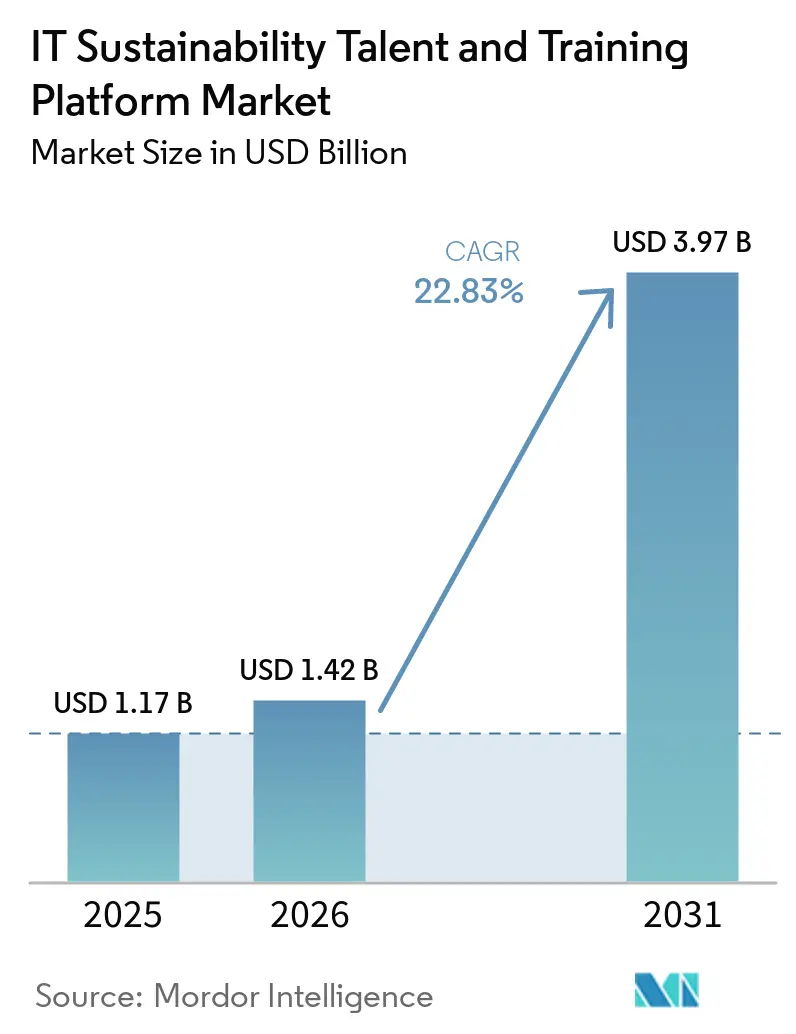
The IT Sustainability Talent and Training Platform Market size is expected to increase from USD 1.17 billion in 2025 to USD 1.42 billion in 2026 and reach USD 3.97 billion by 2031, growing at a CAGR of 22.83% over 2026-2031. The IT Sustainability Talent and Training Platform Market is moving out of a discretionary learning bucket and into a more formal compliance, governance, and workforce readiness category across large enterprises. Buyers are now linking sustainability training to disclosure quality, internal control discipline, board oversight, and supplier-facing reporting obligations, which is changing both approval routes and platform selection criteria. The IT Sustainability Talent and Training Platform Market is also benefiting from faster skill turnover in cloud, AI, green software, and sustainable infrastructure roles, where teams need frequent updates instead of a single annual training cycle. Enterprises are placing more value on platforms that combine content delivery, learning administration, skill analytics, and auditable completion records in one environment, because fragmented approaches create weak accountability across IT, sustainability, and learning teams. This shift is widening opportunities for vendors that can support role-based learning, regulatory content refresh, cross-region deployment, and measurable competency evidence that can sit alongside broader ESG reporting workflows.
Key Report Takeaways
- By component, the platform segment held 68.14% share of the IT Sustainability Talent and Training Platform Market in 2025, while services are projected to expand at a 22.91% CAGR through 2031.
- By deployment, cloud-based delivery held 64.17% share in 2025, while hybrid deployment is projected to expand at a 23.02% CAGR through 2031.
- By end user, IT and digital professionals held 27.19% share in 2025, while sustainability and ESG professionals are projected to expand at a 23.13% CAGR through 2031.
- By learning modality, self-paced digital learning held 26.12% share in 2025, while simulation-based and scenario-based learning is projected to expand at a 23.21% CAGR through 2031.
- By geography, North America held 34.18% share of the IT Sustainability Talent and Training Platform Market in 2025, while Asia-Pacific is projected to expand at a 23.34% CAGR through 2031.
Note: Market size and forecast figures in this report are generated using Mordor Intelligence’s proprietary estimation framework, updated with the latest available data and insights as of January 2026.
Market Trends and Insights
Drivers Impact Analysis of IT Sustainability Talent and Training Platform Market*
| Driver | (~) % Impact on CAGR Forecast | Geographic Relevance | Impact Timeline |
|---|---|---|---|
| Rising Mandatory ESG and Green IT Capability Requirements | 6.5% | Global, concentrated in EU and North America | Short term (≤ 2 years) |
| Hybrid Work Models Increasing Demand for Scalable Digital Training Delivery | 4.5% | Global | Medium term (2-4 years) |
| Fast Skill Obsolescencein Cloud, AI, and Sustainable Computing Roles | 3.8% | North America, APAC, EU | Medium term (2-4 years) |
| Board-Level Pressure for Measurable Sustainability Competency Building | 3.0% | North America, EU, APAC core | Medium term (2-4 years) |
| Growing Adoption of Micro-Credentials and Role-Based Learning Paths | 2.0% | EU, APAC, spill-over to North America | Long term (≥ 4 years) |
| Procurement Preference for Integrated Learning and Reporting Platforms | 1.5% | Global | Long term (≥ 4 years) |
| Source: Mordor Intelligence | |||
Rising Mandatory ESG and Green IT Capability Requirements
Mandatory disclosure rules are creating a new layer of training demand within the IT Sustainability Talent and Training Platform Market, as more employees now need working knowledge of reporting methods, digital sustainability controls, and evidence standards. The EU Corporate Sustainability Reporting Directive expanded the number of companies and non-EU parent entities that must prepare structured sustainability disclosures, thereby increasing the need for repeatable learning tied to ESRS expectations and audit preparation.[1] The publication of ISO/IEC TS 20125-1:2026 is also important because it provides digital services ecodesign with a clearer technical framework that IT teams can use in training and operational practice. These changes are pushing enterprises to move beyond generic awareness modules and toward role-based learning paths for IT, data, procurement, internal audit, and sustainability reporting staff. The IT Sustainability Talent and Training Platform Market is therefore seeing stronger demand for platforms that can refresh content quickly, map lessons to job roles, and preserve completion records that support broader compliance work. Providers that can localize regulatory content without slowing deployment are likely to gain more attention as reporting timelines extend across additional geographies and business functions.
Hybrid Work Models Increasing Demand for Scalable Digital Training Delivery
Hybrid and distributed work has changed the operating model for sustainability learning, giving the IT Sustainability Talent and Training Platform Market a durable delivery advantage over traditional classroom-led approaches. Enterprises now need to reach IT engineers, ESG analysts, procurement managers, and business leaders across many countries within the same reporting cycle, making static annual programs less practical. Self-paced delivery, modular updates, and role-specific learning paths have moved closer to the center of procurement decisions because they support faster rollout across dispersed teams. The IT Sustainability Talent and Training Platform Market is also benefiting from the fact that training now has to keep pace with amendments, extensions, and new interpretations across multiple reporting and technology rules. Buyers are therefore leaning toward cloud-led or hybrid models that can segment content by geography, function, and regulatory relevance without rebuilding the learning structure each time. This dynamic is strengthening the position of vendors that can combine scale, governance control, and detailed completion tracking across a globally distributed workforce.
Fast Skill Obsolescence In Cloud, AI, and Sustainable Computing Roles
The IT Sustainability Talent and Training Platform Market is being driven by the pace of change in technical roles amid AI adoption, cloud migration, and rising sustainability reporting demands. The World Economic Forum reported that 39% of existing skill sets are expected to be transformed or become outdated between 2025 and 2030, while 63% of employers identified skill gaps as the main barrier to business transformation.[2] That broad shift matters here because green software engineering, AI energy efficiency analysis, responsible infrastructure design, and digital emissions measurement all require new technical literacy that was not standard in enterprise learning catalogs before 2024. The IT Sustainability Talent and Training Platform Market is also gaining support from formal credential development, including ITIL 4 Specialist: Sustainability in Digital and IT, which shows that environmental capability inside technology functions is becoming more structured and more visible to employers.[3] This creates room for platforms that can connect skill-gap analysis with curated training, micro-learning refresh, and role-based progression paths rather than relying on broad awareness content. Vendors that can update technical sustainability content at the pace of cloud and AI change are likely to remain more relevant through the next phase of enterprise procurement.
Board-Level Pressure For Measurable Sustainability Competency Building
Board and executive oversight is becoming an increasingly important demand layer within the IT Sustainability Talent and Training Platform Market, as sustainability reporting now carries direct governance, assurance, and reputational consequences. Senior leadership teams are asking for learning formats that are shorter, more applied, and easier to connect to decision-making around disclosures, supplier risk, and technology investment. This is increasing demand for executive briefings, scenario-based modules, and learning journeys that can demonstrate completion and understanding in a board-ready format. CorpStage’s ESG Academy addresses this need by aligning training with the ISSB, TCFD, SASB, GRI, CSRD, and ESRS requirements for board members, executives, and internal audit functions. The IT Sustainability Talent and Training Platform Market is therefore expanding beyond technical user groups and into leadership teams that need stronger fluency in how sustainability data is governed, challenged, and approved. Vendors that can verify competency and present the outcome in clear governance language are likely to access a higher-end segment of enterprise demand.[4]
Restraints Impact Analysis of IT Sustainability Talent and Training Platform Market*
| Restraint | (~) % Impact on CAGR Forecast | Geographic Relevance | Impact Timeline |
|---|---|---|---|
| Limited Budget Approval or Non-Compliance Training Initiatives | -2.5% | Global | Short term (≤ 2 years) |
| Fragmented Ownership Between IT, Sustainability, and Learning And Development Teams | -1.8% | Global | Medium term (2-4 years) |
| Weak Internal Data Visibility on Training Impact And Skill Transfer | -1.2% | Global | Medium term (2-4 years) |
| Localization Burden for Multi-Region Regulatory Content Updates | -0.8% | EU, APAC, MEA | Long term (≥ 4 years) |
| Source: Mordor Intelligence | |||
Limited Budget Approval for Non-Compliance Training Initiatives
The IT Sustainability Talent and Training Platform Market still faces uneven spending patterns in enterprises that have not yet turned sustainability capability gaps into direct compliance or financial risk discussions. Many companies continue to fund this area through discretionary learning budgets rather than compliance, risk, or transformation budgets, making projects easier to defer when cost priorities tighten. This creates a two-speed adoption pattern in which companies under direct reporting pressure move ahead faster, while firms outside the immediate regulatory perimeter postpone broader rollouts. The IT Sustainability Talent and Training Platform Market, therefore, remains more resilient where disclosure obligations, supplier mandates, or investor scrutiny create a clear business case for action. Vendors with a stronger compliance message are better positioned than providers that present sustainability learning as a soft culture or awareness program. Budget resistance should ease over time as procurement and reporting requirements spread through supply chains, but near-term demand is still likely to remain uneven across buyer groups.
Fragmented Ownership Between IT, Sustainability, and Learning and Development Teams
Fragmented internal ownership remains a practical barrier to the IT Sustainability Talent and Training Platform Market, as platform decisions often sit across three functions with different goals and approval routes. IT teams usually focus on security, integration, and access control; sustainability teams focus on framework relevance and disclosure quality; and learning teams focus on adoption and course design. When those groups do not align early, platform buying decisions tend to stall during internal reviews, and rollout can slip even after budget approval. The IT Sustainability Talent and Training Platform Market moves faster when one executive sponsor sets a shared objective and defines how training records will be used across reporting and governance processes. Vendors that bring packaged deployment models, pre-built learning pathways, and clearer ownership templates can reduce some of this friction at the point of implementation. Even so, internal coordination will remain a restraint for providers that rely heavily on buyers to build their own content governance and measurement structures.
*Our forecasts treat driver/restraint impacts as directional, not additive. The impact forecasts reflect baseline growth, mix effects, and variable interactions.
IT Sustainability Talent and Training Platform Market Segment Analysis
By Component:
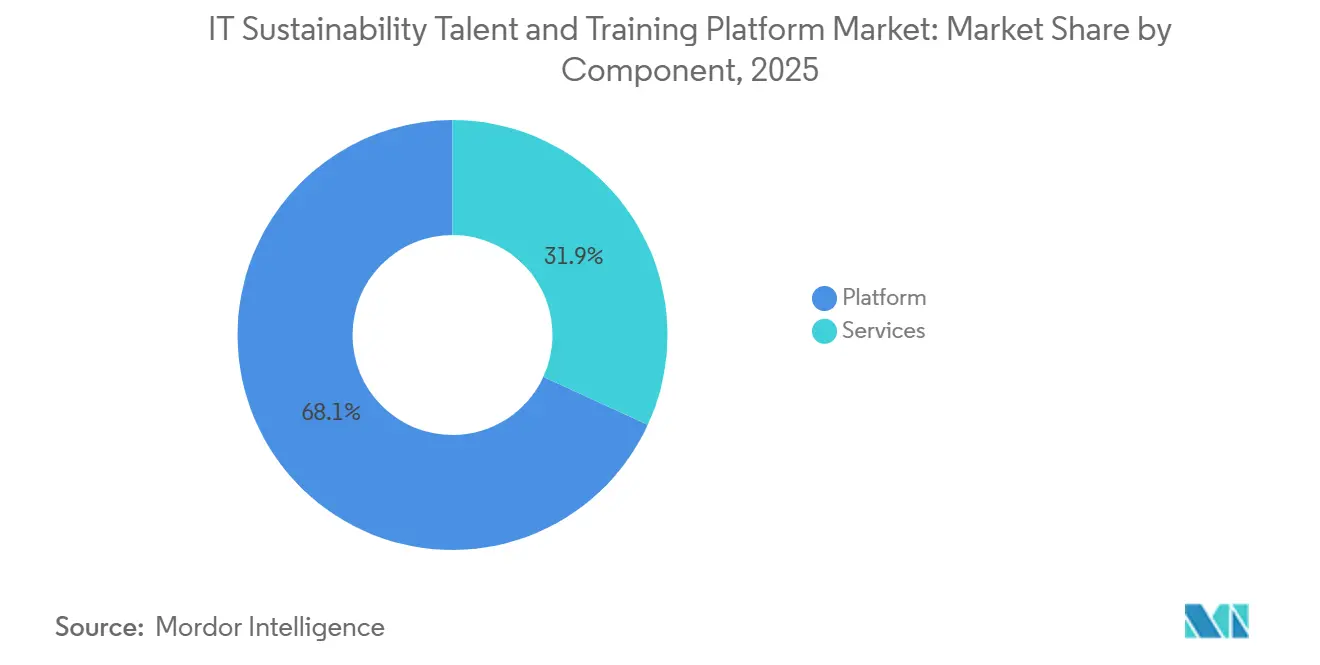
Platform Architecture Drives Enterprise Adoption at ScaleThe platform segment held 68.14% of the IT Sustainability Talent and Training Platform Market share in 2025, reflecting a clear enterprise preference for integrated environments that combine content, administration, skills analytics, and reporting in one system. Buyers increasingly want a platform architecture that can show who completed which training, what framework the content addressed, and how records can support internal audit and disclosure preparation. This preference is commercial as well as operational, because content-only offerings are less attractive when buyers need measurable outputs that can withstand board review and external assurance scrutiny. The IT Sustainability Talent and Training Platform Market has therefore tilted toward vendors that can position their products within a wider governance workflow rather than as stand-alone content libraries. This lead also reflects the advantage of standardized rollout because large companies want a common learning layer that can work across multiple countries, business units, and role groups without forcing separate local systems.
The services segment remained smaller in base share, but it is projected to grow at a 22.91% CAGR from 2026 to 2031, which shows that implementation depth matters almost as much as platform ownership. Enterprises often need help with localized content, regulatory mapping, onboarding plans, and change management when they roll out sustainability learning across different reporting regimes and technical teams. In practice, the platform does not create full value on its own when organizations are managing simultaneous needs around CSRD preparation, ISSB alignment, internal control design, and digital sustainability capability building. The IT Sustainability Talent and Training Platform Market is therefore likely to keep a close link between software and service spending, especially in multi-region deployments where governance and content requirements vary by function and country. Skillsoft’s next-generation Percipio Platform launch in February 2026 illustrates how larger vendors are embedding skills intelligence and workforce-readiness measurement more deeply into platform design, rather than treating those functions as add-ons. As buyer expectations rise, providers that can combine scalable architecture with practical support for localization, integration, and measurement are likely to see stronger renewal performance.
By Deployment:
Cloud Leads While Hybrid Emerges as the Enterprise PreferenceCloud-based deployment retained the largest share at 64.17% in 2025, which kept it at the center of the IT Sustainability Talent and Training Platform Market. Its lead came from easier global rollout, faster content updates, and a pricing model that lets organizations scale usage when disclosure deadlines or procurement demands create sudden training needs. Cloud delivery is especially useful when enterprises need to update modules quickly across several countries and role groups without waiting for internal infrastructure changes. The IT Sustainability Talent and Training Platform Market continues to favor this model because sustainability learning now behaves more like a continuously updated compliance stream than a static annual course. Buyers also value the ability to standardize reporting dashboards and learner records across a broad workforce, which is more efficient when delivery sits in a single cloud-led environment.
Hybrid deployment is projected to grow at a 23.02% CAGR from 2026 to 2031, reflecting a practical compromise between scale and control. Enterprises in regulated sectors still want cloud-based reach and update speed, but they also need stronger options around data residency, access restrictions, internal hosting preferences, and sector-specific security rules. This is particularly relevant in financial services, government-linked organizations, and multinational firms operating under multiple national data rules simultaneously. The IT Sustainability Talent and Training Platform Market is therefore moving toward deployment models that can support centralized learning management while preserving tighter control over user data and internal records where needed. On-premises deployment will remain in a narrow set of use cases, but it faces structural pressure because it is harder to keep content updates, regional rollouts, and measurement processes in step with regulatory change. Vendors that can offer purpose-built hybrid architectures without adding major implementation friction are likely to remain well-positioned in complex enterprise procurements.
By End User:
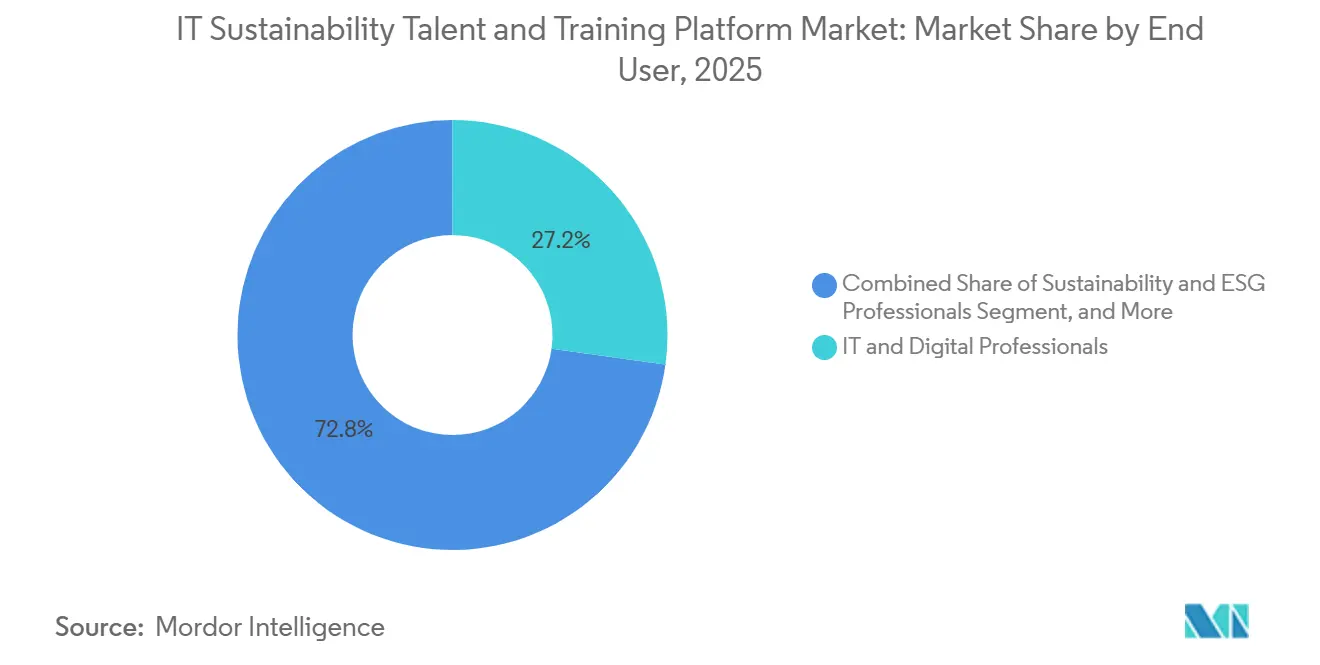
Established Buyer Base Meets Rising ESG Specialist DemandIT and digital professionals represented the largest end-user segment, accounting for 27.19% of market value in 2025, reflecting their role as the primary execution layer for digital sustainability work. These teams are closest to cloud architecture, software efficiency, emissions measurement, data infrastructure, hardware life-cycle choices, and AI deployment practices that shape environmental performance within large organizations. Their training needs are more technical than broad awareness programs, and they often require regular updates because the tools, standards, and reporting methods around sustainable computing keep changing. The IT Sustainability Talent and Training Platform Market has therefore developed around a strong technical user base that needs practical learning tied to systems, workflows, and measurable outcomes. This also explains why enterprise buyers often want content that can move from concept to application quickly, because IT teams are expected to implement sustainability requirements in real operating environments rather than discuss them at a high level.
The sustainability and ESG professionals segment is projected to grow at a 23.13% CAGR through 2031, indicating how quickly formal reporting and assurance capabilities are expanding within companies. Many organizations are building dedicated sustainability reporting teams that need stronger fluency in ESRS topics, double materiality logic, control design, evidence management, and disclosure preparation. HR and learning professionals remain a smaller but strategically important group because they help connect sustainability priorities to workforce planning, recruitment, capability development, and enterprise communication. Operations and facilities professionals also matter because process-level carbon measurement, reduction action, and reporting quality often depend on how digital and physical systems are coordinated across sites and functions. The IT Sustainability Talent and Training Platform Market is thus broadening from a technology-centered buyer base into a cross-functional training requirement that touches reporting, talent, operations, procurement, and leadership. That widening user mix favors vendors that can organize content by function, capability level, and business process, rather than relying on a single generic sustainability curriculum for all learners.

By Learning Modality:
Self-Paced Leadership Faces Structural Competition From Immersive FormatsSelf-paced digital learning held the largest share at 26.12% in 2025, giving it a leading role in the IT Sustainability Talent and Training Platform Market. Its appeal stemmed from operational flexibility, as global enterprises need to train employees across time zones, roles, and reporting cycles without forcing everyone into the same live session. Self-paced delivery also better fits recurring regulatory updates, since modules can be revised and relaunched without reorganizing instructor schedules across several countries. The IT Sustainability Talent and Training Platform Market still relies on this format as the most practical base layer for broad deployment, especially where learner groups include technical teams, governance staff, procurement functions, and leadership cohorts. Buyers also appreciate that self-paced programs can be more easily linked to dashboards, mandatory completion rules, and staged, role-based learning paths within a unified platform.
Simulation-based and scenario-based learning is projected to grow at a 23.21% CAGR from 2026 to 2031, which shows that enterprises want more than awareness when training decisions affect reporting quality and operational trade-offs. Sustainability decisions in technology and procurement often involve competing priorities, which makes applied learning more useful than slide-based content in areas such as Scope 3 reporting, green procurement, infrastructure design, and transition planning. The Digital4Sustainability project published a micro-credentialing framework in February 2026 that uses scenario simulation as a core assessment method for digital sustainability roles, reinforcing the growing institutional support for immersive learning in this field. Harvard Business Publishing and SimInstitute also show how simulation-based sustainability learning is moving into executive and mid-career formats that emphasize applied judgment rather than passive recall. The IT Sustainability Talent and Training Platform Market is likely to keep self-paced learning in the leading volume position, while immersive formats take a larger share of premium and high-accountability use cases. Instructor-led virtual and blended models should remain relevant where organizations need stronger discussion, formal assessment, or visible competency verification for governance-sensitive topics.
Geography Analysis
The Americas IT Sustainability Talent and Training Platform Market
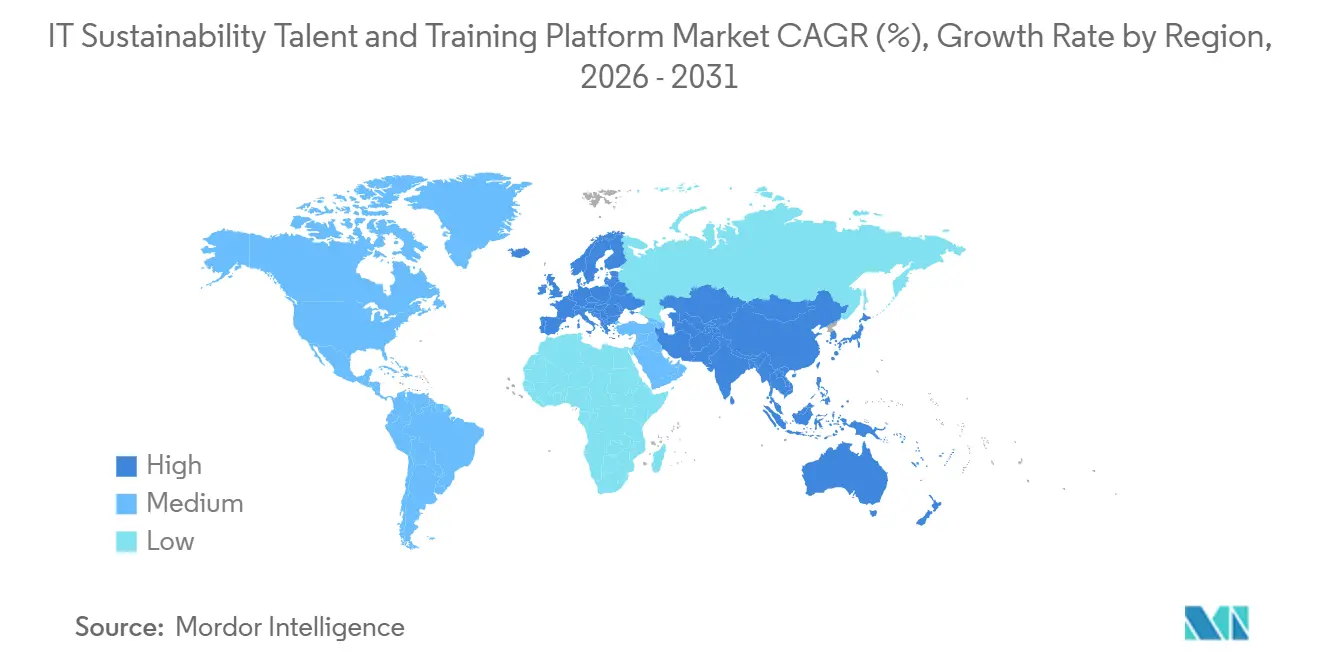
North America held 34.18% of the IT Sustainability Talent and Training Platform Market share in 2025, making it the largest regional block by revenue. The region benefits from a dense concentration of multinational technology companies, more mature enterprise learning budgets, and stronger board-level attention to sustainability governance, digital risk, and disclosure quality. The United States accounted for most regional demand because financial services, technology, and energy companies faced a strong mix of investor pressure, technical retraining needs, and internal reporting expectations. Canada is also building a firmer base for enterprise sustainability capability as listed issuers and large organizations prepare for more structured climate and ESG disclosure expectations. South America remained smaller in revenue, but Brazil is becoming a clearer point of traction as corporate sustainability activity, supply chain disclosure needs, and event-led training demand move higher. Cisco’s July 2025 partnership with Senac to train 500 IT professionals ahead of COP30 in Belém demonstrated how large climate events can generate focused waves of demand for sustainability skills in emerging regional markets.
Europe IT Sustainability Talent and Training Platform Market
Europe remains the most compliance-driven regional setting in the IT Sustainability Talent and Training Platform Market because disclosure obligations are more formal, more visible, and more directly tied to enterprise readiness work. Germany and the United Kingdom are the largest country markets in the region because they combine a broad base of reporting companies with mature learning and development ecosystems. Demand across Europe is especially strong, as organizations need to connect governance expectations with technical execution across IT, data, procurement, and internal control functions. Germany’s NABIT initiative, running from 2026 to 2028, is developing open educational resources on green coding, circular hardware strategies, and CO₂ accounting for IT infrastructure, confirming that digital sustainability capability is becoming a recognized public education priority. Other European markets remain active at different speeds, with multinational subsidiaries often moving earlier than purely domestic firms because parent-level reporting obligations create more immediate training pressure.
APAC and MEA IT Sustainability Talent and Training Platform Market
Asia-Pacific is projected to expand at a 23.34% CAGR through 2031, giving it the fastest growth pace in the IT Sustainability Talent and Training Platform Market. Japan is advancing through corporate governance reform, enterprise digital transformation, and a stronger green IT agenda that supports demand for structured digital learning across technology and reporting roles. India represents the largest volume opportunity because its corporate sector is expanding quickly, its BRSR framework is increasing formal reporting discipline, and its large IT services base creates simultaneous demand for both technical and disclosure-focused training. China is also becoming more relevant as export-oriented enterprises respond to rising international scrutiny of supply chains and stronger expectations for auditable sustainability data and Scope 3 readiness. South Korea and Australia remain established enterprise learning markets with the capacity to integrate sustainability content into broader professional development systems. The Middle East and Africa are still lagging in adoption, but the UAE and Saudi Arabia are laying a firmer foundation through national sustainability programs, economic diversification plans, and formal requirements for large state-linked enterprises and financial institutions.
Competitive Landscape
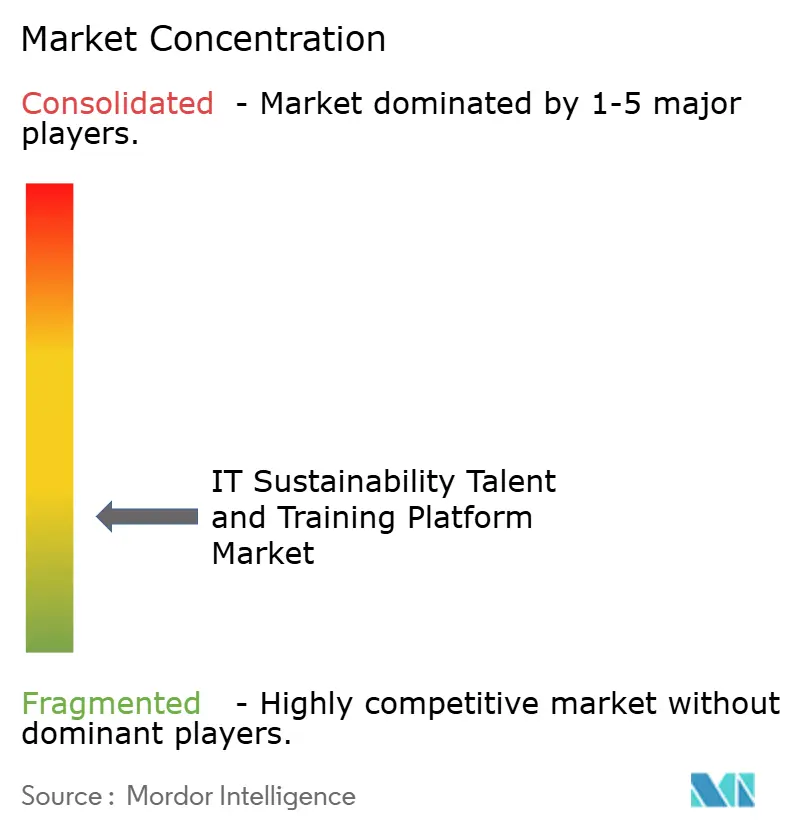
The IT Sustainability Talent and Training Platform Market is fragmented, with no single provider holding decisive influence across components, deployment models, learner groups, and regions. Large enterprise learning platforms such as Pluralsight, Skillsoft, and NIIT Learning Systems hold useful advantages through existing customer relationships, broad content libraries, and established enterprise delivery infrastructure. Specialist providers such as Climate64, 2030 Builders, and CorpStage compete more effectively when buyers need framework-specific governance training, CSRD readiness, or board-focused sustainability capability-building. This mix keeps competition active because buyers do not all want the same product depth, delivery style, or regulatory focus. The IT Sustainability Talent and Training Platform Market, therefore, rewards both scale players and focused providers, depending on whether the buyer's priority is global rollout, technical reskilling, or compliance-specific content.
Competition is becoming less about content volume alone and more about whether vendors can connect training to skill evidence, governance needs, and operational accountability. Microsoft has positioned sustainability learning within a broader ecosystem strategy through Microsoft Learn pathways that support role-based training around sustainability solutions and related digital capabilities. Cisco has also embedded environmental capability within a credential structure through its Environmental Sustainability Fundamentals program, which helps connect training to recognized technical certification pathways. The IT Sustainability Talent and Training Platform Market is giving greater consideration to vendors that can demonstrate measurable outcomes, map learning to roles, and preserve records that buyers can use for reporting and audit purposes. Those capabilities matter more now because enterprises are treating sustainability training as part of a broader operating system for digital responsibility and disclosure readiness.
Recent strategic moves also show where larger players think the market is heading. Skillsoft’s May 2026 sale of its Global Knowledge instructor-led training business for USD 20 million signaled a clearer shift away from legacy delivery models and toward AI-native skills architecture and scalable digital management. SAP’s February 2026 expansion of its learning ecosystem and its commitment to equip 12 million people with AI-ready skills by 2030, including training in sustainability solutions, showed a partner-led route to wider reach across enterprise demand. The IT Sustainability Talent and Training Platform Market is likely to remain highly competitive because large technology vendors can cross-sell training through existing software relationships, while specialists can move faster on framework depth and board-level use cases. Vendors that can connect workforce capability records to sustainability reporting workflows are likely to hold a stronger long-term position than providers that compete mainly on course catalogs.
IT Sustainability Talent and Training Platform Industry Leaders
-
Climate64
-
2030 Builders
-
CorpStage
-
Fitch Learning
-
Skillsoft Corp.
- *Disclaimer: Major Players sorted in no particular order
IT Sustainability Talent and Training Platform Market Companies Covered in this Report
- Climate64
- 2030 Builders
- CorpStage
- Green Software Foundation
- Pluralsight LLC
- Skillsoft Corp.
- NIIT Learning Systems Limited
- Learning Tree International, Inc.
- Fast Lane Institute for Knowledge Transfer GmbH
- Firebrand Training Limited
- QA Limited
- CBT Nuggets, LLC
- ISACA
- The Linux Foundation
- AWS Training and Certification
- Microsoft Corporation
- IBM Corporation
- Oracle Corporation
- SAP SE
- Cisco Systems, Inc.
- Docebo Inc.
Recent Industry Developments in IT Sustainability Talent and Training Platform Market
- May 2026: Skillsoft Corp. completed the sale of its Global Knowledge instructor-led training business to Enduring Ventures Inc. for USD 20 million, enabling a sharper strategic focus on its AI-native Percipio skills management platform. The divestiture redirects investment from legacy classroom delivery toward AI-mediated workforce capability assessment and skills mapping, which is becoming central to enterprise IT sustainability, talent, and training platform procurement.
- May 2026: AWS Training and Certification introduced Lab Maker on AWS Skill Builder, an AI-powered tool generating instant, personalized labs for AWS services, alongside new and updated microcredential topics. These additions expand the practice-based learning infrastructure applicable to cloud sustainability, green infrastructure operations, and the development of competency in carbon emissions management.
- April 2026: Skillsoft reported full-year fiscal 2026 results, disclosing AI content completions up 261% year over year and AI skill benchmark engagement growth of 99%. The data indicates that enterprise demand for AI-integrated learning experiences, including sustainability and ESG content delivery workflows, is scaling significantly faster than platform supply across the sector.
- March 2026: AWS Training and Certification launched multiple new microcredential topics, AWS Builder Labs, and localized exam prep materials on AWS Skill Builder, expanding its stackable role-based digital credential catalog. The microcredential model directly supports modular sustainability learning paths aligned with cloud infrastructure and green computing competency frameworks.
Global IT Sustainability Talent and Training Platform Market Report Scope
The IT Sustainability Talent and Training Platform market comprises platforms and services that build workforce capabilities in sustainability-focused IT practices, ESG compliance, and digital workplace transformation. These solutions provide learning modalities such as self-paced digital learning, instructor-led sessions, blended learning, and simulation-based training to upskill IT, ESG, HR, operations, and leadership professionals. By embedding sustainability knowledge into organizational learning frameworks, these platforms help enterprises strengthen ESG competencies, improve resource efficiency, and align IT operations with global sustainability goals. The primary objective of this market is to enable organizations to cultivate a sustainability-ready workforce, enhance compliance, and drive long-term resilience through talent development and digital learning innovation.
The IT Sustainability Talent and Training Platform market report is segmented by Component (Platform, and Services), Deployment (Cloud-Based, On-Premises, and Hybrid), End User (IT and Digital Professionals, Sustainability and ESG Professionals, HR and Learning Professionals, Operations and Facilities Professionals, and Executive and Leadership Teams), Learning Modality (Self-Paced Digital Learning, Instructor-Led Virtual Learning, Blended Learning, and Simulation-Based and Scenario-Based Learning), and Geography (North America, South America, Europe, Asia-Pacific, Middle East, and Africa). The Market Forecasts are Provided in Terms of Value (USD).
Segmentation Overview
| Platform |
| Services |
| Cloud-Based |
| On-Premises |
| Hybrid |
| IT and Digital Professionals |
| Sustainability and ESG Professionals |
| HR and Learning Professionals |
| Operations and Facilities Professionals |
| Executive and Leadership Teams |
| Self-Paced Digital Learning |
| Instructor-Led Virtual Learning |
| Blended Learning |
| Simulation-Based and Scenario-Based Learning |
| North America | United States | |
| Canada | ||
| Mexico | ||
| South America | Brazil | |
| Argentina | ||
| Rest of South America | ||
| Europe | Germany | |
| United Kingdom | ||
| France | ||
| Italy | ||
| Spain | ||
| Russia | ||
| Rest of Europe | ||
| Asia-Pacific | China | |
| India | ||
| Japan | ||
| South Korea | ||
| Australia | ||
| Rest of Asia-Pacific | ||
| Middle East and Africa | Middle East | United Arab Emirates |
| Saudi Arabia | ||
| Turkey | ||
| Rest of Middle East | ||
| Africa | South Africa | |
| Egypt | ||
| Rest of Africa | ||
| By Component | Platform | ||
| Services | |||
| By Deployment | Cloud-Based | ||
| On-Premises | |||
| Hybrid | |||
| By End User | IT and Digital Professionals | ||
| Sustainability and ESG Professionals | |||
| HR and Learning Professionals | |||
| Operations and Facilities Professionals | |||
| Executive and Leadership Teams | |||
| By Learning Modality | Self-Paced Digital Learning | ||
| Instructor-Led Virtual Learning | |||
| Blended Learning | |||
| Simulation-Based and Scenario-Based Learning | |||
| By Geography | North America | United States | |
| Canada | |||
| Mexico | |||
| South America | Brazil | ||
| Argentina | |||
| Rest of South America | |||
| Europe | Germany | ||
| United Kingdom | |||
| France | |||
| Italy | |||
| Spain | |||
| Russia | |||
| Rest of Europe | |||
| Asia-Pacific | China | ||
| India | |||
| Japan | |||
| South Korea | |||
| Australia | |||
| Rest of Asia-Pacific | |||
| Middle East and Africa | Middle East | United Arab Emirates | |
| Saudi Arabia | |||
| Turkey | |||
| Rest of Middle East | |||
| Africa | South Africa | ||
| Egypt | |||
| Rest of Africa | |||
Key Questions Answered in the Report
What is the size outlook for the IT Sustainability Talent and Training Platform Market?
The IT Sustainability Talent and Training Platform Market was valued at USD 1.17 billion in 2025, stands at USD 1.42 billion in 2026, and is forecast to reach USD 3.97 billion by 2031 at a 22.83% CAGR.
What is driving enterprise demand for these platforms?
Demand is being driven by mandatory disclosure readiness, stronger board oversight, faster skill change in cloud and AI roles, and the need for auditable sustainability competency records.
Which component leads revenue today?
The platform segment led with 68.14% share in 2025 because buyers prefer integrated systems that combine content delivery, administration, analytics, and reporting alignment.
Why is hybrid deployment gaining traction so quickly?
Hybrid deployment is projected to grow at a 23.02% CAGR through 2031 because enterprises want cloud-based scale while preserving stronger control over data residency and internal governance needs.
Which learner group creates the largest current demand base?
IT and digital professionals held the largest share at 27.19% in 2025 because they manage the technical work behind sustainable infrastructure, emissions tracking, and responsible digital operations.
Which region is expected to grow the fastest through 2031?
Asia-Pacific is projected to expand at a 23.34% CAGR through 2031, supported by regulatory reform, large technology workforces, and wider enterprise sustainability training adoption.