
Sustainability Consulting Services Market Size and Share
Market Overview
| Study Period | 2020 - 2031 |
|---|---|
| Market Size (2026) | USD 57.51 Billion |
| Market Size (2031) | USD 180.53 Billion |
| Growth Rate (2026 - 2031) | 25.68 % |
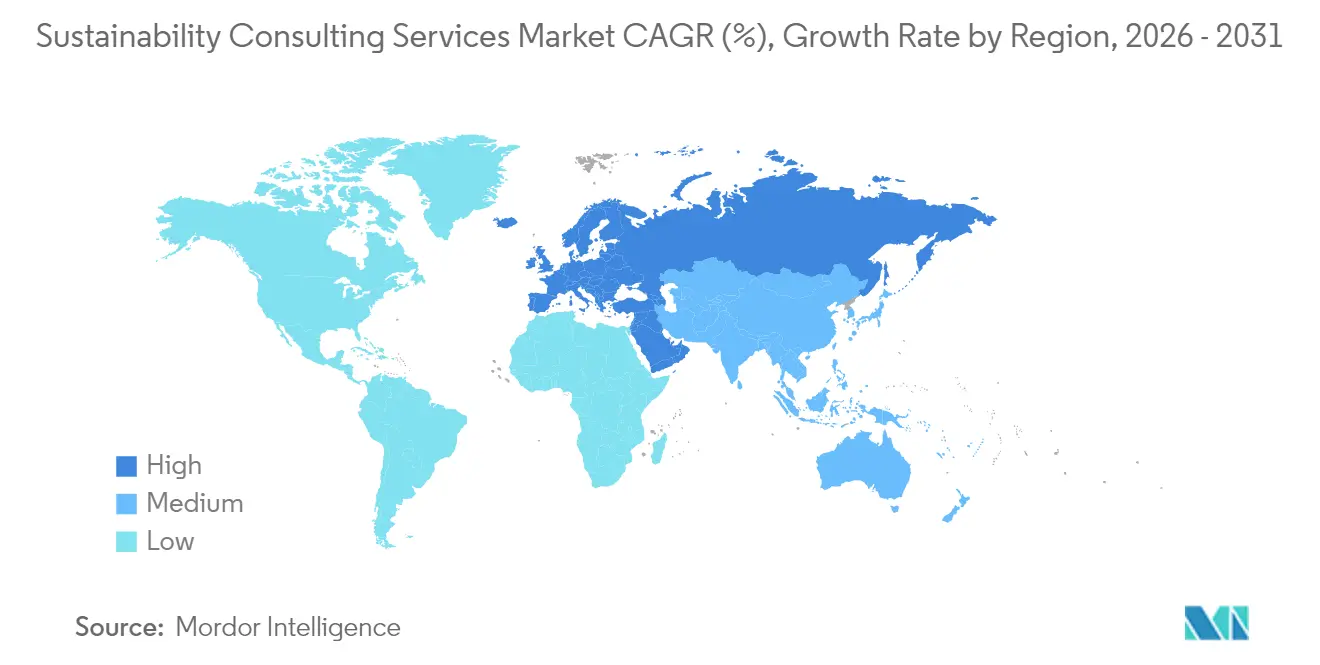
| Fastest Growing Market | Asia Pacific |
| Largest Market | Europe |
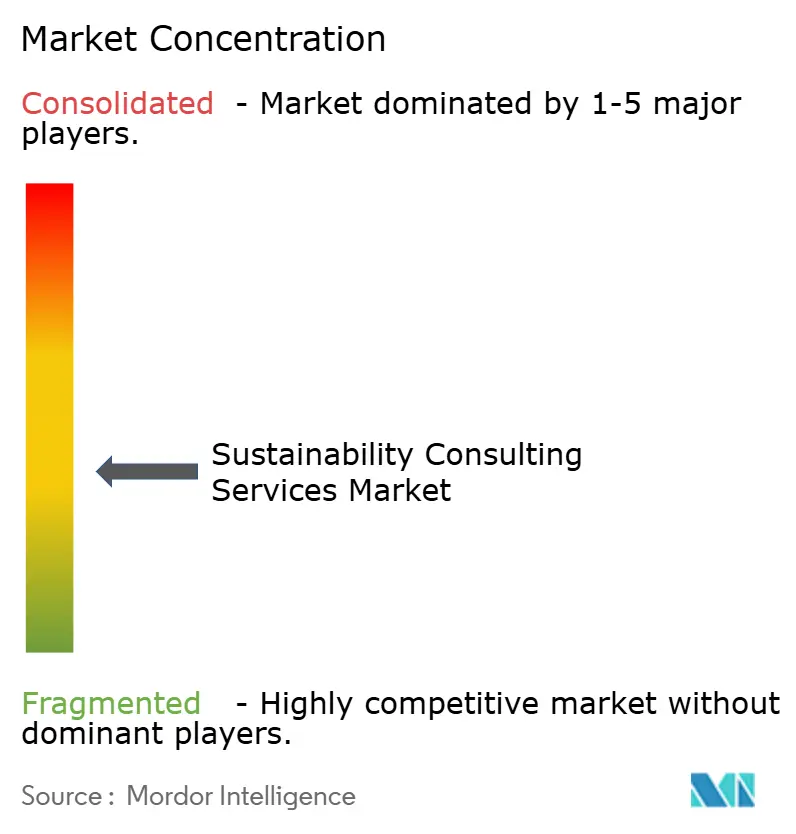
| Market Concentration | Medium |
Major Players *Disclaimer: Major Players sorted in no particular order Image © Mordor Intelligence. Reuse requires attribution under CC BY 4.0. | |
Sustainability Consulting Services Market Analysis by Mordor Intelligence
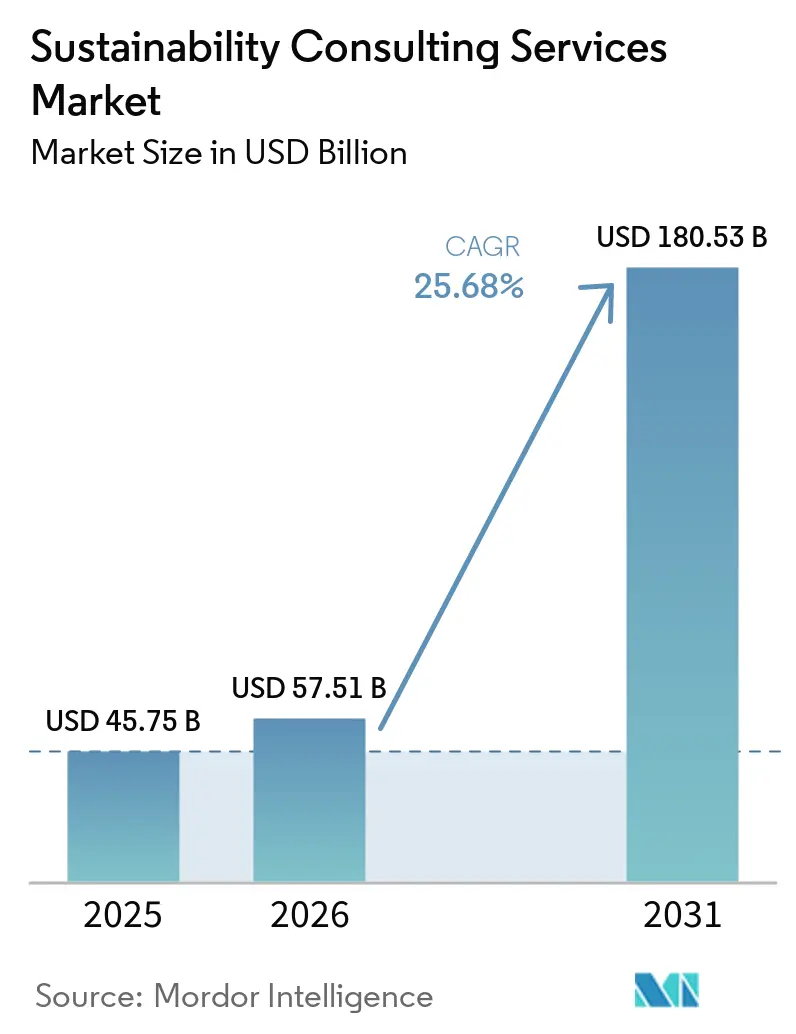
The sustainability consulting services market size was valued at USD 45.75 billion in 2025 and estimated to grow from USD 57.51 billion in 2026 to reach USD 180.53 billion by 2031, at a CAGR of 25.68% during the forecast period (2026-2031). Heightened regulatory mandates, fast-rising corporate net-zero pledges and digital carbon-data platforms are turning environmental, social and governance management into a board-level priority. The European Union’s Corporate Sustainability Reporting Directive alone brings more than 50,000 firms into mandatory disclosure scope, multiplying demand for specialized guidance. At the same time, investors are reallocating capital toward climate-aligned assets, prompting companies to seek external verification of decarbonization plans. Technology adoption is reshaping service delivery as AI-enabled carbon-accounting engines automate data capture, freeing consultants to focus on high-value advisory. Competition is intensifying, yet the market remains sufficiently fragmented for both global majors and niche boutiques to capture share in emerging areas such as biodiversity, circularity and nature-based solutions.
Key Report Takeaways
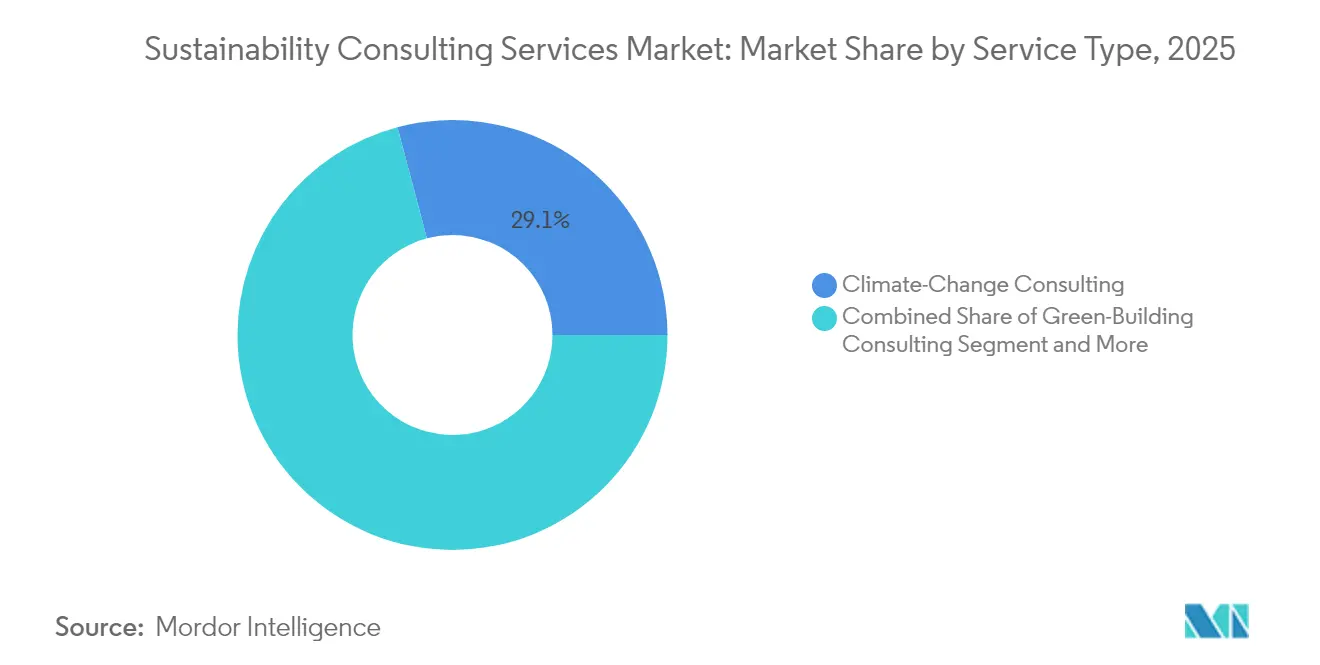
- By service type, climate-change consulting held 29.12% of the sustainability consulting services market share in 2025.
- Circular-economy consulting is projected to record the fastest 18.05% CAGR through 2031.
- By end-user, energy and power accounted for 23.78% of 2025 revenues, while manufacturing and industrials are forecast to advance at a 15.74% CAGR to 2031.
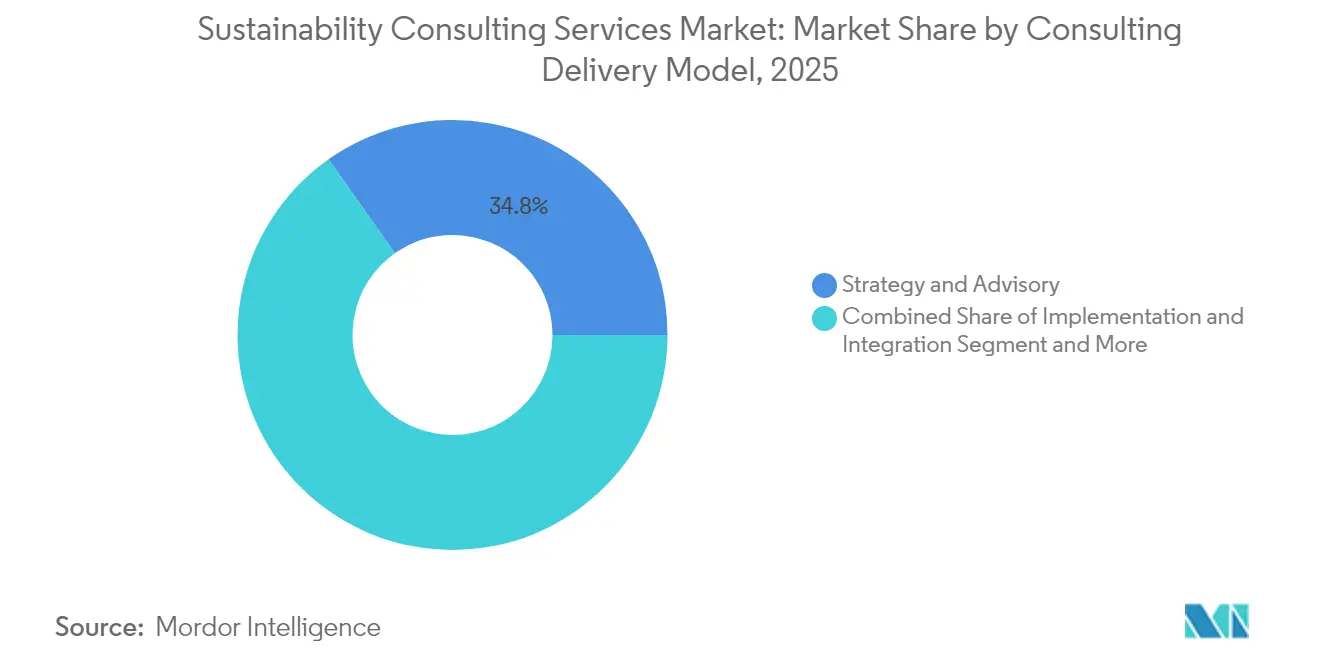
- By consulting delivery model, strategy and advisory captured 34.78% revenue in 2025; digital platforms and analytics are expanding at a 19.25% CAGR.
- By sustainability focus area, climate-change and net-zero led with 35.05% share in 2025, whereas biodiversity and nature-based solutions are expected to post a 20.86% CAGR.
- Europe contributed 38.74% of 2025 revenue, but Asia-Pacific is set to grow the fastest at a 16.92% CAGR.
Note: Market size and forecast figures in this report are generated using Mordor Intelligence’s proprietary estimation framework, updated with the latest available data and insights as of 2026.
Market Trends and Insights
Drivers Impact Analysis of Sustainability Consulting Services Market*
| Driver | (~) % Impact on CAGR Forecast | Geographic Relevance | Impact Timeline |
|---|---|---|---|
| Corporate net-zero commitments | +6.2% | Global, focus on North America and Europe | Medium term (2-4 years) |
| Expanding ESG disclosure regulations (CSRD) | +8.1% | Europe first, spreading to Asia-Pacific and North America | Short term (≤2 years) |
| Investor pressure for climate-risk alignment | +4.3% | Global, led by institutional investors | Medium term (2-4 years) |
| Public-sector decarbonization stimulus | +3.7% | North America, Europe, selected Asia-Pacific markets | Long term (≥4 years) |
| AI-enabled carbon-accounting platforms | +2.8% | Global, early adoption in technology-forward markets | Short term (≤2 years) |
| Sovereign-wealth-fund sustainability mandates | +1.7% | Middle East, emerging Asia-Pacific, selected Africa | Long term (≥4 years) |
| Source: Mordor Intelligence | |||
Corporate Net-Zero Commitments Accelerating Advisory Spend
Large enterprises now treat net-zero targets as hard compliance deadlines rather than aspirational statements. Boards must translate science-based targets into operational roadmaps that span supply-chain mapping, technology selection and stakeholder engagement. Scope 3 emissions regularly exceed 70% of total footprints, amplifying complexity and elevating the need for third-party guidance. Only 16% of the world’s 2,000 largest firms remain on track for 2050 net-zero, underscoring a vast execution gap that external advisors are hired to close [1]. Continuous monitoring, target recalibration and assurance requirements sustain multi-year consulting engagements as regulations tighten and methodologies evolve.
Expanding ESG and Sustainability Disclosure Regulations
The EU CSRD introduces double materiality analysis, structured digital tagging and third-party assurance, creating a steep learning curve for companies with European operations. Staggered adoption timelines from 2024 to 2026 keep advisory demand elevated across successive cohorts of filers. Non-EU multinationals with significant regional sales also fall within scope, extending compliance projects worldwide. Required data-collection depth forces upgrades to reporting processes, IT systems and internal controls, areas where consultancies provide assessment, design and change-management services.
AI-Enabled Carbon-Accounting Platforms Driving Integration Projects
AI engines ingest utility bills, IoT sensor streams and supplier invoices to calculate product-level footprints in near real time. Implementation demands data-architecture redesign, system integration and new governance models. Advisory firms are retained to evaluate vendor solutions, oversee rollouts and develop dashboards that convert raw emissions data into strategic insights. Automated quantification shrinks tactical workload, enabling consultants to concentrate on scenario modeling, abatement pathway prioritization and financial-impact analysis, thereby reinforcing the sustainability consulting services market growth trajectory.
Public-Sector Decarbonization Stimulus Programs
Infrastructure, transport and energy-transition funding packages embed strict sustainability metrics. Government agencies lacking deep technical capacity depend on external experts for program design, tender evaluation and performance verification. Examples include national climate-neutrality strategies that require multi-decade implementation roadmaps and transparent monitoring systems [2]. Long project horizons lock in recurring engagements for consultants specializing in measurement, reporting and verification.
Restraints Impact Analysis of Sustainability Consulting Services Market*
| Restraint | (~) % Impact on CAGR Forecast | Geographic Relevance | Impact Timeline |
|---|---|---|---|
| Acute talent shortage | -3.2% | Global, most severe in North America and Western Europe | Short term (≤2 years) |
| Regulatory-certainty gaps & litigation risk | -2.1% | Global, highest impact in litigious markets | Medium term (2-4 years) |
| Off-the-shelf SaaS sustainability tools | -1.8% | Global, faster uptake in technology-forward markets | Medium term (2-4 years) |
| Carbon-credit price volatility | -1.4% | Global, affecting voluntary markets | Short term (≤2 years) |
| Source: Mordor Intelligence | |||
Acute Talent Shortage Inflating Billing Rates
Demand for professionals who blend climate science, regulatory insight and strategic consulting far outweighs supply. Specialized roles in biodiversity valuation, circular-product design and AI-driven emissions analytics remain especially scarce. Firms raise compensation, poach competitors and invest in upskilling programs, yet pipeline constraints persist. Elevated day rates deter some midmarket clients, dampening project volumes and placing a natural brake on the sustainability consulting services market[3]. Technology-enabled delivery models partly offset the shortfall, but complex engagements still require human expertise.
Off-the-Shelf SaaS Sustainability Tools Disintermediating Consulting
Integrated software platforms now automate data capture, calculation and disclosure for standard ESG metrics. When internal teams deploy these tools effectively, reliance on external support for routine tasks declines. Consulting firms must therefore shift emphasis toward high-value functions such as strategy, change management consulting and assurance. Those unable to evolve risk revenue erosion even as overall sustainability consulting services market demand rises. Partnerships with software vendors and proprietary toolsets become critical to defend margins and demonstrate differentiated value.
*Our forecasts treat driver/restraint impacts as directional, not additive. The impact forecasts reflect baseline growth, mix effects, and variable interactions.
Sustainability Consulting Services Market Segment Analysis
By Service Type:
Climate Consulting Dominance Amid Circularity SurgeClimate-change consulting accounted for 29.12% of 2025 revenue within the sustainability consulting services market. Circular-economy and resource-efficiency engagements, though smaller, will post the strongest 18.05% CAGR to 2031, reflecting growing corporate interest in waste elimination and regenerative design. ESG-reporting advisory gains traction as disclosure obligations expand, while green-building consulting benefits from stricter codes and certification schemes.
Clients pursuing circular-economy strategies demand product redesign, reverse-logistics planning and new revenue-model development. Advisory teams integrate life-cycle assessment tools with financial-impact modeling to guide decision-making. As material costs rise and landfill regulations tighten, leaders view circularity as both risk mitigation and value creation, reinforcing long-run expansion of the sustainability consulting services market.

By End-User Industry:
Energy Leadership with Manufacturing MomentumEnergy and power companies generated 23.78% of 2025 spending, underscoring the sector’s central role in global decarbonization. Manufacturers, however, will pace growth at a 15.74% CAGR as supply-chain mandates propagate and Industry 4.0 investments intersect with resource-efficiency goals. Financial-services clients request climate-risk scenario analysis and sustainable-finance product design, while construction and real estate engagements revolve around green-building codes and embodied-carbon tracking.
Manufacturers face mounting pressure to report scope-3 emissions, comply with customer-driven supplier codes and reduce energy intensity. Consulting assignments span material-flow mapping, renewable-energy sourcing and digital twin deployment. As regulatory and commercial drivers converge, industrial clients contribute an ever-larger slice of the sustainability consulting services market size.
By Consulting Delivery Model:
Digital Platforms Reshape EngagementsStrategy-led projects delivered 34.78% of revenue in 2025, but digital platforms and analytics will accelerate at 19.25% CAGR through 2031. Implementation and integration work remains vital as enterprises embed new systems, whereas managed-service models emerge for continuous data management and reporting. Training services address internal capability gaps caused by the global talent shortfall.
Platform-centric offerings mesh AI engines with human insight. For example, partnerships that integrate data-aggregation software with advisory approaches allow consultants to scale analyses across large client portfolios. As automation lowers unit costs, more mid-sized companies enter the sustainability consulting services market, broadening the addressable base.
By Sustainability Focus Area:
Climate Strength with Biodiversity BreakthroughClimate-change and net-zero themes captured 35.05% of 2025 demand. Biodiversity and nature-based solutions, though nascent, are forecast to compound at 20.86% annually as nature-related financial disclosures gain traction. Circular economy consulting services, social impact, and sustainable finance streams round out client priorities.
Emerging biodiversity standards oblige firms to map ecosystem dependencies and quantify nature-related risks. Consultants blend geospatial analytics, satellite imagery and natural-capital valuation to guide investments in habitat restoration and supply-chain resilience. This specialization strengthens differentiation and enlarges the sustainability consulting services market size for firms possessing ecological expertise.
Geography Analysis
Europe Sustainability Consulting Services Market
Europe generated 38.74% of 2025 revenue, reflecting early regulatory adoption and mature corporate sustainability practices. The CSRD, EU Taxonomy and national climate-neutrality laws sustain multiyear advisory pipelines. German federal agencies, for instance, enlist consultants to draft sector-specific decarbonization roadmaps and monitor progress toward the 2045 neutrality goal. Complex double-materiality assessments and digital tagging rules reinforce demand for integrated legal, financial, and technical expertise.
APAC Sustainability Consulting Services Market
Asia-Pacific will deliver the fastest 16.92% CAGR to 2031. Industrialization, supply-chain export exposure and sovereign-wealth-fund mandates converge to spur consulting spend. Nations such as China and India launch emissions-trading pilots and green-finance frameworks, compelling domestic firms to seek guidance on compliance and opportunity capture. BloombergNEF projects the region needs USD 74-89 trillion in transition capital through 2050, anchoring a sizeable sustainability consulting services market. Service providers that localize offerings while leveraging global playbooks are best positioned.
The Americas and MEA Sustainability Consulting Services Market
North America remains sizeable though maturing. Voluntary corporate commitments, state-level clean-energy standards and investor activism underpin steady growth, yet lack of comprehensive federal regulation tempers acceleration. South American demand is emerging as multinational supply-chain requirements extend downstream, whereas the Middle East and Africa benefit from resource-sector diversification agendas and sovereign-fund ESG goals. Varied policy maturity across geographies ensures differentiated service mixes, bolstering global resilience of the sustainability consulting services market.
Competitive Landscape
The market is moderately fragmented, with Big Four audit-anchored practices, strategy consultancies and technical environmental firms jostling for share. EY’s designation as a 2024 Horizon 3 sustainability-services leader signals the advantage of broad service portfolios spanning strategy, technology and assurance. Acquisition activity accelerates: WSP purchased Power Engineers for USD 1.8 billion to deepen energy-transition capabilities, and private-equity firm Carlyle bought a majority stake in Anthesis, illustrating confidence in the long-run upside.
Technology integration is a key differentiator. Firms embed proprietary analytics engines, carbon-data platforms and AI-driven scenario tools to cut delivery costs and combat talent shortages. Partnerships, such as BearingPoint’s alliance with Sweep, combine software scalability with advisory expertise. White-space opportunities persist in biodiversity measurement, circular-product design and nature-based finance, arenas where specialist boutiques can command premium pricing. The top five players hold an estimated 35-40% of global revenue, leaving ample runway for challengers in the sustainability consulting services market.
Continued patent activity indicates rising innovation intensity. Companies developing energy-storage chemistry, low-carbon cement and remote-sensing biodiversity tools seek advisory help to commercialize technology and align with ESG frameworks. Talent scarcity remains the primary constraint; firms invest heavily in training platforms such as SGS’s Sustainability Unlocked to grow internal capacity and reinforce brand credibility.
Sustainability Consulting Services Industry Leaders
-
Accenture PLC
-
Boston Consulting Group
-
Tata Consultancy Services Limited
-
Capgemini SE
-
Roland Berger GmbH
- *Disclaimer: Major Players sorted in no particular order
Sustainability Consulting Services Market Companies Covered in this Report
- Accenture plc
- Boston Consulting Group, Inc.
- Tata Consultancy Services Ltd.
- Capgemini SE
- Roland Berger GmbH
- Bain and Company, Inc.
- KPMG International Ltd.
- Ernst and Young Global Ltd.
- Deloitte Touche Tohmatsu Ltd.
- PricewaterhouseCoopers LLP
- McKinsey and Company, Inc.
- AECOM
- WSP Global Inc.
- Environmental Resources Management Ltd.
- Jacobs Solutions Inc.
- Arcadis N.V.
- Wood Group plc
- Tetra Tech, Inc.
- Ramboll Group A/S
- Stantec Inc.
Recent Industry Developments in Sustainability Consulting Services Market
- February 2025: SLR Consulting agreed to acquire Malk Partners, boosting environmental advisory depth and European footprint.
- January 2025: BearingPoint partnered with Sweep to integrate AI-powered sustainability-data management with consulting services for CSRD compliance.
- December 2024: EY was named a Horizon 3 Market Leader in HFS Research’s Sustainability Services 2024 report, reflecting strong enterprise-transformation credentials.
- December 2024: Accenture bought IQT Group to scale net-zero infrastructure consulting for global clients.
Global Sustainability Consulting Services Market Report Scope
Sustainability consulting refers to organizations and companies working to create a sustainable world. There are many consulting teams that act as eco consultants, green consultants, environmental sustainability consultants, and environmental management consultants. Similar to business consultants, sustainability consultants are professionals specialized in assisting companies to become more environmentally responsible.
The sustainability consulting services market is segmented by service type (climate change consultancy services, green building consultancy services, ESG consultancy services, and other sustainability consultancy services), by end-user (construction and real estate, energy and power, public sector, and other end users), and by geography (North America, Europe [United Kingdom, Germany, Benelux, Spain, France, Nordics, Rest of Europe], Asia Pacific, Latin America, Middle East and Africa). The report offers market forecasts and size in value (USD) for all the above segments.
| Climate-Change Consulting |
| Green-Building Consulting |
| ESG and Reporting Advisory |
| Circular-Economy and Resource-Efficiency Consulting |
| Sustainability Strategy and Governance |
| Energy and Power |
| Construction and Real Estate |
| Manufacturing and Industrials |
| Financial Services and Insurance |
| Public Sector and NGOs |
| Strategy and Advisory |
| Implementation and Integration |
| Managed Services / Outsourcing |
| Digital Platforms and Analytics |
| Training and Capacity-Building |
| Climate-Change and Net-Zero |
| Biodiversity and Nature-Based Solutions |
| Circular-Economy and Waste-Management |
| Social Impact and DEI |
| Sustainable Finance and Reporting |
| North America | United States | |
| Canada | ||
| Mexico | ||
| South America | Brazil | |
| Argentina | ||
| Colombia | ||
| Rest of South America | ||
| Europe | Germany | |
| United Kingdom | ||
| France | ||
| Italy | ||
| Spain | ||
| Russia | ||
| Netherlands | ||
| Rest of Europe | ||
| Asia-Pacific | China | |
| Japan | ||
| South Korea | ||
| India | ||
| Australia | ||
| Singapore | ||
| Rest of Asia-Pacific | ||
| Middle East and Africa | Middle East | Saudi Arabia |
| United Arab Emirates | ||
| Rest of Middle East | ||
| Africa | South Africa | |
| Egypt | ||
| Rest of Africa | ||
| By Service Type | Climate-Change Consulting | ||
| Green-Building Consulting | |||
| ESG and Reporting Advisory | |||
| Circular-Economy and Resource-Efficiency Consulting | |||
| Sustainability Strategy and Governance | |||
| By End-User Industry | Energy and Power | ||
| Construction and Real Estate | |||
| Manufacturing and Industrials | |||
| Financial Services and Insurance | |||
| Public Sector and NGOs | |||
| By Consulting Delivery Model | Strategy and Advisory | ||
| Implementation and Integration | |||
| Managed Services / Outsourcing | |||
| Digital Platforms and Analytics | |||
| Training and Capacity-Building | |||
| By Sustainability Focus Area | Climate-Change and Net-Zero | ||
| Biodiversity and Nature-Based Solutions | |||
| Circular-Economy and Waste-Management | |||
| Social Impact and DEI | |||
| Sustainable Finance and Reporting | |||
| By Geography | North America | United States | |
| Canada | |||
| Mexico | |||
| South America | Brazil | ||
| Argentina | |||
| Colombia | |||
| Rest of South America | |||
| Europe | Germany | ||
| United Kingdom | |||
| France | |||
| Italy | |||
| Spain | |||
| Russia | |||
| Netherlands | |||
| Rest of Europe | |||
| Asia-Pacific | China | ||
| Japan | |||
| South Korea | |||
| India | |||
| Australia | |||
| Singapore | |||
| Rest of Asia-Pacific | |||
| Middle East and Africa | Middle East | Saudi Arabia | |
| United Arab Emirates | |||
| Rest of Middle East | |||
| Africa | South Africa | ||
| Egypt | |||
| Rest of Africa | |||
Key Questions Answered in the Report
How big is the Sustainability Consulting Services Market?
The Sustainability Consulting Services Market size is expected to reach USD 57.51 billion in 2026 and grow at a CAGR of 25.68% to reach USD 180.53 billion by 2031.
What is the current Sustainability Consulting Services Market size?
In 2026, the Sustainability Consulting Services Market size is expected to reach USD 57.51 billion.
How fast is the market expected to grow to 2031?
It is projected to rise at a 25.68% CAGR to USD 180.53 billion.
Which service segment holds the largest share today?
Climate-change consulting leads with 29.12% revenue in 2025.
Which region will grow the quickest through 2031?
Asia-Pacific is forecast to expand at a 16.92% CAGR.
What delivery model is advancing fastest?
Digital platforms and analytics engagements are increasing at 19.25% CAGR.
Why is talent a major restraint?
Scarcity of multidisciplinary sustainability experts inflates billing rates and limits project capacity.