
Market Overview
| Study Period | 2020 - 2031 |
|---|---|
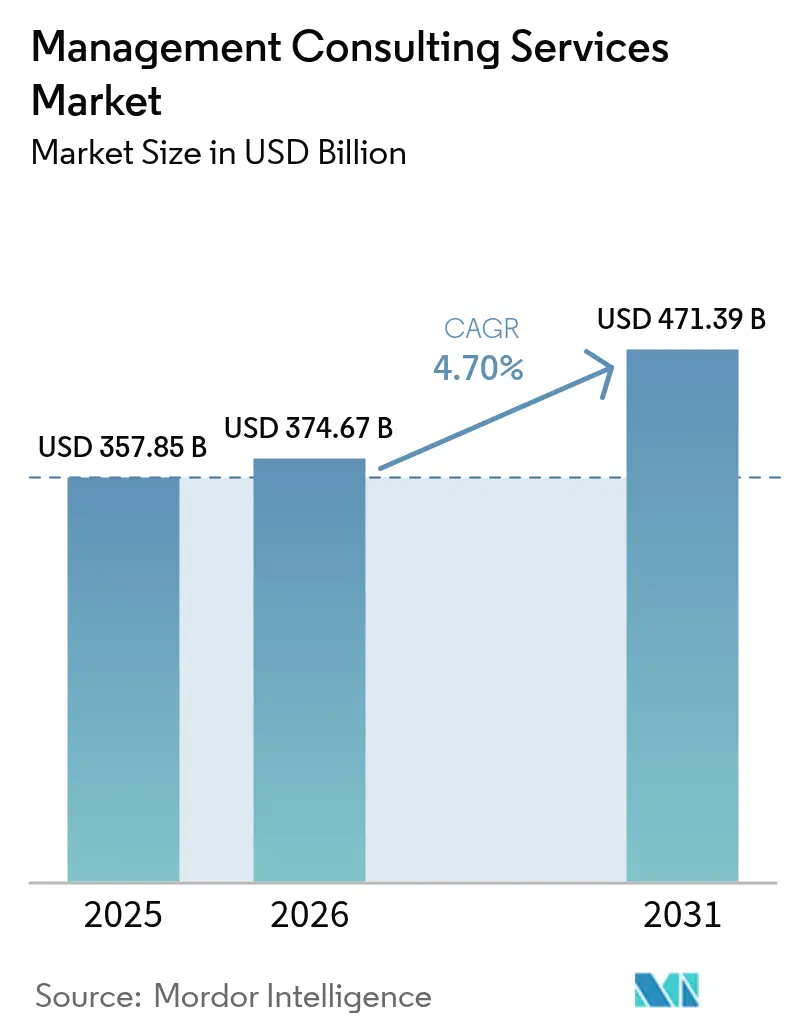
| Market Size (2026) | USD 374.67 Billion |
| Market Size (2031) | USD 471.39 Billion |
| Growth Rate (2026 - 2031) | 4.70 % |
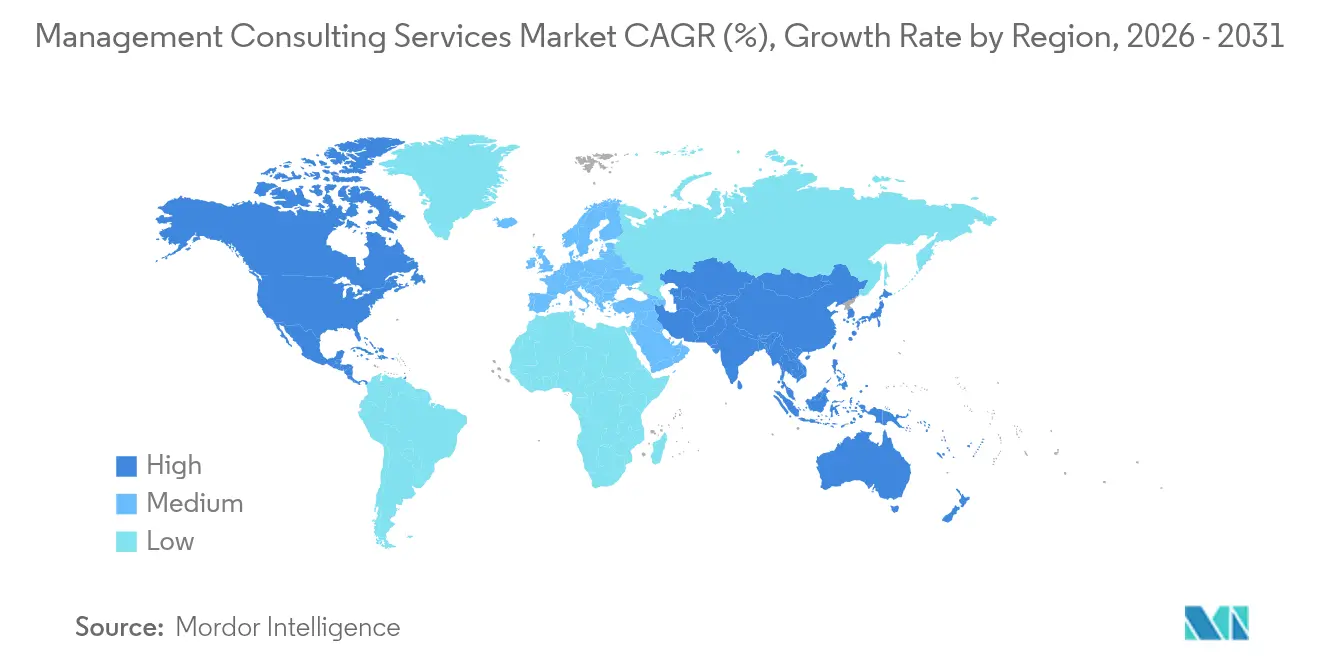
| Fastest Growing Market | Asia-Pacific |
| Largest Market | North America |
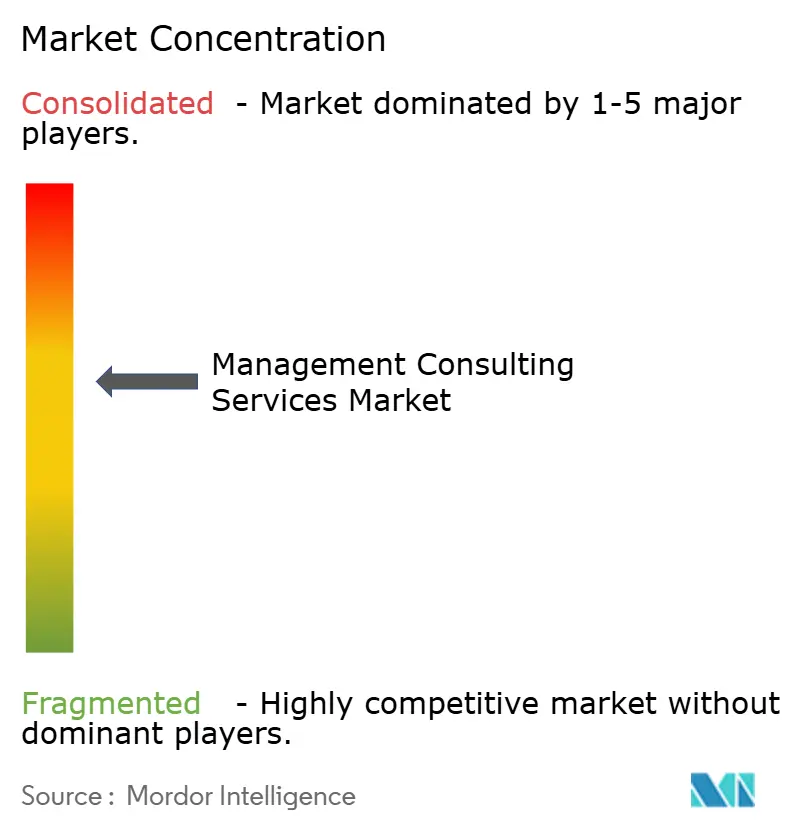
| Market Concentration | Medium |
Major Players *Disclaimer: Major Players sorted in no particular order Image © Mordor Intelligence. Reuse requires attribution under CC BY 4.0. | |
Management Consulting Services Market Analysis by Mordor Intelligence
The management consulting services market size was valued at USD 357.85 billion in 2025 and estimated to grow from USD 374.67 billion in 2026 to reach USD 471.39 billion by 2031, at a CAGR of 4.70% during the forecast period (2026-2031). Solid demand for external expertise in digital transformation, risk management, and operational excellence underpins this steady growth path. Enterprises worldwide keep expanding AI, cloud, and sustainability programs, and they rely on consultants to close capability gaps, standardize best practices, and speed execution. Ongoing regulatory shifts, especially around ESG rules, add further impetus as companies seek guidance to comply without stalling innovation. A parallel rise in remote-first delivery models lowers engagement costs while enlarging addressable client pools, strengthening market resilience even during macroeconomic uncertainty.
Key Report Takeaways
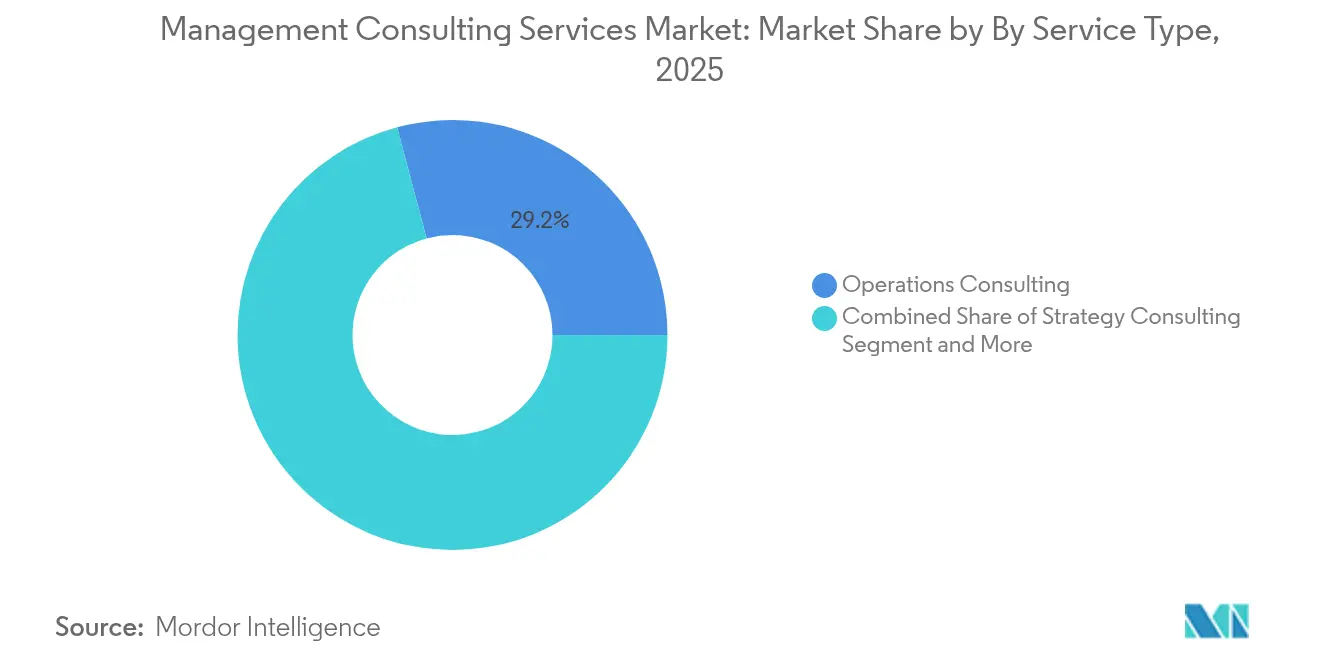
- By service type, Operations Consulting led with 29.15% revenue share in 2025; Digital Transformation Consulting is projected to expand at a 13.13% CAGR through 2031.
- By end-user industry, Financial Services commanded 23.85% of the market in 2025, whereas Healthcare and Life Sciences is poised to grow at an 11.55% CAGR to 2031.
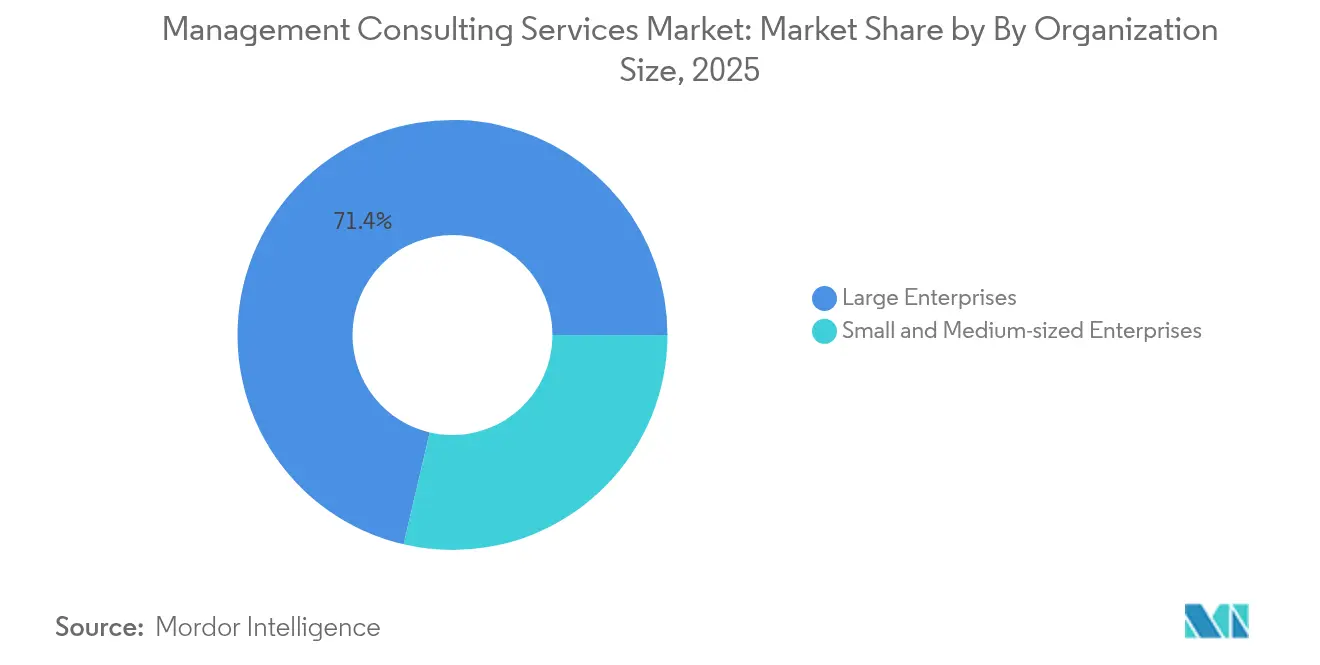
- By organization size, Large Enterprises held 71.35% of demand in 2025, while Small and Medium-sized Enterprises are expected to post a 9.75% CAGR to 2031.
- By delivery model, On-site Consulting accounted for 60.85% of the market in 2025; Remote and Virtual Consulting is on track for a 14.25% CAGR through 2031.
- By geography, North America led with 37.45% market share in 2025, and Asia-Pacific is forecast to be the fastest-growing region at a 10.55% CAGR to 2031.
Note: Market size and forecast figures in this report are generated using Mordor Intelligence’s proprietary estimation framework, updated with the latest available data and insights as of 2026.
Market Trends and Insights
Drivers Impact Analysis of Management Consulting Services Market*
| Driver | (~) % Impact on CAGR Forecast | Geographic Relevance | Impact Timeline |
|---|---|---|---|
| Digital-first transformation demand | +1.2% | Global, especially North America and Asia-Pacific | Medium term (2-4 years) |
| Regulatory and risk-management complexity | +0.8% | Global, notably EU and North America | Long term (≥ 4 years) |
| Outsourcing of strategy and operations expertise | +0.6% | Global, emerging-market focus | Medium term (2-4 years) |
| Emerging-market enterprise growth | +0.9% | Asia-Pacific, Latin America, Middle East and Africa | Long term (≥ 4 years) |
| ESG-linked consulting mandates | +0.7% | Global, EU leading adoption | Medium term (2-4 years) |
| AI “consulting-as-a-service” models | +0.5% | North America and EU early adoption | Short term (≤ 2 years) |
| Source: Mordor Intelligence | |||


Digital-first transformation demand
Organizations allocate record budgets to AI integration, cloud migration, and data-centric architectures. Technology consulting spending is set to exceed USD 400 billion in 2025, and 87% of enterprises that embarked on digital overhauls now rely on external advisors[1]Datacentre Solutions Staff, “Global Enterprises Accelerate Digital Transformation Spend,” datacentresolutions.com. Generative AI projects already represent up to 40% of new engagements among leading firms, pushing consultants to deliver intertwined technology roadmaps, change-management programs, and workforce reskilling packages in multi-year deals. Financial services and healthcare are focal points because regulatory scrutiny magnifies implementation complexity. The outcome is a sustained pipeline that balances near-term efficiency with long-term modernization goals.
Regulatory and risk-management complexity
Expanding ESG and data-privacy rules amplify demand for compliance advisory. The EU Corporate Sustainability Reporting Directive alone fuels an estimated USD 2 billion annual consulting opportunity. Banks and insurers face layered capital, conduct, and cyber-resilience standards that require risk assessment frameworks and reporting automation. Energy and healthcare operators confront parallel mandates tied to safety and environmental disclosures. Consultants supply audit-ready methodologies, RegTech integration skills, and cross-border policy insight, turning compliance from a cost center into a driver of structured transformation spending.
Outsourcing of strategy and operations expertise
Executives increasingly contract out complex planning, process redesign, and cost-optimization tasks to tap objective, industry-specific know-how. Outcome-based engagements now stipulate measurable performance gains that justify fees, aligning consultant incentives with client value. Demand is acute in emerging markets where local firms seek the best global practices to scale. Providers respond by codifying playbooks for supply-chain resilience, digital marketing, and sustainability, enhancing repeatability and profit margins. The shift also broadens the management consulting services market as standardized offerings attract mid-tier clients.
Emerging-market enterprise growth
Rapid economic expansion in Asia-Pacific, Latin America, and parts of the Middle East brings new entrants to the consulting buyer pool. Digital infrastructure buildouts and government modernization programs spur large public-sector engagements, while regional tech champions require market-entry and operational-scaling support. For example, Southeast Asian fintech firms regularly engage consultants for regulatory navigation and product localization. This wave of regional demand offsets slower growth in certain mature markets and lifts global revenue prospects through 2030.
Restraints Impact Analysis of Management Consulting Services Market*
| Restraint | (~) % Impact on CAGR Forecast | Geographic Relevance | Impact Timeline |
|---|---|---|---|
| Talent shortage and high attrition | -0.9% | Global, acute in North America and EU | Short term (≤ 2 years) |
| Rise of low-cost freelance platforms | -0.6% | Global, mid-market focus | Medium term (2-4 years) |
| Outcome-based fee pressure | -0.4% | Global, led by mature markets | Medium term (2-4 years) |
| Data-sovereignty delivery limits | -0.3% | EU and Asia-Pacific regulatory environments | Long term (≥ 4 years) |
| Source: Mordor Intelligence | |||
Talent shortage and high attrition
Consulting firms report attrition rates near 15-20%, while professional-services utilization has dipped as staffing gaps widen. Specialists in AI and advanced analytics command premium salaries, compressing margins. Firms invest in accelerated promotion tracks, flexible work arrangements, and alumni boomerang programs, yet chronic shortages persist. Selective project bidding and tighter resource allocation mitigate the immediate capacity squeeze but may constrain overall market expansion until talent pipelines mature.
Rise of low-cost freelance platforms
Digital marketplaces now match enterprises with seasoned strategists and technologists at rates below traditional firm fee structures. Platforms such as Upwork enable modular project sourcing, a model that gains traction as remote delivery proves credible[3]Upwork Research, “Distributed Consulting Talent Report 2025,” upwork.com. The commoditization of discrete tasks—competitive benchmarking, data visualization, code prototyping—intensifies price pressure on mid-tier consultancies. To defend premium positioning, established firms emphasize integrated end-to-end solutions, proprietary data assets, and risk-sharing contract terms that freelancers cannot easily replicate.
*Our forecasts treat driver/restraint impacts as directional, not additive. The impact forecasts reflect baseline growth, mix effects, and variable interactions.
Management Consulting Services Market Segment Analysis
By Service Type:
Operational Excellence Sustains LeadershipOperations Consulting captured 29.15% of the management consulting services market in 2025, reflecting persistent client focus on cost control and process rigor. The segment’s depth in lean methodologies, supply-chain diagnostics, and performance benchmarking secures recurring engagements. Digital Transformation Consulting, propelled by accelerated AI and cloud adoption, is forecast to advance at a 13.13% CAGR to 2031, making it the primary growth engine. Together, these segments form complementary value propositions as clients merge technology upgrades with workflow redesign. Strategy Consulting maintains relevance for market expansion and portfolio recalibration, while HR and Financial Advisory Consulting benefit from workforce realignment and ESG-linked reporting needs.
The convergence of operational and digital mandates spawns hybrid offerings where consultants embed AI-enabled analytics into process-improvement roadmaps. For instance, industrial clients now expect predictive maintenance models alongside classical throughput analysis, enabling double-digit efficiency gains. Such cross-disciplinary approaches allow firms to command higher fees and protect client relationships from specialist insurgents. As a result, revenue mix continues to shift toward technology-infused services, reinforcing the long-term position of providers that scale digital talent pools early.


By End-User Industry:
Financial Services Anchor DemandFinancial Services accounted for 23.85% of the management consulting services market in 2025, driven by digital banking, capital-efficiency programs, and compliance transformations. The vertical relies on consultants to orchestrate core-system modernization, risk-model validation, and fintech partnership strategies. Healthcare and Life Sciences is projected to expand at an 11.55% CAGR through 2031, spurred by digital health adoption and stricter regulatory oversight. Manufacturing clients seek Industry 4.0 roadmaps, while Energy players turn to advisors for grid modernization and sustainability metrics.
Cross-industry themes such as cybersecurity, data governance, and ESG reporting integrate with sector-specific challenges, intensifying the need for specialized, multidisciplinary teams. In practice, financial institutions now procure bundled offerings spanning AI fraud detection, climate-risk modeling, and customer-experience redesign. Consultants that assemble domain experts with technology architects thus secure multi-year mandates, locking in revenue visibility and raising switching costs for clients.
By Organization Size:
SME Uptake AcceleratesLarge Enterprises held 71.35% of spending in 2025 thanks to complex global footprints and sizable transformation budgets. Yet SME adoption is on a 9.75% CAGR trajectory, sustained by affordable, modular service packages delivered remotely. AI-powered diagnostics and templated playbooks lower entry barriers, allowing smaller firms to contract outcome-oriented advisory without heavy upfront fees. This democratization broadens the management consulting services market size and diversifies revenue streams for providers that can balance volume with customization.
Enterprise clients increasingly stipulate performance-linked fees, reinforcing demand for data-driven engagement governance. In response, consulting firms deploy dashboards that track KPIs in real time, enhancing transparency and trust. SMEs, conversely, often prioritize rapid implementation and cash-flow discipline, pushing consultants to shorten project cycles and adopt subscription models. The dual-track evolution of client expectations compels firms to refine segmentation strategies and resource allocation to safeguard profitability.
By Delivery Model:
Remote Engagement Gains ScaleOn-site Consulting preserved 60.85% share in 2025 as many complex programs still benefit from in-person workshops and stakeholder alignment sessions. Remote and Virtual Consulting, however, is set to climb at a 14.25% CAGR through 2031 as cloud collaboration tools mature and clients normalize distributed work. Hybrid models blend virtual sprints with milestone on-site visits, offering cost-efficient access to global experts without sacrificing relationship depth.
Digital whiteboarding, secure data-rooms, and AI-assisted document drafting cut cycle times while facilitating 24/7 availability across time zones. Consultants pass efficiency gains to clients through slimmer travel budgets and faster deliverables, reinforcing perceived value. Competition intensifies as specialist boutiques leverage virtual reach to contest engagements historically reserved for large incumbents. The resulting pressure accelerates investment in proprietary platforms that differentiate through speed, analytics breadth, and implementation linkage.
Geography Analysis
North America Management Consulting Services Market
North America retained 37.45% of the management consulting services market share in 2025 on the back of robust enterprise technology spending and a dense regulatory environment across banking, healthcare, and energy. Generative AI project demand now constitutes up to 40% of new contracts, lifting revenue per consultant as high-value advisory replaces commodity deliverables. Federal agencies also ramp up digital-services procurement, while private-sector clients intensify ESG and cyber-resilience initiatives. The region’s shift to hybrid engagement models enables firms to serve global subsidiaries without eroding margins, preserving leadership status through the forecast period.
APAC Management Consulting Services Market
Asia-Pacific is the fastest-growing territory with a 10.55% CAGR outlook to 2031, propelled by rapid digitalization, infrastructure rollout, and multinational regional investment. Consulting spend concentrates on financial services modernization, healthcare digitization, and manufacturing productivity. Governments across India and Southeast Asia commission smart-city blueprints and public-sector modernization studies, expanding addressable demand. Local consultancy challengers capitalize on cultural fluency and lower cost bases, but global firms maintain an edge in complex cross-border transactions and deep technical skills.
Europe Management Consulting Services Market
Europe posts steady expansion anchored in ESG compliance mandates and advanced data-privacy rules. The EU Corporate Sustainability Reporting Directive drives firm pipelines in sustainability reporting, while energy transition policies spark grid-modernization advisory across Germany, France, and the Nordics. Financial institutions prioritize digital core upgrades to meet open-banking norms. Data-sovereignty concerns encourage clients to engage advisors with regional hosting partners and specialized governance frameworks, reinforcing demand for niche regulatory expertise.

Regulatory Landscape
Management consulting services operate within a cross-border regulatory environment shaped by data governance, AI governance, procurement rules, and services trade restrictions. In the EU, the AI Act entered into force on 1 August 2024, shifting buyer focus from policy design toward audit-ready implementation as the 2 August 2026 enforcement milestone approaches. This is increasing demand for consulting support in risk classification, governance operating models, documentation, and controls.
Data localization and cross-border data transfer constraints also continue to shape how global engagements are staffed and delivered, particularly for regulated industries where client data access, storage, and processing are tightly controlled. The OECD has highlighted the economic and operational implications of fragmented data regulation, including localization and transfer restrictions, and in 2026 expanded guidance through its Going Digital Integrated Policy Framework and related digital regulatory mapping tools. For consulting firms, these frameworks and rising services trade restrictiveness elevate the need for localized delivery centers, privacy-by-design methods, and documented security controls, especially for remote and virtual consulting models that must satisfy client and jurisdictional requirements.
Value Chain Analysis
The value chain starts with talent and knowledge inputs (domain specialists, data scientists, industry SMEs, and proprietary methodologies) and runs through opportunity identification, proposal development, diagnostic assessment, solution design, implementation support, and ongoing value realization tracking. Delivery is increasingly enabled by collaboration and analytics platforms (secure data rooms, workflow tools, and AI-assisted drafting) that reduce cycle time for remote and hybrid engagements, while large, multi-country programs still rely on on-site workshops and governance cadences to align stakeholders. Partners and subcontractors, including technology vendors, boutique specialists, and freelancer networks, supplement capability gaps, especially for AI, cloud modernization, and compliance automation work.
Data access, client environment readiness, and external shocks are the main risk points in the chain. For TMT-heavy transformation backlogs, industry supply disruptions can cascade into execution when client initiatives depend on hardware availability and rollout timelines. For example, reported shipping disruptions in June 2026 around the Strait of Hormuz delayed telecom network component shipments by weeks, affecting 5G and data center buildouts and increasing the need for scenario planning, procurement governance, and schedule rebaselining. Consulting providers also face internal bottlenecks from specialist scarcity and attrition, notably in AI and advanced analytics, which drives greater reuse of standardized playbooks, offshore delivery, and platform-led delivery to protect utilization and margins.
Competitive Landscape
The management consulting services market is moderately fragmented, with the Big Four audit-linked groups and top strategy houses still dominating large, multi-country transformations. Their combined scale supports heavy investment in generative AI toolkits that automate knowledge retrieval, code generation, and slide production, lifting consultant productivity while safeguarding premium pricing. McKinsey’s “Lilli” platform now underpins 70% of proposal drafting and presentation workflows, showcasing early first-mover benefits.
Mid-tier and boutique firms counter by specializing in high-growth niches such as cloud FinOps, industrial IoT, and Scope 3 carbon accounting. MandA remains a favored path to bolt on scarce capabilities; A.T. Kearney’s purchase of Project Partners Management GmbH broadened SAP S/4HANA capacity in the DACH region[2]Bird & Bird M&A Updates, “Kearney Acquires Project Partners Management GmbH,” birdandbird.com. Freelance talent networks increase competitive pressure at the bottom end of the market by offering modular expertise at lower cost, forcing incumbents to highlight integrated delivery scale and risk-sharing commercial models.
Technology vendors also encroach via consulting arms that couple software licenses with strategic advisory. Cognizant’s USD 5.1 billion Q1 2025 revenue illustrates how tech-services lineage can translate into full-stack transformation engagements. As service lines converge, competitive advantage rests on cross-disciplinary teams, proprietary data assets, and proven outcome-based contracts.
Management Consulting Services Industry Leaders
McKinsey & Company
Boston Consulting Group
Deloitte Touche Tohmatsu Limited
Accenture plc
PricewaterhouseCoopers LLP
- *Disclaimer: Major Players sorted in no particular order
Management Consulting Services Market Companies Covered in this Report
- Accenture plc
- Deloitte Touche Tohmatsu Limited
- PricewaterhouseCoopers LLP
- KPMG International Limited
- Ernst and Young Global Limited
- McKinsey and Company Inc.
- Boston Consulting Group Inc.
- Bain and Company Inc.
- IBM Consulting (International Business Machines Corp.)
- Booz Allen Hamilton Holding Corp.
- Gartner Inc.
- Tata Consultancy Services Limited
- Capgemini SE
- FTI Consulting Inc.
- Oliver Wyman Group (Marsh McLennan)
- Roland Berger Holding GmbH
- Alvarez and Marsal Holdings LLC
- LEK Consulting LLC
- Kearney Inc.
- CGI Inc.
- Capco (Wipro Ltd.)
- Wikistrat Inc.

Market Opportunities and Future Outlook
White space is expanding where enterprises need help converting AI ambition into operating change, controls, and measurable outcomes, particularly as generative AI becomes embedded in new engagements and delivery workflows. Consulting opportunities are concentrated in operational AI integration, including process redesign, model risk governance, workforce reskilling, and KPI instrumentation, rather than model development alone. Vendor and firm investments in AI toolkits are also supporting productivity gains and more standardized deliverables. In TMT-centric client bases, advisory demand is additionally linked to infrastructure modernization programs and platform modernization initiatives where consulting teams connect target architecture, program governance, and implementation sequencing.
A second opportunity area is compliance and cross-border operating model redesign as governments and standards bodies formalize digital governance. The EU AI Act timeline, in force since August 2024 with an August 2026 enforcement milestone, and OECD work in 2026 on digital regulatory governance frameworks are creating demand for readiness assessments, control design, third-party risk processes, and evidence management across distributed delivery. Separately, supply-chain volatility affecting telecom and data center buildouts, including reported shipment delays in mid-2026, is opening resilience-focused operations consulting pipelines, covering contract lifecycle management, supplier risk, and cost-to-serve rebaselining that ties into capital program execution and benefits realization.
Recent Industry Developments in Management Consulting Services Market
- June 2026: Accenture agreed to acquire Whalar, a creator and social agency, and announced a three-year strategic partnership with Whalar Group. The move deepens Accenture Song capabilities in creator-led marketing and commerce, strengthening consulting-led growth programs that connect brand strategy to measurable customer experience outcomes.
- December 2025: Accenture agreed to acquire a 65% majority stake in DLB Associates, a US-based AI data center engineering and consulting firm. This expanded Accenture’s end-to-end data center development capabilities, aligning management consulting and engineering delivery with client demand for AI-ready infrastructure programs.
- March 2025: McKinsey acquired ET Medialabs (ETML), an India-based performance marketing and analytics agency. The acquisition strengthened McKinsey’s digital marketing operations and technology capabilities, supporting integrated consulting engagements that combine growth strategy, analytics, and execution at scale.


Management Consulting Services Market Report Scope and Research Methodology
Market Definition and Coverage
This market is defined as revenues earned from professional management consulting work where firms advise organizations on strategy, operations, organization design, performance improvement, and related management topics, across private and public sector clients and all major regions.
Scope exclusions: IT implementation-only outsourcing, software licensing revenue, and pure staffing or recruitment services are not counted unless they are sold as part of a management consulting engagement.
Segments Covered in This Report
- By Service Type
- Strategy Consulting
- Operations Consulting
- HR Consulting
- Financial Advisory Consulting
- Digital Transformation Consulting
- Risk and Compliance Consulting
- Other Service Types
- By End-user Industry
- IT and Telecommunications
- Healthcare and Life Sciences
- Financial Services (BFSI)
- Manufacturing and Industrial
- Energy and Utilities
- Government and Public Sector
- Real Estate and Construction
- Retail and Consumer Goods
- Media, Entertainment and Sports
- Hospitality and Travel
- Other Industries
- By Organization Size
- Large Enterprises
- Small and Medium-sized Enterprises
- By Delivery Model
- On-site Consulting
- Remote / Virtual Consulting
- Hybrid Consulting
- By Geography
- North America
- United States
- Canada
- Mexico
- South America
- Brazil
- Argentina
- Rest of South America
- Europe
- United Kingdom
- Germany
- France
- Italy
- Spain
- Nordics
- Rest of Europe
- Middle East and Africa
- Middle East
- Saudi Arabia
- United Arab Emirates
- Turkey
- Rest of Middle East
- Africa
- South Africa
- Egypt
- Nigeria
- Rest of Africa
- Middle East
- Asia-Pacific
- China
- India
- Japan
- South Korea
- ASEAN
- Australia
- New Zealand
- Rest of Asia-Pacific
- North America
Data Sources, Market Sizing, and Validation
Desk Research
Desk work starts by building a clean demand map for consulting spend, and then tying it to macro and enterprise activity signals that are publicly trackable. We referenced sources such as the World Bank and IMF for GDP and sector output, the OECD for productivity and business indicators, the US Bureau of Labor Statistics for professional services employment and wage trends, and Eurostat for services turnover and business demography. Where available, we also used national statistics offices, procurement portals, and professional association publications to understand public sector advisory spend patterns.
On the supply side, company filings, annual reports, and investor presentations help confirm service mix shifts and pricing direction, while business press coverage provides context on deal volumes and transformation themes. A paid subscription for company financials and news intelligence was used selectively to standardize revenue disclosures and corporate actions across large and mid-sized consulting firms. The desk sources listed above are illustrative and not exhaustive, and additional public references were used for data collection, validation, and clarification.
Primary Interviews and Surveys
Primary work is used to pressure-test desk assumptions on engagement pricing, utilization rates, typical project duration, and how consulting budgets move across strategy, operations, and people topics. We spoke with a mix of consulting firm leaders, practice heads, delivery managers, and enterprise buyers across APAC, EMEA, and the Americas, so the model reflects differences in deal size, procurement cycles, and regional growth expectations.
Distribution of primary research fieldwork respondents
| Company type | Respondent position | Region |
|---|---|---|
| Top tier: 33% | CXOs: 14% | APAC: 44% |
| Mid tier: 46% | Functional/Unit leaders: 33% | EMEA: 35% |
| Smaller Players: 21% | Managers: 53% | Americas: 21% |
Market-Sizing & Forecasting
Sizing is built using a top-down approach where services output indicators and enterprise spending capacity are reconstructed by region, and then filtered through consulting adoption rates for common management problem areas. To keep the model grounded, we corroborate results with selective bottom-up approximations, such as sampled revenue per consultant, utilization ranges, and typical blended rate bands applied to estimated delivery hours for major engagement types.
Key inputs that shape the totals include regional GDP and corporate profit pools, employment levels within professional services, average billing rate movement, utilization assumptions, and the mix shift toward transformation and operating model programs. Because long multi-year programs can cause timing noise, we also check how public sector advisory budgets and large enterprise restructuring cycles line up with the study years. For forecasting, we rely on scenario analysis with a base case informed by expert expectations on macro growth, cost pressure, and demand for efficiency-led projects, and then adjust the slope using observed historical relationships between enterprise activity and consulting spend.
Data Validation & Update Cycle
Outputs are validated by comparing the final market totals against independent signals such as employment and wage trend lines, large deal commentary, and services turnover indicators, and then reviewing variances that do not fit the expected pattern. When a region or year shows an unusual jump, it is rechecked for one-off effects like currency timing, public budget changes, or temporary utilization spikes, and then assumptions are revisited.
Before sign-off, the model goes through multi-step analyst review so the math, unit logic, and definitions remain consistent across years and regions. The report is refreshed annually, and interim updates are triggered when material events meaningfully shift consulting demand or pricing. Right before delivery, a final pass aligns the market view with the latest public releases and interview feedback.
Mordor Intelligence's Management Consulting Services Market Size Compared Against Other Published Estimates
Published market sizes for management consulting services often do not match, because the boundary of what counts as consulting is set differently, and because currency timing and base years vary across studies. Differences also come from how firms treat long program work, whether subcontracted advisory revenue is double-counted, and how quickly assumptions are refreshed when budgets tighten or rebound.
By tracking utilization, blended billing-rate movement, and client budget signals, Mordor Intelligence keeps the estimate focused on management consulting service revenue recognition, rather than broader professional services bundles, which is a common reason for totals drifting apart.
Benchmark comparison
| Source | Market Size | Gaps in Research Methodology |
|---|---|---|
| Mordor Intelligence | USD 374.67 B (2026) | |
| Global Industry Publisher A | USD 403.50 B (2025) | Uses an industry revenue view anchored to a different base year, and the page-level definition is broad, which can pull in adjacent advisory work that is not strictly management consulting services. |
| Global Industry Publisher B | USD 1.10 T (2026) | Takes a wider industry perimeter for management consultants and may include additional advisory and support activities within the sector, which expands the counted revenue pool versus a service-revenue-only boundary. |
The spread in the table is mainly explained by scope edges and year alignment rather than a single math step. When the market is kept tied to service revenue that can be reconciled to demand indicators and realistic pricing and utilization ranges, the final number is easier to reproduce and to update as conditions change.


Key Questions Answered in the Report
What is the current size of the management consulting services market?
The market generated USD 374.67 billion in 2026 and is projected to reach USD 471.39 billion by 2031.
Which service segment is growing the fastest?
Digital Transformation Consulting is expected to register a 13.13% CAGR through 2031, driven by AI and cloud adoption.
Which region offers the strongest growth opportunities for consulting firms?
Asia-Pacific is forecast to expand at a 10.55% CAGR as rapid digitalization and infrastructure spending fuel demand.
How are delivery models changing in the industry?
Remote and Virtual Consulting is advancing at a 14.25% CAGR, supported by collaboration platforms that lower project costs.
What is the biggest challenge facing consulting providers today?
A global talent shortage, with attrition rates near 15-20%, pressures margins and delivery capacity.
Page last updated on:




