
Europe Consulting Services Market Size and Share
Market Overview
| Study Period | 2020 - 2031 |
|---|---|
| Forecast Data Period | 2026 - 2031 |
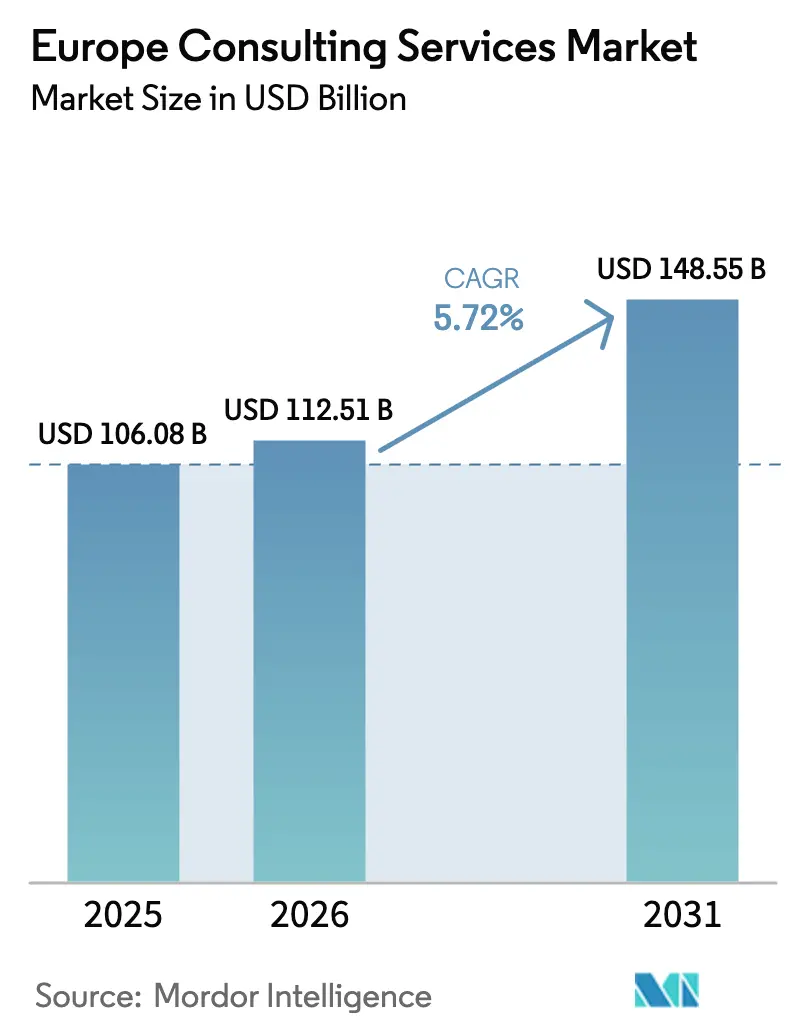
| Base Year Market Size (2025) | USD 106.08 Billion |
| Market Size (2026) | USD 112.51 Billion |
| Market Size (2031) | USD 148.55 Billion |
| Growth Rate (2026 - 2031) | 5.72 % |
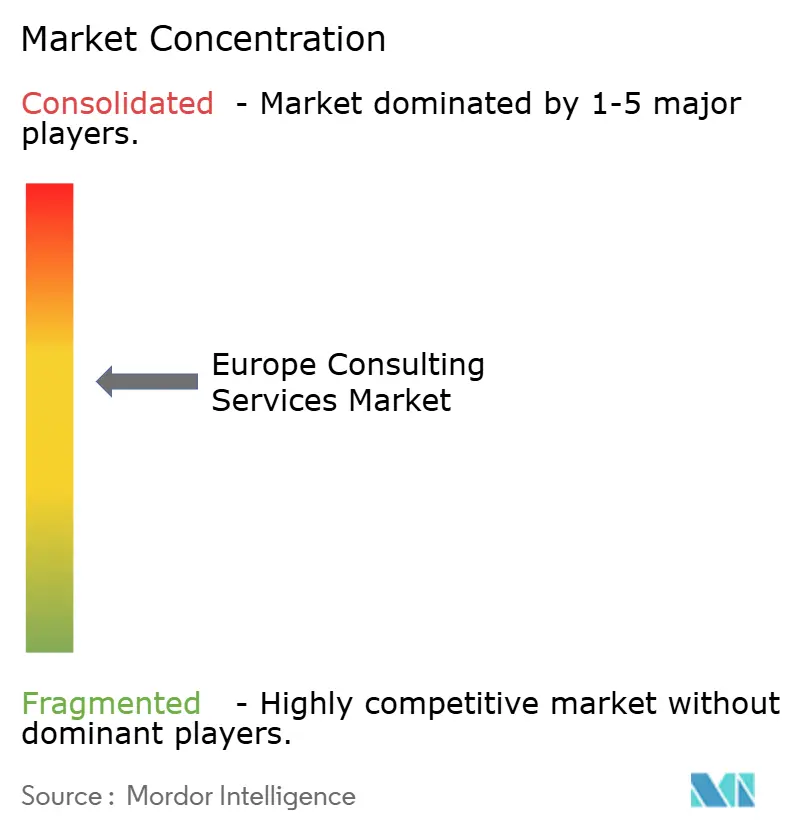
| Market Concentration | Medium |
Major Players *Disclaimer: Major Players sorted in no particular order Image © Mordor Intelligence. Reuse requires attribution under CC BY 4.0. | |
Europe Consulting Services Market Analysis by Mordor Intelligence
The Europe consulting services market size is projected to be USD 106.08 billion in 2025, USD 112.51 billion in 2026, and reach USD 148.55 billion by 2031, growing at a CAGR of 5.71% from 2026 to 2031. The expansion reflects rising advisory spend on Corporate Sustainability Reporting Directive compliance, rapid generative-AI deployment, and Recovery and Resilience Facility-funded digitalization programs. Enterprises are reallocating budgets from discretionary strategy projects toward legally mandated sustainability reporting and technology-enabled productivity gains. Generative-AI adoption is reshaping delivery models, with remote and virtual execution taking share from traditional on-site work. Competitive intensity is escalating as Big Four integrators, strategy houses, and IT-services majors converge on outcome-based, technology-infused engagements.
Key Report Takeaways
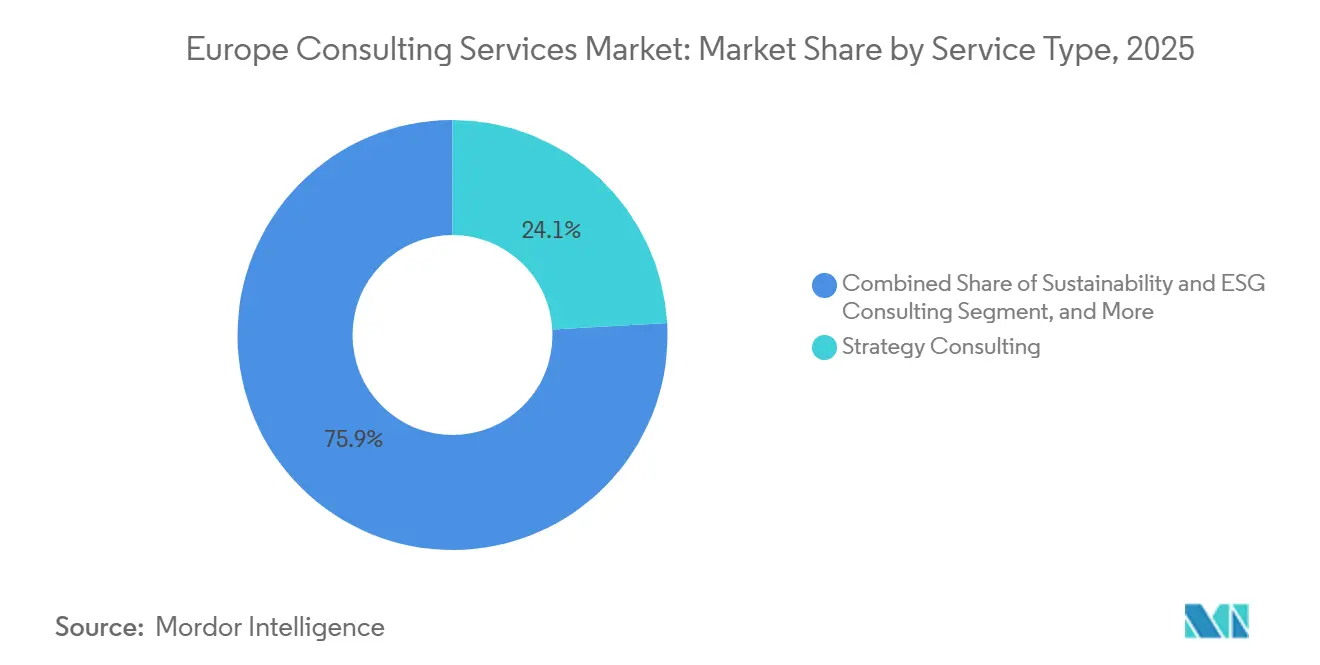
- By service type, strategy consulting held 24.11% revenue share in 2025, while sustainability and ESG consulting is forecast to expand at a 6.81% CAGR through 2031.
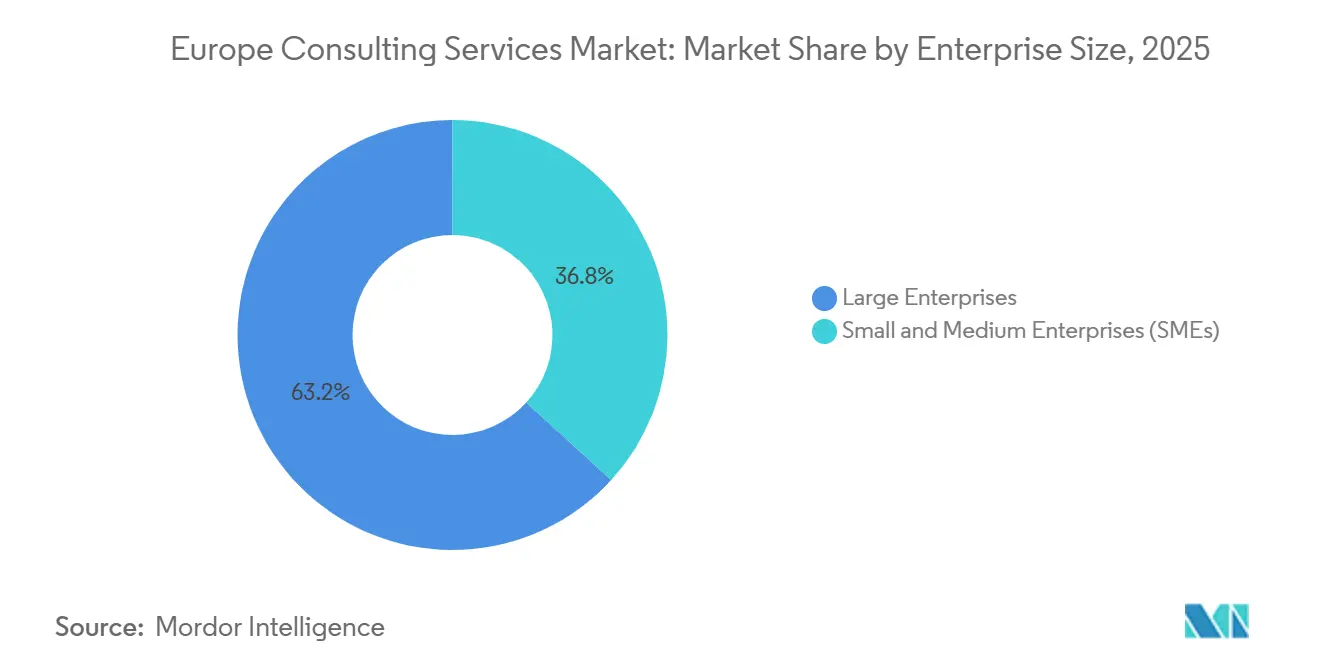
- By enterprise size, large enterprises commanded 63.21% of 2025 spending, whereas SMEs are projected to grow at a 6.23% CAGR through 2031.
- By client industry, BFSI generated 19.87% of 2025 revenue, yet energy and utilities consulting is projected to grow at a 6.58% CAGR through 2031.
- By delivery model, hybrid formats accounted for 49.53% of 2025 engagements, while remote delivery is set to expand at a 6.35% CAGR to 2031.
- By geography, the United Kingdom led with 27.39% share of the Europe consulting services market in 2025; Spain is advancing at the fastest 6.31% CAGR to 2031.
Note: Market size and forecast figures in this report are generated using Mordor Intelligence’s proprietary estimation framework, updated with the latest available data and insights as of 2026.
Europe Consulting Services Market Trends and Insights
Drivers Impact Analysis*
| Driver | (~) % Impact on CAGR Forecast | Geographic Relevance | Impact Timeline |
|---|---|---|---|
| EU Green Deal and CSRD compliance pressures | +1.20% | EU-wide, strongest in Germany, France, Nordics | Medium term (2-4 years) |
| Accelerated client demand for AI-enabled productivity consulting | +1.00% | Global, concentrated in UK, Germany, Benelux | Short term (≤ 2 years) |
| SME digital-maturity funding via EU RRF grants | +0.90% | Spain, Italy, Central and Eastern Europe | Medium term (2-4 years) |
| Regulatory convergence for cross-border services | +0.70% | EU-wide, particularly Benelux, Nordics | Long term (≥ 4 years) |
| Shift to outcome-based pricing models | +0.50% | UK, Germany, France | Medium term (2-4 years) |
| Near-shoring driven by geopolitical risk in supply chains | +0.40% | Central and Eastern Europe, Spain, Portugal | Long term (≥ 4 years) |
| Source: Mordor Intelligence | |||
EU Green Deal and CSRD Compliance Pressures
Roughly 50,000 European companies must publish audited sustainability disclosures beginning with fiscal-year 2025 reports, a tenfold increase versus prior regimes.[1]European Commission, “Corporate Sustainability Reporting Directive (CSRD),” finance.ec.europa.eu Advisory demand centers on ESG data platforms, Scope 3 modelling, and assurance readiness, with one large firm citing a 43% year-on-year rise in CSRD-linked work in 2025.[2]Deloitte, “CSRD Corporate Sustainability Reporting Directive: Implementation Guide,” deloitte.com Legal liability now extends to chief financial officers, making ESG a board-level compliance priority rather than a reputational initiative. The directive’s double-materiality principle requires companies to quantify both climate-related financial risk and their environmental footprint, capabilities rarely found in-house. Germany and France moved fastest due to stringent national enforcement, while Southern and Eastern members are scaling more gradually pending final guidance.[3]PwC, “CSRD Implementation Guide for European Enterprises,” pwc.com
Accelerated Client Demand for AI-Enabled Productivity Consulting
Generative-AI adoption in European enterprises climbed from 12% in early 2024 to 38% by December 2025.[4]McKinsey and Company, “The State of AI in 2025: Generative AI's Breakout Year,” mckinsey.com Consulting engagements now span model selection, prompt engineering, and EU AI Act compliance. Firms bundle use-case road-mapping, pilot execution, and workforce reskilling into multi-year programs that increasingly rely on outcome-based pricing; 62% of one integrator’s European AI projects in 2025 carried success-linked fees. The UK and Germany dominate spend thanks to large talent pools and mature cloud infrastructure, while Southern markets accelerate as hyperscale’s localize data centers to satisfy residency rules.
SME Digital-Maturity Funding via EU RRF Grants
Spain and Italy together received more than EUR 261 billion in RRF allocations through 2026, with at least 20% earmarked for digital transition. Programs such as Spain’s Digitalization Kit subsidize up to EUR 12,000 per SME for advisory services. Italy’s Transizione 4.0 tax credits drive similar uptake, especially in northern industrial clusters. Central and Eastern European members deploy grants to modernize public administration and healthcare IT, compressing timelines and favouring consultancies with pre-built accelerators. The funding window closing in 2026 intensifies demand for rapid advisory interventions.
Regulatory Convergence for Cross-Border Services
The EU Services Directive and mutual-recognition schemes are reducing administrative barriers for multi-country consulting delivery. A January 2025 proposal to standardize engagement contracts seeks to lower legal costs for mid-sized firms expanding across borders. Benelux and the Nordics already recognize professional qualifications across borders, enabling seamless project staffing. Harmonization is most valuable for scarce niche skills such as transfer-pricing or clinical-trial design, where clients demand consistent coverage in multiple jurisdictions.
Restraints Impact Analysis*
| Restraint | (~) % Impact on CAGR Forecast | Geographic Relevance | Impact Timeline |
|---|---|---|---|
| Persistent talent deficit in advanced analytics | -0.80% | Germany, UK, Nordics | Medium term (2-4 years) |
| Fee-compression from procurement-led negotiations | -0.60% | UK, France, Germany | Short term (≤ 2 years) |
| Generative-AI DIY toolkits reducing entry-level work | -0.40% | Global, most acute in UK, Benelux | Short term (≤ 2 years) |
| Regulatory scrutiny on large integrator-consultant MandA | -0.30% | EU-wide | Long term (≥ 4 years) |
| Source: Mordor Intelligence | |||
Persistent Talent Deficit in Advanced Analytics
Germany reported 124,000 unfilled IT and data-analytics roles in December 2025, 17% higher than the prior year. Scarcity inflates salaries, squeezes project margins, and drives firms to acquire boutiques or open near-shore hubs. UK immigration caps further restrict non-EU data-scientist inflow, prompting London practices to shift delivery to Dublin and Warsaw. Nordic universities produce fewer computer-science graduates than local demand, exacerbating the deficit despite liberal visa rules. Regulated clients often insist on onshore teams, limiting off shoring as a mitigation lever.
Fee-Compression from Procurement-Led Negotiations
European corporates centralized consulting spend under category-management frameworks that cut average day rates 15–25% since 2023. Procurement now co-approves engagements above EUR 500,000 and benchmarks proposals against offshore or internal alternatives. Outcome-based pricing shifts delivery risk onto consultancies and demands upfront investment in proprietary tools, challenging mid-sized firms. Generative-AI research assistants further erode willingness to pay for junior labour, pressuring firms to reposition toward high-value C-suite advisory.
*Our forecasts treat driver/restraint impacts as directional, not additive. The impact forecasts reflect baseline growth, mix effects, and variable interactions.
Segment Analysis
By Service Type: Sustainability Consulting Outpaces Traditional Lines
Strategy consulting generated the largest 24.11% share of Europe consulting services market revenue in 2025. Sustainability and ESG projects, however, are forecast to post the highest 6.81% CAGR, propelled by CSRD deadlines and board-level climate-risk oversight. Digital transformation engagements capture adjacent demand as clients embed ESG metrics into ERP and customer dashboards. Operations consulting remains resilient due to cost-containment and supply-chain volatility. Financial advisory benefits from brisk renewable-energy and healthcare deal flow, while technology and cybersecurity advisory converge under the stricter NIS2 regime.
Sustainability’s momentum is shifting wallet share. Firms with verified CSRD methodologies and Scope 3 accounting accelerators are winning multi-year retainers. The Europe consulting services market size linked to ESG assurance is projected to grow faster than any other sub-line through 2031. Meanwhile, outcome-based pricing gains traction in operations and digital transformation, though strategy and financial advisory engagements largely remain time and materials due to intangible value creation. HR and change-management practices pivot toward AI-enabled workforce planning, integrating generative-AI training in more than half of 2025 engagements.



By Client Industry: Energy Transition Fuels Utilities Consulting
BFSI contributed 19.87% of 2025 fees, anchored by Basel IV and Digital Operational Resilience Act compliance programs. Energy and utilities engagements are expected to log the fastest 6.58% CAGR, reflecting grid-modernization mandates under REPowerEU. Manufacturing clients sustain robust spend on Industry 4.0 and circular-economy transitions, while healthcare consulting expands alongside record drug approvals in 2025.
Utilities projects increasingly bundle strategy, technology road-mapping, and predictive-maintenance analytics, lifting the Europe consulting services market size attached to the sector. Consumer and retail demand rebounds, centering on omnichannel integration and sustainability labelling. Public-sector engagements grow as governments deploy RRF funds for digital services, and transportation client’s partner on decarbonization roadmaps aligned with Fit for 55 CO₂ standards.
By Enterprise Size: SMEs Accelerate Advisory Adoption
Large companies captured 63.21% of spending in 2025, yet SMEs are forecast to post the brisker 6.23% CAGR. Grant-backed programs such as Spain’s Digitalization Kit reduce advisory entry costs, expanding the Europe consulting services market share of SME engagements. Standardized accelerators and modular pricing help large consultancies penetrate mid-market demand, while boutiques leverage local language and sector specialization.
Remote delivery lowers travel costs, making it economical to serve SMEs in peripheral regions. The Europe consulting services market size for SME advisory is poised to expand as contract harmonization proposals reduce legal complexity across member states. Large enterprises will continue to dominate capital-intensive ERP and post-merger programs, though procurement pressure compresses margins and forces firms to differentiate through proprietary analytics and co-investment models.
By Delivery Model: Hybrid Dominates, Remote Gains Ground
Hybrid formats held 49.53% of 2025 engagements, balancing on-site relationship building with virtual execution efficiencies. Remote delivery, the fastest-growing model at a 6.35% CAGR, benefits from mature collaboration platforms and client cost discipline. The Europe consulting services market size associated with fully remote work is expanding as engagements deploy specialized talent across borders without visa hurdles.
On-site presence remains essential for high-stakes integration and change-management programs but increasingly follows an immersion-week cadence rather than continuous residency. Remote delivery also supports advisory access for SMEs and niche projects in regulated verticals. Proposed EU guidance on cross-border remote-work taxation could further accelerate adoption by easing compliance burdens.
Geography Analysis
The United Kingdom accounted for 27.39% of 2025 revenue, sustained by London’s concentration of global headquarters and deep capital markets. Germany and France jointly represent roughly 35% of spend, driven by large industrial bases and complex regulatory landscapes. Benelux nations punch above their economic weight owing to dense SME populations and advanced digital infrastructure.
Spain is projected to record the quickest 6.31% CAGR through 2031 as EUR 69.5 billion in RRF grants fund digital and green transitions. Italy follows a similar trajectory propelled by Transizione 4.0 incentives targeting northern industrial clusters. Nordic countries exhibit high consulting intensity per capita, underpinned by early adoption of sustainability reporting and leading AI uptake.
Central and Eastern Europe gains traction as a near-shoring hub for manufacturing and shared services, bolstering demand for supply-chain and cybersecurity advisory. Ireland benefits from its role as a European base for technology and pharmaceutical multinationals, while Portugal and Greece see project activity tied to tourism modernization and smart-manufacturing investments. The Baltics exploit their e-government pedigree to attract fintech and cybersecurity consulting, reinforcing geographic diversity across the Europe consulting services market.
Regulatory Landscape
The regulatory environment underpinning consulting demand in Europe increasingly reflects EU-wide digital and sustainability obligations that require program management, controls, and assurance-ready reporting. CSRD expands audited sustainability disclosures to roughly 50,000 companies starting with fiscal-year 2025 reports, pulling consultancies into ESG data-model design, Scope 3 estimation, and reporting-process redesign. On technology and risk, the EU Data Act has applied since 12 September 2025, and clients are moving into 2026 with implementation work around data access, sharing, and cloud switching terms, which raises demand for legal-technical advisory covering contracting, data governance, and operating-model changes.
A second compliance wave is focused on platform accountability, cybersecurity, and responsible AI. Digital Services Act enforcement tightens in 2026, with the European Commission focusing on systemic-risk obligations for very large online platforms and search engines. That shift increases demand for compliance operating models, content-moderation governance, and audit support. The EU AI Act (Regulation (EU) 2024/1689) sets a dated obligation timeline, with major transparency requirements applying from 2 August 2026 and additional high-risk system compliance obligations tied to 2 August 2027. This is pushing enterprise clients to seek guidance on model risk management, documentation, and controls, while national supervisory readiness remains uneven across member states.
Competitive Landscape
The market remains moderately concentrated; the Big Four collectively hold roughly 35–40% revenue but none exceeds 12% individually. Deloitte, PwC, EY, and KPMG leverage multidisciplinary footprints and audit relationships to win large transformation mandates. Strategy houses McKinsey, BCG, and Bain dominate C-suite advisory, commanding premium rates yet increasingly compete with IT-services majors such as Accenture, Capgemini, IBM Consulting, Infosys, TCS, and Wipro, which bundle advisory with implementation and managed services.
Mid-sized European firms including Roland Berger, BearingPoint, and PA Consulting differentiate through industry specialization and local delivery agility. White-space opportunities in sustainability and generative-AI consulting allow boutiques with deep domain skill to command premium pricing and attract acquisition bids.
Antitrust thresholds introduced in January 2025 slow mega-deals but create room for sub-EUR 500 million tuck-ins, reshaping the competitive chessboard. Technology capability is emerging as the decisive differentiator, with leading firms deploying proprietary analytics platforms, AI assistants, and self-service client portals that raise switching costs.
Europe Consulting Services Industry Leaders
Deloitte Touche Tohmatsu Limited
Ernst & Young Global Limited
KPMG International
PricewaterhouseCoopers LLP
McKinsey & Company
- *Disclaimer: Major Players sorted in no particular order

Market Opportunities and Future Outlook
An opportunity for European consultancies sits at the intersection of generative-AI deployment and regulation-led governance buildouts. The EU AI Act timeline, with major provisions applying from 2 August 2026, is already pulling demand for end-to-end advisory that links use-case selection and model operations to compliance artifacts such as transparency disclosures, risk management, and documentation. In parallel, the report context points to a shift toward technology-infused engagements and success-linked fees, which supports packaging AI productivity programs with measurable outcomes, standardized accelerators, and repeatable governance playbooks rather than bespoke strategy-only projects.
Compliance-led transformation across sustainability and data sharing offers a second route to growth. CSRD implementation for fiscal-year 2025 reporting expands ESG assurance readiness work into ERP, data platform, and internal-controls modernization, while the EU Data Act (applicable since 12 September 2025) creates new advisory demand in cloud contract remediation, data access processes, and monetization strategies for connected-product and service data. Delivery models also matter, with cross-border operating approaches and remote execution gaining traction as clients seek faster access to scarce analytics talent. Procurement-led fee compression since 2023 makes modular, scalable offerings more attractive for SMEs, especially where EU RRF programs such as Spain Digitalization Kit and Italy Transizione 4.0 subsidize advisory entry costs.
Recent Industry Developments
- June 2026: Deloitte Touche Tohmatsu Limited launched Deloitte EMEA, an integrated business entity across 80 countries with 6,000 partners and 132,000 professionals, supported by a 4-year €1.5 billion incremental investment commitment. The integration of cross-border advisory and delivery strengthens pan-European capabilities and positions Deloitte to win large transformation mandates while expanding GenAI and sovereign cloud offerings across the region.
- March 2026: Deloitte Touche Tohmatsu Limited brings EMEA firms together to form a €20 billion integrated business. The move creates a pan-European, integrated service offering that enhances cross-border client engagements and scales digital and AI enabled transformations in Europe.
- February 2026: Deloitte Touche Tohmatsu Limited announces the launch of an EMEA firm. This Europe-wide expansion accelerates pan-European advisory delivery and investment in AI enabled capabilities to support clients across the region.


Research Methodology Framework and Report Scope
Market Definition and Coverage
For this study, the market covers revenue earned from professional consulting engagements delivered to organizations across Europe, where the primary output is advisory input, transformation support, or expert problem solving, billed as fees for services.
Scope exclusions: We exclude pure staff augmentation and temporary staffing, routine outsourced business process work, and software license revenue that is not separable from the consulting service.
Segmentation Overview
- By Service Type
- Operations Consulting
- Strategy Consulting
- Financial Advisory
- Technology Advisory
- HR and Change Management
- Sustainability and ESG Consulting
- Digital Transformation Consulting
- By Client Industry
- BFSI
- Manufacturing and Industrials
- Healthcare and Life Sciences
- Energy and Utilities
- ICT and Media
- Consumer and Retail
- Rest of Client Industries
- By Enterprise Size
- Large Enterprises
- Small and Medium Enterprises (SMEs)
- By Delivery Model
- On-site Engagement
- Remote/Virtual
- Hybrid Model
- By Country
- United Kingdom
- Germany
- France
- Benelux
- Italy
- Nordics
- Spain
- Central and Eastern Europe (incl. Poland)
- Rest of Europe
Data Sources, Market Sizing, and Validation
Desk Research
Desk research was used to set the macro context and to build the first draft of country and industry demand signals. We relied on public statistical releases and policy sources such as Eurostat, the European Commission, OECD, and the World Bank, and we cross-checked labor and price indicators using ILO and national statistics offices where needed.
To make the consulting demand pool realistic, we also reviewed annual reports and investor presentations of large advisory and professional services groups, along with reputable business press coverage of transformation spending cycles. For supporting evidence on regulation-led work, we referenced official publications tied to items like CSRD readiness timelines and major public digital programs. Where financial splits and ownership structures were not transparent, we used a paid subscription for company financials and intelligence, and a separate paid patent database, to fill basic classification gaps. These desk sources are illustrative only, and we also used other public and paid references to collect, verify, and clarify the final dataset.
Primary Interviews and Surveys
Primary work focused on confirming how projects are priced, how demand is shifting between on-site and remote delivery, and which consulting themes are gaining budget priority. We spoke with a mix of consulting providers, corporate buyers, and domain specialists across major European economies so utilization assumptions, fee rate ranges, and typical project durations could be pressure-tested before being locked into the model.
Distribution of primary research fieldwork respondents
| Company type | Respondent position |
|---|---|
| Top tier: 26% | CXOs: 21% |
| Mid tier: 53% | Functional/Unit leaders: 29% |
| Smaller Players: 21% | Managers: 50% |
Market-Sizing & Forecasting
Sizing started from a top down build where Europe level professional services activity was reconstructed using GDP, services output indicators, and business spending signals, and then filtered to the portion that is reasonably attributable to fee based consulting. Once that first pass was built, we corroborated it with selective bottom up checks such as sampled fee rate by role, typical engagement length, and estimated billable utilization ranges discussed in interviews.
A few inputs mattered more than others, including consulting intensity by industry (for example, financial services and manufacturing transformation cycles), public and private investment in digital programs, regulation driven advisory demand (including sustainability reporting readiness), and the share of work delivered remotely versus on site because it changes the staffing mix and blended rates. When data were missing for smaller countries or niche service lines, the gaps were handled using proxy ratios from comparable markets and then rechecked against expert feedback.
For forecasting, we used scenario analysis supported by light multivariate regression on macro and spending indicators, and then adjusted the path based on what interviewees expected for discretionary strategy work versus compliance and technology led projects. This keeps the forecast reproducible, while still reflecting how procurement cycles and delivery models are actually changing.
Data Validation & Update Cycle
Outputs were checked through triangulation across three layers: macro indicators, provider side signals, and buyer side budgeting cues. Where a country or service line showed an unusual jump, we reverified the driver, and if it could not be explained by a clear event like policy timing or investment cycles, we tightened assumptions and recalculated.
Before sign off, the model and key assumptions go through a multi step internal review so arithmetic, logic, and scope consistency are validated. The report is refreshed annually, and if there is a material event (such as a major regulatory change or a sharp macro shift) we trigger an interim review and may re contact experts. Right before delivery, we complete a final update pass so the numbers reflect the latest available information.
Mordor Intelligence's Europe Consulting Services Market Size Measured Against Other Published Estimates
Published market sizes for consulting in Europe often do not match because each publisher makes different choices on what is counted as consulting and how Europe is constructed as a geography. Differences also come from whether figures are reported as billed fees versus total project value, and whether the model assumes stable pricing or rising blended rates.
The largest gaps usually show up when some estimates mix adjacent services like IT outsourcing, implementation heavy managed services, or staffing into the total, which inflates the number even if it sounds directionally right. Currency handling also matters because some sources use local currency aggregation while others convert to USD using a single year rate, and refresh timing can lag when fast moving topics like ESG compliance and GenAI programs shift budgets mid year. In our benchmark, the spread is mainly explained by excluding outsourcing style delivery and counting only fee based advisory revenue across Europe, a scope choice applied by Mordor Intelligence.
Benchmark comparison
| Source | Market Size | Gaps in Research Methodology |
|---|---|---|
| Mordor Intelligence | USD 106.08 B (2025) | |
| Industry Association A | USD 96.50 B (2024) | Often reflects a country panel rather than full Europe coverage, and it can emphasize management consultancy turnover while leaving out adjacent advisory areas that buyers still treat as consulting. |
| Global Consultancy B | USD 125.00 B (2025) | Tends to use a broader definition that can fold in implementation heavy services and outsourcing like work, and it may apply higher blended rate assumptions when projecting large digital programs. |
The comparison shows that the range is largely driven by scope boundaries, panel coverage, and how pricing and currency are treated. By keeping the steps traceable to clear demand indicators and then rechecking assumptions with practitioners, the final number stays practical to interpret and easier to update when conditions change.


Key Questions Answered in the Report
How large is the Europe consulting services market in 2026 and what is its growth rate?
It stands at USD 112.51 billion in 2026 and is projected to grow at a 5.71% CAGR through 2031.
Which service line is expanding the fastest?
Sustainability and ESG consulting is forecast to post the highest 6.81% CAGR as CSRD compliance deadlines approach.
Which client industry shows the strongest growth potential?
Energy and utilities consulting is projected to expand at a 6.58% CAGR, reflecting grid-modernization and energy-transition investments.
What delivery model is gaining share most rapidly?
Remote and virtual delivery is growing at a 6.35% CAGR as clients seek cost efficiency and talent flexibility.
How are SMEs influencing market dynamics?
SME advisory spend is rising at a 6.23% CAGR, fueled by EU grants that subsidize digitalization and sustainability consulting.
What factors are putting pressure on consulting fees?
Centralized procurement negotiations and the availability of generative-AI research tools are compressing day rates by 1525%.
Page last updated on:


 Your data is secure and never sold or shared.


