
Market Overview
| Study Period | 2020 - 2031 |
|---|---|
| Forecast Data Period | 2026 - 2031 |
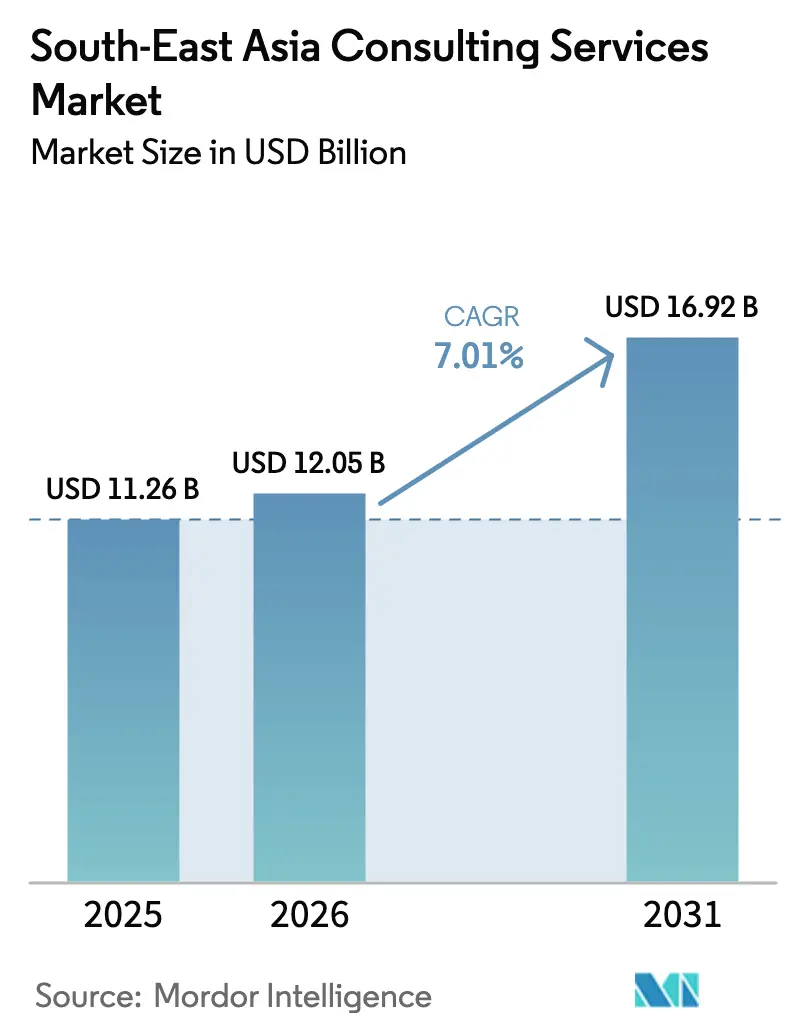
| Base Year Market Size (2025) | USD 11.26 Billion |
| Market Size (2026) | USD 12.05 Billion |
| Market Size (2031) | USD 16.92 Billion |
| Growth Rate (2026 - 2031) | 7.01 % |
| Market Concentration | Medium |
Major Players *Disclaimer: Major Players sorted in no particular order Image © Mordor Intelligence. Reuse requires attribution under CC BY 4.0. | |
South-East Asia Consulting Services Market Analysis by Mordor Intelligence
The South-East Asia consulting services market size in 2026 is estimated at USD 12.05 billion, growing from 2025 value of USD 11.26 billion with 2031 projections showing USD 16.92 billion, growing at 7.01% CAGR over 2026-2031. Robust government-led digitalization roadmaps, mandatory sustainability reporting, and rapid SME formation are the primary forces expanding advisory demand across the ten ASEAN member states. Enterprises racing to modernize legacy applications and integrate AI platforms are channeling the largest spending into IT and Digital Consulting, while the push for transparent environmental disclosures propels Sustainability and ESG advisory uptake. Concurrently, a pivot from episodic projects to subscription-based advisory models is reshaping revenue cycles as clients favor continuous support. Boutiques leveraging cloud-native delivery and independent talent platforms now challenge incumbents on price and agility, while China+1 supply-chain realignment sends manufacturers to Vietnam, Thailand, and Malaysia, unlocking cross-border regulatory workstreams.
Key Report Takeaways
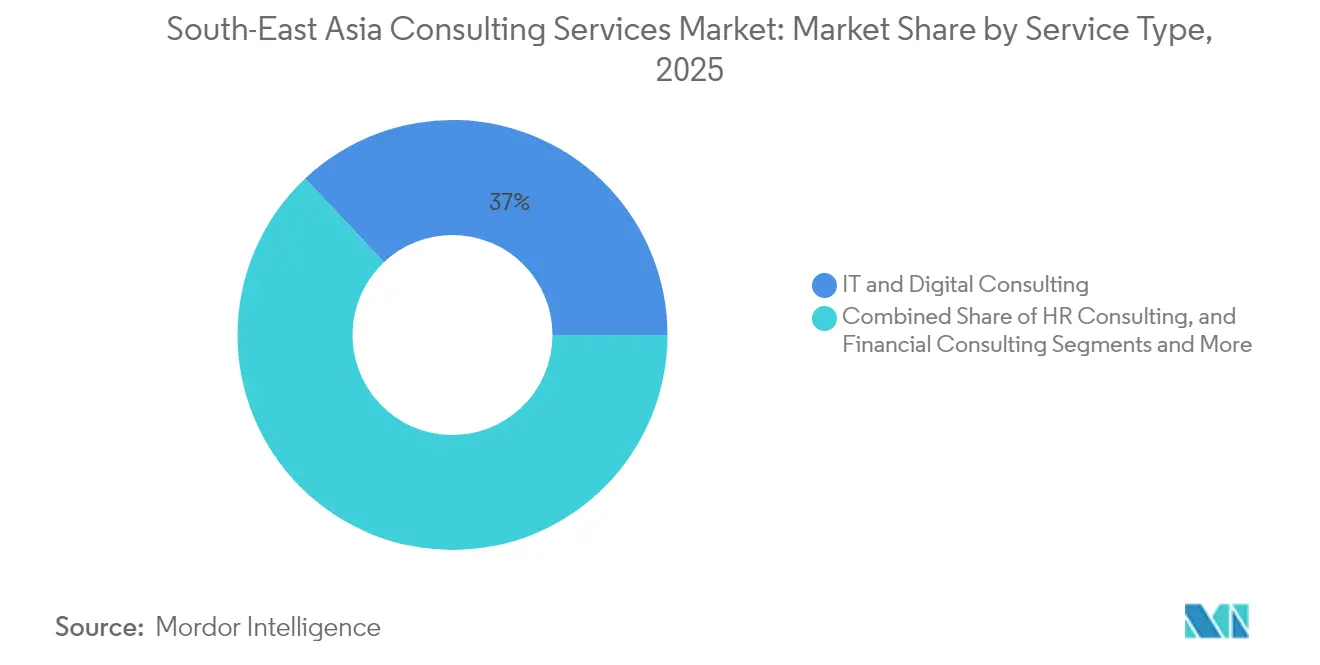
- By service type, IT and Digital Consulting led with 37.02% revenue share in 2025; Sustainability and ESG Consulting is forecast to advance at an 17.55% CAGR to 2031.
- By end-user industry, Financial Services captured 27.05% of the South-East Asia consulting services market share in 2025, while Energy and Utilities is expanding at a 14.06% CAGR through 2031.
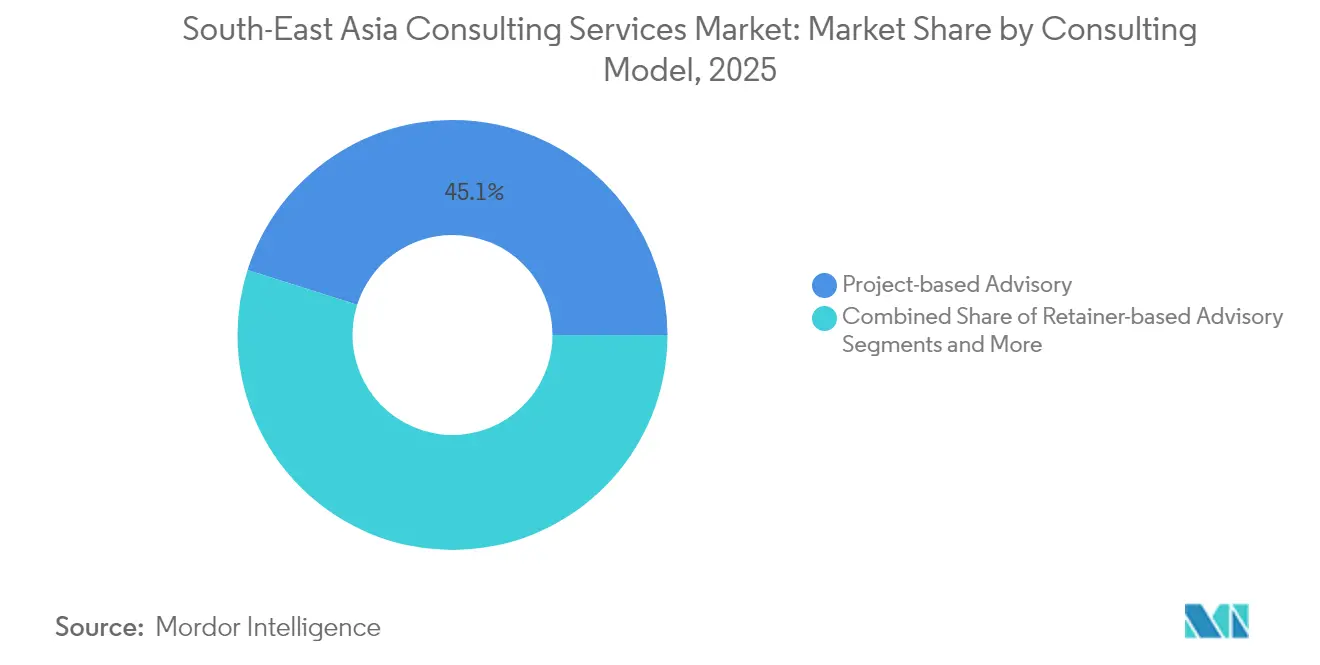
- By consulting model, Project-based Advisory accounted for 45.12% of the South-East Asia consulting services market size in 2025 and Advisory-as-a-Service is set to grow at 16.42% CAGR to 2031.
- By firm size, Large Enterprises held 48.74% share of the South-East Asia consulting services market size in 2025, whereas the SME segment is advancing at a 15.24% CAGR over 2026-2031.
- By country, Singapore accounted for 32.12% of the Southeast Asia consulting services market size in 2025 and Vietnam is set to grow at 13.08% CAGR to 2031.
Note: Market size and forecast figures in this report are generated using Mordor Intelligence’s proprietary estimation framework, updated with the latest available data and insights as of 2026.
South-East Asia Consulting Services Market Trends and Insights
Drivers Impact Analysis*
| Driver | (~) % Impact on CAGR Forecast | Geographic Relevance | Impact Timeline |
|---|---|---|---|
| Digital-first transformation programmes | +2.1% | ASEAN-wide, led by Singapore and Malaysia | Medium term (2-4 years) |
| SME and start-up boom demanding scalable advice | +1.8% | Vietnam, Indonesia, Thailand | Short term (≤ 2 years) |
| Adoption of AI, analytics and cloud platforms | +1.5% | Singapore, Malaysia, Thailand | Medium term (2-4 years) |
| Government digital-economy road-maps and FDI | +1.2% | Indonesia, Vietnam, Philippines | Long term (≥ 4 years) |
| Mandatory ESG-reporting requirements | +0.9% | Singapore, Thailand, Philippines | Medium term (2-4 years) |
| China+1 supply-chain realignment | +0.7% | Vietnam, Thailand, Malaysia | Long term (≥ 4 years) |
| Source: Mordor Intelligence | |||
Digital-first Transformation Programmes
Government programmes such as Singapore’s Smart Nation initiative and Malaysia’s Digital Investment Office are collectively injecting USD 48 billion into regional transformation projects [1]Techerati, “Digital transformation in Southeast Asia requires £48bn,” Techerati.com . Indonesia’s plan to merge 27,000 public-sector apps into nine super-apps exemplifies the complexity of change management, cybersecurity, and cloud migration tasks that demand specialized advice. Singapore’s Analytics.gov platform, now supporting more than 1,600 public-sector users, highlights the consultative work required to govern data, build AI models, and align multi-agency processes. Thailand’s electricity authority chose PLEXOS for grid optimization, signaling rising need for resource-planning advisory across energy utilities. Together these initiatives demonstrate why multi-year engagements around enterprise architecture, governance, and talent upskilling form a resilient revenue stream for the South-East Asia consulting services market.
SME and Start-up Boom Demanding Scalable Advice
Ninety-seven percent of ASEAN businesses are MSMEs, and they face a USD 300 billion funding deficit, prompting governments and donors to subsidize advisory access [HSBC.COM]. Subscription models priced well below the traditional USD 350–1,500 daily rate are gaining ground, enabling founders to secure on-call guidance using independent experts billing USD 250–1,600 per day. Vietnam’s venture ecosystem, supported by InnoVen Capital’s 190 loans, illustrates the appetite for fundraising, unit economics, and go-to-market consulting among high-growth startups. Institutional programs such as the ASEAN Social Enterprise Development Programme 4.0 supply training and seed grants up to USD 40,000, further widening the advisory client base. As founders prioritize sustainable profitability, demand rises for consultants versed in capital efficiency and ESG integration, reinforcing long-term momentum for the Southeast Asia consulting services market.
Adoption of AI, Analytics and Cloud Platforms
Regional AI adoption at scale jumped from 15% in 2020 to as high as 45% in 2025, yet 30-70% of tech job postings remain unfilled, compelling firms to seek external expertise. CapitaLand Investment’s migration to Microsoft Azure saved more than SGD 1 million in annual operating expenses and gave 4,000 staff real-time data access, illustrating cost-saving stories that justify advisory fees. At Changi Airport, AI-driven flight-arrival predictions with 95% accuracy reduced false alarms in security, prompting aviation clients to request similar analytics roadmaps. Healthcare payors across Malaysia and Indonesia cut claims processing times by 75% after cloud transformations, widening the scope of sector-specific consulting engagements. Heightened demand for hyperscale hosting has pushed the data-center colocation market toward a forecast USD 6.89 billion by 2029, signaling continued opportunities in site selection, sustainability compliance, and capacity planning advisory projects.
Government Digital-Economy Road-maps and FDI Inflows
ASEAN’s negotiations on the Digital Economy Framework Agreement seek unified rules on AI governance and digital trade, prompting companies to hire consultants for gap analyses and compliance audits. Indonesia’s creation of GovTech INA Digital and similar agencies institutionalizes procurement channels for transformation advisors. Southeast Asia attracted USD 206 billion of FDI in 2023, eclipsing the USD 43 billion inflow to China and channeling capital into data centers, telecom, and manufacturing ventures that all need regulatory guidance. Public-private partnerships have lifted ICT capex from USD 5.9 billion in 2021 to USD 10.5 billion in 2022, expanding the pipeline for infrastructure consulting. As Malaysia positions itself as a regional data-center hub, opportunities arise for consultants specializing in environmental impact assessments and cross-border data-flow compliance.
Restraints Impact Analysis*
| Restraint | (~) % Impact on CAGR Forecast | Geographic Relevance | Impact Timeline |
|---|---|---|---|
| Corporate in-house consulting build-outs | -1.4% | Singapore, Malaysia, Thailand | Medium term (2-4 years) |
| Price erosion from commoditized offerings | -0.9% | Vietnam, Indonesia, Philippines | Short term (≤ 2 years) |
| Shortage of bilingual domain experts | -0.8% | Region-wide, acute in emerging markets | Long term (≥ 4 years) |
| Data-sovereignty and residency barriers | -0.6% | Vietnam, Thailand, Indonesia | Medium term (2-4 years) |
| Source: Mordor Intelligence | |||
Corporate In-house Consulting Build-outs
Financial institutions such as DBS have cultivated internal digital-transformation squads, reducing dependence on third-party advisors for day-to-day analytics, cybersecurity, and DevOps mandates. These captive units accumulate institutional knowledge and align tightly with corporate culture, often matching or outpacing external consultants on speed of execution. As more enterprises replicate the model, a portion of routine advisory spend migrates in-house, trimming revenue growth for commoditized services. However, complex multi-market transformations, unfamiliar regulatory changes, and independent board-mandated reviews still require external objectivity, preserving scope for high-value engagements. Consulting firms are responding by deepening specialization and offering outcome-based contracts that internal teams struggle to replicate.
Price Erosion from Commoditized Offerings
Standardized deliverables in areas such as ISO compliance, basic ERP migration, and off-the-shelf process re-engineering have become price battlegrounds in Vietnam and Indonesia, where many SMEs balk at day rates above USD 1,000. Platforms brokering independent experts at USD 250–1,600 per day intensify competitive pressure on legacy firms still billing time-and-materials. Automation via AI tools is compressing cycle times for data gathering and scenario modeling, forcing consultants to compete on insight quality rather than labor hours. Market leaders respond with proprietary accelerators, sector-specific playbooks, and subscription offers that bundle advisory and tooling. While margin pressure persists, firms able to demonstrate quantifiable outcomes continue to win wallet share even in price-sensitive segments.
*Our forecasts treat driver/restraint impacts as directional, not additive. The impact forecasts reflect baseline growth, mix effects, and variable interactions.
Segment Analysis
By Service Type: Digital Consulting Dominates Transformation Wave
IT and Digital Consulting contributes 37.02% of 2025 revenue, underscoring enterprise urgency to decommission legacy stacks, adopt cloud-native architectures, and deploy AI workloads. The Southeast Asia consulting services market size for this segment is forecast to expand steadily alongside hyperscale cloud investments and public-sector digital mandates. Sustainability and ESG Consulting, growing at an 17.55% CAGR, gains momentum from Singapore’s 2025 compulsory ESG reporting and Thailand’s re-branded SET ESG Ratings that align with FTSE Russell standards . Clients increasingly demand integrated digital-plus-ESG roadmaps, prompting firms to cross-train technologists in carbon-accounting frameworks. Strategy and Operations Consulting benefits from manufacturers’ China+1 shifts, while Risk and Compliance advisors capitalize on divergent data-localization laws that fragment deployment architectures. HR Consulting remains resilient as 30-70% of tech roles sit vacant, driving projects in talent analytics and workforce planning.
Consultancies now embed AI copilots into delivery, automating document review and scenario modeling, thus shortening sprint cycles and elevating advisory margins. Firms like Tact Social Consulting partner with hyperscalers to bundle cloud credits with ESG advisory, winning enterprise pilots across Thailand. As output-based fees displace billable-hour models, providers quantify value via cost savings, risk mitigation, or carbon-reduction metrics, an approach that resonates with CFOs seeking transparency. The South-East Asia consulting services market share of digital advisory revenue is projected to hold above 35% through 2031 despite the surge in sustainability work, indicating a durable dual-track growth pattern that fuses technology and ESG imperatives.



By End-user Industry: Financial Services Lead Digital Adoption
Financial Services represented 27.05% of 2025 spending, anchored by exhaustive digital banking roadmaps, open-API compliance, and stringent anti-money-laundering rules. KBank’s KBTG unit and Vietnam’s MSB-Backbase partnership are emblematic of institutions investing in omnichannel platforms and AI-enabled credit engines. Energy and Utilities produces the fastest expansion at 14.06% CAGR, fueled by grid modernization and renewable-integration projects such as Thailand’s PLEXOS deployment and Indonesia’s first digital substation in East Java. Manufacturing consulting demand swells as electronics and automotive firms replot supply chains, while telecom operators channel big-ticket capex into 5G and data-center buildouts, attracting infrastructure advisory.
Government and Public Sector engagements escalate with Indonesia’s nine-super-app consolidation, pushing requirements for program management offices, cybersecurity, and service-design expertise. Retail and E-commerce assignments focus on customer-journey redesign and fraud analytics as mobile wallets multiply to an expected 440 million accounts by 2025. Healthcare providers pursue cloud migrations to compress claims-processing times and improve patient triage, opening avenues for HIPAA-analog compliance and legacy-system decommissioning consulting. Collectively, these verticals sustain a robust pipeline, reaffirming the South-East Asia consulting services market as the advisory hotspot within emerging Asian economies.
By Consulting Model: Subscription Services Gain Momentum
Project-based Advisory retains a dominant 45.12% revenue share, particularly for time-bound regulatory implementations and large-scale infrastructure builds. The South-East Asia consulting services market size for subscription engagements-branded as Advisory-as-a-Service-however, is on track for 16.42% CAGR as clients prioritize continuous alignment with shifting regulations and technology updates. Hybrid models now blend outcome-based milestones with rolling monthly touchpoints, reducing scope creep while preserving strategic depth. Managed Services evolve from IT operations outsourcing toward value-added compliance monitoring, especially around data privacy statutes that vary across ASEAN.
Independent talent platforms accelerate disruption; freelancer registrations grew 88% in 2024, enabling smaller businesses to access specialized skills on demand. To defend margins, incumbents invest in proprietary AI accelerators that slash discovery phases and produce real-time dashboards, integrating seamlessly into subscription portals. As advisory budgets shift from capex to opex, predictability of spend positions subscription models to capture a rising fraction of the South-East Asia consulting services market share through 2031.
By Firm Size: SMEs Drive Market Expansion
Large Enterprises commanded 48.74% of 2025 revenue, underpinned by multi-year, region-wide transformation programs. Yet SMEs exhibit a 15.24% CAGR outlook due to democratized consulting access via modular packages and donor-backed capacity-building schemes. The ASEAN Social Enterprise Development Programme illustrates this trend by bundling mentorship with USD 40,000 seed grants, catalyzing demand for go-to-market, ESG, and fundraising advice. Independent platforms offering vetted experts at variable rates allow founders to buy advisory credits instead of locking into retainers, supporting budget flexibility.
For mid-market firms, rising regional expansion ambitions drive cross-border tax, HR, and regulatory workstreams that exceed in-house expertise. Public-sector Entities turn to consultants for digital-government design, cloud migration, and citizen-services optimization, particularly in Indonesia and Malaysia. Collectively these dynamics sustain a balanced revenue mix that insulates the South-East Asia consulting services market from cyclicality tied to a single client class.
Geography Analysis
Singapore and Malaysia form the mature nucleus, boasting advanced data-protection regimes and high cloud-adoption rates that generate steady compliance and optimization work. Indonesia represents the largest addressable opportunity owing to its super-app consolidation and EV-battery investments exceeding USD 1.1 billion, which require end-to-end program governance and vendor management . Vietnam emerges as the fastest-growing advisory destination, benefiting from China+1 manufacturing relocation and a rapidly expanding digital economy recognized as the region’s fastest mover in 2024.
Thailand’s progressive ESG framework, including the SET ESG Ratings initiative, underpins sophisticated sustainability consulting assignments that extend beyond checkbox compliance. The Philippines has enacted a timeline to mandate sustainability disclosures by 2026, driving a pipeline of gap analysis and reporting engagements.
Smaller economies such as Cambodia and Myanmar remain nascent but offer greenfield prospects in telecom rollout and public-finance digitization as political stability permits. Cross-border projects rise in frequency as the ASEAN Digital Economy Framework seeks to harmonize standards, favoring consultancies equipped with bilingual experts and multi-jurisdictional IP protection strategies.
Regulatory Landscape
Regional digital-rulemaking is becoming a key demand driver for risk, compliance, and digital advisory across ASEAN. In May 2026, ASEAN Senior Economic Officials (SEOM) concluded negotiations on the ASEAN Digital Economy Framework Agreement (DEFA), with signing targeted for the 49th ASEAN Summit in November 2026. DEFA covers data governance and privacy, digital identity, e-payments, online safety, cybersecurity cooperation, competition policy, and emerging technologies including AI. The ASEAN Digital Masterplan 2030 also reinforces regulator-led priorities like trusted cross-border data flows and harmonized digital regulations, expanding the scope of multi-country gap assessments and implementation playbooks for clients operating across multiple member states.
At the country level, governments are linking digitalization with governance and resilience requirements that raise the volume of implementation and assurance work. Singapore, through IMDA-led 2026 initiatives such as the National AI Impact Programme and the Building AI-Ready Enterprises, is formalizing enterprise AI adoption pathways, which in turn increases demand for model governance, controls, and operating-model redesign. Vietnam approved Decision 840/QD-TTg (13 May 2026) for a digital technology industry development program for 2026-2030 and advanced national digital transformation priorities for 2026-2030 (vision to 2045), including interoperable government information systems, shared databases, digital identity, digital payments, and AI-integrated platforms. This expands advisory needs around architecture standards, data-sharing, cybersecurity readiness, and program governance.
Value Chain Analysis
Demand comes from enterprises and public-sector agencies running digital-first transformation, AI adoption, and ESG and reporting programs across the ten ASEAN member states. Engagements typically start with strategy and diagnostic work, such as roadmaps, business cases, target operating models, and regulatory gap assessments. They then shift into solution design and implementation, covering cloud migration, data platforms, cybersecurity controls, and process redesign, before moving to assurance and optimization, including risk and compliance monitoring, sustainability reporting support, and continuous improvement. The move toward subscription and managed delivery models is also expanding the post-implementation portion of the value chain, since buyers want ongoing support to keep pace with changing technology stacks and fragmented data-sovereignty requirements.
On the supply side, delivery relies on global consultancies, local and boutique firms, and independent expert platforms. Inputs include domain talent (bilingual and sector specialists), partner ecosystems (hyperscalers, SaaS and cybersecurity vendors), and public enablement programs that standardize toolkits and training. For example, Singapore's Digital Enterprise Blueprint links SME and enterprise adoption with partner-led capability building such as Data+AI Boost SME via Salesforce Trailhead and the Spark GenAI Programme with DBS, IMDA, and EnterpriseSG, which creates downstream needs for implementation partners, governance setup, and secure operations. At the regional level, ASEAN DEFA and the ASEAN Digital Masterplan 2030 strengthen the enabling layer through cross-border data rules, digital identity, payments, and cybersecurity cooperation, increasing the value of consultancies that can coordinate multi-jurisdiction compliance and interoperability across ASEAN operations.
Competitive Landscape
The market remains moderately fragmented; the combined share of the five largest firms is estimated below 50%, allowing niche specialists room to scale. Accenture logged 9% year-on-year revenue growth in Q1 2025 and secured USD 1.2 billion in generative-AI bookings, underscoring heavyweight incumbents’ continued heft. Yet recent MandA reveals a race to bolster ESG and policy-advisory depth: CBRE bought Singapore-based Paia to widen sustainability credentials, and Access Partnership acquired Asia Group Advisors for regulatory reach. Intralink’s purchase of Orissa International signals a growing appetite for market-entry consulting scale across the region.
Technology integration emerges as a differentiator, with providers embedding AI copilots and data-visualization layers into engagement dashboards to streamline delivery. Freelancer platforms further tilt competition by unbundling expertise, pressuring traditional firms to adopt mixed-talent models and outcome-based pricing.
White-space opportunities reside in data-residency compliance, cross-border ESG reporting, and regional supply-chain diversification, where few players yet hold deep credentials. Given these dynamics, the competitive intensity is likely to escalate, favoring providers with niche depth, technology partnerships, and cultural fluency across ASEAN languages.
South-East Asia Consulting Services Industry Leaders
Deloitte Touche Tohmatsu Limited
Accenture PLC
PricewaterhouseCoopers LLP
Ernst & Young Global Limited
Cognizant Technology Solutions Corporation
- *Disclaimer: Major Players sorted in no particular order


Market Opportunities and Future Outlook
Cross-border compliance and interoperability are a clear whitespace as ASEAN moves from negotiation to operationalization of common digital economy rules. With ASEAN DEFA negotiations concluded in May 2026 and signing targeted for November 2026, enterprises running regional e-commerce, payments, and data-driven services need multi-country gap assessments across data governance and privacy, digital identity, e-payments, online safety, and cybersecurity cooperation, followed by implementation support that aligns processes and controls across different member-state requirements. The ASEAN Digital Masterplan 2030 also anchors demand by positioning trusted cross-border data flows and harmonized digital regulations as regional priorities, which supports advisory work that combines regulatory interpretation with enterprise architecture and operating-model change.
AI at scale and public platforms are expanding near-term service lines beyond one-off transformation projects. In Singapore, IMDA's 2026 enterprise AI initiatives, including the National AI Impact Programme and Building AI-Ready Enterprises, and government messaging around agentic AI governance increase demand for end-to-end AI adoption services, from use-case selection and data readiness to governance, cybersecurity, and rollout into business functions. Vietnam's 2026-2030 digital programs, including Decision 840/QD-TTg and national priorities for shared databases, data-sharing services, digital identity and authentication, digital payments, and AI-integrated national platforms, extend the pipeline for consulting-led program management, systems integration governance, and cybersecurity standards alignment, particularly for providers that can translate national platform requirements into implementable enterprise and agency roadmaps.
Recent Industry Developments
- July 2026: Cognizant expanded partnership with Google Cloud to integrate Gemini Enterprise into client environments and expand internal agentic AI deployments. The collaboration broadens Cognizant's AI driven delivery model across SEA enterprises.
- June 2026: Cognizant completed the acquisition of Astreya to enhance AI infrastructure and managed services, effective June 22, 2026. The capacity addition strengthens Cognizant's AI delivery stack and scale in SEA GCC-type engagements.
- May 2026: Cognizant secured a contract with JG Summit Holdings, Inc. to implement ServiceNow IT Service Management and IT Asset Management for IT modernization. The deal reinforces Cognizant's foothold in SEA enterprise IT modernization programs.


Research Methodology Framework and Report Scope
Market Definition and Coverage
For this study, the market is defined as revenue earned from professional consulting engagements delivered to clients across South-East Asia, covering advisory-led services provided on a project or retainer basis, expressed in USD value terms.
Scope exclusions: We exclude audit and statutory assurance work, pure staffing services, and non-consulting outsourcing where the primary deliverable is ongoing operations rather than advisory.
Segmentation Overview
- By Service Type
- HR Consulting
- Financial Consulting
- IT and Digital Consulting
- Strategy and Operations Consulting
- Risk and Compliance Consulting
- Sustainability and ESG Consulting
- By End-user Industry
- Financial Services
- Life Sciences and Healthcare
- IT and Telecommunications
- Government and Public Sector
- Energy and Utilities
- Manufacturing
- Retail and E-commerce
- By Consulting Model
- Project-based Advisory
- Retainer-based Advisory
- Managed Services / Outsourcing
- Advisory-as-a-Service (Subscription)
- By Firm Size
- Small and Medium Enterprises (SMEs)
- Large Enterprises
- By Country
- Singapore
- Indonesia
- Thailand
- Vietnam
- Philippines
- Malaysia
- Rest of Southeast Asia
Data Sources, Market Sizing, and Validation
Desk Research
Desk research was used to map the demand context for consulting in South-East Asia and to set realistic boundary conditions before modeling. We relied on public economic and services indicators, such as ASEAN statistics, World Bank and IMF macro series, national statistics offices, and central bank publications, because these sources help explain budget cycles and enterprise spending confidence.
We also reviewed government digital and industry programs, procurement portals, and regulator publications where advisory spend is indirectly visible through announced initiatives and policy timelines. To ground company-side inputs, we checked annual reports, investor presentations, and reputable press coverage for services revenue cues and hiring signals. Where needed, paid subscriptions were used only for company financials and intelligence, patent databases when innovation themes were relevant, and shipment-level trade data when cross-border services activity required a reality check. The desk sources listed here are illustrative only, and we also referenced other public and subscription sources to collect, validate, and clarify specific data points.
Primary Interviews and Surveys
Primary work focused on validating what is being bought, how engagements are priced, and how demand differs by country and client type across the region. We spoke with consulting practitioners, enterprise buyers, and channel partners so assumptions on engagement mix, local versus cross-border delivery, and typical contract size could be corrected where desk signals were not enough. Because the study covers South-East Asia, the fieldwork was balanced across key economies and industry demand centers to avoid over-weighting any one market.
Distribution of primary research fieldwork respondents
| Company type | Respondent position |
|---|---|
| Top tier: 32% | CXOs: 13% |
| Mid tier: 54% | Functional/Unit leaders: 43% |
| Smaller Players: 14% | Managers: 44% |
Market-Sizing & Forecasting
Market sizing was built using a top-down demand reconstruction, where services output and business spending signals were translated into a consulting revenue pool by country and then rolled up to the regional total. To keep the model practical, we used a short list of inputs that can be checked and refreshed, such as GDP and services output trends, foreign direct investment momentum, public-sector modernization budgets, enterprise digital transformation intensity (including cloud and AI program adoption), and regulation-led advisory triggers like sustainability reporting timelines.
Once the demand pool was established, we corroborated it with selective bottom-up approximations, including sampled engagement value ranges multiplied by estimated project volumes in core consulting categories, and cross-checks against supplier-side revenue footprints where disclosures were available. When bottom-up visibility was weak in smaller countries, gaps were handled by applying peer-country ratios adjusted for business density and public spending patterns, and then re-tested through interviews.
For forecasting, scenario analysis was used, followed by a simple multivariate regression overlay so growth stayed consistent with the main drivers that practitioners agreed move spend each year. Where variables pointed in opposite directions, we kept one conservative assumption and stress-tested the total so the final time series stayed realistic country by country.
Data Validation & Update Cycle
To validate results, estimates were triangulated across independent signals, and the model was checked for outliers at both country and regional levels. If an unusual jump appeared, the driver assumptions were re-opened, and selected respondents were re-contacted to confirm whether it was a real market shift or a data artifact.
A second analyst review is completed to verify calculations, definitions, and currency handling before sign-off. Reports are refreshed annually, and interim updates are made when material events occur, such as major policy changes, macro shocks, or a visible shift in consulting demand patterns. Before delivery, a final review pass is done so clients receive the latest updated view.
Mordor Intelligence's South East Asia Consulting Services Market Size Compared With Other Published Estimates
Published market sizes for consulting services in South-East Asia can look different because firms do not all count the same service lines, and they also choose different base years and currency conversion timings. The range often widens when one estimate blends management consulting with IT system implementation revenue, while another keeps the scope closer to advisory-only work.
Key gap drivers typically include whether implementation-heavy work is included, whether the study covers all ASEAN countries or only the largest four to six, and whether smaller projects for local SMEs are captured or assumed away. The market total also shifts when pricing is projected using fixed rates versus updating average billing rates using hiring cost trends and utilization, and when refresh cycles lag behind recent demand changes. This is reduced here by separating advisory revenue from implementation services before aggregation, a modeling choice applied by Mordor Intelligence.
Benchmark comparison
| Source | Market Size | Gaps in Research Methodology |
|---|---|---|
| Mordor Intelligence | USD 12.05 B (2026) | |
| Specialist Research House A | USD 8.40 B (2024) | Uses an earlier base year and a management-consulting definition that excludes IT system implementation and several adjacent delivery revenues, which compresses the addressable total for the region. |
| Regional Publisher B | USD 13.79 B (2026) | Appears to use a broader service scope that likely rolls advisory and implementation together, and it may assume a more aggressive pricing progression without the same country-level validation checks. |
Looking at the table, the biggest reason for the range is scope, followed by timing and pricing mechanics. When advisory-only revenue is kept distinct and country coverage is made explicit, the resulting number becomes easier to reconcile with demand drivers and repeatable checks, which helps users interpret the market size with fewer hidden assumptions.


Key Questions Answered in the Report
Which advisory segments are growing fastest in South-East Asia consulting?
Sustainability and ESG Consulting is expanding at an 17.55% CAGR through 2031, fueled by mandatory reporting regulations and investor pressure.
How large is client demand for subscription-based consulting?
Advisory-as-a-Service is forecast to grow at 16.42% CAGR as enterprises seek continuous guidance rather than one-off projects.
What drives SME adoption of consulting in the region?
Affordable subscription models and donor-funded accelerator programs are closing the cost barrier, propelling SME consulting demand at 15.24% CAGR.
Which industries present the strongest consulting opportunities beyond finance?
Energy and Utilities is projected to grow at 14.06% CAGR, driven by grid modernization and renewable-integration projects.
How does China+1 affect Southeast Asian consulting demand?
Manufacturers relocating production to Vietnam, Thailand, and Malaysia hire consultants for site selection, regulatory compliance, and supply-chain redesign.
What competitive edge do boutiques hold over global consultancies?
Boutiques leverage specialized ESG expertise, agile delivery, and flexible pricing, often partnering with technology platforms to match large-firm capabilities.
Page last updated on:


 Your data is secure and never sold or shared.


