
Baseball Equipment Market Size and Share
Market Overview
| Study Period | 2021 - 2031 |
|---|---|
| Market Size (2026) | USD 20.67 Billion |
| Market Size (2031) | USD 26.09 Billion |
| Growth Rate (2026 - 2031) | 4.76 % |
| Fastest Growing Market | Asia-Pacific |
| Largest Market | North America |
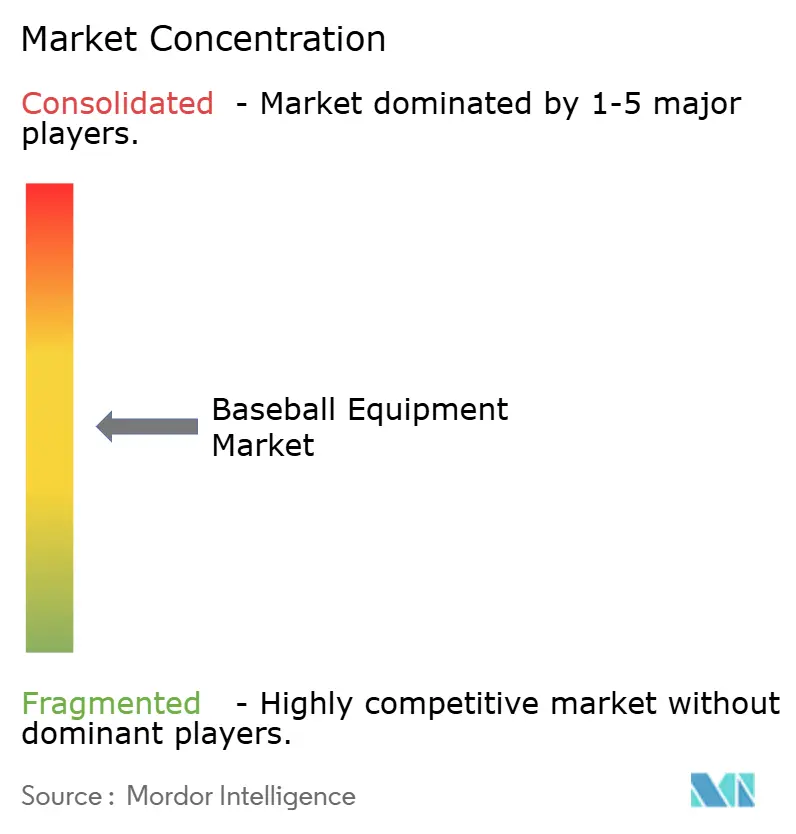
| Market Concentration | Medium |
Major Players *Disclaimer: Major Players sorted in no particular order Image © Mordor Intelligence. Reuse requires attribution under CC BY 4.0. | |
Baseball Equipment Market Analysis by Mordor Intelligence
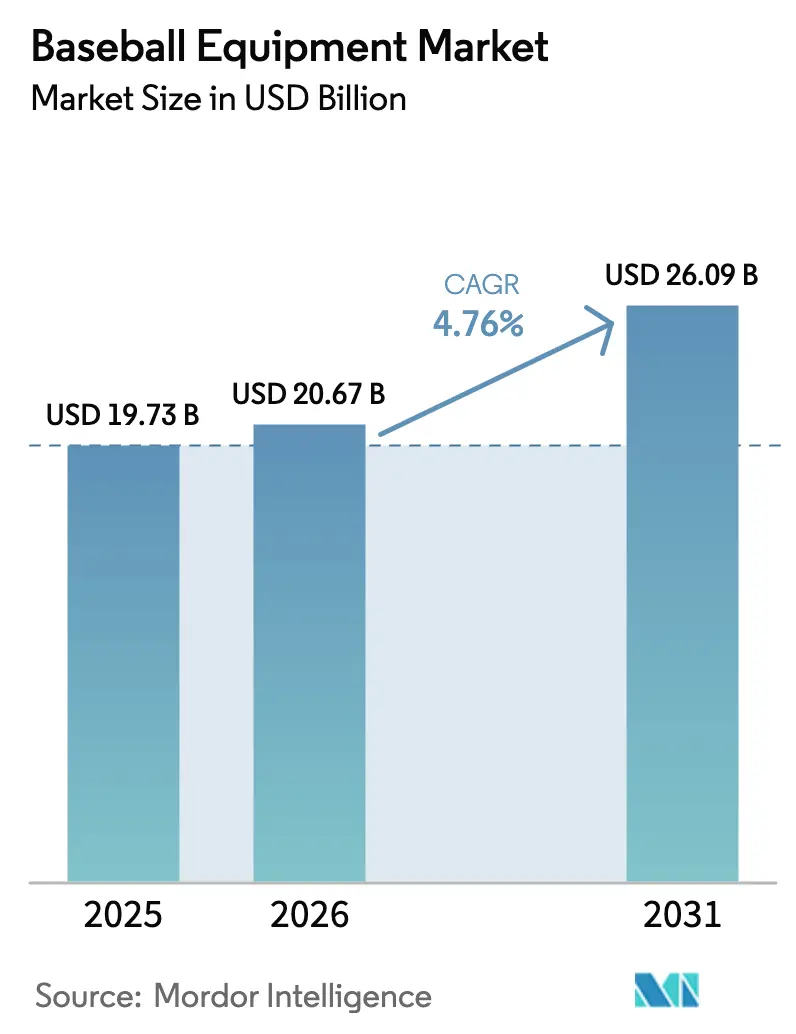
The global baseball equipment market size in 2026 is estimated at USD 20.67 billion, growing from 2025 value of USD 19.73 billion with 2031 projections showing USD 26.09 billion, growing at 4.76% CAGR over 2026-2031. The market is experiencing steady growth, primarily driven by the increasing organization of baseball games and rising participation in baseball and softball, particularly in North America, Japan, and parts of South America. In June 2025, the NCAA Division I baseball tournament, which began with 64 teams, advanced through regional and super regional stages, culminating in the Men’s College World Series (MCWS) in Omaha, Nebraska. Growing youth participation and the expansion of school and college-level tournaments are driving demand for products such as bats, gloves, balls, and protective gear. Technological advancements, including lightweight composite bats and performance-enhancing gloves, are attracting both amateur and professional players. Companies like Easton and Rawlings are investing in product innovation to improve grip and swing dynamics. Additionally, the increasing popularity of women’s baseball leagues and the growth of recreational baseball in emerging markets such as South Korea and Taiwan are contributing to market expansion. Endorsement deals and strategic partnerships with Major League Baseball (MLB) are further enhancing brand visibility and boosting product sales.
Key Report Takeaways
- By product type, bats led with 36.78% of the 2025 baseball equipment market share, while protective gear and accessories registered the fastest 4.92% CAGR.
- By end-user, adult players accounted for 66.88% of 2025 revenue, whereas the children’s segment is projected to expand at a 5.06% CAGR from 2026-2031.
- By buyer type, individual purchasers held 76.13% of 2025 revenue; institutional buyers are forecast to post a 4.9% CAGR through 2031.
- By distribution channel, offline retail stores retained 71.87% of revenue in 2025, while online platforms are on track for a 5.12% CAGR to 2031.
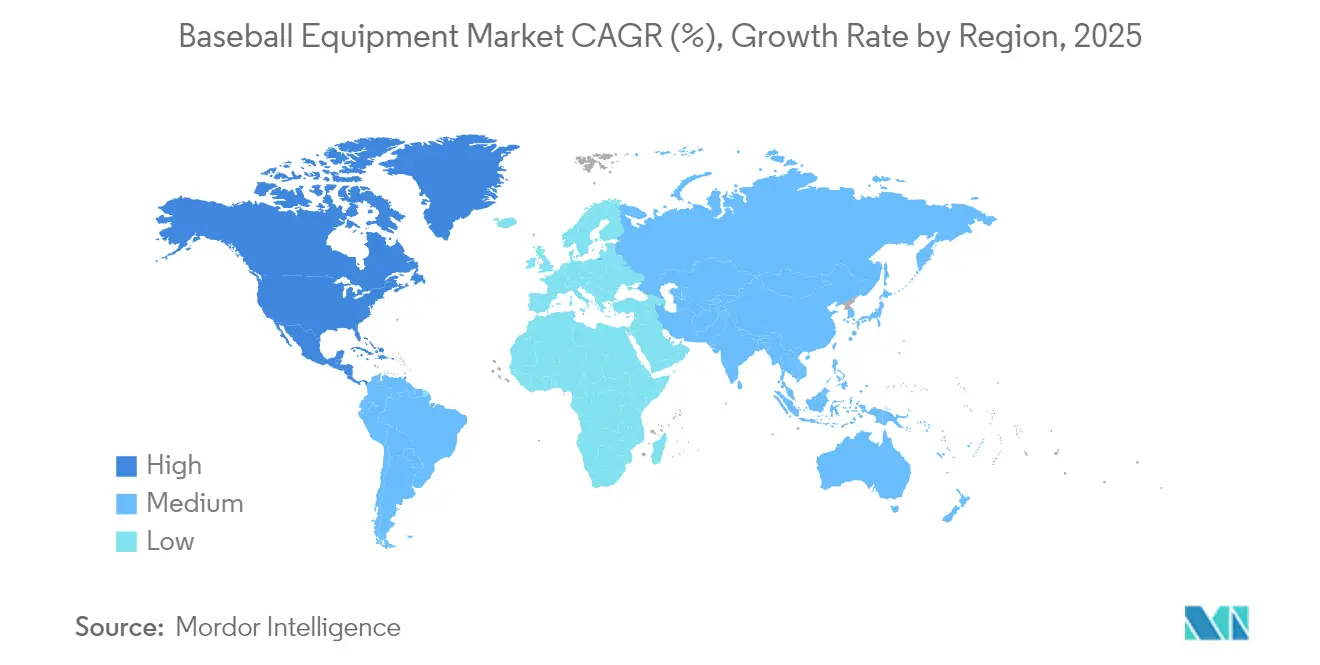
- By geography, North America dominated with 53.33% of 2025 revenue, yet Asia-Pacific is the fastest region with a 5.58% CAGR expected through 2031.
Note: Market size and forecast figures in this report are generated using Mordor Intelligence’s proprietary estimation framework, updated with the latest available data and insights as of 2026.
Market Trends and Insights
Drivers Impact Analysis of Baseball Equipment Market*
| Driver | (~) % Impact on CAGR Forecast | Geographic Relevance | Impact Timeline |
|---|---|---|---|
| Increasing Awareness of Health and Fitness | +0.8% | Global, strongest in North America & Europe | Medium term (2-4 years) |
| Expansion of Baseball Leagues and Tournaments | +0.9% | Asia-Pacific core, spill-over to MEA and South America | Long term (≥ 4 years) |
| Government Initiatives and Grassroots Programs | +0.7% | North America & Asia-Pacific, emerging in Europe | Medium term (2-4 years) |
| Increasing Youth Participation | +1.0% | Global, with accelerated growth in Asia-Pacific | Long term (≥ 4 years) |
| Technological Advancements in Equipment | +0.6% | North America & Europe, expanding to Asia-Pacific | Short term (≤ 2 years) |
| Influence of Celebrity Endorsements and Branding | +0.4% | Global, concentrated in major markets | Short term (≤ 2 years) |
| Source: Mordor Intelligence | |||
Increasing Youth Participation
In 2024, baseball participation in the United States increased to 17.3 million individuals aged six and above, compared to 16.7 million in 2023, as reported by the Outdoor Foundation and the Sports and Fitness Industry Association (SFIA)[1]. The World Baseball Softball Confederation (WBSC) continues to drive recurring demand for baseball equipment through U12 and U18 regional championships, where teams frequently upgrade their gear. In Japan, school-based leagues act as critical pathways to professional baseball careers, encouraging families to invest in high-quality bats, helmets, and advanced training tools. Additionally, Asia-Pacific ministries of sport recognize baseball's contribution to social cohesion and allocate funding to develop youth fields, which, in turn, stimulate local retail markets. These factors collectively sustain a steady demand for baseball equipment and normalize replacement cycles. The growing emphasis on youth development and competitive play further drives the need for premium gear. As players advance through different levels, the demand for specialized equipment rises, creating consistent market opportunities. This dynamic underscores the importance of baseball as a key driver of retail activity and equipment innovation in the global sports market.
Government Initiatives and Grassroots Programs
In June 2025, the Oregon Legislature approved Senate Bill 110 with bipartisan support, marking a significant step toward establishing professional baseball in Portland. The bill allocated USD 800 million in bonds to fund the construction of a state-of-the-art baseball stadium on Portland’s South Waterfront [2]. Globally, municipalities are adopting similar strategies by integrating stadium development with school diamond renovations, driving demand for essential equipment such as bats, helmets, and catcher sets. Nike’s Reviving Baseball in Inner Cities (RBI) initiative strategically addresses these needs by providing no-cost equipment and discounted pricing to eligible clubs, effectively reducing financial barriers for low-income families. Such initiatives not only foster increased participation but also stimulate long-term demand for baseball equipment. Collaborative efforts like these ensure that equipment demand aligns with facility expansion rather than solely relying on player growth. Additionally, standardization requirements within these programs encourage the purchase of certified goods, thereby strengthening the competitive edge of premium brands. Such developments highlight the intersection of infrastructure investment and market growth opportunities in the sports equipment industry.
Expansion of Baseball Leagues and Tournaments
The global expansion of professional baseball leagues and the increasing prominence of international tournaments are driving significant growth in the demand for premium baseball equipment. In November 2024, Baseball United, the first professional baseball league catering to the Middle East and South Asia, announced the official schedule for its inaugural Baseball United Arab Classic tournament. The event will be hosted at the newly launched Baseball United Ballpark in Dubai. Emerging leagues across various regions are creating new opportunities for manufacturers of bats, gloves, and protective gear. As professional standards continue to rise, teams and players are prioritizing investments in advanced equipment to enhance both performance and safety. For example, the growing global audience for the World Baseball Classic has not only fueled interest in the sport but also led to increased sales of baseball equipment. Additionally, sponsorship agreements and broadcasting rights are fostering brand collaborations, encouraging companies like Mizuno and Wilson to introduce high-end product lines. This professionalization trend is also influencing amateur players, who are increasingly purchasing professional-grade gear to emulate their role models.
Technological Advancements in Equipment
Technological advancements in baseball equipment are significantly transforming the market by enhancing performance, safety, and user experience, thereby driving global growth. Innovations such as carbon fiber composite bats are delivering superior swing speed and durability, making them highly appealing to both amateur and professional players. Smart gloves equipped with pressure sensors are undergoing testing to assist players in analyzing grip strength and catching efficiency, showcasing the integration of technology into traditional equipment. In January 2024, a 'Smart Glove' developed at UBC was introduced with the primary aim of aiding stroke recovery, highlighting the potential for cross-industry applications. Leading companies like Wilson and Rawlings are incorporating advanced materials, such as moisture-wicking and breathable fabrics, into gloves and apparel to improve player comfort. Additionally, bat sensors like Blast Motion are enabling players to track swing metrics, facilitating data-driven training and technique refinement. These technologically advanced products are attracting players seeking a competitive edge, thereby driving repeat purchases and increasing demand for premium offerings. As high-tech gear gains traction among teams and training academies, demand is expanding beyond traditional markets like the United States and Japan to emerging baseball hubs worldwide.
Restraints Impact Analysis of Baseball Equipment Market*
| Restraint | (~) % Impact on CAGR Forecast | Geographic Relevance | Impact Timeline |
|---|---|---|---|
| Risk of Injury and Safety Concerns | –0.3% | Global, heightened focus in North America | Medium term (2-4 years) |
| Lack of Time and Lifestyle Constraints | –0.4% | Developed markets, particularly North America & Europe | Long term (≥ 4 years) |
| Limited Access to Facilities and Infrastructure | –0.5% | Emerging markets, concentrated in Asia-Pacific & MEA | Long term (≥ 4 years) |
| Counterfeit and Low-quality Products | –0.2% | Global, concentrated in price-sensitive markets | Short term (≤ 2 years) |
| Source: Mordor Intelligence | |||
Risk of Injury and Safety Concerns
Concussion studies and arm overuse data highlight injury risks, shaping parental decisions on sports enrollment. In 2023, 14.2% of U.S. high school students reported at least one concussion from sports or physical activities, as per the Centers for Disease Control and Prevention. Updated bat standards and age-specific pitching guidelines from USA Baseball’s Medical Safety Committee have increased compliance costs. National Operating Committee on Standards for Athletic Equipment's third-party certification requirements further elevate development expenses, particularly for smaller brands. Premium safety equipment, such as helmets and chest guards, justifies higher price points, but cost-conscious households may delay purchases, affecting short-term sales growth. Clubs and leagues also face financial challenges when required to upgrade full gear inventories, adding to budgetary pressures.
Limited Access to Facilities and Infrastructure
Facility shortages in emerging markets, including rural Indonesia, Vietnam, and parts of Africa, hinder team formation and market growth. World Baseball Softball Confederation Oceania reports indicate that over half of the Pacific Island nations lack sufficient regulation of diamonds, leading to shared practice slots and inconsistent participation. In the United States and Europe, urban expansion and limited maintenance budgets strain field availability. Delayed turf renewal forces leagues to postpone schedules, while families defer equipment purchases. Without adequate investment in infrastructure, grassroots campaigns fail to maximize participation potential. This limitation directly impacts the growth trajectory of the baseball equipment market. Addressing these challenges is critical to unlocking market opportunities.
*Our forecasts treat driver/restraint impacts as directional, not additive. The impact forecasts reflect baseline growth, mix effects, and variable interactions.
Baseball Equipment Market Segment Analysis
By Product Type:
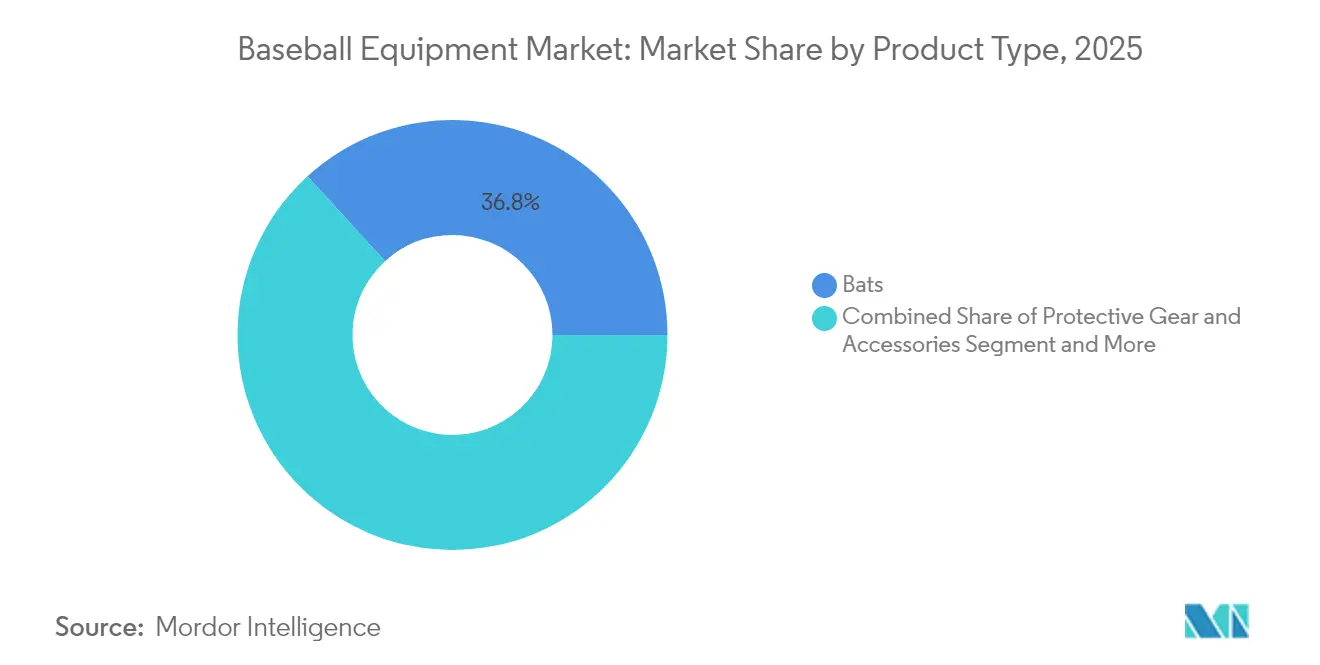
Smart Technology Elevates Premium CategoriesIn 2025, the bat segment emerged as the largest revenue contributor in the baseball equipment market, accounting for 36.78% of total earnings. The introduction of premium sensor-enabled bats, such as the CATX2 Smart model priced above USD 499, has significantly increased average selling prices and improved brand profitability. Apparel ranked as the second-highest revenue generator, driven by consistent replacement cycles and its growing appeal as a fashion statement beyond the field. Ball sales, while characterized by high volumes, generate lower revenue per unit; however, frequent usage ensures a steady demand for replenishment. Protective gear is projected to experience the fastest growth, with a 4.92% CAGR, as stricter safety standards enforced by medical committees and insurance policies drive demand.
Product offerings such as NOCSAE-approved helmets and Nextiles-backed sleeves are reshaping the market by combining safety with performance, encouraging stakeholders to prioritize advanced equipment. The U12 segment has seen a rise in protective gear purchases following USA Baseball's mandate requiring composite helmets with extended ear coverage, leading to recurring seasonal demand. Additionally, smart accessories, such as Diamond Kinetics’ swing trackers and pocket radars, are creating new revenue streams through subscription models, further enhancing the market's overall growth by increasing per-player spending.

By End-User:
Adult Dominance Faces Youth AccelerationIn 2025, adult players accounted for 66.88% of the turnover, driven by increased discretionary spending, multiple league memberships, and a preference for owning various bats for wood, alloy, and composite competitions. Premium gloves, often made from steerhide or kip leather and priced over USD 300 per unit, are favored by adult recreation leagues, contributing to the growth in padding value. Meanwhile, the children's segment is witnessing a robust 5.06% CAGR, spurred by WBSC-sanctioned youth events and the heightened visibility of Little League broadcasts, which in turn drive equipment upgrades. As per e-Stat (Japan), in a survey conducted in November 2024 in Japan, the age group with the highest sports participation rate among adults in Japan was the cohort between 18 and 19 years, with 84.4%.
In emerging Asian markets, parents are making early investments in youth development academies, often bundling equipment packages into tuition fees, which stabilizes demand. Local federations are echoing this trend by offering gear subsidies, especially to boost rural participation. Furthermore, safety regulations like the USABAT certification are prompting families to adopt standardized barrel performances, leading to predictable replacement cycles as children transition to the next age category. Collectively, these dynamics are expanding the baseball equipment market, prompting brands to customize sizing, colors, and technological features for younger athletes.
By Buyer Type:
Individual Preferences Drive Institutional GrowthIn 2025, individuals contributed 76.13% of the revenue, driven by the strong culture of personal ownership prevalent in regions such as North America and Japan. Consumers increasingly prefer personalized equipment, with players customizing glove lacing and bat knob designs. This trend has bolstered the popularity of direct-to-consumer platforms offering advanced tools like volumetric bat builders and engraving services. On the other hand, institutional demand, forecasted to grow at a compound annual growth rate (CAGR) of 4.9%, is fueled by bulk purchases from school districts, travel programs, and academies, which align their orders with roster requirements. The recent merger of Rawlings and Easton Diamond Sports has enhanced product catalog depth, enabling the combined entity to efficiently supply season-start kits, including helmets, catcher sets, and equipment bags, tailored for entire rosters.
Bulk purchasing provides institutions with greater negotiation leverage; however, many are now prioritizing investments in advanced technology solutions. These institutions are increasingly adopting unified analytics ecosystems that integrate with coaching dashboards, offering a premium service. Subscription-based platforms that connect sensor-equipped bats to team accounts enable centralized data management, allowing coaches to monitor swing metrics across multiple age groups through a single interface. This integrated approach not only drives recurring hardware upgrades with each software update but also introduces a service-oriented dimension to the baseball equipment market. Consequently, this strategy helps mitigate revenue seasonality and ensures a more consistent revenue stream throughout the year.

By Distribution Channel:
Digital Transformation Accelerates Online GrowthIn 2025, offline stores accounted for 71.87% of revenue, as many buyers prefer to swing bats in hitting tunnels, check glove fits, and test faceguards before making a purchase. Large-format outlets host demo days with professional staff and promote seasonal trade-in events, recycling gently used gear into beginner programs. Meanwhile, online channels are witnessing a 5.12% CAGR, as e-commerce simplifies repeat orders for items like balls, grip tape, and training aids. Post-pandemic, shoppers have grown to trust sizing guides, and brands now offer virtual bat fittings that analyze swing paths through smartphones.
Direct-to-consumer websites collect detailed data on bat drop preferences and exit velocity goals, allowing for algorithmic recommendations that boost conversion rates. Limited-edition colorways and MLB player signature lines make their online debut, creating a sense of urgency for purchases. Marketplace platforms further enhance the landscape by enabling global cross-border sales, thanks to region-specific compliance filters that assure buyers their bats align with local federation rules. This omnichannel strategy not only broadens reach but also fuels the overall growth of the baseball equipment market, appealing to both tactile shoppers and digital enthusiasts.
Geography Analysis
North America Baseball Equipment Market
In 2025, North America contributed 53.33% of the revenue. The region's advanced infrastructure, high discretionary income, and cultural affinity drove multiple league registrations per athlete. Oregon's USD 800 million stadium project reflected ongoing public investment and signaled facility upgrades requiring new gear (oregonlive.com). U.S.-based brands led product development, ensuring domestic consumers accessed new releases first. High sensor adoption boosted spending and drove premium categories in the baseball equipment market.
APAC Baseball Equipment Market
Asia-Pacific recorded the fastest growth with a 5.58% CAGR, supported by policy initiatives and a large population base. Japan's franchise expansion strengthened talent scouting and boosted high school equipment sales. WBSC Asia events in South Korea, Taiwan, and the Philippines drove demand for NOCSAE-compliant helmets, ensuring tournament standards. Chinese municipal subsidies for field construction in secondary cities expanded baseball's reach. Local factories producing composite bats and gloves enabled brands to quickly adapt SKUs, enhancing market presence.
Europe, South America and Africa Baseball Equipment Market
WBSC Europe enforced stricter equipment certifications, channeling spending to approved suppliers. Germany and the Czech Republic outpaced the average due to school programs promoting baseball for Olympic development. South America, led by Venezuela and Colombia, driven by professional expatriates inspiring local investments. Africa, though nascent, supported by MLB alumni kit donations despite limited diamond access. These regional trends underscored the need for global brands to tailor strategies by market maturity within the baseball equipment sector.
Regulatory Landscape
The baseball equipment market is shaped by certification and safety standards that influence product design, testing costs, and replacement cycles for both bats and protective gear. NCAA and USA Baseball set key requirements for bat performance (including BBCOR), the World Baseball Softball Confederation (WBSC) governs international competition rules, and the National Operating Committee on Standards for Athletic Equipment (NOCSAE) runs third-party certification tied to helmets and protective equipment.
A near-term standards transition took effect in July 2026, when USA Baseball assumed management of BBCOR bat certification standards from the NCAA. Under the announced transition, existing BBCOR-compliant bats remain legal for play alongside new USA BBCOR-certified bats until December 31, 2028, and new USA BBCOR-certified bats are scheduled for retail availability starting in July 2027. This increases the emphasis on updated certification marks and compliance documentation throughout retail and institutional procurement, especially for schools, colleges, and tournament programs that align purchases to eligibility rules.
Competitive Landscape
The baseball equipment market is moderately concentrated, with prominent players such as Adidas AG, Franklin Sports Inc., Nike Inc., Anta Sports Products Limited, and Mizuno Corporation. Strategic technology partnerships are reshaping the competitive landscape. For example, Diamond Kinetics has licensed its swing-tracking firmware to manufacturers, embedding advanced analytics into traditional equipment. Similarly, Motus Global has secured collegiate club contracts, integrating injury-prevention metrics through its sensor sleeve. Nextiles, by collaborating with fabric suppliers, has scaled its smart yarn technology to measure joint angles, positioning itself as a key component supplier for glove and apparel brands (nextiles.tech). These collaborations emphasize the growing importance of data platforms, cloud services, and subscription-based models as competitive differentiators in the market.
In emerging markets, local brands focus on cost competitiveness, but compliance with NOCSAE and WBSC standards has introduced significant regulatory challenges. Larger US and Japanese brands leverage their scale to expedite the certification of new models, creating pressure on smaller competitors with limited testing budgets. However, the rise of online marketplaces has lowered entry barriers, enabling micro-brands to specialize in niche products like custom grip wraps and bat-knob accessories. This shift allows smaller players to achieve growth without requiring substantial inventory investments.
Brand visibility remains a critical factor in both mature and developing regions. Sponsorship of youth academies and securing naming rights for major tournaments continue to be effective strategies for building brand recognition. These initiatives not only enhance market presence but also foster long-term customer loyalty, ensuring sustained growth in the competitive baseball equipment market.
Baseball Equipment Industry Leaders
-
Adidas AG
-
Nike, Inc.
-
Franklin Sports Inc.
-
Mizuno Corporation
-
Anta Sports Products Limited
- *Disclaimer: Major Players sorted in no particular order
Baseball Equipment Market Companies Covered in this Report
- Adidas AG
- Anta Sports Products Limited
- Franklin Sports Inc.
- Chandler Bats
- Nike Inc.
- Rawlings Sporting Goods
- Easton Diamond Sports, LLC
- Fox Factory Holding Corp
- Mizuno Corporation
- DeMarini Sports Inc.
- Victus Sports
- Under Armour Inc.
- Nokona Athletic Goods
- BRG Sports (Riddell)
- The Original Maple Bat Corporation
- Old Hickory Bat Co.
- Warstic Bats
- Axe Bat (Baden Sports)
- SKLZ
- Fanatics, Inc.
Market Opportunities and Future Outlook
Rule-driven purchasing and certification transitions create room for compliant product refreshes and for retail and institutional upgrade programs, particularly in bats and protective gear where standards determine eligibility for play. The July 2026 shift of BBCOR bat certification management to USA Baseball, along with coexistence of legacy-compliant bats until December 31, 2028 and new USA BBCOR-certified bats entering retail from July 2027, supports opportunities for brands and retailers to streamline assortment planning (marking, education, and trade-in programs). It also gives teams and schools a clearer timing window to align bulk replacements with seasonal buying cycles.
Sustainability-led materials and circularity initiatives are increasingly visible as a product-development lane across bats, gloves, footwear, and other soft goods, helping brands differentiate beyond performance claims. Mizuno has disclosed moves such as using recycled aluminum from decommissioned train cars for metal bats, repurposing leather scraps from glove production, and adopting DopeDyed materials for bag linings to reduce water and chemical usage. In apparel and footwear, Adidas partnered with Parley for the Oceans to produce baseball uniforms and high-performance cleats using Parley Ocean Plastic, which can strengthen premium positioning in institutional channels where schools, leagues, and tournaments increasingly standardize supplier lists and uniform programs.
Recent Industry Developments in Baseball Equipment Market
- July 2026: Mookie Betts launches new baseball glove company LGND, introducing MOOK and MVRK series gloves. The launch highlights athlete-led product innovation and expands premium glove options for advanced players. This move uses Betts' profile to accelerate adoption among high-end consumers.
- July 2026: LGND named Official Glove of Perfect Game. The partnership gives access to the youth and amateur baseball ecosystem to support broader glove adoption and loyalty. The alliance also strengthens LGND's visibility across tournaments and youth programs.
- June 2026: CoverFour acquires Chandler Bats. The investment signals further consolidation in the premium bat category. It expands CoverFour's portfolio and distribution within the high-end baseball equipment market.
Baseball Equipment Market Report Scope and Research Methodology
Market Definition and Coverage
For this study, the baseball equipment market includes revenue generated from products purchased to play baseball, such as bats, balls, gloves, protective gear, and related training accessories, across offline and online retail channels.
Scope exclusions: Apparel and general athletic footwear that are not baseball-specific, as well as licensed fan merchandise, are excluded from this market sizing.
Segments Covered in This Report
- By Product Type
- Bats
- Apparel
- Balls
- Protective Gear and Accessories
- By End-User
- Adult
- Kids/Children
- By Buyer Type
- Individual
- Institutional
- By Distribution Channel
- Offline Retail Stores
- Online Retail Stores
- By Geography
- North America
- United States
- Canada
- Mexico
- Rest of North America
- Europe
- Germany
- United Kingdom
- Italy
- France
- Spain
- Netherlands
- Poland
- Belgium
- Sweden
- Rest of Europe
- Asia-Pacific
- China
- India
- Japan
- Australia
- Indonesia
- South Korea
- Thailand
- Singapore
- Rest of Asia-Pacific
- South America
- Brazil
- Argentina
- Colombia
- Chile
- Peru
- Rest of South America
- Middle East and Africa
- South Africa
- Saudi Arabia
- United Arab Emirates
- Nigeria
- Egypt
- Morocco
- Turkey
- Rest of Middle East and Africa
- North America
Data Sources, Market Sizing, and Validation
Desk Research
Desk work starts with building a clean fact base for participation, spending patterns, and product availability, then aligning it with how equipment is sold across channels. To keep assumptions grounded, we referenced public sources such as U.S. Census Bureau trade and retail series, Bureau of Labor Statistics inflation and consumer spending indicators, and international trade statistics from UN Comtrade for sports goods categories that map to baseball gear.
We also used sources such as sporting goods and youth sports association publications, and we reviewed peer-reviewed sports medicine literature on protective gear adoption. Major league and national federation releases were used to track player base shifts and season timing. Company filings, investor decks, and press releases were reviewed to understand product launches, channel mix, and price tiering, which then informed realistic average selling price ranges. In selected cases, paid subscriptions for company financials and news intelligence, patent searches, and shipment-level import and export records were used to cross-check direction and fill gaps. The desk research sources listed here are illustrative only, and additional public and paid references were used for data collection, checks, and clarification.
Primary Interviews and Surveys
Primary work was used to pressure test what we saw in desk research, especially around replacement cycles, price moves by material and performance grade, and how demand differs between youth leagues, school programs, and adult recreation. We spoke with manufacturers, distributors, retailers, coaches, league administrators, and training providers so the demand pool and channel splits could be validated before finalizing the model. Because this is a global market, inputs were also checked across major consuming and producing regions to avoid over-applying seasonality, import reliance, and premium mix assumptions from one geography to another.
Distribution of primary research fieldwork respondents
| Company type | Respondent position | Region |
|---|---|---|
| Top tier: 27% | CXOs: 13% | APAC: 37% |
| Mid tier: 52% | Functional/Unit leaders: 32% | EMEA: 36% |
| Smaller Players: 21% | Managers: 55% | Americas: 27% |
Market-Sizing & Forecasting
The sizing starts from a top down demand pool build where player participation, typical gear kits by level (youth, school, and adult), and replacement timing are translated into annual unit needs. Those unit needs are then priced using realistic average selling prices by product group. To avoid over-counting, adjustments are made for multi-year use items, team-shared equipment in schools, and the share of purchases that happen in the off season versus in season.
Those totals are then checked with selective bottom up approximations, such as rolling up a sample set of supplier and retailer revenue exposure and using channel checks to validate online versus store mix and premium share. Key model inputs include participation in organized leagues, seasonality of purchases, bat material shifts and price steps, protective gear adoption, and inflation-led price increases that vary by product. Forecasts were built using scenario analysis supported by expert expectations on participation trends, price progression, and channel expansion, and then the scenarios were blended into a base case. Where direct volume signals were thin for a country, we used proxy indicators like trade flows, retail penetration, and participation density, then rechecked the implied spending per player with interview feedback.
Data Validation & Update Cycle
Outputs are validated through multiple checks, starting with internal consistency tests like implied spend per player, channel margins, and year to year price movement compared with public inflation series. We also compare modeled results with independent signals such as import direction, major category pricing, and reported growth commentary from public companies, then investigate large variances before sign off.
A second analyst review is used to challenge assumptions that can swing the total, including replacement cycles, premium mix, and the share of purchases tied to organized leagues. If a mismatch shows up, interviews are reopened for that specific topic and the model is corrected with a clear audit trail. Reports are refreshed annually, and interim updates are triggered for material events such as major rule changes affecting equipment, large price shocks in key materials, or major distribution shifts. Before delivery, a final fresh pass is completed so clients receive the most up to date view possible.
Mordor Intelligence's Baseball Equipment Market Size Measured Against Other Published Estimates
Published market values for baseball equipment can vary because each publisher makes different choices on what to count as equipment, which regions to include, and how they move prices forward year by year. Differences also come from how participation is measured, how online sales are treated, and how frequently the model is refreshed.
Some public estimates roll the market into a broader baseball ecosystem number that can include media, events, and merchandise, while others expand equipment to include general sportswear sold alongside baseball gear. In Mordor Intelligence, the value is limited to baseball specific equipment revenue only, and it is tied back to participation based demand, replacement behavior, and price checks, rather than applying a single flat growth factor across all products.
Benchmark comparison
| Source | Market Size | Gaps in Research Methodology |
|---|---|---|
| Mordor Intelligence | USD 20.67 B (2026) | |
| Trade Journal A | USD 13.31 B (2020) | Uses an older base year and appears to focus mainly on core hardgoods, with limited adjustment for channel shift and premium bat pricing over the cycle. |
| Industry Publisher B | USD 3.07 B (2024) | Looks narrower in scope and pricing, which can happen when estimates emphasize select equipment lines or specific end user cohorts, and then apply simplified ASP steps. |
The spread in the table is mainly explained by scope width and the year chosen for the stated value, and by how participation, replacement, and pricing are converted into revenue. By keeping inputs traceable to player counts, purchase timing, and product level price ranges, the resulting market size is easier to reproduce and to update when a single driver changes.
Key Questions Answered in the Report
What is the current Baseball Equipment Market size?
The Baseball Equipment Market is valued at USD 20.67 billion in 2026 and projected to register a CAGR of 4.76% during the forecast period (2026-2031)
Who are the key players in Baseball Equipment Market?
Adidas AG, Nike, Inc., Franklin Sports Inc., Anta Sports Products Limited, and Mizuno Corporation are the major companies operating in the Baseball Equipment Market.
Which is the fastest growing region in Baseball Equipment Market?
Asia-Pacific is estimated to grow at the highest CAGR over the forecast period (2026-2031).
Which region has the biggest share in Baseball Equipment Market?
In 2025, the North America accounts for the largest market share in Baseball Equipment Market.