
Spain Diabetes Care Drugs and Devices Market Size and Share
Market Overview
| Study Period | 2021 - 2032 |
|---|---|
| Forecast Data Period | 2027 - 2032 |
| Base Year Market Size (2026) | USD 1.85 Billion |
| Market Size (2027) | USD 1.98 Billion |
| Market Size (2032) | USD 2.76 Billion |
| Growth Rate (2027 - 2032) | 6.92 % |
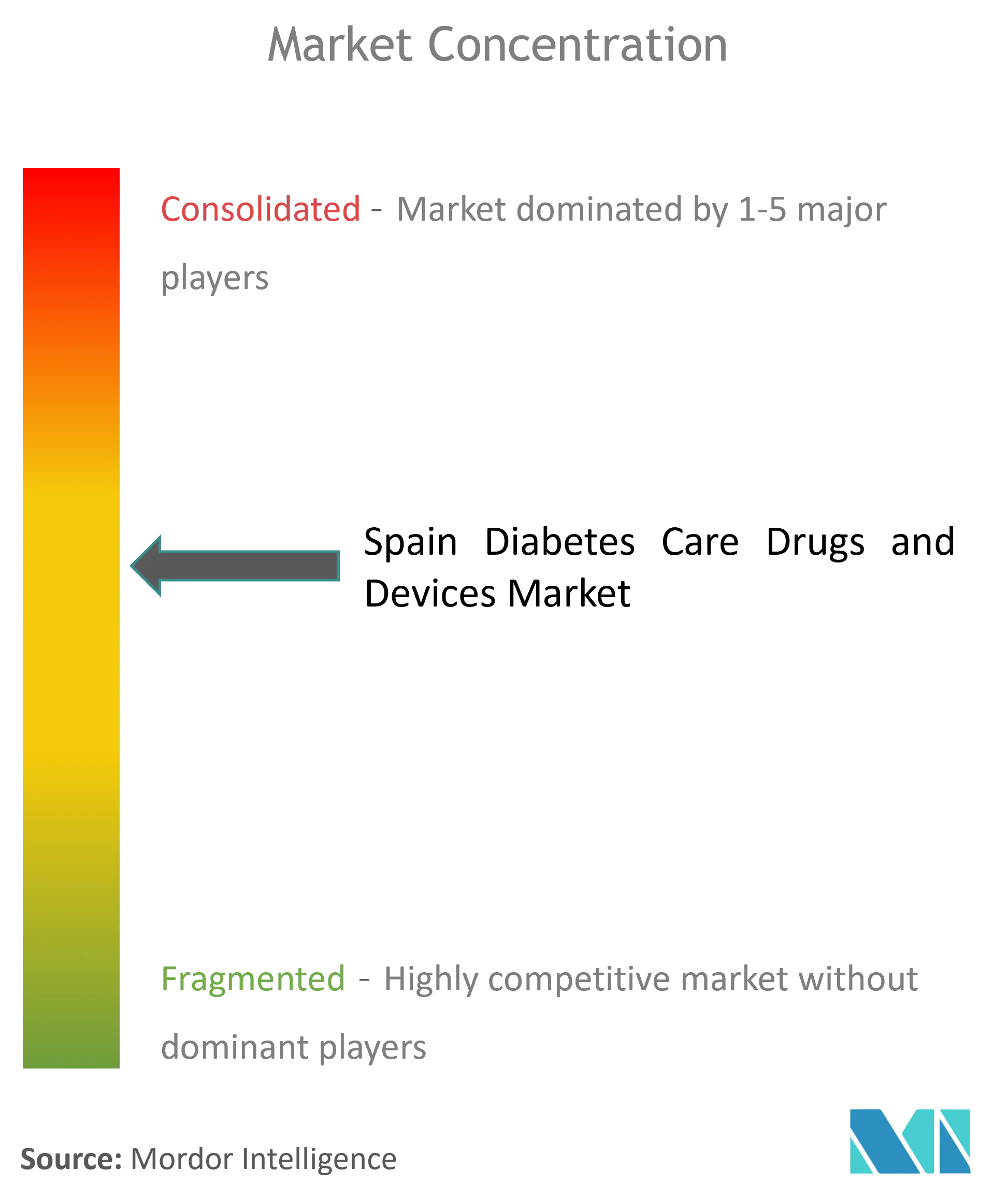
| Market Concentration | Medium |
Major Players *Disclaimer: Major Players sorted in no particular order Image © Mordor Intelligence. Reuse requires attribution under CC BY 4.0. | |
Spain Diabetes Care Drugs and Devices Market Analysis by Mordor Intelligence
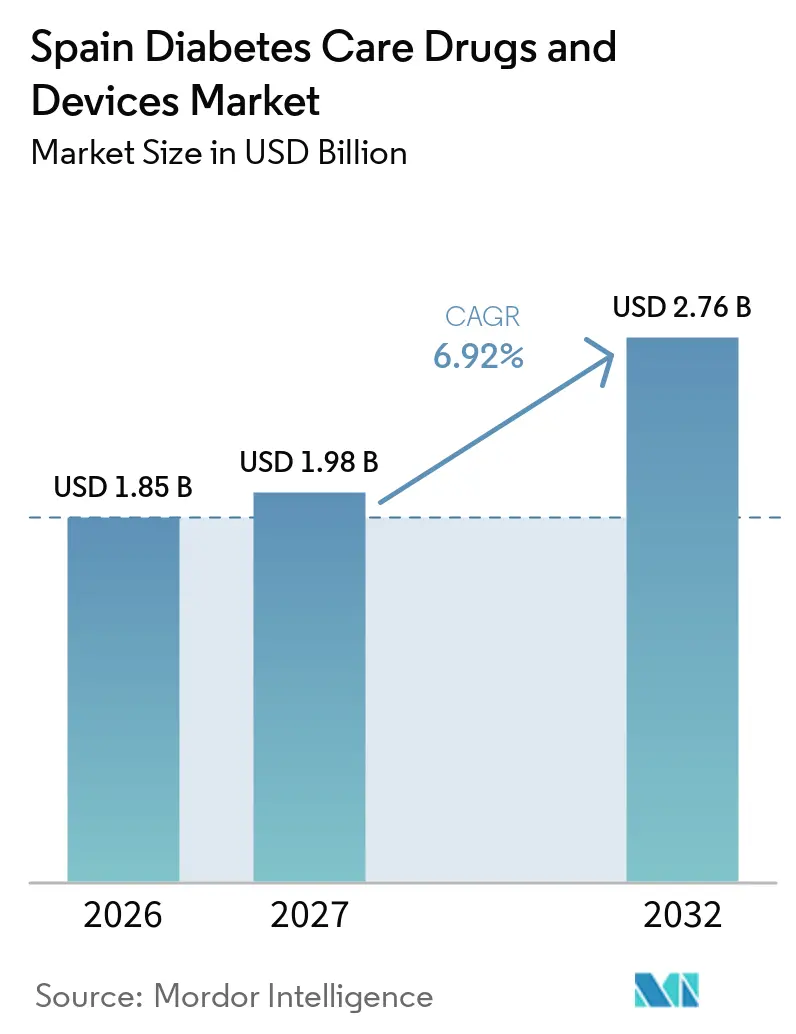
The Spain Diabetes Care Drugs And Devices Market size is expected to increase from USD 1.85 billion in 2026 to USD 1.98 billion in 2027 and reach USD 2.76 billion by 2032, growing at a CAGR of 6.92% over 2027-2032.
According to WHO, Spain has administered 102,258,825 vaccine doses as of 25 June 2022. Baseline hyperglycemia significantly predicts all-cause mortality in non-severe COVID-19 patients, regardless of diabetes history. On October 25, the government declared a state of emergency after clinical trials resumed after about four months of easing certain restrictions. This included partial lockdown measures with movement restrictions until May 9, 2021. The COVID-19 pandemic in Spain has forced the government to introduce new laws and restrictions to stop the spread of the virus. Lockdowns have proven to be an effective approach to reducing the risk of infection. For the above reasons, the expansion of the examination market in Spain is predicted.
Insulin drugs are important in treating type 1 diabetes (T1D). Examples of such drugs are insulin drugs. These devices are associated with improved glycemic control and reduced hypoglycemia. In pharmaceuticals, the insulin category holds a significant market share. Worldwide, he has over 100 million people using insulin, including all type 1 diabetics and 10-25% of type 2 diabetics. Insulin production is very demanding, and only a few insulin manufacturers are on the market. Therefore, there is fierce competition among these manufacturers, who constantly strive to meet their patients' needs by providing the highest quality insulin. Medical devices (T1D) are one of the key components in the treatment of type 1 diabetes. Devices include insulin pumps, continuous glucose monitors (CGM), and blood glucose meters. These devices lead to better blood sugar control and less hypoglycemia.
Thus, the above factors are expected to drive market growth over the forecast period.
Note: Market numbers in this report are based on Mordor Intelligence's proprietary estimation framework, which combines nine months of actuals with Q4 projections for base year 2026.
Spain Diabetes Care Drugs and Devices Market Trends and Insights
The continuous Glucose Monitoring Segment is Expected to Witness the Highest Growth Rate Over the Forecast Period
Continuous blood glucose monitoring (CGM) and multiple daily injections (MDI) have been shown to reduce mild and severe hypoglycemia in patients with type 1 diabetes who are prone to this side effect. People with type 1 diabetes who are at high risk of hypoglycemia can use self-contained continuous blood glucose monitoring, even in dire living conditions imposed by the stringent lockdowns imposed by the COVID-19 pandemic crisis. It may regulate blood sugar levels. Glucose metrics improved slightly during the lockdown period, particularly glucose tolerance-related ones, leading to relief measures.
People with type 1 diabetes (T1D) need to maintain a healthy lifestyle depending on their personality traits, social interactions, socioeconomic status, and living environment factors. The use of continuous glucose monitoring (CGM) with multiple daily injections (MDI) has been shown to reduce non-severe and severe hypoglycemia in type 1 diabetic patients who are prone to this side effect. Patients with type 1 diabetes, at high risk of hypoglycemia, control their blood glucose levels thanks to self-contained continuous blood glucose monitoring, even under harsh living conditions imposed by strict lockdowns due to the COVID-19 pandemic crisis. Small improvements in blood glucose measurement markers, especially those related to glucose tolerance, were associated with the lockdown period. Spanish hospitals have ordered CGM machines to limit staff contact with most COVID-19 diabetic patients. Decisions taken by national bodies such as the Italian Ministry of Health and Spain's Spanish Medical and Health Agency were very limited in scope. These organizations typically have the power to withdraw or reject products but rarely use them for new devices. Spain has the second highest diabetes prevalence in Europe; Spain is also among the top 10 countries in spending on diabetes-related healthcare, with a total of USD 15.5 billion.
Rising diabetes prevalence
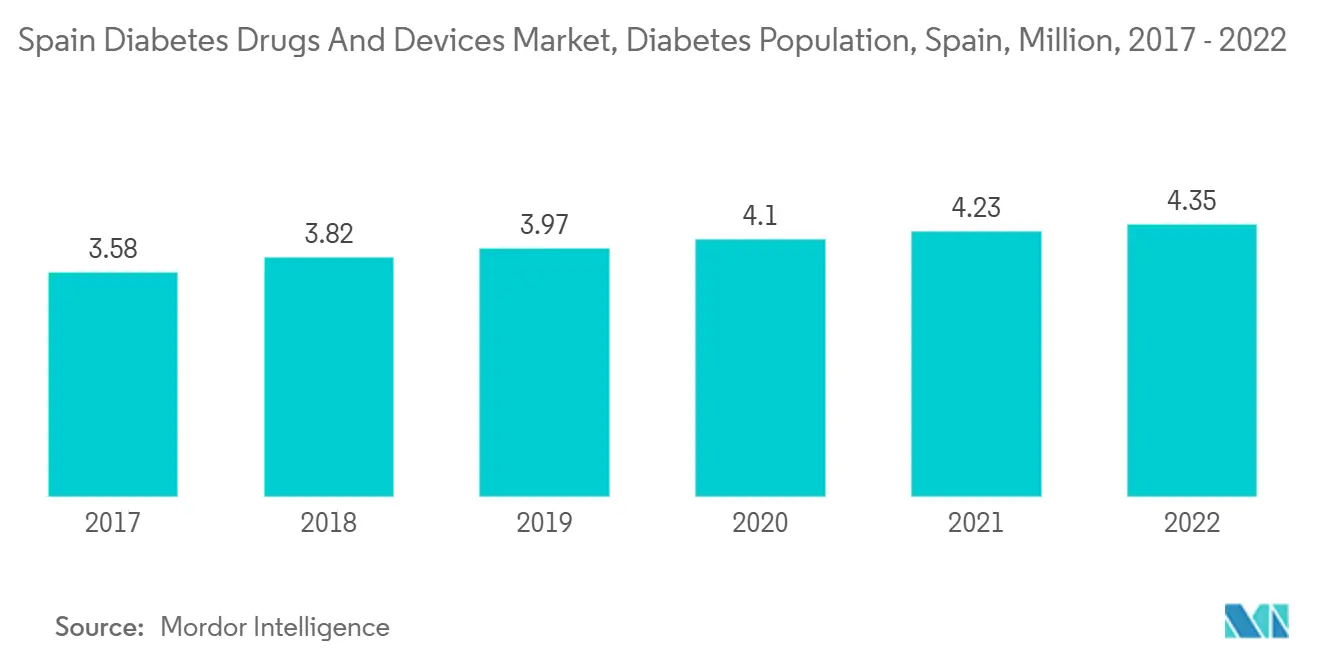
In Spain, the number of people with type 1 diabetes is increasing, recording an annual growth rate of more than 3% during the forecast period. Up to 13.8% of adults in Spain have diabetes, and about 6% are believed to have undiagnosed diabetes. A similar prevalence has been identified in the Valencia region of Spain, with a population of 5 million. In this area, general practitioners monitor most diabetic patients and work closely with endocrinologists to treat more complex cases. Many papers point out that people with diabetes are more likely to develop severe COVID-19 infections, have worse outcomes, and have higher mortality rates. The SED expects the death rate to rise further, as the non-diabetic population has a mortality risk of between 0.9% and 3%. Spanish citizens with diabetes are estimated to have a mortality risk of around 7.3%. In Spain, 30.3% of diabetic patients have never been diagnosed. If not properly recognized and treated, diabetes can lead to serious and sometimes fatal consequences such as heart attack, stroke, kidney failure, blindness, and lower limb amputation. They impair the quality of life and increase medical costs.
According to the Spanish Diabetes Association (SED), therapeutic education about diabetes has evolved from a necessity to a priority and an urgency. With the relentless rise in cases and important advances in disease control and treatment, educational efforts with essential equity measures have so far been required to facilitate access to these new resources for all people with diabetes. More is required. SED also recognizes important advances made in the management of diabetes, particularly through technological advances. For example, it approved funding for a flush system for her type 2 diabetic patients on bolus basal insulin therapy.
Suppose diabetes is not diagnosed or adequately treated. In that case, people with diabetes risk serious and life-threatening complications such as heart attack, stroke, kidney failure, blindness and lower limb amputation. This leads to a lower quality of life and higher healthcare costs, resulting in a greater need for access to healthcare. Evidence suggests that diabetes can be successfully managed, especially if detected early. Multicomponent interventions, including glycemic, blood pressure and lipid control, can reduce a wide range of micro- and macrovascular complications and early mortality associated with diabetes.
Competitive Landscape
Competition in the Spain Diabetes Care Drugs and Devices Market is characterized by continuous product innovation, expansion of digital diabetes management solutions, and strategic collaborations among leading industry participants. Major companies are strengthening their market presence through investments in continuous glucose monitoring (CGM) systems, connected insulin delivery devices, and integrated diabetes management platforms that improve patient outcomes and treatment adherence. The increasing adoption of advanced diabetes technologies in Spain, supported by growing awareness of self-management and remote monitoring, is encouraging manufacturers to expand their product portfolios and enhance their technological capabilities. Strategic partnerships, product launches, and investments in research and development remain key competitive strategies among market participants.
Spain Diabetes Care Drugs and Devices Industry Leaders
-
Medtronics
-
Roche
-
NovoNordisk
-
Sanofi
-
Omnipod
- *Disclaimer: Major Players sorted in no particular order
Market Opportunities and Future Outlook
Spain shows room for connected diabetes care, bringing together monitoring devices, insulin delivery, and digital data flows, supported by public-system access mechanisms. The Interterritorial Council of the Spanish National Health System (SNS) approved the 2025-2028 Development Document for the Chronic Disease Approach Strategy on July 4, 2025, and diabetes is treated as a priority area within this framework, with emphasis on metabolic control, complication prevention, and patient empowerment.
On the access side, the Spanish public system provides blood glucose monitoring and insulin administration supplies free of charge for people with diabetes, and CGMs are fully reimbursed for individuals with type 1 and type 2 diabetes who require multiple daily insulin injections. This reimbursement environment creates space for broader uptake of continuous monitoring and adjacent therapy-management tools (including automated insulin delivery and connected pen-based regimens), especially where interoperability and streamlined supply models reduce clinical workload and support continuity of care across autonomous communities.
Recent Industry Developments
- July 2026: Omnipod 5 Automated Insulin Delivery System and Omnipod Discover data management platform launched commercially in Spain. The expansion of tubeless insulin-delivery in Spain reinforces the Omnipod platform's market footprint and supports broader adoption of automated insulin delivery.
- June 2026: Valencian Community Conselleria de Sanidad launched home delivery service for continuous glucose monitoring devices for ~27,000 diabetic patients. The public CGM access expansion in Spain improves CGM accessibility and could increase demand for insulin-delivery ecosystems and digital diabetes management tools.
- June 2026: Sociedad Española para la Transformación Tecnológica (SETT) / Clinicgram invested 650,000 euros in Clinicgram to advance AI-based software for diabetic foot management. AI-driven diabetic foot management software in Spain supports digital health tools for complication prevention and complements device-based diabetes care with AI-enabled diagnostics.
Research Methodology Framework and Report Scope
Market Definition and Coverage
This market covers the spending in Spain on prescription diabetes therapies and diabetes care devices used to treat, deliver, and monitor diabetes, captured as market value in USD and supported by unit volumes for key product types.
Scope exclusions: We exclude general hospital consumables not specific to diabetes care and non-medical wellness apps that do not directly support therapy delivery or glucose monitoring.
Segmentation Overview
- Devices
- Monitoring Devices
- Self-monitoring Blood Glucose Devices
- Continuous Blood Glucose Monitoring
- Management Devices
- Insulin Pump
- Insulin Syringes
- Insulin Cartridges
- Disposable Pens
- Monitoring Devices
- Drugs
- Oral Anti-Diabetes Drugs
- Insulin Drugs
- Combination Drugs
- Non-Insulin Injectable Drugs
Data Sources, Market Sizing, and Validation
Desk Research
Desk research starts with building a clean demand and reimbursement picture for Spain, since many diabetes products are shaped by public payer rules and regional procurement. We use public health and statistical sources such as the Spanish Ministry of Health publications, National Statistics Institute (INE) demographic tables, OECD Health Statistics, WHO diabetes profiles, and peer reviewed clinical and health economics literature that reports treated population and care patterns.
We then map the product universe using regulatory and trade signals, with practical channel context in mind. Sources include the European Medicines Agency (EMA) product information where relevant, Spanish and EU health system documents on prescribing and coverage, customs and trade releases for medical device categories, and company filings and investor materials for directional revenue mix cues. In a few places, paid subscriptions for company financials and patent databases are used to cross check product timelines and to sanity check addressable revenue pools. This source list is illustrative, and many other public and subscription sources were also referenced to collect data, validate it, and close gaps.
Primary Interviews and Surveys
Primary work focuses on confirming how products are actually used and reimbursed in Spain, since formulary access and device adoption can vary across autonomous communities. We interview and survey stakeholders such as hospital and retail pharmacy channel participants, clinicians involved in diabetes management, distributors, and device focused experts, and we use these inputs to validate penetration, typical replacement cycles, and realistic pricing ranges before finalizing the model.
Distribution of primary research fieldwork respondents
| Company type | Respondent position |
|---|---|
| Top tier: 36% | CXOs: 12% |
| Mid tier: 46% | Functional/Unit leaders: 29% |
| Smaller Players: 18% | Managers: 59% |
Market-Sizing & Forecasting
Sizing is built by reconstructing Spain level demand from the treated diabetes pool and the care pathway, then applying product level usage and pricing logic that fits each category. The top-down approach is used to translate diagnosed and treated patients into annual therapy volumes and device utilization (for example, insulin usage patterns, oral therapy shares, and monitoring frequency), which are then converted into USD using category ASPs.
To keep the totals realistic, we corroborate results with selective bottom-up approximations such as supplier and channel roll ups, sampled ASP multiplied by unit volumes for high visibility device lines, and pharmacy and hospital procurement checks where coverage is strong. Key inputs include the split of patients by therapy type, uptake of CGM versus SMBG, insulin delivery mix (pens, pumps, syringes and related consumables), replacement cycles for sensors and strips, and the timing of reimbursement or tender changes that can shift adoption. When a data point is missing for a small subcategory, we fill the gap using proxy ratios from similar EU markets and then normalize back to Spain using the interview feedback.
Forecasting uses scenario analysis supported by simple multivariate relationships, where future market values are linked to diabetes prevalence, aging trend, treated rate, reimbursement expansion for monitoring, and expected ASP movements after tender cycles. Assumptions are reviewed with primary respondents so the final trajectory reflects what is likely to occur in real procurement and prescribing behavior.
Data Validation & Update Cycle
Validation is done through several checks so the final numbers do not rely on a single source. We compare modeled totals against independent signals such as public health spending direction, therapy mix trends reported in clinical literature, and device adoption indicators discussed by channel participants, and then outliers are investigated before sign off.
Before finalization, the model goes through multi step analyst review, including a second pass on unit economics, currency consistency, and year on year growth logic. If a large variance shows up, respondents are re contacted and the assumption is adjusted with a clear note in the working file. Reports are refreshed annually, with interim updates when material events occur, and a final pre delivery review is done so clients receive the latest updated view.
Mordor Intelligence's Spain Diabetes Care Drugs and Devices Market Estimate Compared With Other Published Estimates
Published estimates for Spain diabetes care drugs and devices often differ because firms do not count the same product basket, and they also use different price bases and update timing. In our work, we keep each input traceable to a real demand driver, and we pressure test it through interviews so the final number is not only arithmetic.
Some external estimates group broader diabetes spending concepts that can include wider diabetes management services or use a longer horizon with optimistic uptake built in. For Mordor Intelligence, the total is limited to the defined drugs set and the listed device categories (including insulin delivery and glucose monitoring), and the model is refreshed using the most recent historical period available before forecasting.
Benchmark comparison
| Source | Market Size | Gaps in Research Methodology |
|---|---|---|
| Mordor Intelligence | USD 2.02 B (2025) | |
| Global Consultancy A | USD 4.80 B (2026) | Uses a broader revenue pool and a later starting year, and it appears to assume faster penetration of advanced monitoring and pump therapy across channels, which lifts the total. |
| Trade Bulletin B | USD 0.95 B (2023) | Looks closer to a drugs only or therapeutics focused view tied to a 2023 base, and it does not clearly account for diabetes device value and recurring consumables volumes. |
The spread across sources is mainly explained by what gets counted and how quickly adoption is assumed to move in a publicly funded system. By keeping the product list explicit, linking volumes to treated use patterns, and then checking pricing and uptake with Spain focused respondents, the estimate stays practical and repeatable for planning.
Key Questions Answered in the Report
What is the current Spain Diabetes Care Drugs and Devices Market size?
The Spain Diabetes Care Drugs And Devices Market size is expected to increase from USD 1.85 billion in 2026 to USD 1.98 billion in 2027 and reach USD 2.76 billion by 2032, growing at a CAGR of 6.92% over 2027-2032.
Who are the key players in Spain Diabetes Care Drugs and Devices Market?
Medtronics, Roche, NovoNordisk, Sanofi and Omnipod are the major companies operating in the Spain Diabetes Care Drugs and Devices Market.
What years does this Spain Diabetes Care Drugs and Devices Market cover?
The report covers the Spain Diabetes Care Drugs and Devices Market historical market size for years: 2021, 2022, 2023, 2024, 2025, and 2026. The report also forecasts the Spain Diabetes Care Drugs and Devices Market size for years: 2027, 2028, 2029, 2030, 2031, and 2032.