
Market Overview
| Study Period | 2020 - 2031 |
|---|---|
| Forecast Data Period | 2026 - 2031 |
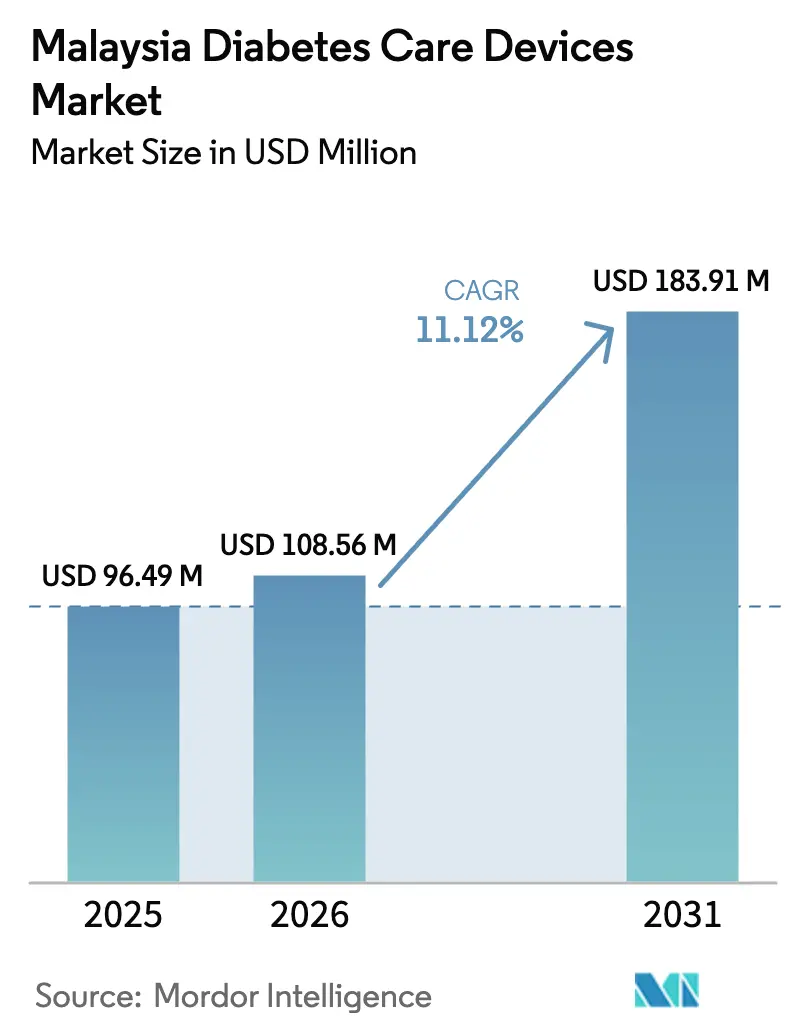
| Base Year Market Size (2025) | USD 96.49 Million |
| Market Size (2026) | USD 108.56 Million |
| Market Size (2031) | USD 183.91 Million |
| Growth Rate (2026 - 2031) | 11.12 % |
| Market Concentration | Medium |
Major Players *Disclaimer: Major Players sorted in no particular order Image © Mordor Intelligence. Reuse requires attribution under CC BY 4.0. | |
Malaysia Diabetes Care Devices Market Analysis by Mordor Intelligence
The Malaysia Diabetes Care Devices Market size is projected to be USD 96.49 million in 2025, USD 108.56 million in 2026, and reach USD 183.91 million by 2031, growing at a CAGR of 11.12% from 2026 to 2031.
Escalating disease prevalence, aggressive foreign direct investment in local manufacturing, and an upshift toward home-based monitoring collectively bolster the Malaysian diabetes care devices market. Public-sector procurement budgets are expanding, yet 40% of adults with diabetes remain undiagnosed, sustaining latent demand for entry-level self-monitoring blood glucose (SMBG) systems. Pharmacy chains have widened point-of-care access, while subscription models package devices, strips, and teleconsultations, lowering behavioral barriers to daily monitoring. Interoperability agreements, such as Abbott’s data-sharing pact with Medtronic, signal a competitive push toward closed-loop ecosystems that integrate continuous glucose monitoring (CGM) with automated insulin delivery, a pairing likely to accelerate the Malaysia diabetes care devices market through 2031.
Key Report Takeaways
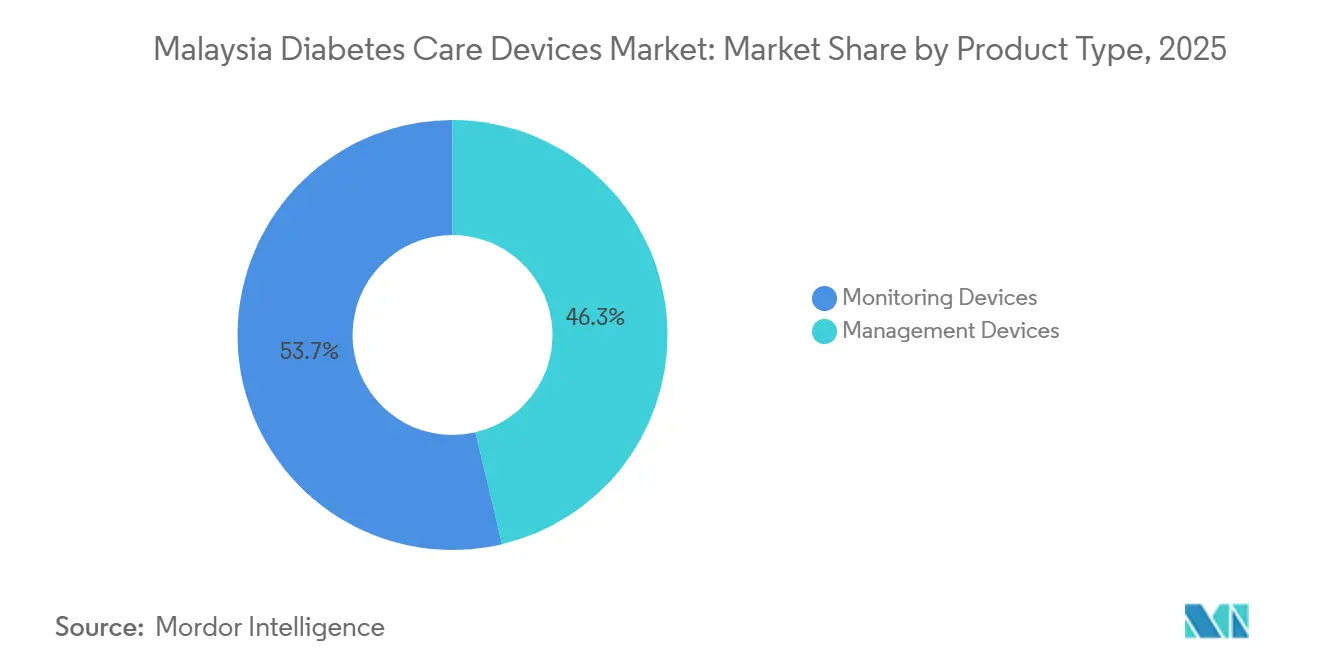
- By product type, monitoring devices accounted for 53.69% of the Malaysia diabetes care devices market share in 2025, whereas management devices are projected to grow at a 13.72% CAGR to 2031.
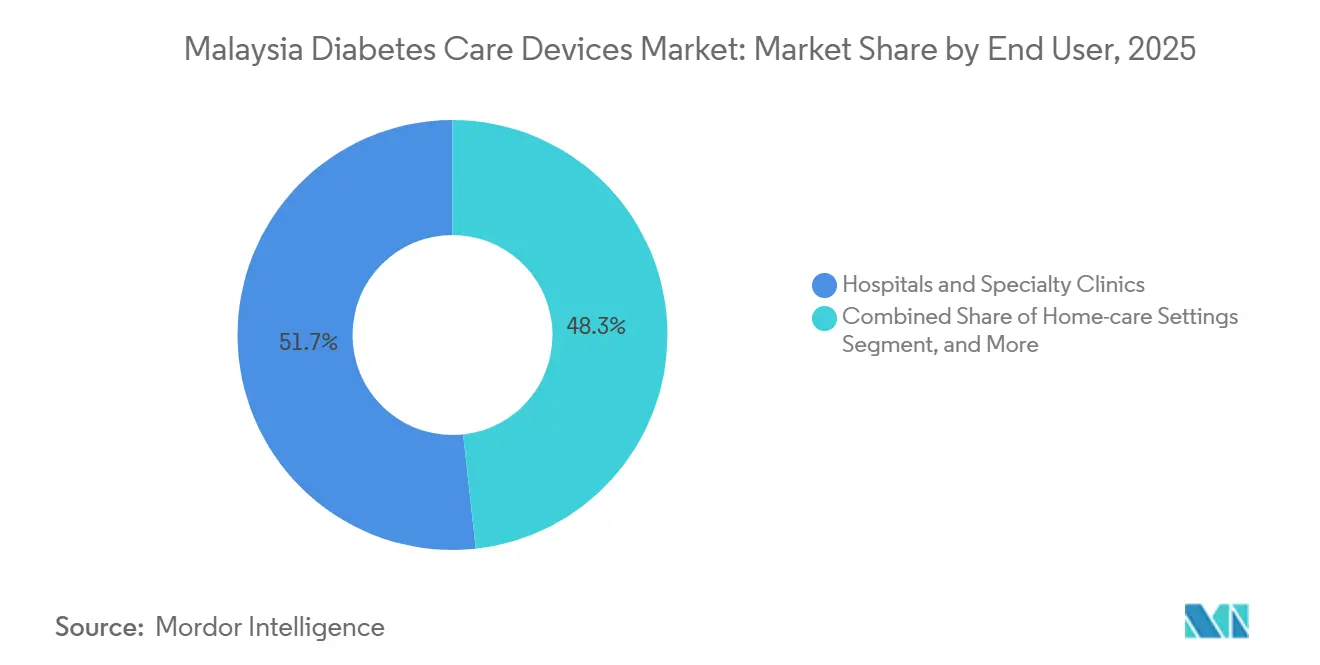
- By end user, hospitals and specialty clinics accounted for 51.73% of revenue in 2025, and the home-care setting segment is forecast to expand at a 14.29% CAGR through 2031.
Note: Market size and forecast figures in this report are generated using Mordor Intelligence’s proprietary estimation framework, updated with the latest available data and insights as of January 2026.
Market Trends and Insights
Drivers Impact Analysis of Malaysia Diabetes Care Devices Market*
| Driver | (~) % Impact on CAGR Forecast | Geographic Relevance | Impact Timeline |
|---|---|---|---|
| Rising Diabetes Prevalence & SMBG Penetration | +2.8% | National, concentrated in Klang Valley, Johor Bahru, Penang urban centers | Medium term (2-4 years) |
| Expanding Public-Health Budget & Device Procurement | +1.9% | National, MOH clinic network across 13 states and 3 federal territories | Short term (≤ 2 years) |
| Home-Healthcare & POC Testing Boom | +2.4% | Urban and peri-urban areas with telemedicine infrastructure | Short term (≤ 2 years) |
| Localised CGM/Insulin-Pump Manufacturing Incentives | +2.1% | Penang, Johor (Iskandar Malaysia), with export spillover to ASEAN | Long term (≥ 4 years) |
| HTA-Driven Push for CGM Reimbursement | +1.5% | National, contingent on MOH and private-insurer policy shifts | Medium term (2-4 years) |
| Medical-Tourism Demand for Advanced Devices | +0.5% | Kuala Lumpur, Penang, Johor medical-tourism hubs | Medium term (2-4 years) |
| Source: Mordor Intelligence | |||
Rising Diabetes Prevalence & SMBG Penetration
Malaysia’s adult diabetes prevalence rose to 15.6% in 2023, yet 44% of diagnosed patients still lack a glucometer at home, underscoring the growth headroom for entry-level SMBG kits. Retail meters sell for RM66–99, while test strips cost RM28–91, a range that aligns with median monthly household incomes and supports recurring consumable demand. National Diabetes Registry data indicate 902,991 active cases in Ministry of Health (MOH) clinics, a figure that excludes the private sector and undiagnosed individuals, thereby widening the total addressable volume. The 2026 budget allocations of RM64 billion (USD 14.2 billion) for metabolic disease management guarantee stable tender volumes for SMBG supplies.[1] Pharmacy majors respond by stocking low-price glucometers such as EASYSURE, offering affordable entry points while securing strip replenishment revenue.[2]
Localised CGM/Insulin-Pump Manufacturing Incentives
Dexcom’s Penang plant, commissioned in 2024 with an investment of RM2.83 billion (approximately USD 662 million), and Insulet’s Johor facility, which was scaled to five production lines in 2024, anchor Malaysia as ASEAN’s principal manufacturing hub for CGM sensors and tubeless pumps. Tax holidays, streamlined device registration under the ASEAN Medical Device Directive, and ready access to a seasoned electronics workforce lower production costs and shorten time-to-market. Biocon and Novo Nordisk have committed RM2.7 billion and RM1.5 billion, respectively, to insulin facilities, reinforcing a vertically integrated local supply chain for the Malaysian diabetes care devices market. Most output feeds export demand, yet local availability improves logistical resilience and supports rapid product rollouts. Over the long term, cumulative capacity may enable price renegotiations with MOH clinics, narrowing affordability gaps for advanced devices.
HTA-Driven Push for CGM Reimbursement
A 2024 MOH health technology assessment ruled CGM non-cost-effective at retail prices of RM279 (approximately USD 62) per 14-day sensor, thereby curbing immediate public funding. Nonetheless, the review highlighted significant quality-of-life gains for Type 1 patients, signaling a policy window for negotiated discounts or outcomes-based reimbursement. Private insurers now pilot selective CGM coverage within pump therapy bundles at premium hospitals such as Gleneagles Kuala Lumpur, paving a blueprint for future public adoption. Singapore’s RM340 per sensor benchmark indicates that Malaysian retail margins remain flexible, thereby strengthening MOH’s bargaining power. If threshold prices fall, CGM uptake could migrate from the affluent niche to a broader Type 2 cohort, redirecting the Malaysia diabetes care devices market toward routine sensor replacement cycles.
Home-Healthcare & POC Testing Boom
Pandemic-era telemedicine catalyzed remote monitoring platforms like DoctorOnCall’s SIHAT program and Speedoc virtual wards, each integrating glucometer or CGM data into remote consultations. A 2024 IDEAS trial reported modest glycaemic improvement due to low engagement, prompting market entrants to bundle coaching with devices for sustained behavior change. SugO365 offers six-month kits at RM260 (approximately USD 57) that include a meter, strips, and teleconsults, while Ottai Health sells CGM units at RM128–199, 30% below the prices of legacy brands, capturing price-sensitive home-care customers. Point-of-care testing in pharmacies now targets walk-in shoppers, and the MOH clinical guideline endorses SMBG for all insulin users, validating home-based protocols. Together these factors accelerate device diffusion into households, reinforcing the Malaysia diabetes care devices market trajectory.
Restraints Impact Analysis of Malaysia Diabetes Care Devices Market*
| Restraint | (~) % Impact on CAGR Forecast | Geographic Relevance | Impact Timeline |
|---|---|---|---|
| High CGM & Pump Cost Burden | -1.8% | National, most acute in rural and lower-income urban segments | Medium term (2-4 years) |
| Import-Dependency & Supply-Chain Risk | -0.9% | National, with vulnerability to USD/MYR exchange-rate volatility | Short term (≤ 2 years) |
| Tropical-Climate Sensor Adhesion Failures | -0.7% | National, exacerbated in coastal and high-humidity zones | Long term (≥ 4 years) |
| Clinician Data-Integration Knowledge Gaps | -0.6% | National, concentrated in primary-care and rural clinics | Medium term (2-4 years) |
| Source: Mordor Intelligence | |||
High CGM & Pump Cost Burden
A single 14-day sensor costs RM279 (approximately USD 62), translating to RM7,200 (approximately USD 1,593) annually. In contrast, hybrid pumps exceed RM20,000 (approximately USD 4,425), which is significantly higher than the RM5,873 (approximately USD 1,299) median monthly household income.[3] The 2024 HTA deemed CGM not cost-effective, which delayed public reimbursement and limited penetration to the top-income quintiles and foreign medical tourists. Private hospitals provide pump packages, yet financing hurdles deter middle-class uptake. Lower-priced alternatives, such as Ottai CGM, reduce hardware expenses by approximately 30%, although the lack of large-scale clinical validation hinders endocrinologist adoption. Unless bulk procurement discounts emerge, high out-of-pocket costs will hinder the diffusion of advanced devices and temper the expansion of the Malaysian diabetes care devices market.
Tropical-Climate Sensor Adhesion Failures
Malaysia’s year-round humidity, typically ranging from 80% to 90%, degrades CGM adhesives, causing premature detachment and forcing users to purchase overlay patches, which adds indirect costs. A 2024 user survey revealed sensor loss rates exceeding 15% per cycle, particularly among outdoor workers. Neither Abbott nor Dexcom has yet commercialized humidity-tuned adhesives for Southeast Asia, compelling clinicians to recommend skin-prep regimens that complicate daily routines. Ascensia’s planned launch of Senseonics’ 180-day implantable Eversense sensor in 2026 could bypass adhesive failures, potentially shifting share in the Malaysia diabetes care devices market. Until then, adhesion breakdown remains a structural deterrent to broader CGM adoption.
*Our forecasts treat driver/restraint impacts as directional, not additive. The impact forecasts reflect baseline growth, mix effects, and variable interactions.
Malaysia Diabetes Care Devices Market Segment Analysis
By Product Type:
Automation Drives Management Device SurgeManagement Devices are forecast to grow at a 13.72% CAGR through 2031, a rate that will tilt revenue leadership away from monitoring devices despite the latter holding a 53.69% share in 2025. Demand for closed-loop insulin delivery hinges on clinical successes, such as a 22% reduction in hypoglycemia with Medtronic’s MiniMed 780G at Subang Jaya Medical Centre. Insulet’s local Omnipod output enhances supply certainty and shortens replenishment cycles, while pharmacy chains continue to stock high-volume insulin pens priced at RM55–65 per pack. Subscriptions that pair pens with virtual coaching blur the line between durable and consumable sales, broadening the Malaysia diabetes care devices market.
Continuous glucose monitoring (CGM) penetration remains below 5% but is poised to rise as Abbott-Medtronic interoperability integrates Libre data into pump algorithms, thereby increasing sensor value beyond stand-alone readings. Roche’s AI-enabled Accu-Chek SmartGuide, approved in 2024, enters a technology race that can compress upgrade cycles despite saturated meter ownership. Still, price competition is fierce; test-strip commoditization pushes manufacturers toward data-driven services to preserve margins in the Malaysia diabetes care devices market.

By End User:
Home-Care Disrupts Hospital DominanceHome-care settings are projected to expand at a 14.29% CAGR, reflecting consumer preference for remote consultations and the avoidance of clinic queues. DoctorOnCall and Speedoc integrate device data into teleconsultation workflows, while SugO365 monetizes recurring strip sales through six-month packages, converting episodic buyers into subscribers. Ottai Health lowers CGM entry barriers, targeting tech-savvy millennials with pricing 30% lower than legacy brands'. Together, these models transfer demand from tertiary centers to living rooms, growing the Malaysia diabetes care devices market size for at-home solutions.
Hospitals & specialty clinics still own a 51.73% share in 2025 due to exclusivity over pump initiation, professional CGM, and complex comorbidity management. Subang Jaya Medical Centre showcases hybrid closed-loop therapy, while Gleneagles Kuala Lumpur caters to expatriates and high-net-worth locals with bundled endocrinology services. MOH clinics struggle with limited budgets for advanced devices, but procurement of SMBG kits ensures baseline access in rural areas. Continued infrastructural investment might tilt share, yet premium technologies will likely stay hospital-led for the next five years within the Malaysia diabetes care devices market.
Geography Analysis
The Malaysia diabetes care devices market concentrates in Klang Valley, Penang, and Johor Bahru, owing to higher household incomes, dense private-hospital clusters, and manufacturing spillovers. Dexcom’s Penang footprint and Insulet’s Johor lines deepen supply resilience while attracting skilled labor pools. Medical tourism funnels international patients to Kuala Lumpur’s Prince Court Medical Centre and Penang’s Gleneagles, reinforcing the uptake of premium devices and ancillary sensor sales. In contrast, Sabah and Sarawak exhibit lower device penetration due to sparse pharmacy networks and reliance on MOH clinics, where SMBG shortages are common. Rural incomes amplify affordability barriers; an annual CGM regimen equates to more than 10% of average household earnings, muting adoption outside urban cores.
Regional policy integration also shapes geographic trajectories. The ASEAN Medical Device Directive harmonizes certification, enabling Malaysian-made sensors to flow seamlessly into Indonesia, Thailand, and Vietnam, insulating Penang and Johor plants from domestic demand volatility. However, over 90% of component raw materials remain imported, exposing local manufacturers to USD/MYR volatility and shipping disruptions. The MOH 2026 budget prioritizes urban tertiary centers, potentially widening urban-rural gaps unless targeted subsidies extend devices to community clinics. Addressing these disparities is critical for balanced growth across the Malaysia diabetes care devices market.
Regulatory Landscape
Malaysia regulates diabetes care devices under the Medical Device Act 2012 (Act 737), overseen by the Medical Device Authority (MDA). Device registration and establishment licensing are handled through the Medical Device Centralised Online Application System (MeDC@St 2.0+). For many imported glucose monitoring and insulin delivery products, MDA also applies verification (abridged) pathways for devices approved in recognized reference markets (such as the United States, EU, Australia, Japan, and Canada), which can shorten time-to-market for multinational portfolios.
Procurement-facing compliance tightened in early 2026. MDA Circular Letter No. 1/2026 (effective 28 January 2026) requires tender-based suppliers to be licensed establishments, comply with Good Distribution Practice for Medical Devices (GDPMD), and maintain post-market vigilance and recall responsibilities, reinforcing traceability for high-volume SMBG consumables and higher-risk CGM and pump systems. Separately, the Medical Device (Designated Medical Device) Order 2026 takes effect on 1 June 2026 and expands categories under oversight, indicating continued broadening of Malaysia's device governance framework.
Competitive Landscape
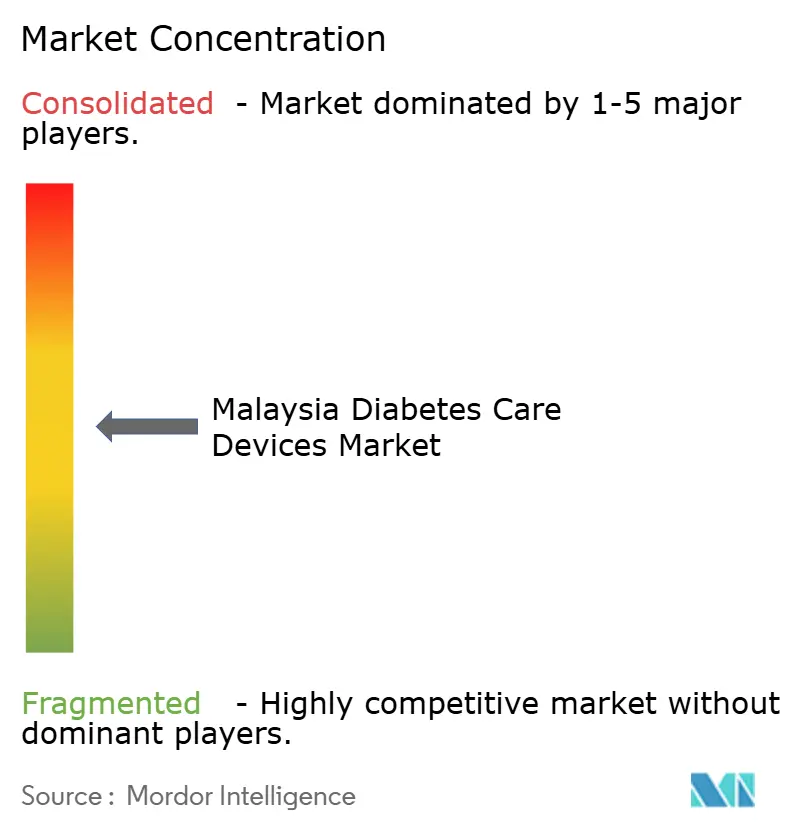
Roughly 20 sizable competitors populate the Malaysian diabetes care devices market, with Abbott, Dexcom, Medtronic, Roche, and Novo Nordisk leading the premium segments. Abbott’s FreeStyle Libre ecosystem gains new leverage through its integration into Medtronic’s MiniMed 780G pump, fostering stickiness that could consolidate share among interoperability leaders. Dexcom’s RM2.83 billion Penang factory, Malaysia’s largest CGM plant, boosts sensor availability and provides a platform for region-specific product tweaks, though humidity-optimized adhesives remain in development. Insulet’s Johor site lifts Omnipod pump output, supporting Southeast Asian expansion and limiting import lag.
White-space innovation focuses on humidity-resistant adhesives, AI-driven glycaemic prediction, and subscription pricing. Roche’s SmartGuide enters the AI arena, while Ascensia’s future Senseonics implant bypasses adhesive shortcomings, potentially reshaping the Malaysia diabetes care devices market share mix. Domestic disruptors Ottai Health and SugO365 pivot on affordability, yet they lack randomized-controlled trial evidence, a gap that multinational incumbents exploit to retain endocrinologist loyalty. Market fragmentation persists, but ecosystem partnerships signal gradual convergence around integrated data platforms and manufacturing scale.
Malaysia Diabetes Care Devices Industry Leaders
-
Medtronic
-
Roche
-
Dexcom
-
Abbott Laboratories
-
Novo Nordisk
- *Disclaimer: Major Players sorted in no particular order
Malaysia Diabetes Care Devices Market Companies Covered in this Report
- Abbott Laboratories
- Arkray
- Ascensia
- Beckton Dickinson
- Biocon Sdn Bhd
- Dexcom
- DKSH Holdings Malaysia
- Eli Lilly and Company
- Insulet
- Medtronic
- Menarini Diagnostics
- MicroTech Medical
- Novo Nordisk
- Roche
- Sanofi
- Senseonics
- SOOIL
- Tandem Diabetes Care
- Terumo
- Ypsomed
Market Opportunities and Future Outlook
Public-sector NCD prioritization creates a runway for higher device utilization across screening, monitoring, and therapy intensification. Budget 2026 framing cited diabetes and obesity as major national cost drivers (RM64 billion annually), and Ministry of Health focus on diabetes interventions supports ongoing tender activity for SMBG meters and strips across the MOH clinic network, where 902,991 active cases are recorded. This policy emphasis also aligns with pharmacy-led point-of-care testing and national behavior-change campaigns (for example, Perang Atas Gula), which expand the funnel of diagnosed and newly monitored patients.
A second opportunity is expanding affluence-led, clinic-centric advanced care into broader home-based management through reimbursement innovation and service bundling. The 2024 MOH health technology assessment deemed CGM non-cost-effective at prevailing retail prices (around RM279 per 14-day sensor), but it still acknowledged quality-of-life gains for Type 1 patients, leaving room for negotiated discounts or outcomes-linked access. Private insurers have already piloted selective CGM coverage within pump bundles at premium hospitals such as Gleneagles Kuala Lumpur. On delivery, telemedicine programs (DoctorOnCall's SIHAT and Speedoc virtual wards) and subscription kits (such as SugO365) are normalizing recurring consumable replenishment and remote coaching. Lower-priced challengers (for example, Ottai Health's CGM pricing below legacy brands) also point to whitespace for validated, humidity-robust solutions that reduce sensor loss and total cost of use in Malaysia's high-humidity conditions.
Recent Industry Developments in Malaysia Diabetes Care Devices Market
- July 2026: Biocon's subsidiary will supply short-acting recombinant human insulin, insulin glargine, and insulin aspart to Duopharma for distribution in Malaysia under contracts valued at over RM225 million. The arrangement strengthens local insulin supply chains and supports public-procurement driven demand for diabetes management in Malaysia, while broadening interoperability through bundled therapeutics and devices.
- June 2026: Duopharma Biotech Berhad secured a three-year contract from the Malaysian Ministry of Health valued at RM155 million to supply recombinant human insulin. This procurement sustains volume growth for diabetes care products and drives demand for monitoring and delivery systems in the market.
- February 2026: Medtronic Diabetes announced FDA clearance of the MiniMed 780G system for use with ultra rapid-acting insulins and expanded its interoperable automated glycemic controller designation for use with the Instinct sensor, developed with Abbott. The clearance broadens compatibility within the CGM and pump ecosystem, accelerating adoption of integrated solutions in Malaysia.
Malaysia Diabetes Care Devices Market Report Scope and Research Methodology
Market Definition and Coverage
This market is sized as the value of diabetes care devices sold and used in Malaysia for routine glucose monitoring and insulin delivery, covering device hardware and the recurring consumables needed to operate them.
Scope exclusions: We exclude diabetes drugs, general hospital supplies that are not specific to diabetes management, and non-diabetes wellness trackers that do not measure or manage blood glucose.
Segments Covered in This Report
- By Product Type
- Monitoring Devices
- Self-Monitoring Blood Glucose Devices
- Continuous Glucose Monitoring
- Management Devices
- Insulin Pumps
- Insulin Syringes
- Insulin Cartridges
- Disposable Pens
- Other Management Devices
- Monitoring Devices
- By End User
- Hospitals & Specialty Clinics
- Primary Care & Diabetes Centres
- Home-Care Settings
Data Sources, Market Sizing, and Validation
Desk Research
Desk work starts with a clean view of the diabetes burden and how patients are treated in Malaysia, because device demand follows the diagnosed population and the intensity of glucose monitoring and insulin delivery.
We referenced public sources such as the International Diabetes Federation, the World Health Organization, the Malaysia Ministry of Health publications, and Department of Statistics Malaysia, and where available we also checked customs and tariff-line trade releases.
To translate demand into dollars, we then pulled price and product availability signals from manufacturer public documents (annual reports, investor slides, product notices) and reputable press coverage of device rollouts and tenders. For checks on company scale and distribution footprint, we used paid subscriptions that provide company financials and intelligence, along with a patents database to understand the direction of monitoring and delivery technology. The desk sources listed are illustrative only, since we used many additional public and paid references to collect data, validate assumptions, and clarify gaps.
Primary Interviews and Surveys
Primary work was used to turn desk assumptions into Malaysia-specific realities, especially around channel mix, average selling prices, and how frequently consumables are replaced. We spoke with a mix of manufacturers, distributors, hospital procurement stakeholders, retail pharmacy participants, and diabetes care clinicians so the model reflects real purchasing behavior across public and private settings.
Because this is a country market, fieldwork emphasized national demand patterns first, then we validated differences across major urban care clusters versus smaller cities to ensure monitoring and refill behavior is not overstated.
Distribution of primary research fieldwork respondents
| Company type | Respondent position |
|---|---|
| Top tier: 36% | CXOs: 17% |
| Mid tier: 45% | Functional/Unit leaders: 26% |
| Smaller Players: 19% | Managers: 57% |
Market-Sizing & Forecasting
Sizing starts with a top-down demand pool build, where diagnosed diabetes prevalence and treated patient counts are translated into annual device usage based on monitoring intensity and insulin delivery adoption. We then apply realistic replacement cycles and consumable run rates to convert users into unit demand, which is subsequently converted to value using Malaysia relevant ASP bands.
In practice, the model is anchored on a small set of inputs that matter most, such as the share of patients on insulin, the split between self-monitoring and continuous monitoring, sensor and test-strip usage per patient, pump penetration, and the typical refill cadence for needles, lancets, and cartridges. The totals are then corroborated with selective bottom-up approximations using supplier roll-ups and channel checks (sampled volume times ASP, plus import and distribution signals) so we can adjust for gaps where public data is thin or where private-pay purchasing is underreported.
For forecasting, we used scenario analysis supported by expert views, because uptake can change quickly with reimbursement decisions, tender wins, and new product launches. Growth assumptions were stress-tested using macro indicators such as healthcare spending trends, diabetes screening activity, and public procurement cycles, and then finalized after reconciling the scenarios with interview feedback.
Data Validation & Update Cycle
Outputs are validated through consistency checks across multiple angles, including per-patient spending, import trends, and whether consumables volumes align with the implied device installed base. When a value looks off, we re-check units, currency timing, and the key conversion rates, and then we re-contact sources if the variance cannot be explained.
Before sign-off, the model goes through stepwise analyst reviews, which includes logic checks on growth drivers and the realism of ASP movement. Reports are refreshed annually, with interim updates when material events occur, such as policy changes, major tender outcomes, or large product introductions. Right before delivery, a final update pass is completed so clients receive the most current view available.
Mordor Intelligence's Malaysia Diabetes Care Devices Market Sizing Compared With Other Published Estimates
Different published values for this market can look far apart, even when everyone is talking about diabetes devices, because the scope lines are often drawn differently and then priced with different assumptions. The biggest swings usually come from what is counted as a device sale versus an ongoing consumable sale, and whether the estimate is anchored on treated patients, total population, or shipment proxies.
The main gap comes from whether recurring consumables are modeled as patient-driven usage or treated as a simple add-on, where Mordor Intelligence counts test strips, lancets, and CGM sensors through replacement frequency tied to Malaysia specific monitoring behavior and then checks the result against channel signals and import flow patterns.
Benchmark comparison
| Source | Market Size | Gaps in Research Methodology |
|---|---|---|
| Mordor Intelligence | USD 96.49 M (2025) | |
| Industry Data Platform A | USD 153.60 M (2025) | This figure appears to bundle a wider diabetes devices basket and may include adjacent diabetes supplies and broader retail markups, which lifts the value even if unit demand is similar. |
| Market Data Publisher B | USD 321.71 M (2022) | The older base year, combined with unclear separation between monitoring hardware and recurring consumables, can inflate the total if multi-year sensor and strip spending is effectively annualized into a single year. |
Taken together, the spread is mainly explained by what gets included, how consumables are converted from users to yearly units, and the choice of base year. Our approach keeps each device line traceable to a small set of inputs, so the final number can be repeated, questioned, and updated when adoption or pricing conditions change.
Key Questions Answered in the Report
How large is the Malaysia diabetes care devices market in 2026?
The Malaysia diabetes care devices market size is USD 108.56 million in 2026 with a 11.12% CAGR projected through 2031.
Which product segment is expanding fastest?
Management Devices, led by insulin pumps, are forecast to grow at 13.72% CAGR to 2031, outpacing monitoring devices.
What fuels home-care device demand?
Telemedicine adoption, subscription bundles like SugO365, and lower-priced CGM options drive an 14.29% CAGR for home-care settings.
Why is CGM adoption still limited?
High sensor costs of RM279 per 14-day unit and humidity-related adhesion failures constrain widespread use.
How do local factories affect pricing?
Facilities from Dexcom and Insulet enhance supply security and may enable future bulk-procurement discounts, though most output currently targets export markets.