
South Korea CRM Marketing Services Market Size and Share
Market Overview
| Study Period | 2020 - 2031 |
|---|---|
| Forecast Data Period | 2026 - 2031 |
| Base Year Market Size (2025) | USD 0.57 Billion |
| Market Size (2026) | USD 0.64 Billion |
| Market Size (2031) | USD 1.24 Billion |
| Growth Rate (2026 - 2031) | 14.14 % |
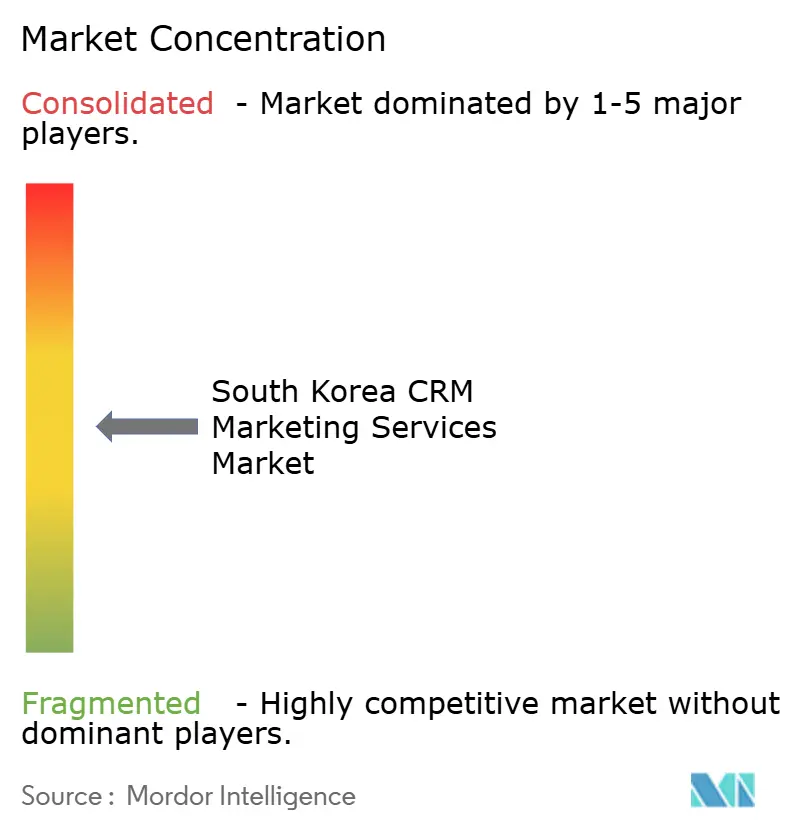
| Market Concentration | Medium |
Major Players *Disclaimer: Major Players sorted in no particular order Image © Mordor Intelligence. Reuse requires attribution under CC BY 4.0. | |
South Korea CRM Marketing Services Market Analysis by Mordor Intelligence
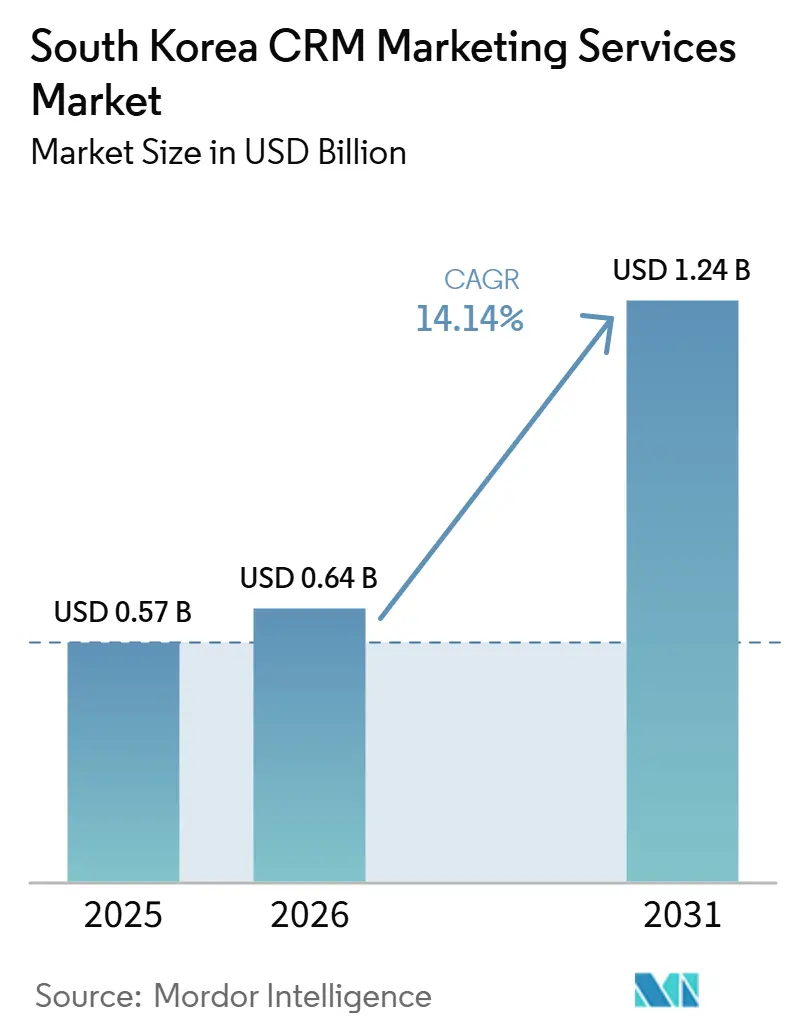
The South Korea CRM Marketing Services Market was valued at USD 0.57 billion in 2025 and estimated to grow from USD 0.64 billion in 2026 to reach USD 1.24 billion by 2031, at a CAGR of 14.14% during the forecast period (2026-2031). The market is expanding as Korean enterprises move from relationship-led selling to more structured customer data operations that rely on formal CRM processes. Consent-managed workflows are now a baseline requirement rather than an optional upgrade, which is lifting spending across implementation, migration, and managed service engagements. Demand is also rising because global CRM products still need meaningful localization to work well with Korea's Naver, KakaoTalk, and mobile app environment. Buyers now favor vendors that can combine compliance readiness, cloud modernization, and ongoing operational support within a single engagement. This creates room for both global platforms and Korean specialists, especially in regulated sectors and in the SME segment, where adoption is broadening.
Key Report Takeaways
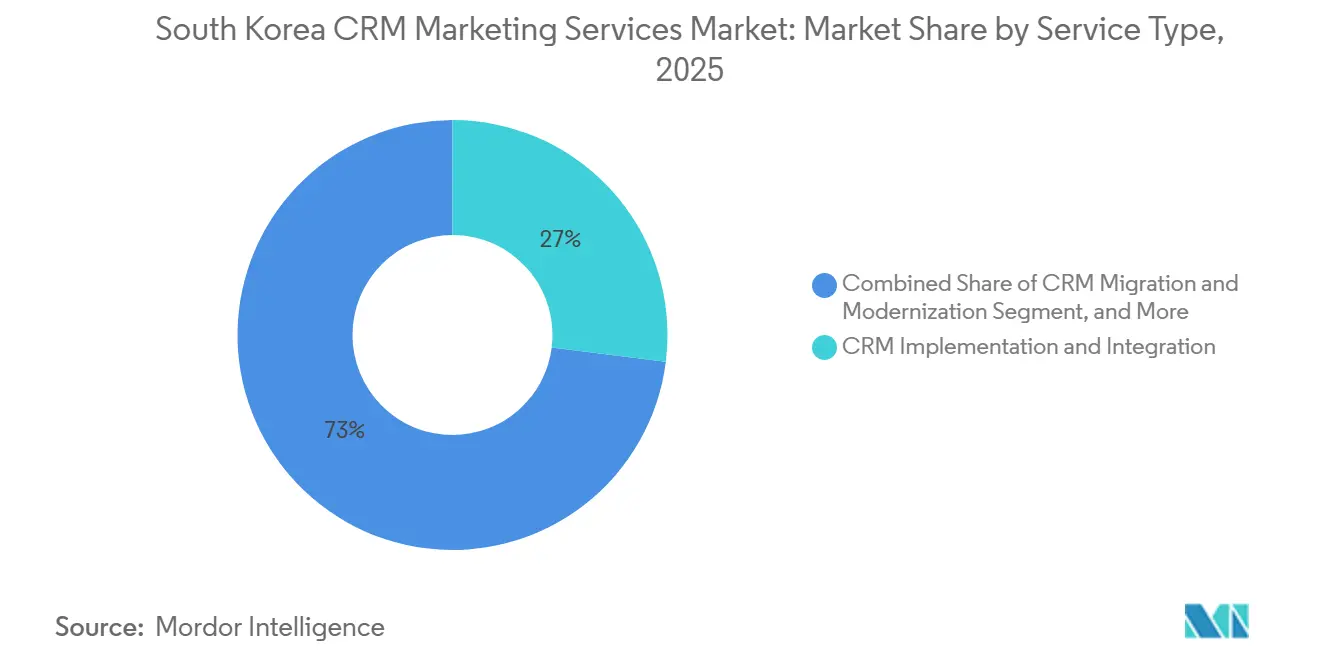
- By service type, CRM Implementation and Integration held 26.98% of the South Korea CRM Marketing Services Market share in 2025, while CRM Migration and Modernization is projected to expand at a 15.92% CAGR through 2031.
- By enterprise size, large enterprises accounted for 57.96% share in 2025, while SMEs are projected to record the highest CAGR at 16.03% through 2031.
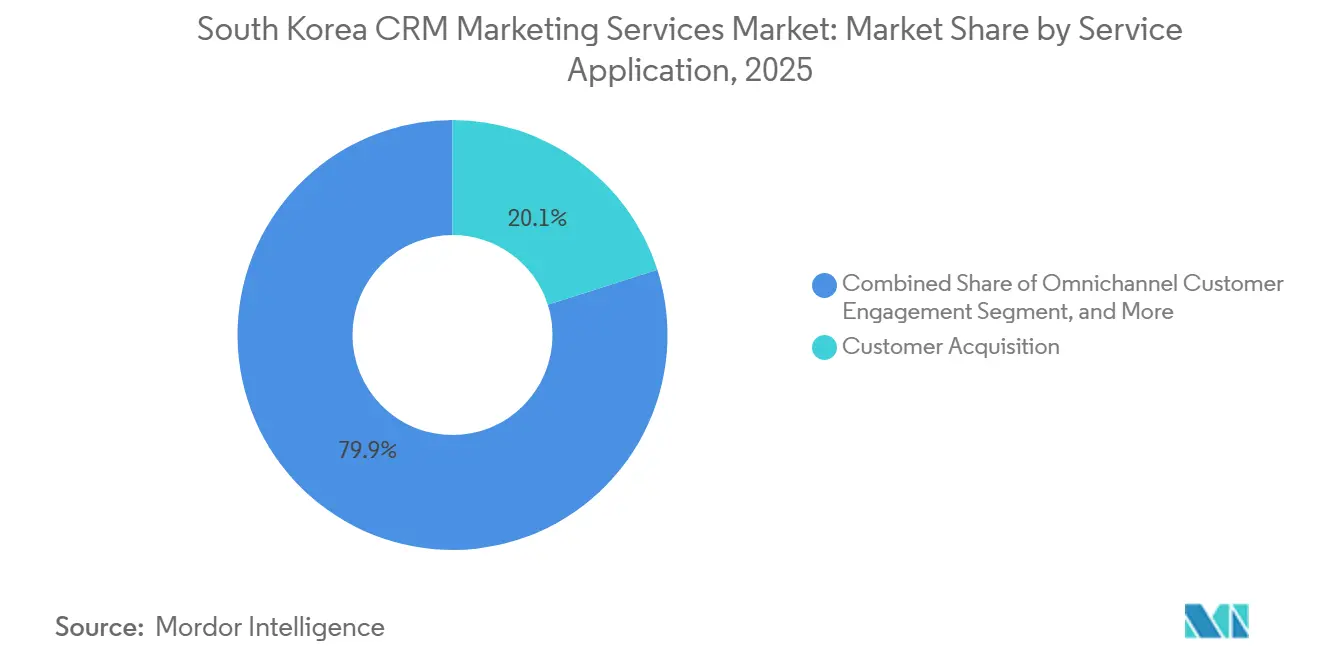
- By service application, Customer Acquisition held a 20.09% share in 2025, while Omnichannel Customer Engagement is projected to grow at a 16.14% CAGR through 2031.
- By end-user industry, BFSI accounted for a 16.10% share of the South Korea CRM marketing services market in 2025, while Healthcare and Life Sciences is projected to expand at a 16.25% CAGR through 2031.
Note: Market size and forecast figures in this report are generated using Mordor Intelligence’s proprietary estimation framework, updated with the latest available data and insights as of January 2026.
South Korea CRM Marketing Services Market Trends and Insights
Drivers Impact Analysis*
| Driver | (~) % Impact on CAGR Forecast | Geographic Relevance | Impact Timeline |
|---|---|---|---|
| Rapid Shift Toward First-Party Data Activation | +3.0% | National, with early concentration in Seoul and Seongnam, Pangyo Tech Valley | Short term (≤ 2 years) |
| Korea-Localized Marketing Automation Demand From Enterprise SaaS Buyers | +2.5% | National, with strong concentration in Seoul and spillover into Busan, Incheon, and Suwon | Medium term (2-4 years) |
| Rising Omnichannel Commerce Orchestration Needs Across Search, Social, and Messaging | +2.0% | National, supported by the reach of KakaoTalk and Naver ecosystems | Short term (≤ 2 years) |
| Increasing Privacy-Driven Preference For Consent-Managed CRM Workflows | +1.7% | National, under Personal Information Protection Commission oversight | Medium term (2-4 years) |
| AI-Driven Personalization And Lead Scoring Adoption | +1.4% | APAC core, with South Korea acting as a high-adoption test bed | Medium term (2-4 years) |
| Cross-Platform Identity Resolution Pressure In Naver, Kakao, and Mobile App Ecosystems | +1.0% | National, tied to South Korea's local digital identity structure | Long term (≥ 4 years) |
| Source: Mordor Intelligence | |||
Rapid Shift Toward First-Party Data Activation
The South Korea CRM Marketing Services Market is benefiting from a strong move toward first-party data as brands adapt to tighter privacy rules and weaker third-party tracking. PIPA has pushed enterprises to rely more heavily on customer information that is collected with clear consent and documented use conditions.[1] This changes the commercial logic of marketing because brands need to offer value before they can gather and activate data at scale. It also increases the need for implementation, customer data platform linkage, campaign design, and ongoing managed services within the same buyer account. When search, commerce, and messaging data sit in separate systems, activation work becomes more service-intensive and less product-led. As more firms complete this shift, the South Korea CRM Marketing Services Market gains from faster payback visibility and broader demand for recurring support work.
Korea-Localized Marketing Automation Demand from Enterprise SaaS Buyers
Demand for localized automation has risen as Korean enterprises move from ERP-led operating models to CRM-led customer workflows. Standard global deployments often require deeper customization in Korea because approval chains, reporting structures, and channel usage patterns differ from those in many other markets. Salesforce Korea reinforced this trend in June 2026 by expanding Agentforce and Data Cloud availability and by assigning forward-deployed engineers to around 60 Korean partner organizations from the second half of 2026.[2] That approach allows local partners to handle workflow adaptation while the platform vendor keeps product consistency and enterprise credibility. It also raises the value of Korean implementation firms that can stay close to the client after deployment and manage ongoing operating adjustments. This is one reason the South Korea CRM Marketing Services Market continues to support a premium consulting layer rather than fully shift to self-service.
Rising Omnichannel Commerce Orchestration Needs Across Search, Social, and Messaging
The South Korea CRM Marketing Services Market is also being driven by the need to coordinate campaigns across search, social, messaging, and mobile commerce within a single operating flow. Naver, KakaoTalk, and brand-owned apps each play a different role in discovery, relationship management, and transactions, making end-to-end orchestration difficult without additional service support. Kakao replaced Chingutok with Brand Message in May 2025 and expanded addressable reach from channel subscribers to users who had provided marketing consent.[3] That shift increased the value of campaign management, automation, and audience synchronization services for brands already using KakaoTalk as a customer channel. It also raised the importance of vendors that understand how Korean messaging behavior fits into broader CRM design rather than treating messaging as an isolated tactic. As firms try to coordinate these touchpoints in one workflow, the South Korea CRM Marketing Services Market sees more demand for middleware, orchestration, and performance optimization support.
Increasing Privacy-Driven Preference for Consent-Managed CRM Workflows
Privacy rules now shape CRM spending decisions almost as directly as platform features or license cost in the South Korea CRM Marketing Services Market. The 2026 PIPA amendment raised the bar for automated decision-making disclosure and established a July 1, 2027, ISMS-P certification requirement for qualifying private entities. PIPC also signaled strict enforcement in 2025, imposing KRW 36 billion (USD 26 million) in penalties on luxury brands for SaaS CRM data breaches. This has pushed buyers to treat consent capture, audit trails, and data governance as core design choices rather than later-stage compliance fixes. Enterprises that build these controls into early project design are better positioned to scale CRM usage across departments without reopening the core architecture. Vendors that combine legal readiness with implementation depth are therefore more likely to win regulated accounts and longer transformation programs.
Restraints Impact Analysis*
| Restraint | (~) % Impact on CAGR Forecast | Geographic Relevance | Impact Timeline |
|---|---|---|---|
| Integration Complexity with Legacy ERP, POS, and Local Messaging Systems | -2.0% | National, with greater intensity in industrial manufacturing clusters and traditional retail | Medium term (2-4 years) |
| High Switching Costs For Teams Embedded in Global CRM Suites | -1.5% | National, concentrated in large conglomerates under multi-year global vendor contracts | Long term (≥ 4 years) |
| Limited Availability of Korean-Language Implementation Talent for Advanced CRM Stacks | -0.8% | National, with sharper shortages outside Seoul | Short term (≤ 2 years) |
| Data Residency, Security, and Compliance Friction for Cross-Border Vendors | -0.6% | National, affecting foreign vendors that access Korean personal data from overseas infrastructure | Long term (≥ 4 years) |
| Source: Mordor Intelligence | |||
Integration Complexity With Legacy ERP, POS, and Local Messaging Systems
Legacy ERP, POS, and local messaging systems still slow CRM rollout across the South Korea CRM Marketing Services Market. Many Korean enterprises built core processes around ERP environments that were not designed to pass customer behavior signals into CRM layers in real time. SAP Korea's continued focus on enterprise cloud migration reflects the deep embedding of these ERP backbones across large organizations.[4] Local POS tools and KakaoTalk-based back ends then add another layer of integration work that standard global middleware often does not solve without customization. Samsung SDS demonstrated one workable route in April 2026 through a domestic RISE with SAP Premium Supplier-based S/4HANA Cloud migration for Samsung Electro-Mechanics, but that model still requires budget depth and specialist talent that many mid-sized buyers do not have. Until lighter and more localized connectors become easier to deploy, project timelines and implementation costs are likely to remain a meaningful restraint.
High Switching Costs For Teams Embedded in Global CRM Suites
Switching costs remain high for teams that have spent years building daily workflows inside global CRM suites. Proprietary data models, long contract terms, and cross-functional dependencies across sales, service, marketing, and IT make replacement decisions difficult, even when local alternatives better align with Korean processes. Korean subsidiaries of multinational firms also need head office approval before changing customer platforms, which stretches decision cycles and limits flexibility. In the SME base, the same problem appears in a smaller form when customer data, automations, and integration layers cannot be cleanly migrated from the incumbent system. Many buyers, therefore, choose partial upgrades or channel add-ons rather than a full migration, even when the long-term case for change is clear. This slows near-term services revenue conversion in the South Korea CRM Marketing Services Market and keeps some demand trapped in extended evaluation phases.
*Our forecasts treat driver/restraint impacts as directional, not additive. The impact forecasts reflect baseline growth, mix effects, and variable interactions.
Segment Analysis
By Service Type: Implementation And Integration Remain The Core Revenue Anchor
CRM Implementation and Integration held 26.98% of the South Korea CRM Marketing Services market share in 2025, which kept it as the leading service type in the market. That position reflects how many Korean enterprises are still installing CRM for the first time or reworking prior deployments to fit the Naver-Kakao-mobile channel environment. These projects rarely stop at basic setup because buyers also need data movement, workflow mapping, access controls, reporting logic, and channel linkage before users can depend on the system every day. In practice, implementation acts as the entry point to broader and longer client relationships inside the South Korea CRM Marketing Services Market. Once deployment begins, clients often discover additional needs in governance, user adoption, and process redesign that keep service partners engaged after go-live.
CRM Migration and Modernization is projected to expand at a 15.92% CAGR through 2031, the fastest pace among service types in the South Korea CRM Marketing Services Market. This growth reflects the delayed but now more active shift from older ERP-linked CRM modules toward cloud-native and more flexible customer stacks. Samsung SDS completed Korea's first RISE with SAP Premium Supplier-based S/4HANA Cloud migration for Samsung Electro-Mechanics in April 2026, which gives the market a visible local example of how large modernization projects can be delivered with domestic capability. Strategy and Consulting, Managed Services, and Training and Support are also becoming more important because many buyers now understand that platform deployment alone does not produce strong CRM outcomes. MegazoneCloud's Salesforce Sales Cloud implementation for PI Advanced Materials in October 2025 showed how post-migration value is increasingly tied to collaboration design, real-time client information management, and embedded AI functions rather than simple system replacement.

By Enterprise Size: Large Enterprises Lead Spending While SMEs Expand The Addressable Base
Large enterprises held 57.96% of the South Korea CRM Marketing Services market share in 2025, which reflects the spending concentration among chaebol groups, major banks, insurers, and large technology firms. These buyers can support long and complex programs that include implementation, integration, data cloud layers, AI agents, compliance design, and organization-wide change management. Their CRM priorities are also moving beyond pipeline visibility toward broader workflow orchestration and customer engagement across multiple channels. That keeps large accounts central to revenue generation in the South Korean CRM Marketing Services Market, even though the number of enterprise clients is smaller than the broader SME base. The scale of these engagements also makes large enterprises the proving ground for advanced use cases that later flow into the rest of the market.
SMEs are projected to record the highest CAGR of 16.03% through 2031, indicating that the next demand wave is moving beyond the largest corporate tier. Kakao's Brand Message launch in May 2025 widened the reach of consent-based messaging and made KakaoTalk-centered campaigns more useful for smaller businesses that rely on direct digital communication to acquire and retain customers. Korean-native subscription CRM tools further lower the barrier to entry by cutting initial costs and reducing the need for extensive customization at the start of adoption. This mix of easier channel activation and lower software complexity gives the South Korea CRM Marketing Services industry a broader demand base than it had during the first enterprise-led phase of adoption. It also creates room for lighter implementation packages, recurring support models, and localized training services designed for firms that do not have large internal IT teams.
By Service Application: Customer Acquisition Stays Largest While Omnichannel Engagement Sets The Growth Pace
Customer Acquisition accounted for 20.09% of the South Korea CRM Marketing Services market in 2025, making it the largest service application in the market. Retail, e-commerce, and BFSI buyers continued to invest in lead generation, audience segmentation, and new-channel outreach because these activities still offer the fastest, most visible commercial returns. This explains why acquisition budgets remained durable even while many organizations were still building the data, integration, and compliance layers required for more advanced CRM use. In the South Korean CRM Marketing Services Market, acquisition work often serves as the initial commercial justification for a broader CRM program. It also gives service vendors an early operating role that can later expand into retention, loyalty, and analytics mandates.
Omnichannel Customer Engagement is projected to expand at a 16.14% CAGR through 2031, which makes it the fastest-growing application area in the South Korea CRM Marketing Services Market. The reason is not only channel proliferation but also a broader shift from one-off outreach to continuous engagement across messaging, mobile apps, and owned digital environments. Buyers increasingly want a single operating model that connects customer journeys, campaign timing, consent status, and response data rather than running each channel as a separate workstream. That shift naturally increases demand for personalization, analytics, campaign orchestration, and retention services. It also favors service partners that can coordinate local messaging behavior, application data, and compliance rules within a single practical execution framework.
By End-User Industry: BFSI Provides Stability While Healthcare And Life Sciences Accelerate
BFSI accounted for 16.10% of the South Korea CRM Marketing Services market size in 2025, which made it the largest end-user group. Banks and insurers are among the most mature CRM buyers because they need to personalize service, protect customer data, and connect CRM output directly to revenue and product decisions. Their programs increasingly move beyond contact management into sales visibility, process automation, and guided recommendations across branch and digital channels. This gives the South Korea CRM Marketing Services industry a steady base of high-value demand that supports long engagements and complex integration work. It also helps explain why the sector remains important for global platform vendors and domestic implementation specialists alike.
Healthcare and Life Sciences are projected to grow at a 16.25% CAGR through 2031, the fastest rate among end users. Public-sector support for AI-based SaaS adoption in hospital information systems is helping move healthcare buyers toward more formal customer and patient engagement tools. Salesforce published a 2025 case study showing that GC Wellbeing reduced administrative work by 50% and reached a 95% monthly active user rate within 1 year of adopting Sales Cloud, linked to the Health Insurance Review and Assessment Service. Government and Public Administration remains an emerging segment, while industrial manufacturing continues to face greater friction in ERP integration than service-led sectors. Even so, both categories add to the medium-term opportunity in the South Korea CRM Marketing Services Market as cloud-first public programs and industrial modernization continue to widen the buyer pool.
Geography Analysis
The South Korea CRM Marketing Services Market is forecast to grow at a 14.14% CAGR through 2031, and demand remains concentrated in the Seoul Metropolitan Area, where the largest buyers and service partners are based. Seoul, Incheon, and Gyeonggi Province host the headquarters of major chaebol groups, leading BFSI institutions, and much of the national technology ecosystem. This concentration gives vendors easier access to executive sponsors, delivery partners, and Korean-language talent during long CRM programs. It also supports faster coordination between platform owners and implementation specialists when large projects move from design into rollout. Salesforce's Korea partner push in 2026 confirmed how strongly enterprise execution still centers on Seoul-based organizations.
Busan, Daegu, and Daejeon are smaller but still relevant demand centers for the South Korea CRM Marketing Services Market, supported by regional finance, healthcare, and mid-sized industrial users. These cities often rely on Seoul-based integrators for larger deployments because advanced CRM architecture talent is harder to secure locally. The geography of demand, therefore, follows a hub-and-spoke pattern, with strategy, solution design, and complex integration concentrated in the capital region. Public digital programs are gradually broadening the buyer base beyond large private enterprises, especially where cloud adoption links to citizen services and health systems. This matters because it introduces new demand even in regions where commercial CRM maturity is still developing.
Industrial zones in Changwon, Ulsan, Cheongju, and nearby manufacturing corridors remain earlier in the adoption curve, but they are becoming more relevant as CRM ties more closely to service, sales, and after-market workflows. Samsung SDS showed in April 2026 that large Korean industrial transformations can cut system downtime by more than 75% from initial estimates during cloud ERP migration, which is a useful sign for future CRM-linked modernization in these regions. Gwangju, Daejeon, and the Incheon Free Economic Zone also contribute incremental demand where AI infrastructure, research activity, and public-sector digitization support new software programs. As these secondary locations mature, the South Korea CRM Marketing Services Market is likely to remain Seoul-led while becoming less dependent on a single metro area than during the first phase of adoption.
Competitive Landscape
The South Korea CRM Marketing Services Market is moderately fragmented, with global platforms strongest in large enterprise accounts, while Korean specialists are gaining ground where localization and price matter most. Salesforce, Microsoft, SAP SE, Oracle, HubSpot, and Adobe benefit from broad product portfolios, established client relationships, and global research investment. Korean-native providers compete by aligning more closely with local workflows and adapting faster to channel behaviors shaped by Naver, KakaoTalk, and mobile commerce. This produces a two-layer structure in which software platform influence and service delivery leadership do not always sit with the same company. It also explains why implementation depth matters almost as much as product breadth in many Korean buying decisions.
Salesforce strengthened its local position in June 2026 by expanding Agentforce and Data Cloud availability in Korea and by assigning forward-deployed engineers to partner organizations that handle localization and enterprise execution. MegazoneCloud followed a complementary path by deepening its role as an implementation and AI operations partner, reporting USD 1.16 billion in 2025 revenue and USD 245.7 million in AI business revenue while also becoming the first Korean managed services provider to obtain ISO/IEC 42001 certification. LG CNS entered the agentic CRM discussion in January 2026 with Clairvo, a CDP-based service that automates customer analysis, target-group creation, and campaign activation via natural-language prompts. Kakao ecosystem changes also support local specialists, as brands need advisers who understand consent-based messaging design and technical integration into Korean customer touchpoints. The result is a competitive field where local execution depth can outweigh pure software brand strength in many account decisions.
White space remains most visible in healthcare CRM, Korean-language AI lead scoring, and SME migration services from older global installs to lower-cost local stacks. Vendors that can connect compliance design, cloud migration, and operational change are likely to have the clearest path to durable contracts. Governance signals are also gaining weight as buyers in finance, healthcare, and public services ask harder questions about AI oversight and the handling of personal data. The South Korea CRM Marketing Services Market, therefore, remains open to both global incumbents and local challengers, but the advantage increasingly sits with firms that can turn localization and compliance into repeatable delivery models.
South Korea CRM Marketing Services Industry Leaders
-
Salesforce, Inc.
-
Microsoft Corporation
-
SAP SE
-
Oracle Corporation
-
HubSpot, Inc.
- *Disclaimer: Major Players sorted in no particular order
Recent Industry Developments
- June 2026: Salesforce Korea hosted "Agentforce World Tour Korea 2026" at COEX, Seoul on June 9, announcing unlimited Agentforce and Data Cloud licensing for Korean enterprises and the assignment of forward-deployed engineers to approximately 60 Korean partner organizations, including MegazoneCloud, LG CNS, Samsung SDS, and Deloitte Digital, commencing H2 2026. The event showcased live CRM and AI agent deployments at POSCO and Musinsa, signaling a transition from traditional CRM service contracts to agentic enterprise subscription models.
- April 2026: Channel Corporation unveiled its AI "CoS (Chief of Staff)" service at a media briefing on June 5, 2026, with a phased release scheduled from late June 2026. CoS performs real-time data collection, product recommendation, and outbound marketing campaign execution, integrating directly with Channel Talk's existing CRM marketing functionality including churn-prevention coupons and AI-powered survey calls.
- April 2026: Braze opened its South Korea AWS-based data center and launched an official KakaoTalk messaging channel on April 8, 2026, enabling Korean enterprises to deliver no-code CRM campaigns directly to 49 million KakaoTalk users while storing customer data within Korea's borders to meet PIPA data residency requirements.
- April 2026: MegazoneCloud reported full-year 2025 consolidated revenue of USD 1.16 billion, 27.9% year-over-year growth, and a profitability turnaround, with AI business revenue reaching USD 245.7 million. The company became the first Korean managed services provider to obtain ISO/IEC 42001 AI management system certification and completed its enterprise AI operating system AIR Studio V2.
South Korea CRM Marketing Services Market Report Scope
The South Korea CRM Marketing Services market refers to solutions and services that enable enterprises to design, implement, and optimize customer relationship management strategies to strengthen customer acquisition, retention, and engagement. These services include consulting, integration, modernization, managed services, and training, supporting applications such as campaign management, marketing automation, customer analytics, omnichannel engagement, and personalization. Driven by South Korea’s advanced digital ecosystem, rapid adoption of cloud-based CRM platforms, and the growing demand for customer-centric strategies, industries such as BFSI, healthcare, IT, retail, manufacturing, and government are increasingly leveraging CRM marketing services to enhance loyalty, improve operational efficiency, and achieve sustainable growth. The primary objective of this market is to empower organizations in South Korea with scalable, data-driven CRM solutions that build stronger customer relationships and deliver a competitive advantage in a dynamic digital economy.
The South Korea CRM Marketing Services market report is segmented by Service Type (CRM Strategy and Consulting, CRM Implementation and Integration, CRM Migration and Modernization, CRM Managed Services, CRM Training and Support), Enterprise Size (Large Enterprises and Small and Medium Enterprises), Service Application (Customer Acquisition, Customer Retention and Loyalty, Campaign Management Services, Marketing Automation Services, Customer Analytics and Insights, Omnichannel Customer Engagement, Personalization Services), and End-user Industry (Banking, Financial Services, and Insurance (BFSI), Healthcare and Life Sciences, Information Technology and Telecom, Retail and E-commerce, Industrial Manufacturing, Government and Public Administration, and Other End-user Industries). The Market Forecasts are Provided in Terms of Value (USD).
| CRM Strategy and Consulting |
| CRM Implementation and Integration |
| CRM Migration and Modernization |
| CRM Managed Services |
| CRM Training and Support |
| Large Enterprises |
| Small and Medium Enterprises |
| Customer Acquisition |
| Customer Retention and Loyalty |
| Campaign Management Services |
| Marketing Automation Services |
| Customer Analytics and Insights |
| Omnichannel Customer Engagement |
| Personalization Services |
| Banking, Financial Services, and Insurance (BFSI) |
| Healthcare and Life Sciences |
| Information Technology and Telecom |
| Retail and E-commerce |
| Industrial Manufacturing |
| Government and Public Administration |
| Other End-user Industries |
| By Service Type | CRM Strategy and Consulting |
| CRM Implementation and Integration | |
| CRM Migration and Modernization | |
| CRM Managed Services | |
| CRM Training and Support | |
| By Enterprise Size | Large Enterprises |
| Small and Medium Enterprises | |
| By Service Application | Customer Acquisition |
| Customer Retention and Loyalty | |
| Campaign Management Services | |
| Marketing Automation Services | |
| Customer Analytics and Insights | |
| Omnichannel Customer Engagement | |
| Personalization Services | |
| By End-user Industry | Banking, Financial Services, and Insurance (BFSI) |
| Healthcare and Life Sciences | |
| Information Technology and Telecom | |
| Retail and E-commerce | |
| Industrial Manufacturing | |
| Government and Public Administration | |
| Other End-user Industries |
Key Questions Answered in the Report
What is the current size of South Korea CRM marketing services and where is it headed by 2031?
The sector was valued at USD 0.57 billion in 2025, stands at USD 0.64 billion in 2026, and is forecast to reach USD 1.24 billion by 2031 at a 14.14% CAGR.
What is driving growth in South Korea CRM marketing services through 2031?
Growth is being driven by first-party data activation, stronger privacy compliance needs, Korea-specific marketing automation demand, and rising omnichannel coordination across messaging, search, and mobile apps.
Which service type leads spending in South Korea CRM marketing services?
CRM Implementation and Integration led with a 26.98% share in 2025, reflecting the need to connect CRM platforms with local channels, ERP systems, and internal workflows.
Which buyer group is expanding fastest in South Korea?
SMEs are growing fastest at a 16.03% CAGR through 2031, helped by lower-cost local CRM tools and broader consent-based messaging reach through KakaoTalk.
Which application area is growing faster than the rest?
Omnichannel Customer Engagement is the fastest-growing application, with a 16.14% CAGR through 2031, as brands move from isolated campaigns toward connected customer journeys.
Which end-user sectors matter most for vendors entering South Korea?
BFSI was the largest end-user segment at 16.10% in 2025, while Healthcare and Life Sciences is growing fastest at a 16.25% CAGR, making both sectors important for vendor strategy.