
North America CRM Marketing Services Market Size and Share
Market Overview
| Study Period | 2020 - 2031 |
|---|---|
| Forecast Data Period | 2026 - 2031 |
| Base Year Market Size (2025) | USD 12.86 Billion |
| Market Size (2026) | USD 13.98 Billion |
| Market Size (2031) | USD 21.20 Billion |
| Growth Rate (2026 - 2031) | 8.68 % |
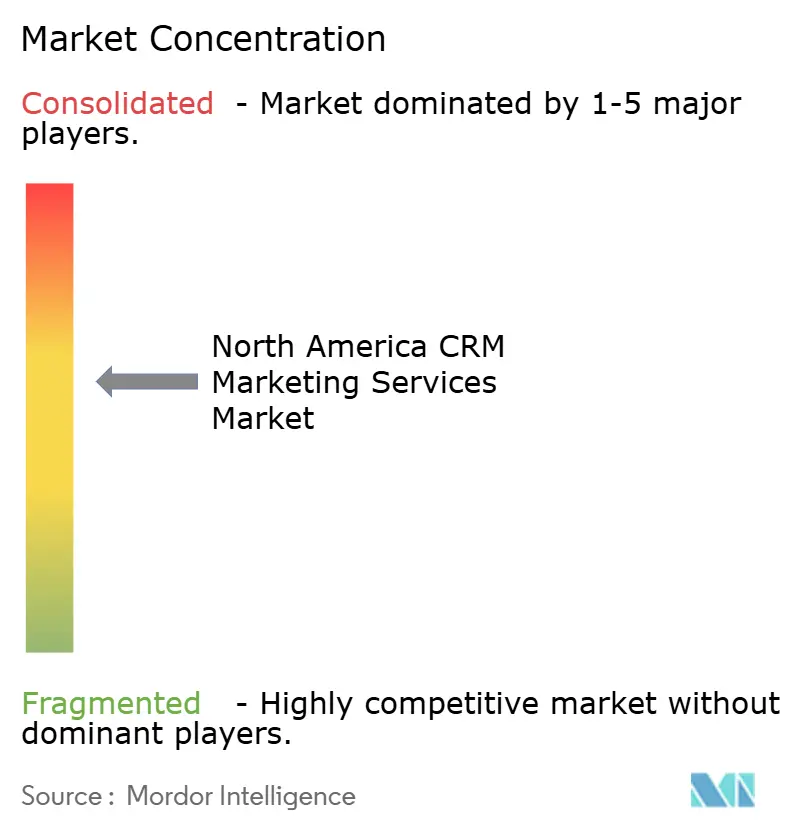
| Market Concentration | Medium |
Major Players *Disclaimer: Major Players sorted in no particular order Image © Mordor Intelligence. Reuse requires attribution under CC BY 4.0. | |
North America CRM Marketing Services Market Analysis by Mordor Intelligence
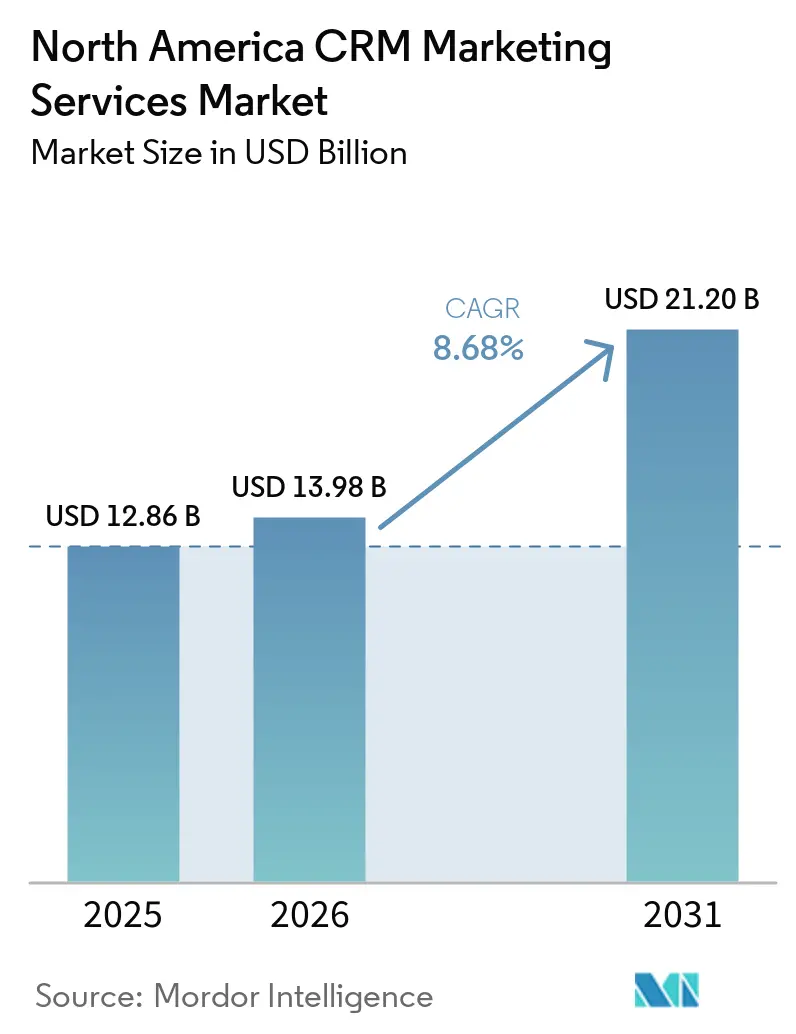
The North America CRM marketing services market size is projected to expand from USD 12.86 billion in 2025 and USD 13.98 billion in 2026 to USD 21.20 billion by 2031, registering a CAGR of 8.68% between 2026 to 2031. The market is expanding because enterprises are treating CRM as an operating system for customer-facing work rather than as a software tool that only stores account and contact data. AI-enabled workflows are increasing the amount of implementation, integration, tuning, and oversight work, which is lifting service revenue beyond the pace of software license growth. Governance, privacy, and workflow control requirements are also widening the service scope, because customer programs now need stronger design, review, and operational support across multiple business functions. Competitive positioning is shifting toward providers with stronger platform certification, deeper vertical delivery models, and better post-deployment support capabilities. The most durable opportunity comes from long-duration programs that combine migration, implementation, optimization, and managed support within the same client relationship.
Key Report Takeaways
- By service type, CRM implementation and integration held 28.31% of the North America CRM marketing services market size in 2025, while CRM managed services are projected to expand at a 12.91% CAGR through 2031.
- By enterprise size, large enterprises held 68.27% of 2025 revenue, while SMEs are projected to expand at a 13.28% CAGR through 2031.
- By service application, customer analytics and insights held 21.19% of 2025 revenue, while personalization services are projected to expand at a 14.63% CAGR through 2031.
- By end-user industry, retail and e-commerce held 23.74% of 2025 revenue, while healthcare and life sciences are projected to expand at a 15.37% CAGR through 2031.
- By country, the United States held 22.31% of the North America CRM marketing services market share in 2025, while Mexico is projected to expand at a 14.16% CAGR through 2031.
Note: Market size and forecast figures in this report are generated using Mordor Intelligence’s proprietary estimation framework, updated with the latest available data and insights as of January 2026.
Market Trends and Insights
Drivers Impact Analysis of North America CRM Marketing Services Market*
| DRIVER | (~) % IMPACT ON CAGR FORECAST | GEOGRAPHIC RELEVANCE | IMPACT TIMELINE |
|---|---|---|---|
| AI Agent Adoption in CRM Platforms | +2.8% | North America, led by United States large enterprises | Medium term (2-4 years) |
| Rising Demand for Customer Experience Management Services | +2.1% | North America, Global | Short term (≤ 2 years) |
| Cloud-Based CRM Migration and Deployment | +1.5% | North America, Canada and Mexico scaling rapidly | Short term (≤ 2 years) |
| Omnichannel Strategy Adoption Across Enterprises | +0.9% | North America, strongest gains in United States retail and BFSI | Medium term (2-4 years) |
| Rapid Digital Transformation Driving CRM Investment | +0.7% | North America, concentrated in United States and Canada | Short term (≤ 2 years) |
| Compliance-Driven CRM Modernization | +0.4% | United States primarily, with secondary impact in Canada | Medium term (2-4 years) |
| Source: Mordor Intelligence | |||
AI Agent Adoption Redefining CRM Service Architectures
AI agent deployment is reshaping the North America CRM marketing services market by moving client work away from one-time setup and toward ongoing tuning, governance, orchestration design, and operational support. Salesforce's Summer '26 release became generally available in June 2026 and introduced Multi-Agent Orchestration in Agentforce, which increased the amount of specialist oversight needed for complex customer workflows. Microsoft's 2026 Release Wave 1 for Dynamics 365 also expanded AI-led functionality across sales, customer service, and contact center applications, which deepened the service effort around copilot-based CRM environments.[1] These releases lengthen delivery cycles because prompts, models, business rules, and review controls need repeated updates after go-live. Providers with stronger AI governance skills and deeper platform certification are therefore winning larger and stickier contracts across the North America CRM marketing services market.
Rising Demand for Customer Experience Management Services
Customer experience spending remains a direct growth engine for the North America CRM marketing services market because buyers want measurable improvements in retention, service quality, and long-term customer value. BAI reported that AI sales assistants in North American lending workflows improved loan production by 5% to 11%, which supports continued service spending around real-time and signal-rich engagement models.[2] Banks are also using richer behavioral and financial signals inside CRM environments, which raises the need for integration, data design, workflow configuration, and ongoing model oversight. Healthcare programs are widening the service scope as well, because patient engagement systems need stronger governance, consent control, and integration with clinical and member-facing processes. This demand continues to shift revenue toward providers that can combine platform skills with delivery experience in regulated, customer-intensive sectors across the North America CRM marketing services market.
Cloud-Based CRM Migration Creating a Long-Tail Services Opportunity
Cloud migration continues to widen the North America CRM marketing services market because organizations still need outside help to replace legacy hosted deployments and rebuild years of customized workflow logic. HubSpot's Spring 2026 Spotlight introduced new AI agents and deal progression tools in April 2026, which increased the appeal of moving toward newer cloud-centric CRM environments. Migration remains service-intensive because old automation layers, integrations, and user processes usually need to be rebuilt inside the target platform rather than transferred without change. Post-migration optimization, user adoption, administration, and support, then create a second wave of recurring revenue after the initial deployment is completed. This pattern favors providers that can manage both re-platforming work and longer-duration optimization programs across the North America CRM marketing services market.
Omnichannel Strategy Adoption Expanding CRM Services Scope
Omnichannel engagement is expanding the North America CRM marketing services market because companies want customer context to move smoothly across sales, service, marketing, commerce, and support interactions. Adobe introduced CX Enterprise Coworker in April 2026 across Experience Platform applications, which increased the demand for partners that can connect customer data, journeys, analytics, and AI-assisted actions across tools. SAP also added AI-personalized communication and cross-channel orchestration features in its Q1 2026 customer experience update, which broadened the amount of ongoing configuration and governance work tied to enterprise CRM programs. Retail, financial services, and industrial manufacturing users all need more integration work when physical, digital, and AI-assisted touchpoints operate together in the same customer journey. That complexity supports premium contracts for firms that can run multivendor and multichannel environments across the North America CRM marketing services market.
Restraints Impact Analysis of North America CRM Marketing Services Market*
| RESTRAINT | (~) % IMPACT ON CAGR FORECAST | GEOGRAPHIC RELEVANCE | IMPACT TIMELINE |
|---|---|---|---|
| Legacy CRM System Integration Challenges | -1.8% | North America, concentrated in the United States large enterprises and Canadian BFSI | Medium term (2-4 years) |
| State-Level Privacy Regulation Complexity | -1.2% | United States primarily, with secondary impact in Canada | Short term (≤ 2 years) |
| Data Quality and Management Gaps | -0.8% | North America, strongest in Mexico and SME segments | Medium term (2-4 years) |
| Limited Infrastructure and Implementation Investment | -0.4% | Mexico, Rest of North America, and the North America SME segment | Medium term (2-4 years) |
| Source: Mordor Intelligence | |||
Legacy CRM Integration Challenges Constraining Enterprise Migration Velocity
Legacy integration remains the clearest brake on the North America CRM marketing services market because older custom workflows and point-to-point links often extend project timelines far beyond initial plans. Migration teams commonly discover hidden dependencies between CRM, ERP, billing, marketing, and service tools only after projects are already in motion. Each of these links must then be rebuilt and tested inside the new platform, which raises delivery risk, adds rework, and slows revenue recognition for service providers. The burden is heavier in large enterprises and in cross-border programs where process standards and approval structures differ across business units. As a result, some buyers phase deployments more slowly, which tempers the pace at which the North America CRM marketing services market can turn demand into closed and scalable service revenue.
Fragmented State Privacy Regulations Increasing CRM Compliance Costs
State-level privacy rules continue to weigh on the North America CRM marketing services market because enterprises must build consent controls, opt-out logic, and automated decision safeguards into customer-facing workflows. This adds legal review, data mapping, governance design, and approval checkpoints to CRM projects that would otherwise move faster and with fewer decision makers. The burden is especially visible in mid-sized organizations that do not have large internal privacy teams and must rely more heavily on outside specialists during implementation. Providers with compliance monitoring capabilities are therefore in a stronger position to defend margins and win recurring managed support contracts. Even so, the extra review and design steps can delay procurement and slow implementation across the North America CRM marketing services market.
*Our forecasts treat driver/restraint impacts as directional, not additive. The impact forecasts reflect baseline growth, mix effects, and variable interactions.
North America CRM Marketing Services Market Segment Analysis
By Service Type:
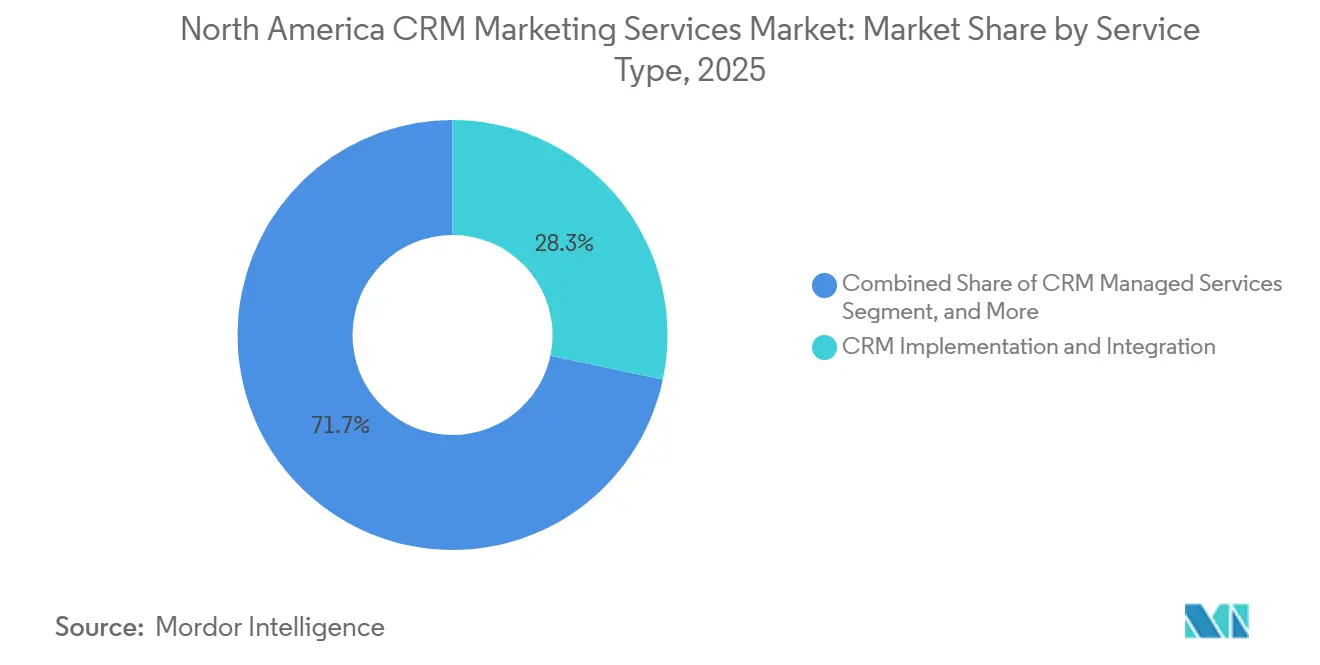
Implementation Complexity Anchors Services RevenueCRM Implementation and Integration held 28.31% of the North America CRM marketing services market size in 2025, which reflects the amount of work needed to connect CRM platforms with data layers, AI tools, engagement channels, and back-office systems. The segment remains the largest because CRM deployments now function as orchestration hubs rather than as standalone contact systems with narrow sales use cases. Each added connection increases design effort, testing cycles, user change management, and post-launch stabilization work, which keeps implementation budgets elevated in the North America CRM marketing services market. Salesforce and Microsoft both expanded AI-led CRM functionality in 2026, which increased the number of workflows, controls, and user experiences that implementation teams must configure and monitor.[3] Strategy and consulting, migration and modernization, and training and support still matter because buyers want outside validation before launch and stronger enablement after deployment.
CRM Managed Services is projected to expand at a CAGR of 12.91% from 2026 to 2031, making it the fastest-growing service type in the North America CRM marketing services market. Enterprises are shifting from project spending to operating-model spending because AI-rich CRM environments need continuous administration, compliance updates, optimization, and performance tuning over a much longer period. This change is especially important for smaller organizations that cannot justify full internal CRM operations teams but still need steady platform oversight. Service providers are therefore packaging managed support as the default next step after implementation, which lowers revenue volatility and strengthens retention across the North America CRM services industry.

By Enterprise Size:
SME Adoption Widens the CRM Services BaseLarge enterprises retained 68.27% of 2025 revenue in the enterprise size split, which shows how strongly large and multi-division transformation programs still shape the North America CRM marketing services market. These organizations usually run broader initiatives that combine consulting, custom implementation, integration, training, governance design, and ongoing support across several business functions. Their preferred partner relationships also tend to last longer because platform changes affect many users, several linked systems, and multiple operating teams at the same time. This gives established providers a stable base of complex work and a lower risk of vendor replacement once delivery standards and governance processes are in place. It also keeps enterprise accounts central to capacity planning and talent allocation across the North America CRM marketing services market.
SMEs are projected to expand at a CAGR of 13.28% through 2031, which makes them the fastest-growing enterprise group. HubSpot expanded its AI-led workflow and CRM feature set in 2026, which supported the move toward more capable cloud deployments for smaller buyers that want faster setup and simpler administration.[4] The segment is widening the client base because prebuilt templates, modular architecture, and cloud delivery reduce the time and cost barriers that once limited advanced CRM programs to larger businesses. As adoption matures, the upsell path from implementation to analytics, AI activation, and managed support is creating a broader long-tail opportunity across the North America CRM services industry.
By Service Application:
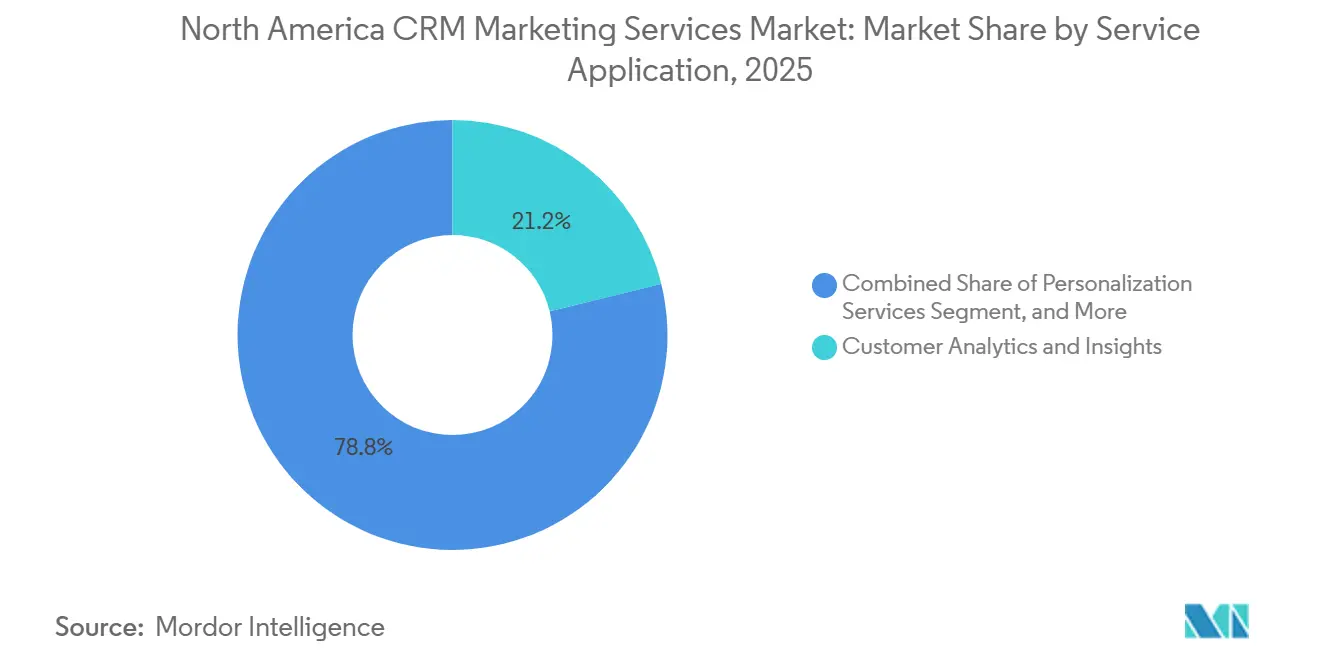
Analytics Sustains Share While Personalization AcceleratesCustomer Analytics and Insights held 21.19% of 2025 service application revenue, which kept it at the center of the North America CRM marketing services market. Analytics work remains foundational because enterprises need cleaner customer profiles, stronger signal design, and more reliable reporting workflows before advanced personalization can scale across channels. This makes analytics spending less discretionary than many campaign-led projects, since it supports later use cases across acquisition, retention, and service. Salesforce's personalization stack uses product and order behavior to guide offer decisioning, which shows how analytics and activation now operate as a connected stream of service work rather than as isolated tasks. As a result, providers that can bridge data engineering and customer-facing execution are well positioned in the North America CRM marketing services market.
Personalization Services is projected to expand at a CAGR of 14.63% from 2026 to 2031, making it the fastest-growing application area. SAP remained a Leader in personalization engines in 2026, which supports continued enterprise spending on configuration, tuning, and governance around individualized engagement programs. The segment is growing faster because enterprises want to move from audience-level campaigns to person-level orchestration using live behavioral signals and predictive decisioning. Omnichannel engagement, retention, campaign management, and marketing automation all benefit from this change, which broadens the mix of service work inside the North America CRM marketing services market.
By End-User Industry:
Healthcare Outpaces Retail As Investment Priorities ShiftRetail and E-Commerce held 23.74% of 2025 end-user revenue, which kept it as the largest vertical in the North America CRM marketing services market. The segment has a long installed base in loyalty, email, and digital engagement, so it continues to generate steady demand for optimization, integration, and platform administration. Retail programs also tend to add new service layers when commerce, service, and promotion data need to work together across channels and customer touchpoints. Financial institutions are also using richer customer signals inside CRM environments, which supports continued spending on integration and model governance across customer-facing workflows. This leaves retail as the scale anchor even as growth broadens across other regulated and service-intensive sectors in the North America CRM marketing services market.
Healthcare and Life Sciences is projected to expand at a CAGR of 15.37% through 2031, making it the fastest-growing end-user segment. The segment is advancing quickly because patient engagement, member communication, and commercial relationship programs all require stronger governance, integration discipline, and workflow support than many other CRM deployments. Information technology, government, industrial manufacturing, and other users are also contributing steady demand through go-to-market optimization, citizen service modernization, and dealer network upgrades. The result is a market where vertical depth matters more each year, especially when compliance needs and workflow complexity rise together in the North America CRM marketing services market.
Geography Analysis
United States and Canada CRM Marketing Services Market
The United States held 22.31% of the North America CRM marketing services market share in 2025, which kept it as the largest country market. The country leads because it has the deepest installed base of enterprise CRM users and the broadest ecosystem of implementation partners and managed support providers. US banks are using dynamic customer intelligence models inside CRM systems, which support ongoing spending on integration, governance, and optimization services. State-level privacy obligations also add review, design, and operating work to deployments, which sustains demand for specialized service capabilities. Canada remained the second-largest national market, with demand centered in financial services, healthcare, and government programs that require disciplined data handling and complex integration work.
Mexico CRM Marketing Services Market
Mexico is projected to expand at a CAGR of 14.16% from 2026 to 2031, making it the fastest-growing country in the North America CRM marketing services market. Nearshoring programs are pushing more firms to modernize customer operations and adopt cloud-based CRM delivery. Growth is also being supported by broader adoption among small and mid-sized businesses that need more structured sales and service workflows but cannot build large internal technology teams. The market still faces delivery constraints because implementation talent and advanced CRM operating skills remain limited in relation to demand. This keeps a large share of current spending focused on implementation, training, and managed support rather than on the most advanced analytics layers in the North America CRM marketing services market.
Broader North American Markets
The Rest of North America contributed smaller but steady volumes, supported by mid-market modernization and cloud-first deployments. These countries are often served by regional partners or by larger firms extending delivery models that were built first in the United States and Canada. The regional pattern shows a two-speed structure where the United States and Canada are focused more on optimization and AI-enabled expansion, while Mexico and adjacent markets are still building core capabilities. That split creates room for both high-touch transformation work and standardized rollout models across the North America CRM marketing services market.
Competitive Landscape
The North America CRM marketing services market shows moderate to high concentration at the platform layer, where Salesforce, Microsoft, SAP, Oracle, and Adobe shape product roadmaps, certification standards, and partner expectations. That influence does not translate into the same level of concentration in service delivery, because the execution base still includes many independent implementers, specialist boutiques, and regional managed support firms. Salesforce reinforced its position in June 2026 by releasing Multi-Agent Orchestration in Agentforce, which tied new AI workflows more closely to partner-led setup, oversight, and ongoing governance.[5] Microsoft also expanded its service pull-through Copilot Cowork for Dynamics 365 and its 2026 release wave, which increased the amount of configuration work around AI-led sales and service processes. This keeps the largest vendors strong at the top of the stack while leaving room for many specialists below them in the North America CRM marketing services market.
Competition among service providers is moving away from basic implementation and toward vertical knowledge, governance controls, deployment speed, and post-launch stability. Healthcare, retail, banking, and industrial manufacturing are the main areas where deep domain expertise now matters most, because each one brings different integration and compliance requirements. Adobe's CX Enterprise Coworker, built on open standards, pointed to a more interoperable environment that can support multivendor implementations rather than only single-platform estates. HubSpot's Spring 2026 expansion of AI agents and workflow tools also strengthened its appeal with smaller accounts that want faster rollout, easier administration, and less technical overhead. These shifts are widening the gap between firms that can package repeatable vertical solutions and those still competing mainly on generic delivery capacity in the North America CRM marketing services market.
White-space opportunities remain strongest in managed support for regulated and operationally complex sectors, where ongoing optimization now matters as much as initial deployment. Specialist firms can still win against broader rivals when they combine strong platform certification with compliance knowledge and disciplined post-go-live support. The North America CRM marketing services market, therefore, remains competitive but not locked up, because platform influence is strong while delivery choices remain broad. Buyers are likely to keep rewarding providers that reduce implementation risk, govern AI use well, and support business outcomes after launch.
North America CRM Marketing Services Industry Leaders
-
Salesforce, Inc.
-
Adobe Inc.
-
Oracle Corporation
-
Microsoft Corporation
-
HubSpot, Inc.
- *Disclaimer: Major Players sorted in no particular order
North America CRM Marketing Services Market Companies Covered in this Report
- Salesforce, Inc.
- Adobe Inc.
- Oracle Corporation
- Microsoft Corporation
- HubSpot, Inc.
- SAP SE
- IBM Corporation
- SAS Institute Inc.
- Pegasystems Inc.
- Zoho Corporation Pvt. Ltd.
- ActiveCampaign, LLC
- Braze, Inc.
- Twilio Inc.
- Brevo
- Constant Contact, Inc.
- Klaviyo, Inc.
- Teradata Corporation
- Amperity, Inc.
- Genesys Cloud Services, Inc.
- InMoment, Inc.
Recent Industry Developments in North America CRM Marketing Services Market
- June 2026: Salesforce released its Summer '26 product update, introducing Multi-Agent Orchestration in Agentforce, enabling autonomous AI agents to collaborate on complex, end-to-end CRM workflows. The release also includes Real-Time Offer Management for personalized channel-specific promotions and Collections with Agentforce for AI-driven invoice management. These capabilities directly expand the implementation and managed services opportunity by requiring expert agent configuration and ongoing governance.
- June 2026: Microsoft made Copilot Cowork for Dynamics 365 generally available for Microsoft 365 Copilot customers worldwide, extending AI-powered CRM functionality into Dynamics 365 Sales and Customer Service through plug-in integration managed via the Microsoft 365 admin center. The general availability marks a significant step toward embedding agentic CRM capabilities into enterprise workflows, expanding the managed services addressable market for Dynamics 365 implementation partners.
- April 2026: HubSpot launched its Spring 2026 Spotlight on April 14, unveiling the Agentic Engagement Object, Smart Deal Progression, and a revamped Prospecting Agent, alongside more than 100 additional platform updates. Three Breeze AI agents, Customer, Prospecting, and Data, became generally available, positioning HubSpot as a direct competitor to enterprise-tier CRM platforms and creating new implementation services demand for HubSpot-certified partners serving SME and mid-market clients.
- April 2026: Adobe unveiled CX Enterprise Coworker at its annual customer experience conference, activating agentic intelligence across Adobe Experience Platform applications including Real-Time CDP, Customer Journey Analytics, and Journey Optimizer. Built on open standards including Model Context Protocol and Agent2Agent, the solution enables cross-vendor CRM integration architectures and new implementation services opportunities for multi-platform partners.
North America CRM Marketing Services Market Report Scope
North America CRM marketing services refer to platforms and professional services that enable businesses across the United States, Canada, and Mexico to manage customer relationships and enhance marketing performance. These services include customer data integration, campaign automation, analytics, personalization, and omnichannel engagement. Businesses use these services to improve customer loyalty, drive revenue growth, comply with regional data privacy and security standards, and leverage advanced AI and cloud technologies.
The North America CRM Marketing Services Market Report is Segmented by Service Type (CRM Strategy and Consulting, CRM Implementation and Integration, CRM Migration and Modernization, CRM Managed Services, and CRM Training and Support), Enterprise Size (Large Enterprises, and Small and Medium Enterprises), Service Application (Customer Acquisition, Customer Retention and Loyalty, Campaign Management Services, Marketing Automation Services, Customer Analytics and Insights, Omnichannel Customer Engagement, and Personalization Services), End-user Industry (Banking, Financial Services, and Insurance (BFSI), Healthcare and Life Sciences, Information Technology and Telecom, Retail and E-commerce, Industrial Manufacturing, Government and Public Administration, and Other End-user Industries), and Country (United States, Canada, Mexico, and Rest of North America). The Market Forecasts are Provided in Terms of Value (USD).
Segmentation Overview
| CRM Strategy and Consulting |
| CRM Implementation and Integration |
| CRM Migration and Modernization |
| CRM Managed Services |
| CRM Training and Support |
| Large Enterprises |
| Small and Medium Enterprises |
| Customer Acquisition |
| Customer Retention and Loyalty |
| Campaign Management Services |
| Marketing Automation Services |
| Customer Analytics and Insights |
| Omnichannel Customer Engagement |
| Personalization Services |
| Banking, Financial Services, and Insurance (BFSI) |
| Healthcare and Life Sciences |
| Information Technology and Telecom |
| Retail and E-commerce |
| Industrial Manufacturing |
| Government and Public Administration |
| Other End-user Industries |
| United States |
| Canada |
| Mexico |
| By Service Type | CRM Strategy and Consulting |
| CRM Implementation and Integration | |
| CRM Migration and Modernization | |
| CRM Managed Services | |
| CRM Training and Support | |
| By Enterprise Size | Large Enterprises |
| Small and Medium Enterprises | |
| By Service Application | Customer Acquisition |
| Customer Retention and Loyalty | |
| Campaign Management Services | |
| Marketing Automation Services | |
| Customer Analytics and Insights | |
| Omnichannel Customer Engagement | |
| Personalization Services | |
| By End-user Industry | Banking, Financial Services, and Insurance (BFSI) |
| Healthcare and Life Sciences | |
| Information Technology and Telecom | |
| Retail and E-commerce | |
| Industrial Manufacturing | |
| Government and Public Administration | |
| Other End-user Industries | |
| By Country | United States |
| Canada | |
| Mexico |
Key Questions Answered in the Report
What is the current size of the North America CRM marketing services market?
The North America CRM marketing services market stood at USD 13.98 billion in 2026, up from USD 12.86 billion in 2025, and is forecast to reach USD 21.20 billion by 2031 at an 8.68% CAGR.
Which service type leads revenue in North America CRM services?
CRM Implementation and Integration led with 28.31% of 2025 revenue, reflecting the large amount of integration and deployment work tied to modern CRM environments.
Which customer group is expanding fastest in CRM services across North America?
SMEs are projected to grow at a 13.28% CAGR through 2031, helped by cloud-native platforms, prebuilt templates, and the rising appeal of managed support models.
Why is healthcare becoming such an important growth area for CRM service providers?
Healthcare and Life Sciences is projected to grow at a 15.37% CAGR because patient engagement, member communication, and regulated data workflows all require deeper integration and governance support.
Which country leads regional demand and which one is growing fastest?
The United States was the largest country market with 22.31% of 2025 revenue, while Mexico is expected to post the fastest growth at a 14.16% CAGR through 2031.
How are AI agents changing CRM service demand in North America?
AI agents are increasing the need for workflow design, governance, tuning, and managed support, which is extending contract duration and lifting demand for specialist service partners.