
Singapore CRM Marketing Services Market Size and Share
Market Overview
| Study Period | 2020 - 2031 |
|---|---|
| Forecast Data Period | 2026 - 2031 |
| Base Year Market Size (2025) | USD 199.48 Million |
| Market Size (2026) | USD 225.77 Million |
| Market Size (2031) | USD 457.66 Million |
| Growth Rate (2026 - 2031) | 15.18 % |
| Market Concentration | Medium |
Major Players *Disclaimer: Major Players sorted in no particular order Image © Mordor Intelligence. Reuse requires attribution under CC BY 4.0. | |
Singapore CRM Marketing Services Market Analysis by Mordor Intelligence
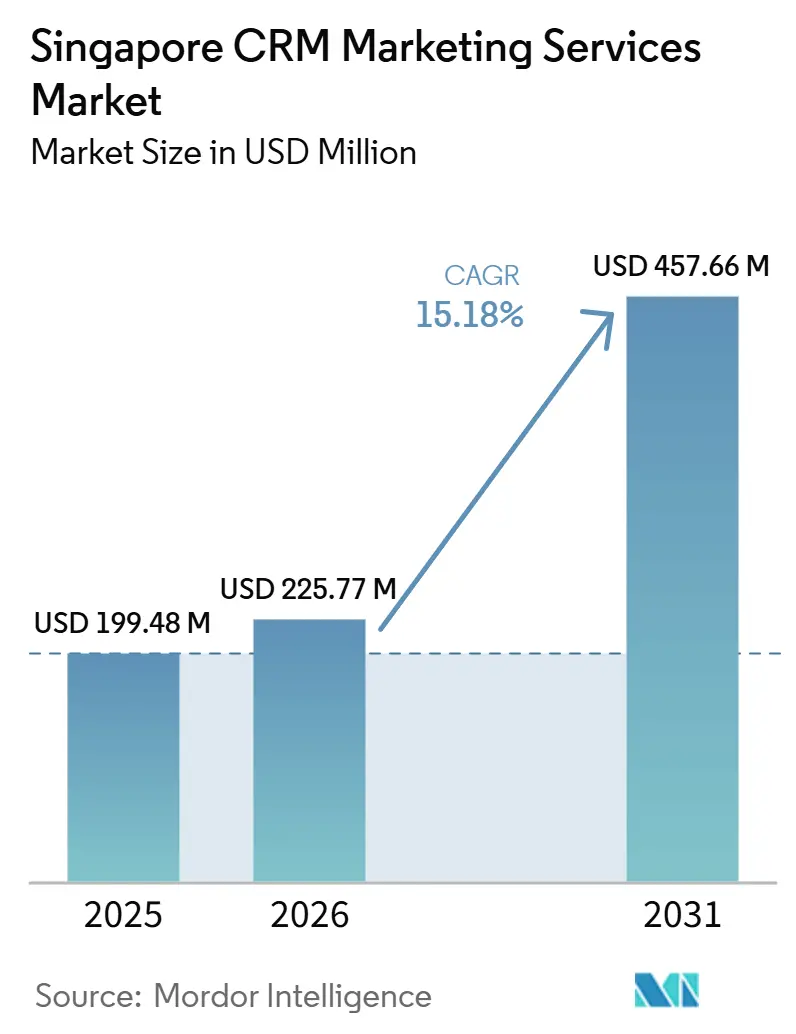
The Singapore CRM marketing services market size was valued at USD 199.48 million in 2025 and estimated to grow from USD 225.77 million in 2026 to reach USD 457.66 million by 2031, at a CAGR of 15.18% during the forecast period 2026-2031. The Singapore CRM marketing services market is expanding as enterprises shift from isolated software purchases to recurring service models that combine implementation, optimization, and AI-led customer engagement. Stronger personalization needs are also supporting demand, because many firms still struggle with fragmented customer data and uneven campaign execution. Large buyers continue to shape spending through multi-module deployments, while smaller firms are entering the category through simpler cloud-based service packages and managed delivery models. The competitive field remains balanced between global platform vendors and local specialists, which keeps innovation high and pushes providers to differentiate through compliance support, faster deployment, and industry-specific execution. Cost pressure and privacy obligations still create friction, yet these same issues increase the need for service partners that can manage integration complexity, consent processes, and ongoing platform performance.
Key Report Takeaways
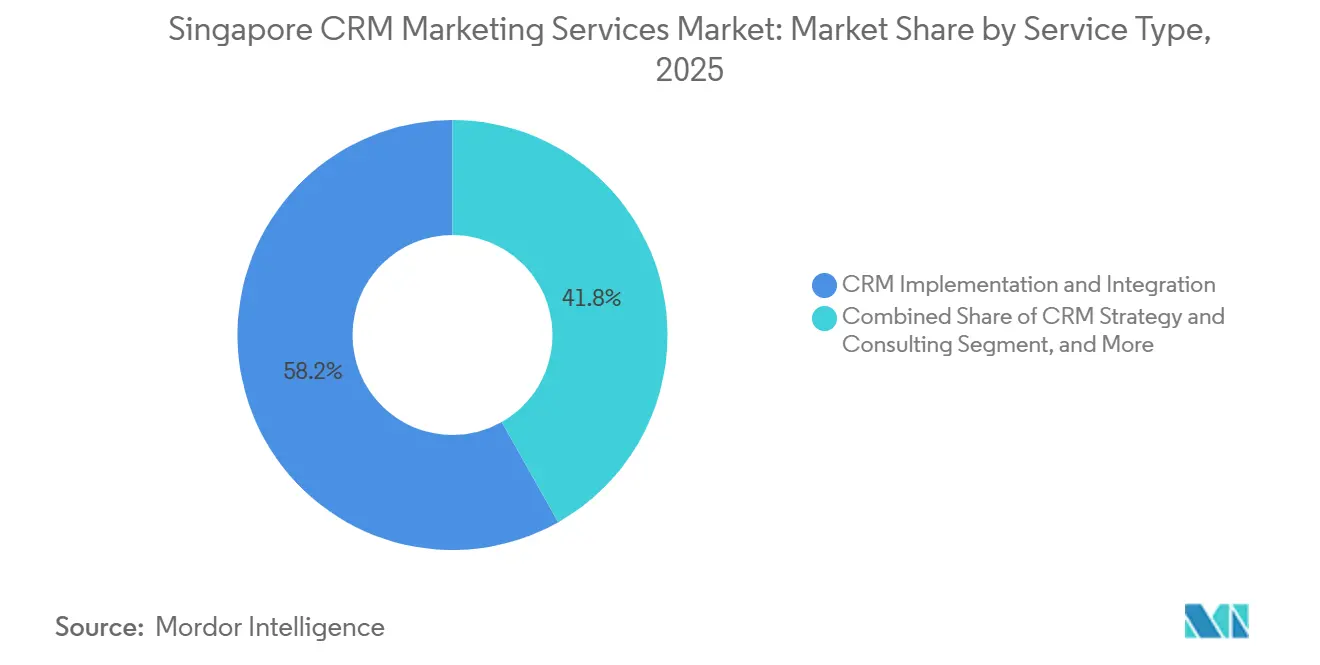
- By service type, CRM Implementation and Integration accounted for 58.18% of the Singapore CRM marketing services market in 2025, while CRM Managed Services is projected to expand at a 17.36% CAGR through 2031.
- By enterprise size, Large Enterprises held 71.47% of the Singapore CRM marketing services market share in 2025, while SMEs are projected to grow at a 17.71% CAGR through 2031.
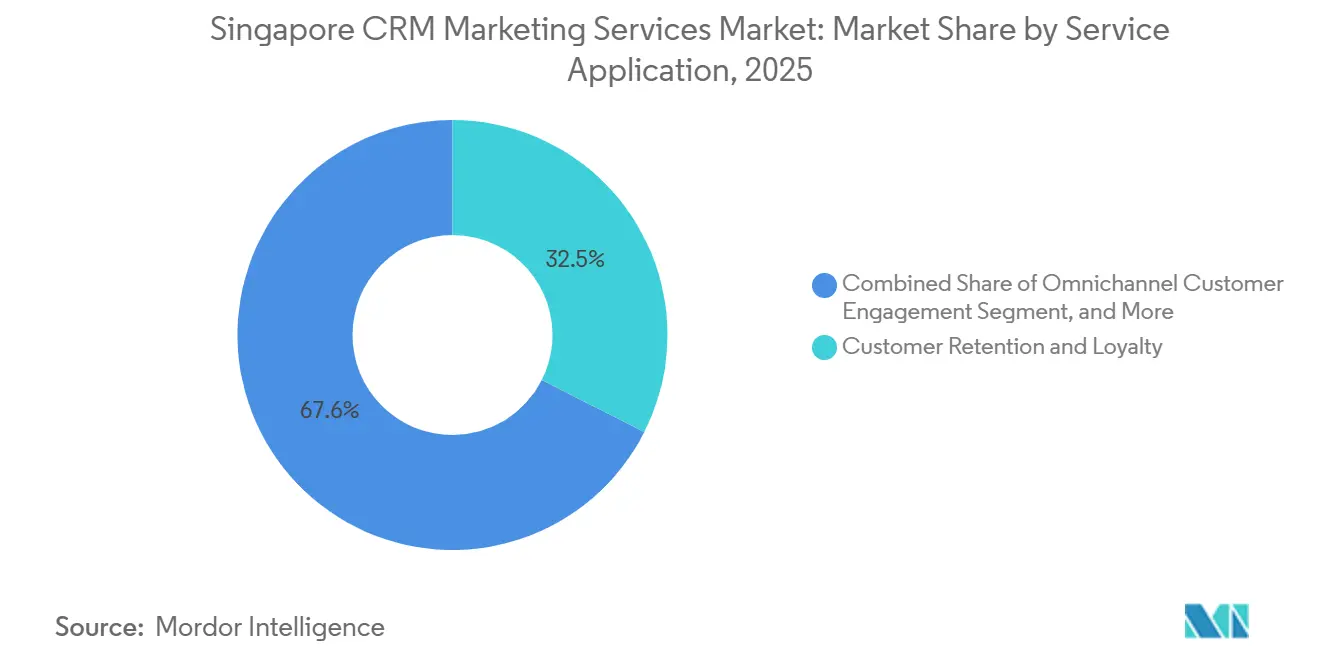
- By service application, Customer Retention and Loyalty accounted for 32.45% of the Singapore CRM marketing services market size in 2025, while Personalization Services is expected to expand at a 16.55% CAGR through 2031.
- By end-user industry, BFSI held 33.12% of the Singapore CRM marketing services market share in 2025, while Retail and E-commerce are projected to advance at a 16.89% CAGR through 2031.
Note: Market size and forecast figures in this report are generated using Mordor Intelligence’s proprietary estimation framework, updated with the latest available data and insights as of January 2026.
Singapore CRM Marketing Services Market Trends and Insights
Drivers Impact Analysis*
| Driver | (~) % Impact on CAGR Forecast | Geographic Relevance | Impact Timeline |
|---|---|---|---|
| Rising SME Demand for Affordable Marketing Automation | +4.5% | National, concentrated in services-sector SMEs across CBD, Jurong, and Tampines commercial zones | Short term (≤ 2 years) |
| AI-Led Personalization Across Small Budgets | +3.5% | National, with ASEAN spill-over as Singapore-based vendors export AI marketing solutions regionally | Medium term (2-4 years) |
| Retail, E-commerce, and Tourism Recovery Driving Customer Retention Spend | +2.8% | National, with concentrated demand in Orchard Road retail and integrated resort hospitality clusters | Short term (≤ 2 years) |
| Singapore as a Regional SaaS Hub for ASEAN Rollouts | +1.8% | National, with secondary adoption signals across ASEAN core markets | Long term (≥ 4 years) |
| Privacy-By-Design CRM Favoring Compliant Vendors | +1.2% | National, with cross-border influence on ASEAN markets where Singapore-regulated entities operate | Medium term (2-4 years) |
| WhatsApp and Omnichannel Engagement Integration | +0.9% | National, with early gains among food and beverage, retail, and professional services SMEs | Short term (≤ 2 years) |
| Source: Mordor Intelligence | |||
Rising SME Demand for Affordable Marketing Automation
Rising SME demand remains one of the clearest growth pillars for the Singapore CRM marketing services market. Smaller firms are under pressure to professionalize lead management, customer follow-up, and retention activity without building large in-house teams. The compliance burden around customer data also means that even basic CRM deployments now require better process design than many small firms can manage in-house. This raises demand for outside providers that can package implementation, training, and ongoing support into affordable monthly service models. It also means first-time buyers often enter through a modest deployment and then expand toward recurring managed contracts once daily usage begins. The result is a wider and more durable client pipeline for the Singapore CRM marketing services market.
AI-Led Personalization Across Small Budgets
Personalization demand is rising faster than in-house execution capacity, which is driving growth in the Singapore CRM marketing services market. Salesforce reported in June 2026 that 86% of Singapore marketers had begun optimizing for AI-generated responses, while 87% still ran generic campaigns. The same Salesforce findings showed that 100% of Singapore marketers faced barriers to personalization, with siloed data and poor data quality cited most often. That gap pushes firms toward service partners that can unify data, build campaign logic, and operate AI-led workflows at manageable cost. DBS reported SGD 1 billion (USD 771 million) in AI-derived economic value in 2025, which strengthens the commercial case for personalized engagement in customer-facing functions. As a result, personalization services are moving from an optional upgrade to a central buying criterion across the Singapore CRM marketing services market.
Retail, E-commerce, and Tourism Recovery Driving Customer Retention Spend
Retail, e-commerce, and tourism activity is creating a larger retention opportunity set for the Singapore CRM marketing services market. Singapore recorded visitor arrivals rose to 16.9 million in 2025, keeping customer acquisition and repeat-visit strategies high on the agenda for merchants and venue operators. Alipay+ data cited in the February 2026 Singapore Tourism Board and Ant International partnership update showed a 36% year-on-year increase in tourism-linked transactions in Singapore during 2025. That spending flow encourages retailers, hospitality operators, and food service businesses to invest in loyalty systems, campaign tools, and cross-channel customer tracking. The Tourism Development Fund received an additional SGD 740 million (USD 570 million) in commitments over the next 5 years, supporting a broader digital adoption path across travel and hospitality businesses.[1] These conditions support faster service adoption in the Singapore CRM marketing services market because retention spend becomes easier to justify when visitor traffic and transaction intensity remain elevated.
Singapore as a Regional SaaS Hub for ASEAN Rollouts
Singapore’s regional command role adds an important structural layer to the Singapore CRM marketing services market. Many ASEAN procurement, deployment, and support decisions are coordinated from Singapore-based headquarters even when end users are spread across several countries. Salesforce committed USD 1 billion over 5 years to Singapore in March 2025, signaling a long-term buildout of AI and CRM capabilities in the city-state. In June 2026, Salesforce opened its AI Innovation Hub in Singapore and linked the site to regional centers of excellence, partnering with organizations across Southeast Asia. That pattern increases demand for implementation, customization, training, and managed support inside Singapore, even when the business case is regional. It also strengthens the Singapore CRM marketing services market by giving local service providers a route into larger cross-border projects through vendor ecosystems and joint delivery arrangements.
Restraints Impact Analysis*
| Restraint | (~) % Impact on CAGR Forecast | Geographic Relevance | Impact Timeline |
|---|---|---|---|
| High Total Cost of Ownership for Advanced Integrations | -3.2% | National, disproportionately affecting micro enterprises and SMEs outside central business zones | Medium term (2-4 years) |
| Data Privacy and Consent Management Complexity | -2.1% | National, with compliance pressure most acute in BFSI, healthcare, and retail sectors | Medium term (2-4 years) |
| Limited In-House CRM Talent among Micro Enterprises | -1.5% | National, concentrated among food and beverage operators and neighborhood service businesses | Short term (≤ 2 years) |
| Integration Friction with Legacy ERP and POS Stacks | -1.0% | National, most pronounced in industrial manufacturing and government sub-sectors | Long term (≥ 4 years) |
| Source: Mordor Intelligence | |||
High Total Cost of Ownership for Advanced Integrations
High ownership costs remain a significant restraint on the Singapore CRM marketing services market. The issue is not limited to software fees, because first-year spending often includes implementation work, data migration, workflow redesign, training, and later-stage optimization. This burden is heavier for smaller organizations that need advanced capability but cannot spread cost across a large user base. Freshworks reported in March 2026 that mid-market firms in Singapore lose 23% of their AI budgets to integration complexity before realizing returns. That loss delays full deployment, narrows vendor choice, and increases caution around multi-module purchases. At the same time, the cost challenge also shifts more clients toward managed service partners, reducing internal execution strain in the Singapore CRM marketing services market.
Data Privacy and Consent Management Complexity
Privacy compliance continues to slow parts of the Singapore CRM marketing services market, even as it creates demand for specialized service support. The Personal Data Protection Act, as amended by Act 19 of 2025, governs the collection, use, disclosure, retention, access, and cross-border transfer of customer data. The Personal Data Protection Commission also requires close attention to Do Not Call screening and related marketing communication controls, which add operational steps to the campaign execution process. In October 2025, the PDPC fined Marina Bay Sands SGD 315,000 after personal data linked to 665,495 patrons was exposed, making enforcement risks more visible across customer-facing sectors. Buyers now place more weight on audit trails, consent workflows, suppression logic, and secure integration design when selecting service partners. That extra diligence lengthens decision cycles, but it also favors vendors that can embed compliance into delivery within the Singapore CRM marketing services market.
*Our forecasts treat driver/restraint impacts as directional, not additive. The impact forecasts reflect baseline growth, mix effects, and variable interactions.
Segment Analysis
By Service Type: Managed Services Gains Ground on an Integration-Dominated Market
CRM Implementation and Integration accounted for 58.18% of revenue in 2025, keeping this category at the center of the Singapore CRM marketing services market. Much of the current revenue base still comes from organizations replacing disconnected contact systems and older marketing tools with unified CRM environments. That foundation work remains necessary because many firms are still aligning customer data, workflow rules, and channel execution inside a single operating model. Large projects also tend to generate follow-on demand for testing, user enablement, and post-launch adjustments, which keeps implementation spending active beyond the initial rollout. In this stage of the Singapore CRM marketing services market, implementation is still the point where most service relationships begin.
CRM Managed Services is projected to grow at a 17.36% CAGR from 2026-2031, indicating where the next layer of spending is headed. Once the core platform is live, clients still need ongoing support for campaign operations, performance tuning, AI model calibration, and workflow maintenance. Salesforce’s March 2025 work with Singapore Airlines showed how an enterprise deployment can extend into a longer support and optimization relationship, as Agentforce, Einstein in Service Cloud, and Data Cloud are embedded into customer case management. Migration and Modernization is also gaining importance as older on-premise systems become less compatible with cloud-native AI tooling. Training and Support remains smaller in revenue terms, but it stays structurally important because adoption quality often determines whether a client expands service scope or stalls after launch.

By Enterprise Size: Large Enterprise Anchors Spend as SME Velocity Accelerates
Large Enterprises accounted for 71.47% of revenue in 2025, making them the primary spending anchor in the Singapore CRM marketing services market. These organizations usually buy broader platform suites, connect more internal systems, and sign longer service contracts than smaller customers. Their deployments also set the performance benchmark for the wider market because they are often the first to test AI-led service and marketing workflows at scale. OCBC announced in July 2026 that it planned to spend more than SGD 1 billion (USD 771 million) annually on AI, digital, and data initiatives under its Next Frontier Strategy, alongside the launch of its AI avatar-powered WoW wealth management application. This level of enterprise investment keeps large accounts central to revenue concentration in the Singapore CRM marketing services market.
SMEs are projected to grow at a 17.71% CAGR from 2026 to 2031, making them the fastest-growing demand pool. Their adoption pattern differs because buyers usually prefer modular deployments, shorter setup cycles, and stronger vendor support after launch. In March 2026, Freshworks found that 92% of Singapore mid-market IT leaders planned to increase AI investment over the next 12-24 months, yet only 20% had integrated AI across core operations.[2] That gap creates room for phased CRM rollouts, managed migration work, and packaged support services that reduce in-house execution pressure. It also means SME growth will likely continue to expand the customer base of the Singapore CRM marketing services market, even if average contract values remain below those of large enterprises.
By Service Application: Retention Commands Volume, Personalization Commands Growth
Customer Retention and Loyalty held 32.45% of revenue in 2025, giving it the largest application share in the Singapore CRM marketing services market. This position reflects the high value of repeat spending in a compact and competitive consumer environment where acquisition costs remain difficult to ignore. Once CRM tools are in place, many firms focus first on loyalty programs, triggered communications, and retention journeys because those uses are easier to measure than broader brand activity. Customer Acquisition and Campaign Management also remain important because they fill the top of the funnel and keep customer records active across multiple channels. In practical terms, retention-led use cases still provide the most immediate revenue logic for many buyers in the Singapore CRM marketing services market.
Personalization Services is projected to grow at a 16.55% CAGR from 2026-2031, ranking it among the strongest areas of expansion. The growth case is tied to the gap between marketer ambition and data readiness, since many firms want tailored engagement but still lack unified records and clean operating workflows. DBS stated that it now delivers more than 30 million monthly AI-generated, personalized nudges to 3.5 million retail and wealth customers, demonstrating how scale becomes possible when CRM integration and analytics are aligned. Marketing Automation Services and Customer Analytics and Insights are increasingly being sold alongside personalization because execution and measurement work best when they are connected. Omnichannel Customer Engagement is also becoming less of a standalone purchase and more of a delivery layer embedded within larger personalization contracts in the Singapore CRM marketing services industry.
By End-User Industry: BFSI Sets the Innovation Ceiling While Retail Scales Fastest
BFSI accounted for 33.12% of revenue in 2025, making it the leading vertical in the Singapore CRM marketing services market. Banks and financial institutions were early adopters of data-led engagement, predictive retention, and AI-supported customer communication, so they continue to set the practical standard for service sophistication. DBS reported SGD 1 billion (USD 771 million) in economic value from AI initiatives in 2025, providing the sector with a clear return benchmark for customer-facing digital investment. Healthcare and life sciences, IT and telecom, manufacturing, and government each use CRM services differently, but all require more structured communication, data handling, and workflow support than before. This keeps BFSI at the leading edge while still leaving room for broader vertical adoption across the Singapore CRM marketing services market.
Retail and e-commerce are projected to grow at a 16.89% CAGR from 2026 to 2031, which makes it the fastest-growing end-user vertical. The reason is clear in the visitor economy: tourism receipts and cross-border transaction activity increased in 2025. Merchants now need better segmentation, multilingual engagement, loyalty tracking, and repeat-visit programs for consumers whose payment habits and purchase patterns differ from domestic shoppers. The streamlined EDGE grant path, beginning in the second half of 2026, also supports digital investment across hotels and travel agents, reinforcing demand for retail and hospitality use cases.
Geography Analysis
Singapore accounted for 100% of the Singapore CRM marketing services market in 2025, as this report is scoped to a single national market. Even so, the Singapore CRM marketing services market cannot be understood solely in terms of domestic population or firm counts, because the city-state also serves as a regional decision-making center for ASEAN technology deployment. Global vendors continue to treat Singapore as a priority base for enterprise CRM and AI activity, and Salesforce reinforced that position through its 5-year investment commitment announced in 2025.[3] The June 2026 launch of the Salesforce AI Innovation Hub in Singapore added a co-innovation venue for customers and partners and strengthened the city’s role in regional CRM testing and rollout activity.
Within Singapore, demand intensity closely aligns with the city-state’s economic zones and sector mix. The financial corridor around Raffles Place and Shenton Way remains the most mature node, as major banks and adjacent financial firms continue to invest in AI-led engagement, service workflow design, and customer retention systems. Orchard Road and Marina Bay are the fastest-growing commercial areas, supported by tourism traffic and premium retail activity. Singapore’s 2026 visitor arrivals were expected to reach 17-18 million, which reinforced the case for continued CRM investment by hospitality and retail operators targeting repeat spending. Technology clusters such as One-North and Science Park also support demand, as software, telecom, and consulting firms need structured tools for partner management and long-cycle business development.
The Singapore CRM marketing services market also stands out from other ASEAN markets because service contracts tend to be more complex and more compliance-sensitive. Buyers in Singapore usually require stronger governance, more integration depth, and higher execution quality than customers in lower-cost regional markets. The Singapore tourism industry in 2026 suggests that hospitality and retail demand would remain active even in a more cautious consumer environment. In June 2026, monday.com named Singapore as its second Asia Pacific headquarters after reporting 23% year-on-year customer growth across Southeast Asia, which confirmed the city-state’s continued role as the preferred commercial anchor for regional expansion.
Competitive Landscape
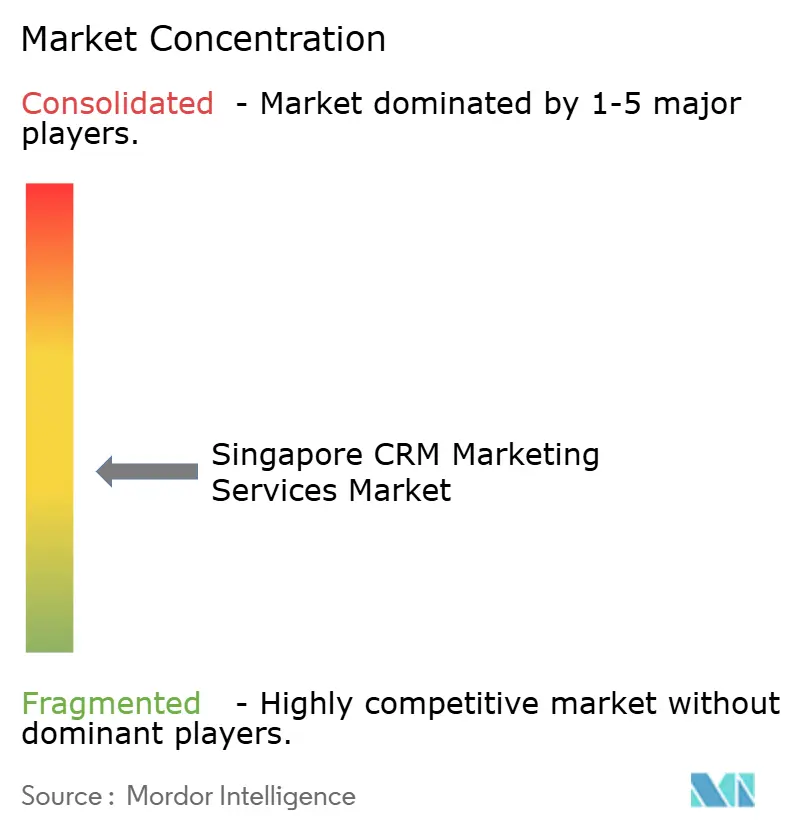
The Singapore CRM marketing services market shows moderate concentration at the platform layer and wider fragmentation across service delivery. Global vendors such as Salesforce, Microsoft, Oracle, SAP, HubSpot, and Zoho remain strong in enterprise accounts because they offer broad product suites and deeper AI integration paths. At the same time, regional integrators and boutique specialists remain relevant because many clients want faster customization, local compliance support, and a more practical omnichannel setup. This balance keeps the Singapore CRM marketing services market competitive without making it structurally concentrated around only 1 or 2 providers.
Salesforce continued to deepen its position through ecosystem expansion, product releases, and on-the-ground investment in Singapore. Its June 2026 Summer ’26 release added multi-agent orchestration, real-time data activation, and stronger AI-led engagement tools, which extended the practical scope of platform-a led service work. Oracle took a similar enterprise-first approach in April 2026, launching Fusion Agentic Applications for Customer Experience across sales, service, and marketing workflows.[4] HubSpot also expanded its addressable footprint with its Spring 2026 Spotlight updates, which included Smart Deal Progression, automated ticket resolution, and Answer Engine Optimization. These moves matter because they expand the set of services partners can sell alongside the core platforms, from onboarding and migration to optimization and ongoing campaign operations. They also raise the bar for smaller providers in the Singapore CRM marketing services market.
White-space opportunity is strongest in SME and micro-enterprise accounts, where cost, simplicity, and local channel behavior matter more than full enterprise stack depth. Providers that can deliver PDPA-aware, WhatsApp-native, and e-commerce-linked service models are better placed to win these customers than vendors that rely on complex default configurations. Freshworks added another competitive signal in 2026 through its AI Agent Studio, MCP Gateway, and growing enterprise contract momentum, indicating that AI-led workflow tooling was becoming central to platform differentiation. Monday.com also raised its profile in the city-state by expanding Singapore’s role as a regional headquarters location for Southeast Asia. Taken together, these moves show that the Singapore CRM marketing services market is competitive not only on software capability, but also on delivery fit, ecosystem depth, and regional execution relevance.
Singapore CRM Marketing Services Industry Leaders
-
Salesforce, Inc.
-
Microsoft Corporation
-
Oracle Corporation
-
SAP SE
-
Adobe Inc.
- *Disclaimer: Major Players sorted in no particular order
Recent Industry Developments
- July 2026: OCBC launched its AI avatar-powered WoW wealth management application and announced plans to spend more than SGD 1 billion (USD 771 million) annually on AI, digital, and data initiatives under its Next Frontier Strategy. The launch signaled faster integration of AI-driven personalization into Singapore’s BFSI CRM infrastructure, with the bank also planning to recruit 600 additional relationship managers over the next 3 years to complement AI-augmented client engagement.
- June 2026: Salesforce opened its AI Innovation Hub at its Singapore office, providing co-innovation space for customers and partners to deploy, test, and iterate on Agentforce deployments, and announced Data and AI Centers of Excellence in partnership with Accenture, PwC Singapore, and Huron, with plans to extend these centers to Thailand, the Philippines, and Indonesia before year-end. The hub operationalized Salesforce’s investment commitment in Singapore and positioned the city-state as the regional activation center for agentic CRM rollouts across ASEAN.
- June 2026: monday.com announced Singapore as its second Asia Pacific headquarters alongside reporting 23% year-on-year customer growth across Southeast Asia, reaching more than 4,700 customers in the region and over 1,000 in Singapore. The designation elevated the importance of the Singapore office, which had opened in October 2025, and signaled the platform’s commitment to using Singapore as the commercial anchor for ASEAN expansion.
- April 2026: Oracle launched Fusion Agentic Applications for Customer Experience, deploying coordinated teams of specialized AI agents engineered for proactive, reasoning-based execution across sales, service, and marketing processes within Oracle Fusion Cloud Applications. The launch directly challenged Salesforce’s Agentforce position in the enterprise CRM segment and expanded Oracle’s competitive surface area in Singapore’s BFSI and government verticals.
Singapore CRM Marketing Services Market Report Scope
The Singapore CRM Marketing Services Market comprises consulting, implementation, managed, and optimization services that help organizations leverage customer relationship management (CRM) platforms to enhance customer engagement, marketing effectiveness, and customer lifecycle management. These services include campaign management, marketing automation, customer analytics, omnichannel engagement, and personalization initiatives. Singapore’s advanced digital infrastructure, strong adoption of cloud technologies, and rising demand for data-driven customer experience strategies drive the market. These services enable organizations to improve customer acquisition, retention, and long-term relationship value.
The Singapore CRM Marketing Services Market Report is Segmented by Service Type (CRM Strategy and Consulting, CRM Implementation and Integration, CRM Migration and Modernization, CRM Managed Services, and CRM Training and Support), Enterprise Size (Large Enterprises, and Small and Medium Enterprises), Service Application (Customer Acquisition, Customer Retention and Loyalty, Campaign Management Services, Marketing Automation Services, Customer Analytics and Insights, Omnichannel Customer Engagement, and Personalization Services), and End-user Industry (Banking, Financial Services, and Insurance (BFSI), Healthcare and Life Sciences, Information Technology and Telecom, Retail and E-commerce, Industrial Manufacturing, Government and Public Administration, and Other End-user Industries). The Market Forecasts are Provided in Terms of Value (USD).
| CRM Strategy and Consulting |
| CRM Implementation and Integration |
| CRM Migration and Modernization |
| CRM Managed Services |
| CRM Training and Support |
| Large Enterprises |
| Small and Medium Enterprises |
| Customer Acquisition |
| Customer Retention and Loyalty |
| Campaign Management Services |
| Marketing Automation Services |
| Customer Analytics and Insights |
| Omnichannel Customer Engagement |
| Personalization Services |
| Banking, Financial Services, and Insurance (BFSI) |
| Healthcare and Life Sciences |
| Information Technology and Telecom |
| Retail and E-commerce |
| Industrial Manufacturing |
| Government and Public Administration |
| Other End-user Industries |
| By Service Type | CRM Strategy and Consulting |
| CRM Implementation and Integration | |
| CRM Migration and Modernization | |
| CRM Managed Services | |
| CRM Training and Support | |
| By Enterprise Size | Large Enterprises |
| Small and Medium Enterprises | |
| By Service Application | Customer Acquisition |
| Customer Retention and Loyalty | |
| Campaign Management Services | |
| Marketing Automation Services | |
| Customer Analytics and Insights | |
| Omnichannel Customer Engagement | |
| Personalization Services | |
| By End-user Industry | Banking, Financial Services, and Insurance (BFSI) |
| Healthcare and Life Sciences | |
| Information Technology and Telecom | |
| Retail and E-commerce | |
| Industrial Manufacturing | |
| Government and Public Administration | |
| Other End-user Industries |
Key Questions Answered in the Report
What is the 2026 value of Singapore CRM marketing services?
The Singapore CRM marketing services market was estimated at USD 225.77 million in 2026 and is forecast to reach USD 457.66 million by 2031, growing at a 15.18% CAGR.
Which service type leads current revenue in Singapore?
CRM Implementation and Integration led in 2025 with a 58.18% revenue share, reflecting continued platform rollout and system unification work across enterprises.
Which service type is growing the fastest through 2031?
CRM Managed Services is projected to record the fastest growth at a 17.36% CAGR as clients move toward recurring support and optimization models.
Why is personalization becoming more important for buyers?
Many firms still struggle with siloed data and generic campaigns, so they are turning to outside providers for data unification, campaign logic, and AI-led customer engagement.
Which end-user sector contributes the most revenue today?
BFSI led end-user demand in 2025 with a 33.12% revenue share, supported by stronger budgets and clearer AI return benchmarks than most other sectors.
Which customer group offers the strongest growth opportunity?
SMEs are projected to grow at a 17.71% CAGR through 2031 because many still need practical, vendor-led CRM deployment and managed support.