
Malaysia CRM Marketing Services Market Size and Share
Market Overview
| Study Period | 2020 - 2031 |
|---|---|
| Forecast Data Period | 2026 - 2031 |
| Base Year Market Size (2025) | USD 129.10 Million |
| Market Size (2026) | USD 150.57 Million |
| Market Size (2031) | USD 329.26 Million |
| Growth Rate (2026 - 2031) | 16.94 % |
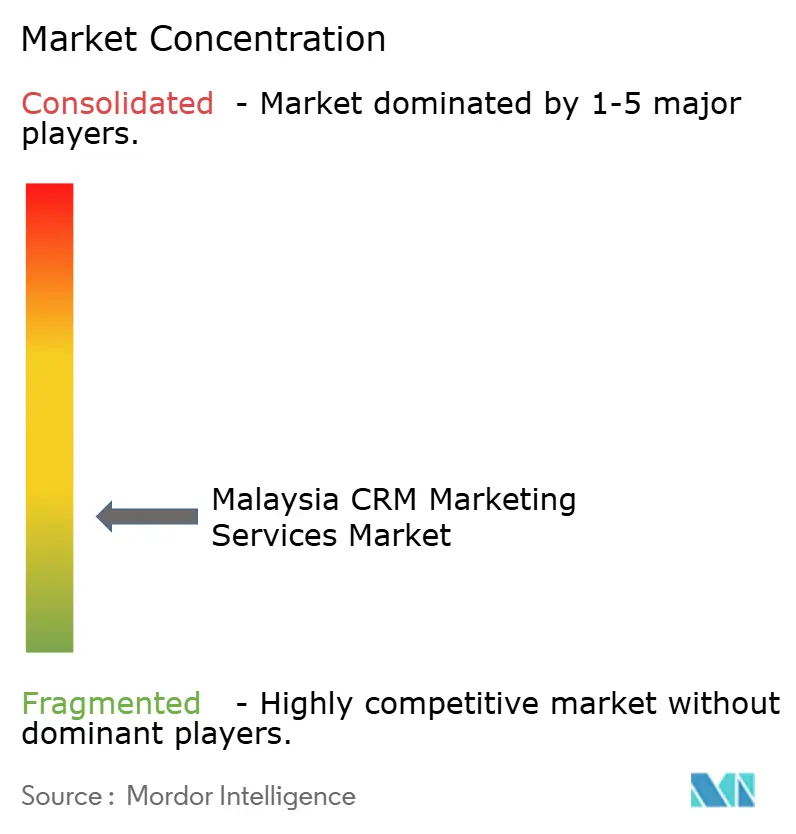
| Market Concentration | Low |
Major Players *Disclaimer: Major Players sorted in no particular order Image © Mordor Intelligence. Reuse requires attribution under CC BY 4.0. | |
Malaysia CRM Marketing Services Market Analysis by Mordor Intelligence
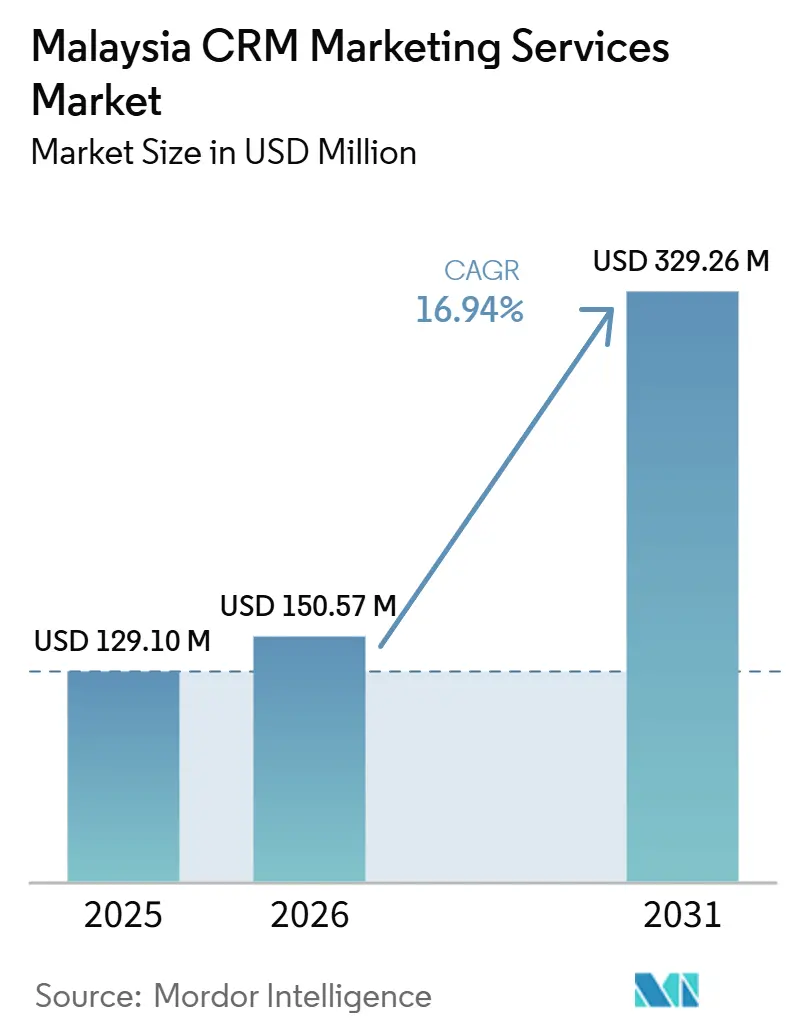
The Malaysia CRM marketing services market size is projected to expand from USD 129.10 million in 2025 and USD 150.57 million in 2026 to USD 329.26 million by 2031, registering a CAGR of 16.94% between 2026 to 2031. The market is moving beyond software deployment because customer data management now sits closer to revenue generation, retention planning, and service delivery decisions across Malaysian enterprises. Full PDPA enforcement in 2025 pushed companies to rebuild consent, governance, and customer data processes, which increased demand for implementation, advisory, and ongoing support services. Mobile-led engagement, especially through WhatsApp, also shifted campaign design away from email-led workflows toward conversational, localized CRM execution. Large enterprises still anchor spending because they carry wider compliance exposure and more complex deployments, while SMEs are entering faster as digital grants and lower-cost service models reduce adoption barriers. Demand remains centered in the Klang Valley and other major commercial corridors, and the mix of global platforms, regional specialists, and local firms keeps the Malaysia CRM marketing services market active across enterprise, retail, financial services, and public sector opportunities.
Key Report Takeaways
- By service type, CRM implementation and integration held 57.19% of the Malaysia CRM marketing services market share in 2025, while CRM managed services is projected to expand at a 18.87% CAGR through 2031.
- By enterprise size, large enterprises held 67.98% of the Malaysia CRM marketing services market share in 2025, while SMEs are projected to expand at a 19.34% CAGR through 2031.
- By service application, customer acquisition accounted for 33.29% of the Malaysia CRM marketing services market share in 2025, while personalization services are projected to expand at a 18.05% CAGR through 2031.
- By end-user industry, BFSI held 32.81% of the Malaysia CRM marketing services market share in 2025, while retail and e-commerce are projected to expand at a 18.42% CAGR through 2031.
Note: Market size and forecast figures in this report are generated using Mordor Intelligence’s proprietary estimation framework, updated with the latest available data and insights as of January 2026.
Malaysia CRM Marketing Services Market Trends and Insights
Drivers Impact Analysis*
| Driver | (~) % Impact on CAGR Forecast | Geographic Relevance | Impact Timeline |
|---|---|---|---|
| Rising First-Party Data Prioritization After Cookie Restrictions | +3.2% | National, with concentrated impact in Klang Valley, Penang, and Johor digital corridors | Medium term (2-4 years) |
| WhatsApp-First and Mobile-First Customer Engagement Models | +2.8% | National, with adoption strongest among SMEs in Klang Valley, Penang, and Johor Bahru | Short term (≤ 2 years) |
| SME Digitalization Grants and Subsidized SaaS Adoption | +2.3% | National, with early gains in Kuala Lumpur, Selangor, and Penang, with spillover to East Malaysia | Short term (≤ 2 years) to Medium term (2-4 years) |
| AI-Assisted Campaign Orchestration and Lead Scoring | +2.2% | Primarily Klang Valley across BFSI, IT, and telecom, with spillover to Penang and Johor manufacturing hubs | Medium term (2-4 years) |
| Omnichannel Retention Demand across Retail, BFSI, and Services | +1.9% | National, with stronger pull in retail hubs and BFSI corridors | Medium term (2-4 years) |
| Cross-Platform Integration with E-Commerce, ERP, and E-Invoicing Stacks | +1.5% | National, with phased enterprise-to-SME relevance | Short term (≤ 2 years) to Medium term (2-4 years) |
| Source: Mordor Intelligence | |||
Rising First-Party Data Prioritization After Cookie Restrictions
A decisive move toward first-party data is shaping the Malaysia CRM marketing services market as third-party tracking becomes less dependable. Malaysia’s Personal Data Protection Amendment Act 2024 was implemented in stages from January to June 2025 and introduced data portability rights, mandatory breach notification, and a risk-based approach to cross-border transfers. That shift made consent design, customer data pipelines, and compliant segmentation tools more central to CRM projects in the Malaysia CRM marketing services market. Companies that once relied on external audience pools now need internal customer records to support targeting, measurement, and retention without weak consent practices. Star Media Group’s selection of Antsomi CDP 365 in March 2025 showed how enterprises were already moving to unify first-party data across publishing, radio, and events operations. The result is a market where compliance raises delivery complexity, but it also turns data governance into a recurring revenue stream for service providers.
WhatsApp-First And Mobile-First Customer Engagement Models
The Malaysia CRM marketing services market is also being redirected by messaging-led customer engagement. The Malaysian Communications and Multimedia Commission reported in 2025 that more than 97% of internet users in the country accessed the internet via mobile devices, further reinforcing the case for mobile-first CRM design. In practice, that behavior makes WhatsApp and related chat tools more important than standard email sequences for many local campaigns in the Malaysia CRM marketing services market. Service providers now need to build workflows for chat triggers, template approvals, multilingual messaging, and real-time customer responses. This has given local firms an advantage, as buyers increasingly want Bahasa Malaysia, English, and Mandarin support built into campaign execution, training, and follow-up processes. It also changes the value of CRM services, because implementation quality now depends on how well the platform supports conversational outreach rather than only how well it stores contacts.
SME Digitalization Grants and Subsidized SaaS Adoption
Government support is opening a faster growth lane for SMEs in the Malaysia CRM marketing services market. Under the Geran Digital PMKS Madani program in 2025, eligible enterprises could receive a 50% matching grant for digital tools, including CRM systems, digital marketing, and e-invoicing solutions.[1] That grant structure reduced the upfront cost barrier and helped smaller firms treat CRM adoption as an achievable operating investment instead of a deferred technology project. It also created a competitive filter inside the Malaysia CRM marketing services market, because providers with MDEC partner status, recognized certifications, and local training support became easier for SMEs to select. The program encouraged service bundles that combine deployment, training, compliance setup, and WhatsApp integration rather than stand-alone software sales. This is why SME demand is expanding faster than the broader market, even though large enterprises still account for most spending today.
AI-Assisted Campaign Orchestration and Lead Scoring
AI adoption is changing buyer expectations in the Malaysia CRM marketing services market from simple automation toward guided decision support. In October 2025, MoneyX and Mandrill Tech launched Net7, described as Malaysia’s first AI-powered Smart CRM, with functions that convert business card data into searchable intelligence and cut manual data entry by up to 99%. In April 2026, Malaysia’s Ministry of Digital and Microsoft launched Microsoft Elevate, a program that followed a pilot phase that had already reached 80,000 learners, while earlier initiatives had upskilled 1.53 million Malaysians in cloud, AI, and cybersecurity capabilities. These developments matter because they expand the pool of buyers who can assess AI-enabled CRM tools and ask more from implementation partners. The Malaysia CRM marketing services market is therefore shifting toward providers that can configure reporting automation, lead scoring, workflow recommendations, and service copilots in practical business settings. AI capability is no longer just a premium add-on, as buyers increasingly view it as part of the core platform value and long-term service quality.
Restraints Impact Analysis*
| Restraint | (~) % Impact on CAGR Forecast | Geographic Relevance | Impact Timeline |
|---|---|---|---|
| PDPA Compliance Burden and Consent Management Complexity | -1.4% | National, with concentrated impact in financial services and healthcare sectors in Klang Valley | Short term (≤ 2 years) to Medium term (2-4 years) |
| Fragmented MarTech and CRM Stack Integration | -1.1% | National, with highest severity in mid-market enterprises across retail, manufacturing, and IT and telecom sectors | Medium term (2-4 years) |
| Shortage Of CRM Implementation and Automation Talent | -0.9% | National, with the shortfall most acute in Klang Valley and Penang | Long term (≥ 4 years) |
| Budget Sensitivity and Slow ROI Recognition Among SMEs | -0.7% | National, particularly in East Malaysia and smaller urban markets outside Klang Valley | Short term (≤ 2 years) to Medium term (2-4 years) |
| Source: Mordor Intelligence | |||
PDPA Compliance Burden and Consent Management Complexity
PDPA enforcement has strengthened the long-term case for CRM investment, but it has also slowed parts of the Malaysia CRM marketing services market. Penalties for breaches of core data protection principles increased, and imprisonment terms rose from 2 to 3 years, making weak compliance a material legal risk. From June 2025, organizations were also required to appoint at least 1 Data Protection Officer and maintain more formal records for cross-border transfers and breach handling. That raised the service scope of many projects in the Malaysia CRM marketing services market, because buyers now expect consent configuration, governance support, audit readiness, and transfer documentation within the delivery model. SMEs are more exposed to the drag, since many do not have internal legal, privacy, or data governance teams to share this work. Providers, therefore, face margin pressure when compliance support expands faster than the original pricing structure allows.
Fragmented MarTech and CRM Stack Integration
Technology fragmentation is another brake on the Malaysia CRM marketing services market, especially for firms that already use several business platforms. Many Malaysian enterprises operate with disconnected CRM systems, e-commerce tools, ERP platforms, and marketing applications, which extend project timelines when data must move across multiple layers. CPA Australia’s 2025 Business Technology Survey for Malaysia identified limited understanding of technology at the board and senior management levels, along with insufficient staff training, as major obstacles to stronger technology uptake. Those capability gaps matter because the Malaysia CRM marketing services market depends on coordinated buying decisions, clear process ownership, and realistic rollout planning. When that alignment is missing, integrations take longer, adoption slows, and buyers delay moving into analytics, managed services, or advanced personalization. This does not remove demand, but it does push value realization further out and reduces the pace of expansion in parts of the market.
*Our forecasts treat driver/restraint impacts as directional, not additive. The impact forecasts reflect baseline growth, mix effects, and variable interactions.
Segment Analysis
By Service Type: Managed Services Become the Main Recurring Revenue Layer
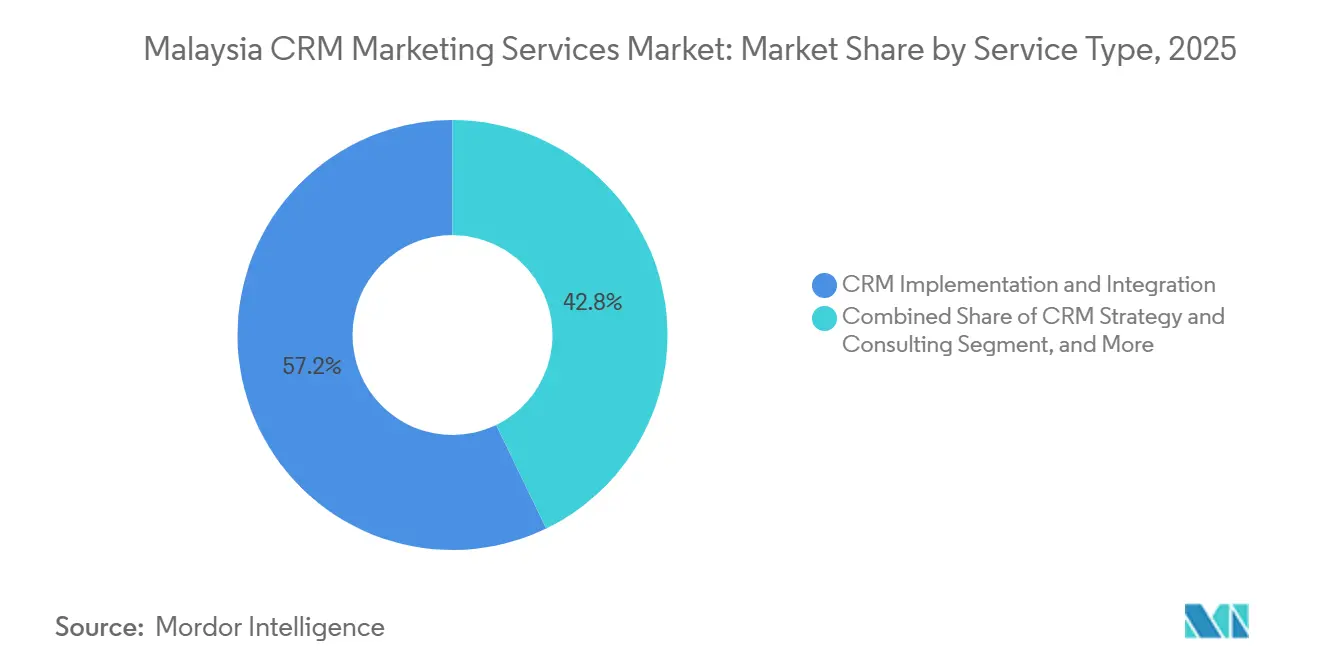
CRM implementation and integration led with 57.19% of the Malaysia CRM marketing services market share in 2025, which showed that core deployment work still anchored demand. That position reflected the fact that many organizations were either launching CRM programs for the first time or consolidating older systems into more unified environments. The Malaysia CRM marketing services market still carries an early-to-mid maturity profile when compared with more saturated parts of Asia Pacific, so first-wave deployment demand remains strong. Migration and modernization work also expanded as companies moved away from legacy or limited SaaS versions and toward cloud-ready setups that support faster analytics and stronger governance. Strategy and consulting remained relevant because many buyers needed help connecting CRM spending to acquisition, retention, service quality, and internal reporting needs.
Managed services are projected to grow at a 18.87% CAGR through 2031, making it the fastest-expanding service type in the Malaysia CRM marketing services market. This shift reflects the gap between what enterprises want from CRM optimization and what many internal teams can sustain after go-live. Buyers increasingly prefer subscription-style support that covers platform administration, campaign execution, reporting, and ongoing performance monitoring. That model also fits the talent shortage inside the Malaysia CRM marketing services industry, because clients can access specialized skills without building full in-house teams. For providers, the move from project work to recurring support improves revenue visibility and deepens client retention across the Malaysia CRM marketing services market.

By Enterprise Size: SMEs Accelerate Adoption While Large Enterprises Retain Scale
Large enterprises held 67.98% share of the Malaysia CRM marketing services market size in 2025, which confirmed that major banks, telecom operators, retail groups, and diversified corporations still account for most contract value. Their projects are larger because they often involve multiple divisions, tighter governance, more integrations, and higher compliance exposure. This part of the Malaysia CRM marketing services market also favors vendors that can manage long implementation cycles and enterprise-level service architecture. Maybank’s August 2025 strategic partnership with Microsoft showed the scale at which top-tier financial institutions are committing to cloud, AI, and customer experience capabilities. Enterprise demand, therefore, remains tied not only to software selection but also to transformation programs that span analytics, productivity, service responsiveness, and personalized customer engagement.
SMEs are projected to grow at a 19.34% CAGR through 2031, which makes them the fastest-growing enterprise cohort in the Malaysia CRM marketing services market. The strongest enabler remains the grant-backed adoption model, as co-funding lowered entry costs for smaller firms that had previously delayed CRM spending. Local platforms also gained favor when they offered WhatsApp integration, local tax alignment, practical onboarding, and multilingual support at a lower total cost. This part of the Malaysia CRM marketing services industry is becoming more structured as buyers seek bundles that combine software access, setup, training, and campaign execution. The result is a more active SME layer that complements enterprise demand rather than replacing it.
By Service Application: Personalization Gains Ground as Efficiency Pressures Rise
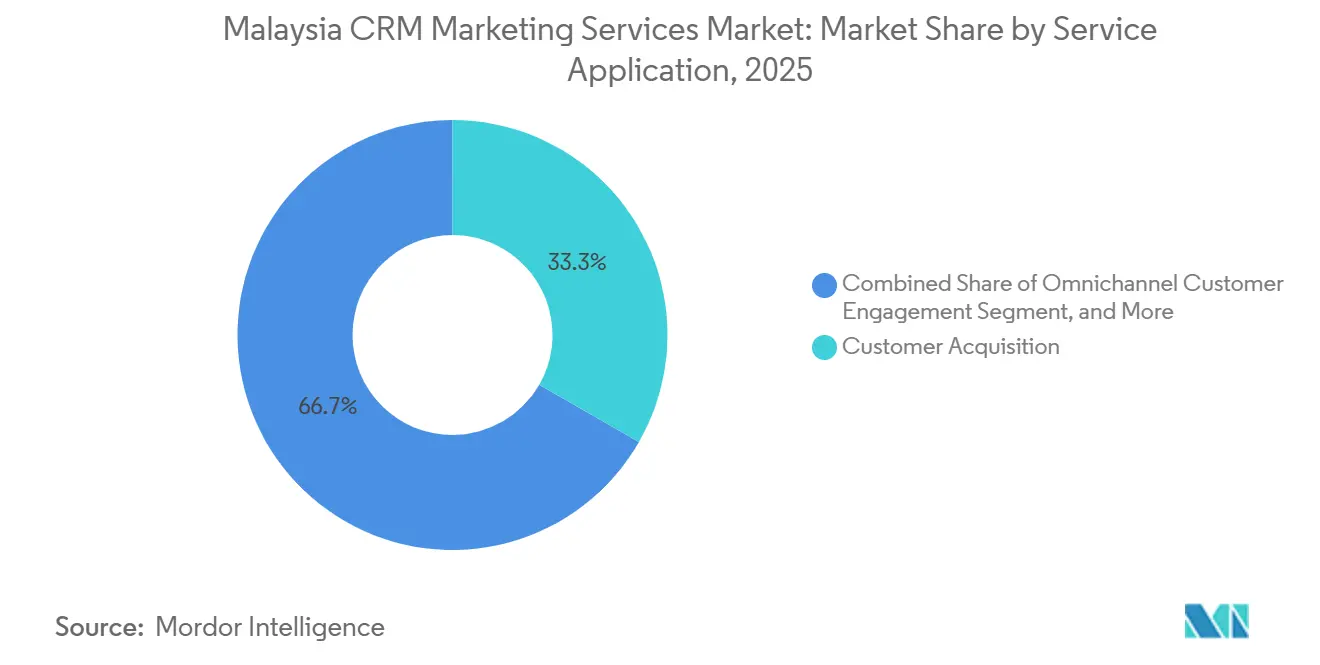
Customer acquisition accounted for 33.29% of the Malaysia CRM marketing services market in 2025, making it the largest application category. That leadership came from sectors where sales pipelines remain highly competitive, including BFSI, retail, and IT and telecom. In these settings, organizations continued to use CRM services to support lead scoring, nurture flows, targeted campaigns, and conversion tracking. Campaign management and marketing automation also remained important because companies wanted better control over message timing, audience routing, and channel coordination across mobile, email, and social touchpoints. The Malaysia CRM marketing services market therefore still gives a large share of application demand to front-end revenue generation tasks.
Personalization services are projected to grow at a 18.05% CAGR through 2031, which gives it the strongest application momentum in the Malaysia CRM marketing services market. This reflects the wider availability of AI tools, stronger first-party data practices, and the need for more relevant customer interactions across channels. Antsomi reported in July 2025 that ZUS Coffee used Antsomi CDP 365 across more than 700 Malaysian stores to support hyper-personalized customer engagement, demonstrating that personalization is becoming an operational standard rather than a niche feature. Customer retention and loyalty work also sit close to this growth path, because rising acquisition costs push brands toward repeat purchase, loyalty tiers, and churn prevention. The Malaysia CRM marketing services market is therefore seeing application demand shift from broad outreach toward deeper use of customer context and ongoing engagement.
By End-User Industry: BFSI Leads Spending While Retail and E-Commerce Move Faster
BFSI held 32.81% of the Malaysia CRM marketing services market share in 2025, which kept it as the largest end-user vertical. The sector combines regulatory pressure, strong budgets, high customer data intensity, and a clear need for service personalization, making it a natural anchor for CRM spending. In November 2025, Alliance Bank launched an AI-powered retail loan origination system with CTOS Data Systems and JurisTech, and the rollout included AI support for documentation, adaptive credit assessments, and more personalized customer journeys. Persistent Systems also reported in 2025 that Malaysia’s first digital bank improved call center efficiency by 40% through a Microsoft Dynamics 365 implementation that gave service agents real-time customer views. That pattern shows how BFSI use cases in the Malaysia CRM marketing services market increasingly sit at the overlap of compliance, service speed, and customer-level decision support.
Retail and e-commerce are projected to grow at a 18.42% CAGR through 2031, making it the fastest-growing end-user segment in the Malaysia CRM marketing services market. The growth is tied to social commerce expansion, the use of loyalty program data, and the need to connect cart activity, channel behavior, and repeat purchase flows within a single customer view. This vertical also benefits more than many others from messaging-led outreach, as retail brands need fast campaign execution, product reminders, and re-engagement sequences that align with mobile behavior.[2] Retail buyers are also more likely to look for CRM services that combine commerce data, promotion triggers, and customer lifecycle management rather than stand-alone contact management. That is why retail is redefining scope in the Malaysia CRM marketing services market even while BFSI still holds the largest revenue base.
Geography Analysis
The Malaysia CRM marketing services market was geographically concentrated in the greater Kuala Lumpur region and the broader Klang Valley corridor in 2025, with these areas accounting for the majority of service revenue. This position reflects the concentration of financial institutions, technology offices, large retail groups, and corporate headquarters in and around Kuala Lumpur. The area also remains the main center for enterprise-scale CRM decision making, especially in banking, telecommunications, healthcare, and organized retail. Maybank’s strategic Microsoft partnership, AFFIN Group’s AI-led banking direction, and Ryt Bank’s agentic AI deployment all pointed to a strong concentration of CRM-related transformation programs around the Klang Valley decision base.[3] As enterprises continue to prioritize customer engagement and data-driven marketing, the Klang Valley is likely to remain the key hub for CRM marketing services in Malaysia.
Penang stands as the second key corridor in the Malaysia CRM marketing services market because it combines an industrial base with a growing business process outsourcing and services layer. Manufacturing-linked CRM adoption is broadening from sales support into customer engagement, supply chain communication, and account management across more touchpoints. ManpowerGroup’s March 2026 BPO talent snapshot identified CRM platforms as a critical technical skill in Malaysia’s BPO workforce, reinforcing the roles of Penang and Kuala Lumpur as important talent pools for ongoing delivery. Johor is also gaining weight as Singapore-linked enterprise activity, digital banking interest, logistics investment, and cross-border business expansion create fresh deployment opportunities. The Malaysia CRM marketing services market is therefore no longer defined only by Kuala Lumpur, even though the Klang Valley still shapes the highest-value enterprise buying patterns.
East Malaysia remains at an earlier stage, but it is strategically relevant because digital inclusion programs and connectivity upgrades are expanding the future customer base for CRM and digital marketing services. That matters for providers that want to serve SMEs with standardized offerings rather than rely only on a narrow enterprise client pool. The Malaysia CRM marketing services market can therefore expand geographically through packaged, lower-friction deployments that fit regional buyers outside the main peninsular corridors. This creates room for local support networks, multilingual service delivery, and more practical onboarding models as demand spreads beyond the largest commercial centers.
Competitive Landscape
The Malaysia CRM marketing services market remains moderately fragmented, with global software brands, regional implementation firms, and local service specialists competing across different buyer groups. Salesforce, Microsoft, Oracle, SAP, HubSpot, Zoho, Freshworks, and Adobe retain strong standing with enterprise buyers because they bring recognized platforms, broad integration ecosystems, and deeper AI tooling. In January 2026, Salesforce expanded its Startup Program into Malaysia, giving startups access to Agentforce products, mentorship, and AppExchange support, and demonstrating a partner-led ecosystem strategy rather than a purely direct sales push.[4] Microsoft also strengthened its presence through Dynamics 365 promotions, enterprise partnerships, and national AI-skilling activities that improved local awareness of AI-enabled CRM capabilities.
Local and regional providers still hold strong advantages in the Malaysia CRM marketing services market where execution depends on language support, WhatsApp integration, HRD Corp claimability, tax alignment, e-invoicing readiness, and faster local response. Firms such as KloudConnect and MYSense built positions by focusing on implementation speed, platform adaptation, and buyer needs that global vendors do not always address at the same pace. This is especially relevant in SME and mid-market accounts where buyers want working bundles, clear service ownership, and manageable cost structures. Antsomi’s enterprise wins with Star Media Group and ZUS Coffee also showed how adjacent customer data platform players can move into the Malaysia CRM marketing services market by owning the first-party data layer that supports execution. As a result, competition is not only between software suites, but also depends on who can combine data readiness, campaign execution, and local service depth most effectively.
The white space in the Malaysia CRM marketing services market sits in managed services paired with AI-led analytics and practical outcome-based delivery. Buyers increasingly want partners who can stay involved after implementation and improve performance through reporting, automation, and channel optimization. Regional partner structures are also strengthening, as seen in Salesforce’s May 2026 ASEAN partner awards and planned AI Centers of Excellence with selected partners, which may raise the quality threshold for larger enterprise projects. That raises pressure on smaller firms, but it also confirms that the Malaysia CRM marketing services market still has room for specialists that can localize quickly and deliver measurable client outcomes.
Malaysia CRM Marketing Services Industry Leaders
-
SAP SE
-
Adobe Inc.
-
Microsoft Corporation
-
Oracle Corporation
-
Salesforce, Inc.
- *Disclaimer: Major Players sorted in no particular order
Recent Industry Developments
- June 2026: The Malaysian government launched the Malaysia Digital 2030 blueprint, setting a national target for the digital economy to contribute 30% of GDP, create 500,000 high-value jobs, and deliver significant savings in the public sector through digitalization by 2030. The plan positioned AI-powered enterprise adoption, including CRM and customer engagement platforms, as a key pillar of national competitiveness.
- April 2026: Malaysia’s Ministry of Digital and Microsoft launched Microsoft Elevate, an expanded national AI capacity-building initiative aligned with the AI Nation 2030 ambition. The program targeted educators, MSMEs, civil servants, and TVET institutions. The pilot phase, launched in January 2026, reached 80,000 learners and built on prior programs that had cumulatively upskilled 1.53 million Malaysians in cloud, AI, and cybersecurity capabilities.
- January 2026: Salesforce expanded its Startup Program into Malaysia and the Philippines, providing Malaysian startups with access to AI-powered Agentforce products, mentorship programs, and AppExchange marketplace go-to-market opportunities. The program became active in 5 markets, India, Malaysia, Philippines, Singapore, and Sri Lanka, and supported more than 435 startups, including more than 230 AI-first companies.
- November 2025: Alliance Bank Malaysia, in partnership with CTOS Data Systems and JurisTech, launched an AI-powered Retail Loan Origination System that integrated generative AI co-pilot assistance for credit documentation, adaptive credit assessments, and personalized customer journeys. Plans were underway to integrate JurisAI for end-to-end AI-driven customer lifecycle management.
Malaysia CRM Marketing Services Market Report Scope
The Malaysia CRM Marketing Services Market comprises services that help enterprises deploy, manage, and optimize customer relationship management (CRM) technologies for marketing and customer engagement initiatives. These services include CRM consulting, integration, migration, managed services, campaign management, and marketing automation. Increasing enterprise digitalization, growing investment in customer experience technologies, and rising demand for personalized engagement benefit the market. These services enable organizations to strengthen customer relationships and improve marketing effectiveness across multiple channels.
The Malaysia CRM Marketing Services Market Report is Segmented by Service Type (CRM Strategy and Consulting, CRM Implementation and Integration, CRM Migration and Modernization, CRM Managed Services, and CRM Training and Support), Enterprise Size (Large Enterprises, and Small and Medium Enterprises), Service Application (Customer Acquisition, Customer Retention and Loyalty, Campaign Management Services, Marketing Automation Services, Customer Analytics and Insights, Omnichannel Customer Engagement, and Personalization Services), and End-user Industry (Banking, Financial Services, and Insurance (BFSI), Healthcare and Life Sciences, Information Technology and Telecom, Retail and E-commerce, Industrial Manufacturing, Government and Public Administration, and Other End-user Industries). The Market Forecasts are Provided in Terms of Value (USD).
| CRM Strategy and Consulting |
| CRM Implementation and Integration |
| CRM Migration and Modernization |
| CRM Managed Services |
| CRM Training and Support |
| Large Enterprises |
| Small and Medium Enterprises |
| Customer Acquisition |
| Customer Retention and Loyalty |
| Campaign Management Services |
| Marketing Automation Services |
| Customer Analytics and Insights |
| Omnichannel Customer Engagement |
| Personalization Services |
| Banking, Financial Services, and Insurance (BFSI) |
| Healthcare and Life Sciences |
| Information Technology and Telecom |
| Retail and E-commerce |
| Industrial Manufacturing |
| Government and Public Administration |
| Other End-user Industries |
| By Service Type | CRM Strategy and Consulting |
| CRM Implementation and Integration | |
| CRM Migration and Modernization | |
| CRM Managed Services | |
| CRM Training and Support | |
| By Enterprise Size | Large Enterprises |
| Small and Medium Enterprises | |
| By Service Application | Customer Acquisition |
| Customer Retention and Loyalty | |
| Campaign Management Services | |
| Marketing Automation Services | |
| Customer Analytics and Insights | |
| Omnichannel Customer Engagement | |
| Personalization Services | |
| By End-user Industry | Banking, Financial Services, and Insurance (BFSI) |
| Healthcare and Life Sciences | |
| Information Technology and Telecom | |
| Retail and E-commerce | |
| Industrial Manufacturing | |
| Government and Public Administration | |
| Other End-user Industries |
Key Questions Answered in the Report
How large is the Malaysia CRM marketing services market in 2026?
The Malaysia CRM marketing services market is estimated at USD 150.57 million in 2026 and is projected to reach USD 329.26 million by 2031 at a 16.94% CAGR.
What is driving demand for CRM marketing services in Malaysia?
Demand is rising because firms are responding to PDPA compliance, first-party data needs, mobile-led engagement, WhatsApp-based outreach, and stronger interest in AI-enabled workflows.
Which service type leads spending in Malaysia?
CRM implementation and integration led the market in 2025 with a 57.19% share, showing that core deployment and consolidation work still account for the largest revenue pool.
Which customer group is expanding the fastest?
SMEs are the fastest-growing enterprise group, with a projected 19.34% CAGR through 2031, supported by grant-backed adoption and lower-cost local service models.
Which end-user vertical matters most today?
BFSI held the largest end-user share in 2025 at 32.81%, because banks and insurers combine high compliance needs, strong budgets, and heavy customer data use.
Which application area is gaining the most momentum?
Personalization services are projected to grow at a 18.05% CAGR through 2031, as brands move toward more relevant and context-based customer engagement.