
Japan CRM Marketing Services Market Size and Share
Market Overview
| Study Period | 2020 - 2031 |
|---|---|
| Forecast Data Period | 2026 - 2031 |
| Base Year Market Size (2025) | USD 1.43 Billion |
| Market Size (2026) | USD 1.56 Billion |
| Market Size (2031) | USD 2.63 Billion |
| Growth Rate (2026 - 2031) | 11.01 % |
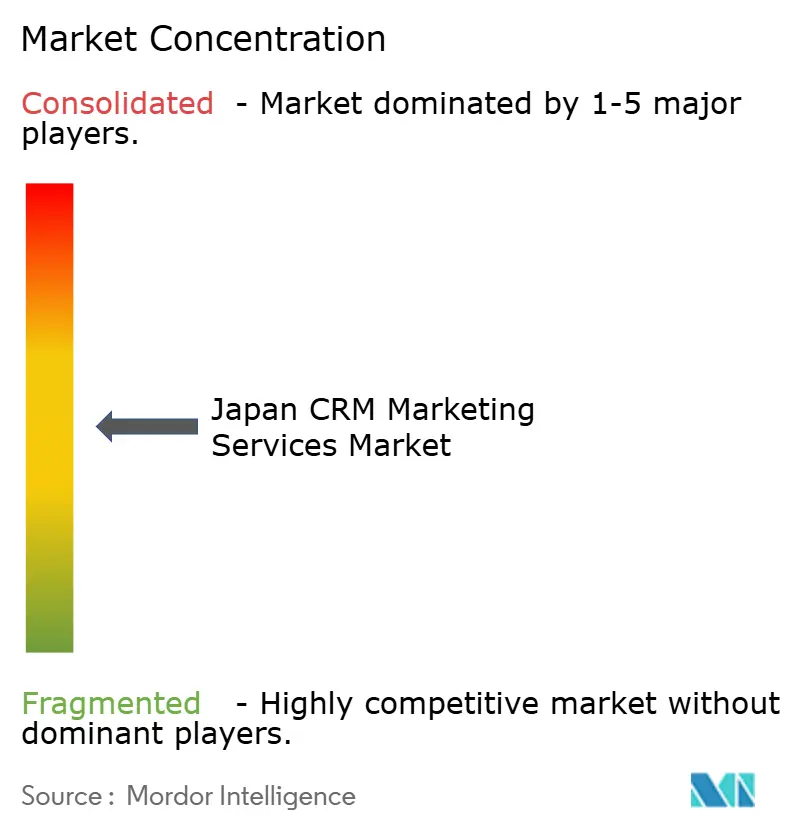
| Market Concentration | Medium |
Major Players *Disclaimer: Major Players sorted in no particular order Image © Mordor Intelligence. Reuse requires attribution under CC BY 4.0. | |
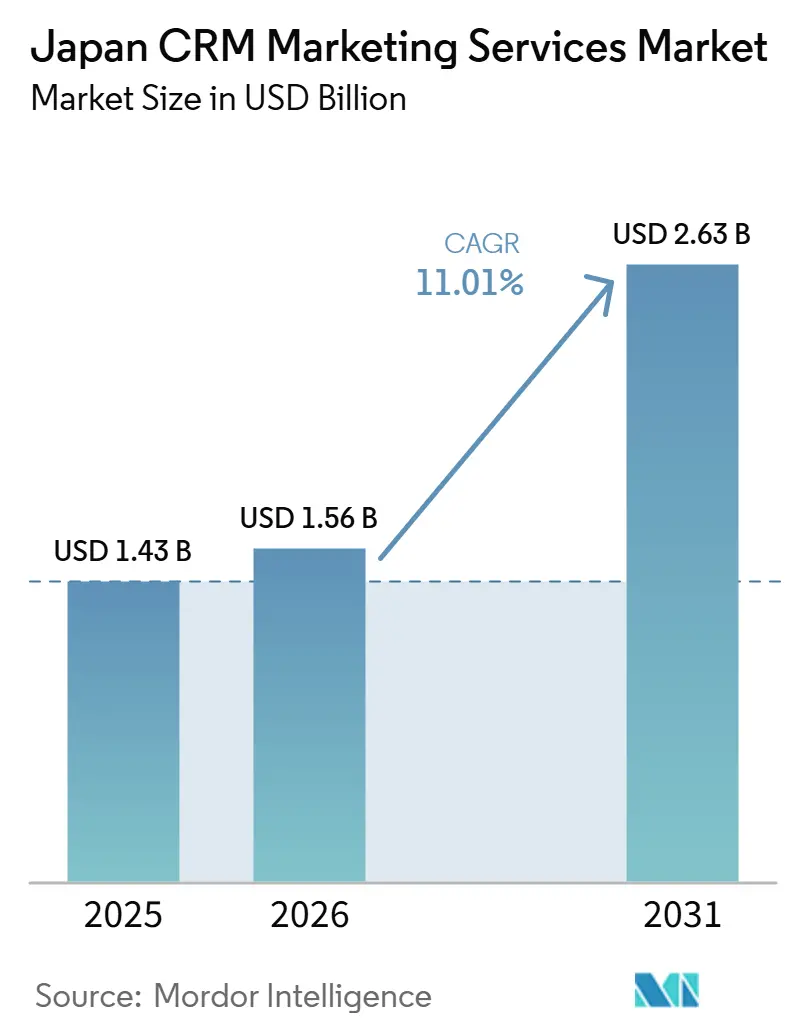
Japan CRM Marketing Services Market Analysis by Mordor Intelligence
The Japan CRM Marketing Services Market size is expected to increase from USD 1.43 billion in 2025 to USD 1.56 billion in 2026 and reach USD 2.63 billion by 2031, growing at a CAGR of 11.01% over 2026-2031. Growth in the Japan CRM Marketing Services Market is being supported by stronger demand for first-party data activation, broader CRM modernization work, and more AI-led personalization programs that require cleaner customer data and tighter system coordination. Large enterprises continue to account for a major share of spending because their legacy systems, multi-channel customer operations, and data governance needs make CRM work more extensive and more service-dependent. The Japan CRM Marketing Services Market is also widening beyond the largest enterprises as smaller firms and regional institutions increasingly rely on outside specialists for implementation, integration, and managed support. Local service providers are benefiting because Japanese-language onboarding, local business-process fit, and sector-specific configurations remain important for actual delivery. Talent shortages and integration friction still slow project timelines, yet those same constraints keep the Japan CRM Marketing Services Market dependent on specialized providers that can manage complex transitions.
Key Report Takeaways
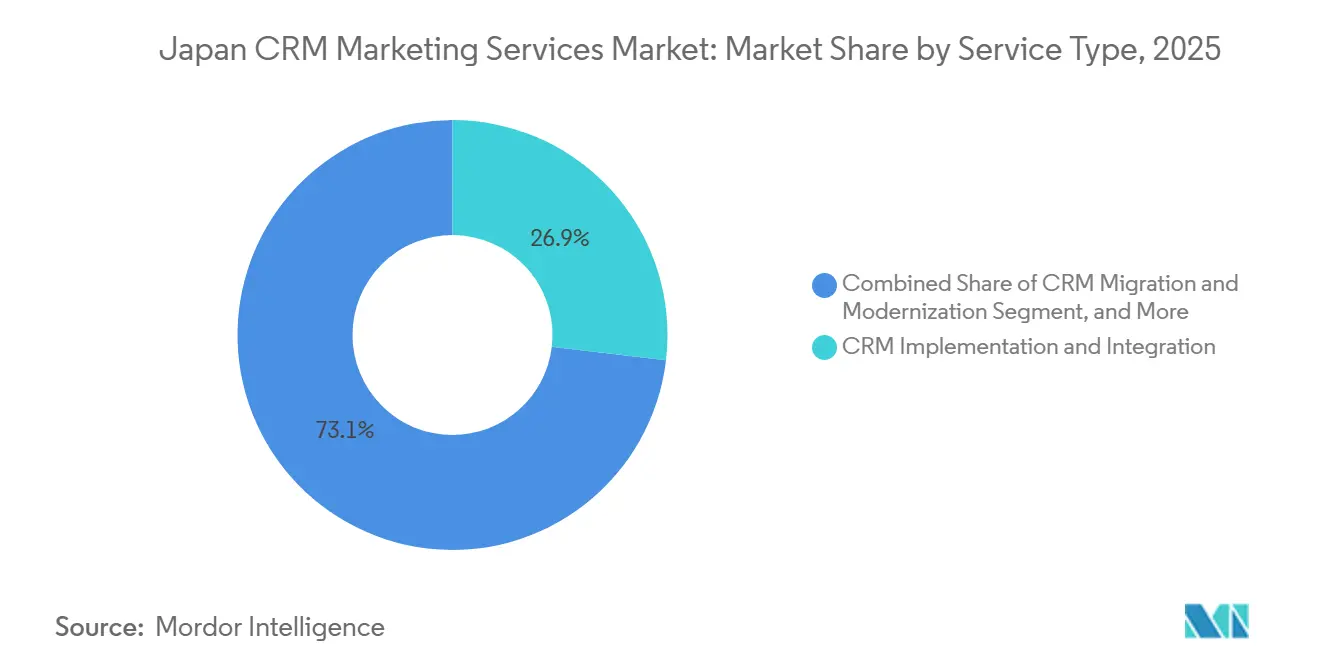
- By service type, CRM Implementation and Integration accounted for 26.87% of revenue in 2025, while CRM Migration and Modernization is projected to expand at a 12.12% CAGR through 2031.
- By enterprise size, large enterprises held 57.91% share in 2025, while small and medium enterprises are expected to record the highest CAGR at 12.23% through 2031.
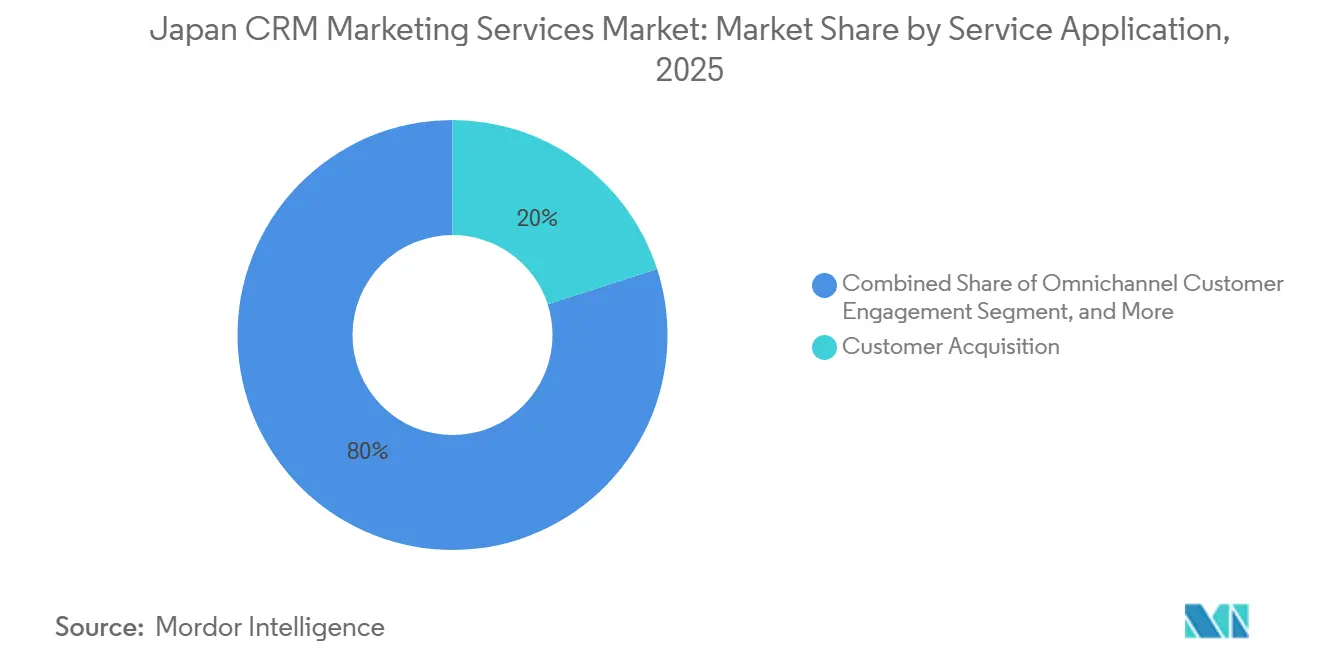
- By service application, Customer Acquisition accounted for 20.04% share in 2025, while Omnichannel Customer Engagement is projected to advance at a 12.34% CAGR through 2031.
- By end-user industry, BFSI held 16.09% share in 2025, while Healthcare and Life Sciences are projected to expand at a 12.45% CAGR through 2031.
Note: Market size and forecast figures in this report are generated using Mordor Intelligence’s proprietary estimation framework, updated with the latest available data and insights as of January 2026.
Japan CRM Marketing Services Market Trends and Insights
Drivers Impact Analysis*
| Driver | (~) % Impact on CAGR Forecast | Geographic Relevance | Impact Timeline |
|---|---|---|---|
| Rising Demand for First-Party Data Activation | +2.3% | National, with strongest concentration in Tokyo, Osaka, and Nagoya enterprise corridors | Short term (≤ 2 years) |
| AI-Enabled Personalization and Journey Orchestration | +2.0% | National, with early adoption concentrated in Kanto and Kansai large enterprises | Medium term (2-4 years) |
| SME Digitization and Outsourced MarTech Adoption | +1.8% | National, with policy-led penetration in regional SME clusters across Hokkaido, Kyushu, and Tohoku | Medium term (2-4 years) |
| Shift From Mass Campaigns to Precision Lifecycle Marketing | +1.5% | National, with strong relevance in BFSI and retail across Tokyo and Osaka | Short term (≤ 2 years) |
| Privacy-Ready Consent Management and Data Governance Needs | +1.1% | National, across all sectors handling consumer data under APPI | Short term (≤ 2 years) to Medium term (2-4 years) |
| Omnichannel Retention Programs in High-Churn Consumer Verticals | +0.9% | National, strongest in retail, telecom, and media | Medium term (2-4 years) |
| Source: Mordor Intelligence | |||
Rising Demand for First-Party Data Activation In Japan
First-party data activation is moving to the center of the Japan CRM Marketing Services Market because firms need stronger control over customer identity, campaign targeting, and performance measurement. That shift is increasing demand for CRM service work that can connect loyalty, telecom, commerce, and service data into usable customer records. NTT Docomo, Intage, and SAIKA began building a marketing platform on the Point Club's single ID infrastructure in December 2025 to measure loyalty formation, from analysis through campaign execution and purchase verification, demonstrating how identity-led marketing is becoming more structured in Japan.[1] Uhuru launched a managed service in April 2026 that combined customer ID management, cross-channel communication design, and AI-driven personalization, underscoring the growing need for hands-on data integration support. In the Japan CRM Marketing Services Market, that combination of owned data, identity resolution, and activation logic is shifting projects away from isolated campaign setups and toward broader customer data architecture work. The result is a steadier pipeline for implementation, migration, and optimization services as enterprises move customer data closer to real-time use.
AI-Enabled Personalization and Journey Orchestration
AI-led personalization is changing the commercial logic of the Japan CRM Marketing Services Market, as the value of CRM systems now depends more directly on how well they support day-to-day decision-making. Salesforce's State of Marketing 2026 reported that teams with fully integrated customer data responded to customers at a rate 42% higher than peers with fragmented data, and they were 60% more likely to use AI agents at scale.[2] Microsoft expanded Dynamics 365 Sales Agent capabilities in its 2026 release wave 1, which signals that CRM tasks are increasingly being redesigned around AI-supported workflows rather than manual execution alone. Uhuru's April 2026 launch also showed that AI-led personalization is packaged with data unification and omnichannel execution as a single managed service rather than a separate add-on. In the Japan CRM Marketing Services Market, this raises the need for service partners that can tune data models, automate journeys, and govern how AI is used across customer touchpoints. It also increases the value of migration and configuration work because poorly integrated systems limit the benefits enterprises can capture from AI-based CRM tools.[3]
SME Digitization and Outsourced MarTech Adoption
SMEs remain one of the least served demand pools in the Japan CRM Marketing Services Market, leaving room for service providers that can offer simpler deployment models and stronger local support. Many smaller firms still need outside help because platform setup, data cleanup, and campaign operations are difficult to manage without dedicated CRM staff. TerraSky and NTT Data established the NTT DATA Salesforce Hub in April 2025 to build a delivery framework targeting 5,000 professionals, reflecting broader CRM implementation demand across the country. Dentsu Soken launched D-NEXUS in February 2026 for regional financial institutions, showing that localized CRM architectures and consulting-led deployment models are becoming more common outside the largest metropolitan accounts. The Japan CRM Marketing Services Market is therefore opening more clearly to providers that can combine regional delivery, Japanese-language support, and more practical onboarding for smaller organizations. This shift matters because incremental wins in SME and regional accounts can broaden the revenue base even when large-enterprise spending remains concentrated.
Shift From Mass Campaigns to Precision Lifecycle Marketing
The Japan CRM Marketing Services Market is moving away from broad campaign execution and toward lifecycle programs built on customer identity, repeat engagement, and measurable outcomes. NTT Docomo, Intage, and SAIKA began developing a platform in December 2025 that uses Point Club's single ID infrastructure to measure loyalty formation by analyzing data, driving campaign execution, and verifying purchase effects. Uhuru's managed offer in April 2026 linked customer ID management, cross-channel communication design, and AI-driven personalization, which shows that campaign work is increasingly tied to unified customer operations rather than stand-alone promotions. Chugai Pharmaceutical adopted Salesforce Sales Cloud, Data Cloud, and Marketing Cloud in July 2025 to build a more flexible and personalized environment for healthcare professional engagement, which points to a similar move toward more tailored communication models. In the Japan CRM Marketing Services Market, this shift increases demand for consulting, integration, and measurement redesign because precision programs depend on unified records and consistent orchestration across channels. It also favors providers that can connect campaign strategy with practical CRM execution instead of treating them as separate workstreams.[4]
Restraints Impact Analysis*
| Restraint | (~) % Impact on CAGR Forecast | Geographic Relevance | Impact Timeline |
|---|---|---|---|
| Skilled CRM Marketing Talent Shortage | -2.3% | National, most acute in non-Tokyo regional markets | Long term (≥ 4 years) |
| Integration Friction Across Legacy CRM, CDP, and MA Stacks | -1.9% | National, heaviest in large enterprises with inherited legacy mainframe systems | Medium term (2-4 years) |
| High Implementation and Ongoing Optimization Costs for SMEs | -1.5% | National, with stronger pressure on SMEs outside major metropolitan areas | Medium term (2-4 years) |
| Tightening Compliance Burden on Data Use and Cross-Channel Tracking | -1.1% | National, across all sectors handling consumer data under APPI | Short term (≤ 2 years) to Medium term (2-4 years) |
| Source: Mordor Intelligence | |||
Skilled CRM Marketing Talent Shortage in Japan
Talent availability remains one of the clearest operating constraints on the Japan CRM Marketing Services Market. The Linux Foundation's 2025 Japan Tech Talent Report found that more than 70% of Japanese organizations were understaffed across key technology functions, including AI, cloud, and platform engineering. The same report stated that onboarding a new technical hire in Japan took 12.7 months on average, while upskilling an existing employee took 5.7 months, underscoring why providers rely heavily on internal training rather than relying solely on external hiring. In the Japan CRM Marketing Services Market, staffing pressure can delay implementation schedules, stretch managed service capacity, and raise billing pressure in specialized roles. It also favors firms with stronger training systems and more reusable delivery frameworks. Even where demand remains solid, a thinner certified talent pool can limit the number of new engagements providers can execute in a given year.
Integration Friction Across Legacy CRM, CDP, and MA Stacks
Integration friction remains a major drag on the Japan CRM Marketing Services Market because many organizations still operate separate systems for customer records, marketing automation, analytics, and service delivery. Microsoft's 2026 CRM roadmap made clear that AI-led sales and service workflows depend on deeper data connectivity inside the operating environment, not just on adding a new front-end feature layer. Uhuru's April 2026 service launch also centered on customer data integration across Salesforce Data Cloud, Marketing Cloud, and Service Cloud, which shows that data unification remains a practical market need rather than a completed task. In the Japan CRM Marketing Services Market, fragmented legacy environments often require more data cleanup, workflow redesign, and governance alignment before customer-facing use cases can scale. That raises the cost and time profile of delivery even when clients are willing to invest. It also means providers can face longer project cycles and lower annual onboarding capacity, as each transformation requires more remediation work before it stabilizes.
*Our forecasts treat driver/restraint impacts as directional, not additive. The impact forecasts reflect baseline growth, mix effects, and variable interactions.
Segment Analysis
By Service Type: Migration Gains Pace As AI-Ready Architecture Becomes A Priority
CRM Implementation and Integration held 26.87% of the Japan CRM Marketing Services market share in 2025, making it the largest service-type segment in the market. This lead reflected the volume of enterprise deployments that continued after the first wave of cloud CRM adoption, as well as the need to connect newer tools with legacy customer records. In the Japan CRM Marketing Services Market, implementation work also remained extensive because organizations often needed workflow redesign, user-role setup, consent handling, and custom integration before platforms could support day-to-day operations. Strategy and consulting continued to matter because large organizations were no longer selecting only a CRM tool; they were deciding how customer data, service processes, and marketing workflows should fit together. Managed services continued to play a meaningful role as well, because many firms still lacked sufficient in-house staff to administer complex CRM environments after go-live.
CRM Migration and Modernization is projected to grow at the fastest rate, at a 12.12% CAGR from 2026 to 2031. That pattern shows that the Japan CRM Marketing Services Market is shifting from first-time deployment work toward re-platforming, cleanup, and architecture redesign for AI-based use cases. Microsoft's 2026 release wave underscored this change by expanding AI-led CRM task execution, which increases pressure on customers to review how older configurations, data flows, and workflow dependencies are structured. Salesforce's 2026 marketing research also showed that integrated customer data is closely tied to faster customer response times and broader AI-agent use, reinforcing the demand for migration work to fix fragmented records before AI is deployed. In the Japan CRM Marketing Services Industry, migration projects are increasingly less about moving data once and more about rebuilding customer architecture so that future orchestration, personalization, and governance can function properly.

By Enterprise Size: Large Accounts Lead Revenue While SME Adoption Broadens Demand
Large enterprises held 57.91% share in 2025, showing how strongly the Japan CRM Marketing Services Market still depended on complex accounts with multi-system customer operations. These organizations continued to spend heavily because they often needed long-duration programs that combined implementation, managed support, data integration, and user training. Large banks, major pharmaceutical companies, and large retail groups also tended to expand their CRM scope over time, which helped preserve revenue concentration even after the initial platform rollout. Chugai Pharmaceutical's 2025 adoption of Salesforce Sales Cloud, Data Cloud, and Marketing Cloud illustrated how enterprise buyers are still committing to broad CRM environments that require ongoing service support beyond software setup alone. In the Japan CRM Marketing Services Market, that dynamic keeps large accounts central because the cost of poor integration or weak governance is much higher when customer operations span many channels and business units.
Small and medium enterprises are projected to expand at the fastest pace, at a 12.23% CAGR through 2031. This growth pattern is important because the SME cycle in the Japan CRM Marketing Services Market is being shaped less by large transformation mandates and more by outsourced delivery, practical onboarding, and local-language support. Many smaller buyers need simpler deployment paths, clearer pricing, and stronger ongoing support because they do not maintain dedicated CRM administration teams after launch. TerraSky and NTT Data's April 2025 creation of a 5,000-person Salesforce delivery framework showed that providers are preparing for broader demand coverage rather than serving only a narrow top tier of enterprise customers. In the Japan CRM Marketing Services Industry, this makes domestic service providers more relevant because they can align implementation with local workflows, internal decision cycles, and smaller operating budgets. As a result, SME growth is broadening the addressable base even if spending per account remains well below that of large enterprises.
By Service Application: Acquisition Still Leads Spend While Omnichannel Engagement Expands Fastest
Customer Acquisition held 20.04% share in 2025, which made it the largest service application segment in the Japan CRM Marketing Services Market. This position showed that CRM spending was often first justified by lead generation, prospect conversion, and more efficient audience targeting. In practice, acquisition work became more service-intensive as organizations moved away from looser targeting models toward first-party identity structures that required cleaner data and better coordination across systems. That shift also pulled in adjacent services because acquisition programs were harder to optimize without stronger analytics, campaign design, and customer record management. In the Japan CRM Marketing Services Market, acquisition therefore remained the main spending anchor even as firms widened their use of CRM beyond prospecting.
Omnichannel Customer Engagement is projected to expand at a 12.34% CAGR through 2031, making it the fastest-growing application area. This growth reflects the rising need to connect customer activity across store, app, website, messaging, and service channels into a single operating view. NTT Docomo, Intage, and SAIKA's December 2025 platform development for the Point Club's single ID infrastructure highlighted how loyalty-linked data connects analysis, campaign execution, and purchase verification within a single framework. Uhuru's April 2026 managed service also combined customer ID management, cross-channel design, and AI-driven personalization, which shows that omnichannel work is becoming more operational and less experimental. In the Japan CRM Marketing Services Market, omnichannel growth also drives adjacent demand for personalization, analytics, and managed optimization, as coordinated experiences depend on unified records and ongoing tuning. That makes this application area one of the clearest growth engines for service providers over the forecast period.
By End-User Industry: BFSI Provides The Revenue Base While Healthcare Accelerates
BFSI held 16.09% share of the Japan CRM Marketing Services market size in 2025, making it the largest end-user segment. Banks and other financial institutions remained major buyers because they needed unified customer records across branch, advisory, app, and service interactions. Dentsu Soken launched D-NEXUS in February 2026 as a CRM and SFA system for regional financial institutions, underscoring the need for a sector-specific architecture in banking rather than a generic deployment. The BFSI role in the Japan CRM Marketing Services Market also stayed strong because customer interaction records, advisory workflows, and internal productivity gains are closely tied to CRM system quality in financial services. Retail, telecom, manufacturing, and government also added meaningful demand, especially where customer history and service continuity mattered across multiple channels.
Healthcare and Life Sciences are projected to grow at the fastest rate, at a 12.45% CAGR from 2026 to 2031. Chugai Pharmaceutical's July 2025 adoption of Salesforce Sales Cloud, Data Cloud, and Marketing Cloud demonstrated that pharmaceutical companies are investing in more flexible, personalized environments for healthcare professional engagement. This supports the view that the Japan CRM Marketing Services Market is seeing broader healthcare demand for migration, engagement design, and data-led communication models. The healthcare opportunity is expanding as firms rebuild how they manage healthcare professional relationships across field activities, digital content, and follow-up programs. In the Japan CRM Marketing Services Industry, there is a steady demand for providers that can handle regulated data, deliver tailored workflow design, and coordinate multichannel engagement. The segment is therefore growing faster, not because healthcare is newly digital, but because its engagement model is being redesigned around more structured CRM operations.
Geography Analysis
Demand in the Japan CRM Marketing Services Market remained centered on Greater Tokyo and the wider Kanto region. This area held the deepest concentration of enterprise headquarters, large CRM platform users, and specialist delivery partners. Kansai formed the second major hub, supported by pharmaceutical, retail, and manufacturing customers with sizable implementation and integration needs. That metropolitan concentration kept high-value consulting and modernization work clustered around the largest corporate accounts.
Regional Japan is becoming more important in the Japan CRM Marketing Services Market as CRM programs spread beyond the Tokyo and Osaka corridor. Yamaguchibank launched a new CRM platform in March 2026 under the YMFG group's 2025-2029 medium-term strategy, demonstrating that regional banks are investing in more customer-centered operating models. Momijibank launched its new CRM platform on the same date under the same group strategy, reinforcing the same pattern across regional finance. TerraSky and NTT Data also established the NTT DATA Salesforce Hub in 2025, signaling a broader delivery footprint for nationwide CRM work rather than a narrow, metro-only model.
Japan stands apart within Asia-Pacific because much of the current demand in the Japan CRM Marketing Services Market comes from modernization, migration, and AI-readiness rather than first-time software adoption. Telecom and loyalty-linked identity structures are also shaping service design in distinctive ways, as shown by NTT Docomo's work on the Point Club single ID infrastructure. This structure raises the value of integration-heavy consulting and managed services because customer data often needs to be connected across older systems and newer engagement layers. It also means providers cannot rely solely on standard global templates when working with Japanese organizations. Growth outside the biggest metro areas suggests that Nagoya, Fukuoka, and other regional centers are becoming more active sources of future demand. As that spread continues, geographic reach and local execution quality will matter more in provider selection across the Japan CRM Marketing Services Market.
Competitive Landscape
The Japan CRM Marketing Services Market remained moderately fragmented with global CRM platforms influencing enterprise buying patterns while domestic service firms handled a large share of implementation and optimization work. This structure gives the largest software ecosystems an advantage in access to the installed base, yet it does not eliminate the need for local delivery partners. Microsoft expanded Dynamics 365 Sales Agent capabilities in its 2026 release wave, reinforcing the shift toward AI-supported CRM operations and creating greater demand for workflow redesign and integration services. Salesforce's 2026 marketing research also linked integrated customer data with faster response rates and stronger AI-agent adoption, which supports continued demand for platform-centered service expansion.
Domestic service firms kept a strong role in the Japan CRM Marketing Services Market by building capacity and tailoring their offers to local operating needs. TerraSky and NTT Data established the NTT DATA Salesforce Hub in April 2025, with a delivery framework targeting 5,000 professionals, demonstrating that large IT groups see CRM services as a national growth line. Dentsu Soken launched D-NEXUS in February 2026 for regional financial institutions, which was a targeted move into a customer base that needs local process fit and sector-specific design. Uhuru launched its Customer Experience Value and LTV Maximization Service in April 2026, combining Salesforce Data Cloud, Marketing Cloud, and Service Cloud into a managed offer built around data unification and AI-led personalization.
White space in the Japan CRM Marketing Services Market remains most visible in SME-focused managed services, healthcare-specific engagement workflows, and AI-ready data unification projects. Chugai Pharmaceutical's July 2025 adoption of Salesforce Sales Cloud, Data Cloud, and Marketing Cloud showed that healthcare buyers are moving toward more personalized engagement environments that require sustained service support. NTT Docomo's loyalty platform initiative also showed that telecom-linked identity assets can become anchors for broader CRM service models in consumer-facing sectors. Competition, therefore, depends less on software brand alone and more on who can connect data, process, and local operating requirements with consistent execution. This keeps room open for both global platform ecosystems and Japan-native service partners as the market expands.
Japan CRM Marketing Services Industry Leaders
-
Salesforce, Inc.
-
Adobe Inc.
-
HubSpot, Inc.
-
Zoho Corporation Private Limited
-
Freshworks Inc.
- *Disclaimer: Major Players sorted in no particular order
Recent Industry Developments
- June 2026: primeNumber launched "prime Insight-First CDP," an AI-native composable customer data platform built on cloud data warehouses, beginning full Japan market rollout. The solution enables autonomous AI-driven customer insight generation and bridges CDP analytics directly into CRM and multichannel delivery pipelines, accelerating AI-ready data architecture engagements for CRM marketing services providers.
- April 2026: Salesforce Japan launched the Forward Deployed Engineering (FDE) Partner Network in Japan, enrolling 9 domestic partners, including TerraSky, with access to Salesforce engineering knowledge and product roadmaps to accelerate enterprise Agentforce deployments. The program is designed to close the gap between experimental AI pilots and full production deployments.
- April 2026: Uhuru launched its "Customer Experience Value and LTV Maximization Service," integrating Salesforce Data Cloud, Marketing Cloud, and Service Cloud to deliver AI-agent-powered omnichannel CRM programs for Japanese enterprises. The service consolidates customer ID management, cross-channel communication design, and AI-driven personalization into a single managed offering.
- March 2026: Yamaguchibank and Momijibank simultaneously launched new CRM systems as part of the YMFG group's 2025-2029 medium-term digital strategy, transitioning from product-centric to customer-centric engagement architectures designed to address Japan's regional banking market under population-decline pressures.
Japan CRM Marketing Services Market Report Scope
The Japan CRM Marketing Services market refers to solutions and services that enable enterprises to design, implement, and optimize customer relationship management strategies to enhance acquisition, retention, and engagement. These services include consulting, integration, modernization, managed services, and training, supporting applications such as campaign management, marketing automation, customer analytics, omnichannel engagement, and personalization. Driven by Japan’s rapid digital transformation, the expansion of e-commerce, and the growing demand for customer-centric strategies, industries such as BFSI, healthcare, IT, retail, manufacturing, and government are increasingly adopting CRM marketing services to strengthen customer loyalty, improve operational efficiency, and achieve sustainable growth. The primary objective of this market is to empower organizations in Japan with scalable, data-driven CRM solutions that enhance customer relationships and deliver a competitive advantage in a highly dynamic digital economy.
The Japan CRM Marketing Services market report is segmented by Service Type (CRM Strategy and Consulting, CRM Implementation and Integration, CRM Migration and Modernization, CRM Managed Services, CRM Training and Support), Enterprise Size (Large Enterprises and Small and Medium Enterprises), Service Application (Customer Acquisition, Customer Retention and Loyalty, Campaign Management Services, Marketing Automation Services, Customer Analytics and Insights, Omnichannel Customer Engagement, Personalization Services), and End-user Industry (Banking, Financial Services, and Insurance (BFSI), Healthcare and Life Sciences, Information Technology and Telecom, Retail and E-commerce, Industrial Manufacturing, Government and Public Administration, and Other End-user Industries). The Market Forecasts are Provided in Terms of Value (USD).
| CRM Strategy and Consulting |
| CRM Implementation and Integration |
| CRM Migration and Modernization |
| CRM Managed Services |
| CRM Training and Support |
| Large Enterprises |
| Small and Medium Enterprises |
| Customer Acquisition |
| Customer Retention and Loyalty |
| Campaign Management Services |
| Marketing Automation Services |
| Customer Analytics and Insights |
| Omnichannel Customer Engagement |
| Personalization Services |
| Banking, Financial Services, and Insurance (BFSI) |
| Healthcare and Life Sciences |
| Information Technology and Telecom |
| Retail and E-commerce |
| Industrial Manufacturing |
| Government and Public Administration |
| Other End-user Industries |
| By Service Type | CRM Strategy and Consulting |
| CRM Implementation and Integration | |
| CRM Migration and Modernization | |
| CRM Managed Services | |
| CRM Training and Support | |
| By Enterprise Size | Large Enterprises |
| Small and Medium Enterprises | |
| By Service Application | Customer Acquisition |
| Customer Retention and Loyalty | |
| Campaign Management Services | |
| Marketing Automation Services | |
| Customer Analytics and Insights | |
| Omnichannel Customer Engagement | |
| Personalization Services | |
| By End-user Industry | Banking, Financial Services, and Insurance (BFSI) |
| Healthcare and Life Sciences | |
| Information Technology and Telecom | |
| Retail and E-commerce | |
| Industrial Manufacturing | |
| Government and Public Administration | |
| Other End-user Industries |
Key Questions Answered in the Report
What is the size of the Japan CRM marketing services market?
The Japan CRM Marketing Services Market is expected to grow from USD 1.43 billion in 2025 to USD 1.56 billion in 2026 and reach USD 2.63 billion by 2031 at an 11.01% CAGR.
Which service type leads spending in Japan CRM marketing services?
CRM Implementation and Integration led with 26.87% share in 2025, reflecting the scale of deployment and integration work still required across enterprises.
Which application area is growing the fastest in CRM marketing services in Japan?
Omnichannel Customer Engagement is projected to grow at a 12.34% CAGR through 2031 as companies connect store, digital, messaging, and service data.
Which customer group is creating the strongest growth opportunity?
SMEs are projected to record the fastest growth at a 12.23% CAGR, driven by rising reliance on outside implementation and support partners.
Which end-user segment contributes the most revenue?
BFSI led with 16.09% share in 2025 because banks and financial institutions continue to invest in unified customer records and advisory workflows.
What is the main operational challenge for service providers in this space?
Talent shortages and legacy integration complexity remain the main delivery constraints, which can lengthen project timelines and limit onboarding capacity.