
China CRM Marketing Services Market Size and Share
Market Overview
| Study Period | 2020 - 2031 |
|---|---|
| Forecast Data Period | 2026 - 2031 |
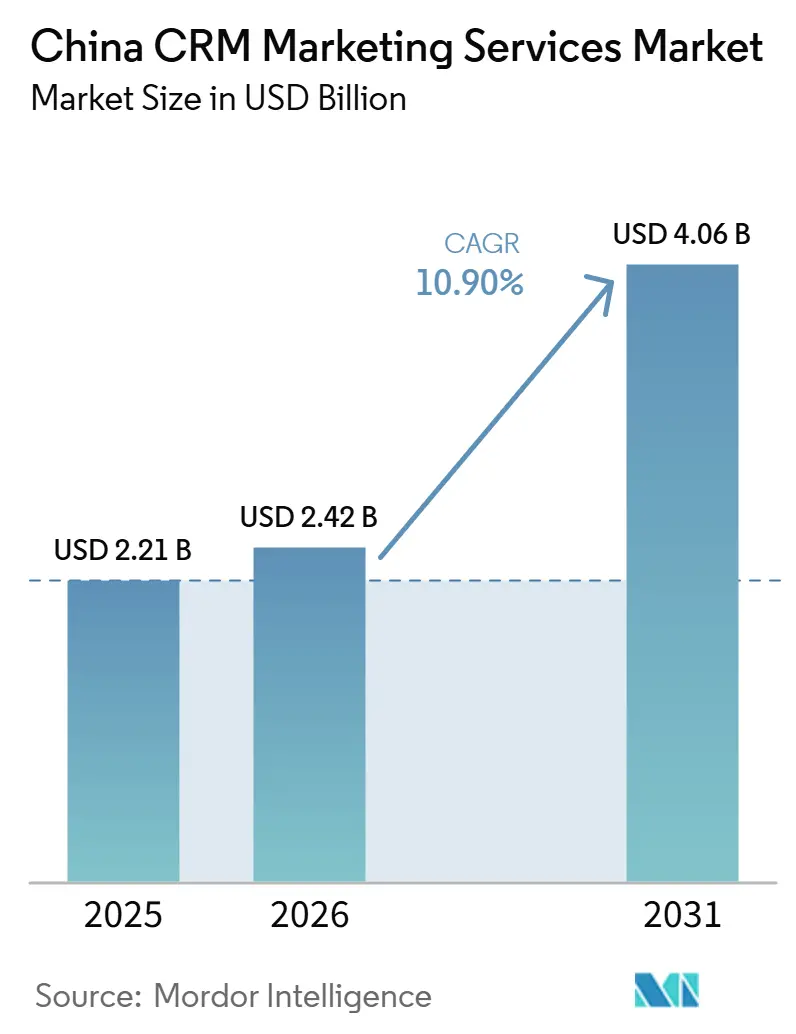
| Base Year Market Size (2025) | USD 2.21 Billion |
| Market Size (2026) | USD 2.42 Billion |
| Market Size (2031) | USD 4.06 Billion |
| Growth Rate (2026 - 2031) | 10.90 % |
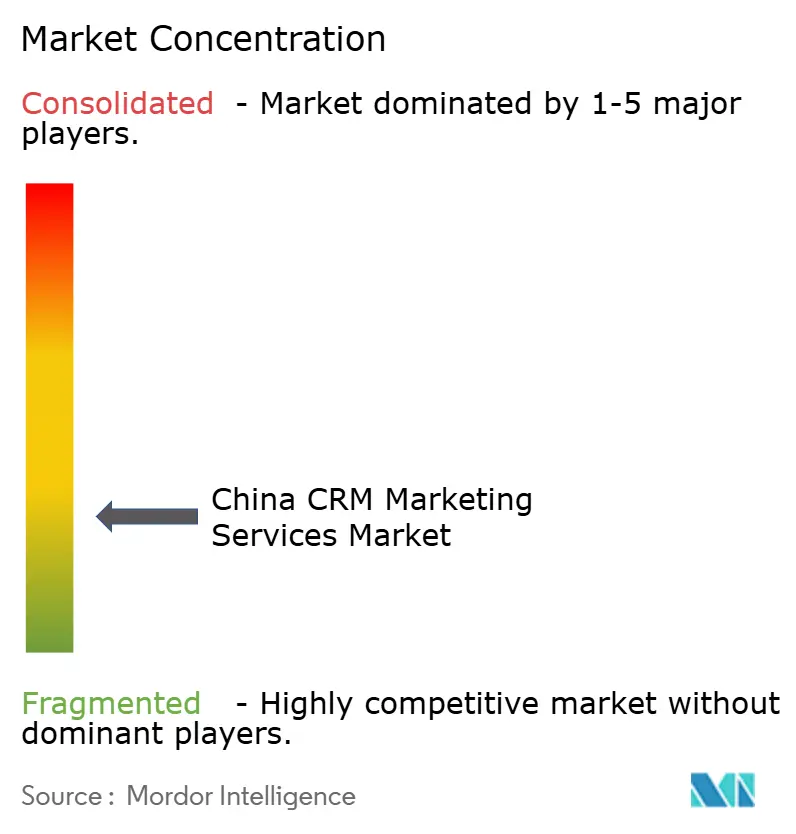
| Market Concentration | Low |
Major Players *Disclaimer: Major Players sorted in no particular order Image © Mordor Intelligence. Reuse requires attribution under CC BY 4.0. | |
China CRM Marketing Services Market Analysis by Mordor Intelligence
The China CRM marketing services market size is projected to be USD 2.21 billion in 2025, USD 2.42 billion in 2026, and reach USD 4.06 billion by 2031, growing at a CAGR of 10.90% from 2026 to 2031. The market is expanding as Chinese enterprises replace legacy on-premises systems with cloud-native CRM platforms that are easier to update and integrate across functions. At the same time, AI-based personalization is moving into day-to-day operations, raising expectations for lead scoring, campaign management, and customer engagement. The number of digital touchpoints continues to rise across commerce, social, and service channels, increasing the need for outside specialists to plan, implement, and manage these environments over time. Privacy rules and cross-border data limits are also changing how projects are designed, which gives an advantage to vendors that can combine technical delivery with compliance discipline. Competition is sharpening as domestic vendors improve AI-native capabilities and large clients seek providers that can deliver modernization work, managed support, and localized execution within a single service relationship.
Key Report Takeaways
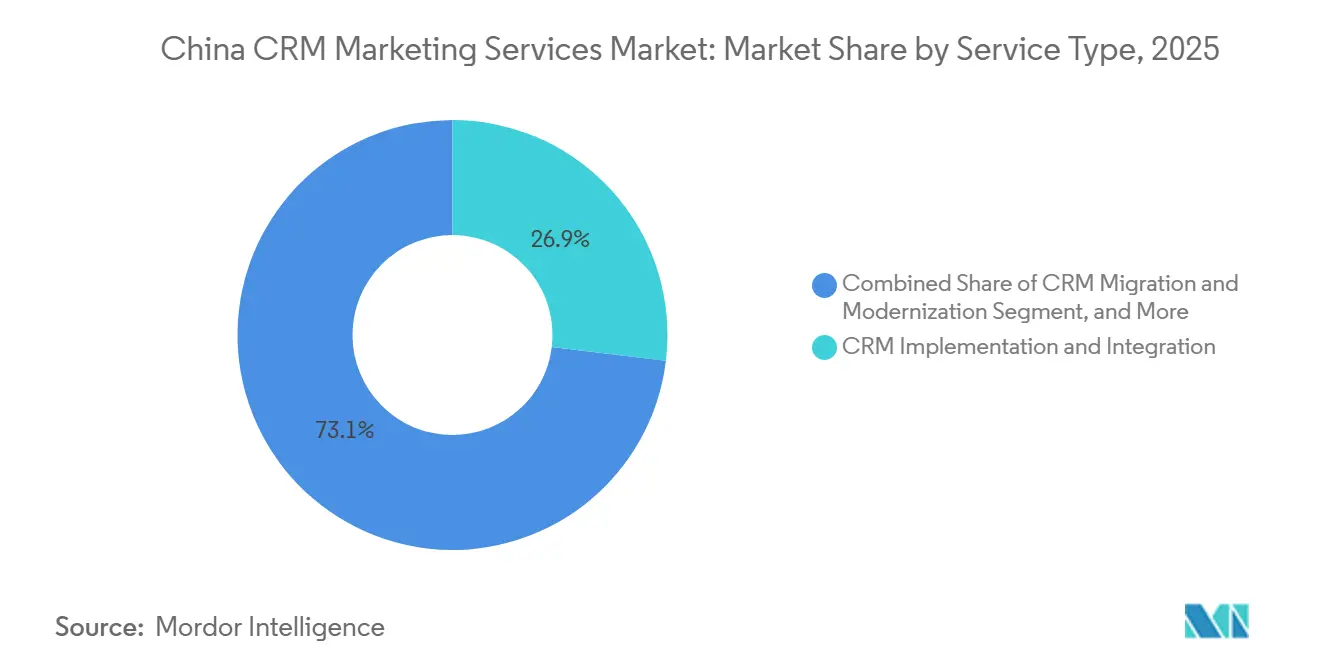
- By service type, CRM Implementation and Integration held 27.08% of the China CRM marketing services market share in 2025, while CRM Migration and Modernization is projected to expand at 11.92% CAGR through 2031.
- By enterprise size, Large Enterprises accounted for 58.06% share of the China CRM marketing services market size in 2025, while Small and Medium Enterprises are projected to advance at 12.03% CAGR through 2031.
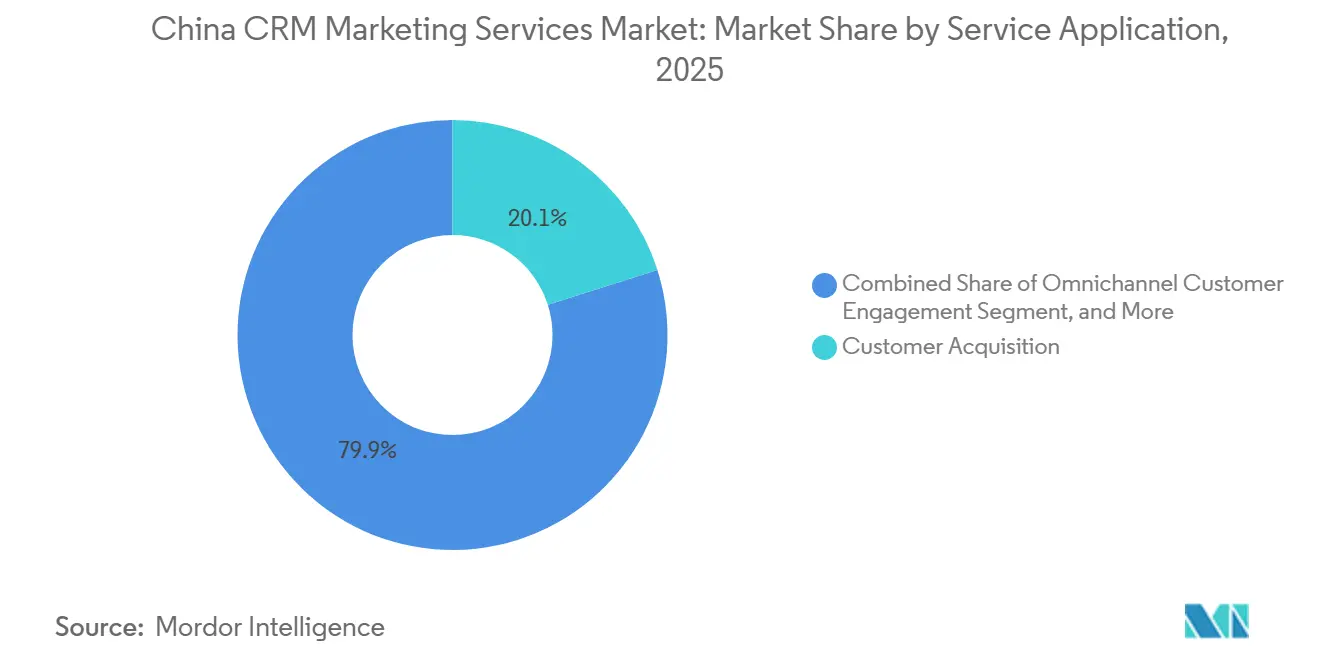
- By service application, Customer Acquisition accounted for 20.11% share of the China CRM marketing services market size in 2025, while Omnichannel Customer Engagement is projected to grow at 12.14% CAGR through 2031.
- By end-user industry, BFSI held 16.12% share in 2025, while Healthcare and Life Sciences is projected to expand at 12.25% CAGR through 2031.
Note: Market size and forecast figures in this report are generated using Mordor Intelligence’s proprietary estimation framework, updated with the latest available data and insights as of January 2026.
China CRM Marketing Services Market Trends and Insights
Drivers Impact Analysis*
| Driver | (~) % Impact on CAGR Forecast | Geographic Relevance | Impact Timeline |
|---|---|---|---|
| AI-Driven Personalization And Lead Scoring Adoption | +2.8% | National, concentrated in Yangtze River Delta, Beijing-Tianjin corridor | Short term (≤ 2 years) |
| First-Party Data Activation Following Cookie Deprecation | +2.1% | National, with early gains in Shanghai, Guangzhou, Shenzhen | Short term (≤ 2 years) |
| Omnichannel Customer Journey Orchestration Demand | +1.9% | National, with spillover into Tier 2 and Tier 3 city expansion markets | Medium term (2-4 years) |
| SME Digitization And Low-Code CRM Adoption | +1.7% | Nationwide, with emphasis on Pearl River Delta and Chengdu-Chongqing clusters | Medium term (2-4 years) |
| Vertical-Specific Compliance And Consent Management Needs | +1.3% | BFSI hubs including Shanghai, Beijing, Shenzhen, and healthcare hubs including Beijing, Hangzhou, Chengdu | Medium term (2-4 years) |
| Cross-Border E-Commerce Expansion From China | +1.1% | Cross-border pilot zones and export-oriented coastal clusters, especially Guangdong, Zhejiang, Fujian | Long term (≥ 4 years) |
| Source: Mordor Intelligence | |||
AI-Driven Personalization and Lead Scoring Adoption
Generative AI is changing the service scope of the China CRM marketing services market because enterprises are no longer treating AI as a small pilot attached to a wider CRM project. A 2026 CRM intelligence maturity framework in China formalized capabilities such as intelligent lead scoring, campaign generation, agent assist, and churn prediction, which shows that AI functions are moving into a more structured deployment phase. Kingdee reported that its AI-native Xiao K portal recorded more than 200,000 active users in 2025, which points to meaningful real-world adoption rather than limited internal testing.[1] The same disclosure said AI-assisted development generated 41% of new code and compressed R&D delivery cycles by 21%, which helps explain why clients are expecting faster CRM configuration and more embedded intelligence in new projects. This is raising the baseline for implementation work because a standard CRM rollout now has to account for model-enabled workflows, guided user actions, and measurable performance outputs. As a result, providers in the China CRM marketing services market are finding that AI expands project scope instead of replacing service demand.
First-Party Data Activation Following Cookie Deprecation
The China CRM marketing services market is also gaining support from the shift away from third-party tracking toward first-party customer data. As platform restrictions tighten and consent expectations become more explicit, enterprises need cleaner customer records, stronger permission controls, and a more reliable way to activate audiences through their own systems. This changes CRM from a support layer for campaigns into a primary system for customer identity, consent history, and engagement continuity. Brands that still depend on opaque audience targeting now face double pressure: acquisition costs are harder to control, and compliance risk is becoming more visible in daily marketing operations. That pressure is increasing the appeal of CRM services that combine data organization, consent architecture, audience segmentation, and activation workflows in one managed environment. It also shortens buying cycles because companies that delay first-party readiness risk losing both efficiency and control at the same time.
Omnichannel Customer Journey Orchestration Demand
The China CRM marketing services market is benefiting from the fact that customer journeys in China move across many platforms in a very short time. A buyer may discover a product on a social platform, switch to a brand account for more details, complete a transaction via a mini-program, and return via a service channel within the same day. That pattern makes orchestration difficult because data, content, and service actions must stay consistent even when the customer moves across separate digital environments. SAP’s Q1 2026 Customer Experience release added AI-assisted SMS campaign analytics and predictive mobile push segmentation, indicating that large platform vendors are building directly for multichannel execution rather than only for record-keeping.[2] The same release also reflected a broader push toward executional AI across sales, service, and engagement workflows, underscoring the need for service providers that can connect automation with day-to-day campaign operations. Providers that can link private-domain customer engagement with back-end CRM platforms are therefore better positioned to win larger and longer contracts in the China CRM marketing services market.
SME Digitization and Low-Code CRM Adoption
Small and medium enterprises are becoming a major growth engine for the China CRM marketing services market, as cloud delivery and low-code tools have lowered the entry barrier to formal CRM use. These companies usually do not follow the same path as large enterprises because they need shorter deployment timelines, simpler buying decisions, and lighter internal IT requirements. Research based on 198 SMEs in Zhejiang found that performance expectancy, effort expectancy, and attitude were significant drivers of social CRM adoption intent, while attitude also played a mediating role in adoption behavior.[3] That finding matters because it shows that product fit alone is not enough, and service providers also need to address leadership confidence, ease of use, and change readiness. It also explains why training, support, and guided onboarding remain important even when low-code tools reduce technical complexity. In the China CRM marketing services market, this means smaller accounts may start with lower implementation fees but still generate recurring value through post-deployment support and managed services.
Restraints Impact Analysis*
| Restraint | (~) % Impact on CAGR Forecast | Geographic Relevance | Impact Timeline |
|---|---|---|---|
| Data Localization And Cross-Border Transfer Constraints | -1.8% | National, most acute for multinationals operating in Shanghai, Beijing, Guangzhou | Short term (≤ 2 years) |
| Integration Complexity Across Legacy Enterprise Systems | -1.5% | National, especially in Yangtze River Delta manufacturing corridors and state-owned enterprise clusters | Medium term (2-4 years) |
| High Implementation And Change-Management Burden For SMEs | -1.2% | Nationwide, most pronounced in Tier 2 and Tier 3 cities with limited IT talent pools | Medium term (2-4 years) |
| Marketing Automation Talent Shortage And Vendor Lock-In Risk | -0.9% | National, with concentration in tier-one city labor markets | Long term (≥ 4 years) |
| Source: Mordor Intelligence | |||
Data Localization And Cross-Border Transfer Constraints
Data localization remains one of the clearest brakes on the China CRM marketing services market because many enterprise CRM programs are tied to regional or global operating models. When customer data needs to stay within mainland China, project teams cannot simply reuse the same architecture, analytics flows, support routes, or AI training designs they use elsewhere. This makes system design more front-loaded, since data location, access control, and workflow routing must be resolved before implementation moves very far. It also reduces the efficiency of centralized delivery hubs because customer support or analytics functions based outside mainland China may need substantial redesign before they can support local operations. For multinational clients, this turns compliance into a delivery issue rather than a legal issue alone. For service providers, it raises the entry barrier and favors firms that already have local infrastructure, localized operating processes, and a stronger grasp of how CRM data should move within China.
Integration Complexity Across Legacy Enterprise Systems
Integration complexity is another major restraint, as many large Chinese enterprises still operate mixed technology stacks built over several phases of digitization. A single client may run older ERP modules, domestic business systems, and newer cloud applications simultaneously, which means CRM programs must connect to systems that were not designed around a common architecture. That creates extra work in middleware design, interface translation, testing, and post-go-live maintenance, and it can slow the pace at which business value becomes visible. SAP’s current transition path shows that cloud-era integration often requires redesign rather than a simple upgrade, especially as organizations move extensions away from the core system and onto newer platforms. The same transition also increases demand for specialists who can work across older customization models and modern cloud workflows simultaneously. In the China CRM marketing services market, providers that already have reusable integration methods and strong delivery discipline are better placed to manage this restraint than generalist firms.[4]
*Our forecasts treat driver/restraint impacts as directional, not additive. The impact forecasts reflect baseline growth, mix effects, and variable interactions.
Segment Analysis
By Service Type: Implementation Volume Sustains The Revenue Base
CRM Implementation and Integration held a 27.08% share of the China CRM marketing services market in 2025, making it the largest service type by revenue. This position reflects the fact that a large part of the market is still building or rebuilding core CRM infrastructure rather than working from a fully mature installed base. Many clients need to connect their CRM with ERP, e-commerce, logistics, and service systems simultaneously, which makes implementation work broader than a simple software setup. That complexity supports steady demand for providers that can handle design, configuration, testing, and deployment under one engagement. It also explains why implementation remains central to the revenue mix even as the broader China CRM marketing services industry moves toward more recurring service models.
CRM Migration and Modernization is projected to grow at a 11.92% CAGR through 2031, making it the fastest-growing service type in the current mix. The migration cycle is being driven by aging on-premise deployments and by the fact that many newer AI functions are more practical on cloud-native architectures. SAP’s Q1 2026 release added AI-based account research, email-to-quote capabilities, and deeper engagement automation, which supports the view that modern feature access is becoming a direct reason to migrate rather than a secondary benefit. The market is also supported by domestic software substitution, which is creating another layer of planned replacement work for organizations that need localized, compliant platforms. Over time, this should keep modernization work active even after initial cloud migration slows. It also changes vendor positioning, as providers that can combine migration execution with later-stage managed support are more attractive than firms that handle only one project phase. Strategy and consulting are benefiting as clients define AI-ready road maps before choosing platforms, while managed services are becoming more valuable as clients seek operational continuity after deployment. Training and support remain the smallest line today, but its role is growing as more frequent platform updates require more frequent user enablement and change management. Taken together, service-type demand shows that the China CRM marketing services market is expanding through both new builds and continuous renewal rather than through a single implementation cycle.

By Enterprise Size: Large Accounts Lead While SMEs Expand Faster
Large Enterprises accounted for 58.06% of 2025 revenue, which made them the dominant buyer group across the China CRM marketing services market. Their weight in the market comes from the scale of their programs, the number of systems involved, and the higher importance they place on security, compliance, and vendor accountability. These organizations also buy the service lines that usually carry better margins, including complex consulting, migration, and multi-year managed support. That gives enterprise accounts a larger role in revenue quality than their share alone might suggest. Kingdee’s FY2025 results showed continued strength in its large-enterprise cloud business, which reinforces the view that platform modernization remains active among complex accounts in China.
Small and Medium Enterprises held 41.94% of the market in 2025, and they are projected to grow at 12.03% CAGR through 2031, which is faster than the large-enterprise segment. Their momentum is tied to lower cloud entry costs, digitization support measures, and the wider use of low-code tools that reduce the need for specialized internal IT teams. Even so, adoption in this group depends heavily on management confidence and ease of use, not only on software availability. Research on Chinese SMEs found that performance expectancy, effort expectancy, and attitude were key determinants of social CRM adoption intent, which means execution quality and user confidence can shape commercial outcomes as much as feature depth. This is why smaller clients often need more structured onboarding, training, and operating support than vendors first expect. It also means churn risk can be higher when products are installed without enough process guidance. For providers in the China CRM marketing services industry, SME demand can therefore become a durable growth source when delivery models are designed around adoption support instead of software handoff alone. The segment’s faster growth also broadens the customer base beyond large corporate accounts, which makes the China CRM marketing services market less dependent on a narrow group of enterprise buyers over time. As adoption spreads, recurring support services are likely to become more important in SME economics than one-time implementation fees.
By Service Application: Acquisition Leads While Omnichannel Work Gains Pace
Customer Acquisition services held a 20.11% share in 2025, making them the largest service application in the China CRM marketing services market. This reflects the continued emphasis Chinese enterprises place on lead generation, prospect management, and first-touch data capture across digital channels. Spending in this area remains high because clients want stronger conversion from the traffic they already pay to attract. At the same time, retention and loyalty work is gaining more attention as rising acquisition pressure pushes management teams to focus more on customer lifetime value. Campaign Management Services is moving away from simple batch execution and toward event-based orchestration, while Marketing Automation Services is helping clients reduce manual process load. Customer Analytics and Insights is also becoming increasingly useful as brands seek to turn first-party CRM records into segmentation, churn alerts, and next-step actions. Personalization Services remains smaller in terms of current revenue, but it is becoming easier to scale as AI reduces the cost of creating and adjusting content for narrower customer groups.
Omnichannel Customer Engagement is projected to grow at a 12.14% CAGR through 2031, making it the fastest-growing application area in the current mix. The pace here reflects the structure of China’s digital environment, where commerce, content, messaging, and services can sit on separate yet closely linked channels. That forces companies to look for CRM service providers that can maintain customer context consistency from one interaction to the next, rather than treating each channel as a separate marketing task. SAP’s Q1 2026 release showed how platform vendors are responding, with AI-assisted analytics and predictive segmentation features designed for more connected engagement execution. This makes omnichannel work more central to delivery plans across the China CRM marketing services market, as clients increasingly want real-time orchestration, not just historical reporting. Personalization is likely to rise alongside it, as individualized content becomes more valuable as journeys move quickly across multiple touchpoints. The combination of acquisition, retention, automation, analytics, personalization, and omnichannel execution also shows that service demand is spreading across the full customer lifecycle rather than staying concentrated at the top of the funnel. That broad mix gives providers more room to deepen accounts after the first implementation is complete. It also raises the advantage of vendors that can combine campaign execution knowledge with platform-level integration skills.
By End-user Industry: BFSI Holds Scale While Healthcare Raises Growth Expectations
BFSI remained the largest end-user segment with a 16.12% share in 2025, keeping it at the center of spending in the China CRM marketing services market. The segment’s weight comes from strict compliance needs, large customer bases, and the high value of improving cross-sell, retention, and lifecycle engagement. These buyers often require a broader delivery scope because CRM programs in financial services touch on data governance, service consistency, campaign control, and customer risk visibility. IT and Telecom also remains an active buying group because operators and cloud service providers rely on CRM tools to support churn management, upsell, and account expansion across large user bases. Retail and e-commerce add another large source of demand, as brands must coordinate customer journeys across marketplace platforms, private-domain channels, and service touchpoints. Industrial Manufacturing is becoming increasingly important as firms formalize account management, distributor support, and service contract tracking through CRM systems rather than informal relationship processes. Government and Public Administration remain smaller, but policy-led digital service programs continue to create selective CRM implementation needs. The end-user pattern shows that the China CRM marketing services market is supported by a broad base of buyers rather than a single vertical.
Healthcare and Life Sciences are projected to grow at a 12.25% CAGR through 2031, making it the fastest-growing end-user segment. Growth here is being driven by digital chronic disease management, wider patient engagement needs, and the use of AI tools to strengthen communication across longer treatment journeys. CRM work in healthcare is not limited to patient outreach because providers and life sciences companies also need structured relationship management with physicians, care networks, and support ecosystems. That creates demand for workflows that are more specialized than those used in standard consumer marketing programs. As health platforms expand their digital operating models, CRM service providers need stronger capabilities in follow-up logic, consent management, and service continuity. This makes healthcare one of the more complex opportunity areas within the China CRM marketing services market, even though it still trails BFSI in current size. The segment also highlights the value of vendors that can adapt engagement programs to stricter data-handling expectations. Over time, healthcare growth should help broaden the market’s vertical mix and drive greater demand for specialized templates rather than generic horizontal delivery models.
Geography Analysis
Geographic market shares were not disclosed, but the China CRM marketing services market remained concentrated in the Yangtze River Delta, the Beijing-Tianjin cluster, and the Pearl River Delta in 2025 and 2026. The Yangtze River Delta stands out for combining a high density of financial institutions, multinational subsidiaries, technology firms, and digitally mature enterprises that can support complex CRM spending. Shanghai remains an important landing point for global CRM platform activity because large-enterprise deployments, customer experience programs, and localized cloud execution often cluster around this corridor. The Beijing-Tianjin cluster serves a different role because it is tied more closely to government agencies, state-owned enterprises, and policy-sensitive replacement cycles. That makes it a natural center for migration, managed services, and compliance-heavy CRM work where domestic software substitution is influencing technology choices.
The Pearl River Delta offers a distinct demand profile for China's CRM marketing services market, as the region combines export manufacturing, consumer electronics, cross-border sales, and a large base of growth-oriented SMEs. CRM needs here are shaped by international buyer management, multichannel selling, and the need to keep customer records useful across domestic and export-facing operations. Providers serving this region need to balance growth enablement with greater attention to data movement and system connectivity, as many companies operate across both local and international business flows. This makes the region important not only for account volume but also for more specialized delivery work tied to channel complexity and cross-border operating patterns. As the regional customer base grows, the Pearl River Delta should continue to support strong demand for flexible cloud deployments and compliance-aware service models.
Tier 2 and Tier 3 city markets such as Chengdu, Chongqing, Wuhan, and Xi’an are at an earlier stage, but adoption is moving faster as digital infrastructure and policy support improve. Government-linked organizations and larger regional enterprises often move first, after which retail, healthcare, and manufacturing users start broader implementation cycles. Low-code tools are especially relevant in inland markets because they reduce the cost and skill requirements to start using formal CRM. This means the China CRM marketing services market is likely to widen geographically over the next few years, even if premium spending remains concentrated in the largest coastal clusters.
Competitive Landscape
The China CRM marketing services market has a two-layer competitive structure, with global platform vendors holding strong positions in large-enterprise work and domestic vendors gaining strength through localization, regulatory fluency, and faster AI adoption. The large-enterprise tier is still shaped by vendors such as Salesforce, SAP, Oracle, and Microsoft Dynamics 365, especially where clients need broad platform depth and established enterprise delivery models. At the same time, the mid-market and SME tiers remain much more open because pricing, channel fit, low-code usability, and localization matter more than global brand scale alone. This creates a market that is concentrated in selected enterprise accounts but widely fragmented across the broader customer base. It also leaves room for providers that focus on vertical-specific delivery models in healthcare, industrial manufacturing, or government-facing work, where generic CRM templates do not fully match local process needs.
Strategic moves in 2025 and 2026 show that vendors are competing more aggressively through embedded AI, localized execution, and deeper post-implementation value. Kingdee launched its AI-first architecture and expanded its AI-led product positioning in FY2025, signaling a direct push to narrow functional gaps and improve retention within enterprise accounts. SAP’s April 2026 Customer Experience release added execution-oriented AI features across sales, service, and engagement workflows, raising the bar for what enterprise clients can expect from a modern CRM stack. SAP also presented its Autonomous CX vision at Sapphire 2026, further reinforcing its direction toward AI-led customer operations and broader workflow automation. These moves matter because they reduce the room for vendors that compete only on implementation labor without a stronger platform or ecosystem proposition.
Competition is also changing in the Chinese CRM marketing services market, as clients now judge vendors on delivery continuity rather than just software selection. Providers that can connect strategy, migration, implementation, managed services, and training into one accountable service chain are better aligned with what buyers want from multi-year CRM programs. Compliance capability is becoming a differentiator, as enterprises need partners who understand how localized data handling affects campaign execution, analytics design, and support operations. This does not eliminate price competition, but it does shift more value toward firms that can lower operating risk while helping clients modernize at speed. Over time, the competitive field is likely to stay mixed, with a few strong leaders in enterprise accounts and a long tail of specialists competing for SME, vertical, and regional opportunities.
China CRM Marketing Services Industry Leaders
-
Salesforce, Inc.
-
Adobe Inc.
-
Oracle Corporation
-
Microsoft Corporation
-
SAP SE
- *Disclaimer: Major Players sorted in no particular order
Recent Industry Developments
- May 2026: SAP unveiled its Autonomous CX vision at SAP Sapphire 2026, introducing six named Joule AI Assistants targeting GA in November 2026 across sales, service, and engagement workflows. The announcement positions SAP's Customer Experience suite as an AI-first enterprise CRM platform, directly competing with Salesforce's Einstein and Oracle's Fusion AI Agents for large enterprise CX budgets in China and globally.
- April 2026: SAP released its Q1 2026 Customer Experience update, embedding AI-powered email-to-quote generation, deep research account planning, AI-assisted SMS campaign analytics, and predictive mobile push segmentation into SAP Sales Cloud, SAP Service Cloud, and SAP Engagement Cloud. The update advances SAP's strategy to embed intelligence directly into customer-facing execution workflows rather than requiring separate AI product purchases.
- March 2026: March 2026: Kingdee International reported FY2025 annual results with total revenue of RMB 7,006 million (USD 973 million), AI contract value of RMB 356 million (USD 49 million), and a turnaround to adjusted net profit of RMB 232 million (USD 32 million). The company launched "Kingdee AI," upgrading its full platform suite to an AI-first architecture, and maintained the No. 1 IDC ranking across China's enterprise application cloud, SaaS ERP, and financial cloud segments.
- March 2026: Oracle launched Fusion Agentic Applications for CX, introducing pre-built AI agents for marketing, sales, service, and supply chain operations within Oracle Fusion Cloud. The agents are included at no additional cost within existing Oracle Fusion licenses, raising the baseline AI feature set available to Oracle's enterprise CRM clients and intensifying competitive pressure on service providers to deliver advanced agent customization.
China CRM Marketing Services Market Report Scope
The China CRM Marketing Services market refers to solutions and services that enable enterprises to design, implement, and optimize customer relationship management strategies to drive acquisition, retention, and engagement. These services include consulting, integration, modernization, managed services, and training, supporting applications such as campaign management, marketing automation, customer analytics, omnichannel engagement, and personalization. Driven by rapid digital transformation, the expansion of e-commerce, and the growing demand for customer-centric strategies, industries such as BFSI, healthcare, IT, manufacturing, retail, and government are increasingly adopting CRM marketing services to enhance loyalty, improve operational efficiency, and achieve sustainable growth. The primary objective of this market is to empower organizations in China with scalable, data-driven CRM solutions that strengthen customer relationships and deliver competitive advantage in a dynamic digital economy.
The China CRM Marketing Services market report is segmented by Service Type (CRM Strategy and Consulting, CRM Implementation and Integration, CRM Migration and Modernization, CRM Managed Services, CRM Training and Support), Enterprise Size (Large Enterprises and Small and Medium Enterprises), Service Application (Customer Acquisition, Customer Retention and Loyalty, Campaign Management Services, Marketing Automation Services, Customer Analytics and Insights, Omnichannel Customer Engagement, Personalization Services), and End-user Industry (Banking, Financial Services, and Insurance (BFSI), Healthcare and Life Sciences, Information Technology and Telecom, Retail and E-commerce, Industrial Manufacturing, Government and Public Administration, and Other End-user Industries). The Market Forecasts are Provided in Terms of Value (USD).
| CRM Strategy and Consulting |
| CRM Implementation and Integration |
| CRM Migration and Modernization |
| CRM Managed Services |
| CRM Training and Support |
| Large Enterprises |
| Small and Medium Enterprises |
| Customer Acquisition |
| Customer Retention and Loyalty |
| Campaign Management Services |
| Marketing Automation Services |
| Customer Analytics and Insights |
| Omnichannel Customer Engagement |
| Personalization Services |
| Banking, Financial Services, and Insurance (BFSI) |
| Healthcare and Life Sciences |
| Information Technology and Telecom |
| Retail and E-commerce |
| Industrial Manufacturing |
| Government and Public Administration |
| Other End-user Industries |
| By Service Type | CRM Strategy and Consulting |
| CRM Implementation and Integration | |
| CRM Migration and Modernization | |
| CRM Managed Services | |
| CRM Training and Support | |
| By Enterprise Size | Large Enterprises |
| Small and Medium Enterprises | |
| By Service Application | Customer Acquisition |
| Customer Retention and Loyalty | |
| Campaign Management Services | |
| Marketing Automation Services | |
| Customer Analytics and Insights | |
| Omnichannel Customer Engagement | |
| Personalization Services | |
| By End-user Industry | Banking, Financial Services, and Insurance (BFSI) |
| Healthcare and Life Sciences | |
| Information Technology and Telecom | |
| Retail and E-commerce | |
| Industrial Manufacturing | |
| Government and Public Administration | |
| Other End-user Industries |
Key Questions Answered in the Report
What is the current and forecast size of the China CRM marketing services market?
The China CRM marketing services market was valued at USD 2.21 billion in 2025, stands at USD 2.42 billion in 2026, and is forecast to reach USD 4.06 billion by 2031 at a 10.90% CAGR.
Which service type leads revenue in China?
CRM Implementation and Integration led with 27.08% share in 2025 because many organizations are still building or rebuilding core CRM connections across business systems.
Which application area is expanding the fastest?
Omnichannel Customer Engagement is projected to grow at 12.14% CAGR through 2031 as brands try to manage connected experiences across social, commerce, messaging, and service channels.
Why are SMEs becoming more important for providers?
Small and Medium Enterprises are forecast to grow at 12.03% CAGR through 2031 as cloud entry costs fall and low-code tools make CRM easier to adopt without large internal IT teams.
Why does BFSI remain the largest buyer group?
BFSI held 16.12% share in 2025 because banks and insurers need large-scale CRM programs that support compliance, retention, cross-sell, and customer lifecycle management.
What is shaping vendor competition in China right now?
Competition is being shaped by embedded AI, localized delivery, data compliance capability, and the ability to combine migration, implementation, managed services, and training in one service model.