
South America Synthetic Media Market Size and Share
Market Overview
| Study Period | 2019 - 2030 |
|---|---|
| Forecast Data Period | 2025 - 2030 |
| Historical Data Period | 2019 - 2023 |
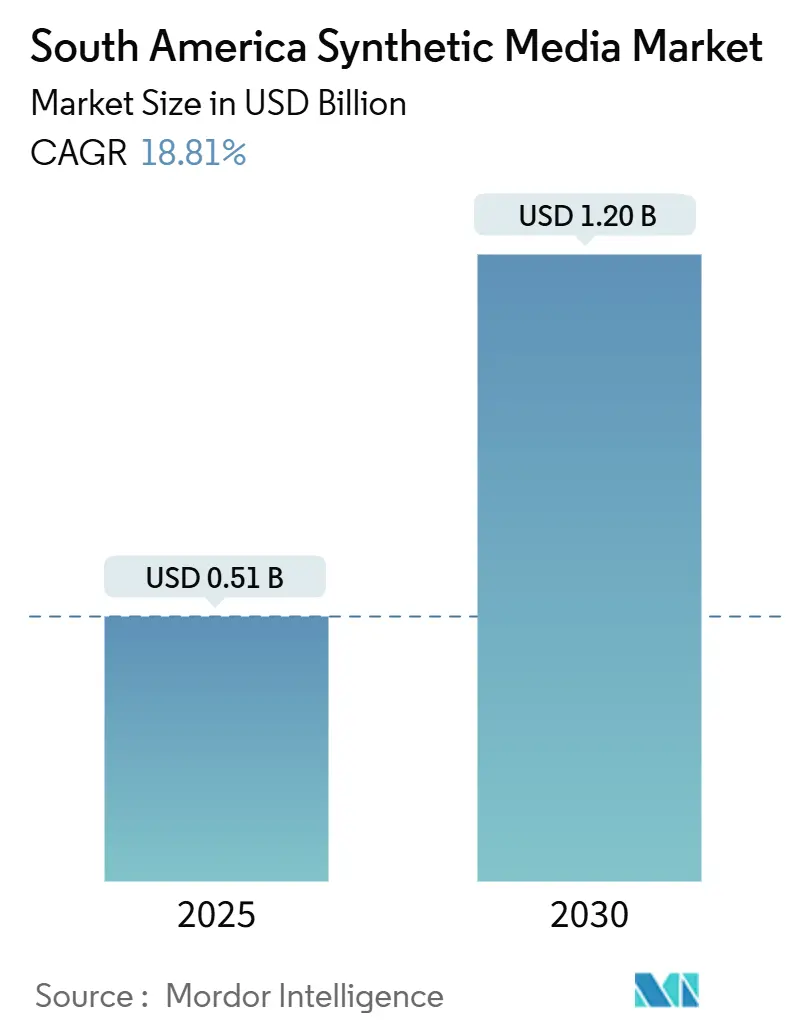
| Market Size (2025) | USD 0.51 Billion |
| Market Size (2030) | USD 1.20 Billion |
| Growth Rate (2025 - 2030) | 18.81 % |
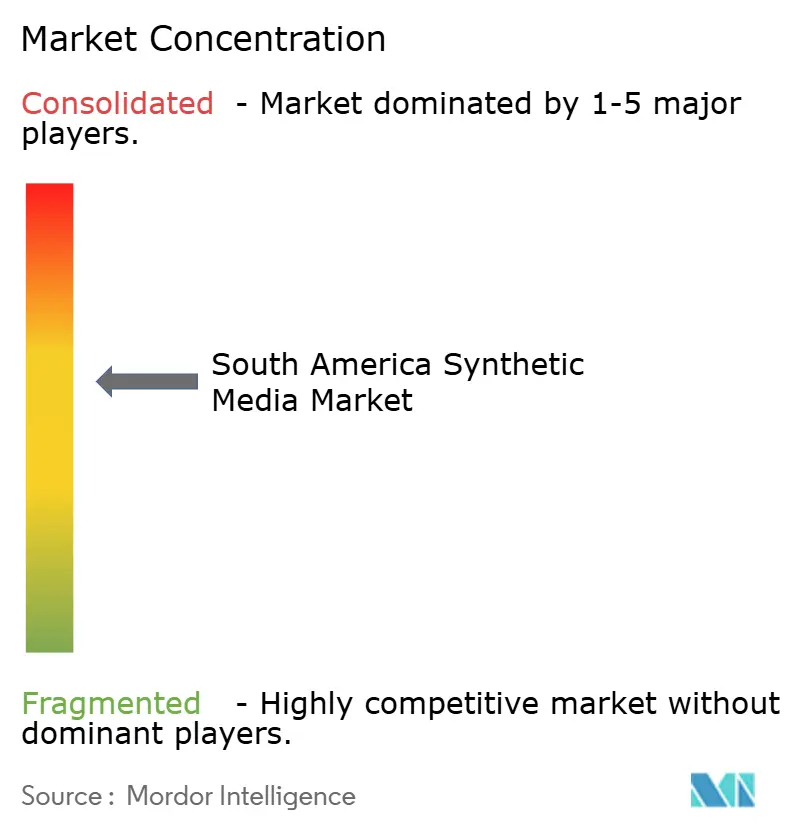
| Market Concentration | Medium |
Major Players *Disclaimer: Major Players sorted in no particular order Image © Mordor Intelligence. Reuse requires attribution under CC BY 4.0. | |
South America Synthetic Media Market Analysis by Mordor Intelligence
The South America synthetic media market size was valued at USD 0.51 billion in 2025 and is forecast to reach USD 1.20 billion by 2030, expanding at an 18.81% CAGR. Widespread demand for Spanish- and Portuguese-specific AI localization, falling compute costs, and a supportive regulatory climate in Brazil and Argentina are accelerating enterprise adoption of synthetic voice, video, and text tools across entertainment, fintech, and retail. Creators gain faster production cycles, while regional data-center investments from Amazon and Scala Data Centers reduce latency and safeguard data sovereignty. Generative AI vendors tailor models to local slang and cultural references, differentiating themselves from generic global offerings. At the same time, import-duty reductions on laptops and GPUs in Argentina and Chile improve hardware affordability, widening access for small studios. Although copyright and deepfake concerns persist, these risks spur innovation in watermarking, identity-protection, and lightweight model architectures that run on locally assembled servers.
Key Report Takeaways
- By geography, Brazil led with 48.31% of South America synthetic media market share in 2024, while Argentina is projected to post a 20.22% CAGR through 2030.
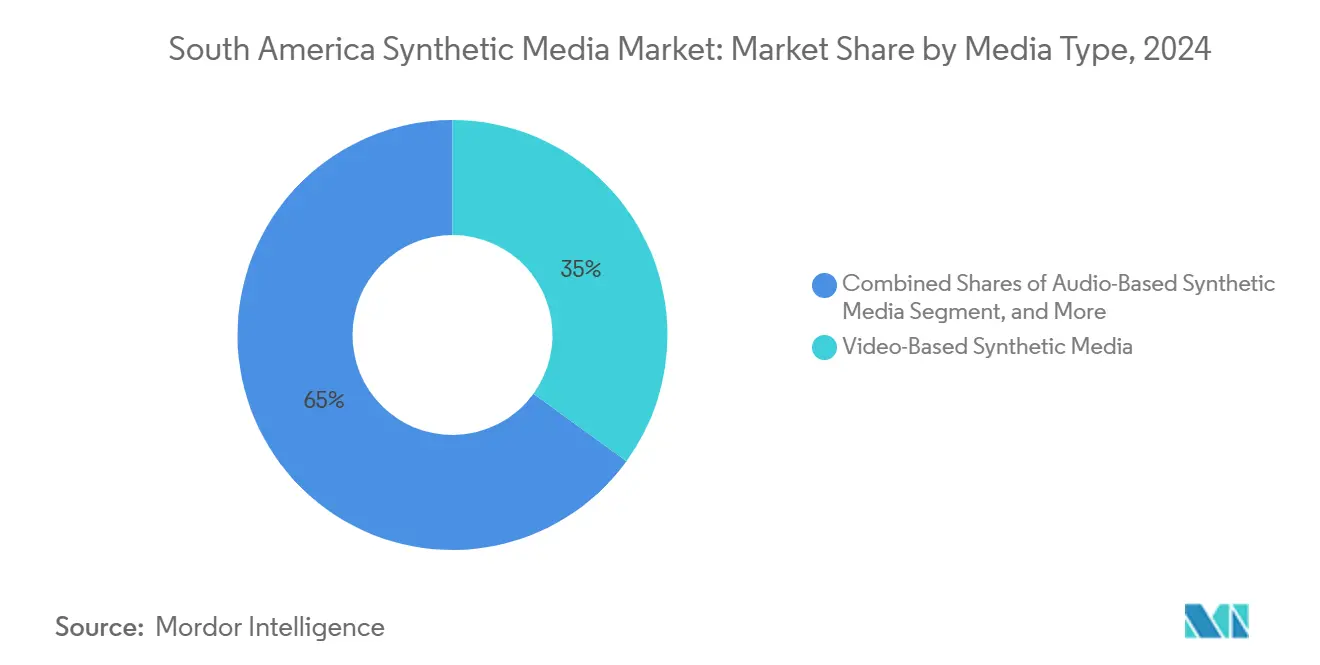
- By media type, video-based formats captured 35.32% revenue in 2024; audio-based applications are set to expand at an 18.97% CAGR.
- By technology, generative AI commanded 41.12% of the South America synthetic media market size in 2024, whereas Natural Language Processing is advancing at 20.62% CAGR.
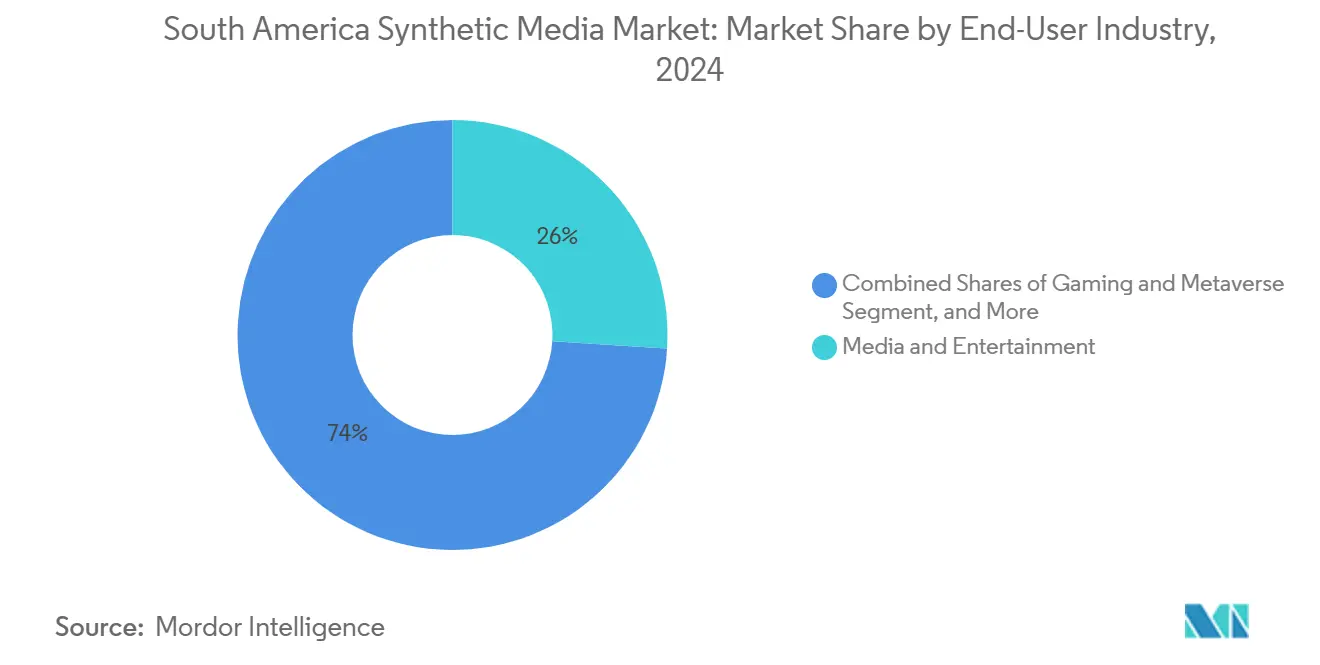
- By end-user industry, media and entertainment accounted for 25.88% of spending in 2024, and gaming plus metaverse uses are pacing the field with a 19.16% CAGR.
Note: Market size and forecast figures in this report are generated using Mordor Intelligence’s proprietary estimation framework, updated with the latest available data and insights as of January 2026.
Proportional positioning is established by comparing regional contributions against the global total, including that of South america. The synthetic media market share in our global report expresses these relative weights.
Market Trends and Insights
Drivers Impact Analysis of South America Synthetic Media Market*
| Driver | (~) % Impact on CAGR Forecast | Geographic Relevance | Impact Timeline |
|---|---|---|---|
| Rising demand for AI-based localization | +3.2% | Brazil, Argentina, Regional | Medium term (2-4 years) |
| Lower costs versus traditional video production | +2.8% | Regional | Short term (≤ 2 years) |
| Integration with creator platforms | +2.1% | Brazil, Argentina, Chile | Medium term (2-4 years) |
| Regulatory push for Spanish and Portuguese dubbing | +1.9% | Regional | Long term (≥ 4 years) |
| Use of synthetic agents in Latin American fintech | +1.7% | Brazil, Colombia | Medium term (2-4 years) |
| Adoption of virtual influencers by esports studios | +1.4% | Argentina, Brazil, Chile | Medium term (2-4 years) |
| Source: Mordor Intelligence | |||
Rising Demand for AI-Based Localization
Cultural authenticity has become the strongest catalyst for the South America synthetic media market, because generic English-centric models struggle with regional idioms and accent variation. The Latam-GPT consortium, comprising 30 universities and firms, released the first collaborative Spanish Portuguese large language model in March 2025.[1]BBC News Mundo, “Latam-GPT, el proyecto que busca ser el primer modelo de inteligencia artificial colaborativo de América Latina,” bbc.com ElevenLabs quickly added Argentine and Brazilian Portuguese voices that cut dubbing time from days to minutes.[2]ElevenLabs, “Argentine Accent Text to Speech & AI Voice Generator,” elevenlabs.io Deepdub’s localized release of the thriller “Every Time I Die” in dual languages illustrates how independent studios can now sidestep costly human voice-over workflows. Brazilian fintech startup Fintalk secured R$ 6 million to train chatbots on informal speech, reinforcing how nuanced localization is a revenue lever even outside entertainment. As a result, localization quality is moving from nice-to-have to a market-entry prerequisite across South America synthetic media market deployments.
Lower Costs Compared to Traditional Video Production
AI lowers production bills by up to 70%, turning synthetic clips into a default option for cash-constrained creators. Netflix finished the VFX pipeline for “The Eternaut” ten times faster using generative tools, validating ROI at studio scale.[3]The Verge, “Netflix admits it used generative AI in a big sci-fi hit to cut costs,” theverge.com Subscription platforms like Synthesia start at USD 10 per month versus hundreds of thousands for location shooting, letting small agencies enter the South America synthetic media market with negligible capital. Virtual influencers cost under USD 1,000 per campaign compared with USD 50,000 for human influencers yet deliver 24/7 brand presence. These savings redirect budgets toward creative development and reach advertising, magnifying downstream demand for localized AI assets.
Integration with Creator Platforms
Embedding AI natively inside social-commerce ecosystems removes technical friction. TikTok Shop’s 2025 Brazilian launch links in-feed generative videos with one-click purchase, shortening the funnel for merchants and creators alike. Magazine Luiza’s “Cérebro da Lu” orchestrates product demos, customer chats, and inventory prompts through a single synthetic persona. Clarín’s UalterAI auto-summarizes news by up to 80%, enriching reader retention without extra staff. Seamless toolkits keep the South America synthetic media market firmly on creator desktops rather than isolated in specialist studios.
Regulatory Push for Spanish and Portuguese Dubbing
Risk-based AI bills in Brazil and Argentina reward firms that guarantee linguistic inclusion and transparency. Streaming services must provide Spanish and Portuguese options for all titles, pushing constant demand for voice cloning, subtitle automation, and sign-language avatars. Local providers gain an edge because they can audit cultural nuances and comply with content-origin tracing rules. Over the next decade, public-service tenders—from court transcription to tourism videos—will prioritize bidders with audited regional AI stacks, widening the South America synthetic media market addressable base.
Restraints Impact Analysis of South America Synthetic Media Market*
| Restraint | (~) % Impact on CAGR Forecast | Geographic Relevance | Impact Timeline |
|---|---|---|---|
| Legal risks around copyright and deepfakes | -2.1% | Brazil-centric | Medium term (2-4 years) |
| Lack of quality regional training data | -1.8% | Smaller markets | Long term (≥ 4 years) |
| GPU import tariffs in Mercosur | -1.3% | Mercosur bloc | Short term (≤ 2 years) |
| Cultural pushback against AI news anchors | -0.9% | Regional media | Medium term (2-4 years) |
| Source: Mordor Intelligence | |||
Legal Risks Around Copyright and Deepfakes
Ambiguous consent rules force producers to budget for legal audits before releasing any likeness-based content. Brazil’s spike in ultra-realistic 3D masks highlights ID-theft threats that regulators equate with synthetic face swaps.[4]Click Petroleo e Gas, “Ultra-realistic 3D masks challenge facial recognition in Brazil,” clickpetroleoegas.com.br Denmark’s draft “performer-consent” clause is influencing Latin lawmakers who favor a 50-year posthumous protection window, raising liability for studios exporting content abroad.[5] InfoJustice, “Danish Bill Proposes Using Copyright Law to Combat Deepfakes,” infojustice.org Voice-actor unions in Mexico and Brazil file collective bargaining claims to secure royalties from AI-generated dubs, delaying rollouts. These headwinds shave 2.1 percentage points off the forecast CAGR for the South America synthetic media market, compelling firms to invest in watermarking, provenance ledgers, and narrow-domain generation that reduces copyright exposure.
Lack of Quality Regional Training Data
The #Somos600M study found that mainstream LLM benchmarks omit Latin variants spoken by 600 million people. In response, Brazilian engineers created the Sabiá model trained entirely on Portuguese corpora, achieving higher comprehension scores than GPT-3.5 in customer-service tasks. Yet most startups lack the capital to curate similarly rich datasets, limiting competition and slowing adoption, especially in Paraguay, Ecuador, and Bolivia. Bias in popular image generators under-represents indigenous phenotypes, undermining trust and generating user backlash. The scarcity of annotated media therefore restrains the overall momentum of the South America synthetic media market until public-private data-donation programs mature.
*Our forecasts treat driver/restraint impacts as directional, not additive. The impact forecasts reflect baseline growth, mix effects, and variable interactions.
South America Synthetic Media Market Segment Analysis
By Media Type:
Video Content Dominates Production WorkflowsVideo captured 35.32% of 2024 spending, equal to USD 0.17 billion of the South America synthetic media market size, thanks to explosive demand from streamers and advertisers. Synthesia’s 140-language pipeline slashes turnaround from weeks to hours while achieving 200-fold energy savings. Audio—though smaller in value—races ahead at an 18.97% CAGR as ElevenLabs expands region-specific voices, letting podcasters spin multilingual editions overnight.
Creators increasingly merge AI video avatars with synchronized AI speech to produce cost-effective telenovela clips, banking explainers, and esports shout-casts. Enterprises appreciate that localized video plus voice expands reach without reshoots, locking in a virtuous cycle that will keep video and audio jointly above 55% of South America synthetic media market revenue by 2030. Text- and image-based formats remain niche but vital for journalistic summaries and social card generation, where Clarín and Pic Copilot automate copywriting and multilingual banner art.



By Technology:
Generative AI Leads Infrastructure InvestmentGenerative models held 41.12% of 2024 revenue, translating to USD 0.20 billion of South America synthetic media market size. Meta’s Llama 3.1 fine-tunes on Brazilian datasets, while OpenAI inked licensing deals with PRISA to enrich Spanish corpora. Natural Language Processing grows fastest at 20.62% CAGR because chat interfaces underpin fintech, public-sector helpdesks, and creator prompts. NVIDIA’s Blackwell GPUs plus BlueField DPUs underpin low-latency inference at local data centers, cutting cloud egress fees and meeting data-residency mandates.
Computer-graphics engines such as Unreal integrate text-to-3D pipelines, letting advertising agencies iterate CGI assets rapidly. Voice synthesis benefits from convergence with speech-to-speech translation, enabling real-time game commentary in Portuguese and Spanish. As firms standardize on multimodal stacks, the South America synthetic media market will see cross-pollination where a single foundation model feeds video, voice, and text, simplifying maintenance and unlocking scale efficiencies.
By End-User Industry:
Gaming Emerges as Growth CatalystMedia and entertainment spent USD 0.13 billion in 2024, equal to 25.88% of the South America synthetic media market share. Yet gaming and metaverse titles show the steepest climb at 19.16% CAGR after Samsung earmarked USD 35 million for Latin-themed virtual worlds. Esports broadcasters deploy AI commentators in regional slang, boosting viewer engagement and sponsorship income.
Retailers leverage virtual try-ons and shoppable clips; TikTok Shop’s embedded AI turns user-generated videos into purchase funnels within Brazil. Education pilots, supported by the World Bank, roll out AI avatars that narrate textbooks in indigenous languages, mitigating teacher shortages. Healthcare uses synthetic scans and voice triage, aided by the BRAX X-ray dataset that tunes radiology AI models for Portuguese reports. Diverse utilization lessens cyclic risk and widens the TAM, ensuring resilient growth for the South America synthetic media market.
By Technology Infrastructure:
Data Centers Drive Regional CapabilitiesRegional Colocation and hyperscale build-outs underpin every layer of value delivery. Brazil invested USD 19.73 billion in data centers during 2023, and Scala plans an additional USD 500 million “AI City” campus focusing on GPU clusters optimized for synthetic workloads. Amazon’s USD 4 billion Chilean expansion offers low-latency inference to Andean nations, trimming cross-border data-transfer costs.
Mercosur GPU tariffs still add roughly 12% to hardware prices, but Foxconn’s Stargate servers assembled in Mexico absorb some shocks by shortening supply chains. Open-access datasets and sovereign-cloud regulations will further root the South America synthetic media market in local soil, enhancing uptime, compliance, and carbon footprints.
Geography Analysis
Brazil Synthetic Media Market
Brazil’s 48.31% revenue share equals USD 0.25 billion of South America synthetic media market size in 2024. Magazine Luiza’s Lu avatar amassed 31 million followers, proving mainstream consumer acceptance. Bill No. 2,338/2023 sets a tiered-risk framework, balancing openness with safeguards, and encourages sandbox pilots that fast-track commercialization. Rising data-center investments through 2029 ensure sufficient compute capacity for next-gen multimodal models.
Argentina Synthetic Media Market
Argentina, though smaller, grows at 20.22% CAGR through 2030 and benefits from zero-duty imports on laptops and GPUs enacted in May 2025. Netflix’s use of generative AI for “The Eternaut” positions Buenos Aires as a viable hub for mid-budget sci-fi and telenovelas. Draft AI governance set for 2026 highlights transparency and cultural inclusion, giving vendors regulatory clarity.
South America and Costa Rica Synthetic Media Market
The rest of South America remains heterogeneous yet promising. Chile spearheads Latam-GPT, aligning 30 institutions around open-source regional models. Colombia secured USD 676 million in startup funding in 2024, with fintech chatbots and edu-tech avatars leading deal flow. Uruguay and Costa Rica roll out AI literacy programs and sandbox regimes that accelerate SME adoption. Cross-border collaborations and common-data frameworks will unlock economies of scale and ensure the South America synthetic media market captures local narratives in both dominant and minority languages.
Mordor Intelligence examines the synthetic media market across diverse other regional markets as well, including Middle East and Africa, North America, and Europe.
Competitive Landscape
Competition is moderately fragmented, with the top five vendors holding roughly 38% of revenues. Meta, OpenAI, and NVIDIA supply foundational models and chips; their regional footprints multiply via alliances with telcos and publishers. Magazine Luiza differentiates by fusing retail data with its proprietary Portuguese LLM, generating hyper-local ad creatives, and thereby defending share against foreign marketplaces. ElevenLabs wins contracts through rapid rollouts of Argentine and Brazilian dialects, while startup Fintalk embeds slang-aware chatbots in neobank apps.
Global cloud giants face rising competition from localized SaaS firms that bundle compliance services and cultural consultancy, closing procurement cycles for banks and media houses wary of cross-border data exposure. Voice-actor unions negotiating royalties have also nudged studios toward hybrid pipelines that mix licensed human voices with AI-generated ambience, favoring vendors fluent in rights-management.
Mergers and Acquisitions appetite remains high: rumors swirl that a U.S. streaming platform may acquire a São Paulo avatar studio to secure dubbing bandwidth ahead of 2026’s sports streaming boom. Sustained VC inflows—USD 40 million raised by Music.AI in January 2025—signal ongoing confidence in vertical specialists who adapt core models for industry-specific flows.
South America Synthetic Media Industry Leaders
Adobe Inc.
Alphabet Inc.
Meta Platforms Inc.
NVIDIA Corp.
OpenAI LLC
- *Disclaimer: Major Players sorted in no particular order
South America Synthetic Media Market Companies Covered in this Report
- Adobe Inc.
- Alphabet Inc. (Google DeepMind)
- Meta Platforms Inc.
- OpenAI LLC
- Microsoft Corp.
- NVIDIA Corp.
- Mutt Data
- Kids Corp
- Manycontent
- Picsart Inc.
- Stability AI Ltd.
- ElevenLabs Inc.
- Beenoculus.
- PlayHT Inc.
- Canva
- Runway AI Inc.
- Vizrt
- Movio Limited (Vista Group International Ltd)
- Deepbrain AI Inc.(AI Studios)
- Pupila Brand Studio LLC

Recent Industry Developments in South America Synthetic Media Market
- July 2025: Netflix revealed generative AI use in “The Eternaut,” finishing VFX 10× faster and validating synthetic pipelines for large-scale series.
- June 2025: Latam-GPT launched its collaborative Spanish-Portuguese LLM with 30 partners, boosting local R&D capacity
- May 2025: Amazon committed USD 4 billion to Chilean cloud infrastructure for low-latency AI services.
- October 2024: Foxconn began assembling NVIDIA GB200 servers in Mexico, regionalizing GPU supply.
- March 2024: OpenAI partnered with PRISA Media to integrate Spanish news into ChatGPT, enriching local training data


South America Synthetic Media Market Report Scope
| Audio-Based Synthetic Media |
| Image-Based Synthetic Media |
| Text-Based Synthetic Media |
| Video-Based Synthetic Media |
| Generative AI |
| Computer Graphics and Visual Effects |
| Natural Language Processing |
| Voice Synthesis and Recognition |
| Others (Augmented Reality and Virtual Reality, Generative Adversarial Networks, and others) |
| Media and Entertainment |
| Advertising and Marketing |
| Gaming and Metaverse |
| E-commerce and Retail |
| Education and Training |
| Healthcare and Life-Sciences |
| Other End-user Industries |
| Brazil |
| Argentina |
| Rest of South America |
| By Media Type | Audio-Based Synthetic Media |
| Image-Based Synthetic Media | |
| Text-Based Synthetic Media | |
| Video-Based Synthetic Media | |
| By Technology | Generative AI |
| Computer Graphics and Visual Effects | |
| Natural Language Processing | |
| Voice Synthesis and Recognition | |
| Others (Augmented Reality and Virtual Reality, Generative Adversarial Networks, and others) | |
| By End-User Industry | Media and Entertainment |
| Advertising and Marketing | |
| Gaming and Metaverse | |
| E-commerce and Retail | |
| Education and Training | |
| Healthcare and Life-Sciences | |
| Other End-user Industries | |
| By Country | Brazil |
| Argentina | |
| Rest of South America |


Key Questions Answered in the Report
What is the current valuation of the South America synthetic media market?
The South America synthetic media market size stands at USD 0.51 billion in 2025 and is projected to reach USD 1.20 billion by 2030.
Which country contributes the largest share of spending?
Brazil leads with 48.31% of regional revenue, driven by strong e-commerce, fintech, and virtual-influencer activity.
Which media type is expanding fastest?
Audio-based synthetic media is advancing at an 18.97% CAGR through 2030 as demand for localized dubbing and voice cloning accelerates.
How are regulatory trends influencing adoption?
Risk-based AI bills in Brazil and Argentina mandate Spanish- and Portuguese-language support, which stimulates continuous investment in localization technology.
What industries outside entertainment are adopting synthetic media?
Gaming, fintech customer service, retail shoppable videos, education avatars, and telemedicine training modules all rely on synthetic media assets.
What challenges could slow market growth?
Copyright liability, deepfake misuse, incomplete regional training datasets, and GPU tariff costs may restrain the pace of adoption over the next two to four years.
Page last updated on:


 Your data is secure and never sold or shared.


