
Market Overview
| Study Period | 2019 - 2030 |
|---|---|
| Forecast Data Period | 2025 - 2030 |
| Historical Data Period | 2019 - 2023 |
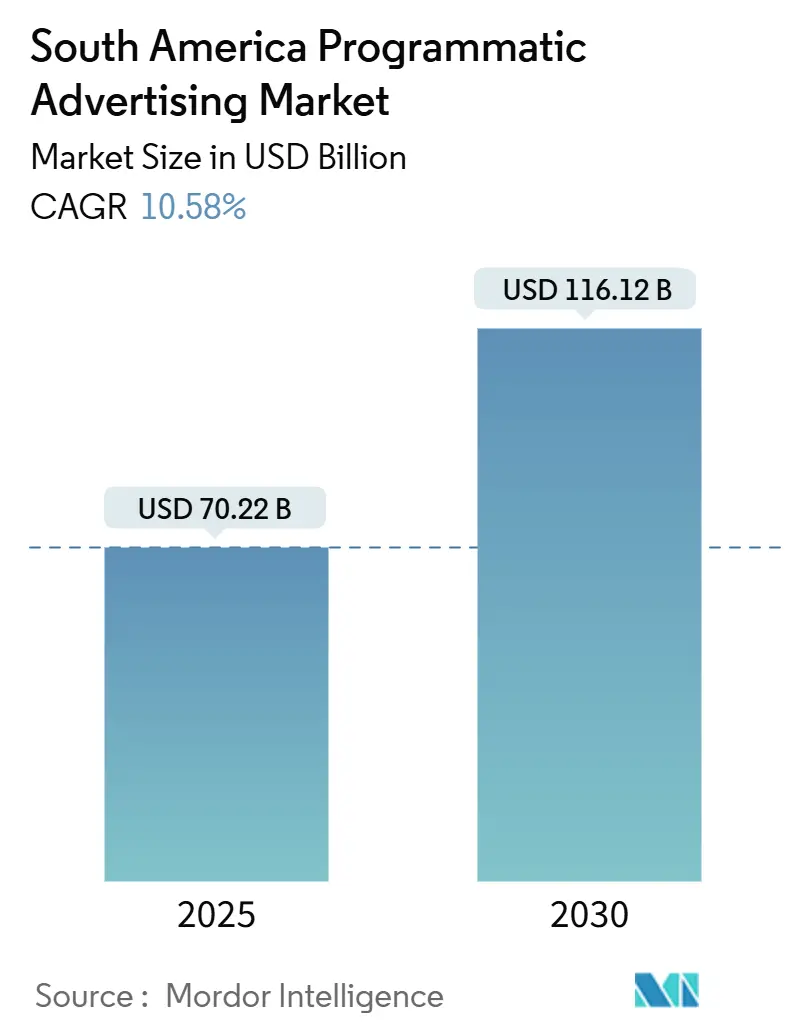
| Market Size (2025) | USD 70.22 Billion |
| Market Size (2030) | USD 116.12 Billion |
| Growth Rate (2025 - 2030) | 10.58 % |
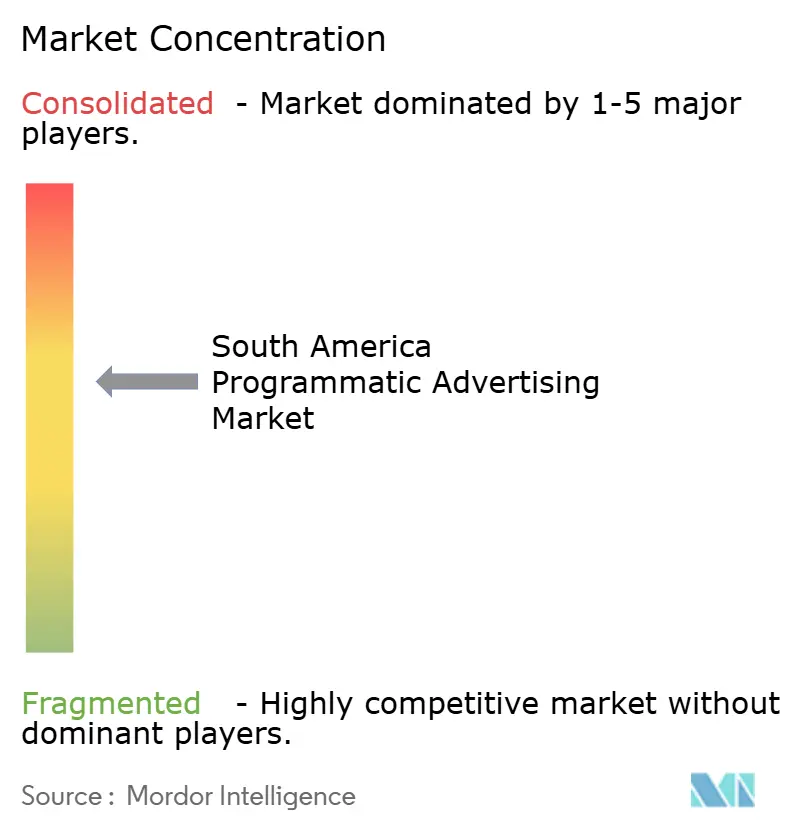
| Market Concentration | Medium |
Major Players *Disclaimer: Major Players sorted in no particular order Image © Mordor Intelligence. Reuse requires attribution under CC BY 4.0. | |
South America Programmatic Advertising Market Analysis by Mordor Intelligence
The South America programmatic advertising market size stands at USD 70.22 billion in 2025 and is forecast to reach USD 116.12 billion by 2030, reflecting a 10.58% CAGR. Growth gathers pace as 418 million residents connect through mobile internet, creating a vast pool of addressable impressions.[1]GSMA Intelligence, “The Mobile Economy Latin America 2024,” gsma.com Connected TV pushes incremental demand, with Brazil’s 89 million monthly viewers positioning the country as the largest CTV market outside the United States.[2]Comscore, “Global Rise of CTV,” comscore.com Advertisers channel budgets into programmatic formats that blend first-party data with artificial intelligence for sharper cross-screen measurement and stronger return on ad spend. Retail media networks operated by e-commerce leaders such as VTEX convert checkout data into premium inventory, easing dependence on third-party cookies. Heightened privacy requirements under Brazil’s LGPD and similar laws raise the compliance bar, prompting platforms to intensify their focus on transparent bidding and direct publisher relationships.
Key Report Takeaways
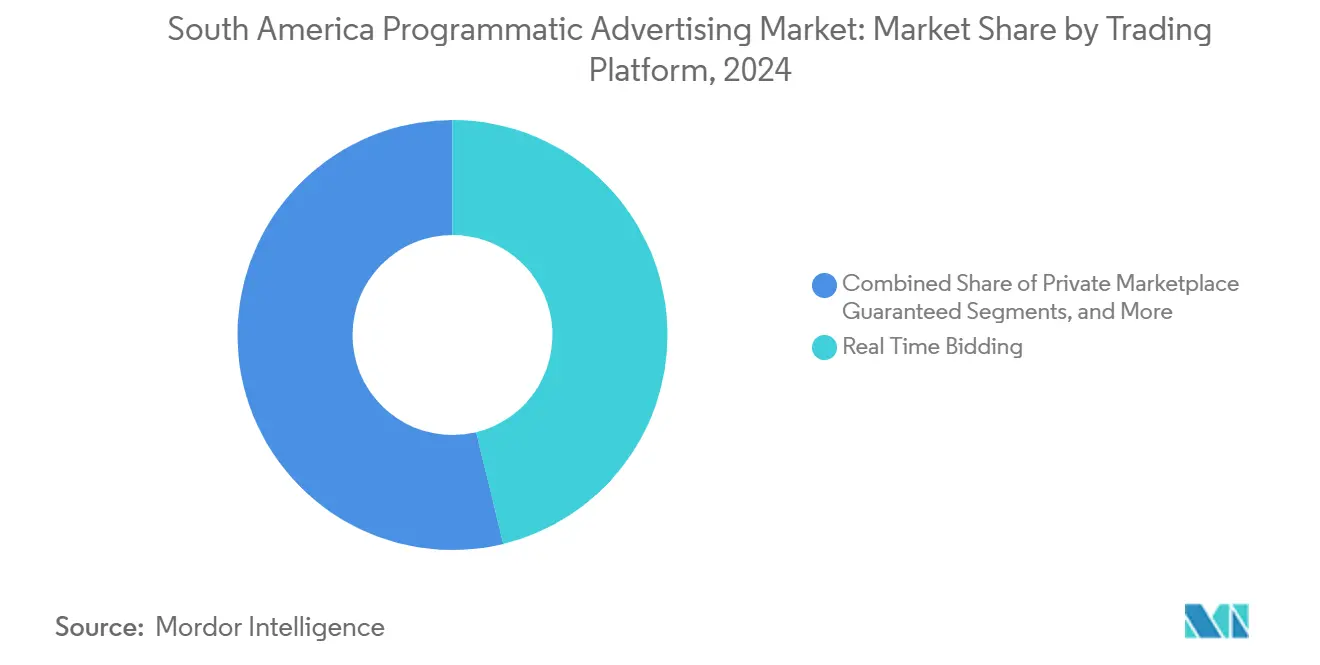
- By trading platform, real time bidding held 46.20% share in 2024; private marketplace guaranteed is projected to grow at a 14.90% CAGR through 2030.
- By advertising media, mobile display secured 57.80% share in 2024; connected TV is forecast to advance at a 12.30% CAGR to 2030.
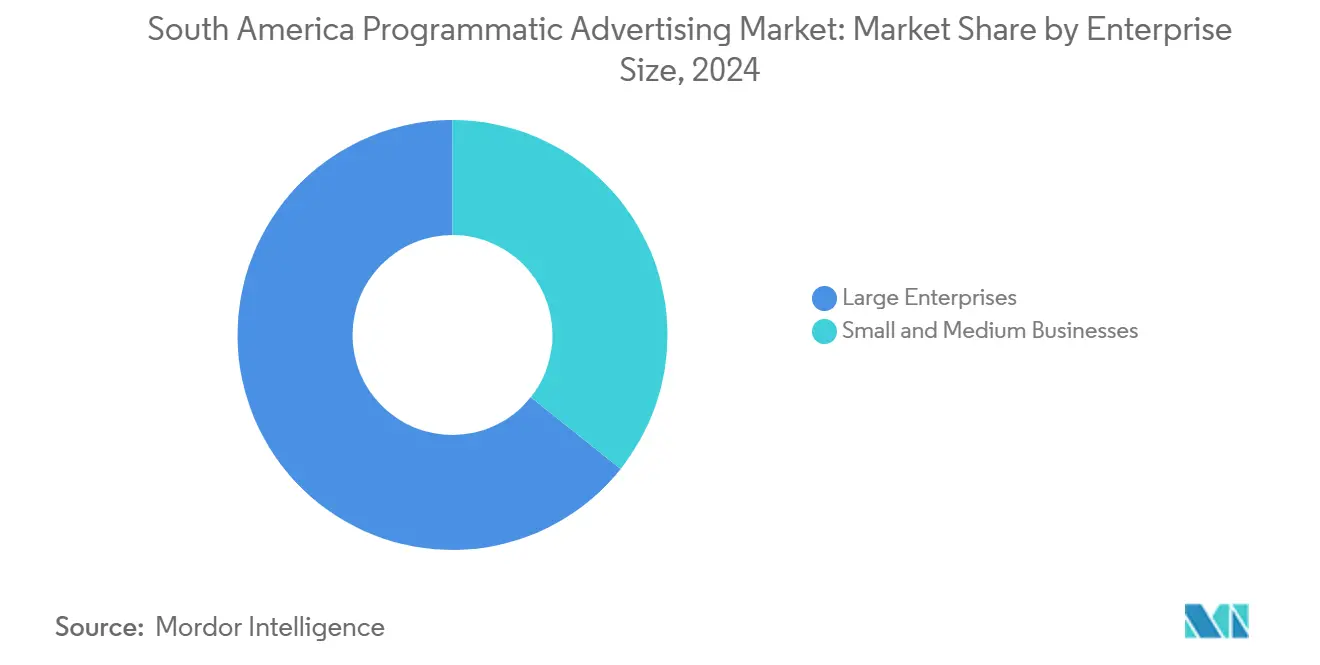
- By enterprise size, large enterprises accounted for 64.30% of spending in 2024; small and medium businesses are set to climb at a 12.70% CAGR by 2030.
- By industry vertical, retail and eCommerce captured 28.50% share in 2024 and is poised to expand at a 13.40% CAGR between 2025 and 2030.
South America Programmatic Advertising Market Trends and Insights
Drivers Impact Analysis*
| Driver | (~) % Impact on CAGR Forecast | Geographic Relevance | Impact Timeline |
|---|---|---|---|
| Surging Mobile Internet Penetration | +2.80% | Brazil, Argentina, Colombia, Chile, Peru | Medium term (2-4 years) |
| Proliferation of Connected TV Inventory | +3.20% | Brazil, Mexico, Argentina, Chile | Long term (≥ 4 years) |
| Adoption of First-Party Data Strategies Post Third-Party Cookie Deprecation | +1.90% | Global, with early gains in Brazil, Argentina | Short term (≤ 2 years) |
| Growth of Digital Media Advertisement Budgets | +2.10% | Brazil, Colombia, Argentina, Chile, Peru | Medium term (2-4 years) |
| Emergence of Retail Media Networks in South America | +2.70% | Brazil, Argentina, Colombia | Long term (≥ 4 years) |
| Programmatic Audio Advertising Uptake | +1.40% | Brazil, Mexico, Argentina | Medium term (2-4 years) |
| Source: Mordor Intelligence | |||
Surging Mobile Internet Penetration
Mobile internet users reached 418 million in 2023, and penetration is projected to hit 78% by 2030, expanding the addressable impression pool for the South America programmatic advertising market. Smartphones account for more than 80% of all connections, enabling accurate location-based and real-time bidding tactics. Monthly data consumption is expected to quadruple to 32 GB per connection by 2030, supporting richer video and interactive formats. Commercial 5G roll-outs promise low-latency auctions that raise win rates and ad viewability. Brazil, Colombia and Chile lead adoption, making them priority markets for mobile-first campaigns that fuse deterministic data with contextual AI targeting.
Proliferation of Connected TV Inventory
Connected TV is the fastest-growing channel in the South America programmatic advertising market, with regional CTV ad spend rising 27% year over year in Q3 2024.[3]Pixalate, “CTV Ad Supply Chain Trends Report – LATAM,” pixalate.com Brazil’s 89 million monthly viewers now represent the biggest audience outside the United States, averaging 4.5 daily viewing hours. Ad-supported video on-demand penetration sits above 95% of CTV households, creating a premium supply that commands higher CPMs. AI-driven contextual ads and private marketplace deals improve brand suitability and fill rates. The dominance of smart TVs 94% of all CTV devices, strengthens household-level targeting and cross-device measurement.
Adoption of First-Party Data Strategies
Cookie deprecation accelerates the migration toward first-party identifiers that bolster audience quality and measurement precision. Retailers, streaming platforms and telcos enrich their logged-in user graphs, helping the South America programmatic advertising market maintain personalization without breaching privacy statutes such as Brazil’s LGPD. Early pilots show improved conversion lift when retailer data fuels look-alike modelling, and private identity frameworks such as UID2 gain traction among publishers seeking interoperable yet secure solutions.
Emergence of Retail Media Networks
Regional e-commerce leaders monetize checkout data to create closed-loop attribution, reinforcing retail media as the most potent engine of growth for the South America programmatic advertising market. Brazil’s online retail sales stood at USD 153 billion in 2024 and are forecast to more than double by 2025, supplying vast purchase-intent signals. VTEX’s acquisition of Newtail extends self-service ad access to 400 advertisers, while Adsmovil’s new retail-media unit accelerates network build-out. First-party context offers brands compliant ways to target audiences as third-party cookies fade.
Restraints Impact Analysis*
| Restraint | (~) % Impact on CAGR Forecast | Geographic Relevance | Impact Timeline |
|---|---|---|---|
| Limited Skilled Programmatic Talent Pool | -1.80% | Brazil, Argentina, Colombia, Chile, Peru | Medium term (2-4 years) |
| Fragmented Publisher Ecosystem Leading to Brand Safety Concerns | -1.30% | Brazil, Argentina, Colombia | Short term (≤ 2 years) |
| Ad-Fraud Incidence in Emerging Markets | -0.90% | Brazil, Argentina, Rest of South America | Short term (≤ 2 years) |
| Data-Privacy Regulatory Uncertainty Across Countries | -1.10% | Brazil, Argentina, Colombia, Chile | Medium term (2-4 years) |
| Source: Mordor Intelligence | |||
Limited Skilled Programmatic Talent Pool
Advanced buying and data-science skills remain concentrated in a handful of metropolitan hubs. Agencies often spend months securing DV360 or Amazon DSP certifications, delaying go-to-market timelines and increasing labour costs. Small advertisers without in-house resources gravitate toward managed-service models, but capacity constraints can create bottlenecks that mute overall growth in the South America programmatic advertising market.
Fragmented Publisher Ecosystem Leading to Brand Safety Concerns
Invalid traffic rates exceed 14% on regional CTV supply and rise past 20% on mobile apps, undermining advertiser trust. Smaller publishers struggle to enforce ads.txt (ads.txt stands for Authorized Digital Sellers, which is a publicly accessible file where publishers declare the sellers who are authorized to sell their inventory) and sellers.json (sellers.json is a publicly accessible ledger used by supply-side platforms (SSPs) and exchanges, which contains details on the inventory they can rightfully sell, inviting arbitrage and opaque reselling. Advertisers respond by concentrating spend within curated marketplaces, sacrificing reach in favour of verified environments.
*Our forecasts treat driver/restraint impacts as directional, not additive. The impact forecasts reflect baseline growth, mix effects, and variable interactions.
Segment Analysis
By Trading Platform: Private Marketplaces Drive Premium Growth
The South America programmatic advertising market size for trading platforms is led by real-time bidding, which retained a 46.20% share in 2024. The demand for open exchanges persists due to their scale and competitive pricing. Yet private marketplace guaranteed deals are projected to log a 14.90% CAGR through 2030 as advertisers seek brand-safe inventory and simpler compliance with privacy laws. Publishers enjoy higher yields and tighter control in these invite-only auctions, which spur supply-side innovation, such as seller-defined audiences and pre-bid verification. Automated guaranteed packages appeal to large enterprises that value fixed pricing combined with automated delivery, while unreserved fixed-rate inventory caters to niche placements where immediacy outweighs the advantages of dynamic pricing.
Publishers and holding-company trading desks accelerate supply-path optimization to curtail hidden fees, improving effective CPMs and transparency. PubMatic’s Activate solution streamlines direct connections that bypass duplicative intermediaries, aligning with global trends toward leaner supply chains. As more impressions migrate to optimized paths, private deals are expected to increase their share of the South America programmatic advertising market over the forecast horizon.



By Advertising Media: Connected TV Accelerates Beyond Mobile
Mobile display secured 57.80% share of the South America programmatic advertising market in 2024, a reflection of the region’s mobile-first behaviour and high prepaid penetration. Rich-media units, rewarded video and app-install formats remain staples for performance marketers. Desktop display holds steady for upper-funnel messaging but loses incremental share to emerging formats. Connected TV, however, is on course for a 12.30% CAGR through 2030, transforming lean-back viewing into measurable, data-driven buys. The South America programmatic advertising market size linked to CTV expands as smart-TV adoption climbs and AVOD services proliferate. Dynamic ad insertion and server-side stitching allow seamless creative swaps, elevating viewer experience and brand recall.
Audio gains momentum as streaming habits deepen. Programmatic pipes now power sequential messaging that bridges audio sessions with complementary display or video exposures, reinforcing omnichannel frequency goals. As measurement vendors standardize incrementality methodologies, advertisers allocate bigger budgets to cross-screen activations that tap both mobile and living-room screens.
By Enterprise Size: SMBs Embrace Cloud-Based Solutions
Large enterprises commanded 64.30% of the South America programmatic advertising market share in 2024, leveraging proprietary data and multi-market footprints to negotiate volume discounts and preferred access to premium supply. Sophisticated stacks integrate demand-side and data-clean-room solutions under unified identity frameworks. Yet small and medium businesses will expand at a 12.70% CAGR to 2030 as cloud-based self-service portals lower cost and skill barriers. Tiered subscription models eliminate minimum-spend thresholds, and AI-powered workflows simplify audience building, bid strategy, and creative iteration.
Platform vendors court SMBs with verticalized templates and localized language support. Certified channel partners bundle training, campaign management, and analytics in one subscription, fostering repeat adoption. As ROI visibility improves, smaller advertisers become a vital growth engine for the South America programmatic advertising market.
By Industry Vertical: Retail Media Transforms Commerce Advertising
Retail and eCommerce held 28.50% share of 2024 spend and is projected to post a 13.40% CAGR through 2030, fuelled by onsite sponsored product ads, offsite display retargeting and shoppable video. Closed-loop attribution that links impression to point-of-sale confirms return on ad spend, prompting packaged-goods brands to reallocate budgets from search to retail networks. Automotive deploys geotargeted creatives that sync with dealership foot traffic peaks, while financial services campaigns pivot to data clean room collaborations that respect KYC obligations. Travel and hospitality engage audiences with dynamic pricing messages tied to real-time inventory, capitalizing on pent-up demand for tourism.
Gaming, fintech, and digital-service providers fall into the “Others” category, utilizing programmatic omnichannel strategies to acquire high-lifetime-value users. The shift toward performance-based KPIs tightens feedback loops, sharpening creative formats and bid multipliers. As vertical boundaries blur, commerce data will underpin an increasingly significant portion of the South America programmatic advertising industry.
Geography Analysis
Brazil anchors the South America programmatic advertising market, propelled by 183 million internet users and 89 million CTV viewers. LGPD compliance efforts standardize consent flows, reducing cross-border frictions and drawing first-mover investment from global platforms. Increased 5G availability further lifts mobile auction liquidity and ad-loading speeds.
Argentina follows as the second-largest contributor, with its robust smartphone base and high banking penetration attracting premium-brand budgets. Regulatory alignment with the European Union eases data mobility, making the market attractive for multinational campaigns. Advanced digital out-of-home networks in Buenos Aires and Córdoba integrate with demand-side platforms, extending omnichannel reach.
Colombia, Chile, and Peru represent the fastest-growing cluster within the South America programmatic advertising market. Rising middle-class populations and supportive telecom regulation hasten broadband uptake, while local publishers adopt open-measurement SDKs that improve viewability verification. Although smaller in absolute terms, the Rest of South America, including Uruguay, Paraguay, and Ecuador, offers green-field potential as connectivity improves and local agencies upskill.[4]DataReportal, “Digital 2025: Brazil,” datareportal.com
Competitive Landscape
Consolidation intensifies as end-to-end stacks compete for incremental budgets inside the South America programmatic advertising market. Google maintains a lead position through Display and Video 360, Ad Manager, and Campaign Manager 360; new links to Netflix inventory promise cross-screen metrics that blend streaming and linear audiences. Amazon doubles down on proprietary demand-side technology, pairing retailer first-party data with machine-learning optimization that automatically adjusts bids based on predicted propensity to purchase. The Trade Desk emphasizes identity interoperability, championing UID2 as a regional cookie-less alternative.
Regional specialists such as Adsmovil carve niches in retail media, leveraging bespoke cultural insights to deliver contextually relevant placements. TenX, OMG Peru, and other certified agencies bridge talent gaps by offering turnkey managed service packages. Supply-side vendors PubMatic and Magnite roll out curated marketplaces to reduce fraud and enhance transparency, while Vistar Media and Hivestack expand their programmatic digital-out-of-home footprints. AI-native disruptors enter with privacy-preserving modelling that keeps user-level data within secure enclaves, aligning with stricter data-protection codes.
South America Programmatic Advertising Industry Leaders
SmartyAds Inc.
Jampp Inc.
BidMind by Fiksu
Adsmovil, LLC
MediaMath Inc.
- *Disclaimer: Major Players sorted in no particular order

Recent Industry Developments
- March 2025: Canela Media opened offices in Colombia and Miami and partnered with Paramount to commercialize Pluto TV, boosting combined regional sales fourfold.
- March 2025: Adsmovil named Juan Pablo Suárez VP Business Development Retail Media to scale network expansion.
- February 2025: Google added Netflix video inventory and The Trade Desk tag routing to Campaign Manager 360 for unified reporting.
- January 2025: VTEX acquired Newtail, adding 400 advertisers to its retail-media offering across the Americas.


South America Programmatic Advertising Market Report Scope
Programmatic Advertising is the utilization of software to buy digital advertising. This automation streamlines transactions, making them more efficient and effective, while consolidating your digital advertising efforts on a single technology platform.
The South America Programmatic Advertisement Market is segmented by Trading Platform (Real-Time Bidding, Private Marketplace Guaranteed, Automated Guaranteed, and Unreserved Fixed-rate), by Advertising Media (Digital Display and Mobile Display), and by Enterprise size (SMBs and Large Enterprises). The Market Forecasts are Provided in Terms of Value (USD). The scope of the study tracks the impact of COVID-19 on the studied market.
By Trading Platform
| Real Time Bidding (RTB) |
| Private Marketplace Guaranteed |
| Automated Guaranteed |
| Unreserved Fixed-rate |
By Advertising Media
| Digital Display |
| Mobile Display |
| Connected TV |
| Audio |
By Enterprise Size
| Small and Medium Businesses |
| Large Enterprises |
By Industry Vertical
| Retail and eCommerce |
| Consumer Packaged Goods |
| Automotive |
| Financial Services |
| Travel and Hospitality |
| Other Industry Vertical |
By Country
| Brazil |
| Argentina |
| Colombia |
| Chile |
| Peru |
| Rest of South America |
| By Trading Platform | Real Time Bidding (RTB) |
| Private Marketplace Guaranteed | |
| Automated Guaranteed | |
| Unreserved Fixed-rate | |
| By Advertising Media | Digital Display |
| Mobile Display | |
| Connected TV | |
| Audio | |
| By Enterprise Size | Small and Medium Businesses |
| Large Enterprises | |
| By Industry Vertical | Retail and eCommerce |
| Consumer Packaged Goods | |
| Automotive | |
| Financial Services | |
| Travel and Hospitality | |
| Other Industry Vertical | |
| By Country | Brazil |
| Argentina | |
| Colombia | |
| Chile | |
| Peru | |
| Rest of South America |


Key Questions Answered in the Report
How large is the South America programmatic advertising market in 2025?
It is valued at USD 70.22 billion and is projected to grow at a 10.58% CAGR to USD 116.12 billion by 2030.
Which trading platform leads spend?
Real time bidding holds 46.20% of 2024 spend, reflecting continued preference for open exchange scale.
Why is connected TV attracting higher growth?
Rapid smart-TV adoption and ad-supported streaming have pushed CTV ad spend to a projected 12.30% CAGR, outperforming all other media.
What drives retail media momentum?
First-party transaction data and closed-loop attribution make retail media the fastest-growing vertical at a 13.40% CAGR through 2030.
How does Brazil influence regional performance?
Brazil's 89 million CTV users and advanced LGPD framework position it as the largest and most sophisticated programmatic market in South America.
What is the main challenge facing advertisers?
Brand safety concerns tied to fragmented publisher supply and elevated invalid-traffic rates remain the most pressing restraint.
Page last updated on:





