
South America OOH And DOOH Market Size and Share
Market Overview
| Study Period | 2019 - 2030 |
|---|---|
| Forecast Data Period | 2025 - 2030 |
| Historical Data Period | 2019 - 2023 |
| Market Size (2025) | USD 1 Billion |
| Market Size (2030) | USD 1.33 Billion |
| Growth Rate (2025 - 2030) | 6.01 % |
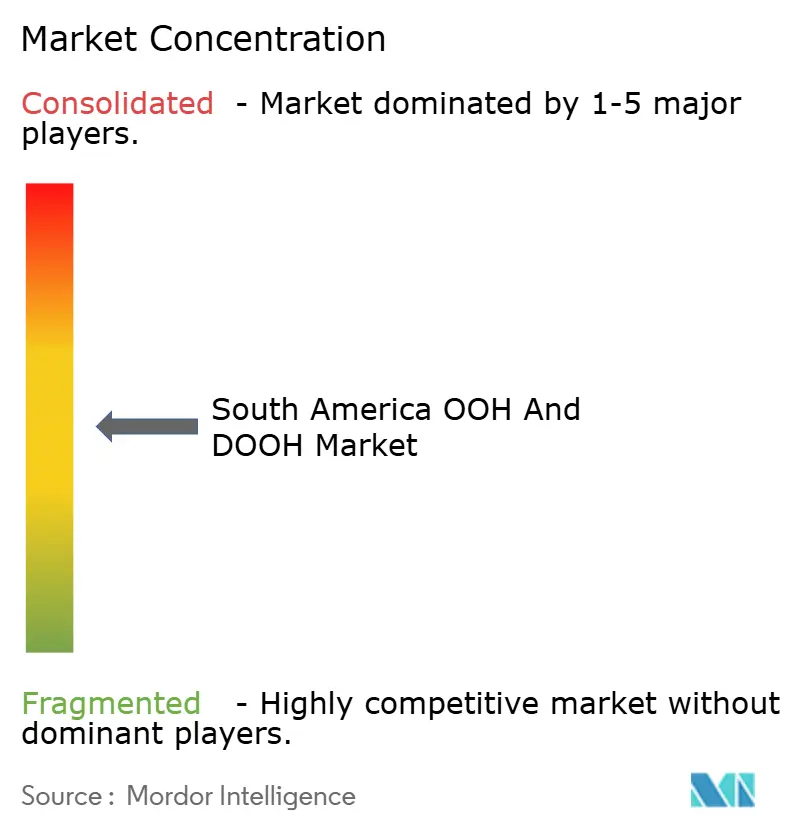
| Market Concentration | Medium |
Major Players *Disclaimer: Major Players sorted in no particular order Image © Mordor Intelligence. Reuse requires attribution under CC BY 4.0. | |
South America OOH And DOOH Market Analysis by Mordor Intelligence
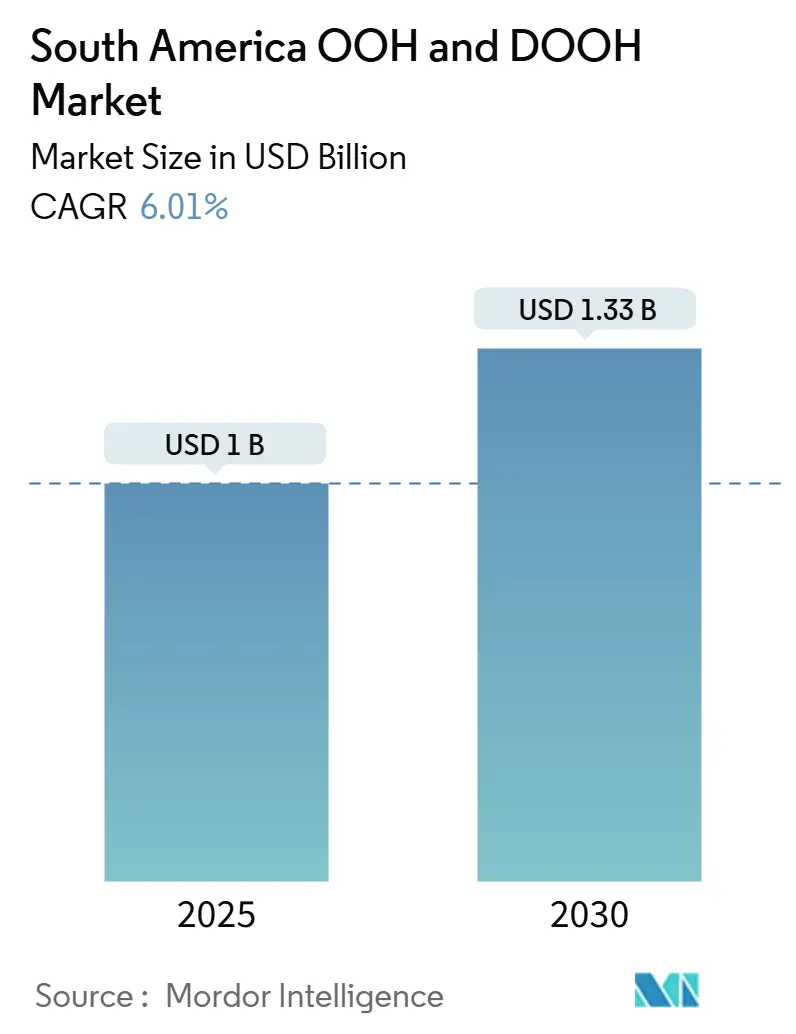
The South America OOH and DOOH market size stands at USD 1.00 billion in 2025 and is projected to climb to USD 1.33 billion by 2030, registering a 6.01% CAGR. This growth reflects accelerated digitization of static assets, wider programmatic buying, and smart-city infrastructure that elevates inventory yield and measurement precision. Digital formats already account for 56.83% of total revenue, a figure supported by long-term municipal concessions that underwrite large LED roll-outs. Programmatic OOH, enabled by first-party telco mobility data, 5G connectivity, and distributed edge computing, advances as the industry’s high-velocity engine, expanding 8.22% through 2030. Transportation applications outpace classic billboards because airports, metro systems, and bus networks monetize extended dwell times with dynamic content. Meanwhile, healthcare advertisers gravitate toward DOOH to deliver compliance-controlled messaging in captive venues such as clinics and pharmacies, while retailers integrate street-level screens into omnichannel retail-media networks.
Key Report Takeaways
- By type, Digital OOH led with a 56.83% share of the South America OOH and DOOH market in 2024 and is projected to advance at a 6.3% CAGR through 2030.
- By application, transportation accounted for 38.2% of the South America OOH and DOOH market size in 2024 and is expected to grow at a 7.44% CAGR through 2030.
- By end user, healthcare is expanding at a 7.44% CAGR through 2030 in the South America OOH and DOOH market, while retail and consumer goods retained a 31.82% revenue share in 2024.
Note: Market size and forecast figures in this report are generated using Mordor Intelligence’s proprietary estimation framework, updated with the latest available data and insights as of January 2026.
Market Trends and Insights
Drivers Impact Analysis of South America OOH And DOOH Market*
| Driver | (~) % Impact on CAGR Forecast | Geographic Relevance | Impact Timeline |
|---|---|---|---|
| Programmatic-ready street furniture roll-outs | +1.2% | Brazil, Mexico, Colombia core markets | Medium term (2-4 years) |
| 5G and edge-computing enabling real-time creative optimisation | +0.8% | Major urban centers across region | Long term (≥ 4 years) |
| First-party telco mobility data partnerships | +0.9% | Brazil, Mexico, Argentina with established telco infrastructure | Medium term (2-4 years) |
| Mainstream migration of TV and CTV budgets into DOOH | +1.4% | Regional, strongest in Brazil and Mexico | Short term (≤ 2 years) |
| Government smart-city tenders bundling OOH inventory | +0.7% | Chile, Colombia, Costa Rica leading adoption | Medium term (2-4 years) |
| Surging pan-regional retail-media networks needing omnichannel reach | +1.1% | Regional, concentrated in major retail markets | Short term (≤ 2 years) |
| Source: Mordor Intelligence | |||
Programmatic-ready Street Furniture Roll-outs
Municipal contracts increasingly bundle digital bus shelters, kiosks, and information panels with Wi-Fi hotspots and environmental sensors, creating long-term revenue streams that subsidize hardware costs. Eletromidia operates 66,652 advertising faces across 80 Brazilian cities and reports that orders for programmatic-enabled street furniture are rising faster than those for classic billboards. About one-quarter of all Brazilian DOOH campaigns now trade programmatically, matching adoption levels in mature Western markets. Twelve- to fifteen-year concession terms give operators predictable cash flows to amortize LED outlays, while programmatic yield management adds upside during peak demand windows.
5G and Edge Computing Enabling Real-Time Creative Optimisation
American Tower maintains 48,000+ sites in South America, many hosting micro-edge data centers that provide sub-10 ms latency essential for dynamic bidding and content swaps. AWS Local Zones in Rio, Bogotá, Buenos Aires, Lima, Querétaro, and Santiago support AI-driven creative that responds to weather, traffic, or audience composition in real time. Operators leveraging distributed compute shorten ad-render times, cut the risk of auction timeouts, and enable privacy-preserving on-device analytics.
First-Party Telco Mobility Data Partnerships
Claro, TIM Brasil, and Telefónica agree to share anonymized mobility insights with screen networks under Brazil’s LGPD framework, allowing advertisers to buy impressions based on verified footfall and dwell time. Eletromidia uses telco signals to build hourly audience profiles, boosting CPMs by up to 18% versus location proxies. Similar tie-ups in Mexico and Argentina provide a measurement layer that aligns DOOH with digital video standards.
Mainstream Migration of TV and CTV Budgets into DOOH
Dentsu projects that DOOH will grow 8.6% in 2025 as linear TV loses reach among younger audiences. Advertisers appreciate unified buying platforms where DOOH inventory appears alongside online video, allowing frequency capping and incremental reach analysis. JCDecaux generated EUR 100.2 million in programmatic sales in 2023 and targets 20–30% of digital revenue from automated channels by 2025.
Restraints Impact Analysis of South America OOH And DOOH Market*
| Restraint | (~) % Impact on CAGR Forecast | Geographic Relevance | Impact Timeline |
|---|---|---|---|
| Currency volatility inflating imported LED hardware costs | -0.9% | Regional, particularly Argentina, Chile, Colombia | Short term (≤ 2 years) |
| Fragmented municipal permitting laws | -0.7% | Regional, varies by jurisdiction complexity | Medium term (2-4 years) |
| Audience-measurement standardisation gaps | -0.5% | Regional, affecting programmatic adoption | Medium term (2-4 years) |
| Power-supply unreliability in secondary cities | -0.4% | Secondary urban markets across region | Long term (≥ 4 years) |
| Source: Mordor Intelligence | |||
Currency Volatility Inflating Imported LED Hardware Costs
Exchange rate fluctuations against the USD lead to cost inflation for LED displays, which are predominantly imported from Asian manufacturers. The Brazilian Senate's LED panel procurement totaling BRL 1.6 million (USD 0.30 million) for institutional displays highlights the significant capital requirements for high-quality digital infrastructure. The Argentine peso devaluation and fluctuations in the Chilean peso compound procurement challenges for operators planning multi-year rollout programs. This currency exposure creates competitive advantages for operators with USD-denominated financing or established supplier relationships that provide currency hedging mechanisms.
Fragmented Municipal Permitting Laws
Regulatory complexity across South American jurisdictions creates operational inefficiencies and delays in expansion for DOOH operators seeking regional scale. Municipal permitting requirements vary significantly between cities, with some jurisdictions, such as Mexico City, implementing comprehensive digital signage regulations, while others maintain outdated frameworks designed for static advertising. Costa Rica's national advertising regulations provide more standardized frameworks, but implementation varies at the municipal level, creating compliance challenges for operators seeking nationwide coverage.
*Our forecasts treat driver/restraint impacts as directional, not additive. The impact forecasts reflect baseline growth, mix effects, and variable interactions.
South America OOH And DOOH Market Segment Analysis
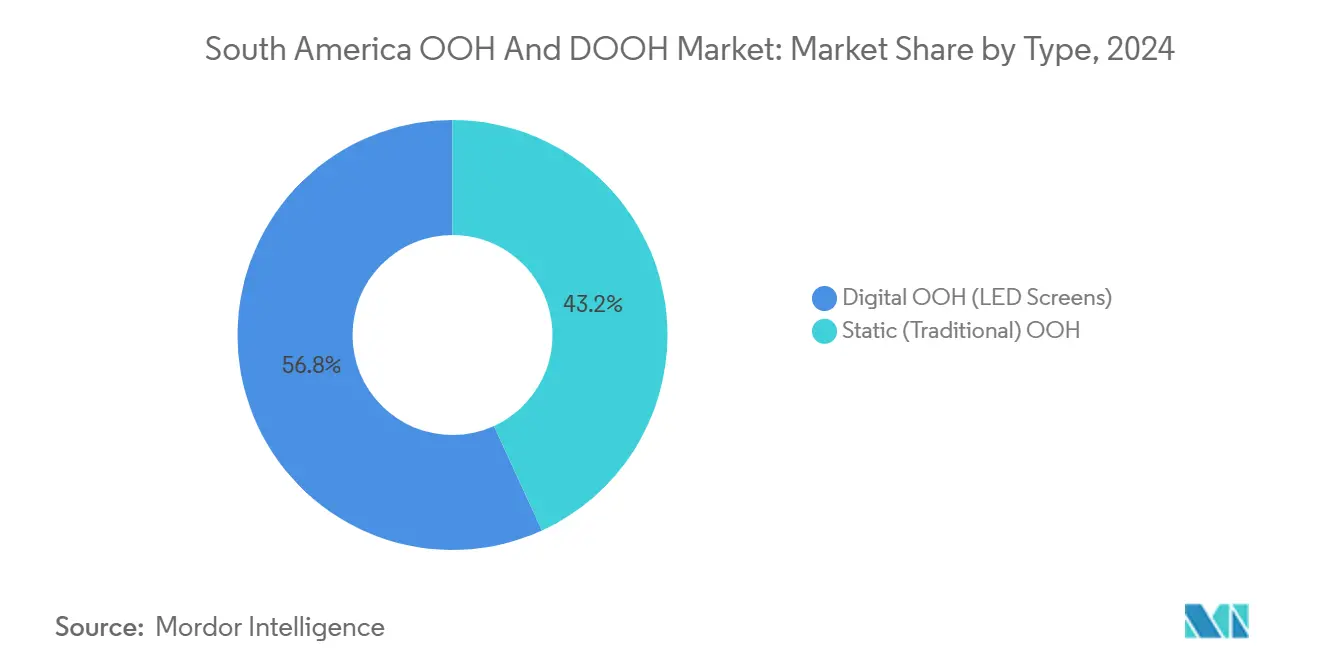
Digital OOH captured 56.83% South America OOH and DOOH market share in 2024, establishing clear dominance over static formats as operators prioritize higher-yield inventory capable of dynamic content delivery and programmatic integration. The South America OOH and DOOH market size for digital formats continues to expand as advertisers shift budgets toward measurable, targetable inventory that provides attribution data comparable to digital advertising channels. Programmatic OOH represents the fastest-growing subsegment at 8.22% CAGR through 2030, driven by advertiser demand for automated buying workflows and real-time optimization capabilities.
OXXO's deployment of over 8,000 digital screens across Mexico demonstrates the scale potential for retail-integrated DOOH networks, with Place Exchange providing programmatic infrastructure that enables automated inventory trading. The programmatic integration transforms static advertising locations into dynamic inventory pools where pricing fluctuates based on real-time demand, weather conditions, and audience demographics. This technological evolution creates sustainable competitive moats for operators who invest in programmatic infrastructure, as manual trading processes cannot match the efficiency and yield optimization of automated systems.
By Application:
Transportation Grows 7.44% Annually While Billboards Maintain 38.74% ShareBillboard applications maintained 38.74% South America OOH and DOOH market share in 2024, reflecting their continued importance for mass-reach campaigns, while Transportation segments achieve 7.44% CAGR through 2030, outperforming static formats through digitization and extended audience exposure times. The South America OOH and DOOH market size for transportation applications benefits from captive audiences with extended dwell times, enabling premium pricing for luxury and travel-related advertising categories. Street Furniture applications gain momentum through smart city integration, where digital bus shelters and kiosks provide municipal services alongside advertising inventory.
JCDecaux's presence in 22 commercial airports across South America, with 5,643 advertising panels, demonstrates the strategic value of transportation inventory where passenger flow patterns enable predictive pricing and dynamic content optimization. São Paulo's metro Orange Line expansion, targeted by Eletromidia for major concession opportunities, illustrates how transportation infrastructure development creates new DOOH inventory in high-traffic corridors. Transportation DOOH also benefits from integrated mobility data that enables audience verification and campaign attribution, addressing measurement standardization challenges that limit programmatic adoption in other application categories.
By End User:
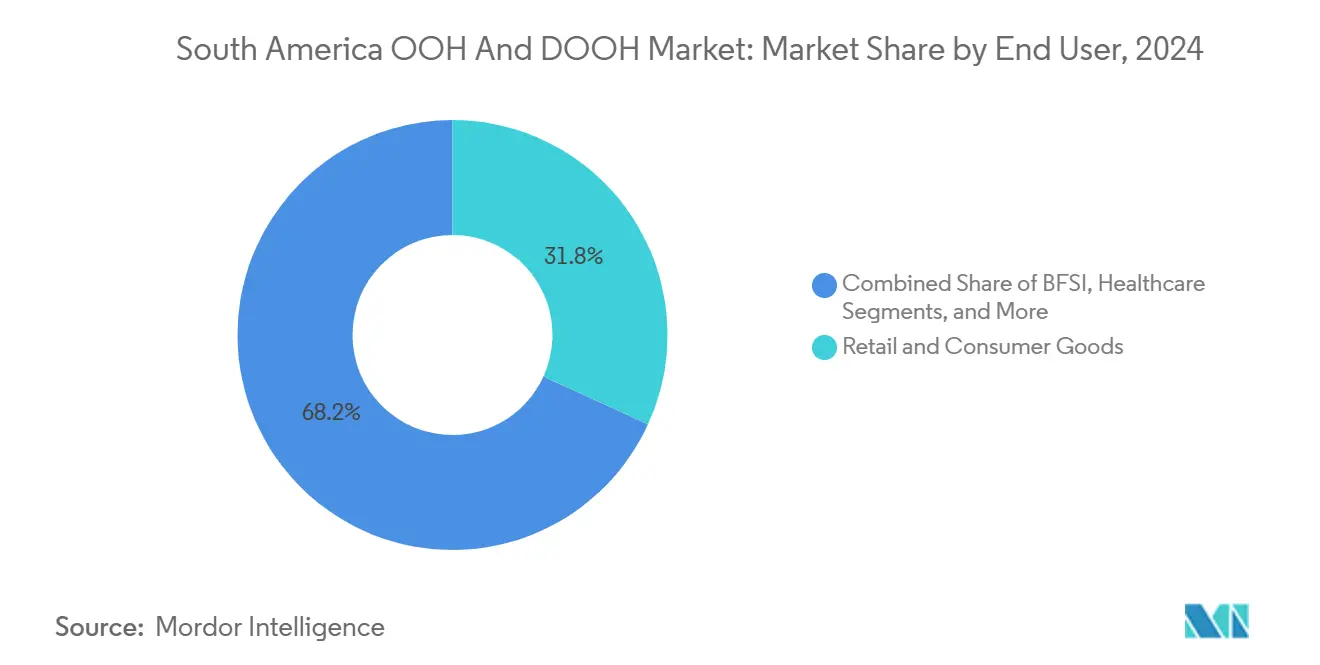
Retail Maintains 31.82% Share While Healthcare Grows 7.44% AnnuallyRetail and Consumer Goods commanded 31.82% South America OOH and DOOH market share in 2024, leveraging DOOH's ability to drive immediate purchase decisions through location-based messaging and promotional campaigns. Healthcare achieves the fastest growth at 7.44% CAGR through 2030, driven by pharmaceutical companies and healthcare providers utilizing DOOH's controlled environment advantages for compliance-sensitive messaging. The South America OOH and DOOH market size for healthcare applications benefits from DOOH's unique ability to deliver targeted health messaging in controlled environments where audience attention levels exceed traditional advertising channels.
Grupo NÓS's expansion into Brazilian favelas, installing 100 new digital screens across 12 communities with programmatic integration, demonstrates healthcare sector opportunities in underserved markets where traditional media penetration remains limited. Pharmaceutical companies particularly value DOOH's compliance capabilities, where content approval workflows and automated scheduling ensure regulatory adherence across multiple jurisdictions. The retail media network expansion, exemplified by Carrefour Brazil's partnership with JCDecaux for in-store digitization, creates omnichannel advertising opportunities that integrate street-level DOOH with point-of-sale messaging.

Geography Analysis
Brazil OOH and DOOH Market
Brazil dominates the South American DOOH landscape through established infrastructure and regulatory frameworks that support large-scale digital deployments. Eletromidia's 66,652 panel network across 80 Brazilian cities demonstrates the market's maturation, with Q1 2024 net income reaching BRL 66 million (USD 12.30 million), representing 6x year-over-year growth driven by events sector expansion and programmatic adoption. Globo's BRL 1.7 billion (USD 0.32 billion) acquisition of Eletromidia control, approved by CADE in December 2024, signals major media conglomerate confidence in DOOH growth potential and cross-channel integration opportunities. The Brazilian South America OOH and DOOH market share benefits from advanced programmatic infrastructure, with 25% of DOOH campaigns incorporating programmatic elements and 51% using exclusively programmatic buying workflows.
Mexico and South America OOH and DOOH Market
Mexico represents the second-largest market opportunity, with OXXO's 8,000+ digital screen deployment demonstrating retail media network scale potential and programmatic integration capabilities. Global Vía Pública's USD 34 million acquisition of Clear Channel operations in Mexico, Peru, and Chile creates a regional platform spanning five key South American markets with integrated DOOH capabilities.
Central America and South America OOH and DOOH Market
Central America benefits from JCDecaux's systematic consolidation, including the merger with Grupo Publigrafik creating a joint venture across six countries and the acquisition of IMC in Costa Rica, establishing comprehensive regional coverage with approximately 24,000 combined advertising panels. The formation of ALOOH (South American Out of Home Association) in August 2024, representing over 25 companies across Argentina, Colombia, Mexico, and Uruguay, creates industry coordination mechanisms that could accelerate standardization and cross-border campaign facilitation.
Competitive Landscape
The South American DOOH market exhibits moderate fragmentation with ongoing consolidation as global operators compete alongside regional specialists for premium inventory and municipal concessions. South America OOH and DOOH market share concentration increases through strategic acquisitions, exemplified by Global Vía Pública's USD 34 million purchase of Clear Channel's regional operations and Globo's BRL 1.7 billion (USD 0.32 billion) acquisition of Eletromidia control, creating integrated media platforms that combine traditional broadcasting with street-level advertising inventory. Technology differentiation emerges as a key competitive factor, with operators investing in programmatic infrastructure, edge computing capabilities, and data analytics platforms to capture premium pricing and automate inventory management.
JCDecaux maintains regional leadership through systematic expansion, claiming 91,682 advertising panels across South America and establishing joint ventures in Central America that create economies of scale for programmatic deployment and cross-border campaign execution. White-space opportunities exist in secondary cities where power supply reliability and municipal permitting complexity create barriers for large-scale operators, enabling regional players to establish local market dominance. Emerging disruptors focus on niche segments, including Grupo NÓS's expansion into Brazilian favelas and Maely OOH's partnership with C2R to digitize São Paulo bus networks, demonstrating how specialized operators capture underserved market segments through innovative deployment strategies.
South America OOH And DOOH Industry Leaders
-
JCDecaux SE
-
Samba Digital Ltda.
-
PRODOOH Tecnologia LTDA
-
Hivestack Inc.
-
Broadsign International LLC
- *Disclaimer: Major Players sorted in no particular order
South America OOH And DOOH Market Companies Covered in this Report
- JCDecaux SE
- Clear Channel Outdoor Americas Inc.
- Lamar Advertising Company
- Grupo Starlite Publicidad Exterior S.A. de C.V.
- Hivestack Inc.
- Broadsign International LLC
- Vistar Media LLC
- Samba Digital Ltda.
- PRODOOH Tecnologia LTDA
- Mooving Walls Pte Ltd.
- Adsmovil S.A.S.
- Outfront Media Inc.
- Posterscope Worldwide Ltd.
- Grupo Mídia Out of Home Brasil S.A.
- Eletromidia S.A.
- Grupo IMX Media S.A.P.I. de C.V.
- Latcom S.A.
- Kinetic Worldwide Ltd.
- OOH!Media Limited
- Focus Media Latinoamérica SpA
Recent Industry Developments in South America OOH And DOOH Market
- February 2025: Global Vía Pública acquired Clear Channel operations in Mexico, Peru, and Chile for USD 34 million, expanding its presence to five key South American markets and positioning itself as a regional OOH leader focused on smart-city aligned communication solutions.
- February 2025: JCDecaux Top Media acquired High Traffic Media in Panama, completing its Panama portfolio with over 5,000 advertising panels across street furniture, billboards, transport, and retail locations while strengthening Central America regional headquarters capabilities.
- October 2024: Globo completed its BRL 1.7 billion acquisition of Eletromidia control after CADE approval, securing 74.01% ownership of Brazil's largest OOH media company with 66,652 panels nationwide and creating integrated TV-digital-street media platform.
- October 2024: JCDecaux Top Media acquired 70% of IMC, Costa Rica's leading OOH company with approximately 4,000 advertising panels, forming a joint venture across six Central American countries and strengthening regional DOOH capabilities.
South America OOH And DOOH Market Report Scope
Digital out-of-home (DOOH) advertising involves showcasing dynamic digital ads in public spaces, indoors or outdoors. It is essentially a fusion of digital technology with the traditional out-of-home advertising landscape. This transition to digital OOH has eclipsed the more traditional offline approaches.
The South America OOH and DOOH Market Report is Segmented by Type (Static OOH and Digital OOH), Application (Billboard, Transportation, Street Furniture, and Other Place-Based Media), End User (Automotive, Retail and Consumer Goods, Healthcare, BFSI, and Other End Users). The Market Forecasts are Provided in Terms of Value (USD).
Segmentation Overview
| Static (Traditional) OOH | |
| Digital OOH (LED Screens) | Programmatic OOH |
| Others |
| Billboard | |
| Transportation (Transit) | Airports |
| Others (Buses, etc.) | |
| Street Furniture | |
| Other Place-based Media |
| Automotive |
| Retail and Consumer Goods |
| Healthcare |
| BFSI |
| Other End Users |
| By Type | Static (Traditional) OOH | |
| Digital OOH (LED Screens) | Programmatic OOH | |
| Others | ||
| By Application | Billboard | |
| Transportation (Transit) | Airports | |
| Others (Buses, etc.) | ||
| Street Furniture | ||
| Other Place-based Media | ||
| By End User | Automotive | |
| Retail and Consumer Goods | ||
| Healthcare | ||
| BFSI | ||
| Other End Users | ||
Key Questions Answered in the Report
How big is the South America OOH And DOOH Market?
The South America OOH And DOOH Market size is expected to reach USD 1 billion in 2025 and grow at a CAGR of 6.01% to reach USD 1.33 billion by 2030.
What is the current South America OOH And DOOH Market size?
In 2025, the South America OOH And DOOH Market size is expected to reach USD 1 billion.
Who are the key players in South America OOH And DOOH Market?
JCDecaux SE, Samba Digital, PRODOOH, Broadsign and Hivestack are the major companies operating in the Latin America OOH And DOOH Market.
What years does this South America OOH And DOOH Market cover, and what was the market size in 2024?
In 2024, the South America OOH And DOOH Market size was estimated at USD 0.94 billion. The report covers the Latin America OOH And DOOH Market historical market size for years: 2019, 2020, 2021, 2022, 2023 and 2024. The report also forecasts the Latin America OOH And DOOH Market size for years: 2025, 2026, 2027, 2028, 2029 and 2030.