
Market Overview
| Study Period | 2020 - 2031 |
|---|---|
| Forecast Data Period | 2026 - 2031 |
| Base Year Market Size (2025) | USD 1.26 Billion |
| Market Size (2026) | USD 1.51 Billion |
| Market Size (2031) | USD 3.74 Billion |
| Growth Rate (2026 - 2031) | 19.86 % |
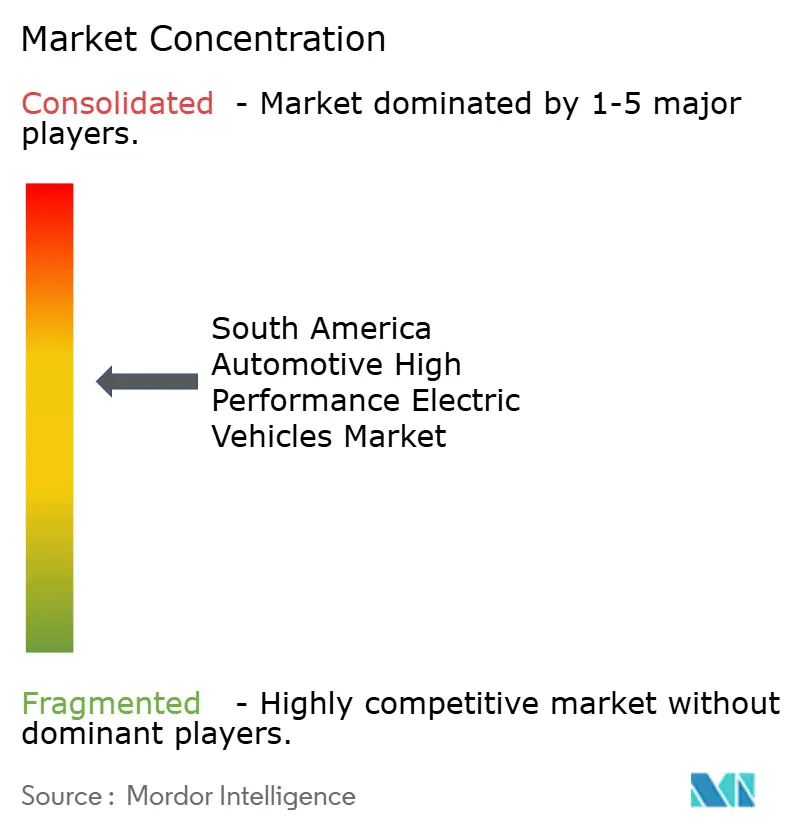
| Market Concentration | Medium |
Major Players *Disclaimer: Major Players sorted in no particular order Image © Mordor Intelligence. Reuse requires attribution under CC BY 4.0. | |
South America Automotive High Performance Electric Vehicles Market Analysis by Mordor Intelligence
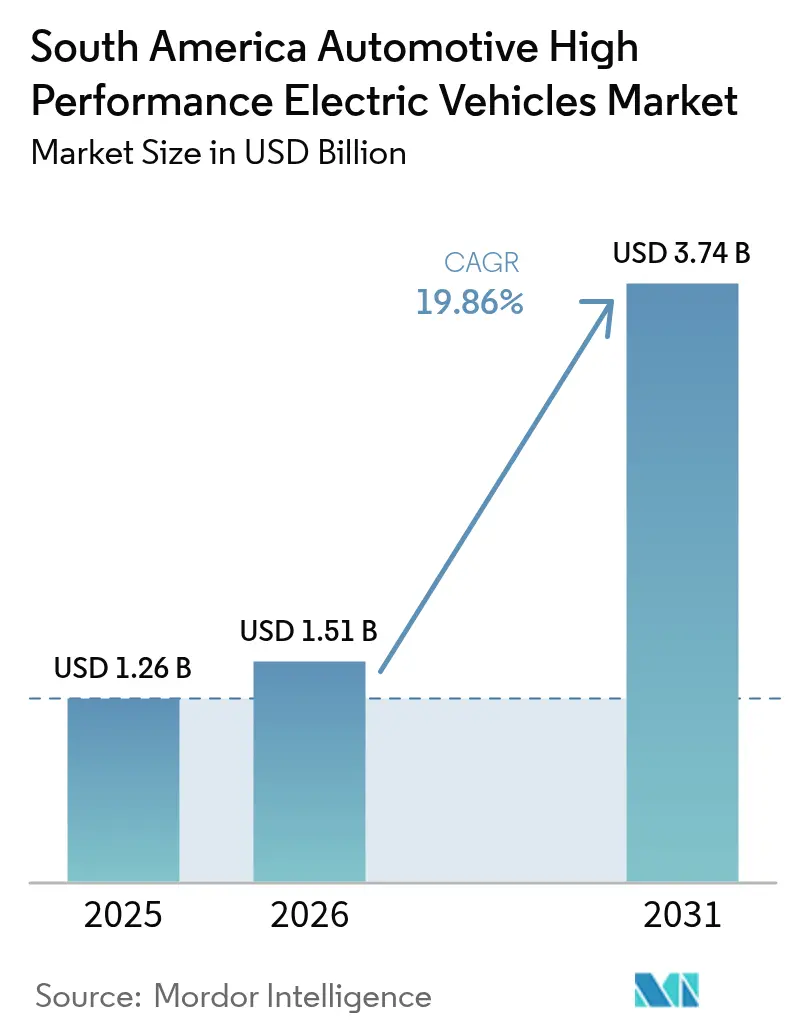
The South American automotive high-performance electric vehicle market size was valued at USD 1.26 billion in 2025 and estimated to grow from USD 1.51 billion in 2026 to reach USD 3.74 billion by 2031, at a CAGR of 19.86% during the forecast period (2026-2031). This sustained expansion reflects several intertwined forces, including the aggressive entry of Chinese OEMs, large-scale localization commitments from incumbent automakers, and regional supply-chain integration anchored in the lithium triangle. Passenger vehicles dominate sales volume, yet light commercial fleets accelerate faster as last-mile delivery operators chase operating-cost savings. Flex-fuel heritage keeps plug-in hybrids in the lead today, but battery-electric adoption is climbing quickly as public DC corridors roll out and price-performance parity improves. Policy remains a double-edged sword: Brazil’s MOVER program rewards low-emission vehicles even as the ethanol lobby slows full BEV incentives, creating a nuanced playing field for manufacturers and investors.
Key Report Takeaways
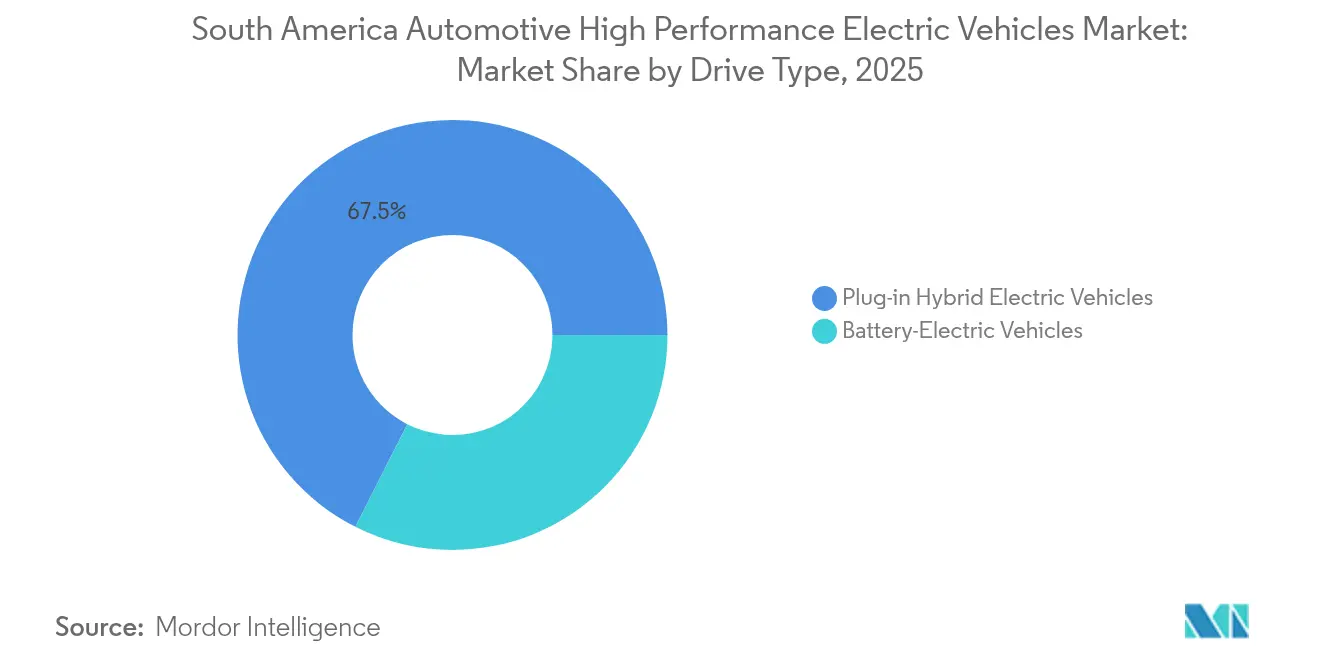
- By drive type, plug-in hybrids led with 67.54% of South America electric vehicle market share in 2025, while battery-electric vehicles are projected to expand at an 17.91% CAGR to 2031.
- By vehicle type, passenger cars accounted for 85.76% of the South America electric vehicle market size in 2025, whereas light commercial vehicles are advancing at a 19.05% CAGR through 2031.
- By peak power output, the 201-400 kW segment captured 55.68% share of the South America electric vehicle market size in 2025; systems above 400 kW are set to grow at a 16.74% CAGR.
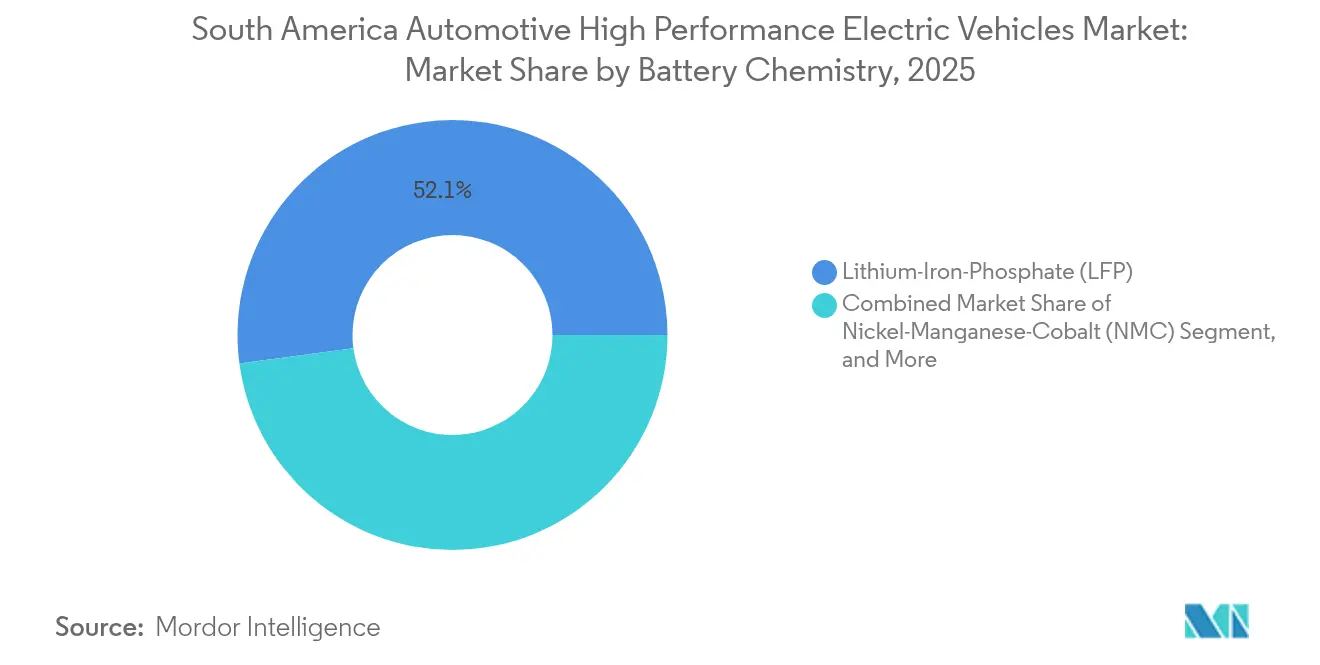
- By battery chemistry, lithium iron phosphate held 52.12% share of the South America electric vehicle market size in 2025, while nickel manganese cobalt batteries record the fastest 21.01% CAGR.
- By price band, sub-USD 50,000 models commanded 57.54% share of the South America electric vehicle market size in 2025; the USD 50,001-75,000 bracket is rising at a 16.32% CAGR.
- By geography, Brazil controlled 65.02% of South America electric vehicle market share in 2025, whereas Uruguay is forecast to post the quickest 19.26% CAGR to 2031.
Note: Market size and forecast figures in this report are generated using Mordor Intelligence’s proprietary estimation framework, updated with the latest available data and insights as of 2026.
South America Automotive High Performance Electric Vehicles Market Trends and Insights
Drivers Impact Analysis*
| Driver | (~ ) % Impact on CAGR Forecast | Geographic Relevance | Impact Timeline |
|---|---|---|---|
| Integrating Lithium-Triangle Supply Chains into Regional BEV Builds | +4.1% | Chile, Argentina, Bolivia production, Brazil assembly | Long term (≥ 4 years) |
| Rapid Expansion of Public DC Fast-Charging Corridors | +3.2% | Brazil, Chile, Argentina core markets | Medium term (2-4 years) |
| Chinese Premium-Value Entrants Closing Price-Performance Gap | +3.7% | Brazil, Argentina, Chile with regional expansion | Medium term (2-4 years) |
| Rising Performance-EV Imports Helped By Mercosur Tariff Waivers | +2.8% | Brazil, Argentina, Uruguay with spillover to Paraguay | Short term (≤ 2 years) |
| OEM Localisation - E.G., BMW Araquari PHEV Line-Up | +2.1% | Brazil manufacturing hub, regional exports | Long term (≥ 4 years) |
| Prestige Motorsport Marketing (Interlagos EV Lap Records) | +1.4% | Brazil primary, Argentina secondary markets | Short term (≤ 2 years) |
| Source: Mordor Intelligence | |||
Rapid Expansion of Public DC Fast-Charging Corridors
Brazil targets 150,000 chargers by 2035, requiring USD 2.5 billion and signalling state commitment to eliminate range anxiety.[1]“Brazil sets 150,000 EV charger goal,” T&D World, T&D World Editors, tdworld.com Curitiba’s electrocenters manage power loads dynamically, illustrating how software optimises grid interaction and keeps deployment costs contained. BYD and Raízen Power co-installed stations that leverage Brazil’s 85% renewable grid, giving the South American electric vehicle market a unique sustainability narrative. Uruguay complements this momentum with 240 chargers—40% of them rapid—funded by Evergo and Ventus, proving smaller economies can reach near-national coverage quickly. Chile anchors its roll-out on fast-growing electric bus fleets, turning public procurement into a catalyst for private-use networks.
Rising Performance-EV Imports Helped by Mercosur Tariff Waivers
Brazil’s Resolution 97/2018 temporarily cut import duties from 35% to zero, allowing Chinese OEMs to seize 92% of 2023 BEV imports and flood showrooms with high-spec models at compelling prices. Argentina extended similar treatment for 2025, widening the regional window for tariff-free sales. Manufacturers rushed to pre-position 7,000 units ahead of Brazil’s phased tariff reinstatement that will reach 35% in 2026. During 2024, Brazil’s performance-EV imports jumped 229%, confirming pent-up demand once fiscal barriers drop. The waiver phase primes consumer expectations for next-generation products and pressures incumbents to localise production sooner rather than later.
OEM Localisation – BMW Araquari PHEV Line-Up
BMW will spend USD 200 million to retool its Santa Catarina plant for plug-in hybrids in 2025, showing how legacy brands will counter low-cost imports with local content and hybrid architectures suited to ethanol blending.[2]“BMW to invest USD 200 million in Araquari plant,” SteelOrbis, steelorbis.com Volkswagen’s USD 580 million Amarok programme in Argentina follows a similar path, balancing export goals with Mercosur rules. Great Wall Motor is migrating from CKD kits to 60% local parts by 2028, borrowing incumbent localisation playbooks while retaining supply-chain scale from China. Localization fosters technology transfer: BMW’s first flex-fuel PHEV calibrations are engineered specifically for Brazilian altitude and temperature cycles. Toyota’s Sorocaba expansion to 100,000 hybrids annually demonstrates how localisation underpins cost control and regulatory alignment.[3]“Great Wall acelera localização no Brasil,” Valor Econômico, valor.globo.com
Prestige Motorsport Marketing (Interlagos EV Lap Records)
Formula E’s 2025/26 season opener in São Paulo offers a high-profile stage to showcase electric performance to a motorsport-savvy public. South American spectators prize acceleration and handling, and live lap-record attempts can reshape perceptions lingering from early-generation EVs. BYD schedules track-day events at Interlagos to prove that silence does not mean slow, reinforcing brand credibility beyond price competitiveness. The timing coincides with a marketing ramp-up around locally built models, linking track success to showroom offerings. Motorsport activation also feeds regional social-media channels, multiplying awareness efficiently across adjacent markets such as Argentina.
Restraints Impact Analysis*
| Restraint | (~) % Impact on CAGR Forecast | Geographic Relevance | Impact Timeline |
|---|---|---|---|
| High Sticker Prices Vs. Flex-Fuel ICE Alternatives | -3.4% | Brazil primary, regional spillover | Short term (≤ 2 years) |
| Bio-Ethanol Lobby Delaying BEV Fiscal Incentives In Brazil | -2.8% | Brazil national policy, Mercosur influence | Long term (≥ 4 years) |
| Slow Roll-Out Of 800 V Ultra-Fast Chargers Outside Capital Cities | -2.1% | Brazil, Argentina interior regions | Medium term (2-4 years) |
| Hydropower Droughts Causing Grid-Stability Concerns | -1.9% | Brazil, Ecuador, regional interconnects | Medium term (2-4 years) |
| Source: Mordor Intelligence | |||
Bio-Ethanol Lobby Delaying BEV Fiscal Incentives in Brazil
The sugarcane industry produces 35.3 billion liters annually and commands strong congressional backing, making exclusive BEV incentives politically fraught.[4] “Bioenergia no Brasil 2025,” Energy Research Company (EPE), epe.gov.br Programs like RenovaBio channel decarbonization credits toward biofuels, sidelining electric options. Petrobras has earmarked USD 2.2 billion for ethanol infrastructure, reinforcing long-term demand expectations. As a result, hybrids that still consume liquid fuel gain easier policy passage than full BEVs, slowing the transition despite rising charging coverage.
Hydropower Droughts Causing Grid-Stability Concerns
Droughts cut Ecuador’s Coca Codo Sinclair dam to 30% output in 2024, foreshadowing similar risks for Brazil’s 109 GW hydro fleet. The IEA warns Latin American hydro capacity could fall 10% by 2060, jeopardizing the clean-energy backbone that underwrites EV emissions claims. Utilities weigh distributed solar and storage to offset volatility, yet grid planners remain cautious about large charging loads during dry seasons. This uncertainty pushes some fleet operators to favor plug-in hybrids or extended-range vans that can operate independent of grid peaks.
*Our forecasts treat driver/restraint impacts as directional, not additive. The impact forecasts reflect baseline growth, mix effects, and variable interactions.
Segment Analysis
By Drive Type: Hybrids Bridge the Transition Gap
Plug-in hybrid electric vehicles held 67.54% share of the South American high perfromance electric vehicle market in 2025, buoyed by Brazil’s nationwide ethanol pumps that deliver seamless range security. Battery-electric volumes are climbing at an 17.91% CAGR as chargers proliferate and total cost of ownership improves. Consumers weigh trip length and fueling convenience, often selecting hybrids for intercity reliability. Toyota’s flex-fuel hybrid programme, scaled up at Sorocaba, demonstrates how global platforms can localize for ethanol compatibility.
The South American high perfromance electric vehicle market continues to shift as OEMs hone bio-hybrid technologies. Stellantis is allocating part of its EUR 5.6 billion budget to Bio-Hybrid drivetrains that pair smaller batteries with efficient ethanol engines, reducing purchase price while cutting tailpipe CO₂. Renault-Geely’s cooperation brings low-emission crossovers built on cost-efficient Chinese architectures, diversifying options in the mid-price tier. Government fleets are early adopters of pure BEVs where predictable urban duty cycles align with charger density, but private buyers gravitate toward hybrids until infrastructure reaches parity outside capitals.



By Vehicle Type: Commercial Fleets Drive Electrification
Passenger cars commanded 85.76% of the South American high performance electric vehicle market size in 2025, anchored by private-use demand in Brazil’s urban centers. However, light commercial vehicles grow fastest at 19.05% CAGR because delivery operators chase fuel and maintenance savings. Depot-based overnight charging minimizes downtime and sidesteps public-infrastructure gaps, making economics straightforward for fleets.
Fleet electrification also attracts policy support. Peru, Paraguay, and Chile channel green-transit grants into e-bus and van procurement, locking in bulk orders that stabilize factory volumes. U Power and Ualabee target 80,000 ride-hailing replacements using battery-swap vans, illustrating creative models for high-utilization vehicles. As supply stabilizes, commercial total-cost parity is forecasted before 2027, amplifying volumes that feed secondary markets for used EVs, catalyzing private adoption.
By Peak Power Output: Mid-Range Systems Dominate
Systems rated 201-400 kW captured 55.68% share of the South American high perfromance electric vehicle market size in 2025, reflecting a balance between capital cost and charging speed suitable for mixed urban-intercity use. Urban taxis, delivery vans, and premium sedans all fall within this bracket, boosting charger utilization.
Ultra-high power installations above 400 kW are expanding at 16.74% CAGR, yet remain largely confined to freight corridors and luxury-oriented hubs where payback timelines justify heavier grid upgrades. ABB’s MCS1200 demonstrates technology readiness. Still, operators face lengthy permitting and transformer lead times outside mega-cities. Below-200 kW home and workplace solutions persist for overnight top-ups, carving out a cost-efficient niche in multi-dwelling residences.
By Battery Chemistry: Cost Drives LFP Leadership
Lithium iron phosphate held 52.12% share in 2025 thanks to thermal stability in tropical climates and lower dollar-per-kWh pricing. Manufacturers leverage abundant regional lithium carbonate to feed LFP cathode plants, reducing shipping and import duties.
Nickel manganese cobalt cells are projected to grow at 21.01% CAGR as premium SUVs require higher energy density for 500-km ranges. Stellantis recently unveiled an Argentina-based battery-materials hub to localise precursor refining, slimming cost differentials with LFP. Advanced chemistries such as LFP-Blade or sodium-ion remain exploratory but could unlock sub-USD 50,000 crossover targets critical for mass adoption in the South America electric vehicle industry.
By Price Band: Affordability Steers Volume
Sub-USD 50,000 models represented 57.54% of the South American high perfromance electric vehicle market size in 2025, indicating that value perception governs early adoption. Import-tariff holidays have kept showroom prices in check, though scheduled hikes will pressure OEMs to assemble locally.
The USD 50,001-75,000 tier is registering the fastest 16.32% CAGR as middle-class consumers gain purchasing power and seek longer-range SUVs with advanced driver assistance. Premium segments above USD 75,000 remain lifestyle purchases centered in São Paulo, Santiago, and Montevideo. Yet halo models play a branding role that trickles down technology to future mid-range launches, sustaining the feature race across trims
Geography Analysis
Brazil remains the anchor, holding 65.02% of the South American high performance electric vehicle market share in 2025; automakers have already pledged over USD 23 billion in electrification investments that span batteries, assembly, and charging alliances. Flex-fuel ubiquity shapes strategies: hybrids capitalize on ethanol’s carbon footprint advantages while pure BEVs compete in cities where public chargers are densest. The government’s MOVER programme layers tax breaks on locally produced low-emission vehicles, accelerating factory commitments from Hyundai, Toyota, and BYD. Rising tariffs on imports will further consolidate production footprints within Brazil, helping stabilize pricing once tariff shields expire.
Argentina illustrates high-growth upside. Tariff abolition on EV imports gives consumers immediate access to global models while Volkswagen readies a USD 580 million Amarok line with electrified variants for 2027. The country’s lithium deposits underpin cell-grade carbonate exports; Rio Tinto’s Arcadium buyout injects the capital required to scale refineries. Currency volatility and macro risk remain, yet low-cost renewable resources and raw-material endowment present competitive advantages that entice OEMs seeking vertical integration.
Uruguay, although small, leads in per-capita adoption at 17.4 EVs per 10,000 inhabitants and is forecast to compound at 19.26% annually through 2031. Private-sector charge-point investment has already rendered most intercity routes viable. Chile ranks next on the readiness index, posting a 133% sales lift in May 2024 and deploying the continent’s largest electric bus fleet outside China. Secondary markets such as Colombia and Peru are climbing from low bases, incentivized by air-quality mandates in congested capitals. Paraguay leverages its Itaipu hydro surplus to market domestically assembled e-buses to neighbours, extending supply-chain diversity across the bloc.
Regulatory Landscape
Brazil is tightening compliance on both market access and lifecycle emissions. Decree 12.435 (2025) regulates the MOVER (Green Mobility and Innovation) program and introduces carbon footprint requirements for new vehicles starting January 1, 2027, pushing OEMs and importers to document emissions beyond tailpipe performance. INMETRO also continues to anchor consumer-facing efficiency and emissions transparency through the PBE Veicular (PBEV) labeling program, with Cycle 18 (2026) updated during 2026.
Technical rules for electrification hardware are also moving toward greater standardization. INMETRO is conducting regulatory impact assessments on lithium-ion battery safety and EV charging systems, with work expected to run through December 2026. That timeline raises the importance of compliant pack design, onboard charging interfaces, and installer-quality requirements. Elsewhere in the region, Colombia issued Decree 0595 (June 11, 2026), creating instruments to support new industrial projects for plug-in hybrid and electric mobility through a transformation and assembly regime, while Chile continues under its long-horizon national framework (Electromobility Strategy to 2030 and targets to 2035), including a 2026 Public-Private Agreement for Electromobility that coordinates industry, research, and policy execution.
Value Chain Analysis
South America’s high-performance electrified vehicle value chain is splitting between an import-led retail channel and a Brazil-centered localization track. Upstream, battery materials are increasingly anchored to the Lithium Triangle (Argentina, Chile, Bolivia), but much of the high-value electrification content, including traction motors, power electronics, and semiconductors, still enters the region through global supply chains. This dependence increases landed-cost exposure to logistics, lead times, and currency volatility, while also keeping SiC/GaN device availability and automotive-grade e-motor component capacity as practical constraints for higher-power platforms.
Midstream localization is accelerating around Brazilian assembly ecosystems and joint ventures. Renault’s partnership with Geely to produce electrified vehicles at Renault’s Sao Jose dos Pinhais plant (Parana) and Stellantis’ plan to manufacture Leapmotor vehicles in Brazil (announced November 2025) show how OEMs use existing industrial footprints and dealer-service networks to scale electrified offerings with local content. BYD’s Bahia industrial complex adds vertical integration momentum by extending vehicle assembly into battery-related operations and local sourcing initiatives, which can support shorter supply lines and smoother compliance with evolving trade and content policies. Downstream, distribution remains concentrated in major urban corridors where fast-charging coverage and aftersales capability are strongest, so dealer readiness, parts availability, and charger interoperability continue to be key enablers for performance-oriented BEV and PHEV adoption.
Competitive Landscape
Competition is fragmenting as Chinese OEMs erode the incumbents’ historical dominance. BYD’s vertical integration strategy delivers cost control from mine to showroom, sustaining a major slice of Brazil’s BEV channel. Stellantis counters by harnessing a multi-brand network and announcing 40 electrified models under its EUR 5.6 billion regional war-chest. Hybrid-centric Toyota leverages its ethanol expertise, committing USD 2 billion to expand flex-fuel hybrid output that appeals to price-sensitive buyers, avoiding long-distance charging stops.
Strategic logic is bifurcating. Chinese brands press cost and software innovation, rolling out OTA features that lock customers into proprietary ecosystems. Traditional OEMs deploy hybrid and bio-fuel synergies, aiming to differentiate through drivetrain versatility and established after-sales coverage. Partnerships blur boundaries: Renault taps Geely for modular EV platforms, while local suppliers like WEG pivot toward e-drives and chargers to capture new value pools.
Technology arms races intensify around charging networks and battery plants. BYD and Raízen promote bundled energy plus mobility packages tied to renewable electricity contracts. ABB, Siemens, and local integrators compete to supply 400 kW public fast-chargers before 800 V architectures scale. Software interoperability and payment standards may become decisive, echoing telecom battles of prior decades. Consolidation is therefore likely, with deep-pocketed players buying niche specialists as the South America electric vehicle market matures.
South America Automotive High Performance Electric Vehicles Industry Leaders
BYD Co. Ltd.
BMW Group
Tesla Inc.
Porsche AG
Volkswagen AG
- *Disclaimer: Major Players sorted in no particular order

Market Opportunities and Future Outlook
Localization-linked trade incentives and new assembly regimes are creating space for OEMs and suppliers across Brazil and select adjacent markets. In Brazil, Camex renewed duty-free import quotas for six months in June 2026 for semi-knocked-down (SKD) and completely knocked-down (CKD) electrified vehicles, a mechanism that supports brands building assembly capability while keeping near-term product flow into dealerships. Colombia’s Decree 0595 (June 2026) established INPIMHEL and the RTE-E transformation and assembly regime, offering another policy-backed route for manufacturers and tier suppliers to invest in local assembly, compliance engineering, and homologation services tailored to plug-in hybrids and BEVs.
Competitive moves in 2026 also point to active investment into capacity, model line-up expansion, and localized components, which translates into opportunities across high-power charging, battery-pack assembly, and localized powertrain components. Reuters reported BYD’s push toward higher local component sourcing at its Camaçari (Bahia) factory by the end of 2026, while Automotive World reported an expansion of battery assembly operations aimed at lifting local content into early 2027 timeframes. On the supply and model side, General Motors began producing a second EV model (Captiva SUV) on a Brazil assembly line in June 2026, MG (SAIC Group) announced assembly of two EV models in Horizonte, Brazil by end-2026, and GWM announced plans for a second manufacturing facility in Aracruz (Espirito Santo). These actions increase demand for locally qualified battery testing, charging equipment integration, thermal-management components, and service tooling, especially as performance-oriented trims move beyond early-adopter metros into broader corridor travel enabled by DC fast-charging buildouts.
Recent Industry Developments
- July 2026: Tesla officially entered the Uruguayan market and confirmed intentions to expand operations into Argentina, starting with the deployment of charging infrastructure. The move adds a premium brand and charging-led go-to-market play to a region where infrastructure availability and interoperability shape performance-EV adoption.
- May 2025: BYD announced a revised operational timeline for its Brazil manufacturing project, indicating the facility would be fully operational by the end of 2026. The update signaled a recalibration of ramp-up plans and reinforced the importance of interim import and assembly strategies while local capacity is built out.
- December 2024: U Power and Ualabee formed a partnership to introduce battery-swapping EVs for ride-hailing fleets, targeting 100,000 units over three years. The initiative highlights an alternative refueling model aimed at high-utilization urban duty cycles, which can accelerate electrification where fast-charging rollout is uneven.


Research Methodology Framework and Report Scope
Market Definition and Coverage
For this report, the market is defined as revenue generated from sales of high-performance electric passenger and commercial vehicles in South America, where the vehicle is sold as a BEV or a plug-in hybrid and is positioned around higher output and performance.
Scope exclusions: This sizing excludes conventional hybrids without a plug, used-vehicle resale values, charging hardware and electricity services, and motorsport-only vehicles not sold for regular road use.
Segmentation Overview
- By Drive Type
- Battery-Electric Vehicles (BEV)
- Plug-in Hybrid Electric Vehicles (PHEV)
- By Vehicle Type
- Passenger Cars
- Light Commercial/Utility Vehicles
- Medium and Heavy-Duty Commercial Vehicles
- By Peak Power Output
- Below 200 kW
- 201 - 400 kW
- Above 400 kW
- By Battery Chemistry
- Lithium-Iron-Phosphate (LFP)
- Nickel-Manganese-Cobalt (NMC)
- Nickel-Cobalt-Aluminum (NCA)
- Advanced Solid-State / High-Silicon Prototype
- By Price Band (USD)
- Less than 50,000
- 50,001 - 75,000
- 75,001 - 100,000
- More than 100 000
- By Country
- Brazil
- Argentina
- Chile
- Peru
- Colombia
- Uruguay
- Rest of South America
Data Sources, Market Sizing, and Validation
Desk Research
Desk research is used to set the market perimeter and build a country-level starting point, before assumptions are tested in primary discussions. We rely on sources that can be revisited each year so the same demand and supply signals can be re-checked when the model is refreshed.
Typical public inputs include national vehicle registration and licensing statistics from transport authorities, customs and tariff schedules along with import-export trade statistics, and macro series from central banks and national statistics agencies. We also reference EV charging infrastructure updates from energy regulators and grid operators, and road transport and emissions publications from environment ministries. Alongside this, automaker annual reports, investor presentations, and credible press releases are used to track model launches, powertrain availability, and price positioning by market. Select paid subscriptions are used only as cross-checks for company financials and news intelligence, and for automotive sales and shipment-level import-export data where public reporting is thin. These desk sources are illustrative, and we also referred to other public documents and datasets for collection, validation, and research clarification.
Primary Interviews and Surveys
Interviews and surveys with automakers, importers, distributors, dealers, fleet buyers, charging specialists, and finance professionals across South America are used to check registration trends, launch timing, price realization, and demand for higher-output vehicles. Respondents also help identify country-level data gaps, challenge secondary assumptions, and clarify how import conditions and charging access affect the final market estimate.
Distribution of primary research fieldwork respondents
| Company type | Respondent position |
|---|---|
| Top tier: 28% | CXOs: 15% |
| Mid tier: 47% | Functional/Unit leaders: 30% |
| Smaller Players: 25% | Managers: 55% |
Market-Sizing & Forecasting
Market sizing is built using a top-down and bottom-up mix. On the top-down side, we start from South America EV sales and registration direction, then narrow the demand pool using performance output positioning and premium price thresholds that are commonly observed in the region. After that addressable pool is formed, results are corroborated with selective bottom-up approximations, including sampled model-level price checks, channel feedback from distributors and dealers, and a limited roll-up of visible high-output launches to keep totals realistic.
Key inputs that shape the model include the BEV versus plug-in hybrid mix, the share of premium and performance trims within EV sales, transaction pricing movement driven by local currency and import duties, and the timing of new high-output model introductions. We also track demand indicators such as fast-charging corridor spread in major metros, early fleet electrification pilots for light commercial use, and policy milestones that influence affordability, including tax incentives and import rules. For forecasting, scenario analysis is applied around incentive stability and the pace of price decline, then a light multivariate regression is used with macro indicators and EV penetration as supporting variables, with outputs filtered through expert views. When bottom-up visibility is limited in smaller markets, proxy shares are calibrated using vehicle parc size and premium vehicle sales signals, and then re-checked against regional totals.
Data Validation & Update Cycle
Model outputs are validated through triangulation across independent signals, and then reviewed for outliers at country totals before regional roll-up sign-off. We check year-to-year movements against launch timing, observed import flows, and price shifts, and any unusual variance triggers a return to sources and additional outreach.
Reports are refreshed annually, with interim updates when material events occur, such as an incentive change, a major launch wave, or a sharp currency move that impacts premium vehicle pricing. Before delivery, an analyst performs a final update pass to confirm the newest inputs and assumptions are reflected so clients receive the latest view.
Mordor Intelligence's South America Automotive High Performance Electric Vehicles Market Size Versus Other Published Estimates
Published market sizes for high-performance electric vehicles in South America can differ because the same terms are used for different product coverage, and because pricing and adoption curves are set differently across countries.
Registration trends by powertrain and country, along with visible high-output model import availability, are the checks that keep Mordor Intelligence anchored to plug-in high-performance vehicles actually sold in the region, rather than expanding the count to broader premium electrified volumes that do not meet the same threshold.
Benchmark comparison
| Source | Market Size | Gaps in Research Methodology |
|---|---|---|
| Mordor Intelligence | USD 1.26 B (2025) | |
| Regional Consultancy A | USD 1.45 B (2024) | The definition appears to include non-plug hybrids in the high-performance bucket and applies a different price screening method, which can inflate the starting value when premium hybrid volumes are added. |
| Industry Publisher B | USD 0.68 B (2026) | The estimate is stated for Latin America and looks closer to a niche premium buyer filter, which can compress near-term size when South America-only demand and light commercial pockets are not fully reflected. |
The gaps mainly come from different powertrain inclusions, geography coverage, and how near-term pricing is translated into USD for premium EVs. With clearer plug-in eligibility rules and repeatable country inputs, the sizing is easier to trace back to market signals and update year after year.


Key Questions Answered in the Report
What is the size of the South America electric vehicle market today and how large will it be by 2031?
The market is worth USD 1.51 billion in 2026 and is projected to reach USD 3.74 billion by 2031, reflecting a 19.86% CAGR.
Which country holds the biggest share and which one is growing the fastest?
Brazil controls 65.02% of regional sales, while Uruguay records the highest forecast growth at a 19.26% CAGR through 2031.
What is the single most important factor driving adoption?
Rapid expansion of public DC fast-charging corridors adds about 3.2 percentage points to the forecast CAGR by improving range confidence.
Why do plug-in hybrids dominate today’s sales mix?
Plug-in hybrids leverage Brazil’s nationwide ethanol infrastructure, giving drivers flexible fueling and limiting range anxiety while chargers roll out.
What key barriers still restrain full battery-electric uptake?
High sticker prices versus flex-fuel cars, slow deployment of 800 V ultra-fast chargers outside capitals, and strong bio-ethanol lobbying all dampen near-term BEV momentum.
Page last updated on:


 Your data is secure and never sold or shared.


