Market Overview
| Study Period | 2017 - 2029 |
|---|---|
| Forecast Data Period | 2025 - 2029 |
| Historical Data Period | 2017 - 2023 |
| Market Size (2025) | USD 1.15 Trillion |
| Market Size (2029) | USD 2.15 Trillion |
| Growth Rate (2025 - 2029) | 17.00 % |
| Market Concentration | Medium |
Major Players *Disclaimer: Major Players sorted in no particular order Image © Mordor Intelligence. Reuse requires attribution under CC BY 4.0. | |

Electric Cars Market Analysis by Mordor Intelligence
The Electric Cars Market size is estimated at 1.15 trillion USD in 2025, and is expected to reach 2.15 trillion USD by 2029, growing at a CAGR of 17.00% during the forecast period (2025-2029).
The global automotive industry is undergoing a transformative shift driven by technological advancements and sustainability imperatives. Major automotive manufacturers are increasingly converting their production lines from internal combustion engines to electric vehicles and hybrid vehicles, reflecting a fundamental change in industry direction. The industry's transformation is evident in the integration of advanced technologies, with approximately 58 million self-driving cars joining the global fleet by 2022, showcasing the convergence of electric vehicle technology and automation. This technological revolution is reshaping the automotive supply chain, particularly in the realm of automotive electronics, as manufacturers adapt to new production requirements and technological capabilities.
The market landscape is characterized by intense competition and strategic partnerships among established automakers and new entrants. Volkswagen Group, for instance, has demonstrated its commitment to the electric future by expanding in South America with a USD 1.08 billion investment announced in April 2023, aiming to introduce 15 new electric and fuel-cell vehicle models by 2025. Similarly, Mercedes-Benz has strengthened its position by establishing new regional headquarters in Doha, Qatar, in March 2023, reflecting the industry's global expansion strategies. These strategic moves highlight the industry's rapid evolution and the increasing importance of establishing a strong regional presence in the electric vehicle market.
Consumer preferences and regulatory frameworks are significantly influencing market dynamics. The industry is witnessing a notable shift in consumer behavior, with projections indicating that electric vehicles will constitute approximately 26% of global new car sales by 2030. This transition is supported by various government initiatives worldwide, with many countries implementing policies aligned with the Paris Climate Policy targets, which call for a 40% decrease in greenhouse gas emissions by 2030. The regulatory landscape continues to evolve, with countries implementing increasingly stringent emissions standards and providing incentives for electric vehicle adoption.
The industry's supply chain and manufacturing processes are experiencing substantial reorganization to accommodate the shift toward electric vehicles. Major manufacturers are investing heavily in retooling their production facilities and establishing new supply chain partnerships. This transformation is evident in the global automotive market's performance, which saw total car sales reaching 63.8 million units in recent years. The industry's focus has shifted toward developing more efficient production methods, implementing advanced manufacturing technologies, and establishing robust supply chains capable of supporting the unique requirements of electric vehicle production. These changes are fundamentally altering the traditional automotive manufacturing landscape and creating new opportunities for innovation and growth in the electric vehicle industry.
Global Electric Cars Market Trends and Insights
The rising global demand and government support propel electric vehicle market growth
- Electric vehicles (EVs) have become indispensable in the automotive industry, driven by their potential to enhance energy efficiency and reduce greenhouse gas and pollution emissions. This surge is primarily attributed to growing environmental concerns and supportive government initiatives. Notably, global EV sales witnessed a robust 10.82% growth in 2022 compared to 2021. Projections indicate that annual sales of electric passenger cars will surpass 5 million by the end of 2025, accounting for approximately 15% of total vehicle sales.
- Leading manufacturers and organizations, like the London Metropolitan Police & Fire Service, have been actively pursuing their electric mobility strategies. For instance, they have set a target of a zero-emission fleet by 2025, with a goal of electrifying 40% of their vans by 2030 and achieving full electrification by 2040. Similar trends are expected globally, with the period from 2024 to 2030 witnessing a surge in demand and sales of electric vehicles.
- Asia-Pacific and Europe are poised to dominate electric vehicle production, driven by their advancements in battery technology and vehicle electrification. In May 2020, Kia Motors Europe unveiled its "Plan S," signaling a strategic shift toward electrification. This decision came on the heels of record-breaking sales of Kia's EVs in Europe. Kia has ambitious plans to introduce 11 EV models globally by 2025, spanning various segments like passenger vehicles, SUVs, and MPVs. The company aims to achieve annual global EV sales of 500,000 by 2026.

OTHER KEY INDUSTRY TRENDS COVERED IN THE REPORT
- Africa's demographic evolution demonstrates consistent growth with a notable acceleration in recent years
- Several European countries are facing population declines, while others are growing, indicating a need for targeted policy interventions
- North America's demographic story highlights steady growth and adaptability, with each nation contributing uniquely to the region's vibrant mosaic, underlining its continued global significance
- Despite a GDP per capita decline in 2022-2023, Africa shows potential for future economic stability through trade agreements and infrastructure development
- Europe's GDP per capita is on track for steady growth, reflecting resilience and strategic policies
- Despite challenges in 2020, by 2023, the US experienced growth, Mexico displayed a robust recovery, while Canada witnessed a dip
- South Africa's consumer vehicle population shows signs of stabilization
- European countries are experiencing growth in CVP, driven by government incentives for eco-friendly vehicles
- North America exhibits diverse trends in CVP, with Canada experiencing a slight decrease, the US seeing an increase, and Mexico showing significant growth
- South Africa, Kenya, and Morocco exhibit declining inflation rates, while Nigeria faces a sharp inflation increase
- Europe is poised for economic stability, with concerted efforts to manage inflation and foster a balanced economic landscape
- From 2017 to 2023, North America, particularly countries like the US and Canada, navigated inflationary spikes, especially post-pandemic in 2022
- Auto interest rates across Africa, Asia-Pacific, and North America showed significant regional diversity, influenced by a combination of economic policies, market dynamics, and global conditions
- Global efforts to expand and enhance EV infrastructure are signaling a collective push toward electrification
- The demand for EVs in Asia-Pacific is fueled by falling battery prices
- The Middle East's battery market: A continuous descent in prices and promising energy trends
- South America’s surging demand for electric vehicle batteries: falling costs and strategic alliances
- The used car sales segment in Asia-Pacific is poised for growth, with China and India leading the expansion, reflecting strong economic signals and shifting consumer demands toward vehicle ownership
- Countries like Australia, India, and Indonesia project a steady upward trajectory in GDP per capita, suggesting robust economic strategies and potential investment in the automotive industries
- Saudi Arabia and UAE, both pivotal nations in the Middle East, demonstrated population growth from 2017 to 2023. While there were slight dips for both countries in between, the overarching upward trend indicates their significant roles and attractions in the region
- South America's demographic narrative, represented by Brazil and Colombia, showcases a story of consistent growth, with Brazil experiencing a pronounced surge
- Asia-Pacific displays a panorama of economic evolution: from the relentless pursuits of emerging economies to the recalibrations of established ones, painting a picture of resilience, adaptation, and ambition
- Projections for the coming years indicate a steady growth trajectory for both the UAE's diversified sectors and its role as a regional business hub. This growth can be attributed to the country's focus on diversification efforts and strategic partnerships
- During 2017-2030, Brazil and Colombia displayed contrasting economic paths. While both faced downturns around 2020, Brazil's GDP per capita showed recovery by 2023, whereas Colombia witnessed a slight decline
- The Asia-Pacific's diverse consumer spending trends on vehicle purchases not only reflect the region's evolving economic conditions but also highlight the shifting consumer preferences and vehicular market dynamics across countries
- In the short term (2022-2023), Saudi Arabia maintained stable consumer spending for vehicle purchases, while the UAE experienced a slight decline, suggesting differing market dynamics
- Brazil and Colombia are expected to see an increase in consumer spending for vehicle purchases (CVP), indicating a recovering automotive market and growing consumer confidence
- Asia-Pacific’s varied inflation rates reflect the diverse economic challenges and responses of each nation, from battling pandemic-induced fluctuations to aiming for future stability through strategic economic policies
- From 2017 to 2030, the Middle East is expected to display varied inflationary patterns, with countries like Iran facing significant challenges, while others like Saudi Arabia and the UAE expected to show stability
- Projections indicate a trend toward economic stabilization and controlled inflation in the region, highlighting a concerted push to restore equilibrium and foster growth
- The global MaaS market is growing significantly growth trajectory, indicating sustained expansion across all regions
- Battery pack prices in Africa continued to decline from USD 186 in 2022 to USD 176 in 2023, driven by technological advancements and increased market competition
- Declining battery prices and government initiatives drive demand for electric vehicles in Europe
- Declining prices of lithium-ion batteries drive the demand for electric vehicles in North America
- The global automotive industry will undergo a transformative phase, with a pronounced shift toward electrification from 2023 to 2025, followed by a period of refinement and consolidation in the subsequent years
- For over a year, Russia's invasion of Ukraine disrupted global crude oil and petroleum product markets
Segment Analysis: Vehicle Configuration
Passenger Cars Segment in Electric Cars Market
The passenger cars segment dominates the global electric cars market, driven by increasing consumer adoption of electric vehicles for personal transportation. This segment encompasses various vehicle types designed for personal and family use, offering a range of options from compact cars to luxury sedans. The growth is supported by the expanding EV charging market size, government incentives, and increasing environmental consciousness among consumers. Major automotive manufacturers are continuously introducing new electric passenger car models with improved range, performance, and features, catering to diverse consumer preferences and price points. The segment's prominence is further reinforced by significant investments in research and development, leading to advancements in electric vehicle technology and overall vehicle efficiency.
Multi-Purpose Vehicle (MPV) Segment in Electric Cars Market
The Multi-Purpose Vehicle (MPV) segment within the passenger cars category is experiencing notable growth, driven by increasing demand for versatile and spacious electric vehicles. MPVs are designed with families and group transportation in mind, offering ample interior space, flexible seating arrangements, and significant cargo capacity. The segment's growth is supported by technological advancements in electric powertrains that maintain performance while accommodating larger vehicle sizes. Manufacturers are increasingly focusing on developing electric MPVs that combine efficiency, functionality, and affordability, making them attractive options for both personal use and commercial applications like taxi services and business fleets.
Segment Analysis: Fuel Category
BEV Segment in Electric Cars Market
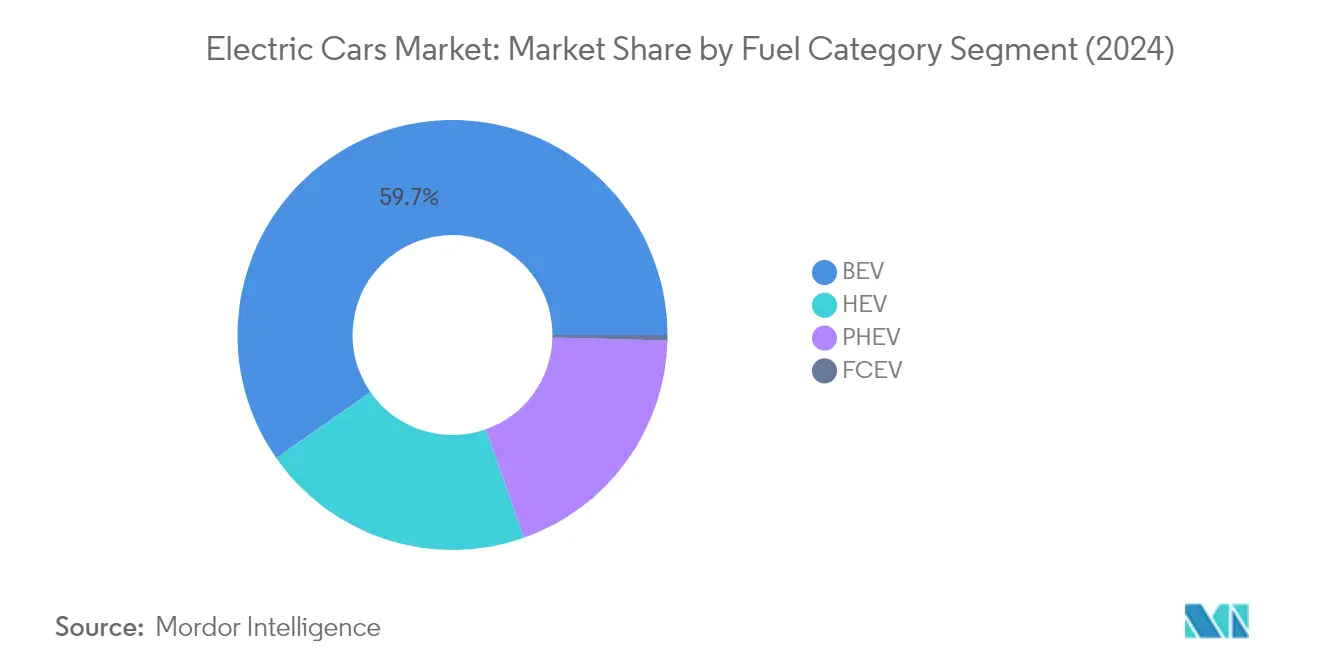
Battery Electric Vehicles (BEVs) have emerged as the dominant force in the global electric cars market, commanding approximately 60% of the total market share in 2024. This substantial market leadership can be attributed to several factors, including significant technological advancements in the EV battery market size, expanding charging infrastructure networks, and strong government support through incentives and regulations. The segment's growth is further bolstered by increasing consumer awareness about environmental sustainability and the expanding range of BEV models across different price points. Major automotive manufacturers have significantly invested in BEV production capabilities, leading to improved vehicle performance, longer driving ranges, and more competitive pricing. Additionally, the continuous development of fast-charging technologies and the growing availability of charging stations have effectively addressed range anxiety concerns, making BEVs an increasingly practical choice for consumers.

FCEV Segment in Electric Cars Market
The Fuel Cell Electric Vehicle (FCEV) segment is positioned as the fastest-growing category in the electric cars market, with a projected growth rate of approximately 35% during 2024-2029. This remarkable growth trajectory is driven by significant advancements in hydrogen fuel cell technology, making FCEVs increasingly efficient and cost-effective. The segment's expansion is supported by growing investments in hydrogen infrastructure development and increasing collaboration between automotive manufacturers and energy companies. FCEVs are gaining particular traction in markets with established hydrogen infrastructure, especially for long-range applications and heavy-duty vehicles. The technology's appeal lies in its quick refueling times, comparable to conventional vehicles, and its potential to offer longer driving ranges than battery-electric alternatives. Furthermore, government initiatives promoting hydrogen technology and clean energy transitions are creating favorable conditions for FCEV adoption across various regions.
Remaining Segments in Fuel Category
The electric cars market is further segmented by Hybrid Electric Vehicles (HEVs) and Plug-in Hybrid Electric Vehicles (PHEVs), both playing crucial roles in the transition towards sustainable mobility. HEVs continue to serve as an important bridge technology, offering improved fuel efficiency without the need for external charging infrastructure, making them particularly attractive in regions with limited charging networks. PHEVs, combining the benefits of both electric and conventional powertrains, provide flexibility to consumers who desire electric-only capability for daily commuting while maintaining the ability to undertake longer journeys without range anxiety. These segments are particularly significant in markets where full electrification infrastructure is still developing, offering consumers a practical stepping stone towards full electric mobility while contributing to reduced emissions and improved fuel efficiency.
Electric Cars Market Geography Segment Analysis
Electric Cars Market in Africa
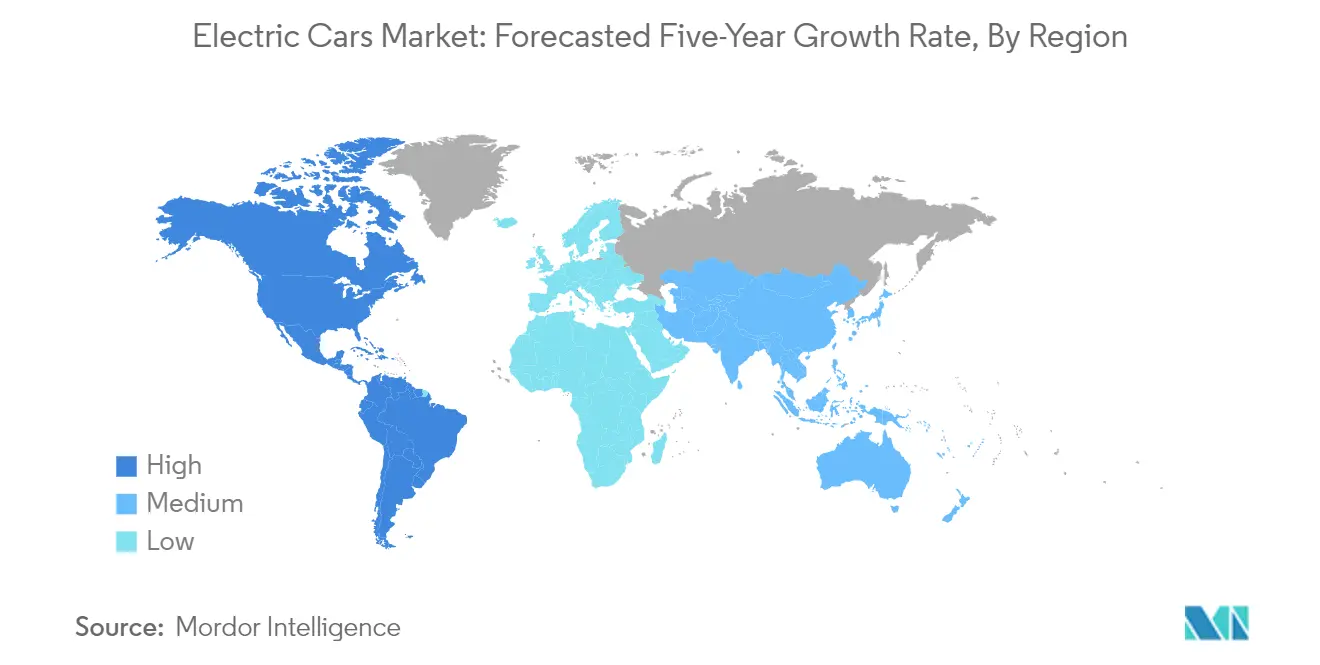
The African electric cars market is gaining momentum in the adoption of electric vehicles, driven by growing environmental consciousness and supportive government initiatives. While the continent faces challenges in terms of charging infrastructure development, several countries are making significant strides in creating favorable conditions for EV adoption. The region's transformation is particularly evident in the implementation of policies promoting clean energy transportation and the gradual expansion of charging networks across major urban centers.Electric Cars Market in South Africa (Largest Market)South Africa leads the African electric vehicle market, commanding approximately 75% of the region's market share in 2024. The country's dominance is attributed to its well-established automotive manufacturing base, robust infrastructure, and progressive government policies supporting electric mobility. The nation has made significant investments in charging infrastructure and offers various incentives to promote EV adoption, including tax benefits and reduced registration fees.Electric Cars Market in South Africa (Fastest Growing Market)South Africa continues to demonstrate strong growth potential in the electric vehicle market, with a projected growth rate of approximately 12% from 2024 to 2029. The country's growth trajectory is supported by increasing consumer awareness about environmental sustainability, expanding charging infrastructure, and government initiatives promoting clean transportation. The nation's automotive industry is actively adapting to this transition, with manufacturers introducing new electric models and expanding their EV portfolios.
Electric Cars Market in Asia-Pacific
The Asia-Pacific region represents a dynamic and rapidly evolving electric vehicle market, characterized by diverse adoption rates across different countries. The region's transformation is driven by strong government support, technological advancements, and increasing environmental awareness among consumers. Countries across the region are implementing various initiatives to promote EV adoption, including subsidies, tax incentives, and investments in charging infrastructure.Electric Cars Market in India (Largest Market)India emerges as the dominant force in the Asia-Pacific electric vehicle market, holding approximately 65% of the region's market share in 2024. The country's leadership position is supported by robust government initiatives, including the FAME II scheme and various state-level incentives. The nation has also witnessed significant investments in charging infrastructure and local manufacturing capabilities, making electric vehicles increasingly accessible to consumers.Electric Cars Market in India (Fastest Growing Market)India demonstrates exceptional growth potential in the electric vehicle market, with a projected growth rate of approximately 120% from 2024 to 2029. This remarkable growth is driven by favorable government policies, increasing consumer awareness, and significant investments in EV manufacturing and charging infrastructure. The country's automotive industry is undergoing a rapid transformation, with both domestic and international manufacturers expanding their electric vehicle offerings.
Electric Cars Market in Europe
Europe's electric vehicle market showcases strong momentum, supported by stringent emission regulations, comprehensive incentive programs, and well-developed charging infrastructure. The region's commitment to sustainability is evident in its ambitious targets for reducing carbon emissions and promoting clean mobility solutions. Countries across Europe are implementing various measures to accelerate the transition to electric vehicles, including purchase subsidies, tax benefits, and investments in charging networks.Electric Cars Market in UK (Largest Market)The United Kingdom stands as the leader in Europe's electric vehicle market. The country's dominance is attributed to its comprehensive approach to EV adoption, including substantial government incentives, extensive charging infrastructure, and strong consumer awareness. The UK's automotive industry has shown remarkable adaptability, with manufacturers increasingly focusing on electric vehicle production and innovation.Electric Cars Market in Czech Republic (Fastest Growing Market)The Czech Republic emerges as the fastest-growing market in Europe's electric vehicle sector. The country's growth is driven by increasing environmental awareness, supportive government policies, and growing investments in charging infrastructure. The nation's automotive industry is actively embracing the electric revolution, with both domestic and international manufacturers expanding their electric vehicle production capabilities.
Electric Cars Market in Middle East
The Middle East's electric vehicle market is experiencing significant transformation, driven by ambitious sustainability goals and increasing environmental awareness. The UAE leads the region's market and demonstrates the fastest growth rate, supported by comprehensive government initiatives and extensive investments in charging infrastructure. The region's commitment to diversifying away from traditional fossil fuels is evident in various initiatives promoting electric mobility, including tax incentives, free charging stations, and preferential parking for electric vehicles. Countries across the Middle East are actively developing their charging infrastructure and implementing policies to encourage EV adoption, particularly in major urban centers.
Electric Cars Market in North America
North America's electric vehicle market demonstrates strong growth potential, supported by comprehensive government initiatives and increasing environmental consciousness. Mexico emerges as both the largest market and the fastest-growing country in the region, driven by significant investments in manufacturing capabilities and charging infrastructure. The region's transformation is characterized by strong collaboration between government entities and private sector players, resulting in expanded charging networks and improved accessibility to electric vehicles. The market benefits from various incentive programs, including tax credits, rebates, and grants for charging infrastructure development.
Electric Cars Market in South America
The South American electric vehicle market shows promising growth potential, with increasing focus on sustainable transportation solutions. Brazil stands as both the largest market and the fastest-growing country in the region, supported by comprehensive government initiatives and growing environmental awareness. The region's transformation is marked by significant investments in charging infrastructure and various incentive programs to promote electric vehicle adoption. Countries across South America are implementing supportive policies and developing charging networks to facilitate the transition to electric mobility, particularly in major urban areas.
Competitive Landscape
Top Companies in Electric Cars Market
The electric cars market is led by prominent automotive manufacturers, including Tesla, BYD, Volkswagen, Hyundai, Ford, Toyota, Stellantis, Mercedes-Benz, General Motors, Nissan, and Renault. These electric car companies are heavily investing in research and development to advance battery technology, charging capabilities, and autonomous driving features. Product innovation remains a key focus, with manufacturers regularly introducing new models across different vehicle segments and price points. Companies are demonstrating operational agility through flexible manufacturing processes and supply chain optimization, particularly in response to semiconductor shortages and raw material challenges. Strategic partnerships for battery production, charging infrastructure development, and technology sharing have become increasingly common. Geographic expansion continues through new manufacturing facilities, particularly in emerging markets, while companies simultaneously strengthen their presence in established markets through enhanced dealer networks and direct-to-consumer sales channels.
Market Consolidation Drives Industry Evolution and Growth
The electric cars market exhibits a moderately consolidated structure, with global automotive conglomerates holding significant market share alongside specialized electric vehicle manufacturers. Traditional automakers leverage their established manufacturing capabilities, brand recognition, and extensive dealer networks while adapting their business models to accommodate electric vehicle production. Pure-play electric vehicle companies differentiate themselves through technological innovation and direct-to-consumer sales approaches. The market has witnessed increased collaboration between automotive companies and technology firms, particularly in areas such as battery development, autonomous driving systems, and connected car features. Regional players, especially in China, have emerged as strong contenders by focusing on domestic market needs while gradually expanding internationally.
The industry is characterized by strategic alliances and joint ventures rather than outright acquisitions, as companies seek to share development costs and technological expertise. Partnerships between automotive manufacturers and battery suppliers have become increasingly important for securing supply chain stability. Vertical integration strategies are evident as manufacturers invest in battery production facilities and charging infrastructure. The market also sees collaboration between traditional competitors to develop common platforms and standards for electric vehicle charging and autonomous driving technologies. These partnerships help companies manage the substantial investments required for electric vehicle development while accelerating time-to-market for new products.
Innovation and Adaptation Key to Market Success
Success in the electric cars market requires a comprehensive strategy encompassing technological innovation, cost optimization, and market positioning. Incumbent manufacturers must balance their existing internal combustion engine business while scaling up electric vehicle operations, requiring careful resource allocation and timing. Companies need to develop differentiated product offerings across various price points and vehicle segments to capture diverse consumer preferences. Supply chain resilience has become crucial, with successful companies establishing direct relationships with raw material suppliers and investing in local production capabilities. Building strong charging infrastructure partnerships and offering innovative charging solutions helps address consumer range anxiety and enhances market acceptance.
Market contenders can gain ground by focusing on specific market segments or regions where they can establish competitive advantages. Success factors include developing innovative battery technologies that improve range and charging speeds while reducing costs. Companies must also navigate evolving regulatory landscapes, particularly regarding emissions standards and government incentives for electric vehicle adoption. Building strong relationships with technology partners and suppliers helps ensure access to critical components and systems. Customer experience and after-sales service have become increasingly important differentiators, with successful companies offering comprehensive digital services and maintenance support. The ability to adapt quickly to changing market conditions and consumer preferences while maintaining operational efficiency will determine long-term success in this dynamic market.
Electric Cars Industry Leaders
-
BYD Auto Co. Ltd.
-
Hyundai Motor Company
-
Tesla Inc.
-
Toyota Motor Corporation
-
Volkswagen AG
- *Disclaimer: Major Players sorted in no particular order

Recent Industry Developments
- September 2023: Daimler AG's subsidiary, Mercedes-Benz Research & Development North America Inc. and Xtelligent entered a partnership with the City of Long Beach to develop transportation technology systems.
- September 2023: Stellantis inaugurated the first battery technology center at Mirafiori plant in Turin, Italy.
- September 2023: Stellantis announced the forthcoming world premiere of the new Peugeot E-3008, an all-electric fastback SUV on September 12, 2023, in the Sochaux factory, France, where it will be manufactured.
Global Electric Cars Market Report Scope
Passenger Cars are covered as segments by Vehicle Configuration. BEV, FCEV, HEV, PHEV are covered as segments by Fuel Category. Africa, Asia-Pacific, Europe, Middle East, North America, South America are covered as segments by Region. Vehicle Configuration
| Passenger Cars | Multi-purpose Vehicle |
Fuel Category
| BEV |
| FCEV |
| HEV |
| PHEV |
Region
| Africa | South Africa |
| Asia-Pacific | India |
| Europe | Czech Republic |
| UK | |
| Middle East | UAE |
| North America | Mexico |
| South America | Brazil |
| Vehicle Configuration | Passenger Cars | Multi-purpose Vehicle |
| Fuel Category | BEV | |
| FCEV | ||
| HEV | ||
| PHEV | ||
| Region | Africa | South Africa |
| Asia-Pacific | India | |
| Europe | Czech Republic | |
| UK | ||
| Middle East | UAE | |
| North America | Mexico | |
| South America | Brazil | |
Market Definition
- Vehicle Type - The category includes passenger cars.
- Vehicle Body Type - This include various body types such as Hatchbacks, Sedans, Sports Utility Vehicles, and Multi-purpose Vehicles.
- Fuel Category - The category exclusively covers electric propulsion systems, including various types such as HEV (Hybrid Electric Vehicles), PHEV (Plug-in Hybrid Electric Vehicles), BEV (Battery Electric Vehicles), and FCEV (Fuel Cell Electric Vehicles).
| Keyword | Definition |
|---|---|
| Electric Vehicle (EV) | A vehicle which uses one or more electric motors for propulsion. Includes cars, buses, and trucks. This term includes all-electric vehicles or battery electric vehicles and plug-in hybrid electric vehicles. |
| BEV | A BEV relies completely on a battery and a motor for propulsion. The battery in the vehicle must be charged by plugging it into an outlet or public charging station. BEVs do not have an ICE and hence are pollution-free. They have a low cost of operation and reduced engine noise as compared to conventional fuel engines. However, they have a shorter range and higher prices than their equivalent gasoline models. |
| PEV | A plug-in electric vehicle is an electric vehicle that can be externally charged and generally includes all-electric vehicles as well as plug-in hybrids. |
| Plug-in Hybrid EV | A vehicle that can be powered either by an ICE or an electric motor. In contrast to normal hybrid EVs, they can be charged externally. |
| Internal combustion engine | An engine in which the burning of fuels occurs in a confined space called a combustion chamber. Usually run with gasoline/petrol or diesel. |
| Hybrid EV | A vehicle powered by an ICE in combination with one or more electric motors that use energy stored in batteries. These are continually recharged with power from the ICE and regenerative braking. |
| Commercial Vehicles | Commercial vehicles are motorized road vehicles designed for transporting people or goods. The category includes light commercial vehicles (LCVs) and medium and heavy-duty vehicles (M&HCV). |
| Passenger Vehicles | Passenger cars are electric motor– or engine-driven vehicles with at least four wheels. These vehicles are used for the transport of passengers and comprise no more than eight seats in addition to the driver’s seat. |
| Light Commercial Vehicles | Commercial vehicles that weigh less than 6,000 lb (Class 1) and in the range of 6,001–10,000 lb (Class 2) are covered under this category. |
| M&HDT | Commercial vehicles that weigh in the range of 10,001–14,000 lb (Class 3), 14,001–16,000 lb (Class 4), 16,001–19,500 lb (Class 5), 19,501–26,000 lb (Class 6), 26,001–33,000 lb (Class 7) and above 33,001 lb (Class 8) are covered under this category. |
| Bus | A mode of transportation that typically refers to a large vehicle designed to carry passengers over long distances. This includes transit bus, school bus, shuttle bus, and trolleybuses. |
| Diesel | It includes vehicles that use diesel as their primary fuel. A diesel engine vehicle have a compression-ignited injection system rather than the spark-ignited system used by most gasoline vehicles. In such vehicles, fuel is injected into the combustion chamber and ignited by the high temperature achieved when gas is greatly compressed. |
| Gasoline | It includes vehicles that use gas/petrol as their primary fuel. A gasoline car typically uses a spark-ignited internal combustion engine. In such vehicles, fuel is injected into either the intake manifold or the combustion chamber, where it is combined with air, and the air/fuel mixture is ignited by the spark from a spark plug. |
| LPG | It includes vehicles that use LPG as their primary fuel. Both dedicated and bi-fuel LPG vehicles are considered under the scope of the study. |
| CNG | It includes vehicles that use CNG as their primary fuel. These are vehicles that operate like gasoline-powered vehicles with spark-ignited internal combustion engines. |
| HEV | All the electric vehicles that use batteries and an internal combustion engine (ICE) as their primary source for propulsion are considered under this category. HEVs generally use a diesel-electric powertrain and are also known as hybrid diesel-electric vehicles. An HEV converts the vehicle momentum (kinetic energy) into electricity that recharges the battery when the vehicle slows down or stops. The battery of HEV cannot be charged using plug-in devices. |
| PHEV | PHEVs are powered by a battery as well as an ICE. The battery can be charged through either regenerative breaking using the ICE or by plugging into some external charging source. PHEVs have a better range than BEVs but are comparatively less eco-friendly. |
| Hatchback | These are compact-sized cars with a hatch-type door provided at the rear end. |
| Sedan | These are usually two- or four-door passenger cars, with a separate area provided at the rear end for luggage. |
| SUV | Popularly known as SUVs, these cars come with four-wheel drive, and usually have high ground clearance. These cars can also be used as off-road vehicles. |
| MPV | These are multi-purpose vehicles (also called minivans) designed to carry a larger number of passengers. They carry between five and seven people and have room for luggage too. They are usually taller than the average family saloon car, to provide greater headroom and ease of access, and they are usually front-wheel drive. |
Research Methodology
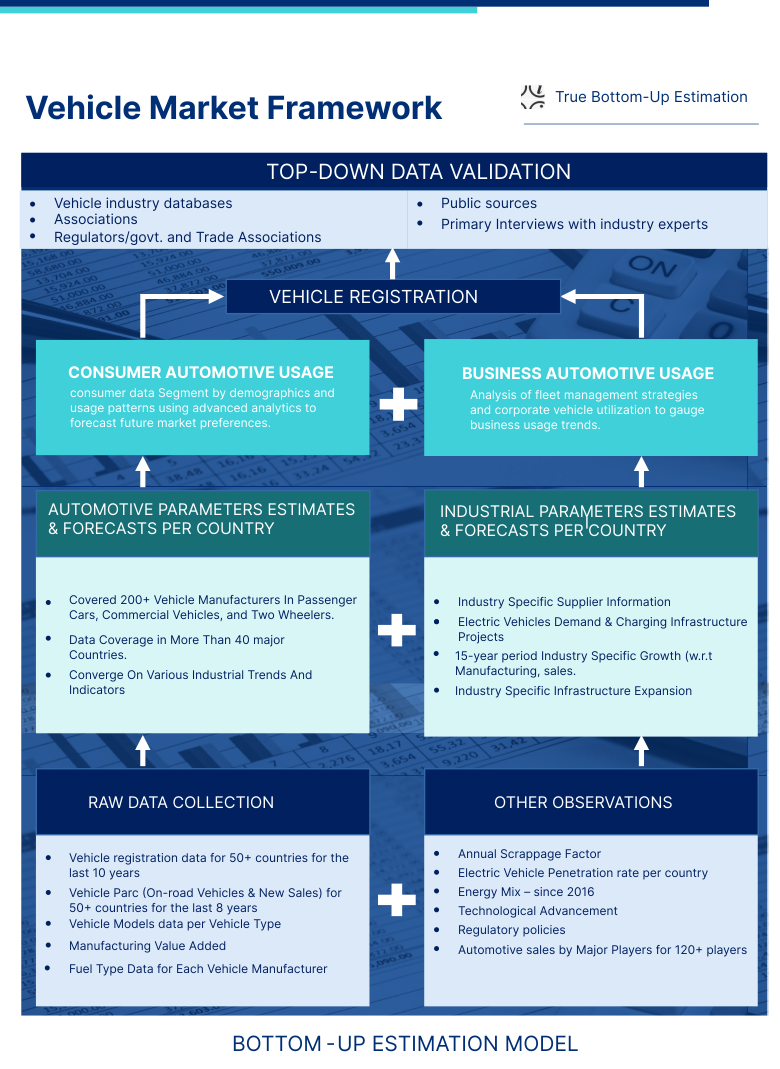
Mordor Intelligence follows a four-step methodology in all its reports.
- Step-1: Identify Key Variables: To build a robust forecasting methodology, the variables and factors identified in Step-1 are tested against available historical market numbers. Through an iterative process, the variables required for market forecast are set and the model is built based on these variables.
- Step-2: Build a Market Model: Market-size estimations for the historical and forecast years have been provided in revenue and volume terms. Market revenue is calculated by multiplying the sales volume with their respective average selling price (ASP). While estimating ASP factors like average inflation, market demand shift, manufacturing cost, technological advancement, and varying consumer preference, among others have been taken into account.
- Step-3: Validate and Finalize: In this important step, all market numbers, variables, and analyst calls are validated through an extensive network of primary research experts from the market studied. The respondents are selected across levels and functions to generate a holistic picture of the market studied.
- Step-4: Research Outputs: Syndicated Reports, Custom Consulting Assignments, Databases & Subscription Platforms.