
ASEAN UEM Market Size and Share
Market Overview
| Study Period | 2020 - 2031 |
|---|---|
| Forecast Data Period | 2026 - 2031 |
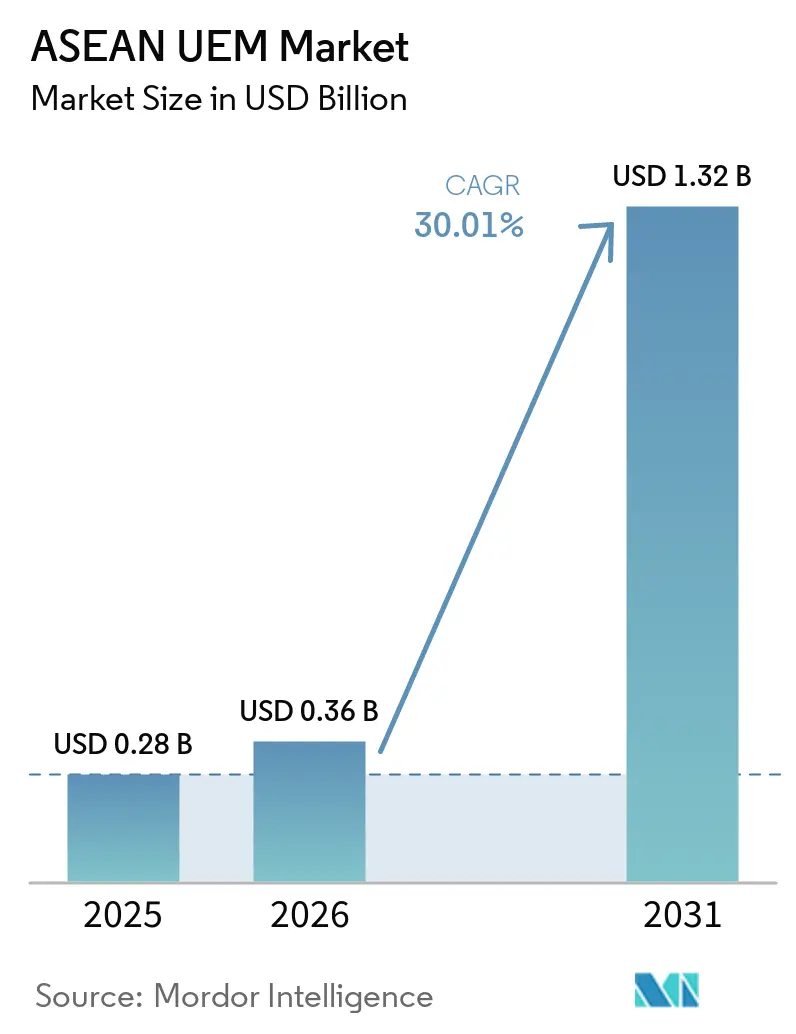
| Base Year Market Size (2025) | USD 0.28 Billion |
| Market Size (2026) | USD 0.36 Billion |
| Market Size (2031) | USD 1.32 Billion |
| Growth Rate (2026 - 2031) | 30.01 % |
| Market Concentration | Medium |
Major Players *Disclaimer: Major Players sorted in no particular order Image © Mordor Intelligence. Reuse requires attribution under CC BY 4.0. | |
ASEAN UEM Market Analysis by Mordor Intelligence
The ASEAN UEM market size is expected to grow from USD 0.28 billion in 2025 to USD 0.36 billion in 2026, and is forecast to reach USD 1.32 billion by 2031 at a 30.01% CAGR over 2026-2031. The growth path reflects a sharp rise in digital operations across ASEAN businesses, where endpoint control now sits closer to core operating risk than to optional IT administration. Demand is rising because enterprises are managing more laptops, smartphones, tablets, shared devices, and connected operational endpoints at the same time, while also trying to keep policy, identity, and security controls consistent. The ASEAN unified endpoint management (UEM) market is also benefiting from a cloud-first shift in enterprise architecture, which makes centralized provisioning, patching, compliance checks, and remote support easier to scale across multiple countries. Competition is tightening because buyers increasingly prefer platforms that connect device control with identity, access, and security monitoring rather than standalone management tools. This creates room for vendors that can support large regional deployments, sovereign requirements, and automation-led support models without raising delivery complexity.
Key Report Takeaways
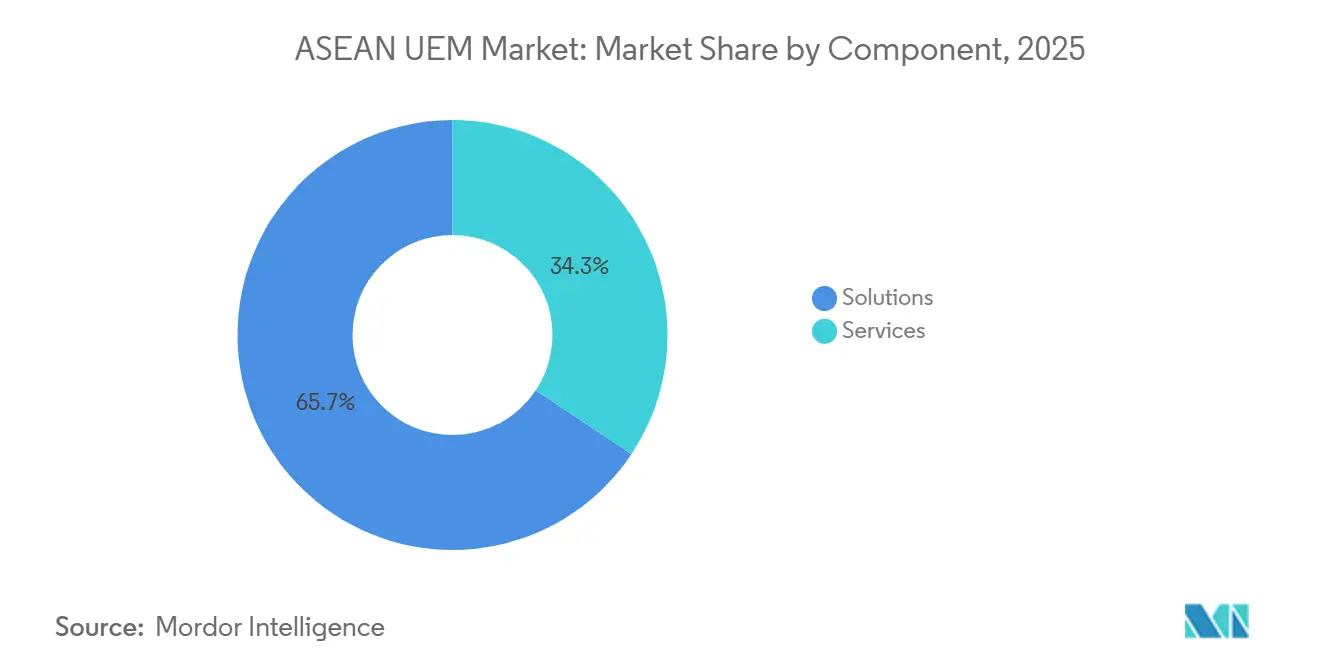
- By component, solutions held 65.66% share of the ASEAN UEM market in 2025, while the same segment grew with 31.23% CAGR through 2031.
- By deployment mode, cloud-based deployment accounted for 59.34% of the ASEAN unified endpoint management market size in 2025 and is projected to advance at a 31.23% CAGR through 2031, while hybrid deployment retained a strategic role in complex regulated environments.
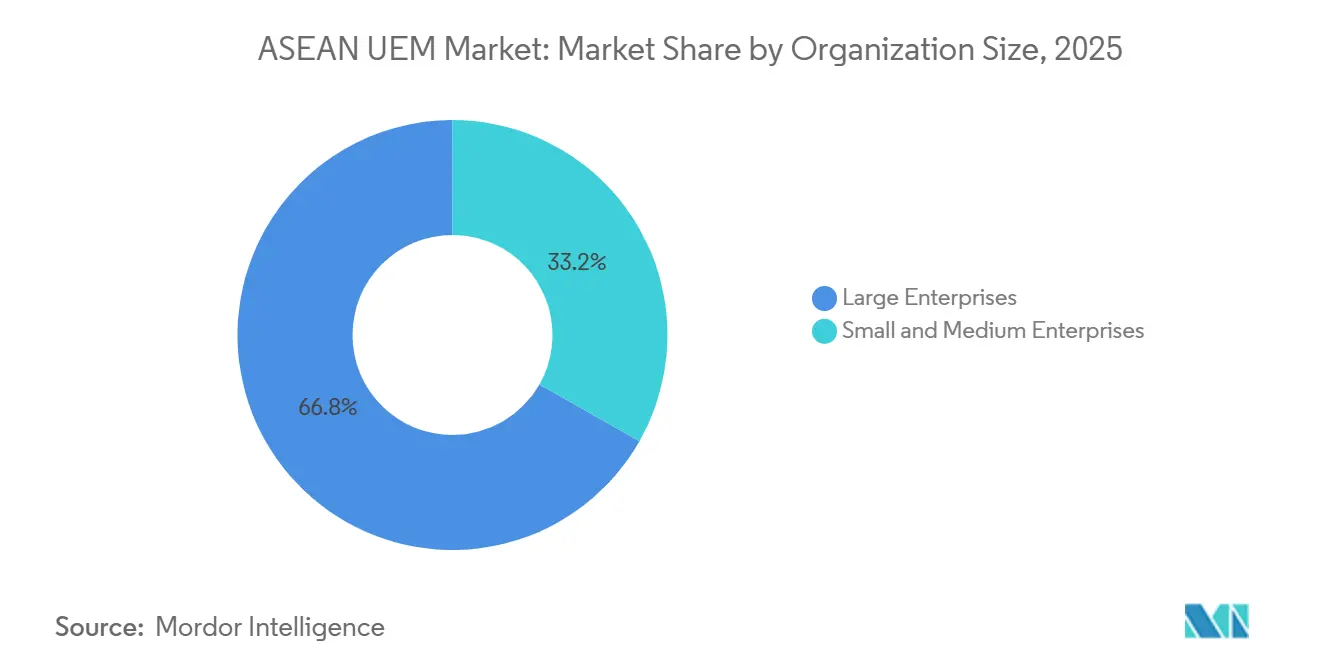
- By organization size, large enterprises held 66.78% share of the ASEAN unified endpoint management (UEM) market in 2025, while small and medium enterprises are projected to record the fastest growth at 31.56% through 2031 as subscription pricing and managed services lower adoption barriers.
- By end-user industry, IT and telecommunications accounted for 19.34% share of the ASEAN unified endpoint management market in 2025, while healthcare is projected to expand at a 31.45% CAGR through 2031 and reset growth expectations across vertical demand.
- By country, Singapore accounted for 23.56% share of the ASEAN UEM market in 2025, while Vietnam is projected to expand at a 31.36% CAGR through 2031.
Note: Market size and forecast figures in this report are generated using Mordor Intelligence’s proprietary estimation framework, updated with the latest available data and insights as of January 2026.
Market Trends and Insights
Drivers Impact Analysis of ASEAN UEM Market*
| Driver | (~) % Impact on CAGR Forecast | Geographic Relevance | Impact Timeline |
|---|---|---|---|
| Hybrid Work and Bring Your Own Device Expansion | +5.5% | Global, highest urgency in Singapore, Malaysia, Philippines | Short term (≤ 2 years) |
| Escalating Cyber Threat Surface and Zero Trust Rollouts | +5.0% | Global, most acute in Singapore, Indonesia, Vietnam | Short term (≤ 2 years) |
| Platform Convergence of Endpoint, Identity, and Access Management | +4.0% | Global, accelerating fastest in Singapore and Malaysia | Medium term (2-4 years) |
| AI-Based Digital Employee Experience Optimization | +3.5% | Asia-Pacific core, early gains in Singapore and Thailand | Medium term (2-4 years) |
| Frontline and Internet of Things Device Growth in Warehousing and Field Operations | +2.5% | ASEAN-wide, spill-over to Indonesia and Malaysia | Medium term (2-4 years) |
| ESG-Led Demand for Device-Level Carbon Analytics | +1.5% | Singapore, Malaysia, early signals in Thailand | Long term (≥ 4 years) |
| Source: Mordor Intelligence | |||
Hybrid Work and Bring Your Own Device Expansion
Hybrid work has moved from a temporary arrangement to a standard operating pattern across many ASEAN enterprises, and that shift is widening the number of devices that need formal control. Personal devices now touch enterprise applications, customer records, collaboration tools, and internal networks far more often than they did a few years ago, which raises the baseline need for unified policy enforcement. The ASEAN UEM market is benefiting because employers want visibility across company-owned and employee-owned devices without slowing daily work. Enforcement action by Singapore’s Personal Data Protection Commission in 2024 reinforced how weak access controls and poor credential governance can turn device exposure into large customer-data incidents, which has pushed many enterprises to tighten endpoint enrollment and policy coverage.[1] Procurement cycles have also shortened in environments where boards and risk committees now expect clearer proof that remote devices are governed to the same standard as office-based assets. This gives vendors an advantage when they can support secure onboarding, remote wipe, policy separation, and auditable access control in one operating model.
Escalating Cyber Threat Surface and Zero Trust Rollouts
Cybersecurity priorities are pulling endpoint management closer to identity and access control, especially as enterprises extend cloud usage and support more distributed workforces. Zero trust programs require the device itself to be treated as a live control point, which means access decisions depend on posture, compliance state, and policy status rather than on credentials alone. The ASEAN UEM market is gaining from this shift because buyers increasingly treat device health checks as part of basic security architecture rather than as optional device administration. Singapore GovTech’s SEED program showed this direction clearly in 2025 by centralizing endpoint management across a large engineering user base while maintaining full CrowdStrike EDR coverage and strong operational visibility.[2] The Government Zero Trust Architecture framework in Singapore also treats endpoint health as a continuous access-control variable, and that design logic is moving from public systems into private-sector security programs. As more organizations map device trust to resource access, platforms that cannot feed clean endpoint posture into broader security workflows are likely to lose relevance.
Platform Convergence of Endpoint, Identity, and Access Management
Enterprise buying criteria are shifting toward platforms that combine endpoint control with identity, access, and security policy in a tighter operating framework. This is changing evaluation logic because buyers now ask whether a device was known, compliant, and tied to a verified identity at the moment access was granted. The ASEAN UEM market is seeing stronger demand for this kind of convergence in financial services, government, and other audit-heavy environments where proof of control matters as much as the control itself. Microsoft’s April 2026 Intune update added a redesigned Linux single sign-on experience through the Microsoft Identity Broker and extended automated enrollment into more Apple device categories, which shows how large vendors are deepening identity-linked endpoint governance from inside broader enterprise ecosystems.[3] That direction matters in ASEAN because regional enterprises often manage device estates across multiple operating systems, multiple cloud environments, and several country-level compliance settings at once. Vendors that can simplify those layers into a more unified control plane are better positioned to defend pricing and hold strategic accounts.
AI-Based Digital Employee Experience Optimization
Digital employee experience has moved closer to mainstream buying criteria because endpoint teams are under pressure to reduce user friction without expanding local support headcount. Enterprises increasingly want platforms that can identify recurring device issues early, automate corrective action, and reduce ticket volumes before productivity is affected. The ASEAN UEM market is responding to that requirement because large, distributed, and multilingual workforces raise the cost of reactive support models. Ivanti’s 2025 Digital Employee Experience Report found that only 32% of enterprises used a unified endpoint management tool to support DEX outcomes, which points to a large installed-base upgrade cycle still ahead. Tanium’s May 2026 launch of Tanium Atlas in Asian-Pacific pushed this theme further by bringing AI-led telemetry analysis and self-healing workflows into regional endpoint operations at scale. As this capability becomes more common, vendors that only offer inventory and policy management may find it harder to defend premium positioning.
Restraints Impact Analysis of ASEAN UEM Market*
| Restraint | (~) % Impact on CAGR Forecast | Geographic Relevance | Impact Timeline |
|---|---|---|---|
| Data Sovereignty and Privacy Compliance Hurdles | -2.5% | Vietnam, Indonesia, Malaysia | Medium term (2-4 years) |
| High Migration and Integration Cost of Legacy Estates | -2.0% | ASEAN-wide, largest drag in legacy-heavy Indonesia and Thailand | Long term (≥ 4 years) |
| Procurement Uncertainty in Post-VMware Transition Environments | -1.5% | Global, acute in Singapore, Malaysia, Philippines | Short term (≤ 2 years) |
| Talent Gap in Low-Code Automation and Scripting for UEM | -1.0% | ASEAN core, strongest in Indonesia, Philippines, Vietnam | Medium term (2-4 years) |
| Source: Mordor Intelligence | |||
Data Sovereignty and Privacy Compliance Hurdles
Cross-border endpoint governance remains difficult because device telemetry, policy data, user identity, and application access records do not always fit neatly within one legal framework. Multi-country operators often need one control model for business efficiency, but they face separate expectations for data storage, transfer, and access review across ASEAN jurisdictions. The ASEAN UEM market therefore expands under a compliance constraint, where technical capability alone is not enough unless it is paired with credible data-residency alignment. ASEAN’s regional work on cross-border cloud principles and data governance guides shows that harmonization is moving forward, but the pace still trails enterprise procurement timelines and practical deployment needs. Singapore’s Personal Data Protection Commission also published 3 regional data governance guides in January 2025, which helped clarify some compliance pathways but did not eliminate the burden of managing country-specific obligations across a shared device estate. This leaves an advantage for vendors that can show regional hosting options, clear policy boundaries, and stronger audit support without forcing customers into multiple disconnected consoles.
High Migration and Integration Cost of Legacy Estates
Many enterprises still run endpoint environments that were built over time through separate tools, older directory structures, custom scripts, and application-specific policies. Replacing those estates is rarely a clean software swap because the old environment is often tied to identity workflows, patch routines, security checks, and help-desk processes that have been customized over several years. The ASEAN UEM market is therefore growing alongside a difficult transition cycle, where buyers want simplification but also need to avoid operational disruption during migration. Large organizations with multi-country footprints often have to run legacy and replacement stacks in parallel for extended periods, which adds cost, duplicates policy work, and slows platform consolidation. Integration work also becomes heavier in regulated sectors where device controls must be mapped carefully to audit requirements, application entitlements, and location-specific governance rules. That makes migration a real growth restraint even when the long-term business case for consolidation remains strong.
*Our forecasts treat driver/restraint impacts as directional, not additive. The impact forecasts reflect baseline growth, mix effects, and variable interactions.
ASEAN UEM Market Segment Analysis
By Component:
Solutions Drive Consolidation, Services Scale with Delivery ComplexitySolutions accounted for 65.66% of the ASEAN unified endpoint management market share in 2025, with a growth rate of 31.23% CAGR, which shows that enterprises still direct most spending toward the core control platform rather than toward surrounding service layers. Buyers want one operating environment that can handle device enrollment, application governance, compliance policy, content access, and workflow automation without forcing teams to manage several disconnected tools. That preference is strongest where security and compliance requirements are rising because enterprises do not want policy gaps between basic device control and higher-risk governance functions. Within the solutions stack, security and compliance management, analytics, and automation are carrying more strategic weight because buyers now expect posture monitoring, policy validation, and faster issue resolution as standard capabilities. Device management remains essential, but it no longer defines competitive differentiation in the same way because multi-OS support and remote policy control have become baseline tender requirements. This is why the ASEAN UEM market is rewarding vendors that can move beyond inventory visibility and show measurable control across the full endpoint lifecycle.
The services layer is scaling because a larger share of deployments now involve integration work, policy redesign, role-based access tuning, and user training across several business units or countries. Many enterprises do not struggle to buy the platform, they struggle to operationalize it in a way that fits legacy applications, regulated workflows, and shared accountability between IT and security teams. The ASEAN UEM industry is therefore seeing service demand rise not as a side activity, but as a practical condition for successful rollout and renewal. Managed UEM support is especially relevant in the mid-market, where buyers want the benefits of centralized endpoint governance but do not always have in-house automation depth. Ivanti’s October 2025 launch of its Secure Unified Endpoint Management offering in Indonesia through PT Berca Hardayaperkasa reflected that channel-led services opportunity and showed how vendors are building local delivery capacity around the platform sale. As ASEAN organizations widen device coverage and tighten control standards, services become the layer that turns platform capability into usable daily operations.
By Deployment Mode:
Cloud Delivers Scale, Hybrid Keeps Strategic RelevanceCloud-based deployment held 59.34% of the market in 2025, and that lead reflects how enterprises prefer faster provisioning, lighter infrastructure ownership, and easier remote policy administration across distributed device fleets. Cloud delivery is also projected to advance at a 31.23% CAGR through 2031, which makes it the fastest-moving deployment model in the current structure of demand. In practical terms, cloud UEM reduces the operational friction of onboarding, patch distribution, remote troubleshooting, and zero-touch setup, which matters more as workforces stretch across offices, homes, warehouses, clinics, and field environments. The ASEAN UEM market size for cloud-based deployment is growing because buyers want elasticity and standardization at the same time, especially when device counts change quickly or business units expand into new countries. The ASEAN Framework on Cross-Border Cloud Computing Principles, published in January 2026, supports this direction by encouraging interoperable cloud architectures that are easier to use across regional operating footprints. That policy signal does not remove every sovereignty issue, but it gives cloud deployment a firmer foundation in regional enterprise planning.
On-premises deployment still matters in government, defense, and tightly regulated institutions where management traffic, policy logs, or device records must remain under direct local control. This part of the market is smaller, but it carries strategic value because it shapes vendor credibility in sovereign and high-assurance environments. BlackBerry’s June 2026 update to its UEM platform reinforced this need by expanding sovereign management capabilities for Apple, Windows, and Android devices from a single on-premises console without cloud dependency. Hybrid deployment sits between those 2 models and retains a strong hold in complex organizations that operate digital front ends alongside regulated back-office systems. The ASEAN UEM industry is likely to keep supporting hybrid demand because many regional conglomerates need shared policy logic without forcing every workload into one infrastructure path. Hybrid therefore works less as a compromise and more as a deliberate operating design for large enterprises balancing scale, control, and country-level compliance.
By Organization Size:
Large Enterprises Anchor Revenue, SMEs Raise the Pace of ExpansionLarge enterprises held 66.78% of the ASEAN UEM market in 2025, which reflects the segment’s earlier start, larger device estates, and stronger compliance obligations. These organizations usually have centralized procurement, formal risk oversight, and enough complexity to justify investment in broad endpoint governance platforms. Their spending remains strong because many are extending UEM beyond employee laptops and phones into operational technology endpoints, shared devices, and frontline equipment that had previously sat outside core governance models. The ASEAN UEM market share remains concentrated in this group because the biggest accounts still run the widest multi-country estates and the deepest policy stacks. Large enterprises also influence vendor road maps since their requirements often shape product priorities in identity integration, automation, reporting, and regulated workload support. In this sense, the leading revenue base is still anchored by mature buyers, even as the source of incremental growth starts to shift.
That shift is most visible in small and medium enterprises, which are projected to expand at a 31.56% CAGR through 2031. SMEs are entering the ASEAN unified endpoint management (UEM) market earlier in their digital maturity cycle because subscription pricing, cloud delivery, and managed services have lowered the effort needed to launch formal endpoint control. UOB’s Business Outlook Study 2026 found that 86% of ASEAN businesses had already adopted digital solutions and that close to 80% planned to increase digitalization spending in 2026, which supports a wider addressable base for SME endpoint investment. JumpCloud’s work with Pos Malaysia showed how a distributed device estate can be moved toward more modern identity and device governance with stronger visibility, which reinforces the value proposition for companies trying to simplify older control models. SMEs do not always buy the most feature-rich platform first, but they are increasingly willing to buy enough control to support secure growth. As a result, this part of the ASEAN UEM market is shifting from selective experimentation to a more repeatable adoption pattern.
By End-User Industry:
IT and Telecommunications Lead Revenue, Healthcare Leads GrowthIT and telecommunications held 19.34% of the ASEAN UEM market in 2025, making it the largest end-user vertical by revenue. The segment leads because it combines 2 demand roles inside one vertical, it is a direct buyer with large internal device estates, and it is also a delivery channel that embeds endpoint management into broader managed service offerings. Telecom operators and IT service firms manage fleets for engineers, support teams, network operations staff, and customer-facing service environments, which keeps their control requirements broad and continuous. They also tend to move earlier on cloud architecture, identity integration, and automated support, which increases their relevance in vendor selection and platform design. Manufacturing and BFSI remain close behind because smart factory programs, connected operations, and stricter audit frameworks continue to widen the need for device-level visibility and policy consistency. This keeps the ASEAN unified endpoint management market tied not only to device growth, but also to the operating model of verticals where uptime, compliance, and remote access matter every day.
Healthcare is projected to grow at a 31.45% CAGR through 2031, which makes it the fastest-moving vertical in the current forecast period. The growth comes from a wider mix of endpoints, including tablets for staff, mobile clinical terminals, workstations on wheels, and connected monitoring equipment that must all fit into a controlled access model. The ASEAN UEM market size for healthcare is rising because clinical environments cannot treat endpoint governance as a narrow desktop function when patient workflows now depend on mobile and connected tools. Healthcare settings also create a management premium because different device types often sit under different usage rules, update cycles, and access sensitivities. Government and defense continue to support sovereign and high-control demand, while retail and e-commerce, education, transportation and logistics, and energy and utilities each add distinct pockets of growth linked to frontline mobility and distributed operations. That mix broadens the addressable base of the ASEAN unified endpoint management (UEM) market and reduces overreliance on any one vertical for long-term expansion.
Geography Analysis
Singapore UEM Market
Singapore held 23.56% of the regional market in 2025, which kept it in the leading country position because it combines mature enterprise demand with one of the strictest cybersecurity operating environments in ASEAN. The Cyber Security Agency of Singapore’s Committee of Supply 2026 speech raised the bar further by extending Cyber Trust Mark expectations across a wider set of entities connected to critical systems, which lifts the operating standard for technology vendors and their enterprise customers. Singapore GovTech’s SEED program also continues to act as a practical reference point for large-scale endpoint governance because it centrally managed a sizeable engineering endpoint base with strong security coverage in 2025. This combination of regulatory discipline and visible government execution supports premium demand for integrated, auditable endpoint platforms. Singapore therefore remains a key benchmark market for buyers and vendors across the wider ASEAN UEM market.
ASEAN UEM Market
Vietnam is projected to record the fastest country-level growth at 31.36% through 2031, which indicates how quickly demand is broadening outside the current center of installed maturity. The country’s growth profile reflects a wider shift toward enterprise digitization, expanding cloud usage, and stronger governance expectations around connected business systems. While the installed base remains smaller than in more mature markets, the speed of adoption suggests that Vietnam is becoming one of the most important future growth pools in the ASEAN unified endpoint management market. Malaysia and the Philippines remain established demand centers because hybrid work, financial sector compliance, and digitization across services and supply chains continue to support steady platform adoption. The ASEAN unified endpoint management market share is still led by the more mature countries, but the demand mix is becoming more balanced as second-wave adopters accelerate.
Indonesia and the rest of ASEAN support the market’s longer-term scale because they add volume, enterprise diversity, and rising cloud-linked demand. Google Cloud’s Indonesia BerdAIa program, launched in May 2025 with 15 large organizations across banking, telecommunications, and consumer goods, points to the type of enterprise modernization activity that creates new endpoint governance requirements beyond traditional office devices. In Malaysia, CelcomDigi’s June 2026 launch of an industrial 5G standalone-powered intelligent warehouse in Shah Alam showed how connected operational environments are creating new classes of devices that require formal endpoint control and support. Thailand, Cambodia, Laos, Myanmar, and Brunei do not yet define the revenue base of the ASEAN UEM market, but they do shape its long-tail expansion through rising digital activity and broader regulatory attention. Over time, that wider regional spread should make growth less dependent on the Singapore-Vietnam axis alone.
Competitive Landscape
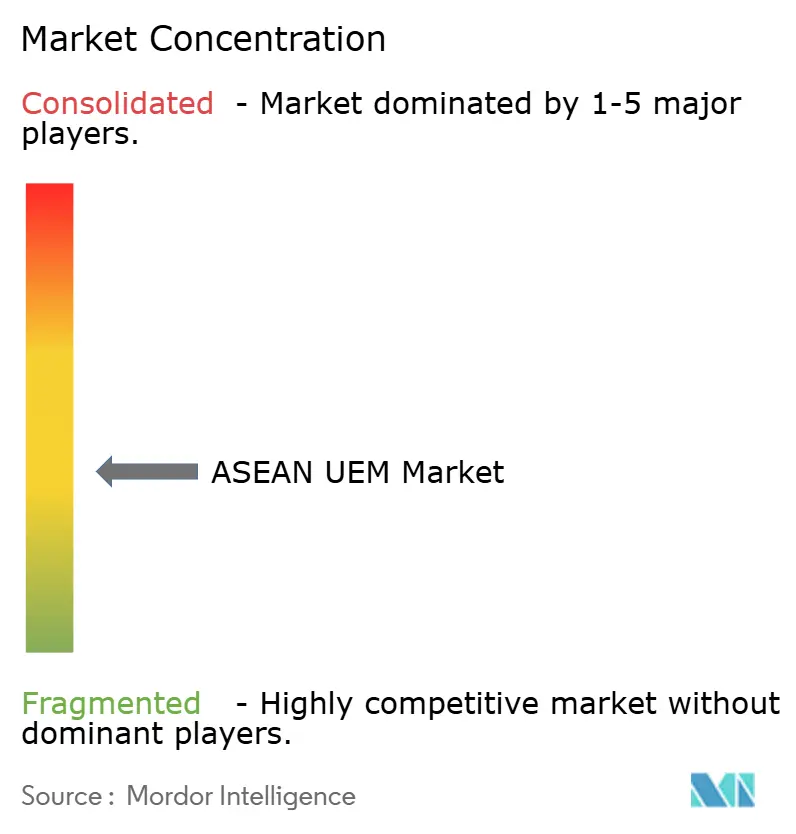
The ASEAN UEM market is moderately fragmented, but the competitive field is not evenly balanced because a few global vendors carry stronger ecosystem leverage than the rest. Microsoft’s Intune platform has a clear structural advantage because it sits inside a broader enterprise stack that already includes identity, security, collaboration, and compliance tools used by many ASEAN organizations. That advantage matters in buying cycles where customers prefer platform consolidation over best-of-breed tool sprawl. Microsoft reinforced this position in April 2026 when Intune added a redesigned Linux single sign-on flow through the Microsoft Identity Broker and automated enrollment support for more Apple device categories. The company’s release cadence also keeps pressure on specialist vendors because improvements arrive as part of a larger operating ecosystem rather than as isolated endpoint features.
Specialist vendors compete by going deeper in sovereignty, automation, or device-class specialization rather than by matching hyperscaler breadth feature for feature. BlackBerry remains important in sovereign and government-oriented procurement because its June 2026 update expanded AI-assisted administration, multi-tenant management, post-quantum cryptography alignment, and broader device support within a control model built around on-premises assurance. Tanium is competing harder on autonomous operations, and its 2026H1 release extended platform reach into operational technology and mobile devices while adding controlled remote shell access with session auditing and approval workflow support. SOTI is strengthening its position in frontline-heavy environments through MobiControl 2026.1, which added real-time Windows issue detection, centralized firmware and patch management, Microsoft Defender integration, and wider automation support for shared-device settings. These product moves show that competition in the ASEAN unified endpoint management (UEM) market is increasingly about operational depth and context-specific fit, not just basic enrollment and policy coverage.
Channel strategy remains critical because much of the next wave of growth sits in markets and buyer groups that need local delivery support. Ivanti’s Indonesia expansion through PT Berca Hardayaperkasa is one example of how vendors are using in-country partnerships to improve access to the mid-market and to attach services more effectively to the core platform. JumpCloud’s regional expansion through its India region launch in May 2026 also supports Asia-Pacific buyers that want closer data residency alignment for identity and device management. White-space opportunities remain strongest in 3 areas, cross-country sovereign control models, industrial and operational technology endpoint governance, and SME-grade platforms that combine lighter deployment with stronger automation. The ASEAN UEM market therefore remains open enough for smaller vendors to win targeted accounts, even as the broadest strategic advantage stays with vendors that can combine device control, identity, security, and local delivery in one offer.
ASEAN UEM Industry Leaders
-
Microsoft Corporation
-
Ivanti, Inc.
-
BlackBerry Limited
-
Zoho Corporation Private Limited
-
Broadcom Inc.
- *Disclaimer: Major Players sorted in no particular order
ASEAN UEM Market Companies Covered in this Report
- Microsoft Corporation
- Ivanti, Inc.
- BlackBerry Limited
- IBM Corporation
- Broadcom Inc.
- Citrix Systems, Inc.
- Jamf Holding Corp.
- SOTI Inc.
- Sophos Limited
- HCL Technologies Limited
- Zoho Corporation Private Limited
- 42Gears Mobility Systems Pvt. Ltd.
- Absolute Software Corporation
- Tanium Inc.
- JumpCloud, Inc.
- Atera Networks Ltd.
- Open Text Corporation
- Matrix42 AG
- Miradore Ltd.
- Micro Focus International plc
- ManageEngine, a division of Zoho Corporation
Recent Industry Developments in ASEAN UEM Market
- June 2026: BlackBerry announced enhanced sovereign UEM capabilities for BlackBerry UEM, introducing AI-assisted administration, post-quantum cryptography aligned with NIST post-quantum standards, expanded multi-tenant management, and macOS support. BlackBerry UEM is the first and only endpoint management solution certified by Germany's Federal Office for Information Security under Common Criteria for managing Apple and Samsung devices in government, a certification that directly positions it for ASEAN government and regulated-enterprise procurement.
- June 2026: CelcomDigi launched Malaysia's first industrial 5G Standalone powered advanced intelligent warehouse in Shah Alam, integrating AI, robotics, IoT automation, and connected endpoint infrastructure at scale. The deployment signals the emergence of 5G-SA-driven industrial device estates across Malaysia that will require dedicated UEM coverage for warehouse IoT and ruggedized devices.
- May 2026: SOTI released MobiControl 2026.1, adding real-time Windows issue detection, centralized firmware and patch management, Microsoft Defender for Endpoint integration, Android and Apple device automation enhancements, and macOS VPN support, broadening coverage for frontline device fleets in ASEAN retail, logistics, and healthcare.
- May 2026: JumpCloud launched a dedicated India data center serving Asia-Pacific customers across Singapore and 30+ APAC countries, providing localized data residency for identity and device management in response to tightening regional data sovereignty requirements.
ASEAN UEM Market Report Scope
The ASEAN Unified Endpoint Management (UEM) Market represents a comprehensive ecosystem of solutions, platforms, and services designed to centrally manage, monitor, and secure a diverse range of endpoint devices, including smartphones, tablets, laptops, desktops, wearables, IoT devices, and ruggedized enterprise hardware, across organizations.
The ASEAN UEM Market Report is Segmented by Component (Solutions [Device Management, Application Management, Content Management, Security and Compliance Management, and Analytics and Automation] and Services), Deployment Mode (Cloud-Based, On-Premise, and Hybrid), Organization Size (Large Enterprises and Small and Medium Enterprises), End-User Industry (IT and Telecommunications, BFSI, Government and Defense, Healthcare and Life Sciences, Manufacturing, Retail and E-Commerce, Education, Transportation and Logistics, Energy and Utilities, and Other End-User Industries), and Country (Indonesia, Philippines, Malaysia, Singapore, Vietnam, and Rest of ASEAN). The Market Forecasts are Provided in Terms of Value (USD).
Segmentation Overview
| Solutions | Device Management |
| Application Management | |
| Content Management | |
| Security and Compliance Management | |
| Analytics and Automation | |
| Services |
| Cloud-Based |
| On-Premise |
| Hybrid |
| Large Enterprises |
| Small and Medium Enterprises |
| IT and Telecommunications |
| BFSI |
| Government and Defense |
| Healthcare and Life Sciences |
| Manufacturing |
| Retail and E-Commerce |
| Education |
| Transportation and Logistics |
| Energy and Utilities |
| Other End-User Industries |
| Indonesia |
| Philippines |
| Malaysia |
| Singapore |
| Vietnam |
| Rest of ASEAN |
| By Component | Solutions | Device Management |
| Application Management | ||
| Content Management | ||
| Security and Compliance Management | ||
| Analytics and Automation | ||
| Services | ||
| By Deployment Mode | Cloud-Based | |
| On-Premise | ||
| Hybrid | ||
| By Organization Size | Large Enterprises | |
| Small and Medium Enterprises | ||
| By End-User Industry | IT and Telecommunications | |
| BFSI | ||
| Government and Defense | ||
| Healthcare and Life Sciences | ||
| Manufacturing | ||
| Retail and E-Commerce | ||
| Education | ||
| Transportation and Logistics | ||
| Energy and Utilities | ||
| Other End-User Industries | ||
| By Country | Indonesia | |
| Philippines | ||
| Malaysia | ||
| Singapore | ||
| Vietnam | ||
| Rest of ASEAN |
Key Questions Answered in the Report
What is the ASEAN UEM market size in 2026 and 2031?
The ASEAN UEM market size stands at USD 0.36 billion in 2026 and is forecast to reach USD 1.32 billion by 2031, growing at a 30.01% CAGR over 2026-2031.
Which deployment model is growing fastest across ASEAN UEM demand?
Cloud-based deployment is the fastest-growing model, with a projected 31.23% CAGR through 2031, supported by easier provisioning, remote administration, and multi-country scalability.
Which customer group is driving the next wave of adoption?
SMEs are projected to expand at a 31.56% CAGR through 2031, showing that growth is broadening beyond large enterprises as subscription pricing and managed services reduce adoption barriers.
Which end-user vertical leads revenue and which one grows fastest?
IT and telecommunications led with 19.34% share in 2025, while healthcare is projected to grow fastest at a 31.45% CAGR through 2031 because clinical environments are adding more connected endpoints.
Why is Singapore still the leading country in this space?
Singapore held 23.56% share in 2025 because it combines mature enterprise demand, strong cybersecurity standards, and visible government execution that lifts procurement expectations across the private sector.
What is shaping vendor competition in ASEAN UEM platforms?
Competition is increasingly defined by platform convergence, sovereign deployment support, AI-led automation, and local channel delivery rather than by basic device enrollment alone.