
Market Overview
| Study Period | 2019 - 2031 |
|---|---|
| Forecast Data Period | 2026 - 2031 |
| Base Year Market Size (2025) | USD 102.13 Million |
| Market Size (2026) | USD 109.78 Million |
| Market Size (2031) | USD 157.53 Million |
| Growth Rate (2026 - 2031) | 7.49 % |
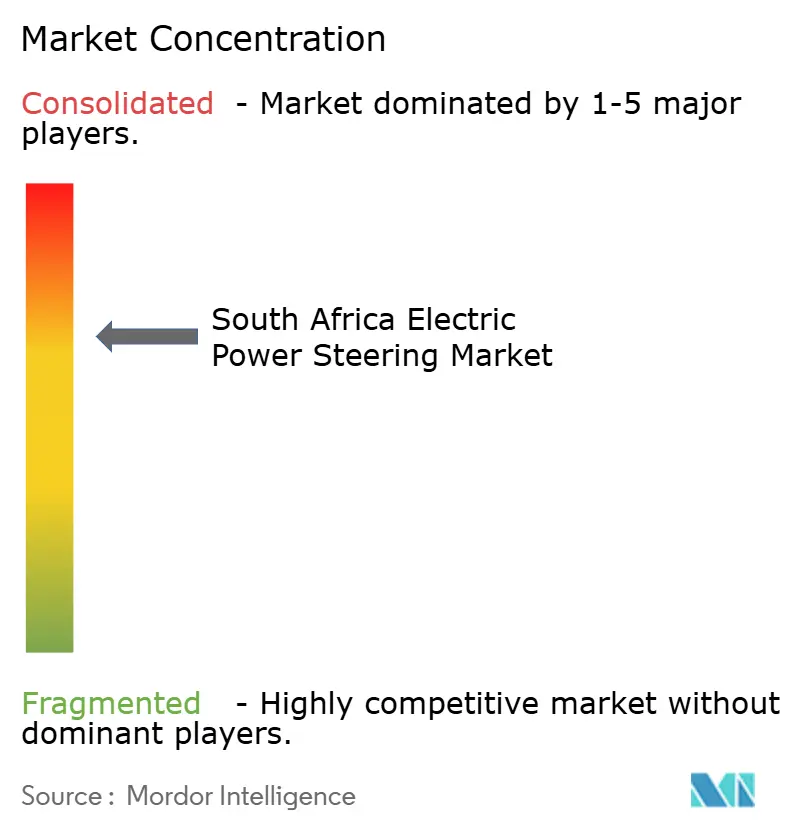
| Market Concentration | Medium |
Major Players *Disclaimer: Major Players sorted in no particular order Image © Mordor Intelligence. Reuse requires attribution under CC BY 4.0. | |
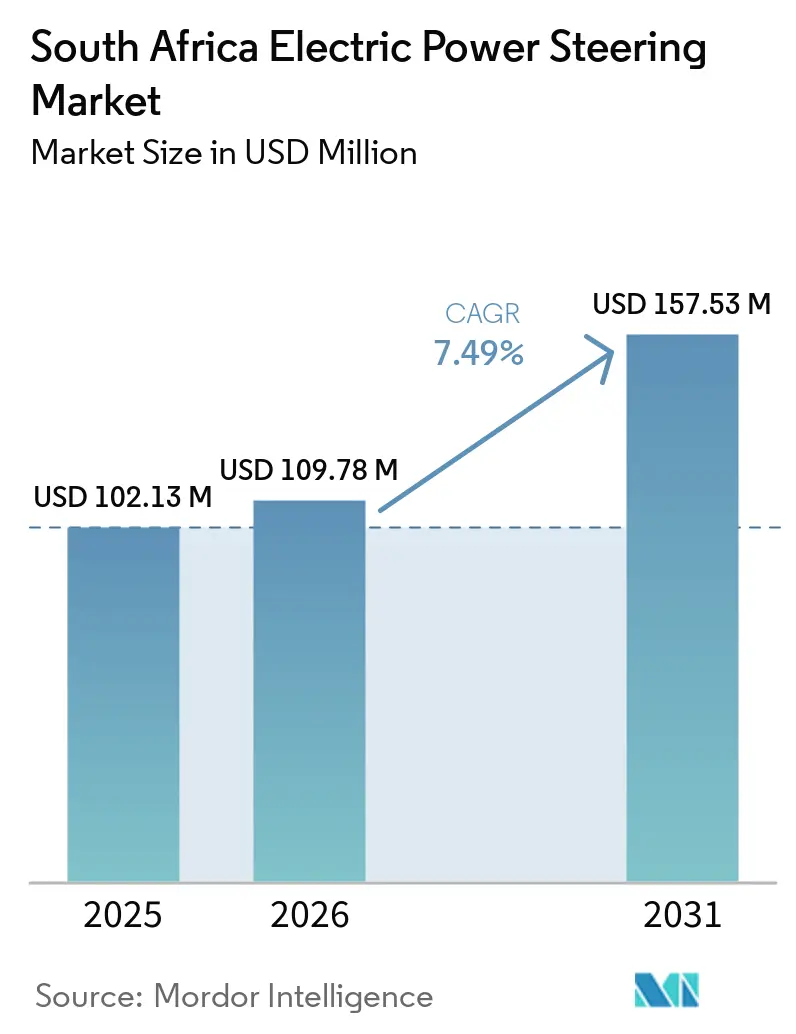
South Africa Electric Power Steering Market Analysis by Mordor Intelligence
The South African electric power steering market size was valued at USD 102.13 million in 2025, is estimated to grow to USD 109.78 million in 2026, and is projected to reach USD 157.53 million by 2031, advancing at a 7.49% CAGR (2026-2031). Favorable import-substitution incentives under the South African Automotive Masterplan 2035, a broad shift toward 48-volt electrical architectures, and the mandatory fitment of electronic stability control (ESC) are widening the addressable base for electric power steering modules. Tier-1 suppliers are refocusing on localized sub-assembly to capture Production Incentive (PI) rebates, while OEMs are trimming bill-of-materials costs by standardizing single-motor dual-pinion designs that cut weight and wiring complexity. The South African Electric Power Steering market also benefits from fast-rising commercial-vehicle demand tied to mining and logistics fleet upgrades. Load-shedding, forex swings, and elevated copper and neodymium prices, however, continue to squeeze margins, forcing suppliers to hedge raw-material exposure and carry higher semiconductor safety stock.
Key Report Takeaways
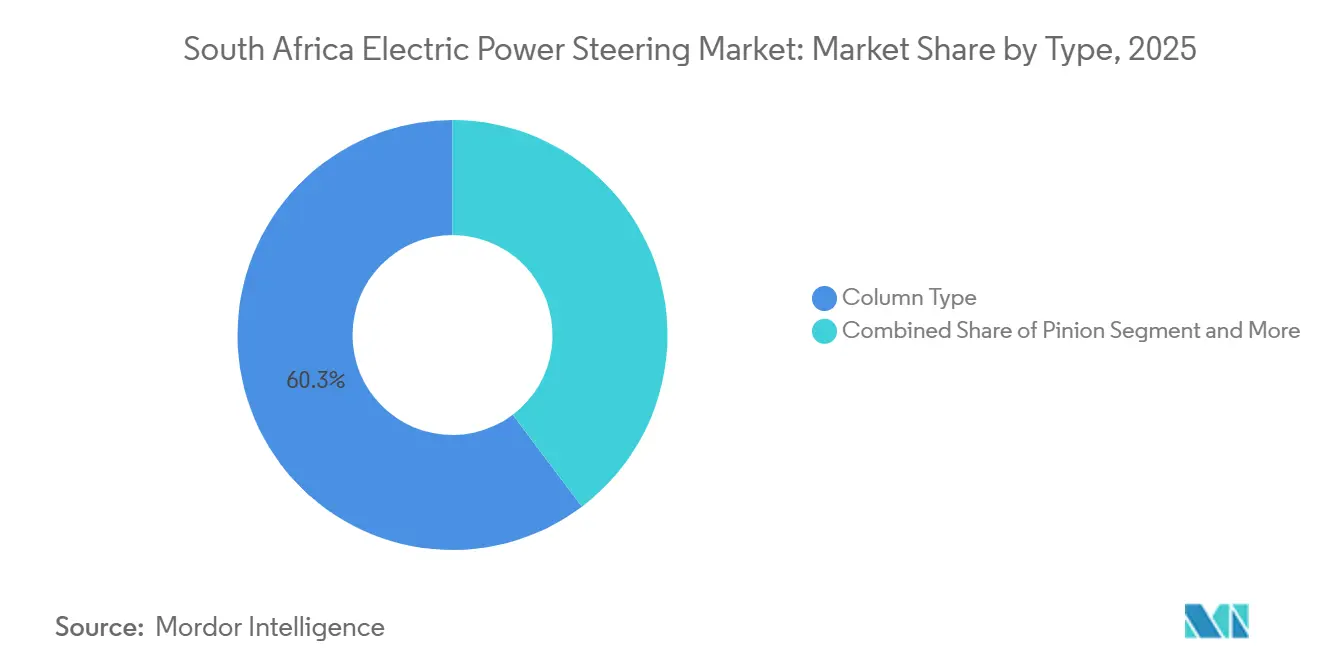
- By type, column configurations captured 60.28% of the South African electric power steering market share in 2025, whereas dual-pinion architectures are forecast to expand at a 9.87% CAGR through 2031.
- By component, steering racks and columns accounted for 44.83% of the South African electric power steering market in 2025, while sensor modules are poised for the fastest 10.24% CAGR to 2031.
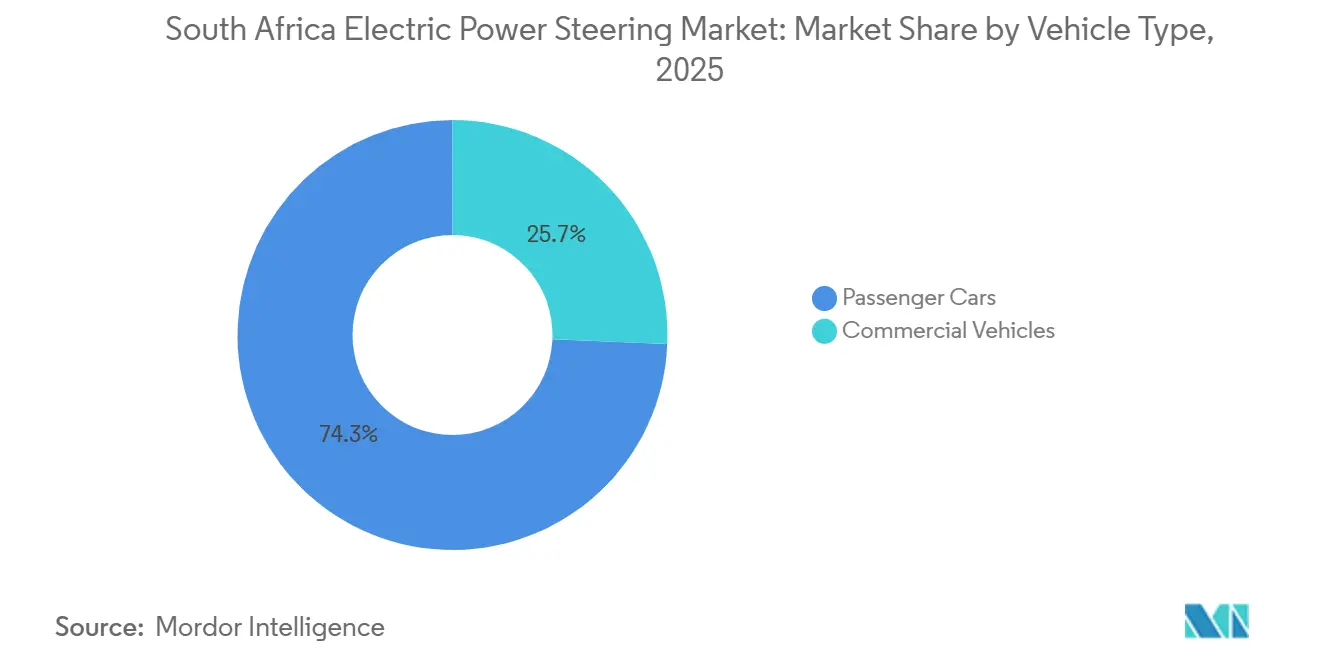
- By vehicle segment, passenger cars accounted for 74.34% of the South African electric power steering market size in 2025, but commercial vehicles are projected to accelerate at an 8.78% CAGR over 2026-2031.
- By propulsion, internal-combustion platforms retained 79.72% of the South African electric power steering market share in 2025, whereas battery-electric vehicles led growth at a 13.12% CAGR toward 2031.
Note: Market size and forecast figures in this report are generated using Mordor Intelligence’s proprietary estimation framework, updated with the latest available data and insights as of January 2026.
South Africa Electric Power Steering Market Trends and Insights
Drivers Impact Analysis*
| Driver | (~) % Impact on CAGR Forecast | Geographic Relevance | Impact Timeline |
|---|---|---|---|
| Strong SUV and Pickup Sales Drive EPS Retrofit Demand | +1.8% | National, with concentration in Gauteng and Western Cape urban centers | Medium term (2-4 years) |
| South African Automotive Masterplan 2035: Localization Incentives | +1.2% | National, targeting Gauteng and Eastern Cape automotive hubs | Long term (≥ 4 years) |
| New ICE Models Shift to 48-V Electrical Architectures | +0.9% | National, led by premium and mid-size passenger-car segments | Short term (≤ 2 years) |
| Mandatory ESC and ABS Rules Boost EPS Rates | +0.7% | National, enforced through NRCS homologation requirements | Short term (≤ 2 years) |
| Mining and Logistics Sectors Demand Steer-By-Wire LCVs | +0.6% | Regional, concentrated in Limpopo, North West, and Northern Cape mining corridors | Medium term (2-4 years) |
| OEMs Push for Single-Motor Dual-Pinion Designs | +0.4% | National, driven by cost-competitive passenger-car platforms | Medium term (2-4 years) |
| Source: Mordor Intelligence | |||
Robust SUV/Pickup Sales Sustaining EPS Retrofit Demand
South Africa’s light-commercial-vehicle registrations rebounded 20.5% year on year in November 2025 after the mining downturn of 2024, bringing SUVs and pickups to 38% of unit sales[1]. Retrofits of column-type electric power steering satisfy ESC mandates without retooling entire steering columns, a preference that keeps the South African electric power steering market anchored in cost-sensitive ICE platforms. Many in-service vehicles still lack electronic stability control, creating opportunities for workshops partnering with Tier-1s to retrofit EPS systems and generate additional revenue. Toyota's Hilux and Ford's Ranger now come equipped with factory-installed electric power steering, in line with UNECE R13H brake regulations, driving demand for replacement modules. The anticipated production ramp under SAAM 2035 is expected to increase retrofit volumes, even if the attach rates per vehicle stabilize.
Automaker Localization Incentives Under South African Automotive Masterplan 2035
Steering-system vendors are leveraging PI rebates on qualifying capital to offset tooling costs. This incentive is driving them to establish localized winding, calibration, and ECU programming lines near OEM plants in Gauteng and the Eastern Cape. Grants from the Automotive Investment Scheme have bolstered component capacity. However, it's noteworthy that precision sensor fabrication continues to be conducted offshore. The trend towards shorter supply chains, emphasizing just-in-time delivery, has led Bosch and Continental to collaborate with local distributors, moving away from importing complete modules. Furthermore, localization acts as a buffer against forex volatility. With a significant portion of value added in rand, it ensures more predictable pricing. This is particularly advantageous in a market where OEMs are hesitant to engage in contracts priced in USD. Collectively, these factors are enhancing the medium-term outlook for South Africa's electric power steering market, making it more cost-competitive compared to hydraulic alternatives.
Shift to 48-V Electrical Architectures in New ICE Models
A 48-volt bus quadruples power headroom compared with legacy 12-volt systems, enabling EPS motors to deliver up to 8 Nm of assist while trimming copper weight [2]. South African mid-size sedans and crossovers adopting mild-hybrid setups meet looming emissions limits under the draft Climate Change Bill without the full expense of battery-electric drivetrains. Higher-resolution magneto-resistive sensors are simultaneously introduced to manage fast actuator cycles required for lane-keeping and automated-parking functions. While 48-volt electric power steering modules cost 18-22% more, tiered supplier pricing and PI incentives mitigate short-term margin pressure. As volumes mature, economies of scale are expected to neutralize the cost delta, solidifying the 48-volt pathway’s role in sustaining the South African Electric Power Steering market.
Mandatory ESC and ABS Rules Raising EPS Attach-Rate
The National Regulator for Compulsory Specifications requires ESC and ABS on every new M1 and N1 model released after 2024, turning electric power steering from a desirable option into a legal obligation. Continuous steering-angle feedback inherent in EPS feeds ESC controllers, eliminating the hydraulic fallback that once prevailed in entry-level pickups. The regulation instantly converts an estimated 15–20% of annual production from hydraulic to electric assist, adding volume headroom even without underlying demand growth. Parallel imports of non-compliant vehicles remain a loophole, but OEM factories in South Africa now certify every new product line with electric power steering. This regulatory certainty underpins forecast stability for the South African electric power steering market over the next four years.
Restraints Impact Analysis*
| Restraint | (~) % Impact on CAGR Forecast | Geographic Relevance | Impact Timeline |
|---|---|---|---|
| EPS Plants Face Semiconductor Shortages | -0.8% | National, affecting all OEM supply chains with global Tier-1 dependencies | Short term (≤ 2 years) |
| Low EV Adoption Slows EPS Upgrades | -0.6% | National, with marginal EV adoption in Gauteng and Western Cape | Long term (≥ 4 years) |
| Torque Sensor Production Lags Domestically | -0.5% | National, requiring imports from Asia and Europe | Medium term (2-4 years) |
| Copper and Magnet Prices Escalate | -0.4% | National, driven by global commodity cycles | Short term (≤ 2 years) |
| Source: Mordor Intelligence | |||
Intermittent Semiconductor Supply to Tier-1 EPS Plants
Lead times for automotive microcontrollers with ASIL-D certification remain at 16-20 weeks, leaving local assembly lines vulnerable when consumer-electronics demand surges. A 2024 fire at a Renesas facility idled Ford’s Silverton plant for six weeks, costing an estimated ZAR 120 million in lost Ranger output [3]. Because South Africa generates lower global volume than China or the United States, steering-system builders rank low on chip-foundry allocation lists, forcing them to stockpile buffer inventory that ties up working capital. Safety-stock expansions partially mute disruption but inflate carrying costs, eroding profitability across the South African electric power steering market. Foundries are adding 300 mm wafer lines, yet automotive’s share of capacity stays under 10%, keeping allocation risk elevated through 2027.
Low EV Penetration Slows High-Value EPS Mix-Upgrade
Battery-electric vehicles currently account for a negligible share of total vehicle sales. This sluggish uptake dampens the demand for advanced EPS modules, which come with integrated thermal management and a significant price premium. Additionally, sporadic charging reliability due to load shedding, coupled with higher vehicle costs from import duties on batteries, further stifles demand. While a tax rebate on EV investments is anticipated to boost adoption, analysts project that penetration won't reach meaningful levels until later. This delay pushes back the realization of scale economies for BEV-oriented steering systems. Consequently, suppliers are predominantly focusing on low-margin column EPS, tailored for internal-combustion models. This gradual shift in focus is expected to negatively impact the outlook for the South African electric power steering market.
*Our forecasts treat driver/restraint impacts as directional, not additive. The impact forecasts reflect baseline growth, mix effects, and variable interactions.
Segment Analysis
By Type: Column Dominance Reflects ICE Legacy
Column configurations accounted for 60.28% of the South African electric power steering market in 2025, as OEMs retrofitted existing steering columns at the lowest possible cost. Dual-pinion systems are forecast to capture incremental share at a 9.87% CAGR through 2031, as they retain fail-safe redundancy while using a single brushless motor, which lowers weight and parts count. Pinion-mount designs are preferred in export-oriented premium sedans produced in the Eastern Cape, where European ride-and-handling benchmarks influence architectural choices. Meanwhile, Gauteng assembly plants, focusing on compact domestic models, opt for column systems to enhance affordability and adhere to NRCS homologation standards. However, for higher-value pickups destined for Europe, there's a noticeable shift towards pinion and dual-pinion setups, driven by stringent crash and ADAS standards. This dynamic forces suppliers to manage a diverse range of SKUs, which, while diminishing economies of scale, ensures a broad coverage across various vehicle programs in South Africa's electric power steering market.
Cost-engineering initiatives are enhancing the appeal of the single-motor dual-pinion EPS. The rationale is clear: as the unit part counts decrease, localizing the motor winding and ECU programming becomes significantly easier. However, a challenge looms: South Africa's machining capabilities must meet the required tolerances for gear backlash. This precision demands imported CNC machinery and specialized tooling fluids. Until local suppliers bridge this precision gap, global Tier-1 companies have no choice but to handle critical machining processes offshore. They then transport these partially finished assemblies back to South Africa for final calibration. This strategy not only secures PI rebates on the locally added value but also aligns with OEM cost and scheduling demands. Given its advantages, this approach is poised to shape the supply strategy for the foreseeable future.

By Component: Sensors Lead Growth
Steering racks and columns together accounted for 44.83% of South Africa's electric power steering market share in 2025 because they are irreplaceable structural elements. Sensor modules, however, will post the fastest 10.24% CAGR through 2031, driven by 48-volt and ADAS adoption that demand sub-0.1-degree angular accuracy. Magneto-resistive ICs from Thailand and Germany are now replacing older Hall-effect components in mild-hybrid sedans. Enhanced sensor resolution fine-tunes lane-keeping and automated-parking algorithms, crucial for vehicles destined for European markets. Calibration benches are being set up by suppliers within the Gauteng Industrial Development Centre facilities, allowing them to charge calibration service fees and thereby boost margins without relying on hardware sales.
Motor assemblies grapple with rising copper and rare-earth costs. However, they're slowly shifting towards integrated temperature sensors, a move aimed at curbing warranty claims, especially in Limpopo’s arid climate. While ECU boards maintain steady demand, they require continuous microcontroller updates to handle 48-volt transients, linking their material costs to the global semiconductor market. Wiring harnesses and brackets, though growing with overall production volume, stand out as potential localization candidates due to their minimal precision-tooling requirements. This diverse component landscape highlights the premium economic value derived from sensors and control software intellectual property in South Africa's electric power steering sector.
By Vehicle Type: Commercial Segment Accelerates
Passenger cars accounted for 74.34% of South Africa's electric power steering market in 2025, reflecting high unit volumes and new ESC mandates across M1 categories. Commercial vehicles, led by pickups and logistics vans, will outpace cars at an 8.78% CAGR through 2031 as mining and e-commerce operators prioritize uptime and plan steer-by-wire pilot fleets. Light commercial pickups, such as Hilux and Ranger, transition from hydraulic to electric steering to meet N1 safety rules, while medium trucks remain essentially hydraulic due to higher assist-torque demands. EPS with predictive-maintenance features alerts fleet managers to wear conditions, reducing unscheduled downtime by up to 18% and justifying premium pricing in mining corridors.
Urban ride-share and delivery startups in Johannesburg and Cape Town further expand the LCV base, stimulating demand for low-maintenance electric steering. Passenger-car growth, in contrast, tilts toward cost-optimized column systems on entry-level hatchbacks, capping margin upside. Premium SUVs upgrade to variable-ratio dual-pinion designs, but absolute volumes stay modest. Suppliers therefore deploy a dual-track strategy: chase scale in passenger-car column architecture while offering high-value, low-volume steer-by-wire solutions to commercial-fleet early adopters.
By Propulsion Type: ICE Dominance Persists
Internal-combustion vehicles accounted for 79.72% of South Africa's electric power steering market size in 2025 and, despite a gradual slide, will remain the revenue mainstay through 2031. Battery-electric units grow fastest at a 13.12% CAGR. The small base limits the absolute volume of steering systems. While hybrids hold a modest market share, they benefit from the same demand for 48-volt step-up driving sensors. This results in a moderate uptick in their motor-assist torque requirements. BEV-specific EPS modules, equipped with cooling jackets and regenerative braking logic, command a premium ASP. This premium could lead to margin expansion once BEV penetration increases.
Government tax rebates are set to incentivize the adoption of electric vehicles. Should grid reliability see improvements, BEV sales might exceed expectations. Suppliers are already importing steering racks tailored for BEVs from Asian facilities, catering to early adopters like the BMW iX3 and Volvo EX30. However, the bulk of capital is still funneled into ICE steering development, aligning with both volume demands and localization incentives. In the South African electric power steering market, the challenge lies in balancing investments across different propulsion types while staying agile, a key determinant of competitive positioning.
Geography Analysis
Gauteng province, bolstered by Ford’s Silverton and Nissan’s Rosslyn factories and Johannesburg’s role as the national logistics hub, accounts for a significant portion of South Africa's demand for Electric Power Steering (EPS). These factories, primarily producing compact sedans and pickups for the domestic market, heavily rely on high-volume column EPS designs. However, with Eskom's load-shedding hitting Gauteng's assembly lines the hardest, steering suppliers have resorted to installing diesel generators and lithium-ion backup arrays, a move that inflates their operating costs. Following Gauteng, the Eastern Cape province contributes substantially to the demand, driven by export-oriented production lines at Volkswagen’s Kariega and Mercedes-Benz’s East London. Here, the emphasis is on dual-pinion and pinion EPS, as European crash standards for export programs elevate the average steering content per vehicle.
In KwaZulu-Natal, Toyota’s Durban facility focuses on compact crossovers and pioneering trials of single-motor dual-pinion modules on the Corolla Cross. The province's port access streamlines the import of torque sensors and brushless motors, significantly reducing lead times compared to inland plants. Meanwhile, northern mining provinces, though contributing minimally to passenger-car volume, carve out lucrative niches with steer-by-wire light trucks, essential for transporting ore and equipment in perilous settings. Suppliers frequently send field engineers from Pretoria to oversee on-site mining trials, bundling these services into contracts that ensure a steady revenue stream.
This dynamic has birthed a hub-and-spoke supply chain: calibration and warehousing operations are concentrated in industrial parks of Gauteng and Eastern Cape, with spokes reaching out to accredited workshops in distant provinces. Incentive packages differ by province—Gauteng's AIDC offers subsidized land, while Eastern Cape's Coega SEZ dangles corporate tax holidays—prompting suppliers to balance capital expenditure efficiencies with their proximity to OEM assembly. This intricate regional landscape influences logistics costs, lead-time risks, and the broader competitive dynamics of South Africa's electric power steering market.
Competitive Landscape
Through multi-year supply agreements with automotive giants like Toyota, Volkswagen, Ford, and Nissan, four global Tier-1s—Bosch, JTEKT, ZF, and Nexteer—command a dominant market share. These industry leaders leverage their scale advantages to spread R&D costs for predictive-maintenance software and ISO 26262-graded electronics across continents, enabling them to offer lower prices than regional competitors. However, the limited market size in South Africa discourages these firms from establishing wholly owned greenfield factories. Instead, they opt for calibration labs, inventory hubs, and forge joint ventures with distributors like Imperial Logistics, which provide essential last-mile warehousing and field-service capabilities.
Chinese and Korean players, such as Zhejiang Shibao and Mando, are strategically focusing on retrofit and commercial-vehicle sub-segments, where brand loyalty is less entrenched and price sensitivity is pronounced. Meanwhile, local assemblers, including parts affiliate Smiths Manufacturing, are delving into sub-assembly partnerships to leverage PI rebates, even as they continue to outsource high-precision gear machining overseas. The technological frontier is buzzing with advancements like over-the-air firmware updates, vehicle-to-infrastructure communication, and steer-by-wire redundancy. Suppliers boasting robust software capabilities are now commanding premium contracts, shifting the competitive focus from mere hardware costs to the broader total cost of ownership value proposition.
Factors such as commodity price fluctuations and semiconductor allocation risks are increasingly influencing balance-sheet resilience. Groups that are vertically integrated and source their motors and MCUs in-house are better positioned to weather shocks from copper and chip price swings than module-calibrators dependent on outside suppliers. While compliance with NRCS and ISO 9001 standards is still fundamental, the new benchmarks for differentiation lie in ADAS readiness and compatibility with 48-volt systems. The overall landscape suggests a trend towards gradual consolidation, with smaller Tier-2 players either carving out niches in the aftermarket or facing exit pressures due to rising costs.
South Africa Electric Power Steering Industry Leaders
-
Robert Bosch GmbH
-
JTEKT Corporation
-
ZF Friedrichshafen AG
-
Nexteer Automotive
-
NSK Ltd.
- *Disclaimer: Major Players sorted in no particular order
Recent Industry Developments
- October 2025: Leapmotor International has made its debut in South Africa, introducing the Leapmotor C10 REEV. This premium family SUV, equipped with advanced electric power steering technology, seamlessly blends the advantages of electric commuting with the practicality of long-distance travel, positioning itself between fully electric cars and conventional hybrids. The inclusion of electric power steering highlights the growing adoption of such systems in the South African electric power steering market.
- September 2025: Eskom, led by its Distribution Division, unveiled its first fleet of electric vehicles (EVs), marking progress in the South Africa electric power steering market. The utility introduced 20 EVs, including light delivery vehicles and trucks, with plans to add 100 more. Deployed in the Distribution and Generation Divisions, these vehicles support operations and highlight the potential of e-mobility to drive demand for electric power steering systems in South Africa.
South Africa Electric Power Steering Market Report Scope
The South African electric power steering market report is segmented by type (column type, pinion type, and dual pinion type), component type (steering rack/column, sensor, steering motor, and other component types), vehicle type (passenger cars and commercial vehicles), and propulsion type (internal combustion engine vehicles, hybrid vehicles, and battery electric vehicles). The market forecasts are provided in terms of value (USD).
By Type
| Column Type |
| Pinion Type |
| Dual Pinion Type |
By Component Type
| Steering Rack/Column |
| Sensor |
| Steering Motor |
| Other Component Types |
By Vehicle Type
| Passenger Cars |
| Commercial Vehicles |
By Propulsion Type
| Internal Combustion Engine Vehicles |
| Hybrid Vehicles |
| Battery Electric Vehicles |
| By Type | Column Type |
| Pinion Type | |
| Dual Pinion Type | |
| By Component Type | Steering Rack/Column |
| Sensor | |
| Steering Motor | |
| Other Component Types | |
| By Vehicle Type | Passenger Cars |
| Commercial Vehicles | |
| By Propulsion Type | Internal Combustion Engine Vehicles |
| Hybrid Vehicles | |
| Battery Electric Vehicles |
Key Questions Answered in the Report
What is the projected value of the South Africa electric power steering market in 2031?
The market is expected to reach USD 157.53 million by 2031.
Which steering-system type currently dominates vehicle assembly?
Column-type configurations hold 60.28% market share due to retrofit affordability.
Which vehicle segment will grow fastest for electric power steering?
Commercial vehicles are set to expand at an 8.78% CAGR between 2026 and 2031.
How do localization incentives affect suppliers?
Production Incentive rebates of up to 62.5% encourage local sub-assembly, lowering landed costs and shortening supply chains.