
Automotive Power Steering Motor Market Size and Share
Market Overview
| Study Period | 2019 - 2031 |
|---|---|
| Market Size (2026) | USD 10.12 Billion |
| Market Size (2031) | USD 12.99 Billion |
| Growth Rate (2026 - 2031) | 5.12 % |
| Fastest Growing Market | Middle East and Africa |
| Largest Market | Asia-Pacific |
| Market Concentration | Medium |
Major Players *Disclaimer: Major Players sorted in no particular order Image © Mordor Intelligence. Reuse requires attribution under CC BY 4.0. | |
Automotive Power Steering Motor Market Analysis by Mordor Intelligence
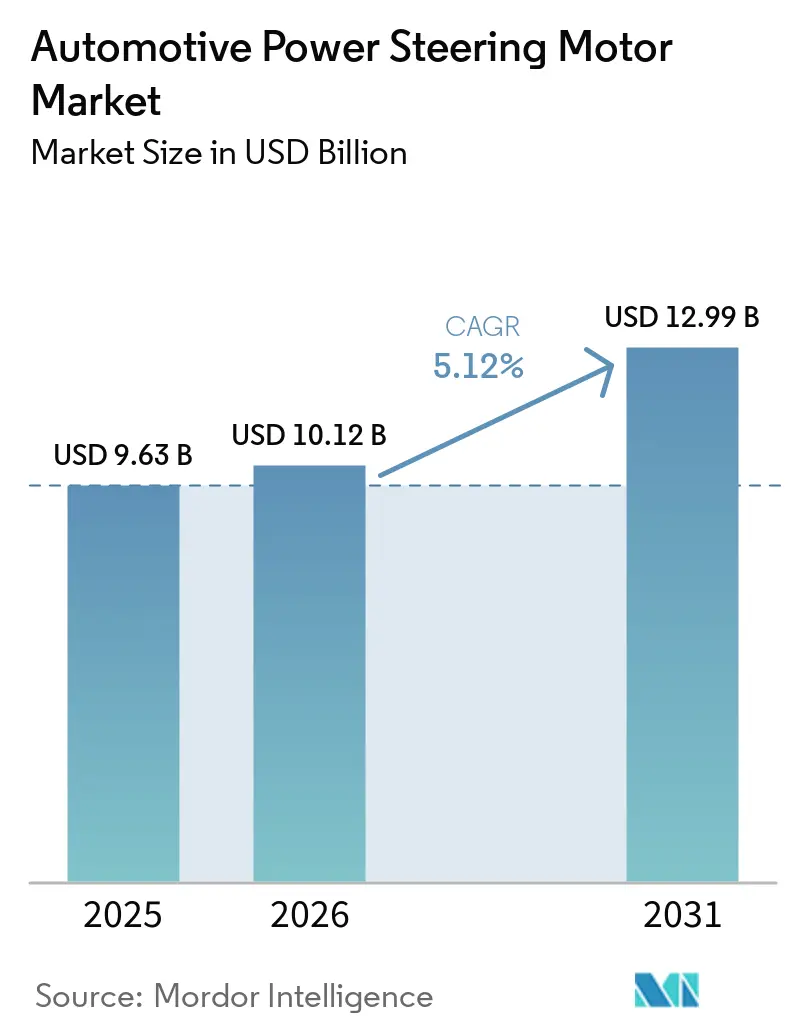
The automotive power steering motor market size was valued at USD 9.63 billion in 2025 and is estimated to grow from USD 10.12 billion in 2026 to reach USD 12.99 billion by 2031, registering a CAGR of 5.12% during the forecast period (2026–2031). Rapid adoption of EPS is driven by stricter fuel-economy and CO₂ rules, integration with advanced driver-assistance features, and the shift toward software-defined vehicle platforms. Automakers view steering motors as critical enablers of steer-by-wire architectures that support higher levels of automation while reducing lifetime maintenance costs. Asia-Pacific remains the principal manufacturing hub, benefiting from dense electronics supply chains and strong battery-electric vehicle output. In contrast, localization strategies in ASEAN and Mexico are helping cushion rare-earth and semiconductor supply risks. Across all regions, brushless DC motors gain share as silicon-carbide inverters make higher-efficiency power electronics financially viable and compliant with future cybersecurity standards.
Key Report Takeaways
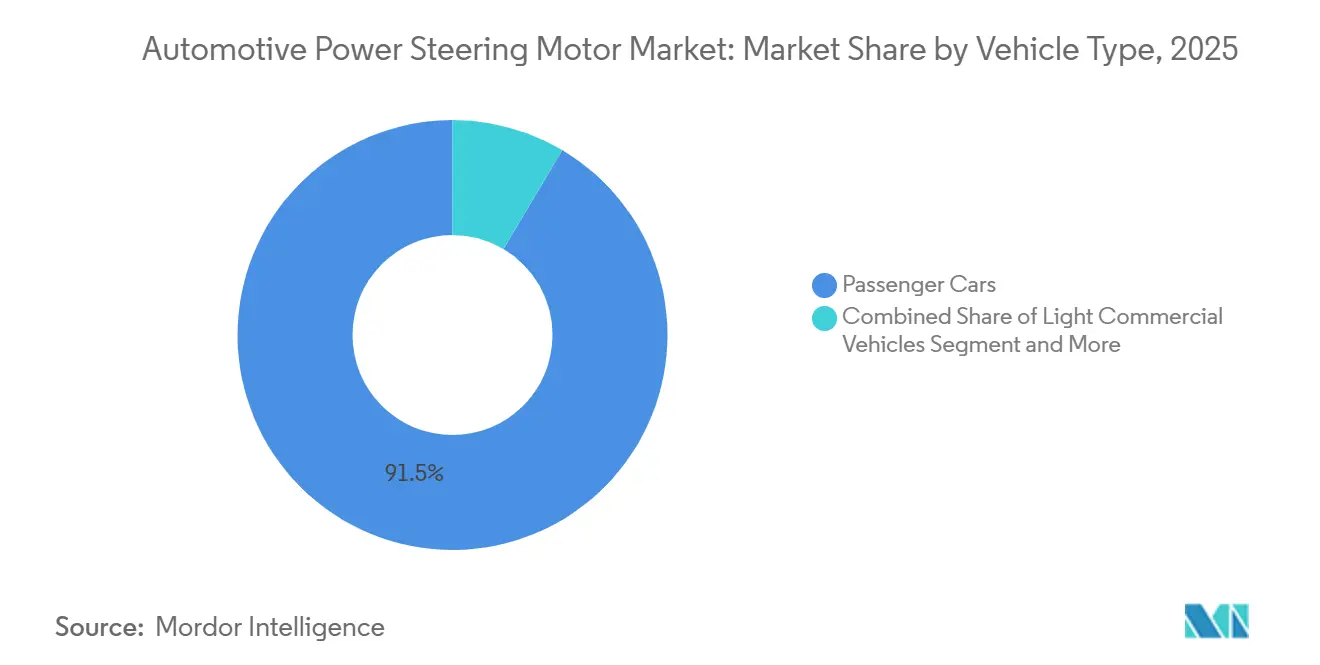
- By vehicle type, passenger cars accounted for 91.48% of the automotive power steering motor market share in 2025, while light commercial vehicles are projected to grow at a 7.12% CAGR through 2031.
- By power-steering type, electric power steering (EPS) dominated with a 70.31% of the automotive power steering motor market share in 2025 and is also expected to register the fastest growth at 8.18% CAGR through 2031.
- By product type, column-assist EPS (CEPS) led with a 41.28% of the automotive power steering motor market share in 2025, while rack-assist EPS (REPS) is forecast to expand at 11.22% CAGR to 2031.
- By motor technology, brushed DC motors comprised 57.45% of the automotive power steering motor market in 2025, whereas brushless DC motors are projected to grow at an 8.72% CAGR through 2031.
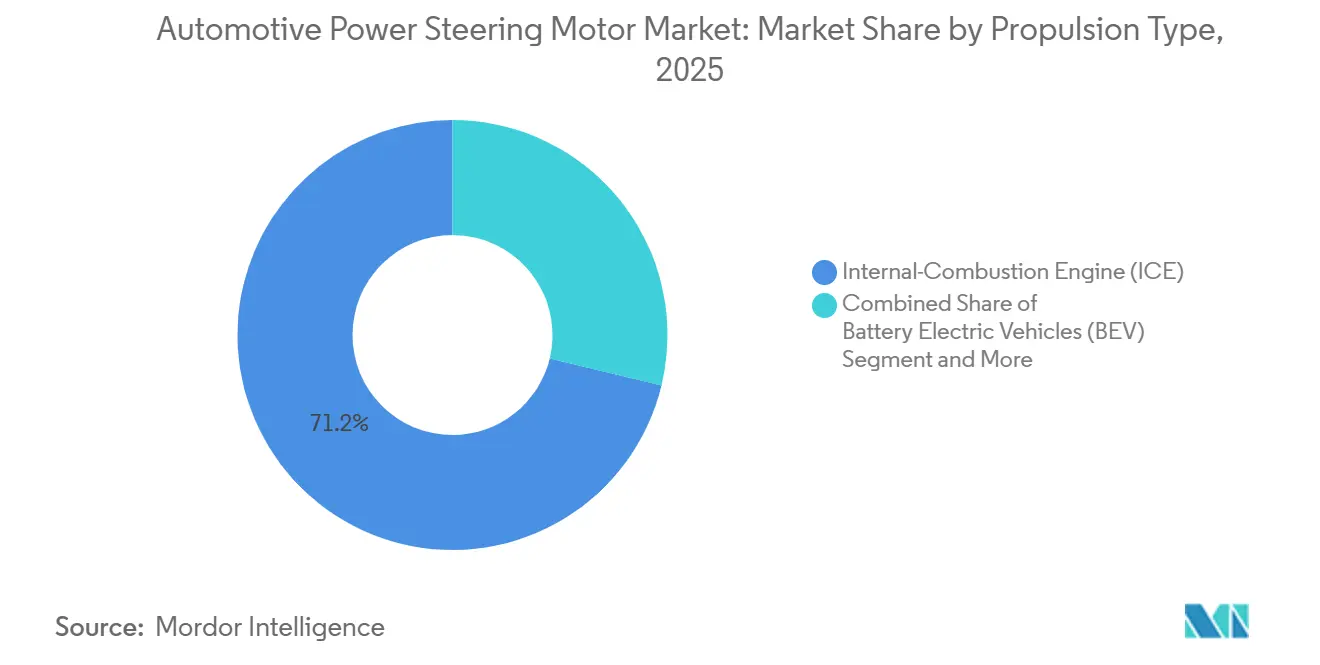
- By propulsion type, internal-combustion engine (ICE) vehicles held a 71.22% of the automotive power steering motor market share in 2025, while battery electric vehicles (BEVs) are set to grow rapidly at a 12.25% CAGR to 2031.
- By sales channel, OEM channels captured 94.35% of the automotive power steering motor market revenue in 2025, while the aftermarket segment is expected to expand at an 8.79% CAGR through 2031.
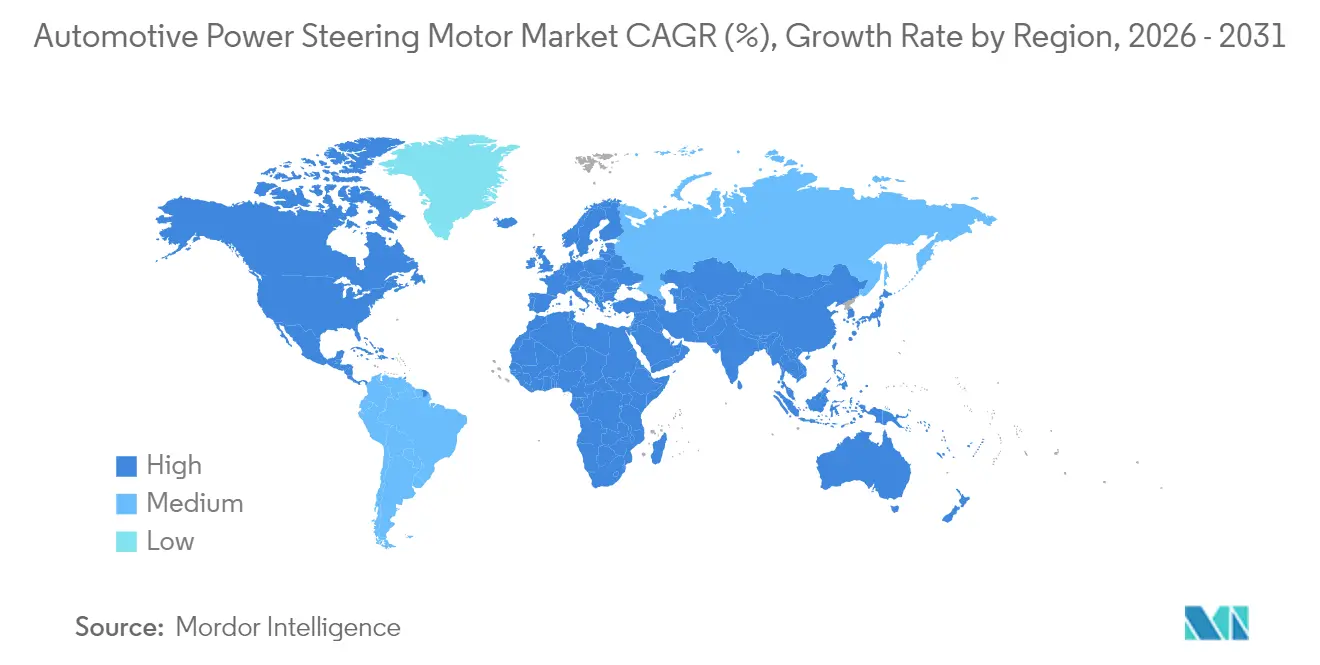
- By geography, Asia-Pacific led the market with a 54.55% of the automotive power steering motor market in 2025, while the Middle East and Africa is expected to post the fastest growth at 9.35% CAGR to 2031.
Note: Market size and forecast figures in this report are generated using Mordor Intelligence’s proprietary estimation framework, updated with the latest available data and insights as of 2026.
Market Trends and Insights
Drivers Impact Analysis of Automotive Power Steering Motor Market*
| Driver | (~) % Impact on CAGR Forecast | Geographic Relevance | Impact Timeline |
|---|---|---|---|
| Shift to EPS for Fuel-Economy and CO₂ Compliance | +1.2% | Global, with EU and China Leading Regulatory Pressure | Medium term (2-4 years) |
| Electrified-Vehicle Production in China and India | +1.1% | APAC Core, Spill-Over to ASEAN Markets | Short term (≤ 2 years) |
| Integration with ADAS and Steer-by-Wire | +0.9% | North America and EU Premium Segments, Asia-Pacific Following | Long term (≥ 4 years) |
| Vendor Localization in ASEAN and Mexico | +0.7% | ASEAN-5, Mexico, with Supply Chain Benefits to NAFTA | Medium term (2-4 years) |
| Silicon-Carbide Inverter Cost Declines | +0.6% | Global, with Early Adoption in Premium EV Segments | Medium term (2-4 years) |
| OEM Over-the-Air Torque-Map Updates | +0.4% | North America and EU, Expanding to Premium Asia-Pacific Models | Long term (≥ 4 years) |
| Source: Mordor Intelligence | |||
Shift to EPS for Fuel-Economy and CO2 Compliance
Regulatory pressure drives EPS adoption as automakers seek 2-4% fuel economy improvements over hydraulic systems, with the technology eliminating engine-driven hydraulic pumps that consume 2-6 horsepower continuously. European Union's CO2 emission targets of 95g/km by 2025 and China's dual-credit policy create compliance urgency that extends beyond traditional cost-benefit calculations[1]. This regulatory momentum accelerates EPS penetration in budget vehicle segments where manufacturers previously avoided the technology due to higher upfront costs. The shift enables automakers to achieve fleet-wide emission reductions without compromising vehicle performance, as EPS systems provide steering assistance only when needed rather than maintaining constant hydraulic pressure. Commercial vehicle manufacturers increasingly adopt EPS to meet stringent emission standards while reducing total cost of ownership through eliminated hydraulic fluid maintenance and improved fuel efficiency.
Rapid Electrified-Vehicle Production in China and India
China's BEV production surge creates concentrated demand for EPS motors, with domestic manufacturers like BYD and emerging players requiring steering systems optimized for electric vehicle architectures rather than ICE retrofits. India's emerging electrification policies compound this demand, as automakers like Tata Motors achieve 80% localization for EV components, including in-house motor production to reduce import dependency. This regional concentration creates supply chain efficiencies for EPS motor manufacturers capable of establishing local production capabilities, while also exposing the market to geopolitical risks around rare-earth material access and technology transfer requirements.
Integration with ADAS and Steer-by-Wire Roadmaps
EPS systems serve as foundational hardware for automated driving features, with steering motors providing the precise torque control required for lane-keeping assist, automated parking, and emergency steering interventions. ZF's recent steer-by-wire deployment in the Nio ET9 demonstrates how eliminating mechanical steering connections enables advanced vehicle dynamics control impossible with traditional systems. This integration creates vendor lock-in effects, as automakers developing autonomous driving capabilities require steering suppliers capable of delivering integrated hardware-software solutions rather than standalone mechanical components. The technology roadmap extends beyond current ADAS applications, with steer-by-wire systems enabling variable steering ratios, customizable driver experiences, and fail-safe redundancy for higher automation levels. Volkswagen's modular steering system development for Premium Platform Electric vehicles illustrates how EPS integration becomes central to software-defined vehicle architectures, requiring continuous over-the-air updates and performance optimization.
Tier-1 Vendor Localization in ASEAN and Mexico
Manufacturing localization accelerates as Tier-1 suppliers establish regional production capabilities to serve growing automotive assembly operations in Thailand, Indonesia, Malaysia, and Mexico. Nexteer's expansion in Mexico with a new technical center creating 350+ jobs by 2026 exemplifies this trend, focusing on electric power steering and steering column innovations with pre-production prototyping capabilities[2]. ASEAN region vehicle production projects to reach 6 million units by the mid-2030s, driven by Chinese OEM investments in EV manufacturing and Japanese automaker capacity expansions[3]. This localization reduces logistics costs and currency exposure while enabling faster response to regional OEM requirements, particularly as Mexico positions itself to become the 5th largest vehicle producer globally by 2025 with a strong focus on electrification components.
Restraints Impact Analysis of Automotive Power Steering Motor Market*
| Restraint | (~) % Impact on CAGR Forecast | Geographic Relevance | Impact Timeline |
|---|---|---|---|
| Semiconductor Supply-Chain Tightness 2025–27 | -1.1% | Global, with Particular Stress in Automotive-Grade Components | Medium term (2-4 years) |
| High EPS Repair Cost for Budget-Car Segments | -0.8% | Global, with Acute Impact in Price-Sensitive Emerging Markets | Short term (≤ 2 years) |
| Rare-Earth Magnet Price Volatility | -0.7% | Global, with Supply Concentration Risk from China Export Policies | Short term (≤ 2 years) |
| Cyber-Security Compliance Cost Burden | -0.5% | North America and EU Regulatory Markets, Expanding Globally | Medium term (2-4 years) |
| Source: Mordor Intelligence | |||
Semiconductor Supply-Chain Tightness 2025-27
Automotive-grade semiconductor shortages continue affecting EPS motor production, with power management ICs and motor control processors experiencing extended lead times that disrupt manufacturing schedules and increase component costs. The automotive industry's transition to 800V electrical architectures compounds this challenge, requiring specialized silicon carbide semiconductors with limited production capacity and stringent automotive qualification requirements. EPS manufacturers face allocation constraints from semiconductor suppliers prioritizing higher-volume consumer electronics over automotive applications, despite automotive's higher per-unit profitability. This supply tightness forces longer-term supply agreements and inventory buffers that increase working capital requirements while limiting production flexibility to respond to demand fluctuations.
High EPS Repair Cost for Budget-Car Segments
EPS system replacement costs ranging from USD 800-1,500 create affordability barriers in price-sensitive markets where vehicle values may not justify repair expenses, particularly for aging budget vehicles approaching end-of-life decisions. This cost structure drives consumers toward aftermarket alternatives or vehicle replacement rather than OEM repairs, limiting market expansion in regions with extended vehicle lifecycles and lower disposable incomes. The complexity of EPS motor-control unit integration requires specialized diagnostic equipment and technician training that many independent repair facilities lack, concentrating repair capabilities among authorized dealers with higher labor rates. Budget vehicle manufacturers face design trade-offs between initial cost competitiveness and long-term serviceability, as simplified EPS architectures may reduce upfront costs but increase repair complexity when failures occur.
*Our forecasts treat driver/restraint impacts as directional, not additive. The impact forecasts reflect baseline growth, mix effects, and variable interactions.
Automotive Power Steering Motor Market Segment Analysis
By Vehicle Type:
Commercial Segments Drive ElectrificationPassenger cars accounted for 91.48% of the automotive power steering motor market share in 2025, driven by regulatory compliance and consumer demand for advanced driver assistance features requiring precise electronic steering control. Heavy commercial vehicles adopt EPS systems more gradually due to higher power requirements and durability concerns. However, emerging applications in electric commercial vehicles create new opportunities for high-torque motor designs. Light commercial vehicles will exhibit the fastest growth at a 7.12% CAGR during 2026-2031, outpacing passenger cars despite representing a smaller market share, as fleet operators prioritize total cost-of-ownership benefits from EPS systems, including reduced maintenance and improved fuel efficiency.
The commercial vehicle transition reflects broader fleet electrification mandates, in which operators seek integrated solutions that combine steering, braking, and powertrain controls to optimize vehicle efficiency and reduce operational complexity. Fleet management systems increasingly require remote diagnostics and predictive maintenance capabilities that EPS systems enable through integrated sensors and communication protocols. This creates opportunities for differentiation for suppliers capable of delivering fleet-optimized solutions with extended service intervals and remote monitoring capabilities that reduce downtime costs.

By Power-Steering Type:
EPS Dominance AcceleratesElectric power steering commanded 70.31% of the automotive power steering motor market share in 2025 and will rise at 8.18% CAGR through 2031, reflecting the technology's evolution from a fuel economy solution to an enabling platform for advanced vehicle features. Hydraulic power steering systems face declining demand as automakers eliminate hydraulic components to reduce complexity and enable electrification, though the technology persists in heavy-duty applications requiring maximum steering force. Electro-hydraulic power steering serves as transitional technology for manufacturers upgrading existing platforms, combining electric motor assistance with hydraulic backup for applications requiring higher power output than pure EPS systems can deliver.
The EPS growth trajectory accelerates beyond traditional adoption curves as the technology becomes a prerequisite for ADAS integration and autonomous driving development. Automakers increasingly specify EPS systems for their software update capabilities and integration with vehicle stability control, creating vendor partnerships that extend beyond component supply to software development and validation services. This shift transforms EPS suppliers from mechanical component providers to integrated technology partners capable of delivering complete steering solutions with embedded intelligence and connectivity features.
By Product Type:
Rack-Assist Systems Gain TractionColumn-assist EPS (CEPS) maintained 41.28% of the automotive power steering motor market share in 2025 due to cost advantages and retrofit compatibility with existing vehicle architectures, particularly in compact and mid-size passenger cars, where packaging constraints favor integrated column-mounted solutions. Rack-assist EPS (REPS) will accelerate fastest at 11.22% CAGR, driven by superior performance characteristics and integration advantages in electric vehicle platforms where steering systems require higher precision and responsiveness. Pinion-assist EPS (PEPS) serves specialized applications requiring intermediate power levels, while dual-pinion EPS (DPEPS) addresses high-performance vehicles demanding maximum steering precision and fail-safe redundancy.
Emerging parallel-axis EPS (PA-EPS) configurations enable packaging flexibility for electric vehicle designs where traditional steering column layouts conflict with battery placement and interior space optimization. The product evolution reflects automakers' shift toward platform-specific steering solutions rather than universal applications, creating opportunities for suppliers capable of delivering customized motor designs and control algorithms. Advanced motor topologies including axial-flux permanent magnet designs enable higher torque density and reduced axial length, addressing space constraints in modern vehicle architectures.
By Motor Technology:
Brushless Motors AdvanceBrushed DC motors retained 57.45% of the automotive power steering motor market share in 2025 due to cost advantages and established supply chains. However, brushless DC motors are projected to grow at an 8.72% CAGR through 2031 as efficiency and durability demands favor the technology's superior performance characteristics. Brushless motors eliminate mechanical wear points and enable precise speed control required for advanced driver assistance features, though higher initial costs limit adoption in budget vehicle segments. The technology transition reflects broader automotive electrification trends where motor efficiency directly impacts vehicle range and battery life.
Silicon carbide power electronics reduce brushless motor costs by improving inverter efficiency and lowering cooling requirements. The SiC device market is expected to experience strong growth through 2031, with automotive applications accounting for a substantial share of power SiC demand. This cost convergence accelerates brushless motor adoption as the total system cost approaches brushed alternatives while delivering superior performance and reliability. Rare-earth magnet alternatives, including ferrite and recycled NdFeB materials, address supply chain vulnerabilities while maintaining motor performance standards required for automotive applications.
By Propulsion Type:
BEV Growth Transforms RequirementsInternal combustion engine vehicles maintained 71.22% of the automotive power steering motor market share in 2025, though battery electric vehicles will surge at a 12.25% CAGR as electrification mandates and consumer preferences drive adoption across global markets. BEV steering systems require integration with regenerative braking and vehicle stability control systems, creating opportunities for suppliers capable of delivering coordinated chassis solutions rather than standalone steering components. Hybrid electric vehicles serve as transitional technology, requiring steering systems compatible with both electric and combustion powertrains while optimizing efficiency across operating modes.
The propulsion mix evolution creates distinct requirements for steering motor design, with BEVs enabling higher voltage operation and integrated thermal management while ICE vehicles require compatibility with 12V electrical systems and engine vibration isolation. Over 50% of battery electric vehicles are expected to utilize silicon carbide powertrains by 2027, up from 30% currently, enabling higher-efficiency steering systems with reduced power consumption. This transition creates technology roadmap challenges for suppliers serving mixed propulsion fleets while developing next-generation solutions for fully electric platforms.
By Sales Channel:
Aftermarket Opportunities EmergeOEM demand dominated with 94.35% of the automotive power steering motor market share in 2025, reflecting the integrated nature of modern EPS systems that require factory installation and calibration with vehicle control systems. Aftermarket demand is set to grow at an 8.79% CAGR through 2031, driven by aging vehicle fleets requiring EPS retrofits and replacement components, particularly in regions with extended vehicle lifecycles and growing service infrastructure. The aftermarket expansion faces challenges from system complexity and diagnostic requirements that limit independent repair capabilities, concentrating service opportunities among authorized dealers and specialized service centers.
Aftermarket growth accelerates as EPS systems reach replacement intervals in early-adoption vehicles, creating demand for remanufactured components and upgrade solutions that improve performance over original equipment. The automotive aftermarket projects significant growth through 2031, though electric vehicle adoption poses long-term challenges as EVs require fewer maintenance interventions than ICE vehicles. This dynamic creates opportunities for suppliers capable of delivering retrofit solutions that upgrade hydraulic systems to EPS while maintaining compatibility with existing vehicle architectures and control systems.
Geography Analysis
APAC Automotive Power Steering Motor Market
Asia-Pacific retained 54.55% of the automotive power steering motor market in 2025, due to China’s leadership in vehicle output and accelerating battery-electric volumes. Localized motor production benefits from regional semiconductor back-end assembly and a dense magnet supply chain. Japanese and Korean Tier-1s lead in precision algorithm design, while Chinese suppliers push scale advantages into export markets. India amplifies momentum with localization incentives that raise domestic value content on new EV models.
MEA Automotive Power Steering Motor Market
While still small, the Middle East and Africa region is forecast to post the fastest 9.35% CAGR to 2031 as Morocco and Saudi Arabia nurture export-oriented assembly plants. Government-backed industrial zones provide tax holidays and renewable-energy pricing that lower operating costs for steering-motor plants. Regional growth also mitigates Europe’s supply-risk concerns by adding geographical diversity in critical component sourcing.
Europe and North America Automotive Power Steering Motor Market
Europe and North America transition steadily toward electrification and Level 2+ driver assistance, stimulating demand for motors capable of ISO/SAE 21434 cyber-secure updates. EU crash-worthiness and emissions rules cement EPS as a default specification across vehicle classes. At the same time, the United States leverages the USMCA trade pact to draw component production into Mexican industrial corridors. Semiconductor shortages remain a headwind, but multi-sourcing strategies and onshoring grants help cushion supply shocks. Combined, mature regions account for over one-third of the automotive power steering motor market, with future expansion tied mainly to software monetization and autonomous-ready steering modules.
Regulatory Landscape
Regulation of steering equipment continues to tighten around safety performance, functional safety, and cyber-secure electronic control, reinforcing the shift from hydraulic assist to EPS and steer-by-wire-ready motor platforms. UNECE Regulation No. 79 (steering equipment) remains a key anchor for type approval across many markets, while functional-safety alignment with ISO 26262 continues to shape validation and software-development requirements for EPS motor control units.
In 2026, steer-by-wire governance became more explicit. ISO published ISO 19725:2026 with system safety guidelines for steer-by-wire, and China advanced steering-system standardization, including GB 17675-2025 becoming mandatory from July 2026. On the trade side, the US Department of Commerce opened an April 1-14, 2026 inclusions window tied to the Section 232 automobile parts tariff inclusions process, adding compliance and sourcing scrutiny for cross-border supply of steering motors, controllers, and related subassemblies.
Value Chain Analysis
The value chain runs from upstream materials (electrical steel, copper windings, bearings, and permanent magnets) to power electronics (motor-control ICs, SiC devices, sensors) and software (control algorithms, diagnostics, safety and cybersecurity artifacts). It then moves into motor manufacture, EPS module integration (CEPS/REPS/other architectures), and OEM vehicle assembly with end-of-line calibration. Tier-1 steering suppliers and vertically integrated electromechanical groups increasingly bundle motors with inverters, controllers, and software, which expands qualification scope and shifts differentiation toward validation capability and embedded-software toolchains.
Two bottlenecks continue to affect the chain. First, rare-earth magnet availability and pricing volatility have pushed suppliers toward alternative motor architectures and more diversified sourcing. Second, automotive-grade semiconductor tightness continues to drive longer lead-time planning and multi-sourcing for controllers and power components. Localization and partnership activity is also visible at the integration layer, including ZF beginning series production of steer-by-wire for the NIO ET9 in February 2025 and ZF Rane Automotive India expanding into rack drive EPS and licensing column drive technology in January 2025 to shorten supply lines and align with regional OEM platforms. In ASEAN, an MoU signed in November 2025 by China Automotive Systems subsidiary Hubei Henglong with KYB-UMW to localize EPS manufacturing in Malaysia points to downstream capacity development closer to vehicle assembly.
Competitive Landscape
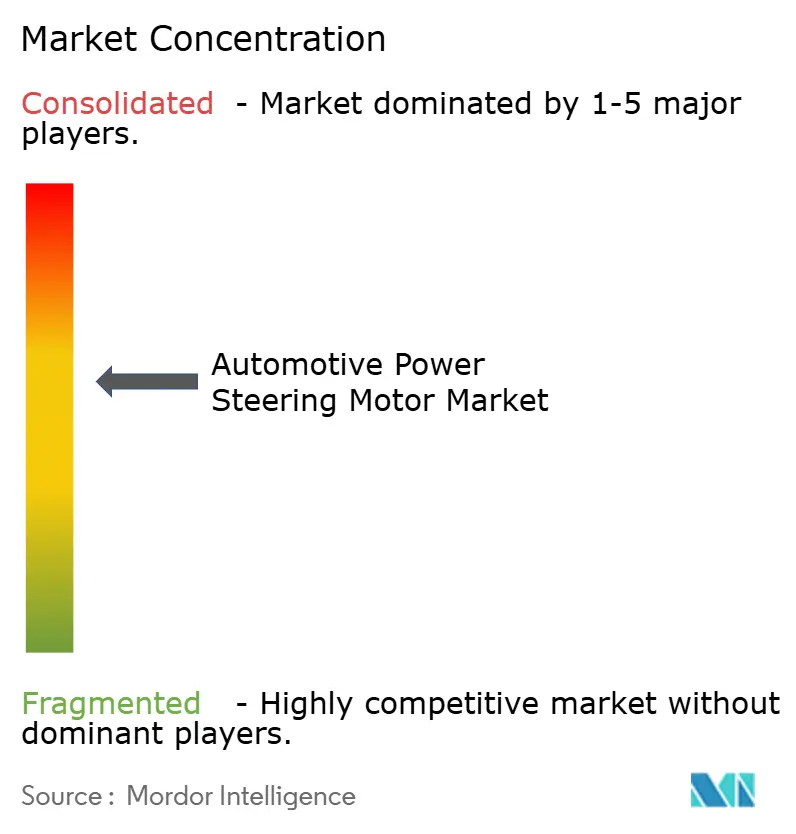
The automotive power steering motor market is moderately concentrated: top global Tier-1s maintain competitive moats via proprietary motor-control IP, integrated inverters, and long-term supply agreements. Bosch, JTEKT, Nexteer, ZF, and Hyundai Mobis collectively supply the majority of EPS racks to volume platforms. Their early investment in brushless algorithms and ADAS interfaces sets high switching barriers for smaller rivals.
Strategic M&A sharpens vertical integration. Schaeffler’s 2024 merger with Vitesco creates a diversified electromechanical giant spanning e-axles, inverters, and steering drives, enabling bundled chassis offerings that reduce BOM complexity for OEMs. Rare-earth-free motor innovations such as ZF’s I2SM unit showcase how market leaders hedge material risk while promising comparable performance, potentially reshaping sourcing models if adoption scales.
Partnerships between steering specialists and software providers intensify. Automakers demand ISO 26262-compliant toolchains and secure update servers, prompting co-development agreements with embedded-software firms. Tier-1s reciprocally sign wafer-capacity deals with power-semiconductor makers to lock in SiC supply. Competitive intensity thus migrates from mechanical output to software quality, cyber-defense, and supply-chain resilience—areas where incumbents still command notable advantages.
Automotive Power Steering Motor Industry Leaders
-
JTEKT Corporation
-
Robert Bosch GmbH
-
Nexteer Automotive Corp.
-
ZF Friedrichshafen AG
-
NSK Ltd.
- *Disclaimer: Major Players sorted in no particular order
Automotive Power Steering Motor Market Companies Covered in this Report
- JTEKT Corporation
- Robert Bosch GmbH
- Nexteer Automotive Corp.
- ZF Friedrichshafen AG
- NSK Ltd.
- Hyundai Mobis Co. Ltd.
- Hitachi Astemo CO. Ltd.
- Thyssenkrupp AG
- Mando Corp.
- DENSO Corporation
- Nidec Corporation
- Mitsubishi Electric Corp.
- DY Auto
- BorgWarner Inc.
Market Opportunities and Future Outlook
Steer-by-wire and higher-content EPS modules create whitespace for suppliers that can provide motors, controllers, and safety cases as an integrated, production-ready package. A concrete signal is Nexteer commencing series production of a steer-by-wire system in April 2026 for a leading Chinese new energy vehicle manufacturer, which raises demand for high-precision motor control, redundancy concepts, and validation services aligned to OEM software-defined vehicle roadmaps.
Regional localization and export programs also widen the addressable base for EPS motor suppliers, particularly in Asia-Pacific and other emerging manufacturing corridors. China Automotive Systems started volume shipments of EPS systems in May 2026 to a European division of a global automaker, targeting 300,000 units annually, and the sourcing requirements underline the need for cost-competitive, compliant motor platforms. Commercial-vehicle electrification adds another opportunity segment, with Nabtesco announcing plans in May 2026 to mass-produce fully electric power steering for large commercial vehicles starting with China, and Knorr-Bremse reporting a series order for electric power steering in Asia-Pacific in June 2026 with SOP scheduled for 2028. These moves support development demand for higher-torque motor designs and durability-focused architectures.
Recent Industry Developments in Automotive Power Steering Motor Market
- May 2026: JTEKT Corporation named its steer-by-wire system Syncusteer and filed an application for trademark registration. This step formalized product positioning as steer-by-wire becomes a higher-content steering architecture and supports clearer commercialization and OEM program engagement around JTEKT-branded SbW offerings.
- April 2026: Nexteer Automotive commenced series production of its Steer-by-Wire system for a production passenger vehicle program with a Chinese new energy vehicle manufacturer. This milestone moves steer-by-wire from pilot demonstrations into scaled vehicle production, raising requirements for motor-control safety, redundancy concepts, and manufacturing validation within EPS supply chains.
Automotive Power Steering Motor Market Report Scope and Research Methodology
Market Definition and Coverage
This market covers the revenue generated from motors used to provide steering assist in passenger and commercial vehicles, across OEM fitment and aftermarket replacement, counted at the point where steering-motor value is realized in the supply chain.
Scope exclusions: It excludes non-automotive steering applications and broader steering system parts that do not contain a steering-assist motor.
Segments Covered in This Report
- By Vehicle Type
- Passenger Cars
- Light Commercial Vehicles
- Heavy Commercial Vehicles
- By Power-Steering Type
- Hydraulic Power Steering (HPS)
- Electro-hydraulic Power Steering (EHPS)
- Electric Power Steering (EPS)
- By Product Type
- Rack-Assist EPS (REPS)
- Column-Assist EPS (CEPS)
- Pinion-Assist EPS (PEPS)
- Dual-Pinion EPS (DPEPS)
- Parallel-Axis EPS (PA-EPS)
- By Motor Technology
- Brushless DC Motor
- Brushed DC Motor
- By Propulsion Type
- Internal-Combustion Engine (ICE)
- Hybrid Electric Vehicle (HEV)
- Battery Electric Vehicle (BEV)
- Plug-in Hybrid Electric Vehicle (PHEV)
- By Sales Channel
- OEM
- Aftermarket
- By Geography
- North America
- United States
- Canada
- Rest of North America
- South America
- Brazil
- Argentina
- Rest of South America
- Europe
- Germany
- France
- United Kingdom
- Italy
- Spain
- Russia
- Rest of Europe
- Asia-Pacific
- China
- Japan
- India
- South Korea
- Indonesia
- Vietnam
- Philippines
- Australia
- Rest of Asia-Pacific
- Middle East and Africa
- Saudi Arabia
- United Arab Emirates
- Egypt
- Turkey
- South Africa
- Rest of Middle East and Africa
- North America
Data Sources, Market Sizing, and Validation
Desk Research
We start by setting a clean fact base on vehicle production, parc, and steering technology adoption so later assumptions do not float. Public sources that are routinely used include OICA production statistics, UNECE and NHTSA safety and vehicle rulemaking notices, US DOE and IEA electrification indicators, Eurostat trade and manufacturing series, and technical literature from SAE and peer reviewed journals.
Next, we layer in company filings, investor presentations, product catalogs, and reputable automotive press to understand how EPS, EHPS, and HPS mixes are moving, and where motor content per vehicle changes (for example, rack assist versus column assist). For pricing reality checks, we also lean on a paid subscription for company financials and news, and a patent database to track motor and controller design direction. These desk sources are not exhaustive, and many other public references are used to collect data, validate values, and clarify open questions.
Primary Interviews and Surveys
Our team validates the model with interviews and surveys across the value chain, covering OEM procurement perspectives, steering system integrators, motor and electronics suppliers, and aftermarket channel participants. Because this is a global market, discussions are spread across major vehicle production hubs and import heavy regions, so penetration, pricing, and replacement patterns can be confirmed before final sign off.
Distribution of primary research fieldwork respondents
| Company type | Respondent position | Region |
|---|---|---|
| Top tier: 30% | CXOs: 13% | APAC: 46% |
| Mid tier: 52% | Functional/Unit leaders: 36% | EMEA: 35% |
| Smaller Players: 18% | Managers: 51% | Americas: 19% |
Market-Sizing & Forecasting
The core sizing is built using a top-down demand pool reconstruction that starts from vehicle production and parc by region, and then applies steering technology penetration and motor content per vehicle. When the steering architecture differs, the motor contribution is adjusted based on assist type (column, pinion, rack) and typical power needs, followed by OEM versus aftermarket split logic.
To keep the totals grounded, selective bottom-up approximations are used as cross checks, such as sampled ASP times estimated volumes for key vehicle groups, channel checks on replacement cycles, and supplier revenue pattern sanity tests. Inputs that commonly matter here include regional light vehicle output, commercial vehicle mix, EPS and EHPS adoption rates, average motor ASP progression by platform class, and replacement rate assumptions linked to parc age and service patterns.
For forecasting, we apply scenario analysis supported by simple multivariate relationships between vehicle production outlook, electrification share, and steering system migration trends, and then align the path with expert feedback from primary discussions. Where coverage gaps appear in smaller regions or niche vehicle categories, the model uses ratio based interpolation anchored to similar markets and is then rechecked against regional production and trade signals.
Data Validation & Update Cycle
We run multi step checks before finalizing numbers, including cross verifying implied motors per vehicle against known steering layouts, and testing regional totals against independent indicators like vehicle output, parc growth, and import export direction. Outliers are investigated, and assumptions get recontacted when large variances show up versus interview feedback or newly released public data.
Each report is refreshed annually, and interim updates are made when there are material events that can shift volumes or pricing, such as sharp vehicle production revisions or regulation changes that accelerate EPS adoption. Before delivery, an analyst performs a fresh pass on key inputs and arithmetic so clients receive the latest updated view.
Mordor Intelligence's Automotive Power Steering Motor Market Sizing Compared With Other Published Estimates
Published market sizes for steering motors often do not match because the scope line is drawn differently, and then different pricing and penetration assumptions are applied on top of it. The year chosen for the starting value, the currency conversion timing, and how OEM and aftermarket are treated also create visible spreads.
Some estimates fold in the wider steering system value or only count EPS motors used in passenger cars, which can push the total higher or lower depending on the mix assumed. For Mordor Intelligence, the count is limited to automotive power steering motors across EPS, EHPS, and HPS, and it is kept consistent by reconciling vehicle production, assist type mix, and replacement demand in the same base year.
Benchmark comparison
| Source | Market Size | Gaps in Research Methodology |
|---|---|---|
| Mordor Intelligence | USD 10.12 B (2026) | |
| Trade Journal A | USD 8.70 B (2025) | Uses an EPS motor only lens with a passenger car heavy demand pool, and the value year is earlier, so technology mix and ASP progression are not carried into the later cycle. |
| Regional Consultancy B | USD 2.55 B (2025) | Treats the market as electric power steering motor shipments tied to a narrower definition, which typically excludes EHPS and HPS motors and can omit commercial vehicle fitment and aftermarket replacements. |
The table shows that most of the gap comes from what is counted as a steering motor market and how the demand pool is constructed by vehicle type and technology. By tying the sizing steps to observable indicators like production, assist architecture, and replacement behavior, the final number stays traceable and can be repeated when assumptions are refreshed.
Key Questions Answered in the Report
What is the current size of the automotive power steering motor market?
The automotive power steering motor market size is estimated to grow from USD 10.12 billion in 2026 to reach USD 12.99 billion by 2031.
Which steering technology dominates the global landscape?
Electric power steering holds 70.31% market share and continues to expand as hydraulic systems are phased out.
What factor is driving brushless motor adoption?
Declining silicon-carbide inverter costs boost efficiency and durability, supporting a 8.72% CAGR for brushless motors through 2031.
How will steer-by-wire affect future demand?
Steer-by-wire requires precise, fail-safe motor control and removes mechanical columns, which will increase demand for high-torque EPS units integrated with advanced software.