
India Electronic Power Steering Market Size and Share
Market Overview
| Study Period | 2020 - 2031 |
|---|---|
| Forecast Data Period | 2026 - 2031 |
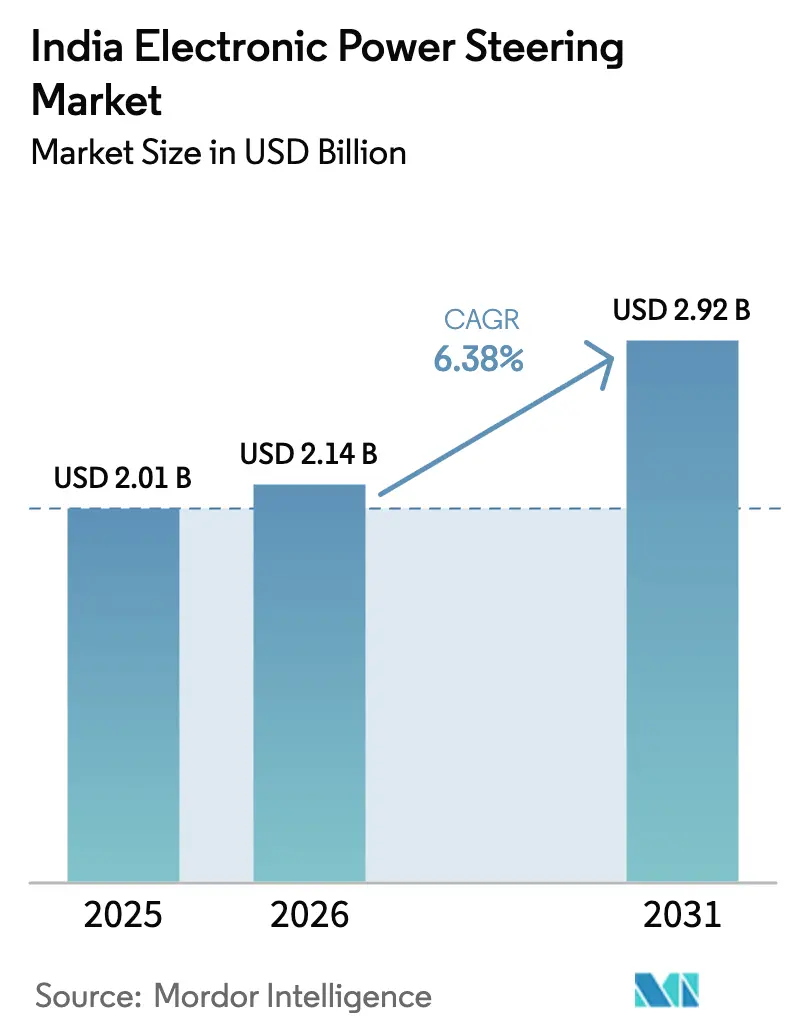
| Base Year Market Size (2025) | USD 2.01 Billion |
| Market Size (2026) | USD 2.14 Billion |
| Market Size (2031) | USD 2.92 Billion |
| Growth Rate (2026 - 2031) | 6.38 % |
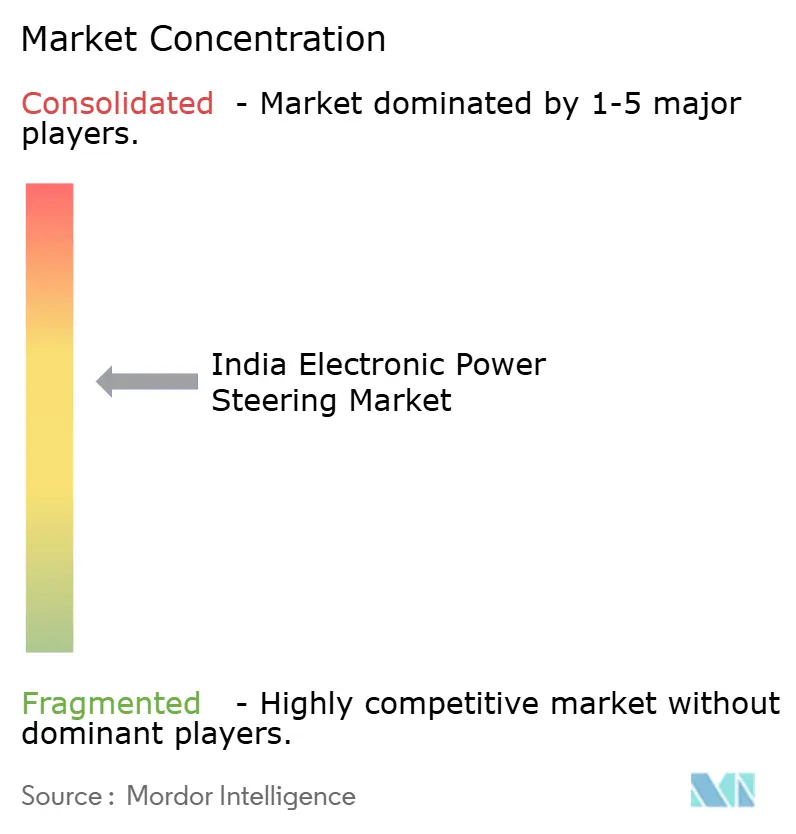
| Market Concentration | Medium |
Major Players_Market_-_Major_Players.webp) *Disclaimer: Major Players sorted in no particular order Image © Mordor Intelligence. Reuse requires attribution under CC BY 4.0. | |
India Electronic Power Steering Market Analysis by Mordor Intelligence
India Electronic Power Steering Market size in 2026 is estimated at USD 2.14 billion, growing from 2025 value of USD 2.01 billion with 2031 projections showing USD 2.92 billion, growing at 6.38% CAGR over 2026-2031. Supported by India’s accelerating push for vehicle electrification, AIS 145 safety mandates, and the Production Linked Incentive program for localized component manufacturing, the market benefits from stronger OEM demand, particularly as passenger-car output grew exponentially in 2024. Rapid SUV penetration, escalating semiconductor partnerships, and scale cost advantages enable wider fitment of column-assist units. At the same time, steer-by-wire pilots highlight a clear path to autonomous functionality. At the same time, higher unit costs versus hydraulic alternatives and imported semiconductor exposure temper the near-term growth trajectory, yet decisive policy moves and ongoing investments by Hyundai, Tata Motors, and Rane Holdings are steadily mitigating these risks.
Key Report Takeaways
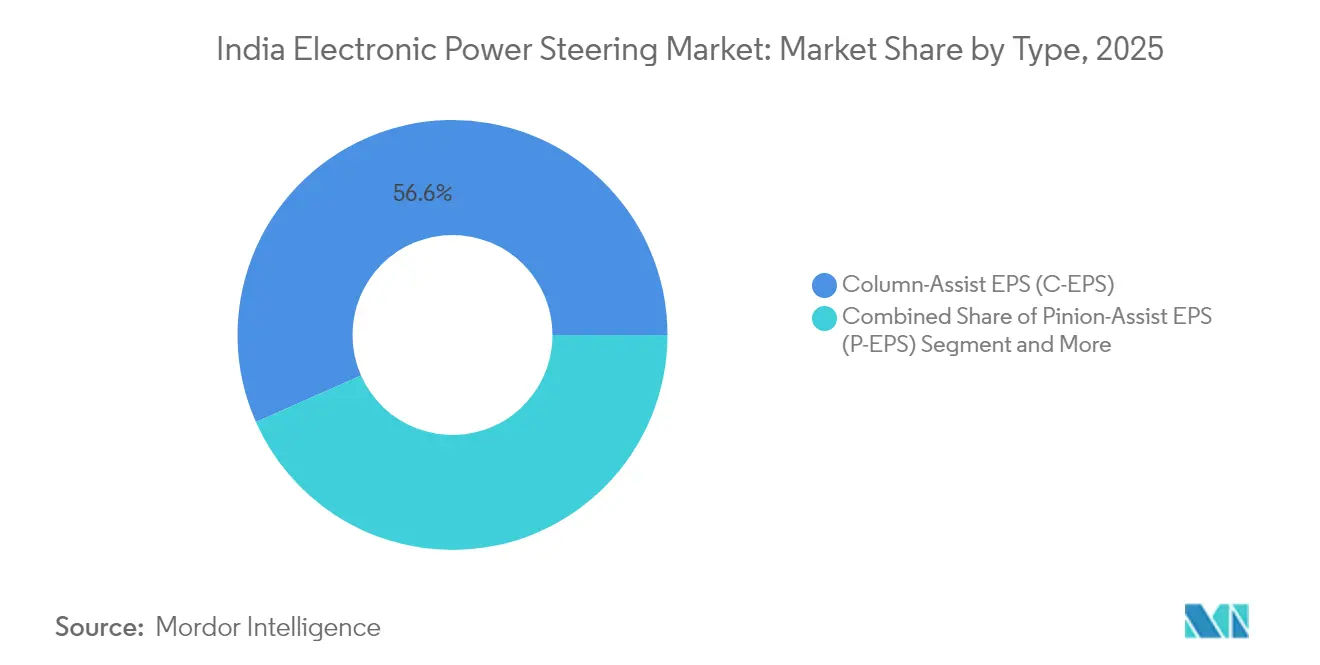
- By type, Column-assist systems held 56.63% of the Indian electric power steering market share in 2025. Integrated steer-by-wire solutions will expand at a 6.45% CAGR during the forecast period (2026-2031).
- By component, steering columns accounted for a 34.74% share of the Indian electric power steering market size in 2025, and electronic control units are advancing at a 6.51% CAGR during the forecast period (2026-2031).
- By vehicle, passenger cars commanded a 72.86% share of the Indian electric power steering market in 2025 and are growing at a 6.52% CAGR during the forecast period (2026-2031).
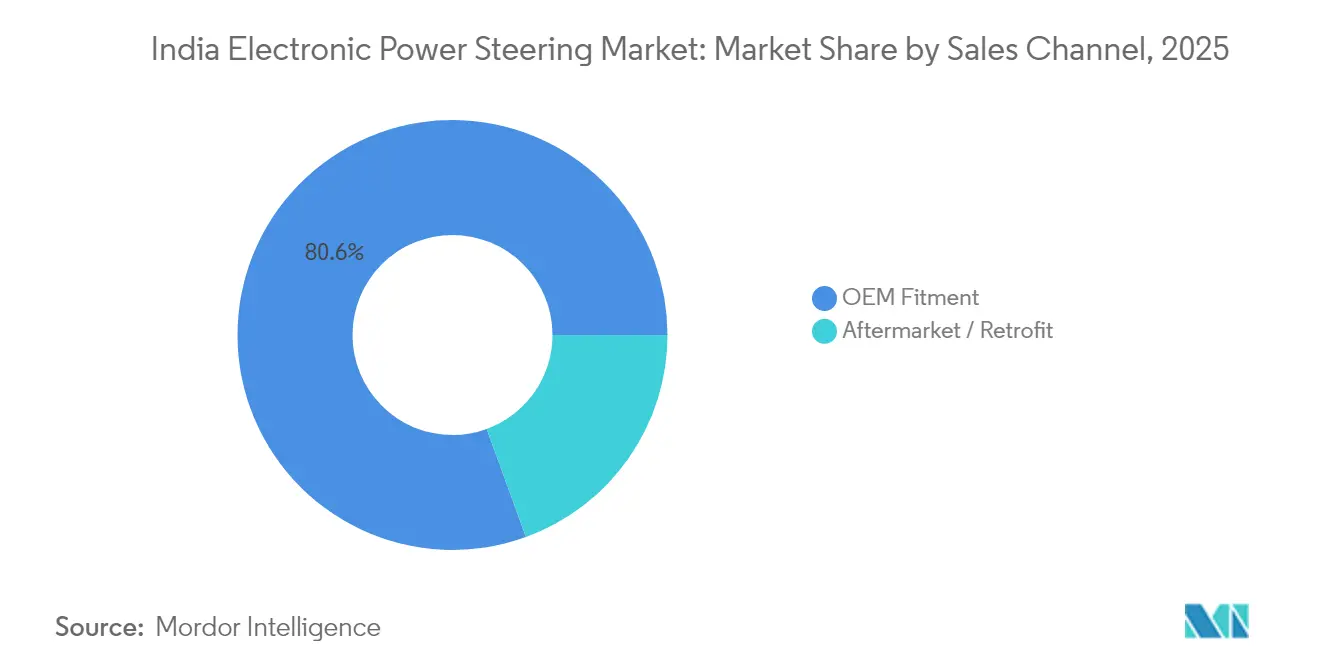
- By sales channel, OEM fitment controlled 80.55% of India's electric power steering market share in 2025; the aftermarket/retrofit channel recorded a 6.46% CAGR during the forecast period (2026-2031).
- By motor technology, BLDC motors accounted for a 62.74% share of the Indian electric power steering market in 2025 and will rise at a 6.49% CAGR during the forecast period (2026-2031).
Note: Market size and forecast figures in this report are generated using Mordor Intelligence’s proprietary estimation framework, updated with the latest available data and insights as of 2026.
India Electronic Power Steering Market Trends and Insights
Drivers Impact Analysis*
| Driver | (~) % Impact on CAGR Forecast | Geographic Relevance | Impact Timeline |
|---|---|---|---|
| Surging Passenger-Car Output | +1.8% | National, with concentration in Tamil Nadu, Maharashtra, Haryana | Medium term (2-4 years) |
| Stringent Safety Regulations | +1.5% | National implementation | Medium term (2-4 years) |
| Demand For Fuel-Efficient Drivetrains | +1.2% | National, stronger in urban markets | Short term (≤ 2 years) |
| Electrification Of Vehicle PARC | +0.9% | Urban centers initially, expanding to Tier-2 cities | Long term (≥ 4 years) |
| OEM Localisation Push | +0.8% | Manufacturing hubs in South and West India | Medium term (2-4 years) |
| Steer-By-Wire Pilots | +0.3% | Premium vehicle segments in metro cities | Long term (≥ 4 years) |
| Source: Mordor Intelligence | |||
Surging Passenger-Car Output
Domestic passenger-car assemblies reached 4.3 million units in FY 2024-25, aided by Hyundai’s capacity build-out and Tata Motors’ multiple state expansions [1]. Higher volumes enable suppliers of the Indian electric power steering market to achieve scale benefits that trim per-unit costs and make column-assist systems viable even in compact hatchbacks. As SUVs and MPVs capture a rising share of production, demand for high-torque assistance grows. Regional clustering across Tamil Nadu, Maharashtra, and Haryana facilitates localized supply chains, allowing quicker just-in-time deliveries and higher localization content. CRISIL expects minimal passenger-vehicle output growth in FY 2026, ensuring sustained mid-term demand for electric steering units.
Stringent Safety Regulations (AIS 145, CMVR)
AIS 145 mandated features such as electronic stability control, lane-departure warning, and autonomous emergency steering, which only require the fine motor control provided by EPS [2]. OEMs are therefore accelerating the phase-out of hydraulic units regardless of incremental cost. Updated CMVR rules impose tighter steering-response benchmarks, further tipping the scales toward electronic control. Commercial-vehicle OEMs, historically reliant on hydraulic setups, are piloting electric solutions to comply. ECU demand also rises because these safety features need higher processing capacities, creating a feed-through boost for semiconductor content per vehicle.
Demand for Fuel-Efficient Drivetrains
Electric power steering eliminates the hydraulic pump’s parasitic losses, improving fuel economy by a minimal margin critical for OEMs meeting CAFE Phase II targets. EPS supports regenerative braking and precise control during electric-only operation in hybrid applications, further driving its use. Rising fuel prices elevate consumer sensitivity to mileage, prompting manufacturers to advertise EPS as a tangible efficiency upgrade. Penetration has thus expanded from premium models into mid-segment hatchbacks, especially in city-centric buyer profiles. EPS’s low standby power draw directly extends driving range for battery electric vehicles, underscoring its indispensability.
Electrification of Vehicle Parc
The PM E-DRIVE program channels incentives toward EV supply-chain localization and charging infrastructure, creating a virtuous cycle for adopting India's electric power steering market. EPS is standard in EV architecture because it minimizes battery drain. Fleet operators in metropolitan corridors trial electric light commercial vehicles with EPS to capture lower total ownership costs. Hybrid pickups and delivery vans in Bengaluru and Delhi further illustrate demand diversification beyond passenger cars. The shift also paves the way for software-defined steering functions such as automated parking.
Restraints Impact Analysis*
| Restraint | (~) % Impact on CAGR Forecast | Geographic Relevance | Impact Timeline |
|---|---|---|---|
| Higher Unit Cost Vs HPS | -1.4% | Rural and price-sensitive urban markets | Short term (≤ 2 years) |
| Import-Reliant Semiconductor Supply Chain | -0.8% | National, affecting all OEMs | Medium term (2-4 years) |
| Scarcity Of Tier-2/3 Service Technicians | -0.4% | Tier-2/3 cities and rural service networks | Medium term (2-4 years) |
| Thermal Reliability Under Tropical Climate | -0.3% | Pan-India, acute in coastal and high-humidity regions | Short term (≤ 2 years) |
| Source: Mordor Intelligence | |||
Higher Unit Cost vs HPS in Entry Cars
Electric power steering costs one-fourth more than hydraulic systems for hatchbacks priced below INR 500,000. Budget-focused rural buyers remain unconvinced by long-term fuel savings, hampering EPS penetration in entry trims. OEM margins already squeezed by rising commodity prices make absorbing the premium challenging. However, domestic fabrication incentives for sensors and BLDC motors under the automotive component PLI are narrowing the gap. Suppliers expect a minimal cost decline within a couple of years as ECU localization scales, bringing parity closer and easing this restraint.
Import-Reliant Semiconductor Supply Chain
Microcontrollers and angle sensors essential for EPS are sourced mainly from Taiwan and South Korea, exposing the Indian electric power steering industry to geopolitical disruptions and currency volatility. The global chip crunch led to OEM production cuts of up to one-fifth, illustrating this vulnerability. Initiatives like Tata-Infineon’s collaborative innovation center in Bengaluru aim to localize design, yet commercial-scale wafer fabs will only go live in few years' time. Until then, Tier-1s must maintain higher inventory buffers and dual-sourcing strategies, adding working-capital strain.
*Our forecasts treat driver/restraint impacts as directional, not additive. The impact forecasts reflect baseline growth, mix effects, and variable interactions.
Segment Analysis
By Type: Column-Assist Systems Lead Market Evolution
Column-assist solutions captured 56.63% of the Indian electric power steering market share in 2025, reflecting their cost-performance sweet spot across compact and midsize platforms. The segment’s dominance is reinforced by minimal chassis redesign requirements, allowing OEMs to retrofit existing hydraulic platforms swiftly. Rack-assist units cater to premium SUVs where steering precision and higher torque are vital. Pinion-assist designs occupy a niche between the two, particularly in sedan applications where road-feel refinement is prioritized. Although steer-by-wire currently represents less than 1% of installations, its 6.45% CAGR indicates growing OEM attention, with Hyundai and Lexus showcasing concept models at the 2025 Auto Expo. Regulatory acceptance will be the inflection point that elevates adoption rates among mass-market brands.
Second-order benefits also materialize: steer-by-wire removes the steering shaft intrusion, enabling frontal crash-zone energy-absorption redesigns and larger infotainment displays. Suppliers such as JTEKT are developing failsafe algorithms that maintain directional control even if a single actuator fails, addressing latent safety concerns. Once regulatory clarity emerges, especially regarding redundant power supply standards, steer-by-wire will likely encroach on the rack-assist space. The column-assist will underpin cost-sensitive variants, ensuring it remains a mainstay of the Indian electric power steering market.

By Component Type: ECU Sophistication Drives Growth
Steering columns held 34.74% of the Indian electric power steering market in 2025, as every EPS façade requires a mechanical or electronic column. Yet electronic control units will outpace at a 6.51% CAGR through 2031 because ADAS integration needs higher processing headroom. The latest Infineon Aurix microcontrollers support ISO 26262 ASIL-D safety, allowing automotive firmware over-the-air updates that slash recall costs. Torque-and-angle sensors also evolve toward inductive designs, eliminating magnets and enhancing precision.
Over the forecast window, ECU average cost content per vehicle will jump exponentially as software-defined cars gain traction. Domestic suppliers like KPIT and Tata Elxsi provide middleware that reduces time-to-market for new steering functions. Such developments create an ecosystem wherein semiconductor design houses, embedded-software firms, and steering-system manufacturers collaborate under one roof, accelerating product cycles and reinforcing the Indian electric power steering market’s competitiveness.
By Vehicle Type: Passenger Cars Dominate Adoption
Passenger cars controlled 72.86% of the Indian electric power steering market in 2025 and are advancing at a 6.52% CAGR, driven by AIS 145, ride-quality expectations, and the surge of SUV body styles that demand precise torque delivery. Compact SUVs like Tata Nexon and Hyundai Venue now feature EPS, signaling price-down diffusion across all trims. Light commercial vehicles are in earlier adoption phases but show promise as e-commerce requires silent, low-maintenance delivery vans for urban logistics. Medium and heavy commercials retain hydraulic setups because extreme axle loads necessitate higher steering effort; however, dual-assist architectures blending hydraulic base with electric overlay are in prototype testing.
Fleet operators increasingly prioritize longer service intervals and reduced downtime, leading to significant gains in total cost of ownership. CRISIL forecasts a notable increase in the adoption of EPS in new sub-5-ton trucks over the coming years. This shift presents a considerable volume opportunity for India's electric power steering market.
By Sales Channel: OEM Integration Dominates
Factory fitment accounted for 80.55% of the Indian electric power steering market in 2025 because EPS calibration requires vehicle-level software integration and compliance certification. The aftermarket rose 6.46% CAGR as retrofit kits became more standardized, targeting taxi fleets and municipal buses seeking operational savings. Kalyani Powertrain’s conversion kits received Automotive Research Association of India approval in February 2025, bolstering confidence among fleet managers. Nonetheless, regulatory inspection frameworks remain stringent, meaning the aftermarket share is unlikely to surpass one-fourth over the next five years.
OEM preference is also driven by warranty coverage and safety liabilities. Tier-1 suppliers provide end-to-end diagnostics embedded in the vehicle’s central domain controller, which is difficult to replicate in the retrofit channel. As a result, the growth of most volumes in the Indian electric power steering market will still originate from new vehicle assembly lines.
By Motor Technology: BLDC Motors Establish Dominance
BLDC motors commanded a 62.74% of the Indian electric power steering market in 2025 and will rise at a 6.49% CAGR, securing their status as the de facto standard for next-generation EPS. Compared with brushed alternatives, BLDC designs deliver better thermal management and eliminate brush wear, aligning with India’s harsh operating temperatures that often exceed. Permanent magnet costs have moderated because of diversified sourcing from Vietnam and Australia, further narrowing the cost gap. SynRM (synchronous reluctance) pilot projects are underway at Nexteer’s Bengaluru R&D center, touting 2% higher efficiency, but mass adoption hinges on volume scale.
Motor-gearbox integration is another frontier; Sona Comstar’s 3-in-1 EPS drive module reduces footprint by 20% and improves NVH characteristics. Such innovation augments the Indian electric power steering market’s technical maturity and encourages OEMs to deploy EPS even on smaller A-segment cars where under-hood space is constrained.
Geography Analysis
Vehicle production is concentrated in Tamil Nadu, Maharashtra, and Haryana, which collectively house about three-fifths of passenger-car output. Chennai’s corridor, complemented by ancillary clusters in Sriperumbudur and Oragadam, draws column-assist manufacturing due to incentives covering land and stamp-duty reimbursement . Pune’s Chakan and Aurangabad zones benefit from multi-modal logistics that ease ECU imports and dispatches of finished goods. Gurugram-Manesar leverages Maruti Suzuki’s ecosystem, encouraging local Tier-1s such as JTEKT India to establish dedicated EPS lines.
Emerging belts like Gujarat’s Sanand and Karnataka’s Tumakuru are scaling rapidly. Gujarat offers one-fifth capital subsidies for EV-related components, compelling suppliers to hedge geographic risk by setting up satellite units. Tumakuru is earmarked for a semiconductor special-economic zone that directly feeds ECU lines. Andhra Pradesh’s Krishnapatnam port further enables outbound shipments, easing export of EPS sub-assemblies to Southeast Asia.
Regional policy competition has tangible effects on the size of the Indian electric power steering market by state. Tamil Nadu is forecast grow exponentially in terms of incremental passenger-car units by 2030, implying roughly 0.6 million incremental EPS units. Maharashtra’s share will evolve toward premium vehicles, tightening demand for rack-assist and steer-by-wire variants. Meanwhile, Uttar Pradesh, historically low on automotive production, is positioning around Greater Noida to attract EV startups, but the material volume impact will surface only after 2028 when assembly facilities mature.
Regulatory Landscape
India's EPS fitment is governed by the Central Motor Vehicles Rules (CMVR), with technical requirements framed through the Automotive Industry Standards Committee (AISC) and published via Automotive Research Association of India (ARAI) as Automotive Industry Standards (AIS). Steering-system safety and occupant-protection expectations are supported by standards such as IS 11939:1996 (impact protection requirements for steering control systems) and AIS-096 (steering mechanism behavior in a head-on collision), which affect OEM design validation, column collapse strategy, and packaging decisions for EPS platforms.
On the industrial-policy side, the Ministry of Heavy Industries administers the Production Linked Incentive (PLI) Scheme for the Automobile and Auto Component Industry to support localized manufacturing of Advanced Automotive Technology products. For EPS suppliers, qualification under PLI reinforces localization of ECU, motor, and sensor value add, while ARAI-linked compliance and type-approval practices help keep software-controlled steering functions aligned with the evolving AIS catalog (including the May 2026 update).
Value Chain Analysis
The India EPS value chain begins with upstream inputs such as aluminum castings and machined housings, BLDC motors and magnets, torque and angle sensors, and semiconductor-heavy ECUs. It then moves to Tier-1 system integration (column-assist, pinion-assist, and rack-assist assemblies) and calibration at OEM vehicle platforms. Key India-active participants include JTEKT India, Rane Group entities (including Rane NSK and ZF Rane), Nexteer Automotive, and ZF Steering Gear (India), with manufacturing footprints clustered around automotive hubs such as Chennai and the Gurugram-Manesar belt. This setup supports just-in-time deliveries to passenger-vehicle assembly lines.
Downstream, OEM fitment dominates because EPS requires vehicle-level software integration and certification, while the aftermarket depends more on standardized retrofit packages and approvals. The chain is being reshaped by technology-transfer and localization arrangements, including Rane and ZF activity around EPS product collaboration and licensing for column-drive EPS technology (announced in January 2025), alongside the industry-wide localization emphasis highlighted in ACMA's FY2024-25 performance review (released July 2025).
Competitive Landscape
Global leaders JTEKT, Nexteer, and ZF hold entrenched OEM relationships, supplying significant electric power steering. JTEKT’s Chennai plant added rack-assist line in 2025 to serve Toyota Kirloskar and Maruti Suzuki. Nexteer capitalizes on its software stack, SecureEPS, to lock in long-term programs with Mahindra & Mahindra. ZF, leveraging its Germany-based autonomy roadmap, anchors the premium steer-by-wire segment.
Indian incumbents are closing technology gaps through acquisitions and joint ventures. Rane Holdings’ September 2024 complete takeover of Rane NSK Steering deepened column-assist know-how while establishing access to NSK’s global patent pool. Sona Comstar diversified into torque sensors by acquiring Novelic Serbia, aiming to offer integrated steering, braking, and driveline solutions. Meanwhile, Tata Autocomp is co-developing ECUs with Infineon, positioning for the software-defined vehicle era.
Strategic differentiation increasingly rests on software and semiconductor integration. Infineon’s purchase of Marvell’s Automotive Ethernet unit underscores a pivot toward networked architectures that underpin autonomous steering commands. Tier-1s are thus recruiting over-the-air update specialists and cybersecurity talent, reshaping traditional hardware-centric competencies. Cost-focused players like JBM Auto emphasize frugal engineering, offering simplified EPS kits for budget vehicles seeking to leapfrog hydraulic setups without advanced ADAS requirements.
India Electronic Power Steering Industry Leaders
-
JTEKT Corporation
-
Nexteer Automotive
-
ZF Steering Gear (India) Limited
-
Denso Corporation
-
Mando Automotive India
- *Disclaimer: Major Players sorted in no particular order
Market Opportunities and Future Outlook
Import substitution and deeper localization of electronics remain visible whitespace for India EPS, especially given the import intensity around steering and drive transmission systems. ACMA reported that drive transmission and steering systems accounted for 56% of India's total auto component imports in FY26, pointing to a large addressable pocket for domestic machining, casting, ECU assembly, and integrated module manufacturing linked to EPS programs.
A second opportunity is the overlap between EPS electrification needs and the broader EV and advanced-component push inside the auto component sector. ACMA reported that the industry grew 12.7% in FY26, and that supplies to the EV segment represented 4.6% of OEM sales. This reinforces demand for higher electronic content (controllers, sensors, and power devices) that can also support EPS ECUs and motor drives. Partnerships and capability build-outs referenced in the report context, such as Tata-Infineon collaboration efforts in India and Tier-1 moves to add EPS lines and electrical-division capacity, further expand near-term procurement and localization programs for EPS-related components across passenger vehicles and emerging electrified LCV applications.
Recent Industry Developments
- May 2026: ZF Steering Gear (India) Limited approved an investment of Rs 25 crore to expand installed casting capacity at its subsidiary Metacast Auto Private Limited from 10,000 to 25,000 metric tonnes per annum. The added upstream capacity supports localization and supply assurance for steering-related housings and components upstream of EPS assemblies. It also supports higher-volume OEM schedules by reducing dependence on external casting supply.
- February 2026: HL Mando Anand India Private Limited reported reaching a cumulative production milestone of 2 crore units of Column-Electric Power Steering (C-EPS). The milestone indicates sustained scale in column-assist EPS manufacturing, which is the dominant EPS architecture in cost-sensitive passenger-car platforms. Higher cumulative output also supports learning-curve cost reduction and wider model-line fitment.
- December 2025: ZF Steering Gear (India) Limited disclosed that its subsidiary DriveSys Systems secured an order of about Rs 151 crore to manufacture and supply machined aluminum parts for a renewable energy conglomerate. The win expands machining utilization and capability that can be used across precision aluminum parts relevant to automotive steering value chains. It also diversifies revenue while maintaining core competencies applicable to EPS component manufacturing.
Research Methodology Framework and Report Scope
Market Definition and Coverage
This market is defined as the revenues generated from electronic or electric power steering (EPS) systems supplied for vehicles sold and used in India, counted across OEM fitment and replacement demand where applicable.
Scope exclusions: It excludes conventional hydraulic steering systems and other adjacent steering parts that are not part of an EPS assembly.
Segmentation Overview
- By Type
- Column-Assist EPS (C-EPS)
- Pinion-Assist EPS (P-EPS)
- Rack-Assist EPS (R-EPS)
- Integrated Steer-by-Wire
- By Component Type
- Steering Column
- Torque & Angle Sensors
- Electric Motor
- Electronic Control Unit (ECU)
- Others (Wiring, Bearings, Housings)
- By Vehicle Type
- Passenger Cars
- Hatchbacks
- Sedans
- SUVs & MPVs
- Light Commercial Vehicles (LCVs)
- Medium and Heavy Commercial Vehicles (MHCV)
- Passenger Cars
- By Sales Channel
- OEM Fitment
- Aftermarket / Retrofit
- By Motor Technology
- Brushed DC Motor
- Brushless DC (BLDC) Motor
Data Sources, Market Sizing, and Validation
Desk Research
Desk work was used to build the starting structure of the model and to pin down the demand pool for India by vehicle category and steering adoption. Public sources such as the Society of Indian Automobile Manufacturers (SIAM), Ministry of Road Transport and Highways (MoRTH) vehicle registration releases, and Government of India trade statistics were used to understand vehicle output, market direction, and import-export movement for relevant steering and steering sub-assemblies.
To keep the inputs usable for a pricing and mix model, we also reviewed sources such as UNECE and other standards bodies for safety and steering related references, peer reviewed papers on EPS efficiency and architecture, and patent databases to sanity check technology shifts (for example, motor and sensor choices). Company annual reports, investor presentations, and reputed press coverage were used to verify capacity additions, program wins, and product mix statements. Select paid subscriptions for company financials and for shipment level trade data were used only where public reporting left gaps. These desk sources are illustrative, and many other public references were also checked for data collection, validation, and clarification.
Primary Interviews and Surveys
Primary work focused on interviews and structured discussions with OEM and supplier side stakeholders, along with aftermarket participants, so assumptions around EPS penetration, pricing movement, and platform mix could be tested. Because this is an India-focused market, inputs were also validated across key automotive manufacturing clusters and buyer types, and then used to adjust desk-led adoption and pricing assumptions where the story did not match ground reality.
Distribution of primary research fieldwork respondents
| Company type | Respondent position |
|---|---|
| Top tier: 25% | CXOs: 15% |
| Mid tier: 58% | Functional/Unit leaders: 41% |
| Smaller Players: 17% | Managers: 44% |
Market-Sizing & Forecasting
The sizing model starts with a top-down build where India vehicle production and sales by category are reconstructed, and then filtered through EPS fitment penetration by vehicle type and steering architecture. Because fitment is not uniform, separate assumptions are used for passenger cars, light commercial vehicles, and medium and heavy commercial vehicles, and then blended based on the annual mix.
To keep the number realistic, results are cross-checked using selective bottom-up approximations, such as rolling up a sampled set of supplier revenues, and validating implied system volumes using typical units per vehicle and a price per system range. Key inputs used in the model include vehicle production trends, EPS penetration by platform, the share of column assist versus pinion assist designs, motor and sensor mix shifts (including brushed DC versus brushless DC), and the OEM versus aftermarket split. Forecasts were extended using scenario analysis, where vehicle demand paths and EPS penetration acceleration were stress-tested, and the final line was selected after it aligned with what primary respondents viewed as achievable. Where bottom-up roll ups had gaps, we filled them using conservative mix-based proxies instead of forcing full supplier coverage.
Data Validation & Update Cycle
Validation is done by checking whether the modeled revenue line matches independent signals, such as vehicle output, penetration direction, and realistic price bands for India. When a variance looks too large, assumptions are reopened, and follow-up calls are triggered to confirm whether it is a real shift, for example a new platform launch, or a modeling issue.
Before sign-off, the model goes through multi-step analyst reviews that include consistency checks across years, currency and inflation handling, and logic checks across vehicle categories and sales channels. The report is refreshed annually, and interim updates are added when material events happen in the market. Right before delivery, we run a fresh pass to ensure clients receive the latest updated view.
Mordor Intelligence's India Electronic Power Steering Market Size Versus Other Published Estimates
Published market numbers for India EPS are not always the same because each publisher draws the line differently on what is counted, which year is treated as the base, and how pricing and penetration are projected forward.
The spread is usually driven by scope choices like whether aftermarket retrofit is included, how commercial vehicles are treated versus passenger cars, and whether the model uses a single average price or a mix-based price curve that changes with component and design shifts. Differences can also come from currency timing, because a yearly average exchange rate and an end-year rate can move the USD figure even when local volumes look steady.
Benchmark comparison
| Source | Market Size | Gaps in Research Methodology |
|---|---|---|
| Mordor Intelligence | USD 2.01 B (2025) | |
| Industry Research House A | USD 2.19 B (2025) | This estimate appears to apply a broader value pool where EPS demand is expanded using higher assumed fitment across commercial vehicles, and pricing is less clearly separated by column assist versus pinion assist mix. |
| Global Publisher B | USD 1.10 B (2025) | This figure looks closer to a narrower counted scope where only selected vehicle categories or a tighter definition of EPS system revenue is used, which can undercount OEM channel breadth and component-driven price differences. |
The table shows a clear band around the 2025 value, and Mordor Intelligence's model anchors the total to India vehicle builds and EPS penetration by vehicle type, with pricing adjusted for architecture and component mix rather than one blended average. With those steps documented and cross-checked, we get a number that is easier to trace back to real volume and mix movements each year.
Key Questions Answered in the Report
How large is the Indian electric power steering market in 2026?
The market will reach USD 2.14 billion in 2026 and reach USD 2.92 billion by 2031.
Which vehicle category is driving most EPS demand in India?
Passenger cars, especially SUVs and MPVs, represent 72.86% of fitments and are growing at a 6.52% CAGR.
What regulation is accelerating EPS adoption in India?
AIS 145 safety standards, effective April 2026, mandate electronic stability control and related ADAS features that require EPS integration.
Why are BLDC motors preferred in electric power steering?
BLDC motors offer higher efficiency, zero brush wear, improved thermal tolerance, and quieter operation—attributes vital for the Indian climate and road conditions.
How will semiconductor localization influence EPS costs?
PLI incentives and joint ventures such as Tata-Infineon are expected to cut ECU and sensor costs by 10% before 2027, narrowing the price gap with hydraulic systems.
What is the growth outlook for EPS aftermarket retrofits?
Although smaller, the retrofit channel is projected to expand at a 6.46% CAGR as standardized kits and regulatory clarity emerge.